

You need to be in New York tomorrow. The meeting matters, the timing matters more, and you don't have room for a three-leg commercial itinerary plus an hour in a terminal that adds nothing to the trip. That's why private flights to New York make sense for more than comfort. They give you control over schedule, privacy, airport choice, and the part most first-time charter clients underestimate: total door-to-door time.
The problem is that New York is also where bad charter buying gets expensive fast. You can pay for the wrong airport, the wrong aircraft category, or an empty repositioning leg you never asked for. Most clients don't overpay because they chose luxury. They overpay because nobody explained how the quote was built.
Your Guide to Private Flights to New York
You need to be in New York tomorrow, and the quote in your inbox looks reasonable until the final invoice adds thousands for aircraft repositioning, airport mismatch, and time you never planned to lose. That is the mistake first-time charter clients make. They shop the headline number instead of the trip.
New York gives you options, which is good news if your advisor knows how to buy this market properly. Aircraft availability is broad, airport access is flexible, and pricing can be competitive. The catch is simple. A busy charter market also makes it easy to hide margin inside routing, ferry legs, and poor sourcing.
The smart way to book starts with one rule. Buy local whenever possible. If the aircraft is already near your departure point, you avoid paying to bring in a jet from somewhere else just to start your trip. That one decision can change the quote more than negotiating the hourly rate.
What smart booking looks like
A disciplined New York charter comes down to four choices:
Start with your precise destination Your end point might be Midtown, White Plains, Long Island, or the Hamptons. The right airport depends on where the ground trip ends. A useful reference is Haute Jets' guide to best private jet airports in Miami, New York, and Los Angeles, which shows how airport selection affects total trip efficiency.
Choose the aircraft for the trip, not the image
A short Northeast leg often calls for a light or midsize jet. Longer routes, larger groups, and heavier baggage needs justify stepping up. Paying for more cabin than the mission requires is one of the easiest ways to waste money.Audit the quote line by line
Repositioning fees, crew overnight charges, peak-day pricing, deicing, and airport handling costs all belong in the conversation before you book. Many inflated quotes hide in those details. If the provider cannot explain each line clearly, move on.Use local operator sourcing instead of default broker inventory
Traditional brokers and jet card programs often push whatever is easiest for their network to sell. A better approach is to source from qualified operators near your route and compare the actual trip cost, not just the advertised rate.
Practical rule: For private flights to New York, the best value usually comes from the aircraft already positioned closest to your trip, with the right cabin size and the right airport for your actual ground destination.
Treat your first New York charter like a logistics purchase with luxury built in. That mindset protects your budget, cuts avoidable fees, and leads to a safer, cleaner booking decision.
Your Gateway to Manhattan The NYC Private Airport Guide
You can book the right jet and still lose an hour on the ground, or pay for unnecessary repositioning because the aircraft is coming into the wrong airport. In New York, the airport decision shapes the actual trip more than first-time charter clients expect. Get that choice right and you cut transfer time, avoid avoidable operating cost, and make local sourcing work in your favor.
BlackJet's New York airport overview makes the core point well: Teterboro is popular, but proximity to Manhattan has to be weighed against congestion, while Westchester or Islip can work better depending on the passenger's final destination.
The airport decision clients often get wrong
The first question should be your final address, not the airport code.
A Manhattan hotel, a Midtown office, a home in Greenwich, and a house in the Hamptons all call for different arrival logic. The smart booking move is to match the airport to the ground leg, then source aircraft from operators already positioned nearby. That is how you avoid inflated charter quotes built around empty repositioning flying. It is also where local operator sourcing beats the standard broker habit of pushing whatever aircraft is easiest to sell that day.
Use this filter before you approve any New York airport:
- Final destination: Midtown, downtown, Westchester, Long Island, and the Hamptons each favor different fields.
- Arrival window: An airport that looks efficient on paper can become a poor choice if road traffic peaks at your landing time.
- Aircraft type: Runway length, operating profile, and ramp practicality affect what works cleanly.
- Transfer plan: If you need a helicopter connection or a specific car service handoff, build that into the airport choice from the start.
For a broader look at how airport selection changes total trip efficiency, see Haute Jets' guide to private jet airport choices in Miami, New York, and Los Angeles.
NYC Private Airport Comparison
| Airport | Code | Drive Time to Midtown | Best For |
|---|---|---|---|
| Teterboro | TEB | Popular for quick Manhattan access | Midtown meetings and classic business arrivals |
| Westchester County | HPN | Better for northern access | Westchester, Greenwich, northern Manhattan |
| Republic | FRG | Better for Long Island access | Long Island clients and Hamptons-bound travelers |
| Newark Liberty | EWR | About 16.7 miles southwest of Midtown | Downtown access and some larger-aircraft missions |
| Islip | ISP | Farther from Manhattan, stronger for eastern Long Island | Long Island travelers and some easier processing scenarios |
Which airport I'd choose by destination
For Midtown Manhattan
Teterboro is still the standard answer. It works well for business aviation, crews know it, and FBO support is mature. But I would not treat it as automatic. If your trip falls into a heavy congestion window, a slightly less obvious airport can produce a faster door-to-door result and a cleaner charter cost if the aircraft is already based there.
For Wall Street or downtown meetings
Newark deserves more attention than many clients give it. Paramount Business Jets notes that Newark Liberty is about 16.7 miles southwest of Midtown, and that East 34th Street Heliport can be part of the transfer strategy for city access. For a tight same-day schedule, the right airport and transfer pairing matters more than choosing the airport with the strongest name recognition.
For Westchester, Greenwich, and northern suburbs
Use Westchester. Flying into New Jersey for a destination north of the city is a poor decision unless aircraft availability clearly changes the economics. This is one of the simplest ways to waste money on a New York charter.
For Long Island or the Hamptons
Republic and Islip usually make more sense. Islip can be a practical fit for certain aircraft and eastern Long Island itineraries, while Republic often works better for western Long Island access. The right answer depends on where the airplane is positioned and where your car is ultimately going.
Choose the airport that reduces total trip time and unnecessary ferry cost. That is the smart way to book New York.
My recommendation
Give your advisor the exact street address, your preferred arrival time, and whether you need a helicopter or direct car transfer before you discuss cabin category. A good advisor will then compare nearby operators and airport options together, not as separate decisions. That is how you avoid hidden repositioning fees and book New York the smart way.
Matching the Mission to the Metal Aircraft Options for NY Flights
You are flying into New York for a morning meeting, landing at the wrong airport on the wrong aircraft, and paying for an expensive reposition you never needed. That mistake starts here, with aircraft selection.
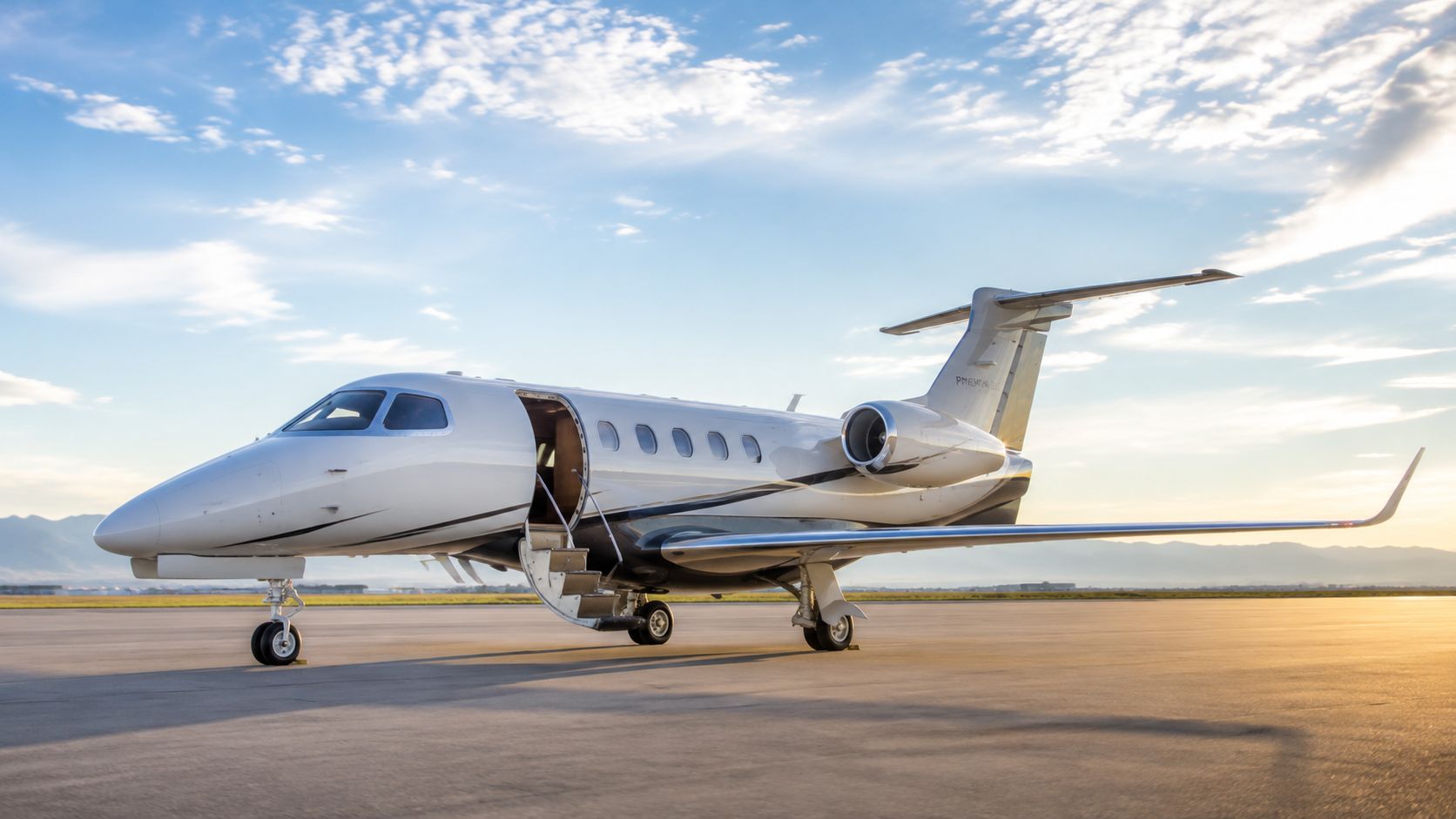
The smart way to book is to match the airplane to the trip you are taking. Passenger count matters. Bags matter. Range matters. Airport performance matters. So does where the aircraft is based. A lower hourly rate on the wrong jet often costs more once ferry time, runway limits, and schedule constraints show up on the quote.
Quick hops and same-day business runs
For short Northeast sectors, keep it simple. A turboprop or light jet is usually the right buy.
That covers missions like Boston, Washington, or other short business hops where you want fast boarding, sensible trip cost, and no wasted cabin. You do not need to pay for transcontinental range on a one-hour flight. You need an aircraft that can get in and out efficiently and keep the total trip cost under control.
This category fits well when you need:
- Fast turns for same-day travel
- Lower operating cost on short sectors
- Comfort for a small group
- Enough baggage space for briefcases and overnight bags
Florida, Chicago, and medium-haul missions
For flights from South Florida, Chicago, or similar stage lengths, midsize and super-midsize jets are usually the right answer. This is the category I recommend most often for first-time New York charter clients because it balances comfort, range, and real-world value.
A light jet can price well on paper for some of these routes. It can also become the wrong choice if passenger count grows, bags increase, or the trip requires stronger runway performance and better cabin comfort. That is where traditional brokers often oversimplify the decision. They sell a category first and sort out the operational fit later.
Focus on what you will feel in the cabin:
- A layout that works for conversation or quiet work
- Better luggage flexibility
- More comfort on longer legs
- A cabin that still feels productive on arrival
Cross-country and international travel
For Los Angeles, heavy ski baggage from Aspen, or transatlantic flying, stop shopping by hourly rate. Choose for range, payload, and cabin function.
Underbooking gets expensive. A smaller jet may look cheaper at first, then trigger a fuel stop, baggage limits, or a schedule compromise that defeats the point of flying private. If passengers need to sleep, work, or arrive ready for a meeting, a heavy jet or ultra-long-range aircraft is the correct tool.
As noted earlier from EvoJets pricing benchmarks, New York charter costs can range from a short Boston turboprop mission at $2,500 to $7,000 from Chicago, $9,000 from Miami, $17,500 from Aspen, $25,000 from Los Angeles, and $60,000 to $75,000 for New York to London on a heavy jet, with ultra-long-range aircraft running $85,000 to $100,000 on that transatlantic mission.
For long-haul New York flying, comfort is part of the operating plan.
My recommendation is simple. Start with the mission, then source locally. That is how you avoid paying hidden repositioning fees for an aircraft based three states away when a better-fit option is already nearby. If you want to compare specific cabin types and models before you book, review the Haute Jets fleet by aircraft category and make.
Decoding Your Charter Quote A Transparent Look at Pricing
You request a New York quote for a simple one-way trip. Two proposals look close on hourly rate, yet one ends up thousands higher because the aircraft is flying in empty from another state. That is how first-time buyers overpay.
A quote should explain the trip, not hide the operator's logistics inside a neat total.
What a quote should clearly show
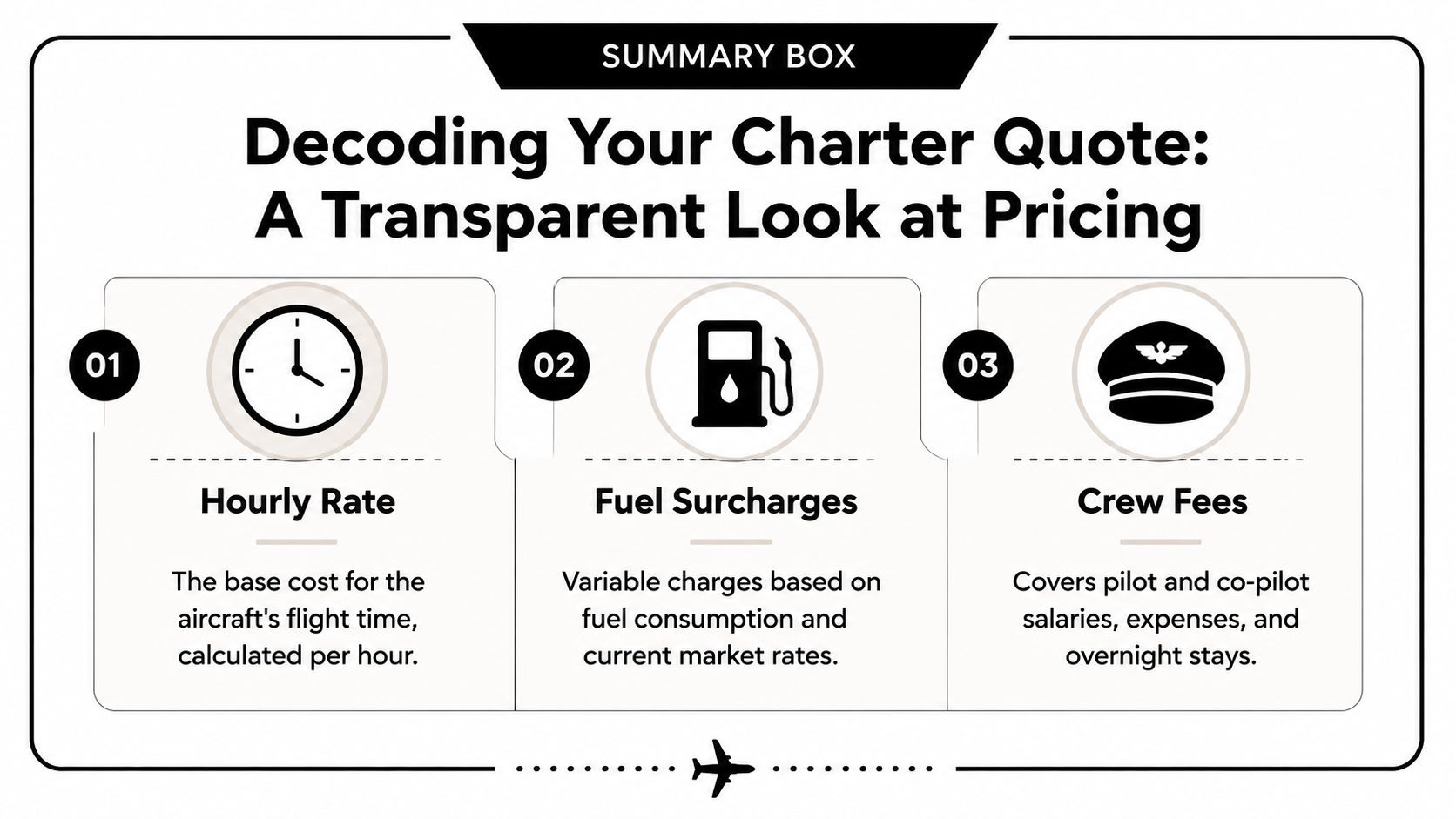
A credible quote breaks out the key cost drivers in plain language:
Aircraft hourly rate
The base flight charge tied to aircraft type and billable time.Positioning or repositioning time
Empty flying before or after your trip. This is the line item clients miss most often, and it can change the economics of the booking fast.Crew expenses
This may include overnight costs, extended-duty considerations, and itinerary-specific operating charges.Airport and handling fees
New York area airport choice affects ground handling, parking, slot coordination, and operating cost.Taxes and segment fees
These should be shown separately, not buried inside a vague total.
If you want a clearer explanation of how these charges fit together, read this private jet charter pricing cost breakdown before you approve any quote.
The fee that deserves your full attention
Repositioning is the charge that separates smart booking from expensive booking.
If the aircraft is already near your departure airport, that cost may be minimal. If the aircraft is based far away, your quote can include billable flight time you never experience as a passenger. The itinerary looks efficient on paper. The invoice says otherwise.
Ask this before you sign: Where is the aircraft coming from, and is any ferry time included in my total?
That question exposes weak sourcing immediately.
Here is how quote quality differs:
- Basic sourcing matches the aircraft category.
- Smart sourcing matches the category and checks local availability.
- Advisor-level sourcing checks local operator options first, reduces empty legs where possible, and keeps safety standards intact.
This is the advantage of sourcing through a local operator network instead of defaulting to a fixed card program or a narrow broker inventory. You get a quote built around your trip, not around whichever aircraft someone needs to sell.
A quick visual helps:
My pricing advice
Judge the quote by total trip cost, aircraft location, and operator quality.
A locally based aircraft with a slightly higher hourly rate often delivers the better value because it cuts waste, shortens non-revenue flying, and gives you a cleaner operating plan. That is the smart way to book private flights to New York, and it is exactly why local operator sourcing consistently beats lazy brokerage and overpriced jet card pricing.
From Quote to Takeoff The Seamless Haute Jets Booking Process
A smooth booking should feel controlled, not mysterious. You shouldn't have to chase tail numbers, ask twice about Wi-Fi, or wonder whether the aircraft in your quote is the one you'll get.

Step one starts with the itinerary, not the airplane
A serious advisor first asks for the route, preferred departure window, passenger count, baggage, pets, catering needs, and final ground destination. For New York, that last detail matters more than many clients expect because the airport choice can alter the trip.
Then comes sourcing. Instead of offering a vague “light jet” bucket, the stronger process is to present actual aircraft options and let the client compare key variables that affect experience:
- Specific make and model
- Aircraft year and cabin layout
- Wi-Fi availability
- Pet compatibility
- Baggage fit
- Ground transfer coordination
Confirmation should remove uncertainty
This is also where safety screening belongs. The publisher standards for Haute Jets are clear: flights are sourced only from Wyvern Wingman or ARGUS Gold/Platinum-rated operators, and clients can choose the exact aircraft rather than accepting category-only assignment. The company also states that clients receive a 24-hour pre-flight confirmation with tail number, crew details, weather briefing, and manifest review.
That's the right standard for first-time New York flyers because it replaces ambiguity with documentation.
Good charter service feels simple because the work is done before you arrive at the FBO.
What the booking flow should feel like
From the client side, the process should move like this:
Request the trip
Share route, schedule window, passenger details, and any special requirements.Review real aircraft options
Not a marketing brochure. Actual available aircraft.Approve the preferred option
Confirm airport, transfer plan, onboard requests, and payment.Receive final flight details
You should have the operational packet before departure, not after repeated follow-up.
If a broker can't clearly explain who operates the flight, where the aircraft is coming from, and what happens if the schedule shifts, keep shopping.
Smart Charter Strategies Finding Value Beyond the Hourly Rate
The best private flights to New York aren't always the cheapest quote or the most expensive cabin. They're the trips where the mission, airport, and aircraft line up without waste.
Where real value comes from
Date flexibility helps
If your schedule can move slightly, your sourcing options usually improve. Even modest flexibility can open access to more suitable aircraft and cleaner routing.
Local aircraft win often
This is the simplest cost-control rule in charter. An aircraft near your departure point is usually better than an aircraft you recognize by name but have to bring in empty.
Empty legs can work, but only when the trip fits
They're useful when your timing is flexible and your route lines up with an operator's repositioning need. They're not reliable enough for every critical business trip, but they can be a strong option for leisure travelers.
What I'd tell a first-time client
- Start with the address, not the airport
- Ask where the aircraft is based
- Don't overbuy cabin size
- Keep one backup departure window if the trip matters
On-demand charter usually beats prepaid programs for occasional New York flying. You keep flexibility and avoid paying for hours you may not use.
Frequently Asked Questions About New York Private Flights
Can I bring my pet?
Usually, yes. But don't assume every aircraft and operator handles pets the same way. Confirm the pet policy before booking, along with crate needs, cabin arrangement, and any cleaning-related terms.
What is an FBO?
An FBO is the private terminal used for business aviation arrivals and departures. It's where you check in for your charter, meet crew or ground staff, and avoid the commercial terminal process.
Why not just use JFK or LaGuardia?
Because convenience on paper isn't convenience in practice. Existing New York charter guidance often mentions JFK and LaGuardia for some private flights, but the more useful decision is comparing congestion, slot limits, and last-mile transfer time against airports built around business aviation access. For many itineraries, the smarter question isn't “Can I use JFK?” It's “Which airport gets me to my final destination fastest?”
How far ahead should I book?
For important New York trips, earlier is better. You'll usually have better aircraft choice, cleaner sourcing, and less risk of paying for a poor-fit option.
What should I ask before I approve the quote?
Ask these five questions:
- Which airport do you recommend for my final destination?
- What exact aircraft am I getting?
- Where is that aircraft based?
- Is any repositioning included in the quote?
- Who is the operating carrier?
What matters most on a first New York booking?
Clarity. You want a transparent quote, a safety-vetted operator, the right airport, and an aircraft that matches the trip instead of inflating it.
If you're booking private flights to New York and want a cleaner way to evaluate airport options, aircraft availability, and trip-specific pricing, Haute Jets offers on-demand charter sourcing with exact-aircraft selection, local operator matching, and no jet card or membership requirement.