You’re probably here because commercial travel has stopped making sense for the way you move. You can buy the front cabin. You can hold status. You can clear the airport faster than others. And you still end up working around airline schedules, crowded terminals, missed connections, and wasted hours.
That’s when private jet charter stops feeling like indulgence and starts looking like a rational travel tool.
The mistake first-time flyers make is focusing only on the airplane. The bigger issue is the booking model behind it. Two clients can fly the same route on the same aircraft type and pay very different amounts because one charter was sourced intelligently and the other carried unnecessary repositioning costs. If you understand that one point, you’ll make better decisions than most first-time buyers.
Beyond First Class What is Private Jet Charter
Private aviation isn’t “first class, but nicer.” It’s a different system entirely. You’re not buying a seat on someone else’s route. You’re booking the entire aircraft, crew, and schedule for your trip.

That matters because true luxury isn’t the leather seat or the catering. It’s control. You choose the departure time, the airport, the passenger list, the luggage load, and the pace of the day. If you’re coordinating a board meeting, a family holiday, or planning your luxury vacation in 2026, that control has practical value.
What on demand charter actually means
On-demand charter is the cleanest way to enter private flying. You book trip by trip, pay for the mission you need, and walk away when the trip is over.
Here’s the simple version:
- You don’t own the aircraft
- You don’t prepay for hours
- You don’t commit to a membership
- You don’t build your travel around a fixed program
That’s why I usually recommend on-demand charter for first-time private flyers. It lets you learn your actual travel pattern before you commit capital or lock yourself into a program that may not fit.
Practical rule: If you don’t already know your annual flying habits with confidence, don’t start with ownership.
What it is not
A lot of confusion comes from lumping everything together under “private aviation.” That’s sloppy thinking.
Jet cards are prepaid access products. They can be useful for people who want a simplified process, but they still require commitment and often come with program rules.
Fractional ownership means you’re buying a share of an aircraft or fleet access structure. That can work for very frequent flyers, but it comes with a much heavier financial and operational commitment.
By contrast, on-demand charter stays flexible. That’s one reason usage has remained strong. Clients have made it clear. They want access, not obligation.
Decoding Your Options Charter Models and Aircraft Tiers
Most first bookings go wrong in one of two ways. The client either picks the wrong access model, or picks the wrong aircraft for the mission.
Fix both, and the process gets much easier.
Choose the right access model first
Think of private aviation access like this:
| Model | How it works | Best for | Main tradeoff |
|---|---|---|---|
| On-demand charter | Pay as you go | Clients who want flexibility | Pricing varies by trip |
| Jet card | Prepaid block access | Frequent flyers who want a set program | Less flexibility, upfront commitment |
| Fractional ownership | Buy into aircraft access | Very heavy users with predictable patterns | Highest commitment and complexity |
I’m opinionated on this. For a first booking, on-demand charter is usually the smartest starting point. You learn what matters to you without paying for structure you may not need.
That flexibility exists inside a large market. In practical terms, major hubs like Miami, New York, and Los Angeles offer deep charter availability.
Match the aircraft to the mission
You don’t need the biggest jet. You need the right one.
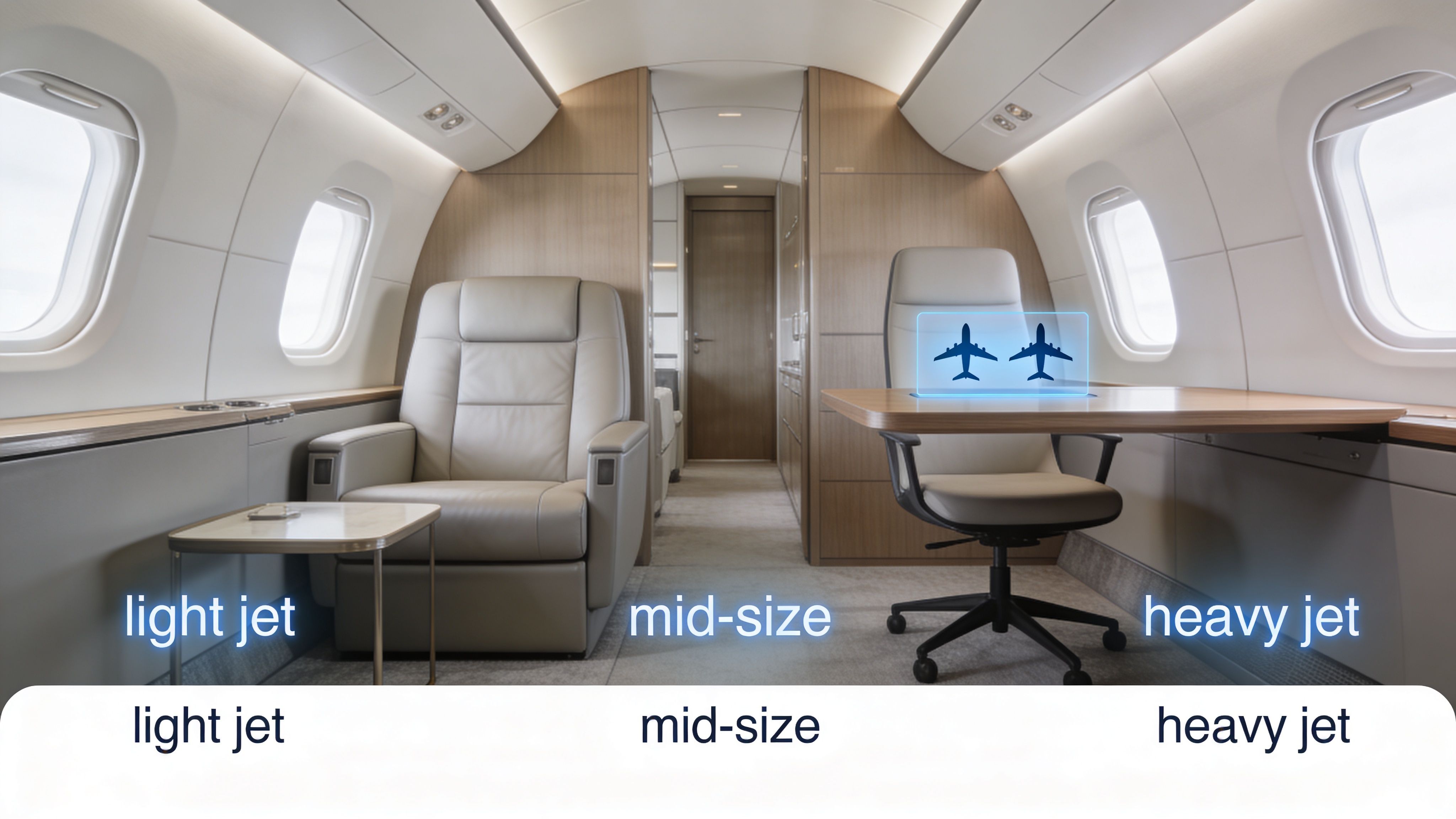
Here’s the way I frame aircraft tiers for new clients:
- Turboprops work for short regional sectors, smaller airports, and practical daytime hops. If you’re doing a quick leisure run or a short business shuttle, they can be a sensible tool.
- Light jets are often the entry point people imagine when they think of private flying. Good for shorter missions with a smaller group and lighter bags.
- Midsize jets give you a better cabin experience and stronger range for longer domestic sectors.
- Super midsize jets are where value gets very interesting for many executives and families. They offer real cabin comfort and serious nonstop capability.
- Heavy and ultra long range jets are for larger groups, longer stage lengths, international routes, and clients who want a more residential onboard experience.
A useful real-world benchmark is the Bombardier Challenger 350. It typically seats up to 10 and offers transcontinental capability, which makes it a strong fit for nonstop domestic trips where comfort and productivity matter.
If you want a quick visual primer before comparing cabins and mission profiles, this overview is useful:
A simple way to decide
When clients get stuck, I ask four questions:
- How many people are flying? Not invited. Confirmed.
- How far are you going? Range solves or creates problems.
- What bags are coming? Golf clubs, skis, garment bags, and pet gear change aircraft suitability.
- Is this a business mission or a comfort mission? Sometimes speed matters most. Sometimes cabin experience does.
Choose the smallest aircraft that comfortably handles your passenger count, luggage, route, and weather requirements. That’s usually where smart charter value lives.
The Real Cost of Flying Private A Pricing Breakdown
First-time clients often ask the wrong question. They ask, “What’s the hourly rate?” That’s incomplete.
A private jet charter quote is a trip quote, not a retail shelf price. The aircraft matters, but the logistics behind that aircraft matter just as much. Sometimes more.
What you’re actually paying for
A typical quote usually includes several moving parts:
- Aircraft charge based on the mission and aircraft selected
- Airport and handling charges tied to where the flight operates
- Crew-related costs when the itinerary requires them
- Taxes and regulatory items where applicable
- Optional services such as catering, ground transportation, and cabin-specific requests
That’s the visible part. The less visible line item is the one that catches first-time charter clients off guard.
The hidden cost most buyers miss
The biggest pricing trap in charter is repositioning. That’s the cost of getting the aircraft to you when it isn’t already near your departure point.
A lot of glossy content talks about empty legs and one-off bargains. Fine. Those can exist. But that’s not where disciplined buyers should focus.
If you only compare headline prices, you’ll miss the actual economics. A “cheap” aircraft quote can become an expensive charter if the airplane has to fly empty to pick you up.
Ask one direct question before you sign anything: “Where is the aircraft coming from?”
How to review a quote like an advisor
When you review a charter proposal, don’t just look at the total. Read it like an invoice.
Focus on these points:
- Aircraft origin: Is the aircraft local to your departure area, or being brought in?
- Specificity: Are you seeing the actual aircraft details, or just a generic category?
- Operational logic: Does the routing make sense for your trip?
- Add-ons: Are catering and ground arrangements included or separate?
- Contract language: Look carefully at substitution terms and cancellation terms.
If you want to understand how line items are presented before requesting a trip, the Haute Jets pricing page is a useful starting point for comparing how charter cost is framed.
The Haute Jets Difference Eliminating Repositioning Fees
Most charter overpayment starts with a sourcing problem. The broker doesn’t have the right aircraft near your departure city, so they solve the problem by flying one in. You pay for that inefficiency.
That’s not a small detail. It’s the structural reason many clients think private flying is more expensive than it needs to be.

Why local sourcing changes the price
The cleaner model is simple. Source aircraft that are already near the client.
That matters because it attacks the cost driver, not just the quote presentation.
If the plane is already in your market, you’re not funding an empty pickup leg that does nothing for your itinerary.
What this changes for the client
A smarter sourcing model improves more than price.
- Availability improves because aircraft are drawn from a broad network of vetted operators rather than a narrow inventory.
- Aircraft choice improves because you’re not forced into whatever one repositioned option happens to be available.
- Booking speed improves in major metro markets where local supply is deeper.
- Route efficiency improves because fewer unnecessary empty sectors are involved.
That’s why I tell clients not to obsess over brand names first. Start with sourcing logic. If the sourcing is wrong, the rest of the quote is built on the wrong foundation.
The recommendation I give first-time buyers
If you’re booking your first charter, insist on three things:
- The exact aircraft, not just a category
- Confirmation of where that aircraft is based before your departure
- A quote built around the mission, not around a broker’s convenience
A charter buyer who ignores sourcing is buying blind.
The practical appeal of the owner-operator model is straightforward. You avoid membership commitments, you widen your aircraft options, and you reduce the chance of paying for somebody else’s deadhead leg.
Your Step-by-Step Guide to Booking a Charter Flight
Booking a charter isn’t difficult. What matters is giving the advisor enough precision to build the right mission. Sloppy inputs produce sloppy options.
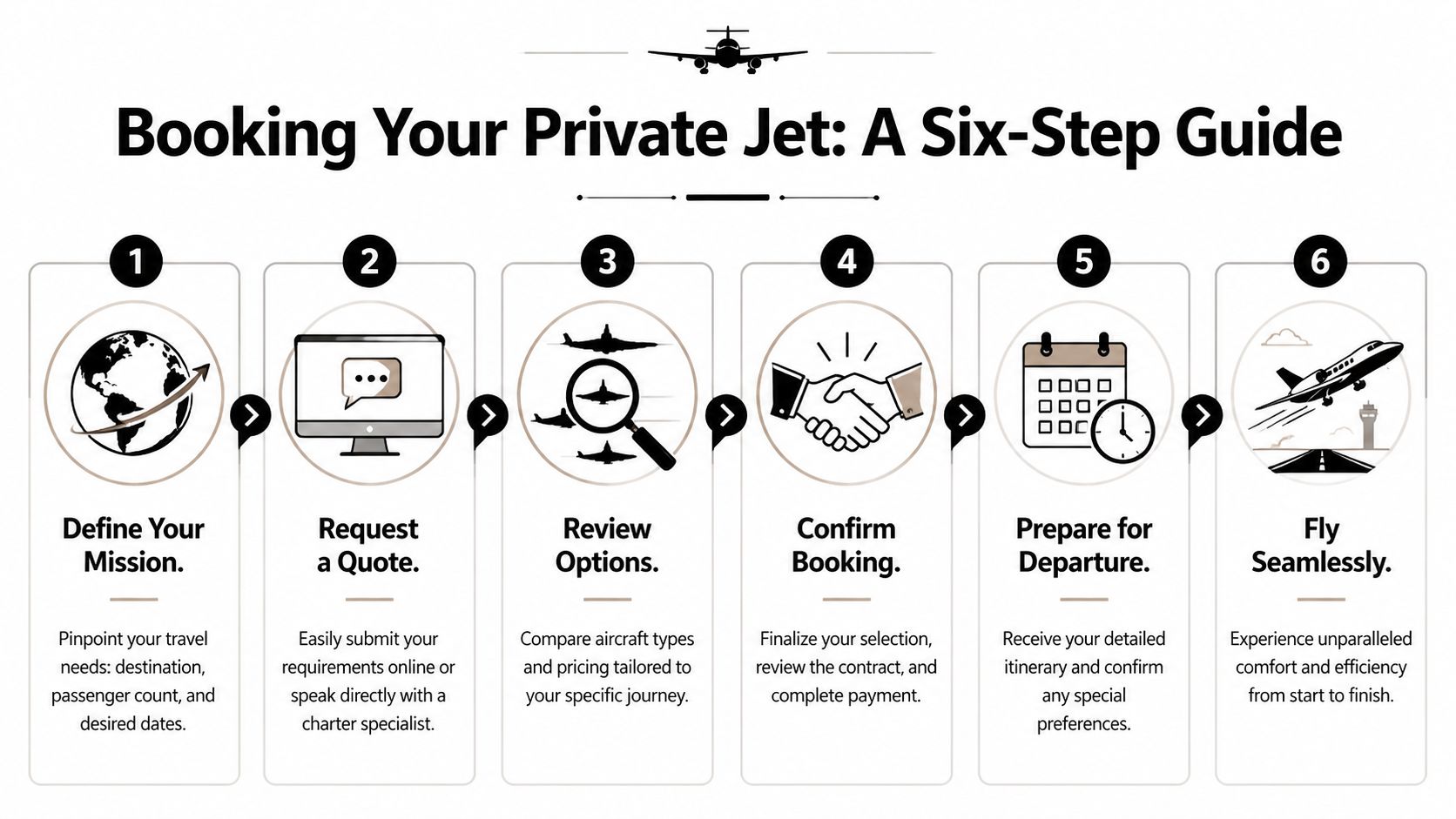
Start with the mission, not the airplane
Before you ask for a quote, define the mission clearly.
You need to know:
- Who’s flying
- Where you want to depart and arrive
- Your preferred departure time
- How much luggage is coming
- Whether pets, catering, or ground transport are required
This sounds basic, but it determines everything from airport choice to cabin suitability.
Request options, then narrow aggressively
Once your request goes in, you should expect customized aircraft options, not a vague promise. On this point, first-time clients should be demanding.
Ask for:
- Year, make, and model
- Cabin configuration
- Wi-Fi status
- Pet policy if relevant
- Baggage suitability
- Departure airport logic
If you’re unfamiliar with the booking flow, this guide to booking a private jet with Haute Jets is a useful reference for what a structured process should look like.
Review the contract like it matters, because it does
A charter agreement is not paperwork theater. Read it.
Look closely at:
- Aircraft substitution language
- Cancellation terms
- Payment timing
- Included services
- Departure time flexibility
- Passenger manifest requirements
A good booking feels smooth because the details were handled early, not because nobody mentioned them.
Don’t approve a charter until you know the exact aircraft and the exact terms for changing it.
Confirm the trip around the ground experience
The flight is only part of the day. Ground movement matters, especially if you’re landing for a villa stay, event transfer, or multi-stop holiday.
If your itinerary continues by road after arrival, it helps to pre-arrange reliable transfers. For clients traveling in Portugal, a vetted professional chauffeur service in Algarve can cleanly connect the air segment to the rest of the trip.
Expect a real pre-flight confirmation
The final step should remove uncertainty, not create it.
A proper pre-flight confirmation should include:
- Tail number
- Crew details
- Final itinerary
- Passenger manifest confirmation
- Any onboard notes such as catering or pet arrangements
That final confirmation is where professional charter handling shows up. If you’re still guessing the day before departure, the process wasn’t managed well.
Safety First Understanding Wyvern and Argus Ratings
If you remember one thing from this article, let it be this. Safety ratings are not optional.
Clients get distracted by cabin photos, speed, and price. Fine. But none of those matter if the operator isn’t held to a serious third-party standard.
Start with Part 135, then go further
For charter, legal compliance is the floor. It isn’t the ceiling.
You want an operator that is properly authorized for charter operations, but you should not stop there. Serious buyers also look for third-party audited safety ratings that evaluate operational discipline, crew standards, and safety culture in a much deeper way than marketing language ever will.
Why Wyvern and Argus matter
The two names clients should know are Wyvern Wingman and Argus Gold or Platinum.
Think of them as your independent filter. They help separate operators who only meet minimum requirements from operators who have invited deeper scrutiny into how they run flights, manage crews, document procedures, and maintain standards over time.
That’s why this should be an essential question during any booking conversation:
- Is the operator Wyvern Wingman rated?
- Is the operator Argus Gold or Platinum rated?
- Can the advisor confirm that in writing?
If you want a deeper primer on what those labels mean, this article on Wyvern and Argus private aviation safety ratings is worth reading before you approve a flight.
If a charter seller gets vague when you ask about operator ratings, stop the conversation.
What a careful client should verify
A disciplined safety check is simple:
- Operator rating: Confirm Wyvern or Argus status
- Aircraft details: Verify the exact plane you’re flying
- Crew visibility: Review the crew information when provided
- Operational clarity: Make sure departure airport, timing, and handling are clearly confirmed
Private aviation should feel easier than commercial travel. It should not feel less rigorous.
Private Jet Charter FAQs
Are empty leg flights worth chasing
Sometimes. Not as a core strategy.
Empty legs can be useful if your timing is highly flexible and your route happens to match an aircraft’s repositioning need. They are opportunistic. They are not dependable. Most first-time clients want control, not chance.
That’s why I treat empty legs as a bonus, not a planning method. If the mission matters, book the mission you need.
Can I pay for a private jet charter with Bitcoin or crypto
In some cases, yes. More clients are asking for it, especially on international or time-sensitive itineraries.
As noted by Jettly’s discussion of crypto payments in private aviation, paying for private jet charters with Bitcoin and other crypto is a growing interest among crypto-forward travelers seeking speed and privacy, and it can bypass traditional banking delays. That makes it relevant when timing matters and banking friction is the actual problem.
The key is operational clarity. Before sending funds, confirm:
- Accepted crypto type
- When the price is locked
- Refund handling
- Booking confirmation timing
Can I bring pets on a private charter
Usually, yes. Private flying is often far easier for pet owners than commercial travel.
But don’t assume every aircraft or operator handles pets the same way. Ask early. A good advisor will confirm the pet policy, cabin rules, and any cleaning or handling requirements before the contract is finalized.
What is an FBO
An FBO, or Fixed-Base Operator, is the private terminal you’ll use instead of the main commercial terminal.
That’s where you arrive, check in, wait briefly if needed, and board the aircraft. It’s one of the biggest quality-of-life upgrades in private aviation because it strips away most of the airport friction that clients are trying to avoid in the first place.
How early should I arrive
Private flyers usually don’t need the long lead times associated with commercial departures. But don’t treat that as an excuse to cut it too close.
Arrive with enough time to handle the basics calmly, confirm baggage, and board without creating a rushed departure. The exact timing should be confirmed with your advisor and the operating team.
What should I ask on my first charter inquiry
Keep it simple and direct.
Ask these six questions:
- What exact aircraft are you offering?
- Where is it coming from?
- Is the operator Wyvern or Argus rated?
- What is included in the quote?
- What can change after I sign?
- When do I receive final flight details?
That short list will protect you from most first-time mistakes.
If you want a private jet charter handled with clear aircraft sourcing, exact aircraft visibility, and no unnecessary membership structure, speak with Haute Jets. The key is simple. Book the right aircraft, from the right location, with the right operator. That’s how you fly private without overpaying.