

You're likely dealing with the exact problem that pushes smart travelers into private aviation in the first place. You have meetings in Singapore, Tokyo, Mumbai, and Dubai inside one tight window. Commercial schedules don't line up. Layovers waste half-days. Airport friction drains the rest. By the time you arrive, you've already spent energy you needed for the deal, the site visit, or the family trip.
That's where private aviation in Asia stops being indulgence and starts being practical. The region is growing fast, but it's also harder to manage than most first-time charter clients expect. Aircraft availability is fragmented. Rules change by country. The quote that looks competitive at first glance can become expensive once repositioning, permits, and routing inefficiencies show up.
This article appears on Haute Jets Journal because this market rewards informed buyers. If you understand the few variables that matter, you'll save time, avoid bad-fit aircraft, and keep control of your schedule.
Welcome to the New Era of Asian Private Aviation
A typical Asia itinerary looks simple on a calendar and messy in real life. One week it's a board meeting in Singapore, investor calls in Tokyo, a manufacturing stop in Mumbai, and a closing dinner in Dubai. The next week it's a family circuit through Phuket, the Maldives, and Bali with zero appetite for missed connections, airport queues, or rigid airline timing.
That's why demand has shifted so decisively toward charter. The Asia-Pacific region is the fastest-growing market for private jet charter services, projected to hold 21.60% of the global market by 2025, with China leading this expansion and India posting the highest regional CAGR, according to Cognitive Market Research. Those numbers matter because they explain what clients are already feeling on the ground. Asia is no longer a side market in business aviation. It's becoming central.

Why Asia feels different
Private jet charter in Asia doesn't work like a copy-paste version of the U.S. or Western Europe. Airports vary sharply in business aviation friendliness. Operating norms change from country to country. A route that looks short on a map can become operationally awkward if the aircraft isn't based nearby or the permits aren't handled properly.
That complexity is exactly why experienced travelers value control. A well-planned charter lets you choose departure time, trim dead hours from the day, and reach airports commercial carriers don't serve efficiently.
For travelers building a broader itinerary beyond the flight itself, I also like practical destination planning resources that focus on pacing and regional flow. A useful example is this guide to seamless luxury travel in Asia, especially if you're combining business stops with resort or family time.
What clients usually get wrong first
They focus on the cabin before they focus on the mission.
A beautiful heavy jet is the wrong answer for a short regional hop if a light jet can do the trip more efficiently. A cheap-looking quote is the wrong answer if the aircraft is flying in empty from far away. And a fast verbal confirmation means very little if the operator can't execute cleanly across multiple jurisdictions.
Practical rule: In Asia, the best charter isn't the fanciest jet or the lowest quote. It's the aircraft that matches the route, is sourced close to departure, and can clear the trip without operational drama.
That's the lens you should use for every decision that follows.
Decoding Asian Routes and Charter Costs
A client books Singapore to Phuket and fixates on cabin size. The main cost driver is usually aircraft sourcing. If that jet is coming in empty from another country, the quote can lose its appeal fast.
In Asia, charter pricing is rarely just about hourly rate. It is a mix of aircraft fit, where the aircraft is based, airport charges, and whether the operator can cover the route efficiently inside a fragmented regional market. That is the part standard charter guides gloss over, and it is where buyers overspend.
For regional flights under three hours, Very Light Jets and Light Jets are usually the right tool. They carry 4 to 8 passengers, cover roughly 1,500 to 3,500 km, and typically charter for USD 3,500 to USD 6,500 per hour, according to ASA Air Charter's Asia small jet guide. That source also notes that using these aircraft for sub-2,000 km missions can cut total charter cost by 40 to 50% compared with heavy jets.
The short-haul rule
For routes such as Singapore to Phuket, Hong Kong to Tokyo, or similar regional sectors, buy the aircraft that fits the mission and is positioned close to departure. A Heavy Jet at more than USD 12,000 per hour is often poor value on that profile, according to market analysis.
The expensive mistake is paying for two things you do not need. Excess cabin. Excess repositioning.
A larger jet only makes sense if the mission demands it. Higher passenger count, serious baggage, a need for a stand-up cabin, or an onward leg that makes a larger aircraft more efficient overall are valid reasons. Vanity is not.
Aircraft Suitability for Popular Asian Routes
| Aircraft Category | Example Model | Passengers | Ideal Route (Example) | Est. Hourly Rate (USD) |
|---|---|---|---|---|
| Very Light Jet | Phenom 300 | 4–8 | Singapore to Phuket | 3,500–6,500 |
| Light Jet | Citation XLS | 4–8 | Hong Kong to Tokyo | 3,500–6,500 |
| Heavy Jet | Global 6000 | 14–16 | Dubai to Hong Kong | 8,500–14,000+ |
| Ultra-Long-Range Jet | Gulfstream G650 | 14–16 | Los Angeles to Hong Kong | 8,500–20,000+ |
| VIP Airliner | VIP-configured large cabin aircraft | 16–50 | Head-of-state or large group missions | 16,000–23,000 |
When long range is worth the money
On trans-Asian or intercontinental missions, the economics reverse. Range matters because every stop adds cost, time, handling exposure, and schedule risk.
Ultra-Long-Range jets cost USD 8,500 to USD 20,000+ per hour, and a 14-hour flight such as Los Angeles to Hong Kong can exceed USD 190,000, according to BlackJet's private plane rates analysis. BlackJet also explains that fuel stops can push total trip cost up by 20 to 40% once landing fees, delays, and repositioning are included.
This is also where Asian operating nuance starts to matter. A direct long-range aircraft may price higher on paper, yet still be the cheaper decision if the alternative involves extra permits, extra ground time, and overnight crew complications across multiple jurisdictions. If you want a clearer view of the approval chain behind those routings, review these private jet overflight permit requirements in Asia.
Ask a better question. Which aircraft completes the mission at the lowest total trip cost with the least operational friction?
Short regional trips reward local sourcing and right-sizing. Long missions reward range and fewer stops.
What to look for in a quote
A credible quote should show that the broker understands Asian trip economics, not just aircraft categories.
Use this checklist:
- Aircraft logic: Does the cabin class match the route length, passenger count, and baggage profile?
- Local sourcing: Is the aircraft based near departure, or are you funding a long empty reposition?
- Total mission view: Are you comparing total trip cost instead of chasing the lowest hourly rate?
- Operational realism: Can the aircraft fly the route as planned without avoidable stops?
- Charge visibility: Are positioning, handling, parking, and airport fees shown clearly?
Smart buyers in Asia do not chase the biggest cabin or the cheapest headline number. They buy the least aircraft that fully covers the mission, sourced as locally as possible, with a quote that exposes a complete cost structure up front.
The Hidden Hurdle of Permits and Regulations
The largest difference between a smooth Asia charter and a stressful one often has nothing to do with the airplane. It's paperwork.
Asia is a patchwork of national aviation systems. Each country controls its own overflight permissions, landing approvals, airport procedures, and documentation standards. Some hubs are relatively straightforward. Others require patience, sequencing, and local knowledge. If you're used to more unified operating environments, this catches you off guard fast.
How the permit problem actually works
A private flight across Asia can require more than a single approval. The operator may need one set of permissions to land, another to overfly neighboring airspace, and still more coordination for airport slots, handling, and local compliance.
That's why last-minute itinerary changes can become expensive or impossible. If you move one leg, the rest of the chain may need to be reworked.
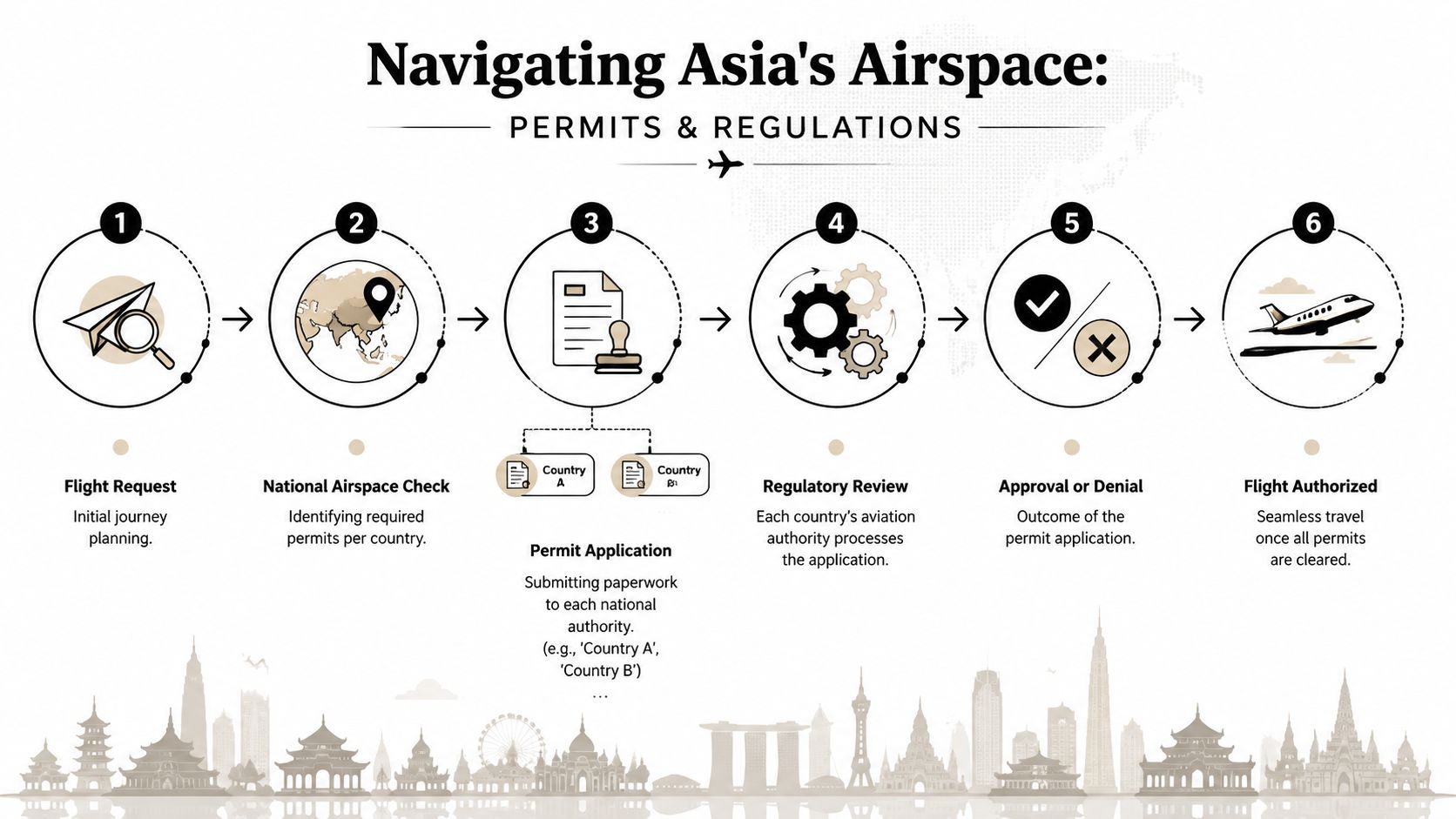
For a deeper look at the operational side, review private jet overflight permits. It's one of the least glamorous parts of charter aviation and one of the most important.
What experienced travelers do differently
They plan in layers.
- Lock the mission first. Confirm cities, passenger count, and timing before you start pushing for aircraft options.
- Build around the hardest jurisdiction. If one country is likely to be slower or more restrictive, shape the itinerary around that leg first.
- Keep backup timing. Flexibility of even a few hours can save a trip when approvals tighten.
- Avoid assuming regional consistency. Singapore and Dubai may operate very differently from other jurisdictions on the same itinerary.
- Ask who is handling the permits. If the answer is vague, that's a warning.
Why this matters to cost
Permits affect price indirectly but decisively. When approvals lag, crews time out, aircraft reposition awkwardly, and airport access windows narrow. A route that looked efficient can become expensive because the operational plan wasn't built around regulatory reality.
The clients who think permits are “just admin” are usually the ones paying for avoidable schedule changes later.
Broker expertise shows up in practical terms, not in glossy branding, but in whether your aircraft departs when you were told it would.
Insisting on the Gold Standard of Aviation Safety
A polished cabin means nothing if the operator behind it cuts corners. Safety in private aviation should never be treated as a soft promise. It needs independent verification.
The two names that matter most in charter vetting are Wyvern and ARGUS. Those audits look beyond marketing language and into the systems that protect you, including pilot records, training standards, maintenance discipline, and operational oversight.
What these ratings mean in practice
If an operator holds a meaningful third-party safety rating, someone external has reviewed more than the aircraft exterior and a certificate on the wall. They've looked at how the operation runs.
That includes areas clients rarely see:
- Pilot standards: recurrent training, qualification records, flight experience oversight
- Maintenance discipline: documentation quality, maintenance practices, inspection processes
- Safety management: whether the company has a real reporting and risk-control culture
- Operational control: dispatch, crew duty awareness, trip planning, procedural consistency
This matters even more in a fragmented region. Private jet charter in Asia often involves many operators across many jurisdictions. Independent safety screening gives you a common standard when geography doesn't.
Don't confuse availability with quality
Some brokers can find an aircraft quickly. That alone doesn't make it an acceptable aircraft.
Leading charter services in Asia, like those curated by Paramount Business Jets, offer access to over 4,000 aircraft certified by both ARGUS and Wyvern, according to Paramount Business Jets' Asia charter page. That's the benchmark mindset clients should adopt. Access matters, but vetted access matters more.
For a practical framework on what to insist on, review private jet safety standards.
Here's a useful visual primer on the safety conversation clients should have before booking:
My recommendation
If the operator is not Wyvern Wingman or ARGUS Gold/Platinum rated, move on. There are too many quality aircraft in the market to compromise here.
Non-negotiable: Safety should be independently audited, not self-described.
That standard removes a surprising amount of noise from the buying process. It helps you reject weak options quickly and focus only on aircraft that deserve consideration.
Booking Logistics Empty Legs and Payment Flexibility
Most first-time charter clients think booking starts with selecting an aircraft. It doesn't. It starts with trip clarity.
The cleaner your request, the cleaner your quote. Dates, city pairs, passenger count, baggage, pets, catering, and whether your schedule can tolerate slight shifts all affect what comes back to you. In Asia, that discipline matters because airport access and permit timing can tighten without much notice.
The booking sequence that works
A smooth charter booking usually follows a simple rhythm:
- Start with the fixed points: departure city, arrival city, travel date, and passenger total.
- Add mission details: luggage profile, onboard Wi-Fi needs, pets, catering style, and ground transport.
- Review aircraft on suitability first: don't start by asking for the “best” jet.
- Confirm commercial terms: payment timeline, cancellation language, and what's included.
- Expect a pre-flight package: tail number, crew details, terminal instructions, and timing confirmation before departure.
Clients who rush the first step often create their own confusion later. If your itinerary is still moving, say so. A good charter plan can absorb flexibility, but only if it's disclosed early.
Where empty legs fit
An empty leg is a repositioning sector that would otherwise fly without paying passengers. If your route and timing line up, it can be a smart way to reduce spend.
The tradeoff is obvious. Empty legs are opportunistic, not purpose-built. The aircraft is moving because of another mission, not because it was designed around your exact schedule. That means they work best for travelers with some timing flexibility and a clear understanding that schedule changes can happen.
If you want the mechanics and tradeoffs laid out clearly, read this guide to what an empty leg flight is.
Payment is simpler than people expect
Private charter payment doesn't need to be complicated. Most transactions are still handled through standard banking channels, and many providers also accept card payments. Some clients now prefer digital asset settlement because it fits how they already manage liquidity and high-value transactions.
The important point isn't the method. It's the paper trail. Before paying, confirm the contracting party, the operator details, the aircraft being booked, and the cancellation terms. Speed matters in charter, but verification matters more.
Empty legs are a tactical buy, not a travel strategy. Use them when the fit is clean. Don't build a critical business trip around one unless you can absorb change.
That mindset keeps you flexible without becoming reckless.
The Haute Jets Advantage Wholesale Access and Local Sourcing
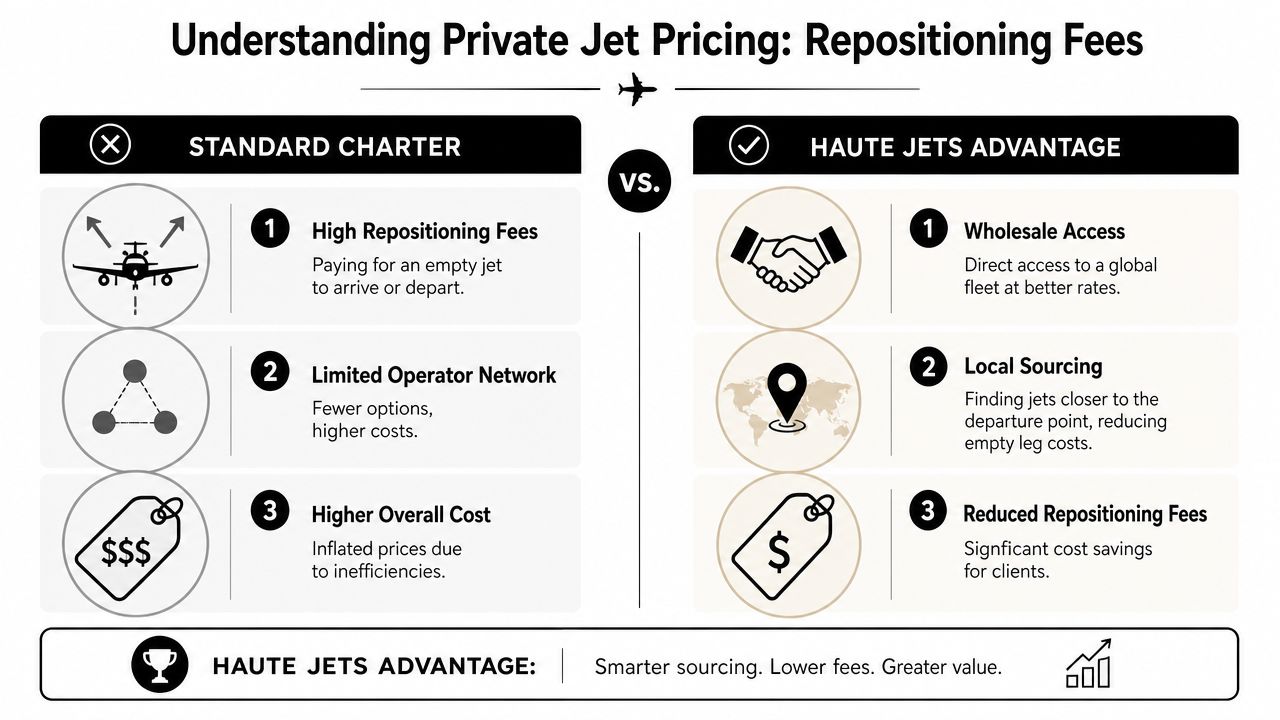
Most charter overpayment in Asia comes from a simple mistake. The aircraft is in the wrong place before your trip even starts.
A standard broker may show you a good-looking jet at a fair-looking rate, then subtly build in the cost of getting that aircraft to you. In Asia, that can become expensive fast, especially if you're departing from a resort market, an island destination, or a secondary city with limited based inventory.
Repositioning is the fee clients miss most often
In Asia, remote destinations like the Maldives often require 3 to 5 hour repositioning flights, adding USD 15,000 to USD 25,000 to the charter fee. These hidden costs can inflate total prices by 20 to 40% when aircraft are not locally sourced, as highlighted in this market commentary on hidden charter costs in Asia.
That's not a small rounding error. It can completely change whether a quote is competitive.
Why local sourcing beats generic brokering
The strongest charter strategy in Asia is usually local sourcing. Find the right aircraft already positioned near your departure city, or at least close enough that ferry cost stays controlled.
That approach improves three things at once:
- Pricing: You're not paying for unnecessary empty movement.
- Response time: Nearby aircraft are easier to activate cleanly.
- Operational confidence: Shorter positioning chains reduce the chance of disruption.
Here's the practical comparison.
| Model | What usually happens | What you should want |
|---|---|---|
| Standard broker model | Aircraft selected first, location problem solved later | Aircraft selected with local positioning in mind |
| Remote departure city | Ferry costs layered into final quote | Nearby operator sourced where possible |
| Quote structure | Base rate looks fine, total cost drifts upward | Total mission cost is clear from the start |
Where wholesale access matters
A broad owner-operator network puts buyers in a strong position. It means the search starts with the market that exists, not with a narrow in-house inventory or a small favorite list.
That matters in Asia because the operator market is fragmented. One city may have multiple strong options. The next may have very few. If your broker can't cast a wide net, you'll feel it in both price and aircraft choice.
The cheapest-looking quote is often the most expensive one once repositioning shows up.
This is the part many glossy charter guides skip. They talk about cabin classes, champagne, and airport lounges. They don't talk enough about where the aircraft is sleeping the night before your flight. In Asia, that detail can determine whether your quote is disciplined or bloated.
Your Guide to Smart Asian Air Travel
You are flying from Hong Kong to Phuket for a short stay, then onward to Singapore for meetings. On paper, it looks simple. In practice, the wrong aircraft choice, a poorly timed permit request, or a broker sourcing from outside the region can add cost, delay departure, and limit your airport options.
That is the situation with private jet charter in Asia. Buyers who get the best results treat each trip as an operating plan, not a luxury purchase. They focus on aircraft range, airport restrictions, permit lead times, operator quality, and where the jet is positioned before the first quote even lands in their inbox.
The practical playbook
Use a simple framework and stick to it:
- Choose for the route, not the image: short intra-Asia sectors often price and perform better on the right midsize or light jet than on a larger aircraft you do not need
- Build around local rules early: permits, cabotage limits, airport slots, and parking constraints can reshape the trip
- Set a hard safety floor: Wyvern and ARGUS matter because they filter out weak operator choices before they become your problem
- Read the full mission cost: ask where the aircraft is based, how it is positioning, and what charges appear if your schedule changes
- Use flexibility strategically: empty legs and slight timing adjustments can improve value, but only when the routing still fits your agenda
Ask better questions up front, and the market becomes easier to buy from.
What Smart Travel Looks Like
A well-run charter in Asia feels controlled. The aircraft fits the route. The operator is reputable. The permit work is handled early. The quote reflects the complete mission cost rather than a low headline number padded later with repositioning and operational extras.
That is where experienced buyers separate themselves from occasional charter users. They do not need to know every operator in the region. They need to know what creates friction, what inflates cost, and what signals that a broker is selling convenience instead of solving the trip properly.
If you want that level of control without paying for repositioned aircraft you didn't choose, Haute Jets is built for it. Haute Jets sources from 3,500+ owner-operators across 175 countries, works only with Wyvern Wingman or ARGUS Gold/Platinum-rated operators, and gives you on-demand charter access without memberships or jet cards. Request a quote, review the exact aircraft, and book with confidence.