

You're comparing two private jet quotes for the same Austin departure, and the numbers don't make sense. One broker says the light jet is available immediately. Another says the aircraft must reposition before pickup. Both describe a similar cabin, yet the final totals are far apart. The aircraft category is only part of the answer.
A smart private jet charter in Austin starts with the aircraft's actual location, the airport and FBO handling the trip, and the operator's current safety credentials. Those details affect price, timing, comfort, and how much control you have before departure. This guide is written for first-time charter clients who want a clear quote and no surprises at the terminal.
Why Austin Charter Pricing Varies So Wildly
A light jet from Austin to Aspen can produce sharply different quotes for the same weekend. One aircraft may already be staged in Austin. Another may need to fly in from Dallas or Houston, carry that positioning cost, then reposition again after dropping you off.
That operational difference can create a gap of thousands of dollars even when the cabin category looks identical. Austin charter pricing can range from about $2,300 per hour to about $23,000 per hour, depending on aircraft class and mission requirements, according to Austin charter pricing data. The hourly rate still leaves important questions unanswered: Is the aircraft local? Will the crew need an overnight stay? Must the operator ferry the jet empty?
Ask where the aircraft is based
Ask the broker one question before comparing cabin finishes:
Practical rule: Confirm where the aircraft is based and whether the quote includes positioning.
A jet based near Austin may begin the trip without an extra ferry leg. A jet sourced elsewhere may need an empty flight to AUS or another nearby airport, along with fuel, crew time, landing charges, and handling. Haute Jets describes its local-sourcing model as a way to avoid the 20% to 40% repositioning markup that can appear in traditional broker quotes and jet card structures, as stated by Haute Jets' local-sourcing model. Treat that figure as the company's description of its own model, not as an independent industry benchmark. The charge may appear as a separate line item or be folded into the total.
Aircraft availability, rather than the cabin alone, often explains the final difference. One traveler is paying for transportation from Austin. Another is paying to bring the aircraft to Austin before the charter begins.
Compare the quote, not just the rate
Request these details in writing:
- Aircraft location: Identify the aircraft's current base or staging point.
- Positioning charges: Confirm whether ferry legs, crew repositioning, and return positioning are included.
- Airport choice: Confirm whether the quote uses Austin-Bergstrom or Austin Executive.
- FBO charges: Ask the operator to identify handling and passenger-service assumptions.
- Aircraft identity: Request the exact year, make, model, and tail number when available.
Local sourcing does not guarantee the lowest quote. Availability and itinerary complexity still affect the total. It removes one avoidable source of inflation, however, and that makes aircraft location a required comparison point before you evaluate catering, seating, or ground transport.
Choosing the Right Austin Airport and FBO
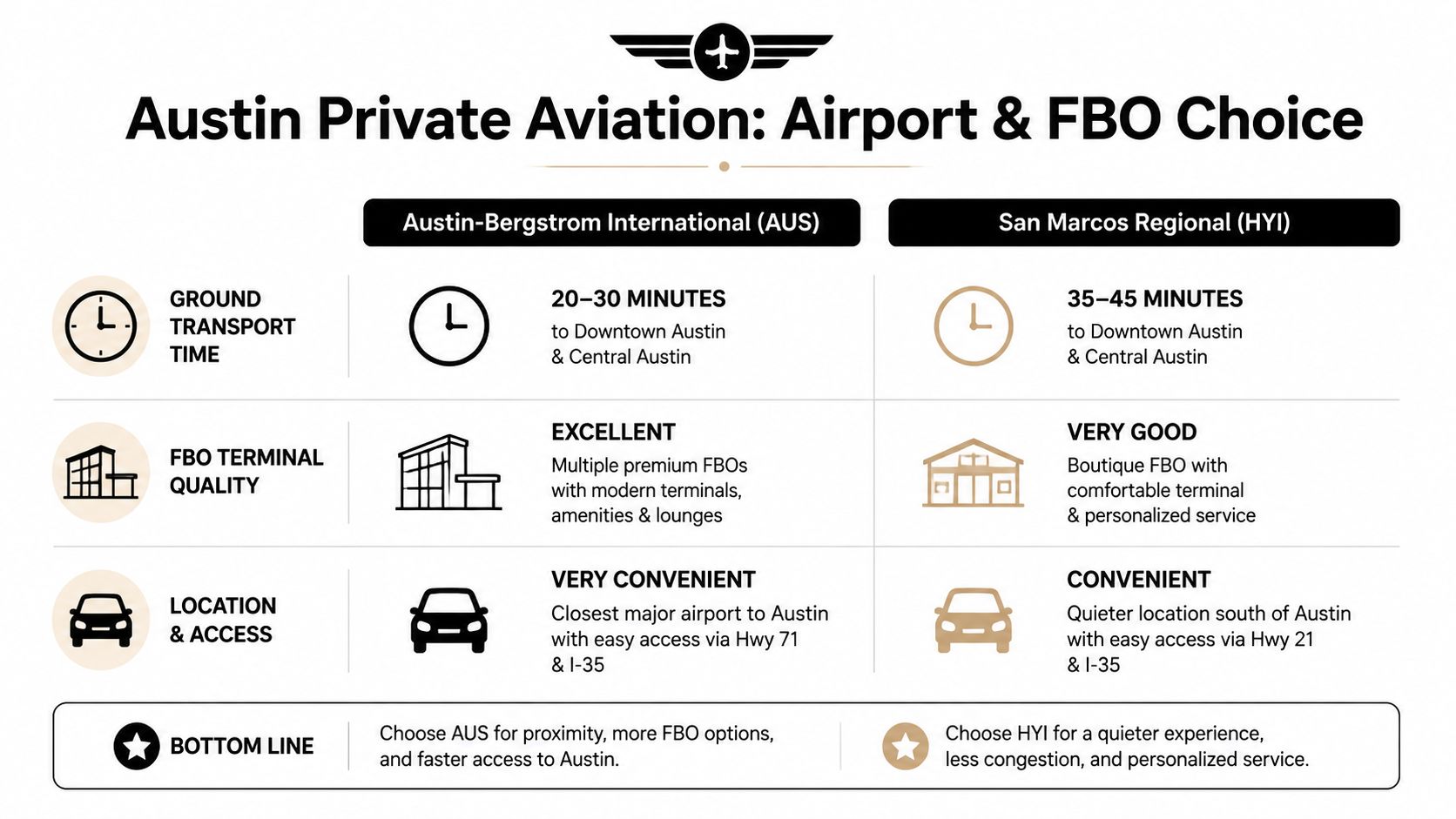
Austin has two principal private-aviation gateways, and they serve different trip profiles. Austin-Bergstrom International Airport, AUS or KAUS, is open 24 hours every day and sits about 5 miles southeast of downtown Austin, according to airport information from Paramount Business Jets. Austin Executive Airport, EDC or KEDC, offers a more focused general-aviation environment south of the city.
Use AUS for international access and larger missions
AUS has two runways, including one measuring 12,250 feet and another measuring 9,000 feet, supporting missions ranging from light jets to long-haul aircraft, as detailed by LunaJets' Austin-Bergstrom airport overview. The airport also supports multiple private-aviation facilities, including Signature Flight Support and Atlantic Aviation. Million Air states that it's the only FBO on the field open 24/7, while the airport itself remains available around the clock through the chosen FBO and handling arrangement, according to Million Air's AUS location information.
AUS is the stronger default for international charter planning. It's a U.S. port of entry, and CBP's KAUS general-aviation fact sheet states that arrival inspections are generally available seven days per week within defined time windows. That doesn't mean an international arrival is automatic. Your operator must coordinate customs, passenger documentation, aircraft handling, and the planned arrival time.
During major Austin events, including SXSW and Formula 1, ask the operator to confirm airport acceptance, parking, crew positioning, and ground handling before you pay. Peak demand can affect aircraft availability and FBO workflow even when the airport itself is open.
Consider EDC for a more localized departure
Austin Executive Airport has a 6,025-foot longest runway, an elevation of 620 feet, and a single FBO, Henriksen Jet Center, according to PrivateFly's Austin airport information. That setup can suit domestic trips where the aircraft, passengers, and ground transfer align with the airport's operating profile.
The choice should follow the mission, not a broker's default template:
- Choose AUS when you need international customs coordination, a larger runway environment, or access to AUS-based FBO options.
- Consider EDC when your passengers are south or west of central Austin and the aircraft can operate comfortably from its runway.
- Specify the FBO in the request. “Austin” is incomplete because passenger handling, vehicle access, lounge experience, and aircraft staging depend on the facility.
For AUS-specific planning, review the Haute Jets Austin-Bergstrom charter page and ask your provider to confirm the precise pickup terminal before departure.
Understanding True Charter Costs Beyond the Hourly Rate
An Austin charter quote that shows only an hourly rate is incomplete. Your final total can also include aircraft time, fuel, landing charges, crew expenses, overnight stays, FBO handling, catering, ground transport, and aircraft positioning. Some costs follow the route and aircraft. Others come from the airport, schedule, or operator.
Aircraft positioning is the cost brokers often leave buried. If the selected jet is not already near Austin, the operator may charge ferry time to bring it in and move it afterward. Local sourcing can remove much of that exposure. A broker quoting an aircraft from outside the region may add a 20-40% repositioning markup, even when a comparable locally based aircraft is available.
The FBO also affects the ground portion of the trip. At Bergstrom, the three FBOs can differ in parking, passenger handling, vehicle coordination, aircraft staging, and facility charges. Require the quote to identify the selected FBO. “Austin” alone does not describe the experience or the handling cost.
Read the cost anatomy line by line
Ask the provider to separate these categories:
- Flight charges: Billable flight time and any applicable minimums.
- Positioning: Ferry flights needed to bring the aircraft to Austin or move it after the trip.
- Airport charges: Landing, parking, and related airport costs.
- FBO handling: Ramp service, passenger handling, and facility charges.
- Crew expenses: Overnight accommodation, meals, and transport when the itinerary requires them.
- Variable services: Catering, special provisions, pets, ground vehicles, and international coordination.
Compare offers only after fixing the variables. Give every provider the same departure airport, FBO, passenger count, baggage assumptions, aircraft category, catering request, and schedule. Otherwise, the lowest hourly rate may hide more positioning or service charges.
Use route and aircraft class as a starting framework
The table below is a qualitative planning framework, not a price promise. Aircraft class, availability, positioning, and trip requirements determine the final figure. For a broader explanation of the cost components that should appear in a quote, review this private jet charter cost guide.
| Route | Light Jet | Midsize Jet | Heavy Jet |
|---|---|---|---|
| Austin to Dallas | Efficient for a small group and short mission, subject to availability and positioning | More cabin space than the route may require | Usually difficult to justify unless capacity or range demands it |
| Austin to Aspen | Practical for a smaller party with disciplined baggage planning | Strong balance of cabin comfort, luggage capacity, and route flexibility | Appropriate when the group needs substantial space, range, or onboard amenities |
| Austin to New York | May require tighter payload and range planning | Suitable for many business itineraries, depending on aircraft performance | Best suited to larger groups, longer-range requirements, and premium cabin expectations |
Demand a written all-in total. It should identify the aircraft, FBO, positioning plan, crew costs, services, and every fee before you authorize payment.
Vetting Operator Safety Ratings the Right Way
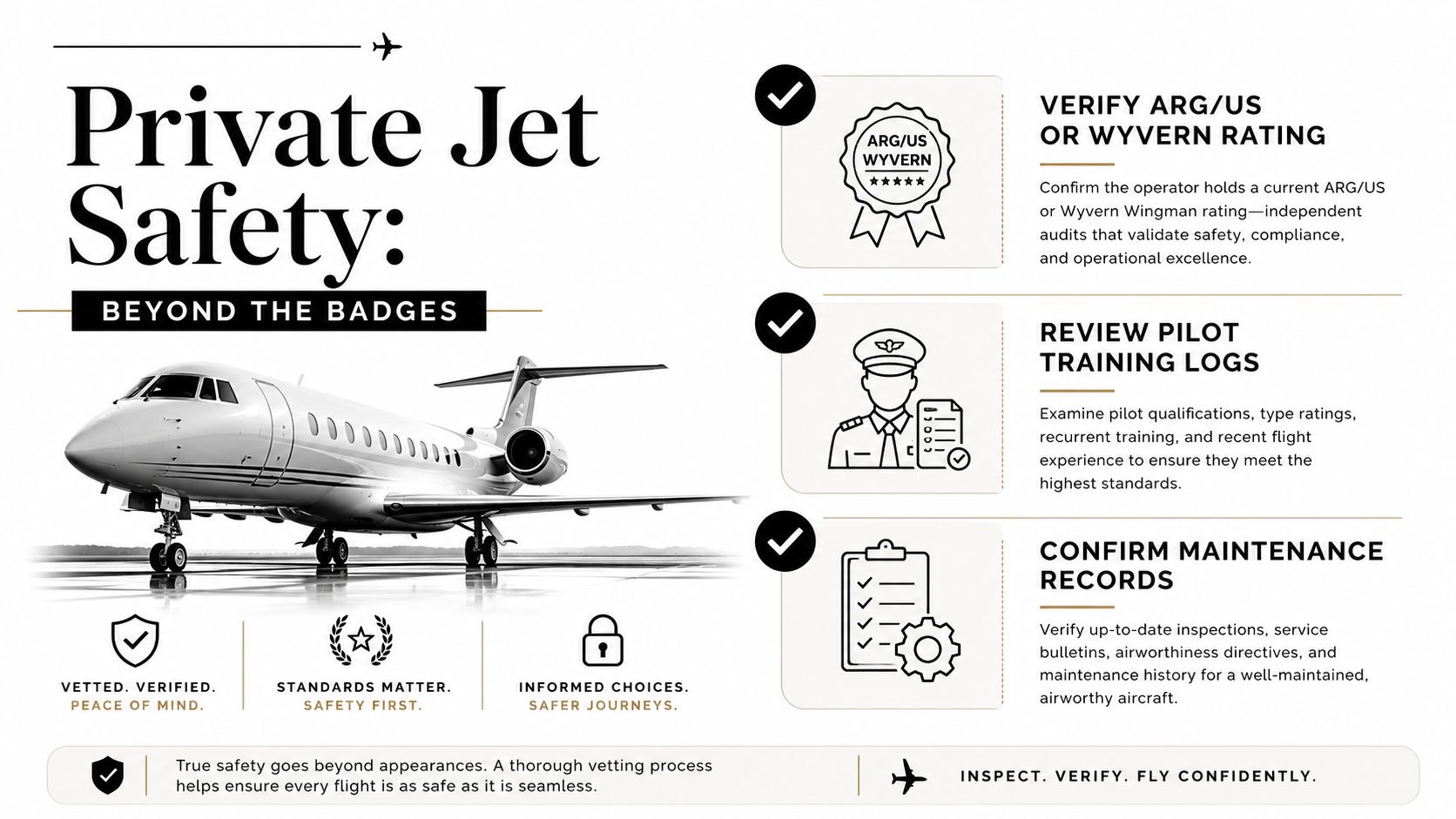
A safety badge is a screening tool, not permission to stop asking questions. ARGUS Gold, ARGUS Platinum, and Wyvern Wingman are audited standards with different requirements, so an operator should identify the exact program rather than use a general safety claim. ARGUS Gold includes an on-site audit. ARGUS Platinum adds more demanding requirements and is commonly linked with documented safety-management and emergency-response planning, according to SkyAccess' comparison of ARGUS and Wyvern standards.
Wyvern Wingman also includes an on-site evaluation of operations, crew qualifications, maintenance systems, and safety culture. Wingman Pro provides more ongoing oversight than the standard Wingman program. The rating reflects the operator's position at the latest evaluation. It is not a permanent guarantee for every aircraft or trip.
Treat certification as current due diligence
Industry summaries describe recertification cycles that commonly span roughly 12 to 24 months. Wyvern Wingman audits are commonly renewed every two years, while Wingman Pro adds continuous or quarterly oversight, according to the safety-rating explanation from True Skies. Ask for current confirmation before the trip, particularly when the booking was made well before departure.
Give the broker or operator this checklist:
- Verify the program: Ask whether the operator holds ARGUS Gold, ARGUS Platinum, Wyvern Wingman, or Wingman Pro.
- Confirm current status: Request current validity or verification instead of relying on an old PDF.
- Identify the operating carrier: Confirm that the certificate belongs to the company operating your flight.
- Ask about the aircraft: Check that the specific aircraft and tail number are covered by the operating arrangement.
- Review records when appropriate: Ask which pilot qualification, maintenance, and operational documents can be shared.
A rating cannot answer every question about a particular flight. It gives you a disciplined starting point only when the broker verifies the actual operating carrier, aircraft, and current status.
Watch the following overview before you approve an operator:
For a closer examination of both audit families, read Haute Jets' guide to Wyvern and ARGUS safety ratings. Ask who operates the aircraft, verify the current rating, and require documentation instead of accepting “safe” as a complete answer.
Matching Aircraft to Your Austin Trip
Passenger count is only the first filter. Route length, baggage, runway requirements, cabin layout, and the aircraft's actual location determine whether a category is suitable. A light jet can be ideal for a short business mission, while a larger aircraft may be the sensible choice when luggage, cabin time, or international range matters.

Match the cabin to the mission
A tech executive flying a Phenom 300 from Austin to Dallas for a same-day meeting may value speed, direct access, and a compact cabin over a larger galley or sleeping arrangement. The trade-off is limited space for bulky luggage and fewer amenities than a midsize or heavy jet.
A family traveling to Aspen for ski season may prefer a Challenger 350. The midsize cabin provides a more comfortable environment for a longer trip and offers a better platform for winter clothing and equipment, subject to the aircraft's actual baggage configuration. The operator should confirm payload, luggage capacity, and airport suitability before booking.
A corporate group flying to London may require a Gulfstream G550 or another long-range heavy jet. The relevant questions are range, passenger comfort, sleeping arrangements, connectivity, crew planning, and international handling. AUS's long runway infrastructure supports a broad range of private-jet missions, but the aircraft's performance and payload still need to be reviewed for the specific itinerary.
Don't book by category alone
Two aircraft with the same model name can have different interiors, connectivity, lavatory arrangements, seating layouts, and baggage access. Ask for the exact tail number whenever the operator can provide it, then confirm:
- Cabin layout: Review the actual seat configuration, not a generic model photograph.
- Connectivity: Confirm the available Wi-Fi system and whether service is expected along the route.
- Baggage: Discuss unusual, oversized, or sports equipment before contracting.
- Crew and service: Ask who operates the aircraft and what catering setup is available.
- Airport limitations: Confirm runway, payload, and performance assumptions at both ends.
A category is a useful search tool. It isn't a substitute for the specific aircraft you'll board.
Booking Logistics That Make or Break the Experience
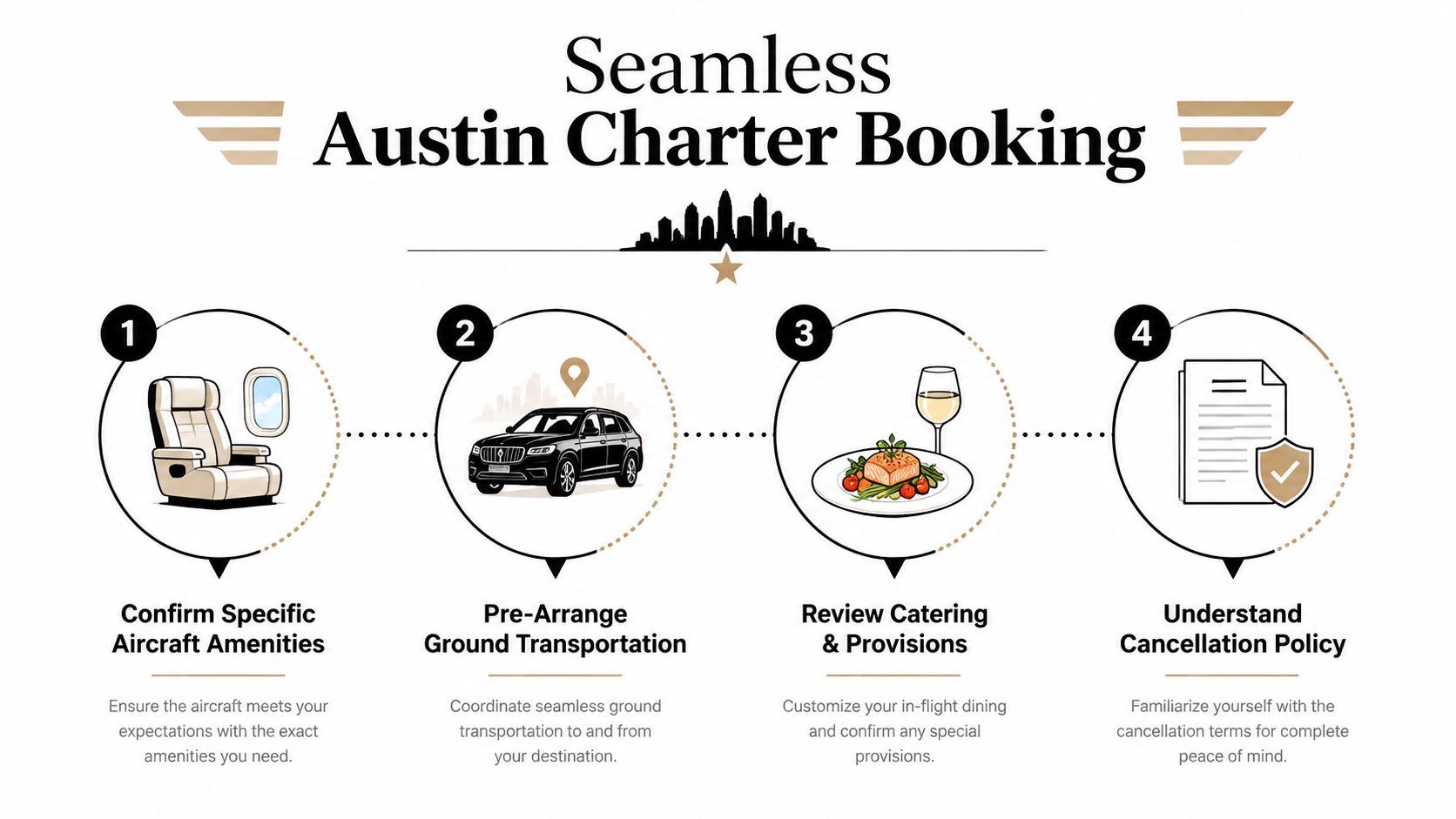
The smoothest Austin charter is usually won before the aircraft arrives. Give the provider complete passenger, baggage, pet, catering, and ground-transport information at the beginning. Last-minute details create avoidable substitutions, service limitations, and handling changes.
Pets need more than a verbal approval. Confirm whether the animal can remain in the cabin, what restraint or cleaning requirements apply, and whether the selected aircraft has enough floor and seating space. Catering also needs precision. State dietary restrictions, preferred brands, hot-meal requirements, and delivery timing rather than asking for “standard catering.”
Build the ground plan around the FBO
Your vehicle should be assigned to the correct facility, not merely sent to “AUS.” Confirm the FBO name, terminal entrance, driver contact, vehicle type, and passenger pickup procedure. If your party is using Austin Executive Airport, verify the Henriksen Jet Center arrangements separately from an AUS departure.
Empty legs can also reduce the cost of a trip when your timing matches an aircraft's required repositioning flight. They aren't guaranteed inventory. Ask for the confirmed routing, cancellation terms, aircraft identity, and whether the flight can accommodate your preferred departure window before treating an empty leg as a firm solution.
Handle international details early
AUS is a U.S. port of entry, but international arrivals require customs planning. CBP inspection availability is generally offered seven days per week within defined windows, according to the CBP KAUS fact sheet. Your operator should coordinate the arrival time, passenger documentation, aircraft paperwork, and FBO handling rather than leaving those steps to the traveler.
Before payment, confirm:
- Passenger manifest: Names and identification details are correct.
- Pets: Cabin access, documents, and cleaning arrangements are approved.
- Catering: Menu, allergies, delivery time, and beverage preferences are recorded.
- Ground transport: Vehicles are assigned to the precise FBO.
- Payment: Ask whether bank transfer, card, or digital-asset payment is available.
- Cancellation: Read the timing rules for changes, empty legs, and aircraft substitutions.
How Haute Jets Delivers Lower-Cost Austin Charters
Haute Jets addresses Austin charter costs by searching across 3,500+ owner-operators in 175 countries, according to its published network information. That reach helps the team find aircraft already positioned near Austin, avoiding quotes inflated by an incoming ferry leg and its repositioning charge. Local sourcing can remove the 20-40% repositioning markup often built into traditional broker quotes.
The model is on-demand and per flight. Clients do not pay annual membership fees, purchase prepaid hours, or accept blackout dates. Each trip is priced around its actual routing, availability, airport, and FBO requirements.
Exact aircraft selection changes the conversation
Request the specific year, make, model, and cabin layout, rather than accepting a broad “light jet” or “midsize jet” label. Confirm Wi-Fi, catering, pet policies, and ground transport before approving the aircraft. These details determine whether the jet suits the trip.
Haute Jets states that every operator in its network holds a Wyvern Wingman or ARGUS Gold or Platinum rating. Its stated pre-flight confirmation process provides the tail number, crew bios, weather briefing, and passenger manifest 24 hours before departure. Ask for those records in writing.
FBO selection also affects the ground experience. Confirm the departure and arrival FBO, vehicle access, parking arrangements, and passenger handling. A low hourly rate loses its value if the aircraft is positioned at an inconvenient airport or the ground plan is vague.
Weather, availability, airport restrictions, and itinerary changes can still alter the quote. Before payment, require an itemized total showing aircraft cost, positioning assumptions, airport and FBO charges, and cancellation terms.
Haute Jets offers on-demand Austin charter planning with local sourcing, exact-aircraft selection, and operator screening. Visit the Austin private jet charter page to request a quote that identifies the aircraft, airport, FBO, positioning assumptions, and final logistics before you commit.