

A Boston biotech executive has a Miami investor meeting in 36 hours. The assumption is simple: call a broker, choose a jet, and leave from the most convenient airport. Then the first quote arrives, followed by another that is $8,000 higher because the aircraft would depart from Logan rather than Hanscom, and a repositioning fee appears that wasn't included in the opening estimate.
That problem is common in private jet charter Boston searches. The aircraft category, departure airport, positioning plan, FBO charges, route length, and booking window can change the economics before anyone boards. Boston's private aviation market is especially operationally nuanced because Logan serves a dense commercial environment, while Hanscom Field is built around general aviation and business flying. Seasonal leisure demand also places pressure on routes toward Cape Cod, Martha's Vineyard, Nantucket, Florida, and the wider Northeast Corridor.
This guide takes a direct view. Choose the airport before comparing aircraft, demand an all-in quote rather than a headline hourly rate, and treat repositioning as a primary pricing variable, not a footnote.
Why Boston Private Jet Charter Demands Smart Planning
The executive in the opening scenario isn't really choosing between two aircraft. They're choosing between two operating plans. One aircraft may already be positioned near Hanscom Field, while another may need to arrive at Logan before the passenger itinerary begins. The broker's initial number can look attractive until ferry legs, FBO handling, crew requirements, and airport charges are added.
Boston's aviation geography makes this distinction meaningful. Hanscom Field in Bedford is described as the region's largest general aviation airport and the second-busiest airport in Massachusetts after Boston Logan. A private aviation study covering January 2022 through July 15, 2023 identified 31,599 private flights at Hanscom, with 15,781 departures, 15,735 arrivals, and 761 unique destinations in its analysis of Hanscom traffic. That activity reflects a market designed for business and private flying rather than scheduled airline operations.
The four decisions that shape the quote
- Airport selection: Logan may be preferable for international handling or downtown access, while Hanscom is usually the stronger domestic starting point.
- Aircraft sizing: A light jet can be efficient for a small group, but luggage, range, runway performance, and cabin requirements may justify a larger aircraft.
- Pricing transparency: A base hourly figure doesn't necessarily include positioning, fuel-related charges, landing costs, handling, crew expenses, or winter services.
- Booking timing: Last-minute availability can be excellent, but the aircraft nearest Boston may not be the aircraft with the ideal cabin or range.
Hanscom's traffic profile also shows why Boston charter demand isn't purely corporate. The same study estimated that 49% of flights were recreational or luxury travel, more than 42% departed on weekends, and 36% traveled to airports near luxury or vacation destinations in the covered period. Boston clients often want speed to leisure destinations, not just access to financial centers.
Practical rule: Don't approve an aircraft until the broker identifies its current base, proposed departure airport, and every ferry leg attached to your itinerary.
A good Boston charter quote should answer one question clearly: what will it cost to move your passengers from their door to the destination, including the aircraft's movement before and after the trip? If the answer only describes an hourly rate, you don't yet have a decision-ready proposal.
Choosing the Right Boston Departure Airport
Airport choice should follow the mission, not habit. Logan, Hanscom, and smaller regional airports serve different trip profiles, and the nearest airport isn't automatically the most efficient one.
Logan for international coordination and downtown access
Boston Logan International Airport has a mature private aviation environment. Signature Flight Support opened a $13 million FBO in 2008, described as a two-story, 13,000-square-foot private aviation center with passenger and crew lounges, offices, and separate street-side and ramp-side entrances in its opening coverage. Logan now has three primary FBOs on the airport's southwest side, with 24/7 operations, customs support, private lounges, conference rooms, and crew-rest areas according to Boston Logan FBO guidance.
Choose BOS when international customs coordination, downtown proximity, or a specific long-range aircraft matters more than minimizing ground complexity. Logan's commercial traffic environment can introduce delays, and FBO handling may be more expensive than at a general aviation airport.
Hanscom for most domestic private flights
Hanscom Field, or BED, is about 14 miles northwest of downtown Boston and is described as the largest general aviation airport in New England in Boston airport guidance. It has multiple full-service FBOs, no scheduled commercial traffic, and a workflow designed around general aviation. Those characteristics usually make it the preferred departure point for domestic charter clients as described by Boston charter operators.
Hanscom is the default recommendation for New York, Washington, Chicago, Miami, and many other domestic routes, provided the aircraft can meet runway and payload requirements. Operators such as Jet Aviation provide 24-hour service on call with prior notice, which supports early or late departures when arrangements are made in advance.
Regional airports for local convenience
Provincetown Municipal can make sense for Cape Cod access. Lawrence Municipal may suit North Shore passengers, while Norwood Memorial can be practical for South Shore travelers. These airports may reduce the ground journey, but the aircraft and route options can be narrower. Ask whether the selected jet can operate from the airport with the required payload, runway margin, and fuel plan.
| Airport | Best For | FBO Fee Premium | Customs Available | Ground-to-Tarmac Time | Runway Limitations |
|---|---|---|---|---|---|
| Logan, BOS | International departures, downtown access, long-range aircraft | Typically higher than regional alternatives | Available through airport facilities and FBO coordination | Depends on traffic and FBO operations | Commercial-airport operating constraints |
| Hanscom, BED | Most domestic charters and general aviation access | Often lower than Logan | Confirm for the specific itinerary | Usually streamlined because there is no scheduled commercial traffic | Confirm aircraft payload and runway requirements |
| Provincetown, PVC | Cape Cod access and seasonal leisure travel | Confirm in quote | Confirm for itinerary | Often convenient for local passengers | Aircraft and operational limits must be checked |
| Lawrence, LWM | North Shore convenience | Confirm in quote | Confirm for itinerary | Often convenient for local passengers | Aircraft and operational limits must be checked |
| Norwood, OWD | South Shore convenience | Confirm in quote | Confirm for itinerary | Often convenient for local passengers | Aircraft and operational limits must be checked |
The correct sequence is straightforward: select the airport, confirm the aircraft's current position, verify ramp access and handling, then compare the all-in price. A Boston-area aircraft isn't necessarily ready to depart from the airport you selected.
Selecting the Right Aircraft for Your Route
Aircraft selection should begin with passengers, luggage, range, and runway requirements, in that order. Buying an oversized cabin for a small group is wasteful, but choosing a small aircraft that forces a fuel stop or rejects the luggage plan is false economy.
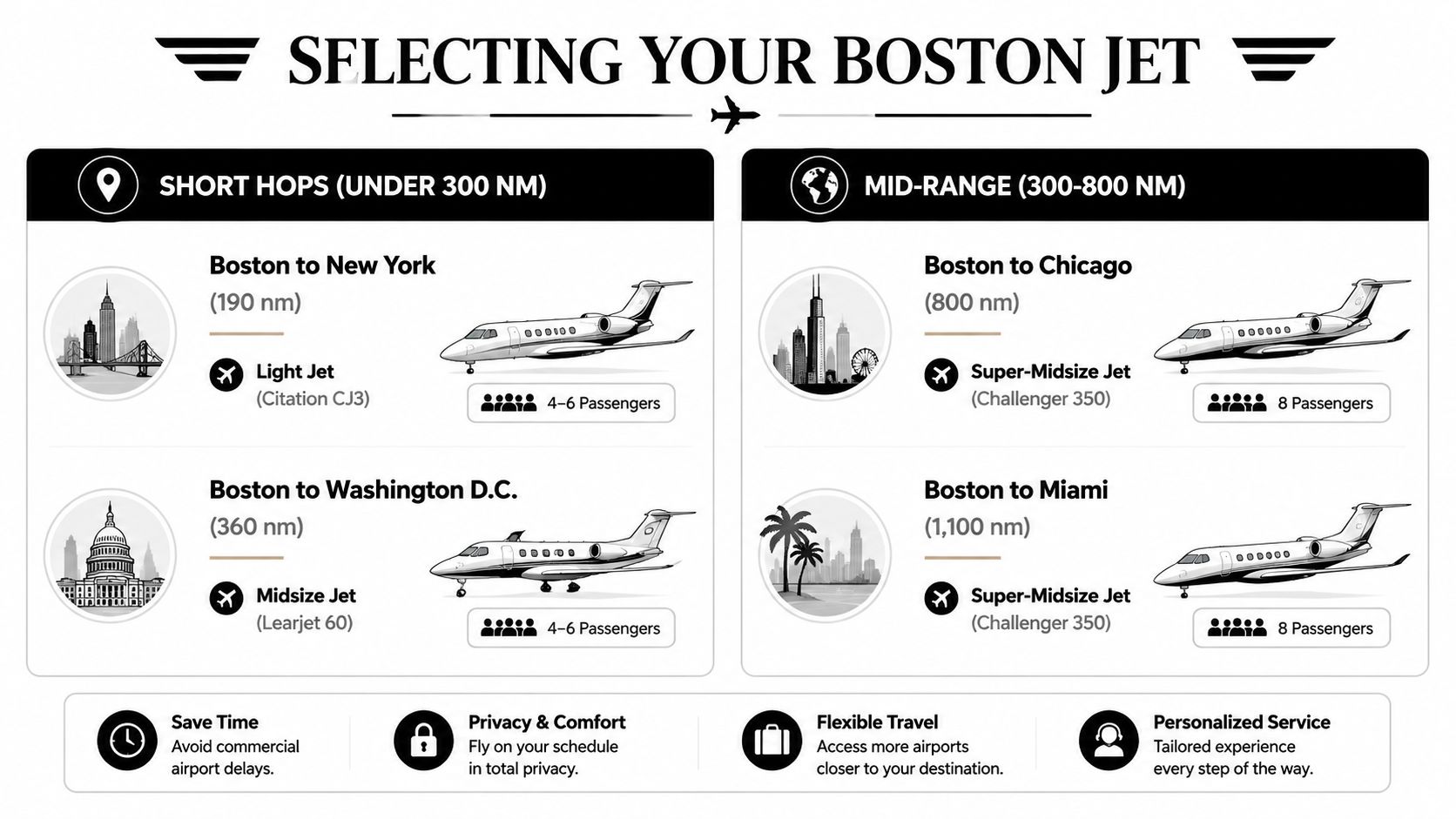
For short Northeast routes, a light jet is usually the right starting point. Boston to New York is roughly 190 nautical miles, while Boston to Washington is roughly 390 nautical miles, based on the route examples supplied for this guide. A Phenom 300 or Citation CJ3+ can suit smaller groups seeking a fast regional flight, but the broker still needs to confirm payload, baggage, and airport compatibility.
Match cabin size to the actual mission
- Short hops: Light jets are appropriate when the group is small and baggage is manageable. The Citation CJ3+ and Phenom 300 are familiar examples for Northeast business travel.
- Mid-range routes: Boston to Chicago, roughly 850 nautical miles, and Boston to Miami, roughly 1,250 nautical miles, call for a more careful range and comfort assessment. A Hawker 900XP or Citation Latitude can provide a larger cabin, an enclosed lavatory, and better suitability for longer domestic sectors.
- Long-range routes: Boston to London, roughly 3,450 nautical miles, requires a long-range plan, while Boston to Dubai demands substantially greater endurance and cabin support. Gulfstream G650 and Bombardier Global 7500 aircraft represent the heavy-jet end of the market, with the comfort and range expected for flights lasting many hours.
The quoted aircraft category can conceal meaningful differences. A midsize jet with a stand-up cabin may be more suitable than a light jet for a team carrying presentation materials, garment bags, or equipment. Conversely, a heavy jet is unnecessary for a small group making a short regional hop unless privacy, cabin configuration, or a specific schedule justifies it.
Use the short-haul aircraft selection guide when comparing cabin layouts rather than relying on passenger capacity alone.
Cabin capacity is a ceiling, not a recommendation. The right aircraft gives your group enough space and range without charging you to carry unused seats.
Ask for the exact make, model, year, cabin layout, baggage capacity, Wi-Fi availability, and lavatory configuration. Those details matter more than the marketing label “light,” “midsize,” or “heavy.”
Understanding Real Charter Pricing and Hidden Fees
A private jet quote has at least two layers. The first is the aircraft's operating price for the passenger leg. The second is everything required to position, handle, fuel, crew, and release that aircraft for your itinerary.
Boston-specific pricing guides show broad dispersion, from about $2,000 per hour for turboprops to more than $20,000 per hour for VIP airliners in a 2026 pricing overview. Those figures are useful only as category context. They don't tell you what your aircraft will cost from a selected Boston airport.
What the invoice should expose
Repositioning is the largest overlooked variable. Independent industry guidance indicates that repositioning fees can add about 30% to 100% to a charter invoice, while route-specific empty-leg guidance places some discounts at roughly 25% to 75% below standard charter pricing in its explanation of deadhead economics. The result depends on aircraft location, itinerary direction, timing, and whether an existing empty leg matches your route.
Other charges can include:
- Aircraft positioning: Ferry flights needed to bring the jet to Boston or return it after the trip.
- Fuel and airport charges: Fuel surcharges, landing costs, ramp handling, and FBO services.
- Crew expenses: Overnight requirements, duty-time considerations, and schedule changes.
- Seasonal operations: De-icing, hangar coordination, and winter handling in New England.
- International processing: Customs, permits, and related arrival or departure coordination.
Request the aircraft base airport, inbound ferry leg, outbound ferry leg, FBO charges, crew assumptions, and fuel treatment in writing. The private jet charter cost guide is useful for framing the distinction between a headline rate and an all-in itinerary.
| Route | Aircraft Category | Base Hourly Rate | Estimated Total One-Way | Common Hidden Fees |
|---|---|---|---|---|
| Boston to New York | Light jet | About $3,500 to $5,000 per hour | About $4,500 to $7,000 | Positioning, FBO handling, fuel-related charges, taxes, crew requirements |
| Boston to Miami | Midsize jet | About $5,500 to $8,000 per hour | About $12,000 to $18,000 | Positioning, handling, fuel-related charges, crew expenses, itinerary timing |
| Boston to London | Heavy jet | About $12,000 to $18,000 per hour | About $65,000 to $95,000 | International handling, permits, positioning, crew, airport charges |
The ranges above are planning figures, not promises. The aircraft's location can matter more than the nominal hourly rate. A lower-rate jet based far from Boston may create a higher invoice than a more expensive aircraft already positioned at Hanscom.
One-way versus round-trip economics
One-way bookings often create a return-positioning problem. If the aircraft has no onward mission from your destination, the operator may price the empty return into the charter. A round-trip itinerary can reduce that inefficiency when the aircraft and crew can remain in place, but the quote must show how waiting time, crew duty, and aircraft availability are calculated.
Jet card programs can offer more predictable pricing for travelers who value rate consistency and guaranteed access. On-demand charter is usually more flexible, but the final price varies with aircraft position, demand, airport choice, and itinerary complexity. Compare the payment model against your actual travel pattern, not against an advertised hourly number.
How to Book Your Boston Private Jet Charter
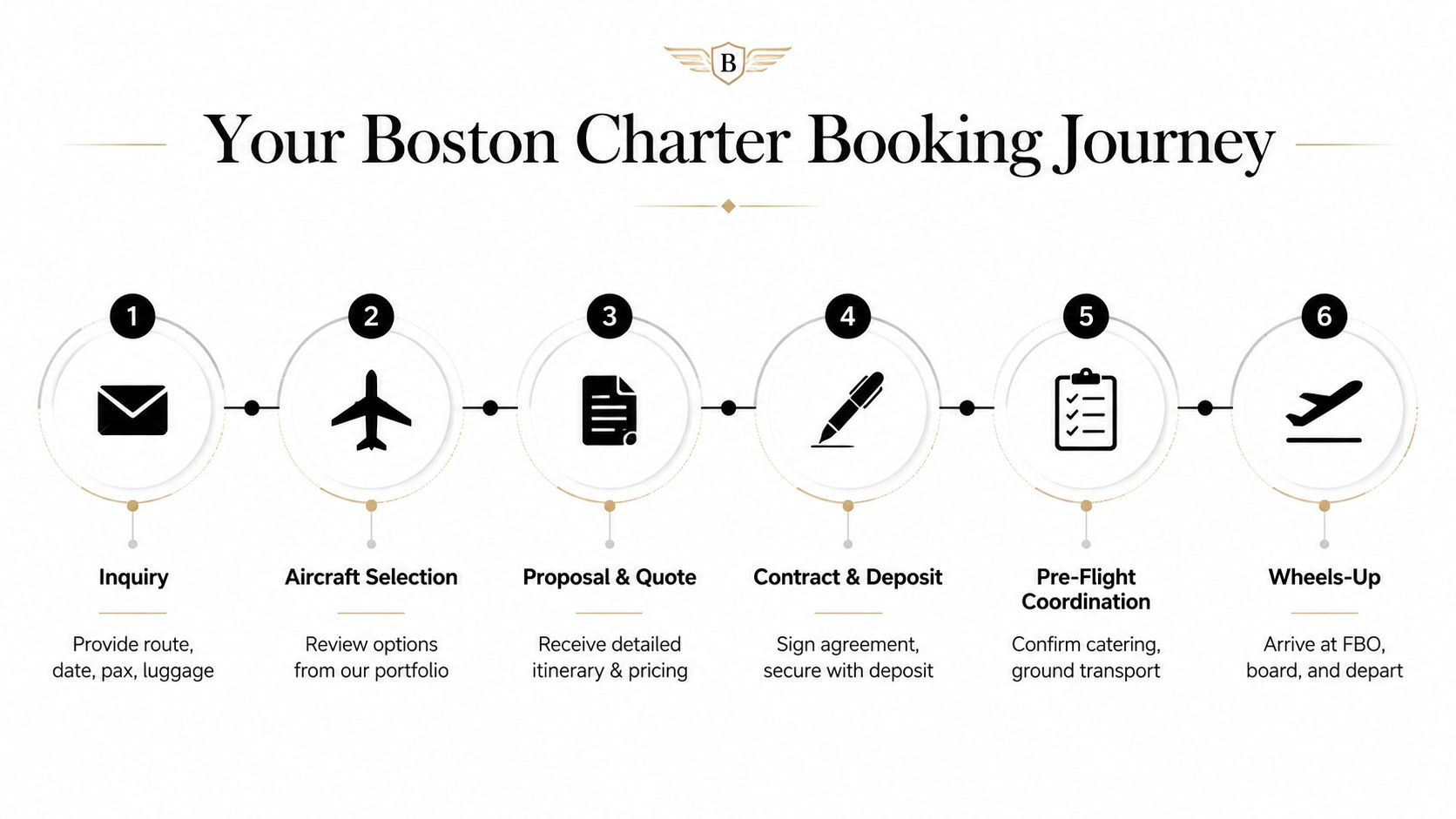
A disciplined booking process prevents most avoidable surprises. Start with a complete request rather than asking for “a jet to Miami.” Give the broker your passenger count, luggage volume, preferred departure airport, destination, date, preferred departure window, return details, pets or special equipment, and any cabin requirements.
Build the request correctly
The broker should understand whether Hanscom, Logan, or a regional airport works for you. If you're flexible, say so. Airport flexibility can reveal an aircraft that is already nearby and eliminate unnecessary ferry costs.
Preliminary responses from reputable operators may arrive quickly, but the quality of the quote matters more than speed. Ask for:
- The exact aircraft make, model, year, and tail number when available.
- The operating carrier and applicable safety credentials.
- The aircraft's current base and all positioning legs.
- A complete fare showing included and excluded charges.
- Cancellation, substitution, delay, and refund terms.
Move from quote to departure
Once you've selected the aircraft, read the contract before sending funds. Confirm the deposit schedule, final payment deadline, cancellation provisions, aircraft substitution language, and responsibility for weather or airport closures. Don't assume “all-inclusive” means every concierge request is included.
Before departure, the operator or broker should collect the passenger manifest and required Secure Flight information, arrange catering, coordinate ground transportation to the FBO, and monitor the weather. Ask who owns each task and who will contact you if the aircraft, airport, or schedule changes.
Same-day charter from Hanscom or Logan is possible, but availability narrows and pricing pressure rises. If the trip is time-sensitive, prioritize a suitable aircraft already near Boston over a particular model that requires a long ferry leg. The aircraft's position is often the most important fact in the proposal.
Safety, Empty Legs, and Payment Options
Safety screening, empty-leg economics, and payment terms belong in the same conversation because a cheaper operational plan is worthless if the carrier, schedule, or contract isn't acceptable.
Start with the operator, not the aircraft's interior. Require an ARGUS Gold or Platinum or Wyvern Wingman safety rating, verify the carrier's Part 135 operating authority, and ask about pilot experience and aircraft-specific qualifications. A broker should be able to identify the operating entity and provide documentation or a verification path. Don't accept a logo on a presentation as independent verification.
Use empty legs selectively
Empty legs can work well for flexible leisure travelers and executives with movable schedules. Boston's seasonal flow can create useful repositioning opportunities toward Florida in winter and Europe in summer, but the aircraft's primary mission controls the schedule. The empty leg may depart at an inconvenient time, change with little notice, or disappear if the original charter changes.
The empty-leg flight guide explains the trade-off clearly. Treat an empty leg as a discounted opportunity, not as a guaranteed substitute for an on-demand charter.
Savings require flexibility. If your meeting, connection, or event can't move, pay for schedule control instead of forcing the trip into an empty-leg window.
Payment options vary by operator. Wire transfer remains common for high-value charters, while some providers accept corporate credit arrangements or digital assets such as Bitcoin and Ethereum. Frequent flyers may also evaluate jet cards or fractional ownership, but those models introduce commitments and contractual rules that don't apply to a single on-demand flight.
- Corporate flight departments: Prioritize auditability, operator credentials, repeatable invoicing, and a reliable service contact.
- High-net-worth individuals: Prioritize discretion, aircraft specificity, passenger privacy, and a clear substitution policy.
- Occasional leisure travelers: Compare on-demand quotes and consider an empty leg only when the schedule is genuinely flexible.
Haute Jets is one on-demand option that connects clients with owner-operators across its network, provides aircraft-level selection, and states that its network uses Wyvern Wingman or ARGUS Gold or Platinum-rated operators. Evaluate it against other providers by reviewing the actual aircraft, carrier, fees, and contract for your specific trip.
Making Your Final Charter Decision
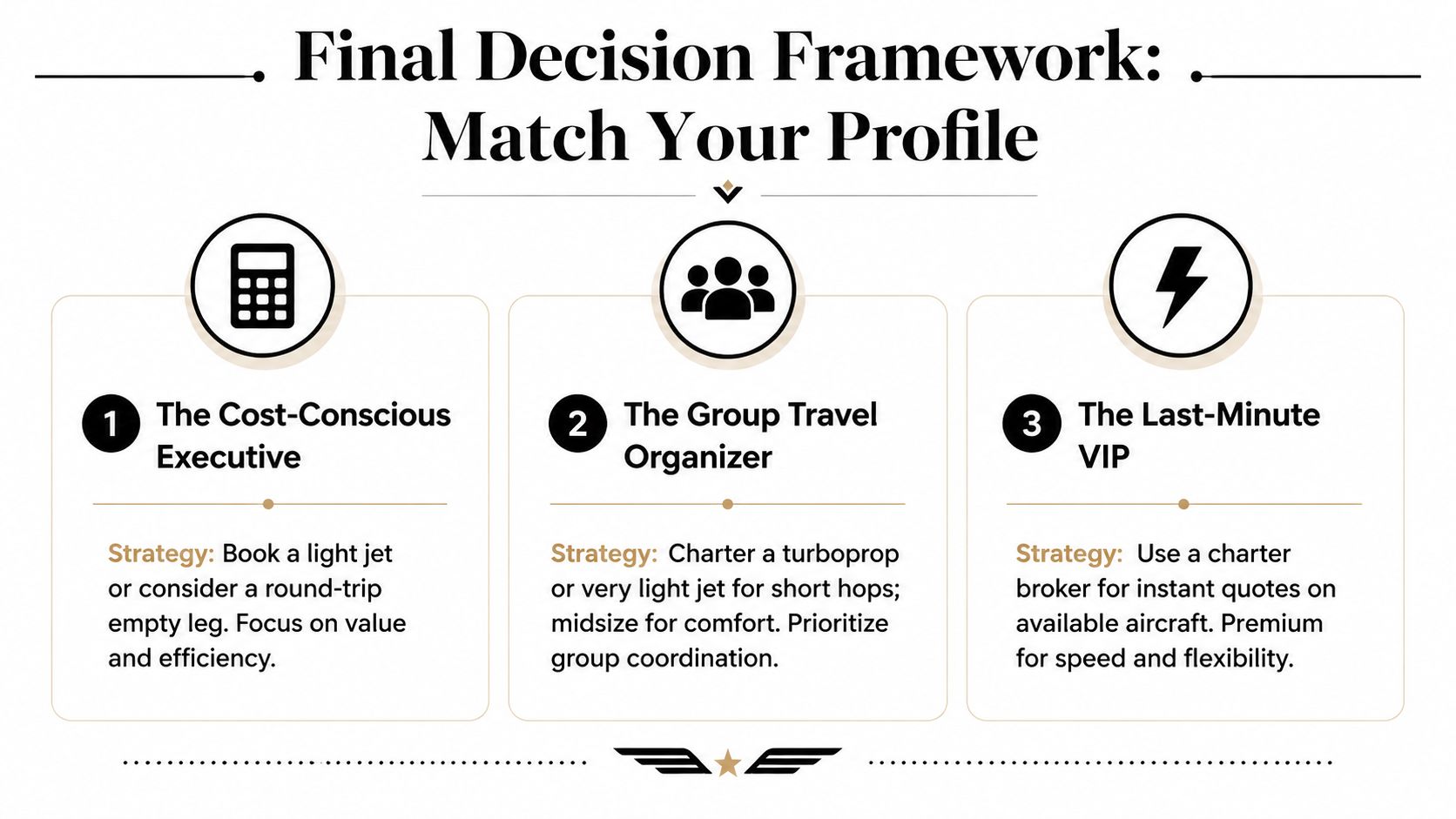
The right Boston charter strategy depends on what you're protecting.
The cost-conscious executive should start with Hanscom, accept aircraft flexibility, and investigate a round-trip or matching empty-leg opportunity. The time-sensitive corporate team may prefer Logan for proximity or a jet card structure for predictable access, provided the agreement delivers the availability and airport handling promised. The ultra-high-net-worth traveler flying transatlantic should focus on heavy-jet range, cabin configuration, customs coordination, and crew planning rather than chasing the lowest hourly rate.
Before signing, verify these five points:
- Operator safety rating and operating authority
- Repositioning fee transparency
- Aircraft age, model, and cabin configuration
- Cancellation and substitution terms
- FBO handling quality and airport suitability
Quote-shopping across multiple platforms can create inconsistent aircraft descriptions, duplicate inventory, and proposals that aren't truly comparable. A strong relationship with one accountable broker is usually more valuable than collecting disconnected headline rates.
Tell your broker your most frequent routes, passenger counts, luggage needs, preferred airports, and tolerance for schedule flexibility. That information produces a useful Boston charter strategy, not just another generic quote.
Haute Jets can help compare Boston Logan and Hanscom departures, identify aircraft already positioned near your route, and present the aircraft details and operating terms before you commit. Visit Haute Jets to request a personalized consultation built around your routes, passenger count, and preferred travel schedule.