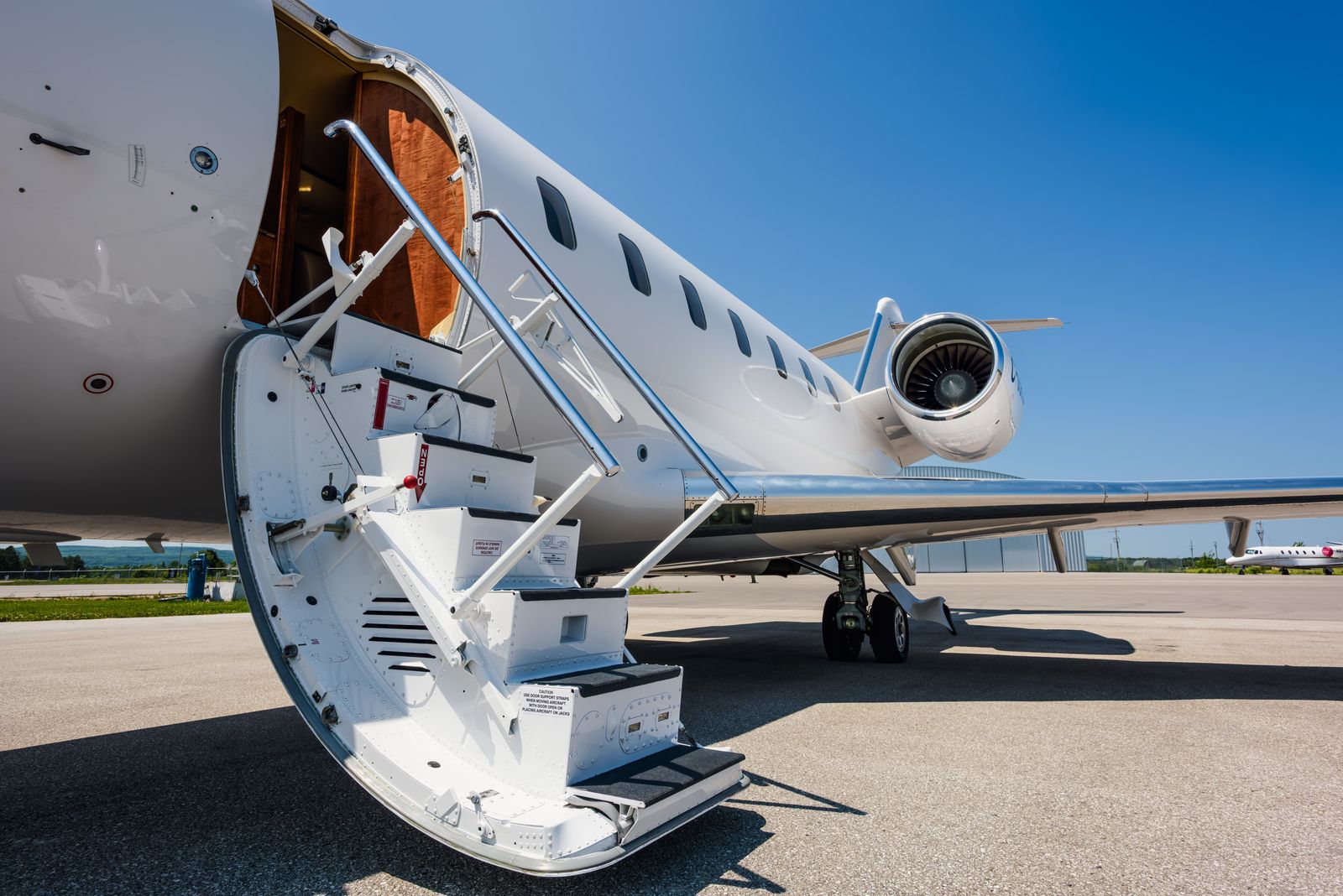
The main cost driver, however, is often the repositioning flight, the empty leg an aircraft makes before it ever picks you up.
That distinction changes how you should read a quote. A low hourly rate can still produce an expensive itinerary if the aircraft must fly in from another city, wait for your departure, or reposition again after drop-off. Chicago has enormous aviation reach, but that scale can make private charter pricing harder to interpret unless you ask where the aircraft is based and which flight hours you're paying for.
Why Chicago Is a Private Aviation Powerhouse
Chicago's private aviation strength starts with O'Hare. The airport has a dedicated Fixed Base Operator, Signature Flight Support, serving corporate and private aircraft with fueling, aircraft service, and passenger lounge facilities. The Chicago Department of Aviation also publishes monthly air-traffic data for O'Hare and Midway going back to 2000, giving the city an unusually developed view of its aviation activity through the official Chicago airport traffic data.
In 2024, O'Hare was described as the world's fourth busiest airport and the U.S. airport with the most connections. That connectivity attracts executives, sports organizations, production teams, and luxury travelers who value direct scheduling over commercial timetables. It also creates friction. Commercial traffic dominates the most visible airport infrastructure, while business aviation often works more efficiently through dedicated facilities away from the main passenger terminals.
Scale helps routes, but not always pricing
Chicago Executive, DuPage, and Gary/Chicago give charter operators alternatives to the commercial-airport environment. Chicago Executive, or PWK, is particularly important because it has three private jet terminals and multiple FBOs, including Atlantic Aviation and Signature Aviation, according to Chicago Executive Airport FBO information. Those facilities support quicker passenger handling and reduce the terminal congestion associated with large commercial airports.
The hidden issue is aircraft location. A Citation X based in Cincinnati or a Phenom in Detroit may look attractive on an hourly quote, but the operator still has to fly that aircraft to Chicago before your departure. That ferry movement can appear as repositioning, deadhead, or positioning time. If the quote doesn't show it clearly, you may mistake the aircraft's flight rate for the total trip cost.
Practical rule: Ask for the aircraft's current location, the pickup airport, and every positioning segment before comparing hourly rates.
Chicago is therefore both a route advantage and a pricing trap. The city offers excellent access to New York, Florida, the West Coast, and international destinations, but demand doesn't guarantee that the right aircraft is already sitting at your chosen airport. A credible advisor should make that operational detail visible instead of burying it in an all-in total.
Chicago's Private Jet Airports at a Glance
Choosing the airport is the first practical decision in a Chicago charter. The right field depends on passenger location, aircraft size, destination, customs needs, and how much ground time you can tolerate. O'Hare offers the broadest connectivity, while PWK, DPA, and other business-aviation airports can make the actual departure much faster.
| Airport | Code | FBO Options | Best For | Drive to The Loop |
|---|---|---|---|---|
| O'Hare International | ORD | Signature Flight Support | International departures, corporate travel, and missions requiring O'Hare access | Traffic-dependent |
| Chicago Midway | MDW | Signature Aviation | Larger aircraft and convenient city access | Traffic-dependent |
| Chicago Executive | PWK | Atlantic Aviation, Signature Aviation, multiple private terminals | Light and midsize charters, North Shore executives, fast passenger turns | Traffic-dependent |
| DuPage | DPA | Multiple business-aviation handling options | Western suburbs, Aurora, and west-side corporate travel | Traffic-dependent |
| Gary/Chicago | GYY | Business-aviation handling options | Overflow capacity and some Indiana-side itineraries | Traffic-dependent |
| Waukegan | UGN | Local business-aviation facilities | North suburban departures and shorter regional missions | Traffic-dependent |
| Rockford | RFD | Regional and business-aviation handling options | Larger operational flexibility and selected long-range missions | Traffic-dependent |
My default airport recommendations
PWK is the default for many light and midsize charters. Its FBO network, private terminals, and North Shore position make it a sensible choice for passengers coming from the northern suburbs or downtown corporate corridors. It also works well when the priority is a clean handoff from vehicle to aircraft.
MDW fits heavier aircraft and city-oriented itineraries, but commercial scheduling can limit flexibility. It can be convenient for passengers near the South Side and central Chicago, especially when the aircraft and slot situation support it.
GYY can serve as an overflow option when PWK availability tightens, while UGN and RFD deserve consideration for north-suburban or operationally specific missions.
For O'Hare-specific planning, review the Chicago O'Hare private terminal information before assuming ORD is automatically the most convenient departure point. The airport that looks closest on a map isn't always the airport that produces the cleanest aircraft match.
Aircraft Options and Realistic Capacities
Aircraft selection should follow the mission, not the passenger count alone. Chicago weather, winter clothing, bulky luggage, ski equipment, golf bags, and presentation materials can make a cabin feel cramped long before every seat is occupied.
Match the aircraft to the trip
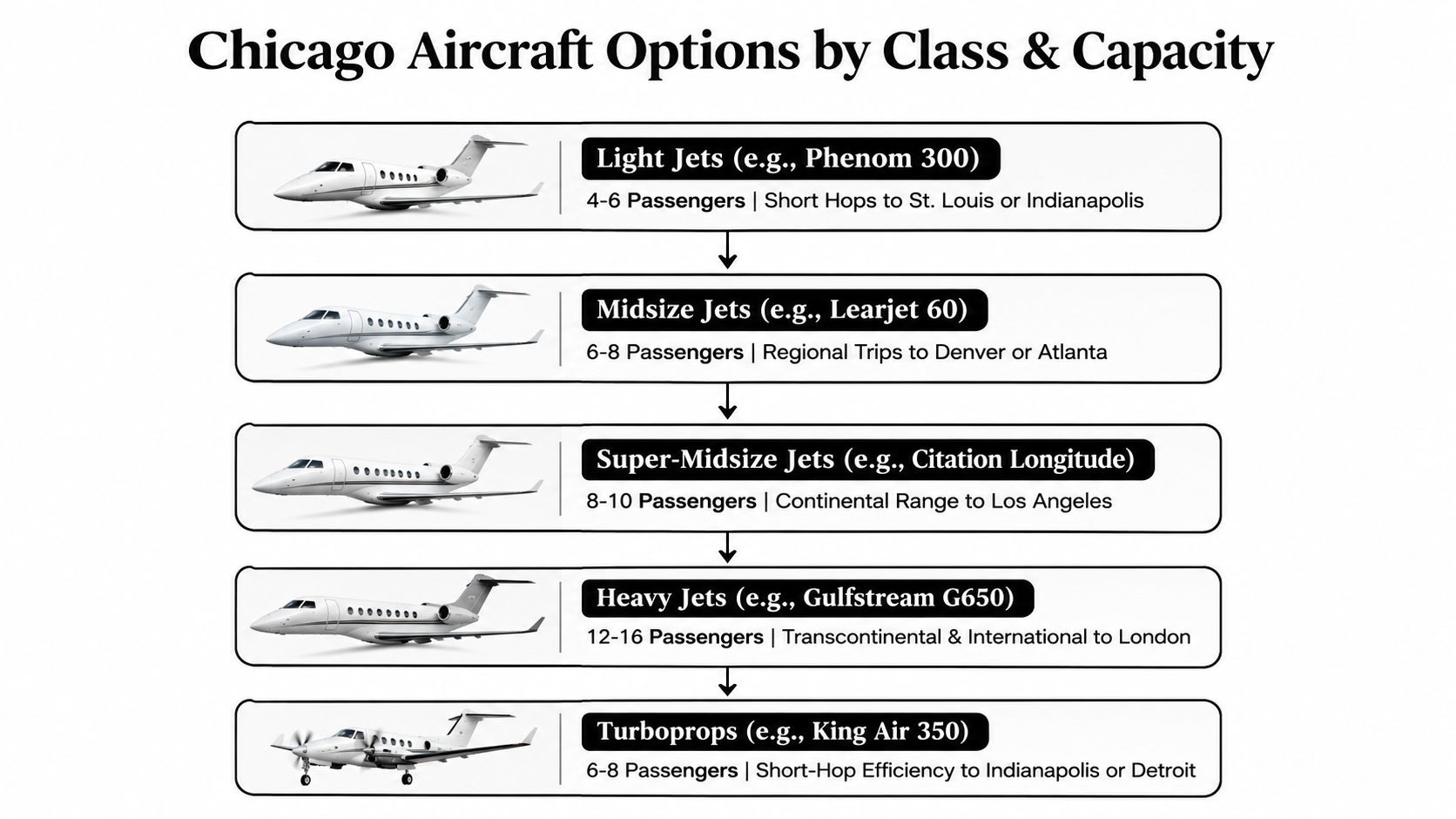
Turboprops, including the King Air 350, are efficient for short regional hops such as Indianapolis, Milwaukee, or Detroit. A practical passenger load is often six to eight people, but baggage volume matters. Turboprops are the value choice when runway access, regional range, and operating economy matter more than jet speed.
Light jets, such as the Phenom 300 and Citation CJ3+, generally suit six to seven passengers on regional missions. They work well for New York, Atlanta, and Nashville, although some itineraries may require a fuel stop. Their smaller baggage compartments can become restrictive for winter coats, equipment cases, or several days of luggage.
Midsize jets, including the Citation Latitude and Hawker 900XP, are the most versatile business category for many Chicago departures. They can carry around eight passengers comfortably and are better suited to coast-to-coast travel, sometimes with a fuel stop. Their cabins and baggage areas provide a more forgiving balance between comfort and cost.
Super-midsize jets, such as the Challenger 350 and Praetor 600, make sense for nine or ten passengers, transcontinental routes, and travelers who don't want to compromise cabin space. They offer a stronger combination of range, stand-up comfort, and luggage capacity than most light aircraft.
Long-range jets, including the Global 6000 and Gulfstream G650, serve groups of roughly twelve to fourteen passengers on nonstop international or transcontinental missions such as London or Los Angeles. They're expensive to operate, but the cabin, range, crew facilities, and baggage capability can justify the category when a fuel stop would undermine the itinerary.
Before requesting a quote, give the advisor the complete passenger profile, not just the headcount. Tell them about hard-sided cases, sports equipment, garment bags, pets, and winter luggage. Then compare actual cabin layouts and baggage diagrams through the Haute Jets fleet overview, rather than choosing a category from a generic seating label.
What Chicago Charter Pricing Really Covers
Aircraft choice is the biggest pricing lever, but aircraft location determines whether the quoted rate remains meaningful. Those are aircraft-class ranges, not guaranteed trip totals.
An all-in quote usually reflects flight time, fuel, landing and handling fees, crew costs, federal excise tax, segment tax, and any positioning. Chicago winter operations may also require additional coordination for de-icing, hangar arrangements, or schedule protection. The important question isn't whether a broker shows one attractive hourly number. It's whether the quote reveals every operational assumption.
Repositioning changes the comparison
A jet can be physically close to Chicago but still be unavailable for your exact departure window. A broker may source an aircraft from a broad marketplace, then add the cost of bringing it to PWK, MDW, DPA, or ORD.
A broker with access to 3,500+ vetted aircraft from Wyvern- and ARGUS-rated FAA Part 135 operators can reduce that exposure by looking for aircraft already near the departure city. The rationale is simple. If the operator already lives at or near your departure airport, you aren't paying for a needless deadhead leg. That doesn't eliminate every positioning charge, but it gives the advisor a much better chance of matching aircraft location to itinerary.
| Cost Component | Standard Broker Quote | Wyvern/ARGUS-Only Operator (Haute Jets) |
|---|---|---|
| Aircraft selection | May prioritize broad availability | Searches directly across rated owner-operators |
| Positioning | Can include inbound or outbound deadhead | Seeks aircraft already near Chicago |
| Flight time | May be blended into a total | Should be shown with the operating itinerary |
| Taxes and fees | Confirm whether FET and segment tax are included | Request an itemized all-in total |
| Winter charges | De-icing and handling may be excluded | Require written treatment of weather-related charges |
| Aircraft identity | May remain general during early quoting | Request the named aircraft and tail number before signing |
Ask this before paying: “Which hours are passenger flight hours, which are positioning hours, and are FET, de-icing, and after-hours handling included?”
Don't accept a quote that hides those answers. A low base rate is meaningless if the aircraft has to cross several cities before pickup.
How to Book a Private Jet from Chicago
Start with the itinerary, not the aircraft photograph. Send departure airport preferences, destination, dates, desired departure time, passenger count, luggage details, pets, catering needs, and ground-transfer requirements. For the widest selection and stronger pricing, Haute Jets states that booking 48 to 72 hours in advance is preferable, while requests can be handled with as little as 4 to 6 hours' notice when availability allows, according to its Chicago to New York charter guidance.
The booking sequence
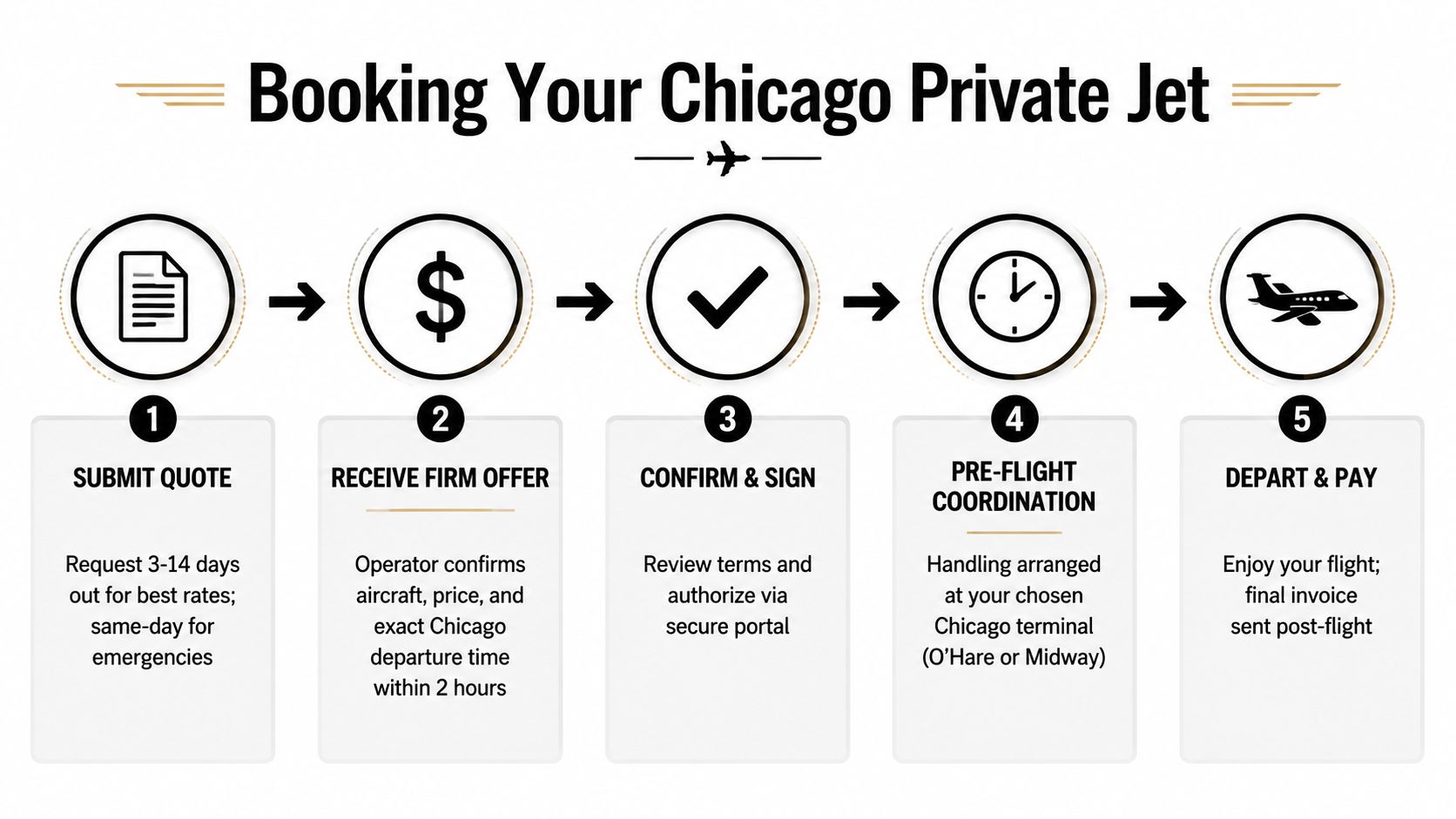
Request quotes early. A request made several days ahead gives the operator time to find an aircraft already positioned near Chicago. Same-day requests are possible, but flexibility may be needed on airport, aircraft, or departure window.
Demand a firm aircraft offer. The offer should identify the aircraft type, operator, tail number when available, departure FBO, total price, included services, and cancellation terms. Don't compare anonymous “light jet” offers.
Review and authorize. Confirm the passenger manifest, contract, payment schedule, and cancellation language. ACH, wire, and other accepted payment methods should be established before the itinerary becomes time-sensitive.
Lock the terminal details. Your confirmation should identify whether you're departing from ORD, MDW, PWK, or DPA, along with the FBO address, arrival instructions, and crew or operations contact.
Use the pre-flight call properly. The final coordination call should confirm catering, ground transport, passenger changes, weather, and special requests. Treat it as an operational checkpoint, not a courtesy phone call.
Traffic patterns and aircraft availability can vary by day, so I won't promise that Tuesdays or Wednesdays always produce lower costs. Ask the advisor to compare departure days and positioning options instead of assuming a fixed weekly rule.
Empty Leg Flights from Chicago Explained
Empty legs are one-way repositioning flights operated without the original charter client. Chicago generates these opportunities because aircraft move regularly through business-aviation airports such as PWK and DPA. The lower price reflects an aircraft movement the operator already needs to make, not a lower safety category.
The discount has a price
An empty leg suits travelers who can adjust their schedule. It is a poor fit when you need a precise departure time, a particular cabin, or a guaranteed return aircraft. The original mission determines the route, aircraft, and departure window. Mechanical or scheduling problems can also leave fewer replacement options than a standard charter.
| Route | Standard Charter (Light Jet) | Typical Empty Leg Price | Flexibility Window |
|---|---|---|---|
| Chicago to New York area | Standard market quote | Fixed around the aircraft's existing movement | |
| Chicago to Teterboro | Standard market quote | Discount depends on live positioning inventory | Limited departure flexibility |
| Chicago to Los Angeles | Standard market quote | Discount depends on route and aircraft availability | Narrower timing for long repositioning patterns |
| Chicago to Aspen | Standard market quote | Seasonal inventory may appear | Date and time can be highly constrained |
| Chicago to Van Nuys | Standard market quote | Variable discount based on aircraft movement | Aircraft-specific |
| Chicago to Palm Beach | Standard market quote | Inventory may align with winter travel patterns | Limited schedule control |
Ask four questions before accepting the offer: Which aircraft is repositioning? What departure window is fixed? Which airport and route are attached to the movement? What happens if that aircraft becomes unavailable? Review what an empty leg flight means before treating a dramatic discount as an automatic bargain.
Never pay standard-charter pricing for an offer marketed as an empty leg. Require the original positioning logic, the cancellation terms, and the fallback plan in writing. The discount is worthwhile only when the schedule and operational conditions fit your trip.
Ground Logistics, Catering, and Pre-Flight Confirmation
A private flight doesn't begin when the aircraft door closes. It begins when the vehicle arrives at the correct FBO, the passengers walk directly to the aircraft, and every service provider has the same departure information. Treat the FBO, ground transfer, and catering as one logistics layer.
At ORD, Signature Flight Support can support corporate and private aircraft activity, including services for international-oriented itineraries. At MDW, Signature Aviation is a practical option for city access and larger-aircraft handling. PWK offers multiple private terminals, including Atlantic Aviation and Signature Aviation, with a more focused business-aviation environment.
Build the handoff around engines-on
Tell the coordinator where each passenger starts, what vehicle is required, and whether anyone needs assistance. A chauffeured sedan may suit an executive traveling alone, while an SUV or Sprinter may be more appropriate for a group with winter luggage or equipment. The driver should be timed to the aircraft's readiness, not just assigned a generic pickup time.
Catering deserves the same discipline. Standard orders can often be arranged with short notice, while bespoke menus, kosher or halal service, allergy controls, and specialty requests need earlier coordination. Specify whether food is for a short regional leg, a full business itinerary, or a group that expects a complete meal service.
The useful standard: One coordinator should own the FBO, vehicle, catering, passenger manifest, and crew communication rather than leaving you to reconcile separate vendors.
At the 24-hour confirmation point, verify:
- Manifest: Passenger names and identification details are final.
- Aircraft: Tail number, cabin configuration, and baggage capacity are confirmed.
- Balance: Weight and balance information reflects the actual passenger and luggage list.
- Catering: The final menu, delivery location, and dietary requirements are recorded.
- Ground transport: Vehicle, driver contact, pickup timing, and FBO address match the flight plan.
- Operations: Weather, crew rest, maintenance status, and possible airport restrictions have been reviewed.
That coordinated handoff is what separates a smooth Chicago departure from a chain of last-minute phone calls.
Practical Answers for Chicago Charter Clients
Can I bring a pet?
Usually, pets can travel in the cabin, but the aircraft operator controls the policy. Provide the animal's size, breed, carrier details, and destination requirements when requesting the quote. The operator may require documentation, additional cleaning, or a cleaning deposit, especially if the pet will move freely in the cabin.
PWK and DPA can be convenient for pet travel because the passenger process is handled through private aviation facilities rather than a large commercial terminal. International trips require a separate review of destination entry rules and customs procedures. Don't wait until the travel day to disclose an animal.
How do TSA and customs work?
Private aviation doesn't mean passengers can ignore security or border requirements. Domestic passengers still follow the procedures established by the operating FBO and crew, while international arrivals and departures require customs coordination.
ORD is the principal Chicago option for many international private-aircraft procedures, and the relevant CBP arrangements should be confirmed with the operator before signing. Ask whether the itinerary can use a Private Aircraft Clearance Program option, what passenger information is required, and how far in advance the manifest must be submitted. The answer depends on the route, aircraft, operator, and FBO.
Can I pay by ACH, wire, or cryptocurrency?
Payment methods vary by charter provider and operating company. ACH and wire transfers are common options for larger charter invoices, while cryptocurrency may be available through selected providers. Confirm the accepted currency, payment deadline, identity checks, refund process, and exchange-rate treatment before authorizing the flight.
Don't send funds to an account supplied through an unverified email change. Verify payment instructions through a known contact at the charter company.
What happens if I cancel or reschedule?
The contract controls the result. Cancellation exposure can change according to how close the cancellation is to departure, whether the operator has committed the aircraft, and whether the flight requires special services or international arrangements. Read the cancellation schedule, weather provisions, rescheduling rules, and refund language before payment.
What if the aircraft has a mechanical issue?
The operator should provide a replacement aircraft or an alternative plan when one is available, but the replacement may differ in model, cabin layout, baggage capacity, or departure airport. Ask how the provider handles a downgrade, upgrade, delay, or cancellation and whether you can reject a materially different aircraft.
Weather diversions follow the same operational principle. The crew makes the safety decision, while the trip coordinator manages ground transport, passenger communication, catering changes, and onward arrangements. Chicago winter conditions make this coordination especially important, but no advisor can guarantee that weather will not alter the itinerary.
The advisor's synthesis
The smartest Chicago charter clients match the airport to the mission, then match the aircraft to the passengers and baggage. They treat repositioning as the primary price driver, compare itemized all-in quotes, use empty legs only when the schedule allows, and insist on a clear safety and operator profile.
The 24-hour confirmation isn't administrative paperwork. It's the moment when the manifest, aircraft, crew, weather, catering, vehicle, and FBO should align. If those details remain vague at that point, the booking isn't ready.
Haute Jets helps arrange on-demand Chicago departures through a network of Wyvern- and ARGUS-rated FAA Part 135 operators, with aircraft sourcing designed to reduce unnecessary repositioning and expose the actual trip economics. Visit Haute Jets with your preferred airport, schedule, passenger count, and baggage details, and request an itemized charter comparison before you commit.