

Your meeting has moved, the airline schedule no longer works, and you're searching private jet charter near me on your phone. Several listings show the right cabin. None tells you where the aircraft will be before your flight, or how much you'll pay to bring it to you.
That's where an expensive booking often starts. Before comparing leather seats or hourly rates, establish which aircraft can serve your trip with the least unnecessary flying, then verify who can legally operate it.
Why the Phrase Near Me Changes How Charter Works
A nearby charter office isn't the same thing as a nearby aircraft. The office may be around the corner while the jet being quoted needs to arrive from another city. Conversely, a sourcing team elsewhere may find an available aircraft already parked at your departure airport.
Near me is a sourcing question, not a storefront question. Your search needs to identify an aircraft's expected location when you need it, its availability for your itinerary, and the operator responsible for the flight. A photograph and a cabin category don't answer those questions.
Start with the aircraft's location
Ask where the proposed aircraft will be immediately before pickup. Then ask whether its previous assignment, maintenance status, and crew availability support your departure. An aircraft's advertised home base is useful context, but it isn't proof that the aircraft will be there.
A national broker can source locally, and a local broker can propose a distant aircraft. The distinction isn't national versus local branding. It's whether the person building your quote searches available supply around your departure city or offers a familiar aircraft without testing alternatives.
Practical rule: Compare the aircraft's operating plan before comparing its cabin photographs.
Match the aircraft to the mission
The nearest aircraft isn't necessarily suitable. Passenger count, route length, airport infrastructure, and available operators affect what can serve the trip. The FAA's general aviation and Part 135 survey describes a diverse fleet that includes piston aircraft, turboprops, and different jet categories, rather than a standardized private-jet service.
Give the sourcing desk your actual mission, not just a preferred aircraft name. A regional trip with modest luggage presents a different sourcing problem from an international itinerary with a full cabin.
The useful comparison connects local availability, positioning costs, operator verification, and the purchase model. Proximity can simplify the operation and reduce unnecessary flying. It doesn't, by itself, establish safety or guarantee the lowest total price.
How Local Aircraft Sourcing Works Across 175 Countries
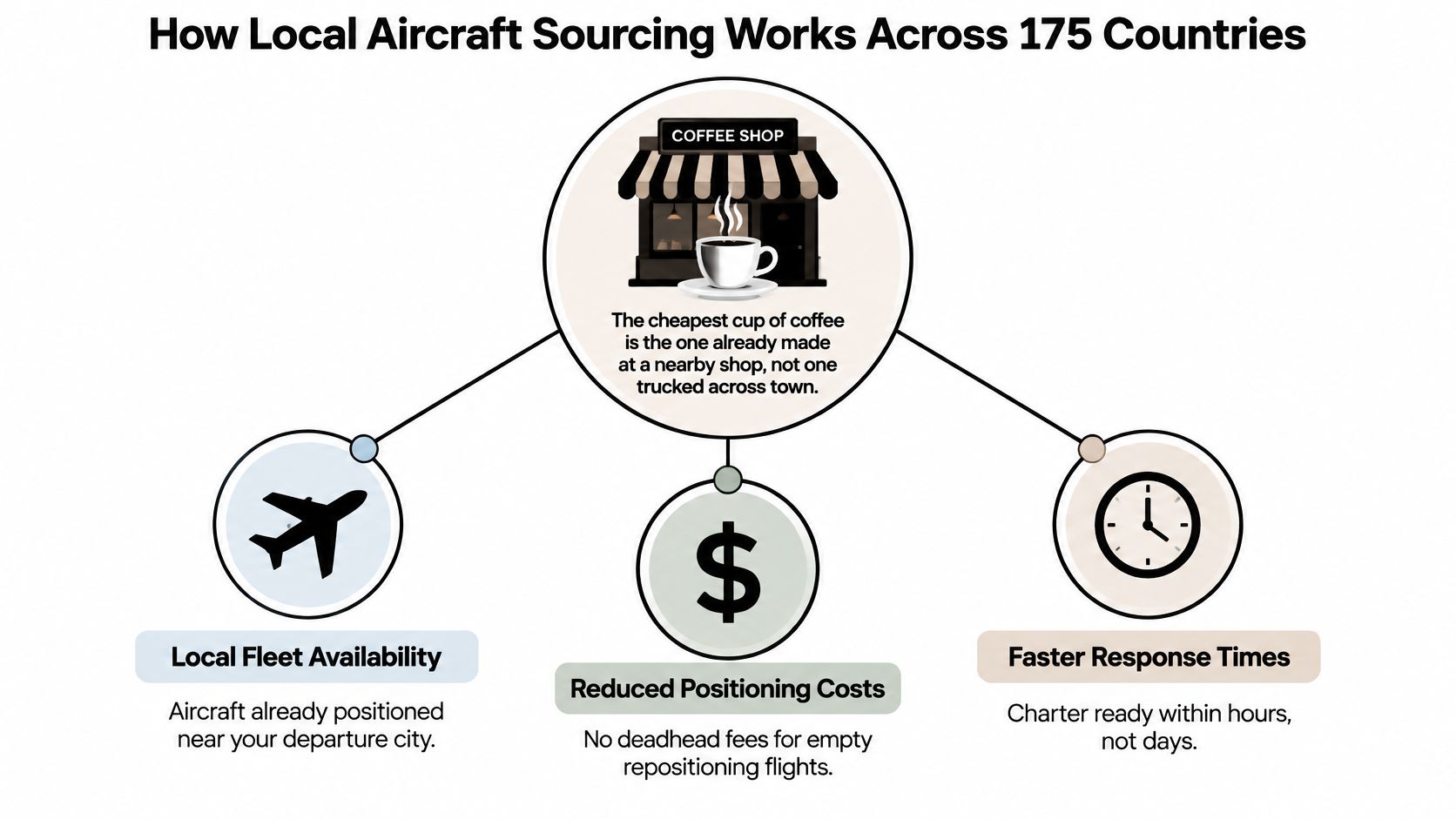
Think about ordering coffee. You'd usually choose a suitable nearby shop rather than pay someone to transport a cup across town. Charter sourcing follows a similar logic, except the aircraft must also meet the route, passenger, crew, and regulatory requirements.
The owner-operator sourcing network connects the search to aircraft across 175 countries. Its practical value isn't the country count alone. It's the ability to identify a suitable aircraft near the departure point instead of assuming that a distant listing is the only option.
The diagram shows the basic relationship between local supply, positioning, and readiness.
Know who does what
Several businesses can be involved in the same booking. Their roles shouldn't be blurred.
- Aircraft owner or owner-operator: Owns the asset and may also operate it. Ownership alone doesn't establish authority to sell a passenger charter.
- Management company: Handles agreed responsibilities for an owner, potentially including maintenance coordination, crew arrangements, and charter administration.
- Broker: Arranges the transaction between the traveler and the operating carrier. The broker's name on a proposal doesn't identify who will conduct the flight.
- Certificate holder: Holds the applicable operating authority and exercises operational control over the charter.
For U.S. compensated carriage, the FAA's guidance for pilots, owners, and operators explains the connection between the certificate holder, flight crew, aircraft documentation, and required operating procedures.
Search broadly, confirm specifically
In Miami, a sourcing desk might compare aircraft at different nearby airports. In a regional city, it might need to widen the search because the closest suitable aircraft isn't available. A broad network gives the desk more candidates, but only live confirmation establishes whether a particular aircraft can perform your flight.
Ask the desk to distinguish based nearby, currently nearby, and expected nearby before departure. Those descriptions aren't interchangeable.
Network size creates options. Good sourcing turns those options into a specific aircraft, an accountable operator, and an achievable itinerary. Don't accept geographic reach as a substitute for that final confirmation.
Why Repositioning Fees Drive Charter Prices Up
Suppose a broker proposes an aircraft in Teterboro for your departure from Miami. Before carrying you, that aircraft must reach Miami. The quote needs to account for that empty movement somewhere, whether it appears as a separate positioning charge or inside the total charter price.
That's why an attractive occupied-flight hourly rate can produce an unattractive invoice. You're comparing different operating plans, not different prices for the same cabin.
Compare complete itineraries
For a regional departure, ask the desk to compare a suitable locally available turboprop or light jet with the proposed aircraft arriving from elsewhere. Don't assume the jet wins because its advertised hourly rate looks competitive. Compare the complete mission, including what happens after you land.
Cost Components in a Typical Light-Jet Charter Quote
| Cost Component | Typical Driver | Share of Quote |
|---|---|---|
| Passenger-carrying flight | Aircraft category and itinerary | Route-dependent |
| Positioning flights | Aircraft location before and after your trip | Can be material or absent |
| Airport and ground services | Departure and arrival airport arrangements | Airport-dependent |
| Taxes | Applicable trip and jurisdiction requirements | Quote-specific |
| Requested services | Catering and other agreed arrangements | Request-dependent |
| Event charges | Airport demand and local event policies | Potentially substantial |
There's no defensible universal percentage for each row. Require an itemized explanation rather than treating a generic cost allocation as your trip's actual economics. Use the guide to private jet fees to organize questions about what's included and what remains chargeable.
Ask for the total cost of delivering the itinerary, not just the cost of the hours you'll spend aboard.
Watch the return and the airport
An aircraft close to your outbound departure may still need a costly movement afterward. For a return trip, ask whether it will remain available, leave and return, or be replaced by another aircraft. The cheaper outbound proposal isn't automatically the cheaper complete trip.
Event logistics can also outweigh an apparent sourcing saving. A tournament charter guide published by Haute Living reports possible host-city FBO event surcharges of $5,000–$7,500 per aircraft per day, separate from ordinary airport charges.
Your sharper question is: Is this aircraft already near my departure airport, and exactly what positioning and airport costs are included?
What the Booking and Pre-Flight Process Looks Like
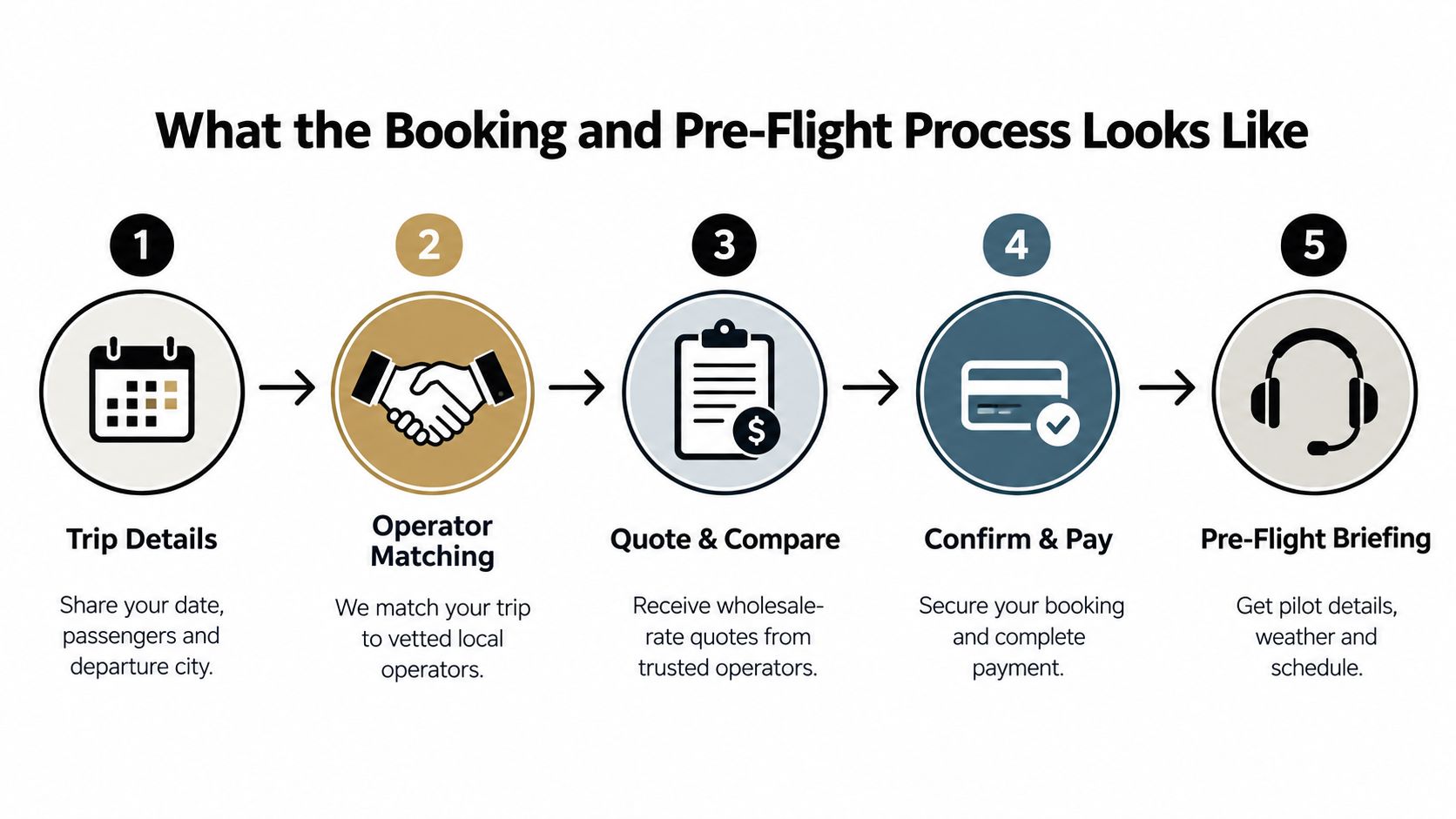
A useful charter request starts with your date, preferred departure time, passenger count, departure city, and destination. Add luggage, pets, ground transport, and any requirement that could change the aircraft selection. If a meeting time is fixed, say so before the desk begins sourcing.
The process should produce increasingly specific answers, not merely a payment request.
This flow shows the handoffs from the initial request to the departure briefing.
Turn recommendations into a confirmed assignment
An aircraft category is a reasonable starting point. It's not the finished booking. Ask for the specific make, model, cabin layout, proposed tail number, and operating carrier before treating competing proposals as equivalent.
Compare contractual details alongside the aircraft. What happens if the aircraft becomes unavailable? Who approves a substitute? Which services are confirmed, and which are still requests? A lower quote can be less useful if the cancellation and substitution terms don't fit your trip.
- Before committing: Establish the proposed aircraft, carrier, complete price, and cancellation terms.
- Before departure: Reconcile the confirmed aircraft and crew with the operator's dispatch arrangements.
- If anything changes: Request updated documents and an explanation of the effect on timing, capability, and price.
Same-day sourcing should be treated as an availability request, not a promise based on a search result. A local aircraft helps only when the operator can also support the mission.
Require a usable departure package
Request a 24-hour pre-flight confirmation containing the tail number, crew identities and biographies, weather briefing, passenger manifest, and schedule. This is a useful operational checkpoint, not a substitute for the operator's current dispatch assessment.
The discussion of charter oversight and pre-flight checks explains why aircraft, crew, maintenance status, and trip documentation need to be considered together. Crew biographies provide context, but the operator still needs to confirm current qualifications. The weather briefing should explain the operating outlook, not imply conditions can't change.
For a short-notice booking, request the same information as soon as the assignment is established rather than pretending the normal lead time exists.
The accompanying video provides another reference point for the booking conversation.
Push back on an unnamed operator, an unexplained aircraft substitution, or an indefinite promise to confirm the tail number later.
Safety Verification Beyond the Safety Badge
A nearby aircraft isn't safer than a repositioned aircraft. Local sourcing can remove an additional movement from the plan, but safety depends on the operator, aircraft condition, qualified crew, and the decisions made for the actual mission.
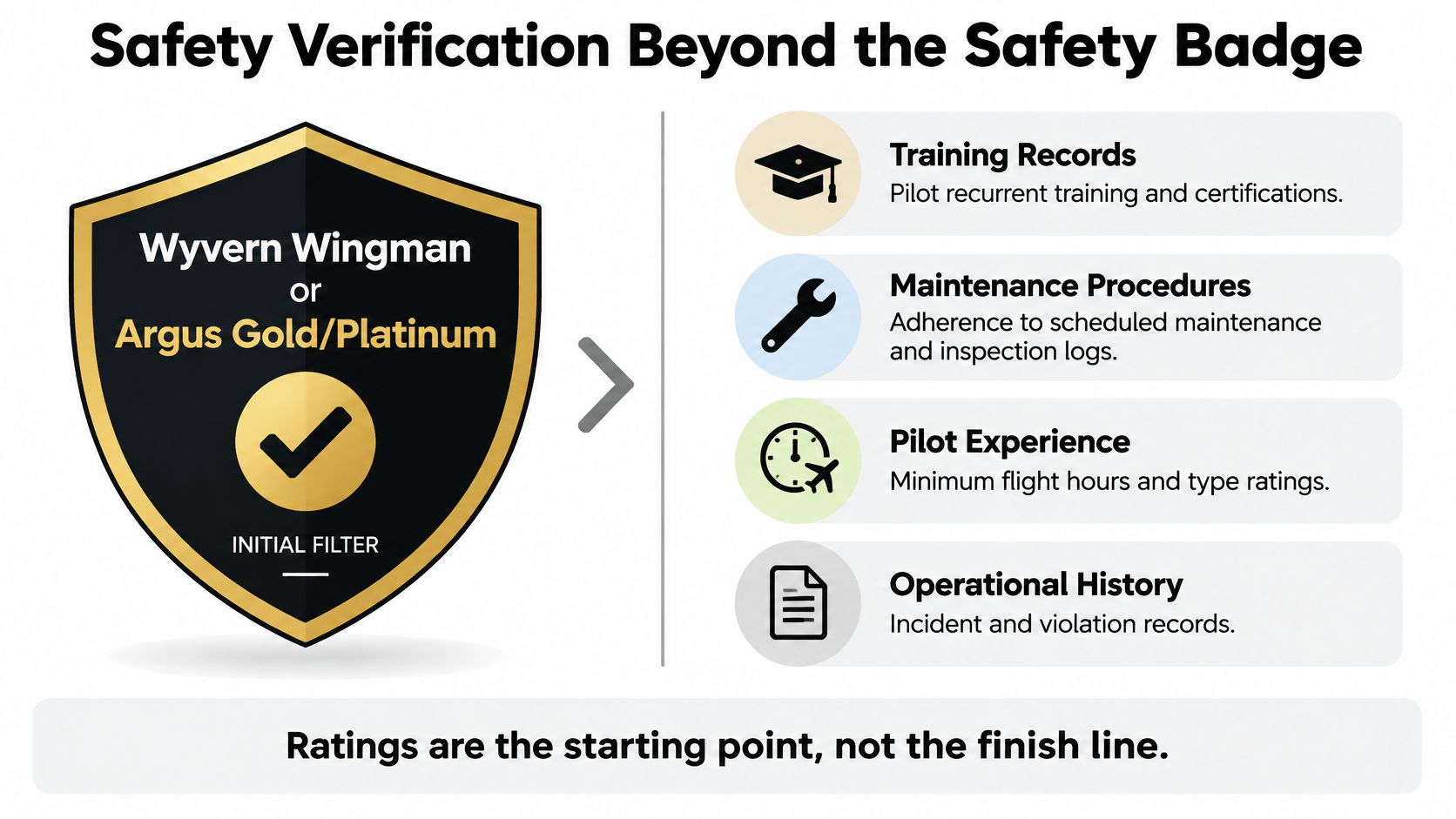
Wyvern Wingman and ARGUS Gold or Platinum ratings can help screen operators. They shouldn't end the inquiry. A badge on a listing doesn't tell you whether the aircraft and crew ultimately assigned to your flight have been checked.
The checklist below separates the initial filter from the supporting operational review.
Examine the operation behind the rating
Independent oversight can examine training records, maintenance procedures, pilot qualifications, emergency planning, and regulatory compliance. The useful question is how those practices apply to the carrier and assignment you're buying. Ask the sourcing desk to explain its private aviation safety verification process, including how it handles substitutions.
Recurring oversight matters because documents and qualifications can become outdated. Still, don't describe any rating as a guarantee against an incident. Nor should a particular commercial badge be confused with legal authority to operate.
Booking standard: Verify the assigned operation, not just the operator's marketing credentials.
Ask for evidence before payment becomes final
The FAA's passenger guidance on legal charter advises travelers to request the operator's Air Carrier or Operating Certificate and treats refusal as a warning sign. It also identifies unclear operational control, absent passenger briefings, unusually low prices, and missing Federal Excise Tax as potential red flags.
Use a practical checklist:
- Legal carrier: Obtain the certificate holder's legal name and certificate number, and establish who exercises operational control.
- Aircraft authorization: Confirm that the proposed tail number is authorized under that operator's certificate and appropriate for the itinerary.
- Crew readiness: Ask the operator to confirm required qualifications, current training, and currency for the assigned crew.
- Aircraft status: Request confirmation of airworthiness, applicable maintenance compliance, and insurance.
- Written updates: Require a revised departure package if the aircraft, crew, carrier, or itinerary changes.
These are U.S.-specific certificate checks. For flights elsewhere, ask for the corresponding local operating authority and applicable permissions rather than assuming Part 135 is a global standard.
A legitimate sourcing discussion should accommodate these questions without turning them into a confrontation. You're not asking to run the operator's flight department. You're establishing which organization accepts responsibility for your transportation.
The polished listing is a marketing asset. The certificate holder, assigned aircraft, and crew are the operational question.
On-Demand Charter, Empty Legs, Jet Cards, and Fractional
Choose the purchase model around how you travel, not around a brochure's promise of access. Irregular trips, predictable business travel, and highly flexible leisure departures create different buying decisions.
For context, a Haute Living overview of private charter gives a broad range of $5,000–$20,000 per flight hour for midsize to large jets. It also notes that passenger details are required for security and that the aircraft's passenger capacity cannot be exceeded. That range isn't a light-jet quote or a substitute for a complete itinerary price.
The comparison below is a starting point. Contract terms, rather than category labels, determine what you receive.
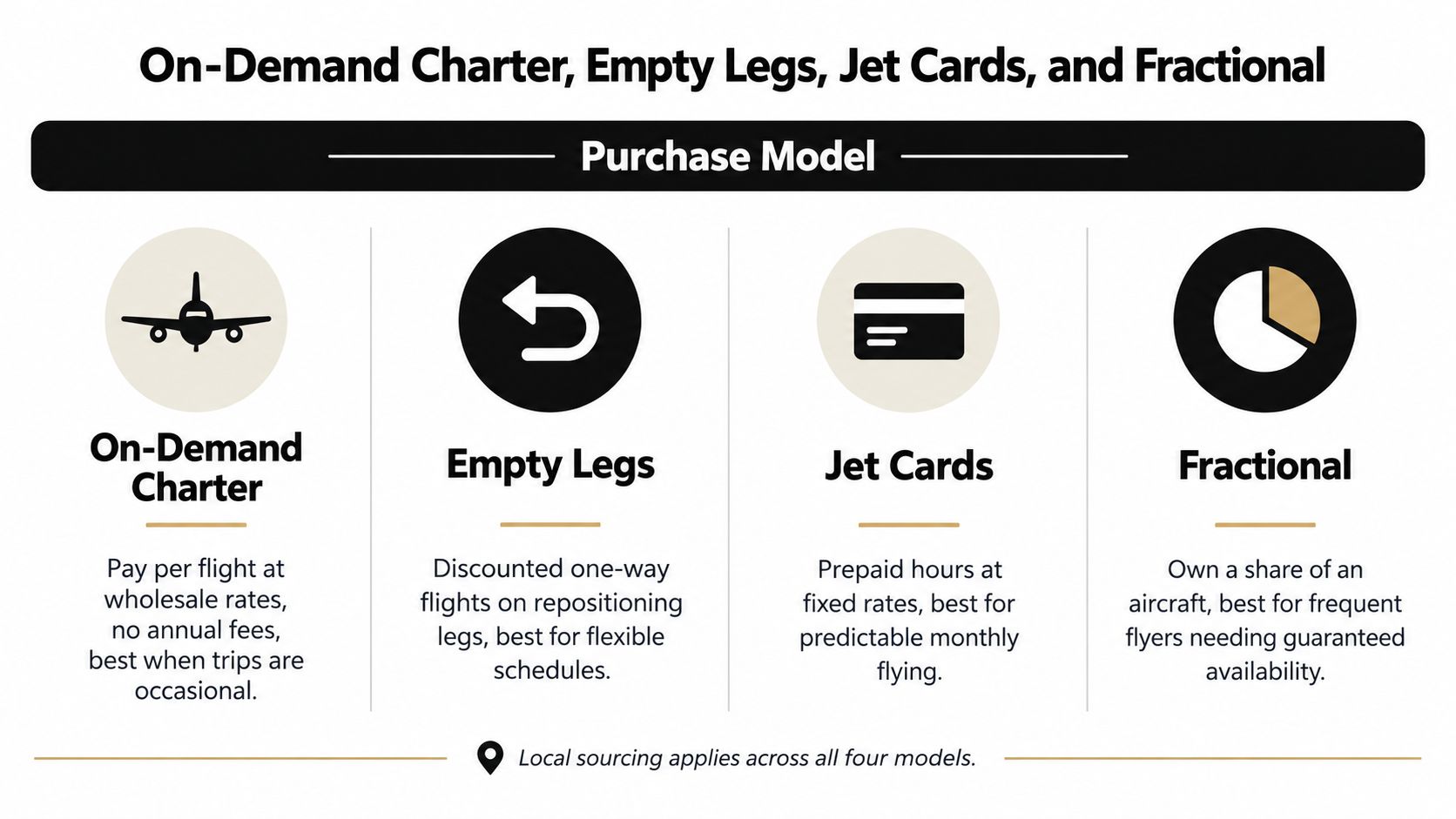
Match commitment to your travel pattern
| Model | Practical fit | Trade-off to examine |
|---|---|---|
| On-demand charter | Irregular itineraries and trip-by-trip buying | Price and availability are established for each request |
| Empty leg | Travelers who can adapt to a pre-existing movement | Dependence on another itinerary and limited recovery options |
| Jet card | Travelers who value prepaid access and defined commercial terms | Booking rules, peak restrictions, exclusions, and refund provisions |
| Fractional ownership | Frequent users willing to make a longer-term commitment | Ownership obligations and the agreement's access conditions |
On-demand charter avoids committing to prepaid hours to arrange an individual trip. It also lets you test different aircraft against different missions. Ask what a wholesale or direct-to-owner pricing claim includes rather than assuming the label proves a lower total.
With jet cards, examine the entire agreement before equating prepaid hours with unrestricted availability. With fractional ownership, evaluate your overall usage and contractual obligations, not just whether you repeat a particular route.
Treat empty legs as conditional opportunities
An empty leg exists because an aircraft needs to move within another operating plan. If that underlying itinerary changes, your opportunity may change too. Establish whether you're purchasing an entire aircraft or a seat, and what cancellation or replacement protection applies.
A 2025 climate analysis of private aviation reported 19.5 million tonnes of CO2-equivalent globally in 2023, 25 percent growth over a decade, and an estimated 41 percent of private-jet flights operating as empty repositioning legs. A discounted fare doesn't, by itself, establish an environmental benefit.
For travelers arranging a broader Hawaii itinerary, Kona Snorkel Trips' guide to private charter options is a separate boat-charter planning resource. Keep those destination arrangements distinct from the aviation contract and its schedule protections.
Putting It Together for Your Next Flight
A useful search for private jet charter near me ends with an accountable proposal, not a nearby address. The sourcing desk should explain why the proposed aircraft fits your route and how the complete operating plan affects the price.
Give competing providers the same itinerary and requirements. Otherwise, you may be comparing different airports, aircraft capabilities, service inclusions, or cancellation protections without realizing it.
Send these questions with your request
- Who operates the flight? Identify the legal certificate holder and applicable authority.
- Which aircraft is proposed? Request the tail number and confirmation that it's authorized for the operation.
- Where will it be? Establish its expected location before pickup and the positioning included in the quote.
- What arrives before departure? Agree on the written confirmation package and how changes will be communicated.
Keep the answers alongside the quote. If a provider changes the aircraft or terms, you'll have a clear basis for checking whether the replacement still meets your needs.
For readers of this Journal, the practical next step is straightforward: submit a real trip, ask for a locally sourced option, and compare its complete terms with an alternative. Don't buy solely on proximity, a safety badge, or an hourly rate.
Private aviation is an operating system, not a product, and the right sourcing partner makes the difference.
Haute Jets offers on-demand charter sourcing without memberships or prepaid flight hours. Visit Haute Jets with your route, travel dates, passenger count, and luggage requirements, and request a proposal identifying the aircraft, operating carrier, positioning costs, and pre-flight confirmation arrangements.