

You may be comparing aircraft, hotel suites, and a yacht transfer while trying to protect an event arrival and a firm return date. That's the moment to stop building a wish list and start testing the trip against its constraints. In private aviation, a beautiful itinerary that cannot absorb a delay is not a luxury plan. It's an expensive gamble.
Good luxury travel planning starts with what must happen, when it must happen, and what you'll do if the original plan fails. Then you match aircraft and services to those requirements. That order protects the experience, the schedule, and your ability to make a calm decision when conditions change.
Why Constraints Drive Every Great Luxury Travel Plan
A traveler flying from New York to Europe for a private event, then continuing to a yacht embarkation, has more than a route to arrange. The event has a start time, the yacht has a departure window, and the return may need to fit around a board meeting or family commitment. If a medical requirement, pet, or unusually large luggage load affects the journey, those details are constraints too.
The right question isn't, “Which jet do you want?” It's, “What must be true for this trip to work?” Turn each fixed commitment into a latest-arrival time, then work backward through flight time, airport access, passenger processing, ground transfers, and a recovery buffer. A preferred aircraft only matters once it can satisfy that chain.
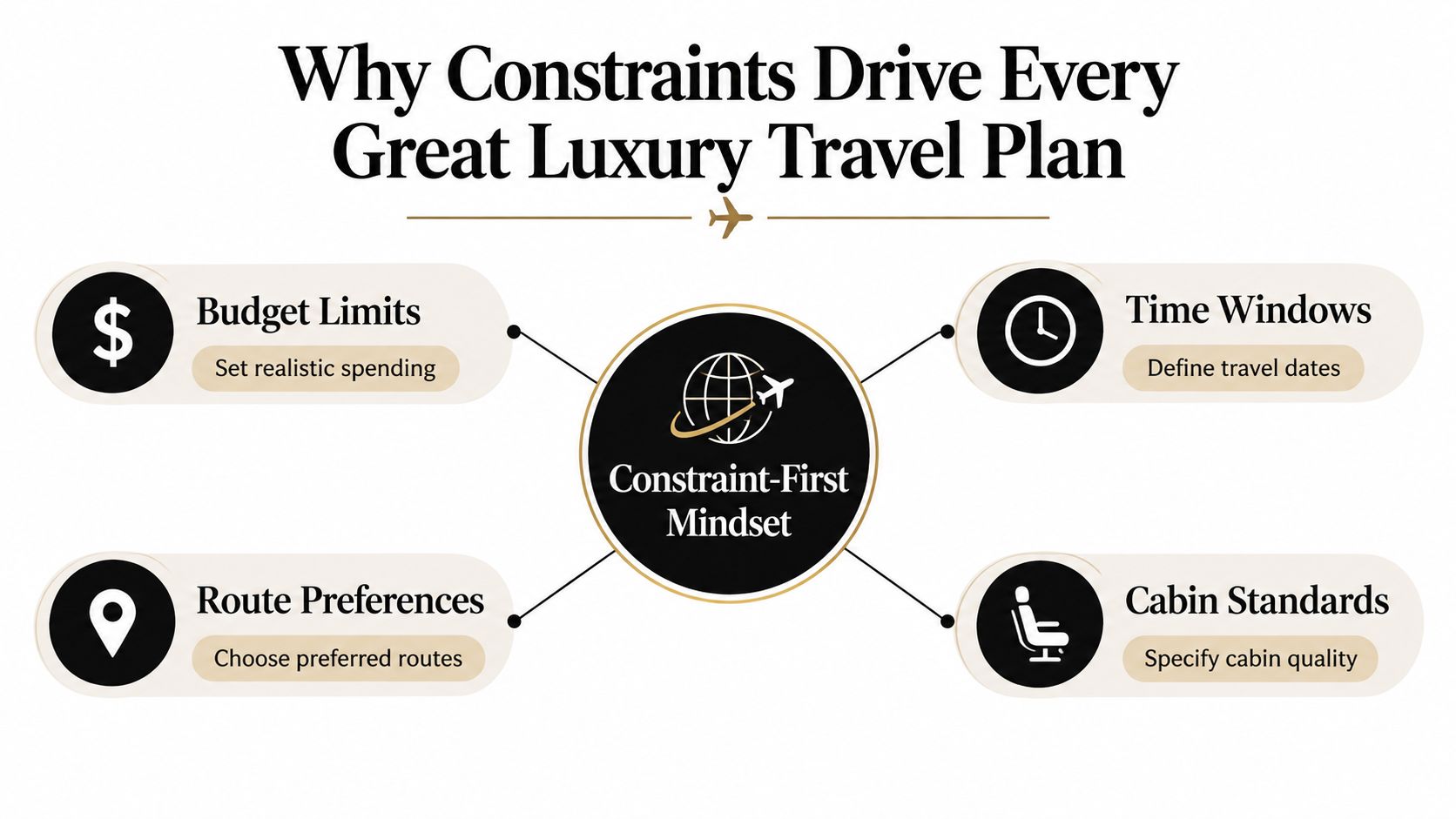
Build the plan around what cannot move
Separate the trip into fixed commitments and adjustable preferences. Event arrival, medical needs, and yacht departure belong in the first group. Cabin finish, departure airport, and sightseeing sequence may be flexible, depending on the traveler.
A practical plan records the latest acceptable arrival for each commitment and names the fallback if a disruption threatens it. You should be able to see who owns each decision, which supplier must act, and how the traveler will be notified. Track the plan against three measures: the share of critical commitments protected, response time when something changes, and the time needed to activate the fallback.
That mindset applies beyond aviation. For example, a traveler adding a marine wildlife experience to a Hawaii stay can use a specialist guide to check timing, location, and activity logistics before locking in flights and transfers. This plan a Kona manta ray tour resource can help clarify how a particular excursion fits into the wider itinerary.
The market also rewards experience-led planning. Mastercard estimates the global luxury travel market at approximately $1.38 trillion in 2023, with projected annual growth of 7.9% through 2030. Its research says high-net-worth travelers represent roughly 36% of worldwide travel spending and nearly 70% of luxury-travel spending, while more than half of affluent travelers prefer meaningful experiences to shopping and souvenirs. Mastercard's affluent travel research reinforces the practical point: protect the experience by designing around the traveler, not around a jet brochure.
Vetting Operators and Establishing Operational Control
Before discussing cabin finishes, establish who is legally responsible for operating the flight. For a U.S. on-demand charter, the operator should hold the required authority, and the provider should retain operational control. That means the responsible entity controls the initiation, conduct, and termination of the flight, and supplies or formally supervises the aircraft, crew, maintenance, insurance, and flight management.
Part 135 operations are subject to more demanding pilot qualification, maintenance, inspection, and operating standards than private-pilot operations. Part 119 certification requirements also matter to an operator's authority. The FAA warns travelers to treat arrangements as a red flag when a company supplies an aircraft and crewmember but tries to transfer operational control to the customer. FAA guidance on safe charter operations explains why a polished itinerary is no substitute for knowing who is accountable.
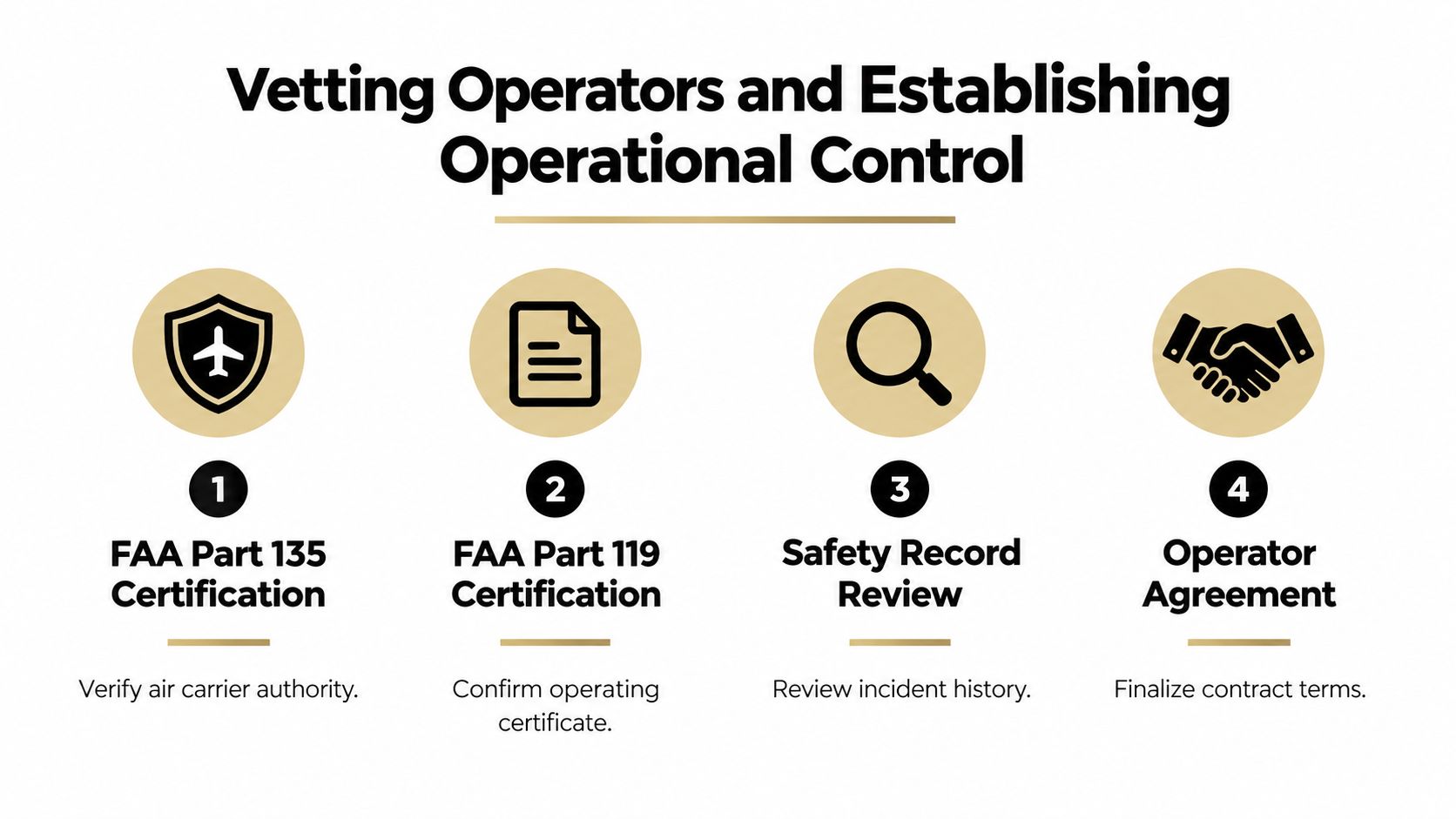
Use a documented vetting workflow
Define the traveler profile. Share passenger count, medical constraints, pets, luggage, connectivity needs, and schedule tolerance. The operator can't assess suitability without the actual requirements.
Screen the certificate and aircraft pairing. Confirm the operator's certificate and that the specific aircraft is operating under that operator's authority. Don't accept a company name as proof that the aircraft on the quote is covered.
Identify operational control and liability. Ask who decides whether the flight can depart, who manages it, and which entity is responsible. Get the answer in writing.
Validate aircraft and crew readiness. Review crew qualifications, aircraft status, weather minima, alternate airports, and recovery options. Ask who will make the call if conditions change.
Confirm the contract and trip details. Require written confirmation of the tail number, routing, crew, catering, ground transport, and cancellation terms. Record who approves aircraft substitutions.
Revalidate before departure. Confirm the final details and keep a written audit trail, including the person authorized to escalate a disruption.
Third-party safety audits add another useful check, but they don't replace the operating certificate or your review of the actual flight arrangement. Haute Jets states that its operator network uses Wyvern Wingman or Argus Gold/Platinum ratings. Ask any provider what audit applies to the operator assigned to your flight and what documentation it can share. For further background on safety considerations, consult private aviation safety.
Practical rule: If nobody will clearly state who holds operational control, don't proceed until the contract and operating arrangement are clear.
Matching Aircraft Category to Itinerary Demands
Choose the aircraft to meet the itinerary, not to impress the passenger list. Passenger count is only the starting point. Luggage volume, route length, runway access, weather, onboard connectivity, and the possibility of a diversion all affect the right cabin.
| Category | Typical Passengers | Range | Indicative Hourly Rate |
|---|---|---|---|
| Light jet | Small group | Short to medium routes | Approximately $3,000–$5,000 |
| Midsize jet | Medium group | Medium routes | Quote by aircraft and itinerary |
| Super-mid jet | Medium group | Longer routes | Quote by aircraft and itinerary |
| Heavy jet | Larger group | Long-haul routes | Approximately $10,000–$12,000, with some larger aircraft and services at $10,000–$20,000 or more |
The indicative rates for light and heavy jets come from Haute Jets Journal's private jet planning guide. They're not a complete trip price: routing, aircraft, service selection, and other itinerary details affect the quote. Get a route-specific proposal rather than multiplying an hourly figure and assuming it captures every cost.
Match the cabin to the route
A light jet can be the sensible choice for a short hop when the passenger and baggage count fit. A larger aircraft may add cost without adding value if the itinerary doesn't need its cabin space or range. Conversely, a transatlantic or transpacific journey calls for an aircraft capable of covering the route with appropriate operating margins, not merely a cabin that looks spacious.
Midsize and super-mid aircraft can suit trips that need more cabin room or range than a light jet offers, while heavy jets serve larger groups and longer routes. But category labels don't settle the question. Two aircraft in the same category can differ in cabin layout, luggage capacity, speed, and connectivity.
Before accepting a proposal, ask the provider to confirm passenger and baggage limits for the exact aircraft, the destination's runway suitability, expected route performance, and Wi-Fi availability. A helpful comparison of models and configurations is Haute Jets' overview of top private aircraft. Treat it as a starting point, then verify that the specific aircraft fits your actual route and needs.
Building a Realistic Booking Timeline
Start earlier than you think you need to. A domestic charter may come together on shorter notice than a complex international journey, but a late request narrows your options for aircraft, routing, and ground coordination. Lead time is what gives you choices before you have to compromise.
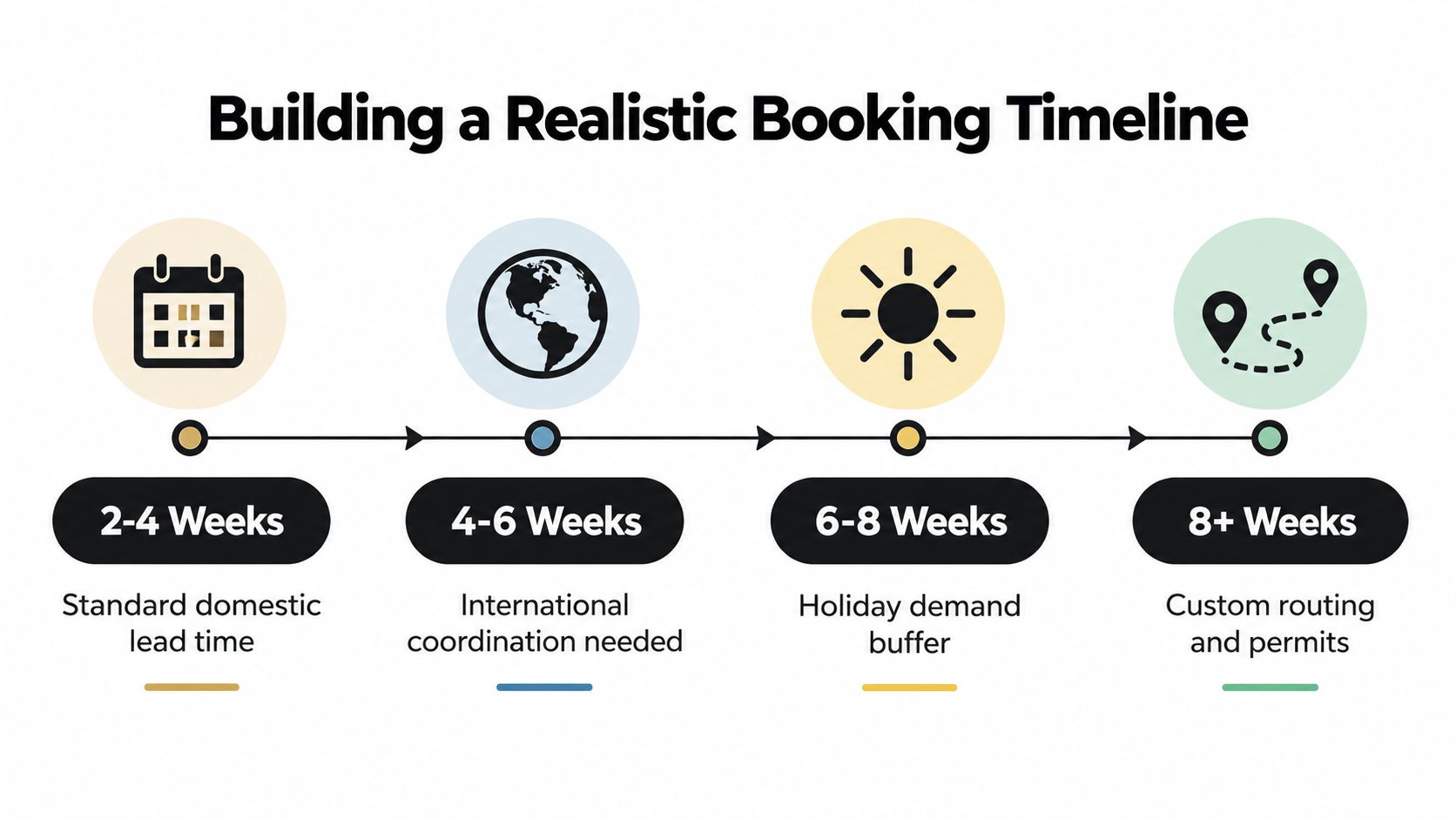
Work backward from departure
Use a planning window that reflects the trip's complexity:
- Domestic charters: Start roughly 2–4 weeks ahead when the schedule is straightforward.
- International flights: Allow 4–8 weeks where routing, entry requirements, or coordination add complexity.
- Peak periods and major events: Book early and expect less flexibility as demand rises.
- Multi-leg itineraries: Give the planner room to coordinate each aircraft, transfer, and ground supplier.
The 2026 FIFA World Cup is scheduled across 16 host cities in the United States, Canada, and Mexico, beginning June 11, 2026, in Mexico City and concluding July 19, 2026, at MetLife Stadium in New Jersey. Haute Jets' World Cup 2026 private jet guide notes that private-aviation planning must account for same-day match itineraries, late-evening FBO operations, ground transfers, and tighter aircraft availability roughly 7–10 days before knockout matches. For a major event, don't leave aircraft sourcing until the match schedule becomes urgent.
Assign one person to own the live itinerary. That owner should coordinate the charter provider, travel advisor, concierge, and destination management company, and ensure every stakeholder uses the same current version. GBTA reports that 31% of travel managers said they couldn't support travelers who booked outside their primary system, a warning against letting disconnected bookings disappear from view. The Corporate Event Transportation Planning Guide offers useful context for coordinating ground movement around business events.
Make the final confirmation useful
Set a 24-hour pre-flight confirmation as a firm checkpoint. It should identify the tail number, crew, weather briefing, passenger manifest, route, ground transport, and contact for operational updates. Read it carefully and raise discrepancies while there's still time to resolve them.
Specifying the Exact Aircraft and Onboard Experience
Once the category fits, specify the aircraft itself. “Heavy jet” doesn't tell you the year, make, model, or cabin layout, and those details can change the experience. Ask for the exact aircraft under consideration and confirm that its configuration meets your requirements before you approve the booking.

Put every preference in writing
A good request is specific enough for an operator to answer yes or no. Confirm the following directly:
- Cabin and aircraft: Year, make, model, seating arrangement, and available baggage space.
- Connectivity: Wi-Fi type and expected coverage along the route. Don't assume the aircraft has it or that service will work everywhere.
- Catering: Meal preferences, allergies, timing, and any items that must be available onboard.
- Pets and equipment: Confirm pet policies and how medical equipment will be handled before travel day.
- Ground movement: Name the pickup and drop-off points and confirm transfers at both ends.
- Security and special handling: Tell the provider what the traveler needs, then ask who is responsible for coordinating each request.
Local aircraft sourcing can affect the quote because an aircraft positioned near your departure city may avoid unnecessary repositioning. Haute Jets says it sources from more than 3,500 owner-operators across 175 countries, with operators holding Wyvern Wingman or Argus Gold/Platinum ratings. Its luxury travel concierge overview describes that sourcing network. Ask for the proposed aircraft's location and a clear breakdown of the pricing rather than assuming a network size guarantees a particular aircraft or fare.
This is also where an on-demand model may suit a traveler who wants to book one flight or many without committing to a membership or jet card. Compare the written terms, pricing basis, and aircraft details across providers. For a destination experience that needs its own transport and timing coordination, this guide to private guided Grand Canyon luxury trips can help you consider how an excursion fits around the flight plan.
Before the final confirmation, review the actual flight details rather than relying on an earlier quote. Haute Jets describes providing the tail number, crew bios, weather briefing, and passenger manifest 24 hours before departure. Those specifics should be in your pre-departure review, whichever provider you choose.
Here's a closer look at the aircraft and cabin details travelers should clarify before confirming:
When Empty-Leg Flights Make Sense and When They Don't
An empty-leg flight exists because a private aircraft has completed a one-way booking and needs to reposition without passengers. The operator may offer that repositioning flight at an unusually low price, but the traveler accepts the aircraft's existing schedule and route. The departure airport, destination, and departure time are fixed, so you should treat the offer as a narrow opportunity, not a flexible charter.
That trade makes sense for a spontaneous, one-way trip when you can accept a change of plan. If the departure time suits you and the route matches your needs, the fare may be attractive. You still need to check the operating details and ask what happens if the underlying repositioning plan changes.
Don't build a critical itinerary around one
Empty legs are poor foundations for event travel, a tight connection, a multi-leg itinerary, or group movement. If you must arrive for a specific commitment, an option with fixed departure conditions can leave you with few ways to protect the rest of the trip. The apparent saving can disappear if you need to book replacement transport or rearrange ground logistics.
Use empty-leg inventory as a separate track from your primary travel plan. Keep your main charter based on the commitments you can't miss, then consider an empty leg only if it fits without making the fallback harder. If you're researching availability and terms, Haute Jets' guide to getting empty-leg flights can help you understand how to assess the option.
Before accepting, ask what is fixed, what can change, and how much notice you'll receive if the flight no longer operates as expected. If the provider can't explain the contingency, the low fare isn't enough to justify the risk. For a traveler with schedule flexibility, this can be a useful opportunistic purchase. For a traveler whose itinerary depends on arriving at a defined time, book around the commitment instead.
Building a Resilient and Verifiable Final Plan
A resilient itinerary accounts for more than aircraft availability. Weather, wildfire exposure, hurricane season, water stress, airport reliability, and access to medical care can change whether a destination is appropriate for a particular traveler. Luxury travel advisors report that climate effects are prompting changes: nearly half said clients are changing plans, 78% said clients are choosing shoulder or off-peak travel, and 76% said clients favor destinations with more moderate weather, according to the 2025 Virtuoso Luxe Report.
That shifts the definition of luxury. A resilient route with a viable backup may be more valuable than a fragile plan built around the most famous hotel or the busiest seasonal event. Rank destination alternatives, identify backup airports, and make sure the ground transport and accommodation can still work if the original plan changes.
Sustainability deserves the same scrutiny. Ask whether the proposal reduces emissions through routing, aircraft efficiency, passenger load, or available sustainable aviation fuel, and request transparent emissions information. Don't treat offsets as proof that the flight's emissions have been eliminated. IATA's 2025 net-zero progress report estimates that only 1.0% of airline CO2 was mitigated through offsets or sustainable aviation fuel. That figure is a reason to ask precise questions, not to assume every sustainability claim has the same meaning.
Run the final check before wheels-up
At the 24-hour confirmation, verify the tail number, crew bios, weather briefing, passenger manifest, and ground transport. Make sure the traveler's contact details and any medical or dietary requirements are current, and confirm who can authorize a change if the aircraft, airport, or weather plan shifts.
Keep one live itinerary and one named owner. That person should know whom to call, which alternative airport or route is viable, and what action triggers the backup. The objective isn't to preserve the original schedule at all costs. It's to protect the commitments that matter and activate a workable alternative quickly.
Haute Jets helps travelers source on-demand aircraft, compare specific aircraft configurations, and coordinate flight details around the wider itinerary. If you're planning a charter and want to build the trip around your real timing, routing, and onboard requirements, visit Haute Jets.