
Private jet charter rates per hour in 2026 range from roughly $2,900 for a turboprop to $16,000 or more for an ultra-long-range jet. That spread is real, but it won't predict your invoice. The aircraft sitting closest to your departure airport, the minimum hours in the operator's contract, and the fees buried below the headline rate decide what you pay. Treat the hourly figure as a screening tool, not a quote, and you'll compare offers the way experienced buyers do.
Why the Hourly Rate Is Just the Starting Line
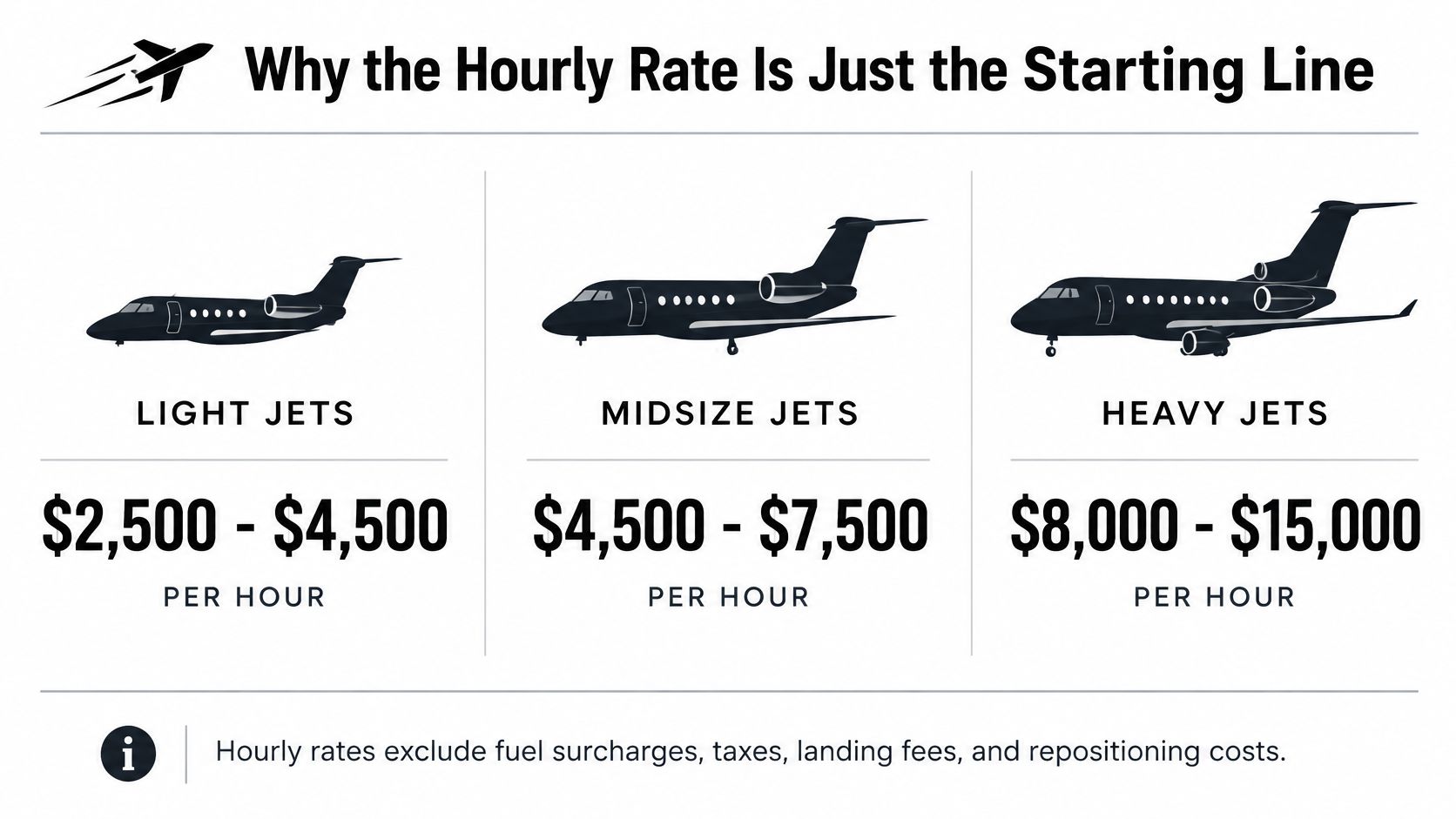
Start with the category, then distrust the headline. Indicative 2025-2026 ranges put turboprops near $2,000 per flight hour, light jets at $2,600-$3,500, midsize jets at $3,500-$5,500, super-midsize aircraft at $5,500-$7,500, heavy jets at $8,000-$13,000, and ultra-long-range aircraft at $10,000-$14,000 or more, according to published private jet market indicators. Those figures help you shortlist aircraft. They don't close a deal.
What the published number leaves out
No audited public database records realized charter prices, so a published rate is a market indicator, not a standardized tariff. Operators can add minimum flight time, landing and handling charges, crew expenses, catering, de-icing, international permits, taxes, and overnight costs. A short flight can therefore cost far more per occupied hour than the brochure suggests, especially when a daily minimum applies.
Availability changes the math again. A jet already near your departure airport can produce a lower total than a cheaper aircraft that must fly empty to collect you. That's why two quotes for the same model, same route, and same departure time can land far apart.
Divide the all-in trip price by occupied flight hours. That's the only hourly number worth comparing.
Other benchmarks show the same pattern with different edges. One 2025 industry estimate placed light jets around $2,500-$4,500, midsize jets around $4,500-$7,000, and heavy jets at $8,000-$12,000 or more per flight hour in brokerage market pricing data. Newer aircraft, longer range, seasonality, short booking lead time, and crew positioning all push a quote within, or beyond, its category range.
Don't ask which provider has the lowest rate. Ask which specific aircraft, from which base, produces the lowest all-in total for your exact itinerary.
Aircraft Categories and Their Typical Hourly Range
Match the mission first. Overspecifying wastes money, but underbuying can force a fuel stop, squeeze baggage, or leave you with a cabin that feels wrong for a longer leg. The right category is the smallest aircraft that completes your route nonstop, comfortably, with your passengers and bags.
Haute Jets Journal's 2026 category breakdown lists turboprops at $2,900-$3,500 per hour for short trips under 500 miles, light jets at $3,200-$4,500 for regional flights of one to three hours, midsize jets at $5,000-$7,500, super-midsize aircraft at $6,500-$9,000, heavy jets at $8,500-$12,000, and ultra-long-range jets at $12,000-$16,000 or more. Use those bands to sanity-check a quote, not to demand a price an operator hasn't offered.
2026 Private Jet Charter Rates Per Hour by Category
| Category | Hourly Range | Passengers | Range | Best Use |
|---|---|---|---|---|
| Turboprop | $2,900-$3,500 | Small groups | Short trips under 500 miles | Island hops and short regional legs |
| Light jet | $3,200-$4,500 | Small groups | Regional flights of one to three hours | Fast short-haul business and leisure trips |
| Midsize jet | $5,000-$7,500 | Medium groups | Longer regional and transcontinental missions | More cabin room on multi-hour routes |
| Super-midsize jet | $6,500-$9,000 | Medium groups | Extended nonstop missions | Coast-to-coast comfort without stepping into a heavy cabin |
| Heavy jet | $8,500-$12,000 | Larger groups | Transcontinental and intercontinental missions | Long routes, bigger cabins, more service |
| Ultra-long-range jet | $12,000-$16,000 or more | Larger groups | Intercontinental missions | Longest nonstop legs and maximum cabin capability |
Turbo-props deserve more respect than first-time buyers give them. On a short hop, runway performance and efficiency can matter more than jet speed. Light jets win when you want speed on a regional route without paying for unused cabin volume.
Midsize and super-midsize aircraft are where many buyers should focus. You get a meaningful step up in cabin comfort and nonstop capability, and you avoid heavy-jet pricing on routes that don't need it. Heavy and ultra-long-range aircraft earn their premium through greater fuel burn, higher reserve requirements, larger crew and cabin service burden, and access to longer nonstop missions, as explained in category pricing analysis from AvNet.
Don't choose by status. Choose by certified range, runway performance, cabin layout, model year, and base location, then confirm the tail-specific aircraft before you wire funds.
What Really Goes Into the Final Invoice
Treat the hourly number as the floor of your invoice. Everything stacked above it is where brokers earn their margin and where first-time flyers get surprised.
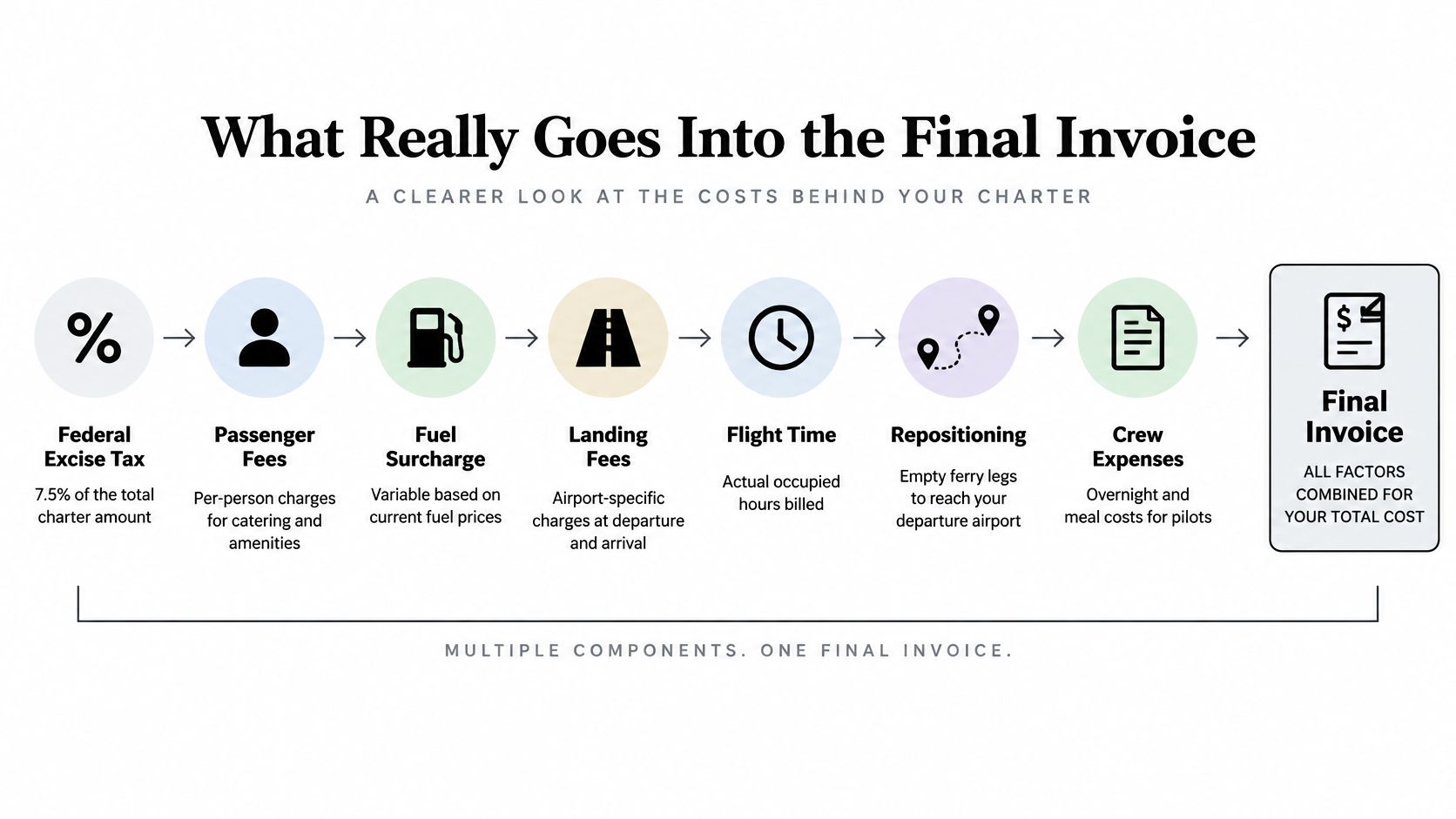
The National Business Aviation Association separates occupied-hour charges covering fuel, maintenance, engine reserves, and pilot fees from the rest of the trip, benchmarking roughly $3,900 per occupied charter hour plus about $500 per hour in fuel surcharge in its NBAA fractional ownership guidance. Positioning, landing and handling, crew lodging, catering, de-icing, and overnight expenses all sit outside that figure. On a two-day trip with a crew overnight and winter de-icing, those extras can rival the flight time itself.
If a quote doesn't itemize that stack, you aren't looking at transparency. You're looking at marketing.
Line items that surprise first-time buyers
- Federal excise tax: U.S. invoices may carry 7.5% federal excise tax plus passenger segment fees, as detailed in charter cost breakdowns covering taxes and airport charges. The same breakdown puts landing fees at roughly $100 to $1,500 per flight depending on the airport, and FBO handling at about $150-$500 per stop at the private terminal.
- Crew and waiting costs: Overnight lodging, meals, aircraft parking, and crew waiting time apply whenever the aircraft stays with your itinerary.
- Trip-specific extras: Catering, de-icing, international permits, and fuel adjustments can move the total after the first estimate.
Airport choice matters more than first-time flyers expect. A primary airport brings higher landing and handling exposure, while a suitable secondary airport often cuts both cost and ground friction. Ask before booking, not after the invoice arrives.
For a visual walk-through of how occupied time, minimum billable time, and airport charges stack into a final invoice, this cost-component video covers each line item in order.
Demand a written breakdown that mirrors Haute Jets Journal's guide to private jet fees, with occupied time, minimum billable time, repositioning, taxes, airport fees, and overnight costs on separate lines. Then sort each charge into three buckets: fixed, route-dependent, and avoidable. That sorting shows you exactly where a different aircraft, a different airport, or a harder negotiation saves real money. A broker who refuses to itemize is telling you something. Believe them.
The Repositioning Surcharge Most Brokers Bury
The cheapest hourly rate can produce the most expensive trip. I see buyers make this mistake constantly. They chase a lower number on a jet based far away, then pay for empty flying they never occupy.

Repositioning happens when the selected aircraft must fly empty to your departure airport, return to base afterward, or both. The operator doesn't absorb that ferry time out of generosity. You pay for it directly through a higher all-in quote, or indirectly through minimums and routing conditions.
The surcharge in plain numbers
Budget for repositioning to inflate your charter price by an estimated 20-40% when you book through a traditional broker or jet-card program and the selected aircraft isn't already based near your departure city. On a substantial trip, that isn't a rounding error. It's often the entire difference between a smart quote and a bad one.
Two identical aircraft in the same category can produce wildly different invoices. One sits at an airport near your origin with its crew available. The other matches on model year and cabin but starts in another region, needing a long ferry leg before pickup and another after drop-off. The second jet can advertise a lower hourly rate and still lose badly on total price.
Buyer rule: Never compare hourly rates until you've compared where each aircraft starts its day.
One-way itineraries deserve extra scrutiny. If the operator has no follow-on mission from your destination, your quote may carry the cost of getting the aircraft somewhere useful again. Round trips can create the opposite problem when the jet waits for days and daily minimums accumulate.
Here's the part most comparison articles leave invisible: the surcharge is a sourcing failure. Whether a well-positioned aircraft exists near your origin depends on how deep your broker's network runs. Haute Jets sources from 3,500+ owner-operators across 175 countries, which is why repositioning shows up far less often on its quotes. A broker working a shallow list of local operators will bill you the ferry time and call it standard.
Ask three direct questions. Where is the aircraft before my flight, where does it need to go afterward, and exactly how much ferry time is inside my price? If a broker can't answer clearly, don't book.
How Local Sourcing Rewrites the Price Equation
Local sourcing isn't a discount gimmick. It's simple operating logic. Put passengers on an aircraft that's already near the origin, and you remove empty time, reduce crew complications, and give the operator a cleaner mission to price.
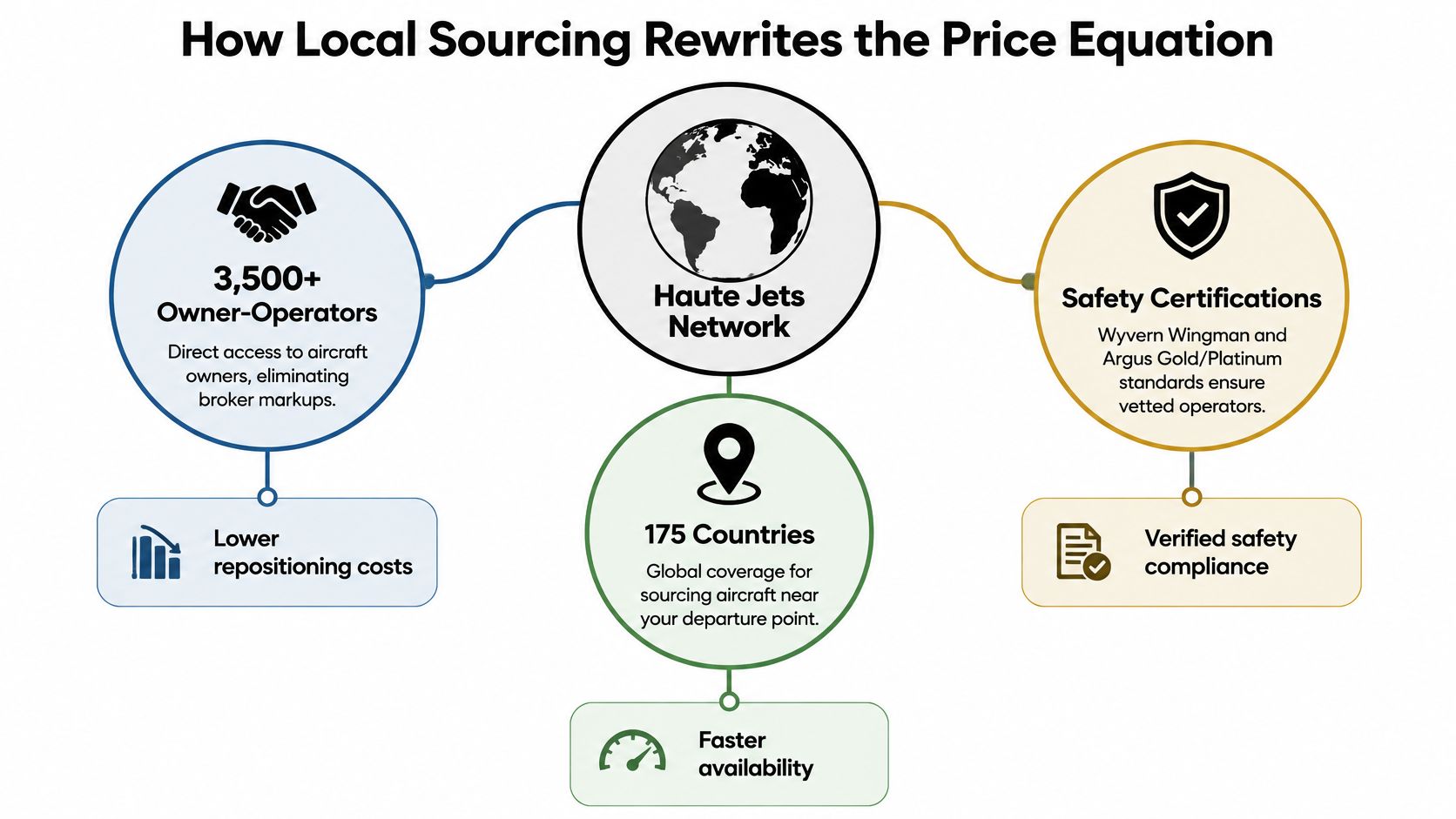
Haute Jets sources from 3,500+ owner-operators across 175 countries, a model described in its owner-operator network overview. Every operator in that network holds a Wyvern Wingman or Argus Gold/Platinum rating. That safety filter matters because a large network is only useful if the aircraft inside it meet a consistent third-party audit standard.
What changes on your invoice
- Less ferry exposure: A locally positioned aircraft reduces or eliminates the empty leg you'd otherwise fund.
- Cleaner minimums: Operators don't need to protect themselves against a long, unproductive positioning day in the same way.
- Fewer overnight complications: A crew that starts and ends near home is less likely to generate avoidable lodging and waiting costs.
- More substitution options: If one tail doesn't fit on cabin, Wi-Fi, pet policy, or schedule, a broad local pool gives you another specific aircraft to evaluate.
Don't confuse network size with automatic savings. A nearby aircraft can still be the wrong choice if its cabin layout, maintenance status, crew duty position, or airport performance doesn't fit your mission. Local sourcing works when it improves both position and aircraft selection.
Insist on tail-specific confirmation. You should know the exact year, make, model, cabin layout, and included services before departure. The operator network model also supports a disciplined confirmation window covering tail number, crew information, weather, and passenger manifest before you travel.
My recommendation is blunt. Source locally first, then negotiate within that shortlist. Buyers who start with a national lowest-rate search often end up funding someone else's empty airplane.
What a Real 2026 Trip Costs Across Three Routes
Routes expose weak pricing logic fast. A short hop punishes minimums, a regional route rewards the right category, and a transatlantic mission makes range essential. Run each itinerary through occupied time, ferry time, taxes, airport fees, and waiting costs before you judge the total.
Miami to the Bahamas on a turboprop
This is the classic short-hop case. A turboprop fits the mission because the distance is short and efficiency matters more than maximum speed. Your risk isn't the category rate. It's paying a daily minimum that makes the effective hourly cost look nothing like the advertised figure, plus international handling and airport charges on a brief itinerary.
Use a locally based aircraft if you can. Flying a jet in from elsewhere for a short island leg is usually poor economics, even when the hourly quote looks competitive at first glance.
New York to Miami on a midsize jet
This regional mission is long enough for cabin comfort to matter and busy enough for aircraft position to swing the quote. A light jet may fit some groups, while a midsize cabin gives you more room and flexibility. The wrong move is choosing solely by category. A well-positioned midsize aircraft can beat a poorly positioned smaller jet once ferry time and minimums enter the price.
For a separate rental baseline, Haute Jets Journal's 2026 rental price guide places light jets at $2,500-$4,000 per hour, midsize jets at $4,000-$8,000, and heavy jets at $8,500 and above, while stressing that sourcing and itinerary structure determine the final quote.
Transatlantic on an ultra-long-range cabin
Don't bargain-shop your way into an aircraft that needs a stop you didn't plan. Ultra-long-range pricing reflects nonstop capability, larger crew requirements, and the cost of keeping that capability available. A lower-category aircraft that adds a fuel stop also adds landing exposure, handling, time, and operational complexity.
Market averages won't rescue a bad route plan. One 2026 report noted charter and jet-card pricing rose 1.7% year over year, while Q3 2025 hourly rates declined 0.1%, even as activity increased, in coverage of private jet pricing versus inflation. Route-specific position still beats market commentary.
Build your own estimate in this order. Pick the category, estimate occupied hours, add any ferry exposure, then layer taxes, landing, handling, crew, and catering. If the broker's total can't be traced through those steps, send it back.
When Empty Legs Beat the Standard Rate
Empty legs are a discount lane, not a pricing system. An operator already needs to move an aircraft empty for its next mission, so it sells that specific leg at a lower price. You adapt to the airplane's schedule. The airplane doesn't adapt to yours.
That trade can be excellent when your dates, origin, destination, and passenger count line up. Median empty-leg prices were about $7,691 across 4,565 listings, with another index showing approximately $8,600 and 75% of tracked flights below $10,000 for the entire aircraft, as cited in Haute Jets Journal fee coverage in the earlier section.
The New York to Miami test
One cited comparison placed a standard New York-Miami light-jet charter at roughly $18,500 against an empty-leg range of approximately $5,800-$8,200. That's a serious saving, but only if the available leg matches your trip. A departure from the wrong airport at the wrong time isn't a bargain. It's a different itinerary.
Use Haute Jets Journal's empty-leg cost guide to understand availability before you build plans around one. Book an empty leg when you're flexible and the routing is useful. Don't make it your primary plan for a wedding, closing, medical trip, or any schedule that can't move.
My advice is to monitor empty legs opportunistically while holding a conventional charter option for important travel. Flexibility creates the discount. Rigidity destroys it.
The One Rule for Comparing Charter Quotes
Compare all-in trip totals from aircraft based near your origin, not private jet charter rates per hour in isolation. That single rule protects you from minimums you didn't see, ferry legs you didn't approve, and taxes that appeared after the sales call.
Ask every provider the same three questions. What's the exact aircraft and tail number, how much occupied versus ferry time is in the quote, and what's the full itemization of taxes, airport fees, crew costs, and surcharges?
If two quotes can't be broken into the same line items, they aren't comparable yet.
Pick the aircraft that fits the mission, starts closest to you, and presents the cleanest total. Don't reward the lowest hourly headline. Reward the most transparent invoice.
Get a quote built around aircraft already near your departure city, with the exact tail, cabin, and all-in price confirmed before you commit. Visit Haute Jets to request your route, compare locally sourced options across its global operator network, and book per flight without a membership or jet card.