
Late in the day, the request usually sounds simple. You need to be in Mumbai tomorrow morning for a board meeting, or your family decides on a fast weekend departure and the airline schedule no longer works. Then the quote arrives, and the confusion starts. One operator gives a low hourly rate but adds fees later. Another offers an aircraft category, not a specific jet. A third promises flexibility but won't explain why the final number moved.
That's where most first-time charter clients in Delhi lose confidence. The aircraft isn't the hard part. The hard part is knowing whether the quote reflects the actual mission, whether the jet is already in the NCR, whether the operator is properly permitted, and whether the “good deal” is hiding avoidable costs. This article appears on Haute Jets Journal to make that process easier to read and easier to judge.
Your Guide to On-Demand Private Jet Travel from Delhi
A Delhi charter request often starts with urgency. A promoter needs to be in Mumbai and back without losing half a day in terminals. A family wants privacy, flexible departure timing, and a calmer airport experience. A principal flying with security or sensitive business materials doesn't want a crowded commercial environment.
Delhi works well for private aviation because it's a natural origin point for both domestic and international flying. The market is active, but it's also uneven. You'll see polished websites, broad promises, and rate cards that look straightforward until the operational details show up. That's why private jet charter in Delhi rewards clients who ask better questions before they book.

What first-time clients usually get wrong
The first mistake is focusing only on the hourly rate. In Delhi, that number can be meaningful, but it rarely tells the full story by itself. The second mistake is assuming every aircraft available in India is equally priced once airborne. It isn't. The base city of the aircraft, the permit category, and airport charges can change the quote materially.
Practical rule: A clean charter quote should tell you what you're paying for before you pay, not after the aircraft is assigned.
Another common issue is accepting a category without asking for the specific aircraft. “Light jet” can describe the cabin size you need, but it doesn't tell you the year, interior condition, baggage setup, or whether the aircraft is ideal for your route and passenger profile.
What a smarter Delhi booking looks like
A better process starts with the mission, not the marketing. Departure city, destination, passenger count, bags, timing flexibility, and whether you need a same-day return all shape the right aircraft. Once that's clear, the next question is whether the jet is already positioned near Delhi or must be ferried in.
That single detail often separates a fair quote from an expensive one.
If you understand where the hidden costs usually sit, private aviation from Delhi stops feeling opaque. It becomes what it should be: a logistics decision with clear trade-offs, transparent pricing, and a predictable experience on the ground and in the air.
Understanding Delhi Private Jet Charter Costs and Aircraft
A client leaves a meeting in Gurgaon at 4 p.m. and wants to be in Mumbai for dinner. The first quote looks straightforward. Then the final number rises once GST, airport handling, and an empty positioning leg are added. That pattern is common in India, and it is the main reason first-time charter buyers feel the market is less transparent than it should be.
The useful question is not only, “What is the hourly rate?” The better question is, “What is the full trip cost from wheels-up to final invoice, and is the aircraft already in or near Delhi?” In this market, those two answers often matter more than the category label on the quote.
What usually drives the total charter price from Delhi
A proper Delhi charter quote generally includes four cost buckets:
- Aircraft flight time: The base charge linked to aircraft category and mission length.
- GST: Domestic charter pricing in India is often shown before tax, so clients should confirm whether GST is already included.
- Airport and ground handling charges: These vary by airport, aircraft size, parking time, and service requirements.
- Positioning or ferry cost: If the aircraft is based outside Delhi NCR, the empty sector to bring it in may be billed to the client.
Positioning is where pricing gets distorted fastest. A jet with a low hourly rate can still be the expensive option if it has to come from Jaipur, Mumbai, or another base before your passengers even arrive at the terminal.
That is why I ask for aircraft base location early, before discussing cabin refreshments or onboard Wi-Fi.
Hidden costs are more pronounced in India
Delhi charters have a few local pricing realities that deserve attention. Domestic GST affects the total immediately. Airport charges at busy gateways such as IGI can vary by aircraft type and timing. Regulatory paperwork can also influence cost and aircraft choice, especially if the trip may turn into a short-notice international sector or requires specific operator approvals.
These details are not unusual in private aviation. They are just handled unevenly by brokers and operators. Some present a low starting figure and fill in the rest later. A stronger process prices the mission as it is going to fly.
Haute Jets approaches this from the wholesale side. The goal is to source aircraft that fit the mission and are positioned sensibly, so the quote reflects real operating cost rather than a marketing number padded by late additions. If you want a clearer framework for reading each line item, this guide to private jet charter cost breaks down how trip pricing is usually built.
Sample aircraft categories for Delhi charters
| Aircraft Category | Max Passengers | Approx. Range | Estimated Cost/Hour (INR) |
|---|---|---|---|
| Light Jet | 6 to 8 | Short to medium domestic sectors | ₹2.5 lakh to ₹4 lakh |
| Midsize Jet | 8 to 9 | Longer domestic sectors and nearby international missions | ₹3.25 lakh to ₹4 lakh locally sourced, or higher depending on mission |
| Heavy Jet | 10 to 16 | Long-range domestic and international routes | ₹7.5 lakh to ₹12 lakh |
These bands are only a starting point. Two light jets can price very differently if one is already at Delhi and the other must be ferried in, or if one can complete the trip inside crew and duty limits more efficiently than the other.
Choosing the right aircraft for the route
For a Delhi to Mumbai business shuttle, a light jet often works well for a small group with limited baggage and a tight schedule. It keeps the operating cost lower and usually makes sense when speed and convenience matter more than cabin volume.
A midsize jet earns its keep when the passenger count rises, baggage is bulkier, or the group wants more cabin comfort for work in flight. It can also be the better value if the route may change at the last minute or continue onward after the first stop. In those cases, paying a little more for the right aircraft often avoids a much more expensive change later.
Heavy jets fit larger groups, longer sectors, and passengers who want a wider cabin and more range. They also bring higher airport, handling, and operating costs, so they should be chosen for a real mission need, not only for prestige.
The practical rule is simple. Compare full-trip pricing, not category names. Ask where the aircraft is based, what taxes and airport charges are included, whether parking or night stops are extra, and whether the quote reflects the mission you are flying. That is how Delhi private jet charter pricing becomes predictable instead of opaque.
The Step-by-Step Charter Booking Process
A good booking process feels calm because the hard decisions happen early. The bad process feels easy at first, then gets messy when the paperwork, aircraft details, and schedule clarifications arrive late.
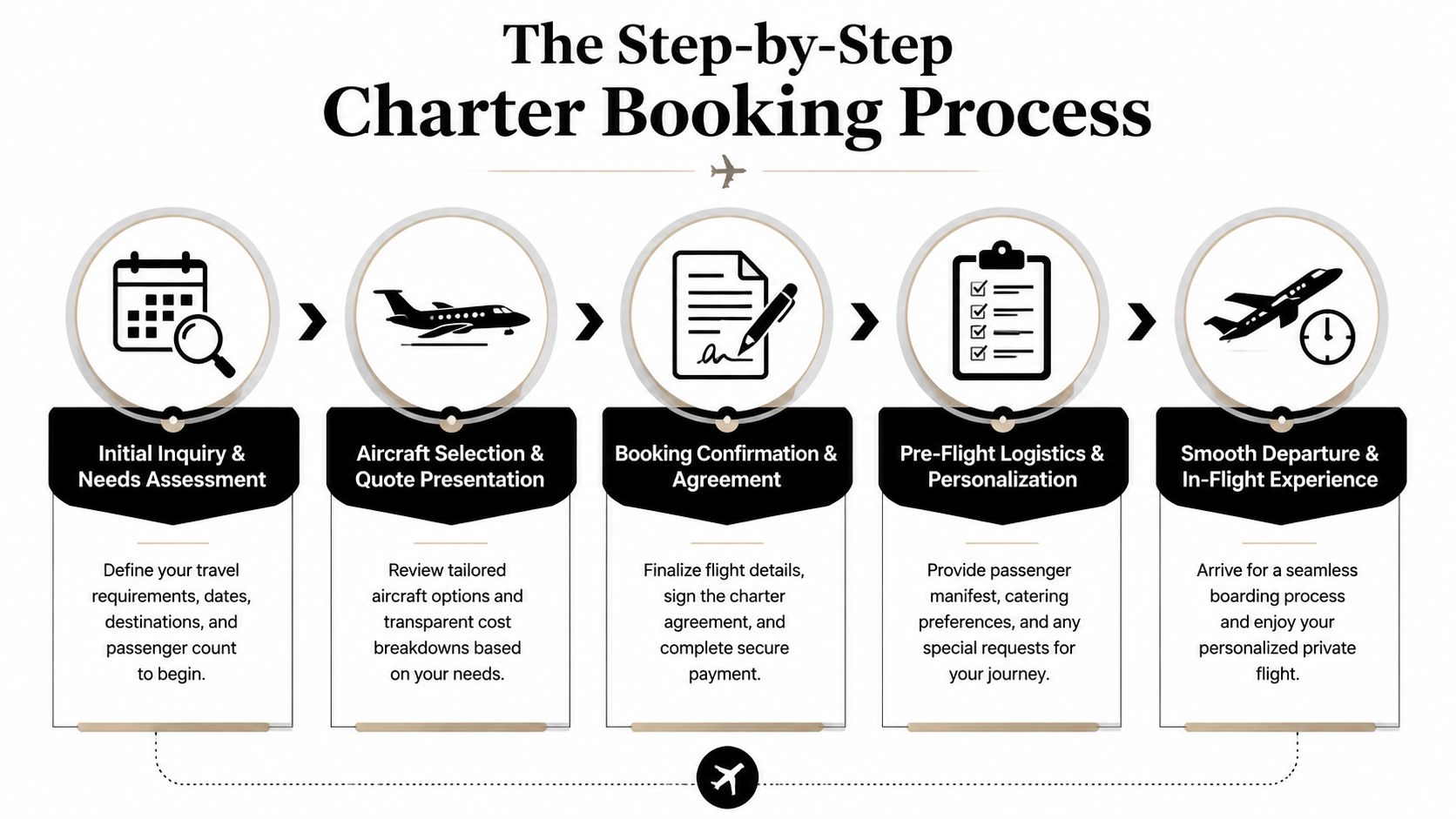
The first move is defining the mission with enough precision to get a real quote. Give the departure point, final destination, date, ideal departure window, passenger count, and luggage profile. If anyone is traveling with unusual baggage, pets, security personnel, or medical needs, that should be stated up front because aircraft suitability changes quickly once those details enter the picture.
Here's the process at a glance.
Start with trip accuracy, not speed
Clients often think a fast quote is the sign of a strong charter provider. It isn't. A fast quote that doesn't reflect bags, ground timing, aircraft location, or route constraints only creates rework later.
The better approach is to submit:
- Passenger details: Full count, and whether the group includes children, assistants, or security.
- Route needs: One-way, round trip, same-day return, or multi-stop.
- Cabin priorities: Wi-Fi, catering expectations, pet policy, and baggage shape.
- Timing tolerance: Exact departure versus a usable window.
Evaluate the aircraft, not just the number
Once quotes come back, compare the specific aircraft being offered. Some services present a broad category and assign the tail later. Others let you review the actual year, make, and model before you commit. That matters because two aircraft in the same category can feel very different in cabin finish, luggage access, and suitability for the route.
One option in the market is Haute Jets, which allows clients to select the specific aircraft and provides full pre-flight details before departure. That model suits clients who don't want to accept a generic aircraft category and hope the final assignment matches expectations.
Ask for the actual aircraft details before payment, not after contract signature.
A strong quote review also checks the operator credentials, departure logistics, and whether the itinerary includes realistic turn times. If the mission is important, a “cheaper” quote with vague aircraft assignment is often the more expensive decision.
Later in the process, the booking becomes more administrative, but this is also where confidence should increase, not drop.
Confirmation should remove surprises
After you approve the aircraft and sign the agreement, the operator or broker will need the passenger manifest and identification details required for the flight. Catering, ground transport, and any cabin requests should be finalized at this stage.
The best confirmation process gives you concrete operating details before departure. For many clients, the most reassuring package is the one delivered roughly a day before the flight: the tail number, crew information, final timing, and the passenger manifest as filed. At that point, there should be no ambiguity about what aircraft is flying, who is operating it, and when you need to arrive.
That's what turns private aviation from a luxury purchase into a controlled transport decision.
Delhi Airport Logistics and Ground Services
The airport experience in Delhi is one of the clearest reasons people choose charter. You're not buying only a seat. You're buying control over the ground process.
At Indira Gandhi International Airport, private flyers typically use dedicated business aviation handling rather than the commercial passenger flow. That means separate coordination, more privacy, and a shorter path from curb to aircraft. For first-time clients, the term worth knowing is FBO, or fixed-base operator. In practical terms, it's the private side of the airport experience: lounge access, document checks, security coordination, and ramp transfer.
What the ground experience should feel like
A well-run private departure in Delhi feels directed, not crowded. Your driver arrives at the designated private handling point. Staff verify the manifest and identification. Bags are processed without the usual terminal bottlenecks. If ground transport is arranged properly, the handoff is smooth.
This airport guide to Indira Gandhi International Airport VIDP gives useful context on the airport itself and helps first-time flyers understand where private operations differ from airline travel.
The Indian regulatory detail many clients never hear
In India, charter cost isn't shaped only by aircraft size and airport charges. Registration and operating category matter too.
Indian charter prices can be inflated by 30% to 35% due to regulatory costs associated with Private Category aircraft versus NSOP, or Non-Schedule Operator Permit, aircraft, a distinction explained in this discussion of Indian charter regulations. In plain language, some aircraft carry a cost structure that can make your quote meaningfully higher, and many first-time buyers aren't told why.
That's why permit status should be part of the commercial conversation, not buried in the operator background.
If a Delhi quote looks unusually high, ask whether the aircraft is operating under NSOP or Private Category. That question often clarifies the price immediately.
Ground coordination that actually matters
For domestic departures, lead times are usually more forgiving than for international missions, but details still matter. A clean manifest, correct IDs, and confirmed car timing prevent most day-of-flight friction. For international departures from Delhi, permit and border formalities become more important, and small documentation errors can create delays.
The ground service side also includes practical requests people tend to underestimate:
- Catering timing: Last-minute changes are possible, but earlier is smoother.
- Vehicle coordination: Especially important if you're traveling with family office staff or security.
- Special handling: Pets, medical equipment, and oversized baggage should be flagged in advance.
Clients rarely remember the paperwork. They remember whether the airport experience felt controlled. That usually depends less on luxury and more on whether the operator understood Delhi's logistics from the start.
Ensuring Your Safety with Certified Operators
Price matters. Timing matters. Neither matters more than the operator.
In private aviation, safety claims are easy to make because every operator can say the right things on a website. The harder question is whether an independent third party has reviewed the operation in a meaningful, ongoing way. That's why experienced charter buyers put more weight on recognized audits than on self-description.
What to look for before you approve a flight
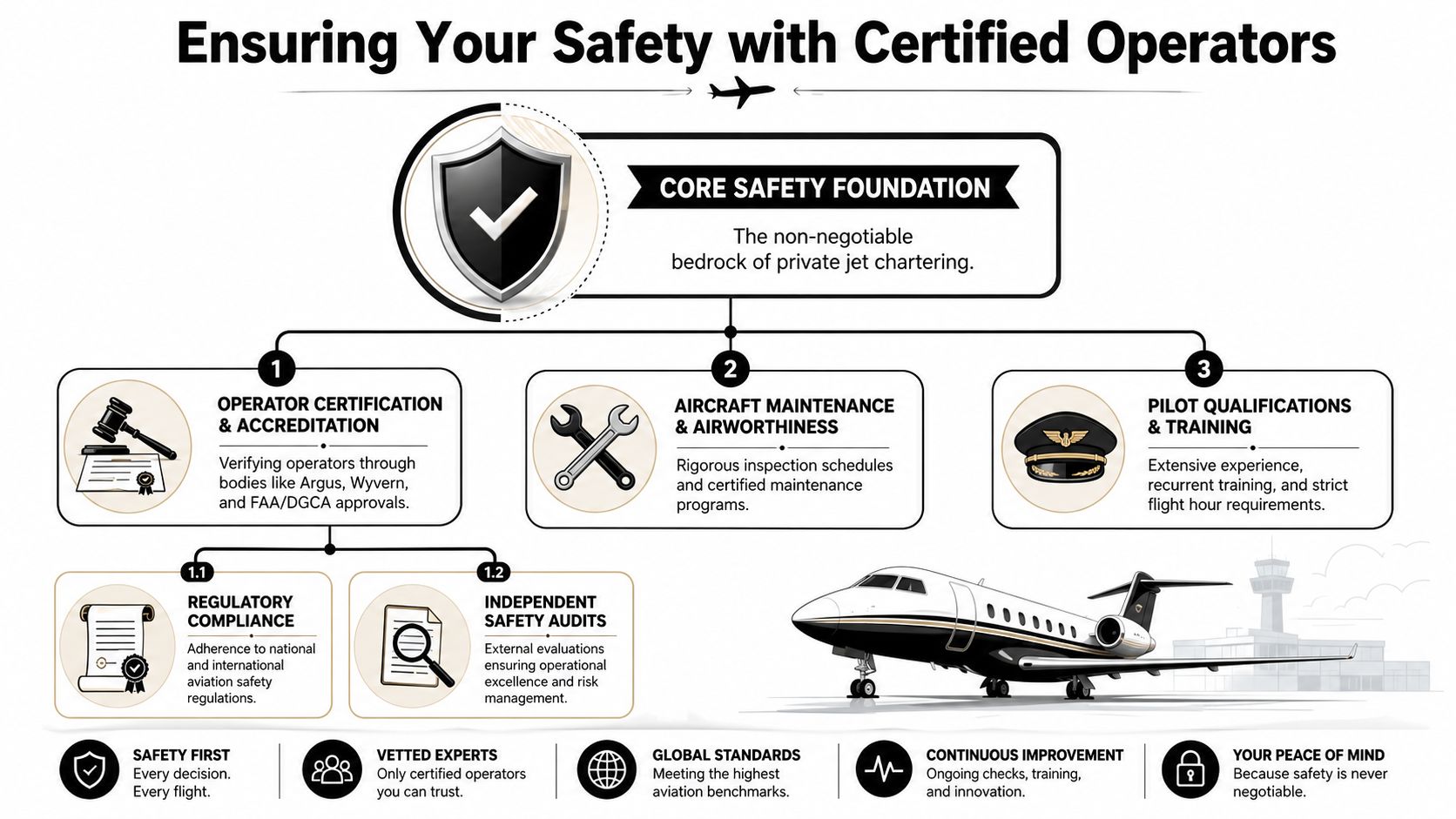
The two names clients should know are Wyvern and Argus. These are third-party safety auditors used across business aviation to assess operator standards beyond basic marketing language. When an operator holds a Wyvern Wingman rating or an Argus Gold or Platinum rating, it signals a higher level of external scrutiny around operational practices, crew qualifications, and maintenance oversight.
That doesn't replace your own due diligence. It gives you an objective starting point.
The three checks that matter most
When reviewing a charter option, focus on a short list.
- Operator accreditation: Ask whether the operator carries a current Wyvern or Argus credential, not whether they “follow high standards.”
- Aircraft maintenance path: Confirm the aircraft is maintained through recognized programs and is current for the mission.
- Crew currency: Make sure the flight is staffed by properly qualified crew assigned through the operator's standard process.
Safety gets weaker when clients treat it like a brochure item instead of a booking criterion.
A common first-time mistake is assuming the platform, broker, and operator are all the same entity. Sometimes they are. Often they aren't. The company taking your inquiry may be sourcing lift from an operator you've never heard of. That's normal in charter. What isn't acceptable is being unable to identify who is operating the flight.
Why third-party verification matters
Independent audits matter because they create a standard clients can verify without becoming aviation specialists. You shouldn't need to inspect a maintenance log yourself to understand whether the operator belongs in a top-tier charter shortlist.
The cleanest policy is simple: fly only with operators that meet recognized third-party standards. That removes a lot of noise from the decision.
For clients booking premium travel out of Delhi, especially on unfamiliar aircraft or with short notice, this is one area where convenience should never override process. A polished cabin and a low quote don't compensate for weak operator transparency. A certified operator with a clear paper trail does.
Insider Tips for Cost-Effective Charter Flights
A Delhi client asking for a same-day departure to Mumbai often focuses on the hourly rate first. The final invoice usually moves for other reasons. The aircraft may be sitting in another city. The routing may trigger extra parking, handling, or duty costs. In the Indian market, those line items can change the quote more than a small difference in aircraft category.
The practical way to control spend is to buy around the mission, not the badge on the tail. If six passengers are flying with light baggage on a short domestic sector, paying for a midsize or super-midsize cabin without a clear operational reason usually wastes money. The right aircraft is the one that covers range, baggage, runway limits, and comfort without carrying cost you do not need.
Where Delhi charter quotes usually get expensive
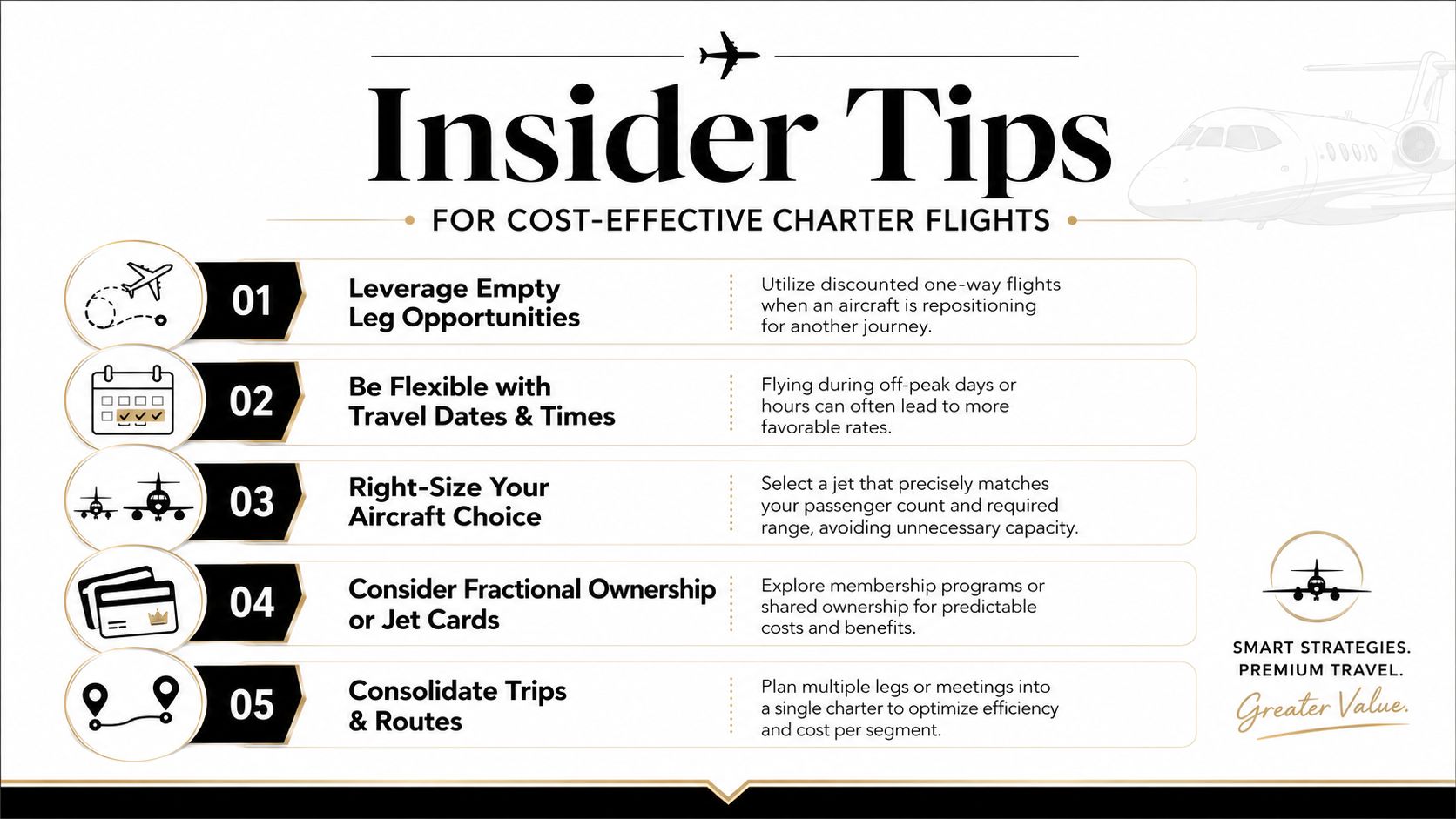
Repositioning is the first item to check. A quote can look competitive until you learn the aircraft must come in empty from Mumbai, Ahmedabad, or Dubai before it ever reaches Delhi. That ferry cost is real, and in India it often catches first-time clients off guard.
Regulatory and airport charges also matter. Depending on route and airport pair, you may see handling fees, parking, permit-related costs, and taxes that are not obvious if a provider gives you only a broad all-in number. A serious charter discussion should make clear which charges are fixed, which are estimated, and which depend on timing or airport use.
Empty legs can help, but only when the trip is flexible enough to fit the aircraft's existing schedule. Travelers considering that option should read this guide on what an empty leg flight is before assuming a discounted sector will behave like a standard on-demand booking.
Habits that produce better pricing
Cost-aware clients usually do four things well:
- Give a real timing window: Even a few hours of flexibility can open access to a better-positioned aircraft.
- Share the full itinerary early: If there is a same-day return, overnight wait, or onward leg, include it at the start so pricing reflects the actual mission.
- Ask where the aircraft is based: This is the fastest way to surface ferry costs before they get buried in the quote.
- Match the cabin to the trip: Choose up only when passenger count, baggage volume, sector length, or onboard expectations justify it.
One more trade-off matters in Delhi. Prepaid programs and jet cards can suit frequent flyers, but they are not automatically cheaper on India-origin missions. If the provider is steering you into limited inventory or masking repositioning inside a fixed rate, the format is convenient but not always efficient. On-demand charter usually works better when you want to compare actual aircraft availability against the route in front of you.
The goal is transparent wholesale pricing, not the lowest headline number. A cheaper quote with an out-of-position aircraft often becomes expensive by departure day. Haute Jets helps avoid that problem by sourcing against the live mission, identifying local or better-positioned lift where possible, and showing clients where repositioning and airport charges are affecting the price.