

You've got a Thursday evening departure from Denver, a ski weekend on the calendar, and a broker's quote that looks reasonable until the aircraft location, airport transfer, and winter handling charges appear. Or you're leaving early Friday for a board meeting in Dallas and discover that the “Denver” aircraft is coming from another hub. In both cases, the hourly rate is only the beginning.
A smart private jet charter Denver booking starts with the route, airport, aircraft, and operator, in that order. Denver is a distributed business-aviation market, and local sourcing can matter more than negotiating a few dollars off the hourly rate. The wrong airport or a repositioned aircraft can inflate a traditional quote by 20–40%, according to Haute Jets' published sourcing model.
Why Denver Is a Different Private Charter Market
A Thursday departure to Aspen and a Friday flight to Dallas can both start in Denver, yet they require different charter decisions. Aspen demands mountain access, aircraft performance, weather planning, and a short transfer from the south metro area. Dallas may call for an early departure, reliable Wi-Fi, productive cabin space, and an aircraft already positioned nearby.
Before requesting a quote, define the mission:
- Destination arrival time: When must you reach the destination, not leave the ground?
- Passengers and baggage: How many travelers are coming, and will skis, samples, or other bulky items be loaded?
- Trip structure: Is the itinerary one-way, round-trip, or multi-city?
- Arrival constraints: Do altitude, runway, weather, or aircraft-performance limits affect the destination?
- Aircraft location: Is the aircraft based near Denver, or must the operator reposition it into the market?
The aircraft's starting point deserves the same attention as its hourly rate. Repositioning can add 20–40% to a traditional broker quote, so local operator sourcing and the correct departure field often save more than negotiating a small hourly discount.
Centennial Airport, or KAPA, remains a major private-aviation gateway for the region. It is described as the primary general aviation airport in the Denver metro area, with just under 900 operations per day and more than 30,000 annual business-jet departures, according to Centennial Airport's private-aviation overview. That volume supports established FBO services, aircraft availability, and quicker turnarounds.
Denver's airport network changes the economics
Rocky Mountain Metropolitan Airport, or KBJC, serves the north and west metro area, including Boulder and Broomfield. Denver International Airport, or KDEN, handles airline traffic and some large-cabin private operations. Mountain airports then shape whether the final itinerary works efficiently, particularly when runway, weather, or aircraft-performance limits affect the mission.
Centennial's general-aviation role also has a long operating history. Jet Linx opened its Denver operation there in 2010, and the airport had received recognition at the 1975 Paris Air Show as the best general aviation airport in America. Denver International handled 38,898,467 passengers in 2023, up 12.3% from 2022, reflecting the scale of demand across the wider market.
Practical rule: Treat Denver as an airport-and-operator sourcing problem, not a single-city quote request.
Choosing the Right Denver Departure Airport
The best departure field depends on where you're starting, where you're going, and what the aircraft needs. Centennial usually wins for south Denver and many ski-bound trips. BJC is a better fit for Boulder, Broomfield, and the U.S. 36 corridor. KDEN earns its place when the aircraft is large, the itinerary is international, or weather resilience and runway length justify the extra ground time.
| Airport | Best For | Runway / Aircraft Limit | Drive From Key Areas | Typical FBOs |
|---|---|---|---|---|
| KAPA, Centennial | South Denver, Cherry Creek, Highlands Ranch, light and midsize ski trips | Longest runway reported at 10,002 feet, supporting a broad range of private-jet missions | About 15 miles southeast of downtown. Usually practical for south metro travelers | Signature Aviation, TAC Air, and other established FBO services |
| KBJC, Rocky Mountain Metropolitan | Boulder, Broomfield, north and west Denver, ski-corridor access | Longest runway reported at 9,000 feet, suitable for many private-jet missions | About 20 miles northwest of downtown, with strong access for Boulder and western suburbs | Full-service private-aviation FBOs, including Sheltair ground handling |
| KDEN, Denver International | Heavy jets, international arrivals, and aircraft requiring a long runway | Dedicated private-aviation facilities and a 16,000-foot runway | Best for travelers already near the airport or flying large-cabin and international missions | Dedicated private-aviation facilities |
| KEGE, Eagle County | Arrival into the Vail Valley and an alternate mountain gateway | Mountain-airport suitability depends on aircraft performance and conditions | Not a Denver departure field. It's an arrival option for the resort region | Regional FBO services |
Centennial is roughly 12–15 miles south and southeast of downtown Denver and is described as the second busiest general aviation airport in the United States, with more than 340,000 operations annually and no scheduled commercial flights, according to Centennial Airport charter coverage. That density is useful when you want a light or midsize jet sourced locally.
BJC's position makes it attractive for travelers north of downtown and for ski itineraries that benefit from less commercial-airport congestion. It's also described as Denver's primary private-jet hub, with Vail about 45 minutes away and Breckenridge about 1 hour away by ground transfer, according to Denver mountain-charter coverage.
For KDEN-specific terminal information, review the Denver International private terminal guide. Don't choose KDEN just because its runway is longer. Choose it when the aircraft, international handling, or operational requirements make that advantage meaningful.
Matching Aircraft Size to Your Mission
A four-hour Denver departure with four travelers, presentation cases, and checked bags requires a different aircraft from a short mountain hop for two people. Choose the aircraft around the mission, then require the operator to source it near the departure airport. That approach limits repositioning fees, which traditional broker quotes can inflate by 20–40%.
Start with true passenger count plus baggage, then check the one-way block time. A cabin that technically seats everyone may still lack usable luggage capacity or workspace.
Use cabin class as a planning tool
For planning, compare the cabin classes rather than accepting the first aircraft a broker offers:
- Very light jets, such as the Phenom 100 or Citation Mustang, suit 1–4 passengers and short legs under 2 hours. Choose them when baggage is limited and the route is straightforward.
- Light jets, including the Citation CJ3, CJ4, and Phenom 300, fit many 2–3 hour missions and balance speed, cabin utility, and operating cost.
- Midsize jets, such as the Hawker 900XP and Citation Latitude, work better for transcontinental comfort, extra baggage, or a cabin where travelers need to work.
- Super-midsize aircraft, including the Challenger 350 and Praetor 600, suit nonstop East Coast missions and some international itineraries.
- Heavy jets, such as the Gulfstream G450, G550, and Global 6000, fit long missions where range, cabin space, and crew support outweigh a low hourly figure.
A light jet often looks attractive until baggage, passenger comfort, or a required fuel stop changes the assignment. For a long leg, a midsize cabin can improve productivity and comfort without automatically making the per-seat economics unattractive.
Ask for the complete mission cost, not only the hourly rate. The quote should identify the departure airport, aircraft location, ferry segments, and return plan. Local operator sourcing at Centennial or Rocky Mountain Metropolitan can eliminate unnecessary repositioning that a traditional broker may build into the quote.
The right aircraft completes the mission without a technical stop, baggage compromise, or unnecessary repositioning.
An empty leg in the next cabin size may be the better choice when its timing and airport pair match your plans. Confirm those details before treating the lower price as a real saving. The operating carrier, tail number, and cabin layout are confirmed in the 24-hour pre-flight packet sent before departure.
Pricing, Repositioning, and Empty-Leg Opportunities
A Denver charter quote has two cost layers: the aircraft's operating rate and the cost of bringing that aircraft to your departure airport, then moving it afterward. Traditional brokers often foreground the hourly figure while burying ferry and deadhead segments. That approach can make a locally sourced flight look expensive when it is the lower all-in option.
Local sourcing is the first price test
Ask whether the aircraft is already positioned near Centennial, Rocky Mountain Metropolitan, or another practical Denver-area airport. Haute Jets reports that traditional brokers and jet-card programs may inflate charter prices by 20–40% through repositioning fees. The right comparison is the complete mission cost, including ferry segments, crew movement, airport handling, and the return plan.
This question matters on Aspen, Telluride, Jackson, and Sun Valley routes, where seasonal demand sends aircraft through the Rocky Mountain market. Local operator sourcing can reduce unnecessary repositioning because the aircraft and crew may already be nearby. A traditional broker quote that includes a long ferry leg can therefore cost more than a direct local arrangement, even when both quotes show a similar hourly rate.
| Factor | Full Charter | Empty Leg |
|---|---|---|
| Aircraft access | Reserved specifically for your itinerary | Uses an aircraft already repositioning |
| Schedule | Built around your departure and return | Limited to the operator's existing movement |
| Airport pair | Usually negotiable within operational limits | Often fixed or less flexible |
| Price structure | Includes the planned mission and applicable positioning | Can reduce the cost of a repositioning flight |
| Best fit | Important meetings, fixed ski weekends, multi-leg travel | Flexible travelers with adaptable timing |
| Main risk | Paying for unnecessary deadhead segments | Losing the flight if the primary charter changes |
Empty legs are discounted repositioning sectors, not a separate aircraft category. Their value depends on flexibility. Accepting a different departure time, nearby airport, or one-way itinerary can make an empty-leg offer attractive. A family that must leave at a fixed hour from one exact FBO should choose a conventional charter sourced from an operator already serving the region.
Review the empty-leg flight guide before comparing these offers. Request the aircraft tail, operating carrier, departure and arrival airports, cancellation terms, and total price. Until those details are confirmed, treat the quote as an opportunity, not a booked flight.
Safety and Operator Checks That Actually Matter
A polished website isn't a safety credential. Before paying a deposit, verify the operating carrier, aircraft, crew standards, and independent audit status. The strongest starting point is a provider that can identify the actual Part 135 operator rather than hiding behind a broker brand.
Run this check before signing
- Wyvern Wingman: Ask for the operator's registry information and confirm that the status is active through the relevant Wyvern system.
- IS-BAO Stage 3: Verify the operator's registration and stage status through the International Business Aviation Council's records. Stage 3 indicates a mature safety-management culture.
- Argus Gold or Platinum: These ratings evaluate operator safety practices, aircraft, crews, and operational systems. Ask what the current rating applies to and whether it covers the specific operator flying your trip.
- Pilot experience: Request total flight hours, type-specific hours, and recent experience in the aircraft model. Mountain routes deserve direct answers.
- Crew readiness: Confirm crew-rest planning, simulator training, and the maintenance program supporting the aircraft.
- Documentation: Review the FAA operating authority and applicable DOT and Part 135 documentation before accepting a final itinerary.
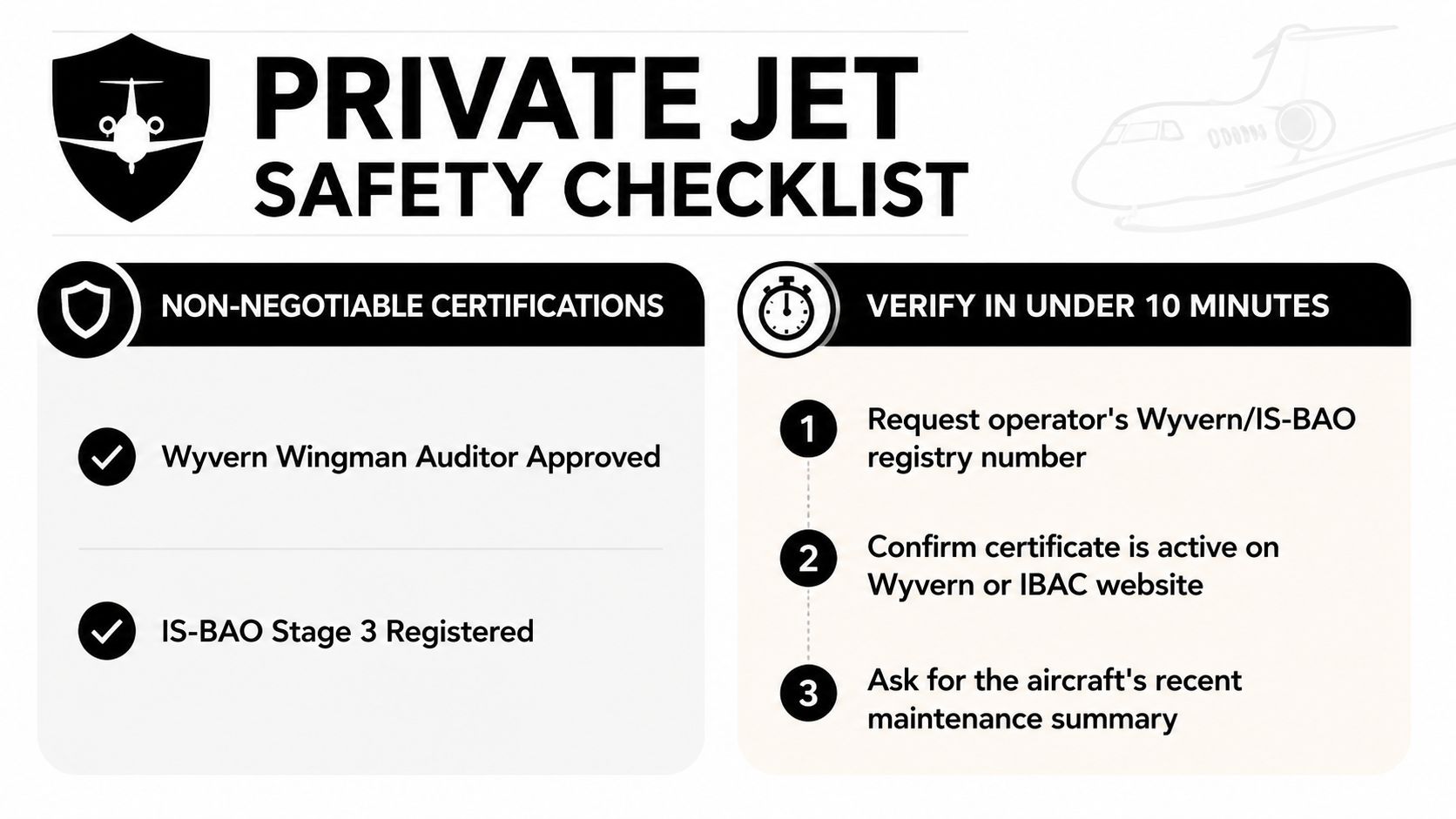
A serious operator should also provide a 24-hour pre-flight confirmation. That confirmation should include the tail number, crew details, weather briefing, passenger manifest, NOTAM review, fuel-reserve policy, and a direct contact path to the captain or flight department.
Red flag: If the seller can't name the operator, tail number, or accountable flight department before payment, you're buying a marketing promise rather than a transparent charter.
Denver's altitude and mountain routing make operating-base location relevant. A provider with aircraft and operational support near the region can reduce unnecessary ferrying and improve coordination when weather, de-icing, or destination restrictions change. For broader safety context, use this private-jet safety resource, then apply the checklist to the exact aircraft and operator on your quote.
Booking Timeline, Documents, and Ground Logistics
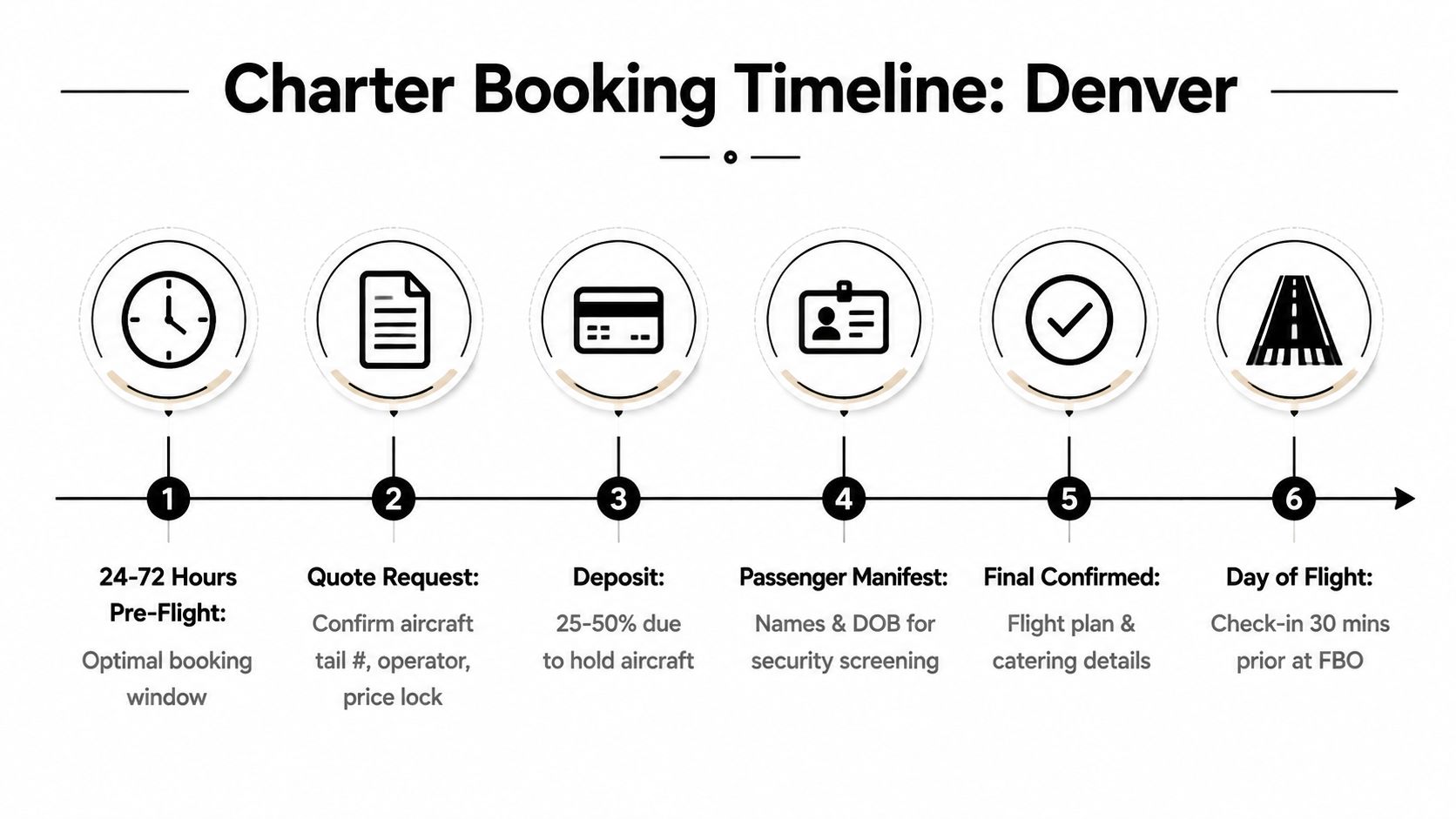
For domestic Denver departures, the practical booking window is often 24–72 hours when aircraft availability cooperates. Peak ski dates, large groups, specific cabin layouts, and international itineraries require earlier planning because the aircraft, crew, FBO, and ground transport all need to align.
Start by demanding a written quote that names the aircraft type, operating company, airport pair, schedule, inclusions, and cancellation terms. The operator should identify the tail number before departure, even if availability requires a substitution during the initial quoting stage.
Documents and deposits
Passenger manifests normally require each traveler's legal name and date of birth. The private terminal still conducts identity and security procedures, so incomplete information can delay departure. For international legs to Mexico or Canada, confirm passport, customs, immigration, and operator documentation requirements before the contract is executed.
Deposits commonly fall between 25–50%, as shown in the booking workflow provided for this charter process. Cancellation language matters just as much. A 12-hour cancellation window may appear in the agreement, but the exact penalty structure can vary by operator, aircraft, route, and timing, so read the contract instead of relying on a verbal summary.
Ground handling decides whether the trip feels private
Lock the FBO at the same time as the aircraft. Centennial offers multiple established FBO options, and its jetCenters of Colorado facility advertises hangar space and de-icing services, according to Centennial FBO information. That capability matters during winter ski departures, when de-icing can add turnaround time and complicate the departure sequence.
Confirm catering, baggage handling, vehicle access, and ground transportation. For mountain trips, coordinate the resort transfer before departure rather than waiting until arrival. An integrated concierge can also arrange hotel check-in support, ski-rental delivery, and restaurant reservations, but those services should appear in the itinerary and pricing summary.
Post-flight invoicing should clearly separate the deposit, remaining balance, handling, catering, transportation, and any approved changes. Ask when the final invoice will be issued and who has authority to approve additional charges during the trip.
A Smarter Way to Charter in Denver
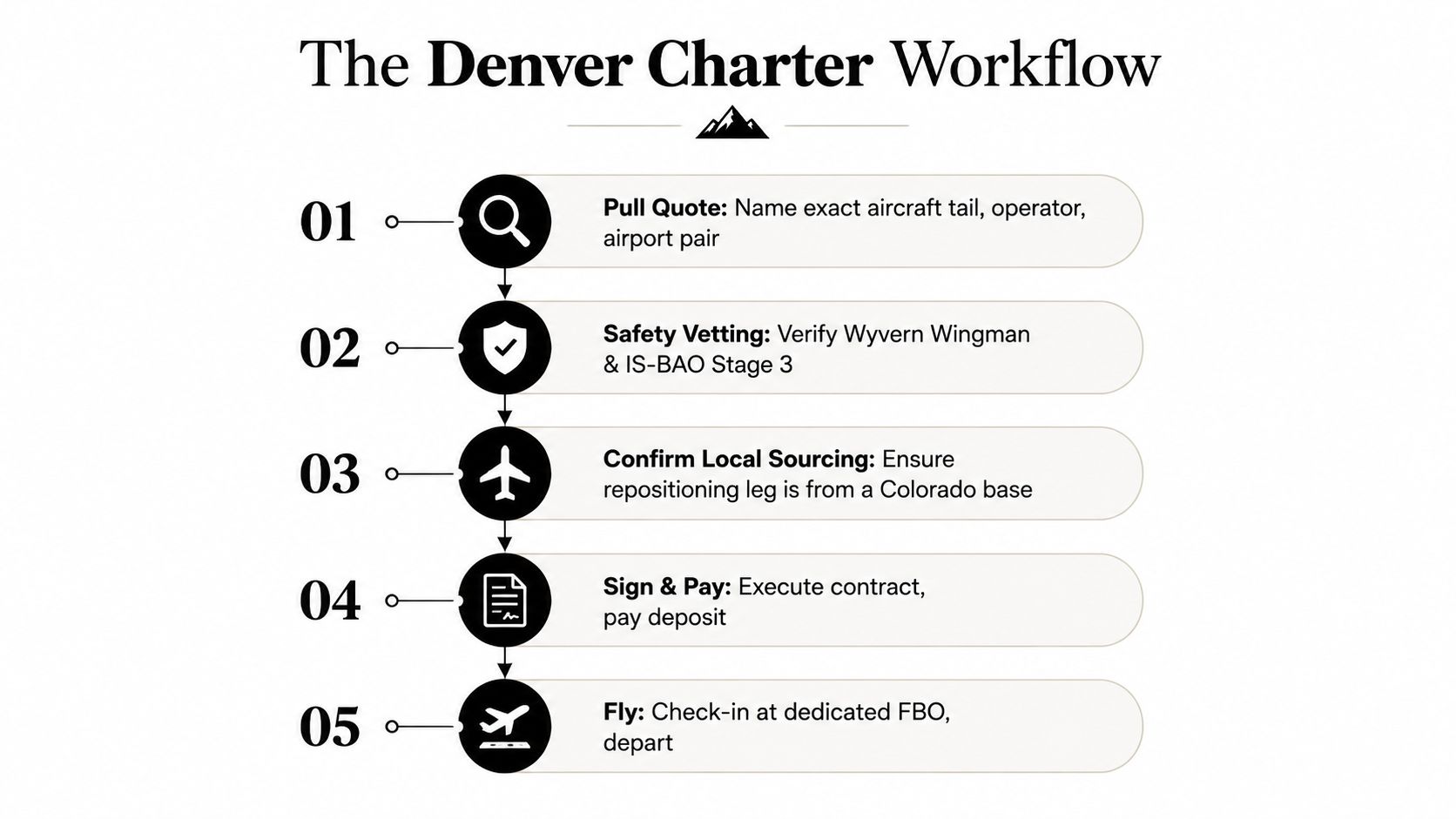
The efficient Denver booking process is repeatable:
- Pull a complete quote: Require the exact aircraft tail when available, operating company, departure airport, arrival airport, block-time assumption, and total price.
- Test local sourcing: Ask whether the aircraft is based in Colorado or whether the quote includes a repositioning leg from another hub.
- Verify safety status: Confirm active Wyvern Wingman or Argus Gold/Platinum status and review the operator's IS-BAO position where applicable.
- Lock the ground plan: Select the FBO, de-icing support, catering, vehicles, and resort transfer before signing.
- Compare flexible alternatives: Request empty-leg alerts from multiple operators, but accept one only when its timing, airport pair, aircraft, and cancellation terms fit the mission.
The biggest savings usually come from avoiding unnecessary aircraft movement, not from forcing a smaller cabin. Local sourcing can remove the 20–40% repositioning premium associated with traditional broker and jet-card models, while airport arbitrage lets you compare KAPA, KBJC, and KDEN against the traveler's actual ground route.
Haute Jets offers on-demand sourcing from owner-operators, access to aircraft across its international network, operator screening through Wyvern Wingman and Argus Gold or Platinum standards, and booking without membership fees or jet cards. Its Denver-relevant model addresses the practical issues that determine the invoice, including airport selection, local aircraft availability, empty-leg matching, safety verification, and coordinated ground logistics.
Get a Denver charter quote from Haute Jets with the exact aircraft, operator, airport pair, and repositioning details shown upfront. Tell the team whether you're flying to Aspen, Telluride, Dallas, or another destination, and ask them to compare a locally based aircraft against any empty-leg option before you commit.