

Germany's private charter market is growing fast enough that a bad sourcing decision can add thousands to a single trip. Demand is rising, aircraft are rotating constantly between city pairs, and major airports like Frankfurt and Munich punish late planning with tighter slot availability, longer handling timelines, and fewer good-value options.
This growth directly impacts anyone booking private jet charter Germany. A primary pricing problem is not the advertised hourly rate. It is repositioning. If the aircraft has to ferry in from another airport, or worse, another country, you pay for that movement whether it is shown clearly in the quote or buried inside it. In Germany, customs coordination and airport slot timing can push that cost even higher.
Smart buyers focus on three questions first. Where is the aircraft based? How will customs and ground handling be managed at the departure and arrival airports? Is the quote fully inclusive of repositioning, crew, handling, and any slot-driven operational costs?
That is where a local sourcing model saves real money. Haute Jets sources against live operator availability near the route, which helps clients avoid unnecessary ferry legs, cut wasted spend, and reduce booking friction. On many Germany itineraries, that approach can save 20 to 40 percent compared with quotes built around the nearest available jet instead of the right one. The broader shift in private travel demand is also clear in the 2025 wealth and mobility trends report.
If you are flying into Frankfurt, Munich, Berlin, Hamburg, or Düsseldorf, treat logistics as part of the price, not a side note. In Germany, the cheapest-looking quote is often the expensive one.
Germany's Booming Private Aviation Market
Germany's private aviation market is growing fast, and that growth changes how smart clients should buy charter. More demand means more aircraft movement, tighter airport coordination, and wider price gaps between a well-sourced trip and an expensive one.
As noted earlier, Germany's charter market is expanding at a strong pace. That matters because growth in this market does not create pricing consistency. It creates competition for aircraft, slots, handlers, and positioning efficiency, especially around Frankfurt, Munich, Berlin, Hamburg, and Düsseldorf.
What this growth means for clients
Germany rewards clients who treat charter as an operational purchase, not a luxury purchase. The aircraft itself is only part of the decision. The difference often comes from where that aircraft sits before your trip, how quickly the operator can secure the required airport timing, and whether the routing works cleanly through local handling and customs procedures.
Busy markets expose weak sourcing immediately. A broker who cannot source locally often fills the gap with a distant aircraft and passes that cost to the client. Sometimes it appears as a separate repositioning line. Sometimes it is buried inside the quote. Either way, you pay for it.
Ask one question early. Where is the aircraft based right now?
That question often matters more than the cabin category. Two jets can look identical on paper and produce very different total costs because one is already near your departure point and the other must ferry in from another part of Germany or from outside the country. In a market with tight airport procedures and busy business corridors, those inefficiencies add up quickly.
For a broader view of how affluent mobility patterns are changing, read the Haute Jets wealth and mobility trends report for 2025.
Why most charter advice misses the point
A lot of charter content gives you aircraft classes and sample hourly rates. That is entry-level information. In Germany, value comes from sourcing discipline.
The strongest option is usually the aircraft that fits the mission and starts close to the route. That is why a local sourcing model regularly saves 20 to 40 percent on Germany itineraries. It cuts unnecessary ferry legs, reduces timing risk, and avoids the friction that shows up when airport slots and ground handling are treated as afterthoughts instead of cost drivers.
The right question is simple. What is included in this quote, and why is this aircraft the right one for this route?
Understanding Private Jet Charter Costs in Germany
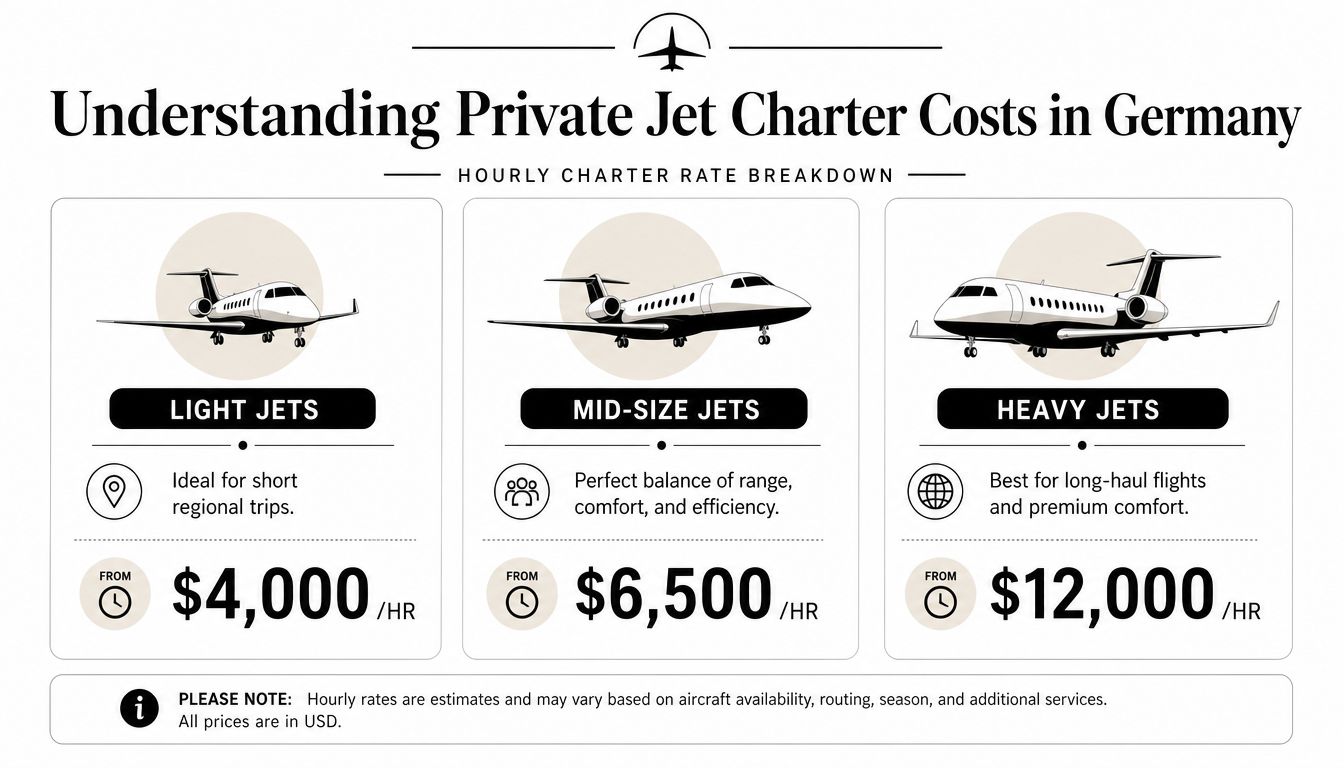
Pricing in Germany follows a clear aircraft hierarchy, but no serious client should stop at category alone. The hourly rate is your starting point, not your final number.
In Germany, light jets typically cost between $3,500 and $4,800 per hour, midsize jets range from $4,800 to $6,000, super midsize jets run from $6,000 to $7,500, and heavy jets range from $8,500 to $10,500 per hour, based on these Germany charter cost benchmarks.
The hourly rate by aircraft type
Use the ranges as rough mission planning numbers.
| Aircraft category | Typical Germany hourly range | Best fit |
|---|---|---|
| Light jet | $3,500 to $4,800 | Short regional trips, compact passenger groups |
| Midsize jet | $4,800 to $6,000 | Intra-European business travel with more cabin comfort |
| Super midsize jet | $6,000 to $7,500 | Longer sectors and travelers who need range plus stand-up cabin space |
| Heavy jet | $8,500 to $10,500 | Long-haul flights, larger groups, more luggage |
If you want a broader breakdown of what typically goes into a quote, this guide on private jet charter cost is a useful companion.
What changes the quote
The category rate doesn't tell you enough. In Germany, the final number usually shifts because of operational details:
- Aircraft make and model: A newer Citation Latitude won't price the same way as an older midsize cabin, even if both sit in the same broad category.
- Airport choice: Frankfurt and Munich operate differently from secondary airports. That affects handling, timing, and flexibility.
- Trip structure: A same-day return, overnight crew wait, or multi-stop itinerary changes the economics.
- Lead time: Last-minute demand compresses options and usually weakens your negotiating position.
- On-board requirements: Catering, Wi-Fi expectations, pet accommodation, and baggage profile all shape aircraft selection.
Practical rule: Ask for the exact aircraft, not just “a heavy jet” or “a midsize.” Category pricing hides quality differences and sourcing inefficiencies.
The mistake clients make
Clients often compare quotes as if they're buying a seat. They're not. They're buying a moving asset, crew time, airport access, and positioning logic wrapped into one number. If one quote is much higher, it doesn't automatically mean the operator is expensive. It may mean the aircraft is badly located for your mission.
That's why the financial side of private jet charter Germany only becomes clear when you pair the rate card with the routing logic behind it.
Navigating Major German Airports and FBOs
Airport choice shapes the entire experience. In Germany, it affects your ground time, your customs flow, your scheduling reliability, and sometimes the aircraft you can source efficiently.
The main private aviation gateways are straightforward. Frankfurt works best for finance, multinational business traffic, and long-haul connectivity. Munich is ideal for southern Germany, Alpine access, and luxury leisure travel. Berlin serves government, media, and startup traffic. Hamburg is efficient for northern Germany and maritime industry travel. Düsseldorf is a strong access point for the Ruhr and western corporate corridors.
What an FBO actually does
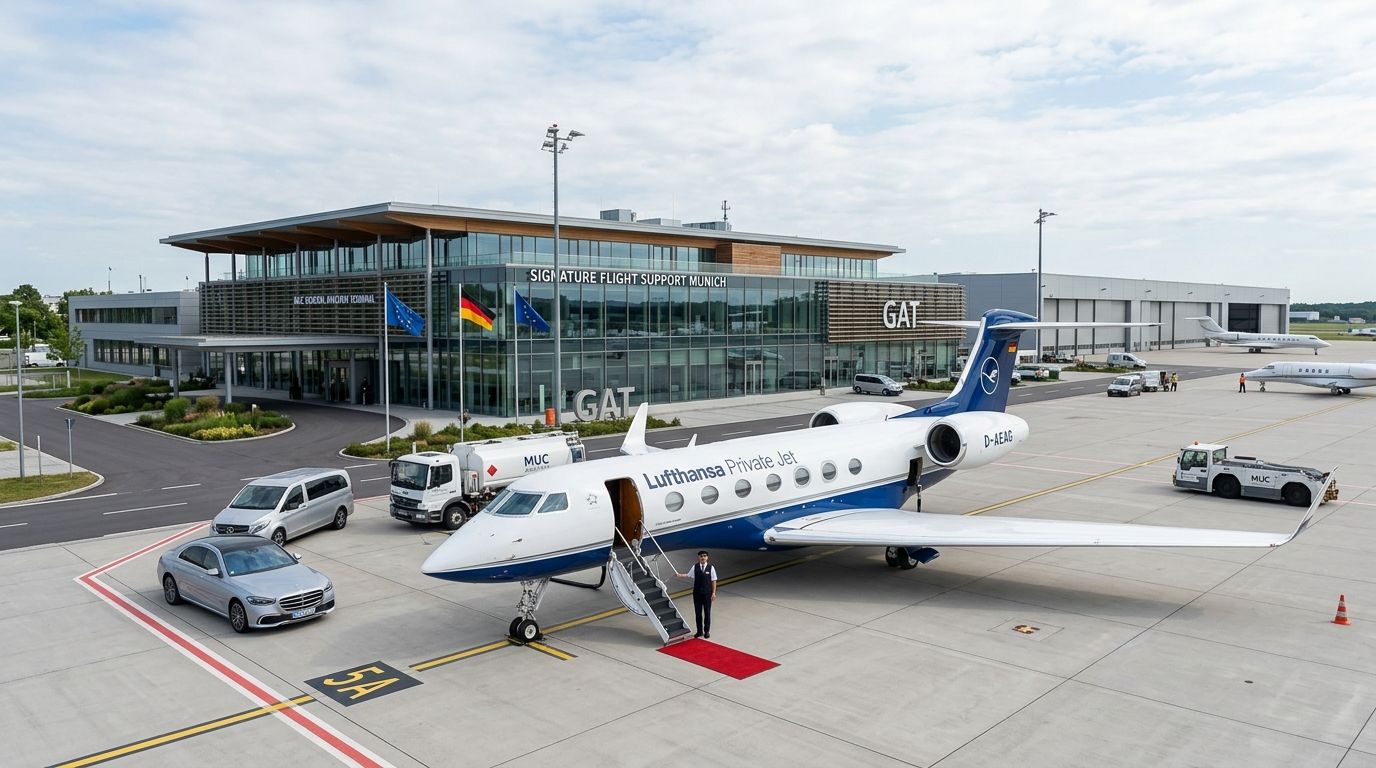
An FBO is the private terminal and service hub for private aviation. That's where passengers arrive, clear formalities when required, meet crew, handle baggage, and transfer directly to the aircraft. A good FBO turns a commercial-airport headache into a controlled handoff.
For Germany arrivals, especially at busy hubs, the FBO also acts as the coordination point for handlers, security, ramp access, and any timing-sensitive passenger requirements. If you're flying with assistants, pets, production gear, or a tight onward schedule, small operational mistakes in such instances become expensive.
You can get a sense of how this works at one of the country's busiest gateways through this look at the Frankfurt Airport private terminal.
Customs is where bad planning shows up
For flights arriving in Germany from outside the EU, customs and border handling need to be arranged cleanly before wheels-up. Data indicates that 42% of private jet complaints in Europe relate to uncommunicated customs procedures, according to this private jet booking questions guide.
That number tracks with what clients experience in real life. The flight itself usually goes smoothly. Confusion starts on arrival when nobody has clearly explained manifest checks, handler coordination, or exactly where and when passengers will clear.
A few rules make this easier:
- Confirm arrival status early: Non-EU flights need different handling than intra-Schengen hops.
- Use airports with strong private terminal support: Major airports can be excellent, but only when the paperwork and handlers are aligned.
- Don't assume “private” means automatic speed: It means control, not exemption from border formalities.
If customs hasn't been spelled out in writing before departure, expect friction on arrival.
The Hidden Cost of Repositioning and How to Avoid It
Most charter overpayment stems from this.
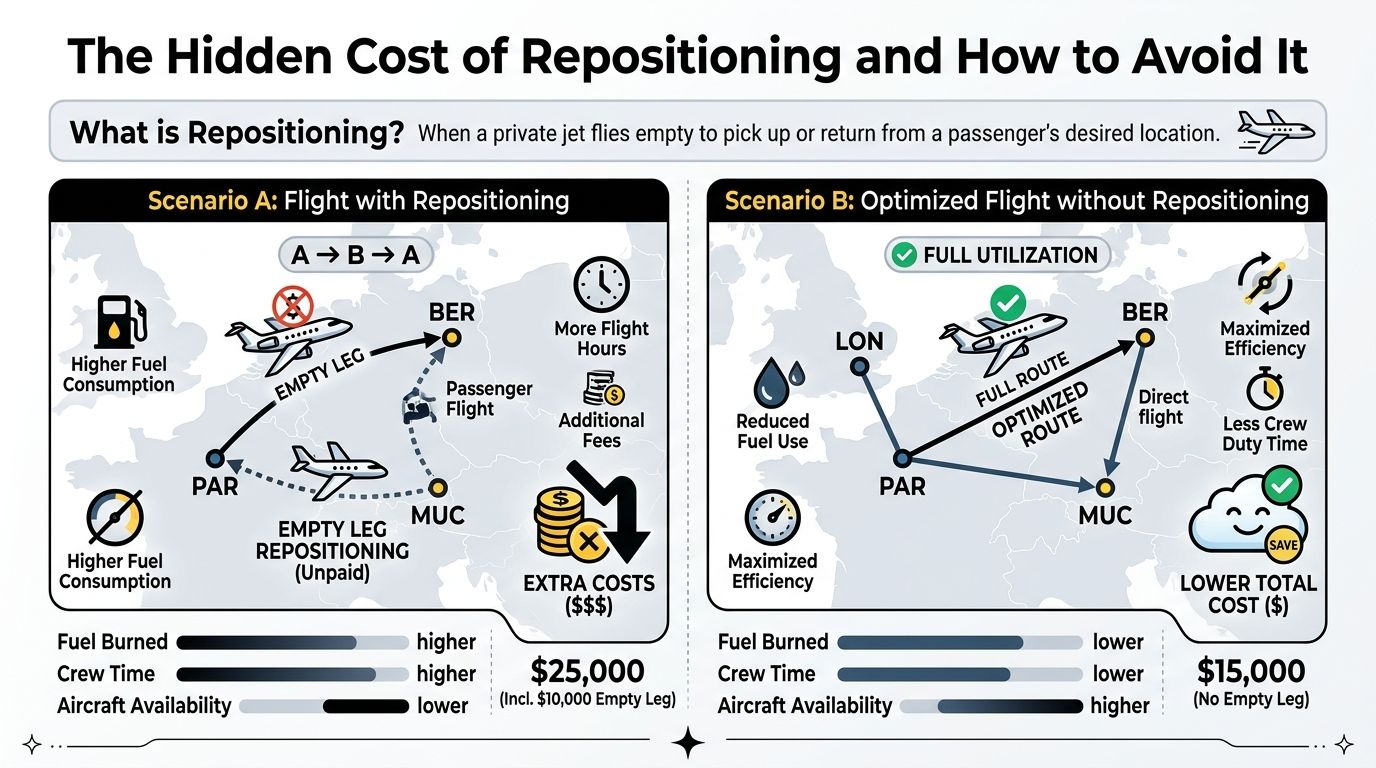
Repositioning means the aircraft has to fly empty to pick you up, or fly empty after dropping you off so it can return to base or continue to its next assignment. You're not sitting on that leg, but you may still be paying for it. In Germany, that cost gets buried inside otherwise normal-looking quotes.
Repositioning fees can inflate base charter costs by 20 to 40% when aircraft aren't sourced locally. Last-minute bookings in Germany can also incur 20 to 30% higher fees due to positioning constraints and airport fee volatility, according to this private jet charter pricing overview.
Why quotes vary so much
Two flights can look identical on paper and still price very differently.
One aircraft may already be near Berlin, Frankfurt, or Munich. Another may need to come in from another city before your trip even starts. That empty movement adds time, fuel burn, crew complexity, and handling charges. If the broker doesn't explain it, the quote just looks “high.”
Here's the cleanest way to explain it:
| Booking scenario | What you're paying for | Cost pressure |
|---|---|---|
| Locally sourced aircraft | Your actual mission | Lower |
| Repositioned aircraft | Your mission plus empty movement | Higher |
| Last-minute with poor local availability | Your mission plus urgent positioning constraints | Highest |
How to avoid paying for someone else's logistics problem
Don't accept a quote until you've asked these questions:
- Where is the aircraft based right now?
- Is any repositioning included in this number?
- If I shift departure time slightly, can you source a closer aircraft?
- Is this the exact aircraft or just a category placeholder?
Those four questions eliminate a lot of noise.
A local sourcing model is the obvious fix. Instead of selling whatever aircraft a broker happens to control or prefers to move, it searches for aircraft already positioned near your departure point. That strips out unnecessary empty legs and gives you a more honest cost base. One example is Haute Jets, which sources from locally based owner-operators rather than relying on a fixed membership fleet. In practical terms, that means fewer inflated quotes caused by poor aircraft placement.
The cheapest-looking hourly rate can become the most expensive trip if the jet starts in the wrong city.
Safety and Regulatory Standards in Germany
Germany is a strict operating environment, which is exactly what you want. Any aircraft flying charter there must comply with European regulatory requirements, and reputable operators work within a well-defined framework of maintenance, crew qualification, and operating procedures.
That said, baseline compliance isn't enough for premium charter. Clients shouldn't confuse legal minimums with top-tier risk management. True separation happens at the operator level.
What to look for beyond legal compliance
The strongest shorthand in charter safety is third-party audit quality. In the private aviation market, Wyvern Wingman and ARGUS Gold or Platinum are the labels experienced buyers pay attention to because they indicate a deeper level of operational vetting than a broker's sales language ever will.
When I review an operator for a Germany itinerary, I focus on four things:
- Audit status: Wyvern Wingman or ARGUS Gold/Platinum is the baseline I'd want for high-value clients.
- Aircraft suitability: Not every approved aircraft is the right aircraft for weather, baggage load, runway constraints, or mission length.
- Crew quality: Experience matters most when the trip gets irregular, not when everything is easy.
- Operational transparency: If a broker won't clearly identify the operator, tail number timing, and aircraft details, move on.
What sophisticated clients should insist on
The right safety conversation is specific.
Ask for the exact operator. Ask which aircraft you're flying. Ask whether the crew and aircraft details will be confirmed before departure. Ask whether the provider checks pet rules, Wi-Fi availability, and baggage constraints against the exact tail, not just the model type.
Safety is not a slogan. It's the sum of operator quality, aircraft suitability, and disciplined pre-flight communication.
That's also why the smoothest charters often feel uneventful. The visible luxury matters, but the invisible preparation matters more.
Your Step-by-Step Guide to Booking a Charter
A good charter booking should feel controlled from the first call. If it feels vague, it will probably stay vague all the way to wheels-up.
For Germany itineraries, I'd book in this order.
Start with the mission, not the aircraft
Give the broker the route, travel date, preferred departure windows, passenger count, baggage profile, and any special handling needs. If you start by asking for “a heavy jet” without defining the trip, you'll get broad quotes that are harder to compare.
For reference, route economics can vary sharply. A light jet from London to Berlin typically costs about $12,600 one way, while a large jet for 12 passengers from New York City to Berlin averages about $99,400 one way, based on these Berlin private jet charter benchmarks.
Compare quotes the right way
Don't compare category labels alone. Compare the full trip logic.
- Check the exact aircraft offered. A model name tells you more than “light” or “midsize.”
- Ask whether the quote is all-in. You want clarity before you commit, not line items later.
- Look at aircraft location. A nearby jet often beats a nominally cheaper option sourced from farther away.
Confirm the details that affect the experience
Experienced travelers set themselves apart from first-time buyers.
- Cabin setup: If you need to work in flight, ask about Wi-Fi and seating layout on the exact aircraft.
- Ground logistics: Confirm chauffeur timing, terminal access, and who's meeting you on arrival.
- Special requests: Pets, ski equipment, production cases, and dietary catering should all be written into the booking record.
Insist on a pre-flight confirmation package
Before departure, you should receive a final brief that confirms the aircraft, schedule, passenger details, and operating specifics. That's when issues get caught early. If a provider treats final confirmation as optional, that's a warning sign.
The booking itself isn't hard. The hard part is making sure the quote, the aircraft, and the execution all match.
Why Haute Jets Offers the Smartest Way to Fly
Germany is a lucrative charter market, but it isn't a forgiving one. Pricing gets distorted when brokers pull aircraft from the wrong city. Airport handling gets messy when customs details are left vague. Safety language gets fuzzy when providers hide the actual operator until the last minute.
That's why the smarter approach is straightforward. Source locally whenever possible. Demand exact-aircraft transparency. Use operators with serious third-party safety audits. Pay per trip, not into a membership structure that limits your flexibility.
For clients who want one platform built around that logic, Haute Jets works from a network of 3,500+ aircraft across 175 countries, focuses on locally sourced aircraft, limits flying to Wyvern and ARGUS-rated operators, and doesn't require membership fees or jet cards. In Germany, that model is financially sensible because it addresses the main issue that inflates charter pricing in the first place: unnecessary repositioning.
The practical advantage
What matters most isn't branding. It's process.
- Transparent sourcing: You want to know whether the aircraft is close to your departure point.
- Clear safety filters: You want operator quality screened before the quote reaches you.
- Trip-by-trip flexibility: You shouldn't have to buy a program just to access a sensible aircraft option.
- Exact aircraft choice: The year, make, model, and cabin configuration matter.
Clients who split time between air and sea often think this way already. If you're planning a broader European leisure itinerary after Germany, Explore Effortlessly for Mediterranean yacht charters is a relevant planning resource for coordinating the next leg well.
The bottom line is simple. In private jet charter Germany, the winning move isn't finding the lowest headline rate. It's stripping out avoidable cost, tightening the handling chain, and booking the right aircraft in the right place from the start.
If you want a transparent quote for Germany with the exact aircraft, operator details, and trip logic laid out clearly, contact Haute Jets. You'll get on-demand charter options without membership fees, without jet cards, and without paying extra for a poorly positioned jet.