

You're probably looking at two very different airport experiences right now. One option is the usual grind through a major hub, crowded roads, terminal bottlenecks, and wasted time before you even reach the aircraft. The other is a quieter, faster departure through Hamilton, where private flying can feel the way it should: controlled, discreet, and efficient.
That's why so many first-time charter clients start with the wrong question. They ask, “How much is the jet?” The better question is, “What exactly am I paying for?” In the Hamilton market, that distinction matters. A polished quote can still hide costly logistics, especially when the aircraft isn't based nearby.
This article appears on Haute Jets Journal because that problem deserves a straight answer. If you're booking a private jet charter from Hamilton, Ontario, you should understand the airport, the aircraft choices, and the one pricing issue that catches first-time clients most often.
Why Charter a Private Jet from Hamilton
A first-time client in Burlington books what looks like a competitive charter out of Hamilton. The aircraft is sitting in another city, so the invoice picks up repositioning time, extra crew cost, and more billable flight hours than expected. That is the mistake I see most often in the Hamilton market, and it is why your departure airport matters less than where the aircraft is coming from.
Hamilton is a strong private aviation option for travelers across Hamilton, Burlington, Oakville, Niagara, and the western GTA because it can cut hours of avoidable ground time from the trip. But the airport itself is only part of the value. The smarter play is sourcing an aircraft that is already local, or at least already positioned sensibly for your route. That is where many generic charter quotes fall apart.
John C. Munro Hamilton International Airport is well suited to private operations, with infrastructure that supports everything from short regional trips to larger cabin aircraft, as outlined by Hamilton International Airport. For clients who want a practical alternative to Pearson, Hamilton gives you a cleaner start and far less ground friction. If you want context on how airport choice affects the whole trip, this private jet airport guide for first-time charter flyers is worth reading before you request quotes.

Why clients choose Hamilton over a larger hub
Clients usually pick Hamilton for one simple reason. It makes the trip easier to control.
- Better driveway-to-runway timing: If you are based west of Toronto, Hamilton often beats Pearson on total travel time.
- Less terminal friction: Private departures here are typically faster and calmer than a major hub experience.
- Stronger privacy: That matters for executives, families, athletes, and public figures.
- Better fit for same-day schedules: A quick outbound and return is far more practical when the airport process stays efficient.
Here is my advice. Do not judge a Hamilton charter quote by the aircraft photo, the cabin category, or the opening price. Judge it by sourcing. Ask where the aircraft is based, whether the operator has to reposition into CYHM, and whether you are paying for empty legs before your trip even starts.
The primary advantage is time discipline. Private aviation from Hamilton works best as a scheduling tool for people who value direct access, predictable departures, and fewer moving parts. In this market, Haute Jets' local sourcing model solves the problem other guides skip over. It reduces the odds that your quote is inflated by a jet ferrying in from somewhere else just to pick you up.
That is how you save money from Hamilton. You do not start by chasing the cheapest hourly rate. You start by eliminating unnecessary repositioning.
Your Local Gateway John C Munro Airport
John C. Munro Hamilton International Airport is officially designated as John C. Munro Hamilton International Airport, located at Salem Rd, Mount Hope, ON L0R 1W0, Canada, and it serves as the region's primary private aviation gateway. Its international designation matters because it supports direct customs and border processing for private flights traveling to destinations such as the United States or the Bahamas, as outlined in John C. Munro airport private aviation information.

Why the airport layout matters
Most first-time charter clients focus on the aircraft. I'd focus on the airport process first.
At Hamilton, the private aviation experience is built around the FBO environment rather than the commercial terminal flow. That changes your day in a useful way. You arrive closer to your aircraft, wait in a quieter lounge, and move through pre-departure steps without the churn that defines a large hub.
The biggest overlooked advantage is customs. A key advantage of CYHM is its on-site FBO customs facilities, which allow private jet passengers to clear customs without ever entering the main terminal, a significant time-saver compared to Toronto Pearson that is often overlooked, according to Hamilton airport customs and FBO details.
You're not choosing Hamilton because it's smaller. You're choosing it because it removes steps that don't add value.
That's especially useful for cross-border trips. If your itinerary includes the U.S. or another international destination, clearing customs on-site through the FBO keeps the trip clean and direct.
What to expect on arrival
Your driver can drop you at the private terminal rather than the commercial curbside maze. If you're driving yourself, the parking and handoff are much simpler than what most clients are used to at a major airport.
Once inside, the pace changes fast:
- Check-in is efficient: You're confirming the manifest, not standing in a public queue.
- The waiting area is quieter: You can work, take calls, or sit in peace.
- Boarding is direct: When the crew is ready, you walk to the aircraft.
If you want a broader primer on how private terminals work, this guide to the private jet airport experience is worth reading before your first departure.
When Hamilton is the right call
Hamilton is the right airport when access, speed, and privacy matter more than airport brand recognition. It's also a smart fit for people who don't want to fight traffic into Toronto just to leave Toronto again by air.
For many travelers, CYHM isn't the backup airport. It's the more intelligent one.
Matching Aircraft and Budgets for Hamilton Routes
A first-time client in Hamilton usually asks the wrong opening question. They ask which jet looks best. The right question is which aircraft can cover the route cleanly, carry the passengers and bags you have, and avoid paying for range or cabin space you will not use.
That matters more at CYHM than many guides admit. Hamilton can price well on paper, but only if the aircraft category fits the route and the airplane is sourced locally enough to avoid waste in the quote. Start with mission fit. Then compare price.
For short trips into the U.S. Northeast and Midwest, I would price a Very Light Jet or Light Jet first. For longer domestic sectors, or if you have a fuller passenger list with more luggage, move up to a Midsize or Super Midsize. That is the practical way to shop Hamilton charters without overspending.
Route and aircraft matches that make sense from CYHM
Use these as starting points, not as aircraft shopping by image:
- Toronto area to New York with 2 to 4 passengers: Very Light Jet if bags are modest and schedule flexibility is good.
- Hamilton to Boston or Chicago with 4 to 7 passengers: Light Jet is usually the best value.
- Hamilton to Vancouver with a larger group or a tighter business schedule: Super Midsize is the safer shortlist.
The pattern is simple. Short sectors reward discipline. Long sectors punish undersizing.
Estimated Charter Costs from Hamilton (CYHM)
| Destination | Aircraft Category | Typical Passengers | Estimated Cost (One-Way) |
|---|---|---|---|
| New York | Very Light Jet | 3 to 5 | $6,500 |
| Chicago | Light Jet | 6 to 8 | $7,500 |
| Boston | Light Jet | 6 to 8 | $8,000 |
| Vancouver | Supermidsize Jet | Up to 10 | $27,500 |
Those example ranges line up with broader Canadian charter pricing guidance from NovaJet, which notes Light Jet hourly pricing in Canada often falls in the low-to-mid four-figure range, with added handling costs depending on the airport and mission profile, according to Canadian private jet hourly cost guidance with Hamilton operational notes.
Do not treat that table as your final budget. Treat it as the base case before positioning, handling, de-icing season, and crew logistics are sorted. Hamilton quotes can swing more on those details than on the published aircraft category.
My recommendation by trip type
Here is the framework I give Hamilton clients:
- Two to four passengers on a short cross-border hop: Ask for a Very Light Jet first, then compare against a Light Jet only if baggage or weather margins look tight.
- Five to eight passengers to the U.S. Northeast or Midwest: Start with a Light Jet. This is the sweet spot for value on many Hamilton departures.
- Long domestic trips or executives who need more cabin productivity: Price a Midsize and Super Midsize side by side, then choose based on total trip cost, not vanity.
One more cost point gets ignored too often. Airport and handling charges are part of the actual trip budget, not fine print. If you want a quick reference for how ground fees can affect private aviation economics in another market, this breakdown of UK private jet landing and handling fees is useful context.
My advice is blunt. Do not buy category first. Buy trip logic first. And in Hamilton, trip logic includes asking where the aircraft is coming from before you approve anything. If you want a clearer sense of category tradeoffs on shorter sectors, read this guide on choosing the right aircraft for short-haul private flights.
The Hidden Cost Inflating Your Charter Quote
Often, many Hamilton clients overpay.
A broker gives you a quote that looks competitive. You compare aircraft categories, glance at the departure time, and assume the number reflects the actual trip. Then the final invoice includes operating logic you never intended to fund. The jet wasn't based in Hamilton. It had to be brought in from another city. You paid for that movement.
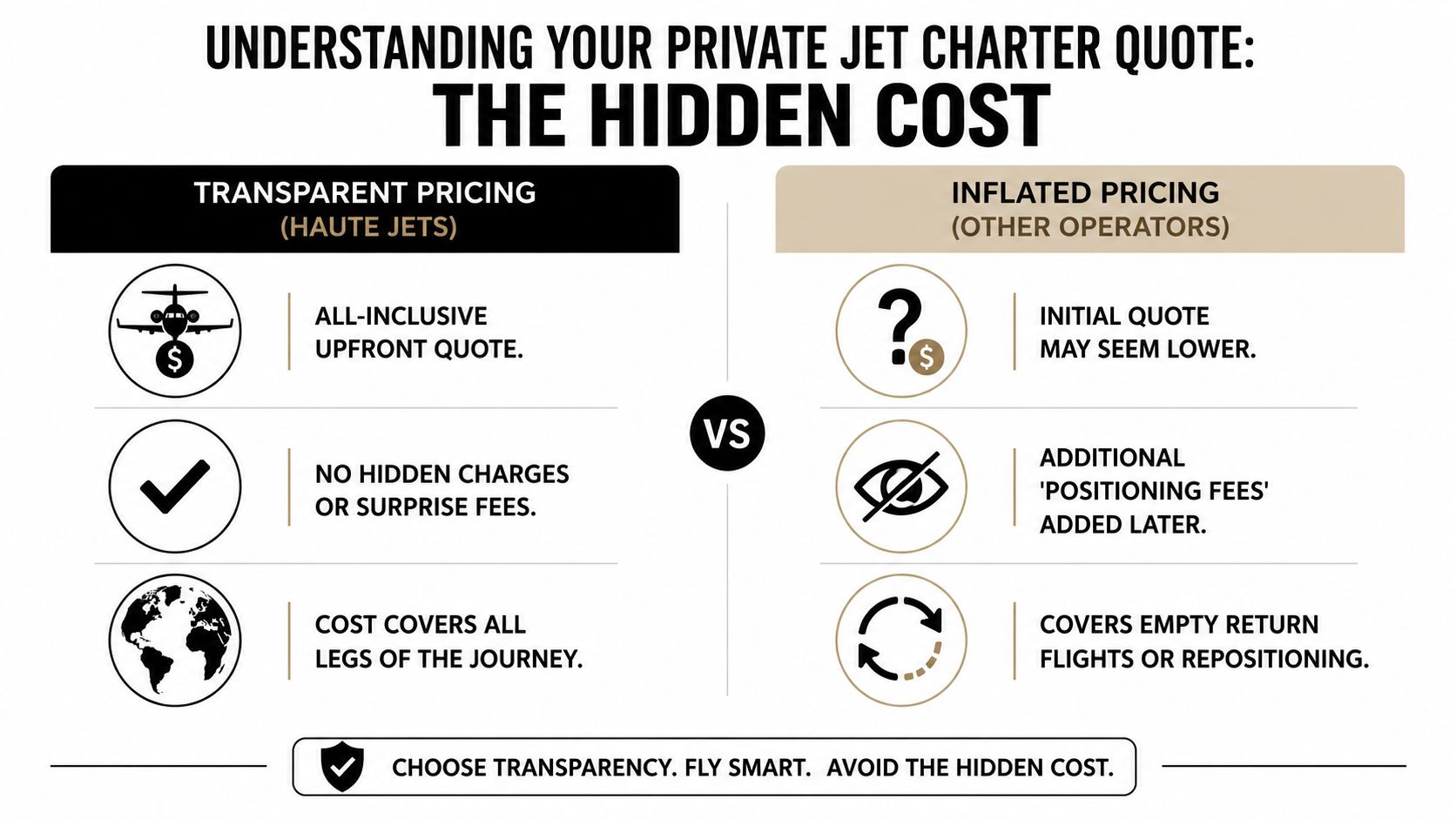
Many charter quotes for Hamilton (CYHM) secretly include repositioning fees that inflate the cost by 20–40% when an aircraft is flown in from Toronto or Montreal. Local sourcing models eliminate this hidden penalty, according to Hamilton charter pricing notes on repositioning fees.
What repositioning actually means
Repositioning is simple. The aircraft has to fly empty before your trip starts, or after it ends, because it wasn't where you needed it to be.
That empty movement still costs money. Crew time, fuel, airport charges, and aircraft use don't disappear because you weren't on board. Some providers absorb part of that. Many pass it directly to you.
Here's the problem in Hamilton. It's close enough to larger markets like Toronto and Montreal that some brokers treat CYHM as an add-on rather than a true source point. That creates a hidden premium for clients who don't ask one direct question: Where is this aircraft based?
How to spot the issue before you book
Ask these questions before you approve any quote:
- Aircraft base location: Is the jet already based near Hamilton?
- Positioning disclosure: Does the quote include any ferry or bring-in segment?
- All-in clarity: Are handling, crew, and airport logistics already built into the number?
- Alternative sourcing: Is there a comparable aircraft closer to departure?
A lot of first-time clients focus only on category. That's a mistake. A Light Jet based nearby can be the smarter buy than a similar aircraft that has to be flown in.
Advisor's view: If the aircraft starts somewhere else, you should assume the quote deserves a second look.
If you want a broader feel for how airport and handling charges can affect private aviation pricing across markets, this overview of UK private jet landing and handling fees gives useful context on how non-flight costs can shape the final number.
Why transparent pricing matters more in Hamilton
Hamilton isn't overpriced by nature. It gets overpriced when clients unknowingly pay for someone else's logistics chain.
That's why transparent pricing beats flashy quoting. You want the true trip cost, not a low teaser number followed by operational add-ons. If a provider can't clearly explain the aircraft's location and every leg covered by your quote, keep shopping.
For a deeper breakdown of how charter pricing is built, read this guide to private jet charter pricing and cost components.
How to Book Your Hamilton Charter Flight
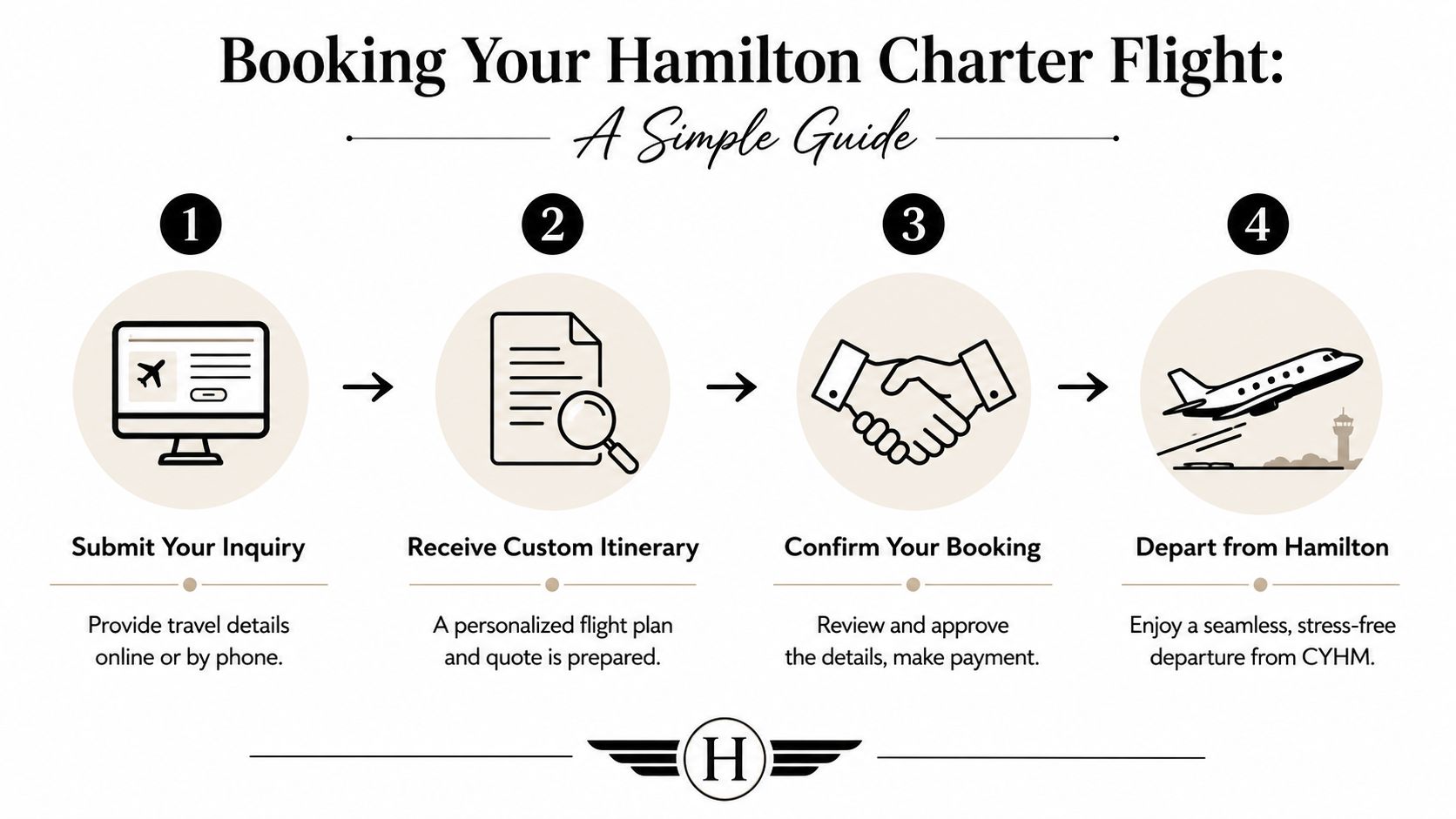
You call for a Hamilton departure, get a quote fast, and assume the hard part is done. It isn't. CYHM bookings often look straightforward until a buried aircraft repositioning leg turns a decent quote into an expensive one. The smart move is to book with exact trip details and force clarity before any payment goes out. Haute Jets does this well because its local sourcing model starts with aircraft that are already practical for Hamilton, not jets that only become “available” after a costly bring-in.
Start with a tight brief. Send your exact departure and destination airports, preferred departure window, passenger count, luggage, pets, and any car service or catering needs. If you're flexible on timing by even an hour or two, say so. That can widen the pool of nearby aircraft and cut total cost.
The quote review most clients rush
Read the quote line by line. Hamilton clients get in trouble when they approve based on aircraft category and departure time, then miss where the aircraft is coming from.
Check these points first: aircraft type, operator name, current aircraft base or prior location, baggage limits, cancellation terms, and whether the itinerary reflects your real schedule or a generic template. If the advisor cannot tell you the exact make and model, keep pushing. If they cannot explain whether the jet is already in Southern Ontario, move on.
For teams coordinating frequent trips, tools built for seamless travel management can keep traveler details, approvals, and schedule changes organized in one place. The phrase is clunky. The function is useful.
Safety is the filter
Price matters. Operator quality matters more.
Every operator in the Haute Jets network must hold a Wyvern Wingman or Argus Gold/Platinum rating. That requirement keeps the screening simple for first-time clients. If you are comparing providers, use the same standard and ask the question directly before approval.
A polished quote means very little if the operator behind it does not meet a serious third-party audit standard.
You should also ask for the operator name before you approve the trip, not after the wire is sent.
Here's a useful walkthrough of the client side of the process:
The final confirmation you should expect
Once you approve the aircraft, the provider should issue a clear trip confirmation with no gaps and no vague placeholders. You want the aircraft locked, the operator identified, and the schedule confirmed.
That confirmation should include:
- The aircraft details: Year, make, model, and cabin configuration if relevant.
- The tail number: You should know the exact aircraft assigned.
- Crew and schedule information: Departure timing, terminal instructions, and passenger manifest review.
- Special requests: Catering, Wi-Fi, pet approval, and ground transportation.
For Hamilton departures, ask one extra question before final signoff. Is this the aircraft's first revenue leg of the day from CYHM, or is it arriving from somewhere else first? That one question exposes hidden repositioning risk fast.
If you are booking a larger aircraft, ask for a weight-and-balance calculation before final confirmation when payload or runway planning could affect the trip. It is a simple check, and it prevents avoidable last-minute changes.
What to Expect on Departure Day
A good Hamilton departure feels almost boring. That is what you want.
You should not be sorting out aircraft changes, chasing a driver, or hearing that the jet is "just coming in" from another airport. In the Hamilton market, that last-minute scramble usually traces back to one problem. The aircraft was never local, and the quote hid the repositioning risk until departure day. Haute Jets avoids that trap by sourcing locally first, which gives you a cleaner departure and a lower chance of schedule drift.
At CYHM, your car can pull up to the private terminal, and the check-in process is brief. If you drive yourself, parking and handoff are usually easy. You walk into the lounge, confirm the manifest, and wait in a quiet room instead of dealing with a crowded terminal.
How the departure usually works
First-time charter clients often expect a long private-aviation ritual. Hamilton is simpler than that.
You will usually go through the day in this order:
- Arrival at the FBO: Staff confirm the passenger list and any final catering or bag details.
- Short lounge stop: You can take a call, use the restroom, or grab coffee.
- Escort to the aircraft: An FBO staff member or crew member walks you straight to the jet.
- Departure: Once everyone is onboard, the crew handles the rest.
Hamilton works well for this because private traffic moves efficiently and congestion is usually lighter than at larger Toronto-area airports. That matters on the day of travel. It means fewer delays getting from the door to the runway, especially when your aircraft is already based nearby.
Smart moves that save time and prevent problems
A smooth departure starts the day before.
- Arrive with a realistic buffer: For most domestic departures, 20 to 30 minutes is usually enough. If you have pets, catering changes, or a large group, give yourself more time.
- Keep the manifest final: Name changes and late passenger swaps can slow things down fast.
- Tell the charter team exactly what you are bringing: Golf clubs, skis, garment bags, strollers, and hard-shell luggage can create fit issues on smaller jets.
- Confirm the aircraft's inbound status the night before: Ask whether the jet is sitting at CYHM or still flying in from another airport. That one question catches a lot of bad Hamilton quotes.
- Lock in ground transportation early: The flight may be private, but a missing car at either end still ruins the day.
The best charter days are predictable.
If you booked the right aircraft with a provider that knows the Hamilton market, departure feels quick, private, and controlled. This is a significant advantage. You save time, avoid unnecessary friction, and reduce the odds of paying for someone else's ferry leg without realizing it.
If you want a smarter way to book from Hamilton, Haute Jets solves the problem most clients never see until they've overpaid for it. The team sources from 3,500+ owner-operators across 175 countries, focuses on locally based aircraft to avoid repositioning markups, works only with Wyvern Wingman and Argus Gold/Platinum operators, and lets you book on demand with no memberships or jet cards. If you're comparing quotes for a private jet charter from Hamilton, Ontario, start with a provider that tells you exactly which aircraft you're getting and why the price is the true price.