

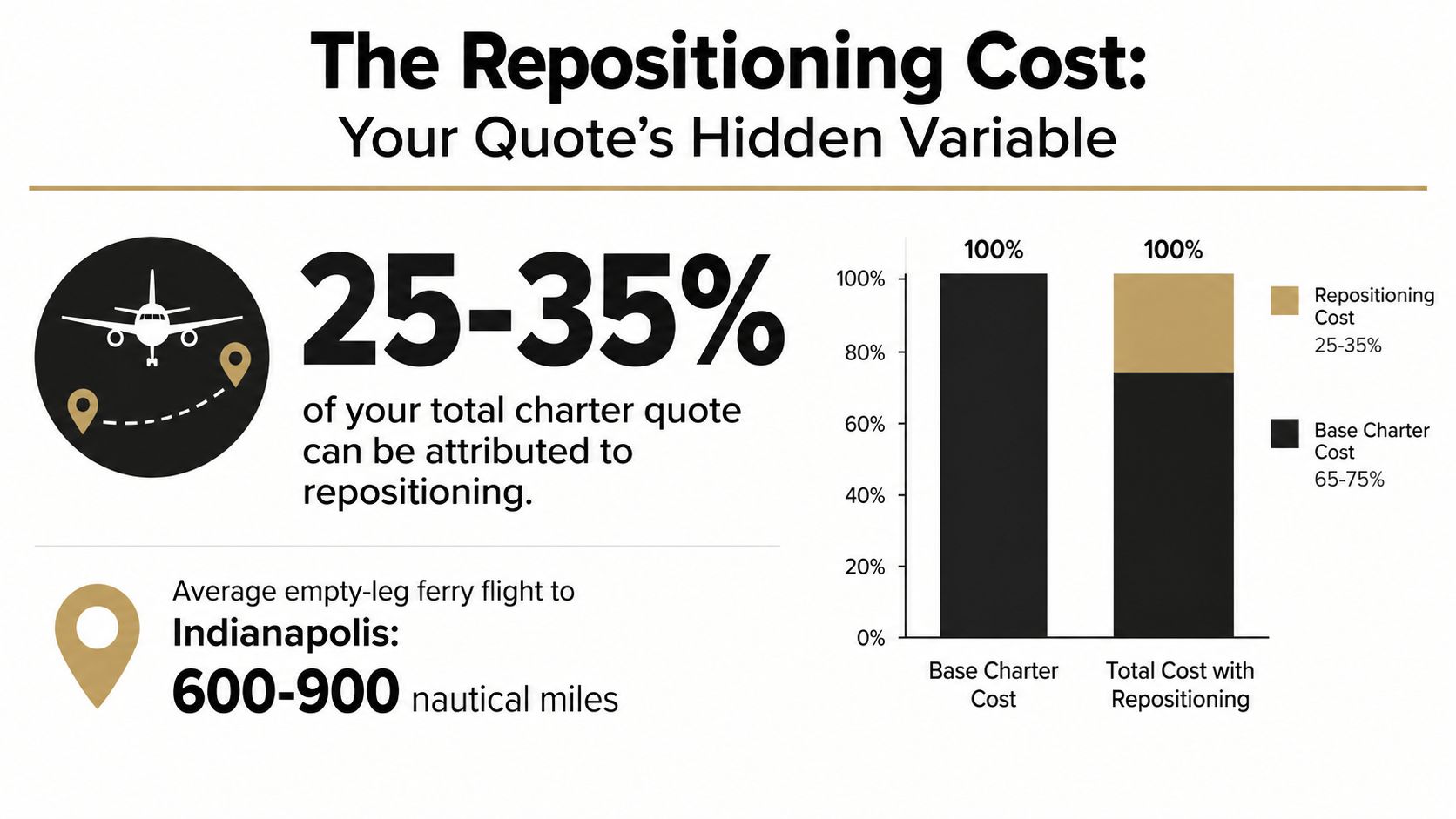
A private jet charter from Indianapolis can become materially more expensive before a passenger ever boards, because the aircraft may need to fly empty to the departure airport. That repositioning leg can add roughly 20% to 40% to the charter price when the aircraft isn't already nearby, according to Global Plane & Jet Charter's explanation of charter quotes. The right question, therefore, isn't “What's the hourly rate?” It's “Which airport, aircraft, and operator produce the lowest credible all-in price?”
That distinction matters across the Indianapolis market. A corporate travel manager may need repeat access for executive meetings, while a private traveler may be comparing a light jet to Aspen, a super-midsize aircraft to the West Coast, or a long-range cabin for an international itinerary. In every case, three decisions shape the quote more than a flashy advertised rate: the departure airport, the aircraft class, and the operator's independent safety credentials.
Why Indianapolis Is a Real Private Aviation Market in 2026
Indianapolis has the infrastructure to support serious business aviation, not just occasional event traffic. Indianapolis International Airport is about 7 miles southwest of downtown and operates 24 hours a day, while Indianapolis Executive Airport has served general aviation since its origins as Terry Airport in 1957 and received State of Indiana certification in 1958, according to Paramount Business Jets' Indianapolis airport overview.
That history gives charter buyers meaningful choice. The metro area includes Indianapolis International, Indianapolis Executive, Indianapolis Regional, Eagle Creek Airpark, and Indianapolis Metropolitan Airport. Operators can select the field that best matches the aircraft, passenger destination, runway requirement, and ground-transport plan instead of forcing every mission through one commercial hub.
The three decisions behind every quote
First, choose the airport. A long-range aircraft may need the runway and support available at IND, while a light regional flight could be more efficient from TYQ or another reliever field. Airport choice affects ground time, FBO charges, aircraft availability, and the possibility of an additional repositioning leg.
Second, select the cabin by mission. Passenger count alone isn't enough. Range, baggage volume, runway performance, and the need for a nonstop itinerary all matter. Paying for a heavy jet when a light or midsize aircraft fits the trip is wasteful. Choosing too small an aircraft can create a second problem, such as a fuel stop, baggage limitation, or poor payload margin.
Third, verify the operator. A polished broker proposal doesn't replace independent safety documentation. Ask for current third-party credentials, insurance details, pilot qualifications, and the aircraft tail number before money changes hands.
Broker's rule: A low hourly rate is only useful after the operator confirms the aircraft's location, total flight legs, airport fees, taxes, and safety documentation in writing.
Indianapolis is mature enough that buyers shouldn't accept generic broker behavior. Local positioning and transparent aircraft sourcing usually matter more than negotiating a small adjustment to an hourly figure.
The Five Airports That Matter for Indy Charter
Indianapolis has five fields relevant to private charter, and they serve different parts of the metro area. Airport choice sets practical limits on aircraft selection, FBO access, operating hours, and scheduling. The right field can reduce ground time and avoid an unnecessary repositioning leg. The wrong one can force a larger airport, a longer drive, or an aircraft change.
Indianapolis International Airport
Indianapolis International Airport, IND or KIND, is the technical heavyweight. Its runway system includes an 11,200-foot concrete runway, a 10,000-foot concrete runway, and a 7,278-foot asphalt runway, according to Haute Jets' Indianapolis International Airport information. The airport has two FBOs and 24/7 private aviation support, so it is the clear choice for heavy-cabin, long-range, and international missions.
IND also provides more performance margin when weather, payload, or fuel requirements become demanding. Choose it for a corporate group carrying substantial baggage or booking a nonstop transcontinental itinerary. The extra drive to IND is often cheaper than forcing a reliever field into a mission it cannot support.
Indianapolis Executive Airport
Indianapolis Executive, TYQ or KTYQ, sits north of the city and serves the area's general aviation traffic. Its early development included a 3,340-foot by 60-foot paved runway and a 3,000-foot by 200-foot turf runway, followed by state certification in 1958, as documented by Jet Access' Indianapolis service information.
TYQ is a practical executive gateway for regional and many domestic private flights. Its location can shorten ground travel for northern suburban business corridors, while its general aviation setting avoids a commercial terminal. Ask the operator to confirm the current FBO schedule, aircraft suitability, and payload limits for the specific trip.
Indianapolis Regional Airport
Indianapolis Regional, MQJ or KMQJ, serves the eastern side of the metro area and has 24-hour airport operations. That schedule supports early departures, late arrivals, and same-day executive travel. MQJ fits passengers based east of Indianapolis, particularly when a light or midsize jet meets the runway and payload requirements.
Eagle Creek Airpark
Eagle Creek Airpark, EYE or KEYE, provides west-side access. It suits piston aircraft, turboprops, and very-light jets, but the operator must verify runway suitability, payload, weather limits, and operating conditions before booking a larger aircraft. A convenient location does not compensate for an aircraft that lacks adequate performance margin.
Indianapolis Metropolitan Airport
Indianapolis Metropolitan, UMP or KUMP, is another reliever option for piston and very-light aircraft. It works for a narrowly local trip when the aircraft fits the field. Do not use it as an IND substitute for a heavy jet, extensive fuel load, or international support.
| Airport | Code | Longest Runway (ft) | FBO Count | Best Suited Aircraft Class | Operating Hours |
|---|---|---|---|---|---|
| Indianapolis International | IND / KIND | 11,200 | Two FBOs | Heavy, long-range, international, and all major categories | 24/7 private aviation support |
| Indianapolis Executive | TYQ / KTYQ | 5,500 | Confirm with operator | Light, midsize, and selected larger domestic aircraft | Confirm with operator |
| Indianapolis Regional | MQJ / KMQJ | 6,000 | Confirm with operator | Light and midsize regional missions | 24-hour airport operations |
| Eagle Creek Airpark | EYE / KEYE | Confirm with operator | Confirm with operator | Piston, turboprop, and very-light jet traffic | Confirm with operator |
| Indianapolis Metropolitan | UMP / KUMP | Confirm with operator | Confirm with operator | Piston and very-light jet traffic | Confirm with operator |
Use IND for coast-to-coast, long-range, heavy-payload, or international travel. Use TYQ, MQJ, or another reliever when the aircraft, passenger count, destination, and operating limits make local access more efficient. Require the broker to show the airport choice, FBO arrangements, and any repositioning leg in the written quote.
Aircraft Classes and What They Mean for an Indy Trip
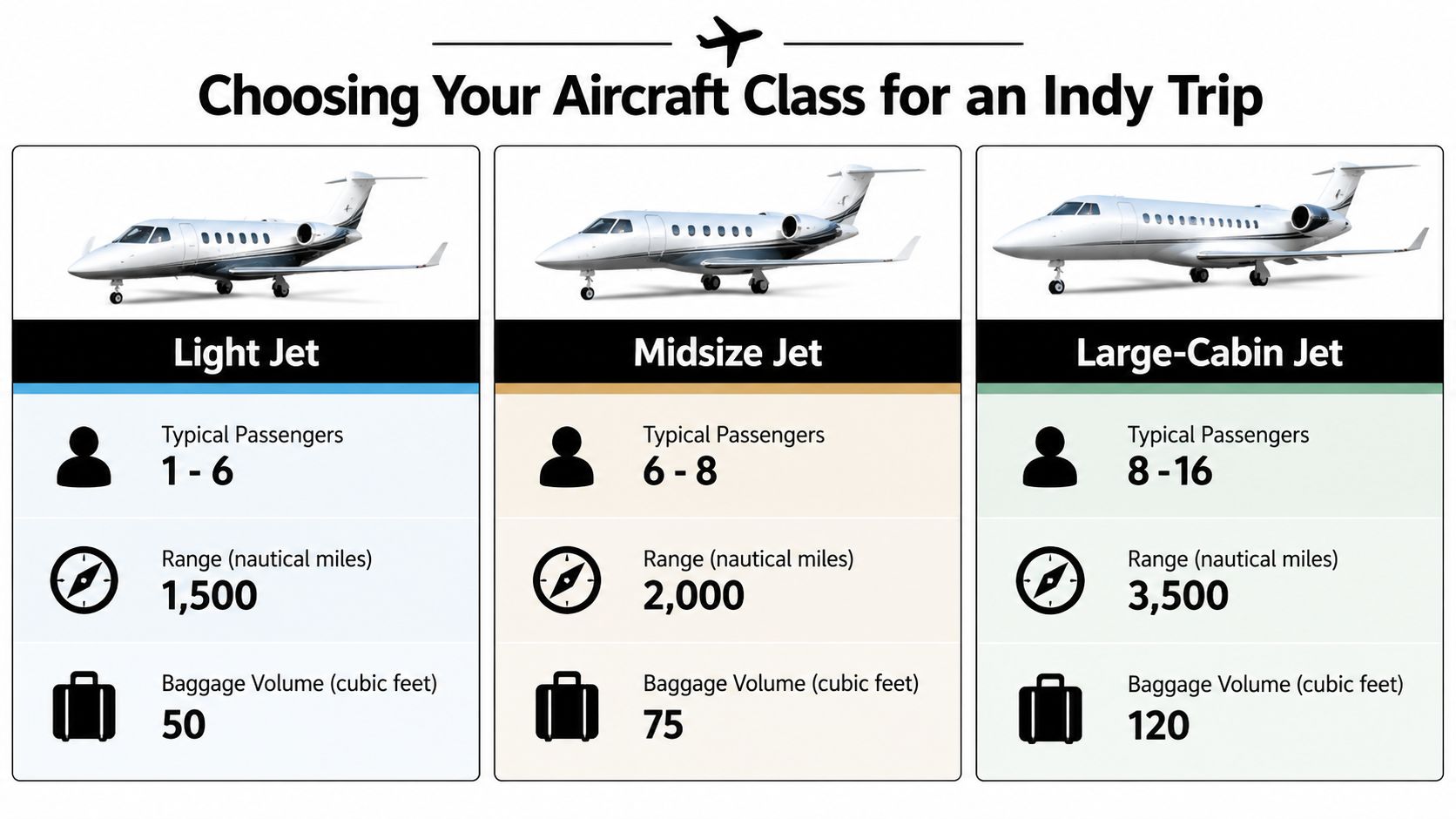
For an Indianapolis charter, aircraft class should follow the mission, not the label. Start with passengers, range, and baggage volume, then check whether the aircraft's operating limits and airport choice support the route. A midsize cabin is not automatically better if the trip does not require it.
Light jets
A Phenom 300 or Citation CJ4 fits four to six passengers on regional and domestic routes when the group has compact luggage requirements. These aircraft work well from Indianapolis to New York or Miami without paying for a larger cabin. Their practical range is roughly 1,500 to 2,000 nautical miles, and the Phenom 300 offers approximately 70 cubic feet of cargo space.
That baggage figure matters on missions such as Indianapolis to Aspen. Passenger count may fit comfortably while skis, winter clothing, and other equipment consume the available hold. Ask the operator for the usable baggage volume for the specific tail, not only the aircraft family's published cabin description.
Midsize and super-midsize jets
A Citation XLS+ or Hawker 860XP gives six to eight passengers more cabin space and a range around 2,500 nautical miles, making it a sensible choice for Phoenix or Denver. For longer domestic missions, a Citation Sovereign+ or Challenger 350 carries roughly eight to ten passengers and provides the comfort and range needed for transcontinental flights such as Los Angeles or Seattle.
The additional cabin supports working space, luggage flexibility, and a stronger nonstop profile. Confirm the payload after fuel, passengers, and baggage before accepting the recommendation.
Heavy and ultra-long-range aircraft
A Falcon 2000 or Gulfstream G450 suits 12 to 14 passengers on full transcontinental or Caribbean missions. A Global 5500 or G650ER moves into the international category, carrying approximately 14 to 19 passengers and supporting nonstop routes to destinations such as London or São Paulo.
For a clearer explanation of how cabin categories affect charter selection, review Haute Jets' guide to private jet types.
Indianapolis Charter Pricing in 2026 and What Drives It
Published Indianapolis charter prices are useful for screening aircraft, not approving a budget. Air Charter Advisors' Indiana pricing overview lists Indiana estimates beginning at about $2,000 per hour for a turboprop and $5,000 per hour for a light jet. Its Indianapolis estimates place light jets around $4,000 to $5,500 per hour and ultra-long-range aircraft around $9,500 to $13,000 per flight hour.
Aircraft class can change the total dramatically on the same city pair. In Air Charter Advisors' Indianapolis estimates, a light jet from New York to Indianapolis runs about $18,000 to $28,000, while an ultra-long-range aircraft can reach $55,000 to $85,000. That spread makes hourly rate a poor standalone buying metric.
| Cabin Class | Hourly Rate (USD) | IND → MDW (Chicago) | IND → TEB (Teterboro) | IND → ASE (Aspen) | IND → VNY (Van Nuys) |
|---|---|---|---|---|---|
| Light jet | $4,000 to $5,500 | Light jet generally suitable | Light jet generally suitable | Payload and baggage dependent | Light jet may require a fuel or payload review |
| Midsize jet | Published estimates vary | Usually more cabin than needed | Useful for added comfort | Practical for added baggage | Suitable for longer-range comfort |
| Super-midsize jet | Published estimates vary | Usually excessive for this route | Usually excessive for this route | Useful for payload and comfort | Suitable for transcontinental comfort |
| Heavy jet | Published estimates vary | Usually excessive for this route | Usually excessive for this route | Mission-dependent | Mission-dependent |
| Ultra-long-range | $9,500 to $13,000 | Usually excessive for this route | Usually excessive for this route | Mission-dependent | Mission-dependent |
These route descriptions are planning guidance, not firm quotes. Airport choice, aircraft location, payload, and schedule can outweigh the published hourly figure, particularly when the aircraft must reposition before pickup.
Require a written proposal showing flight time, repositioning, federal excise tax where applicable, segment fees, overnight crew costs, catering minimums, fuel surcharges, and airport charges. Haute Jets' private jet cost guide provides useful background on charter pricing. The operator's all-in quote, with each charge identified, controls the transaction.
Repositioning Is the Hidden Cost Most Brokers Don't Show You
Repositioning is the empty ferry leg that brings an aircraft to Indianapolis before pickup. If the jet is based elsewhere, the client usually pays through a higher charter total or a separate deadhead charge. The impact can reach roughly 20% to 40% of the charter price when the aircraft is not already near the departure airport, according to Global Plane & Jet Charter.
That cost can outweigh an hourly-rate negotiation. A jet with a higher hourly rate but already staged near IND, TYQ, or MQJ may deliver a lower final invoice than a cheaper aircraft flying empty from another market. Ask which airport the aircraft will use, because local positioning can change the economics before the passenger leg begins.
What to demand from the quote
Request the aircraft's current location, pickup leg, passenger leg, and return or onward positioning leg. Require the broker to identify each movement in writing. Without that detail, you cannot compare proposals or verify whether the quoted aircraft is available for your schedule.
Empty-leg availability can reduce the effective cost when an aircraft is already passing through Indianapolis. The schedule must match the passenger departure time and destination, and the operator must disclose the actual aircraft and any restrictions. Flexibility helps only when the terms are visible.
The practical test: Compare the full invoice with repositioning included, not the largest hourly-rate number at the top of a proposal.
Routes Corporate Travel Managers Book Out of Indianapolis
Corporate demand from Indianapolis tends to divide into short regional work, major domestic business corridors, and longer leisure or international missions. The aircraft should follow the route, not the other way around.
For New York access, Teterboro and White Plains are common business destinations. A super-midsize or heavy jet can make sense for a larger executive group, substantial baggage, or a schedule that demands stronger nonstop flexibility. Charlotte and Atlanta suit midsize aircraft for banking, logistics, and event travel, while Washington Dulles often calls for a super-midsize cabin when the group needs workspace and schedule control.
Business and leisure pairings
- New York, Teterboro or White Plains: Select a midsize, super-midsize, or heavy aircraft based on passenger count and cabin needs.
- Charlotte or Atlanta: A midsize jet is often the practical fit for a regional corporate itinerary.
- Washington Dulles: A super-midsize aircraft offers useful room for executives and equipment.
- Aspen or Eagle-Vail: A super-midsize jet can provide the payload and comfort needed for winter travel, but airport conditions and aircraft positioning require careful review.
- Naples or Palm Beach: A light jet may be appropriate for a smaller group traveling with moderate baggage.
- London Stansted: An ultra-long-range aircraft is the correct starting point for a nonstop international mission when the passenger count and schedule justify it.
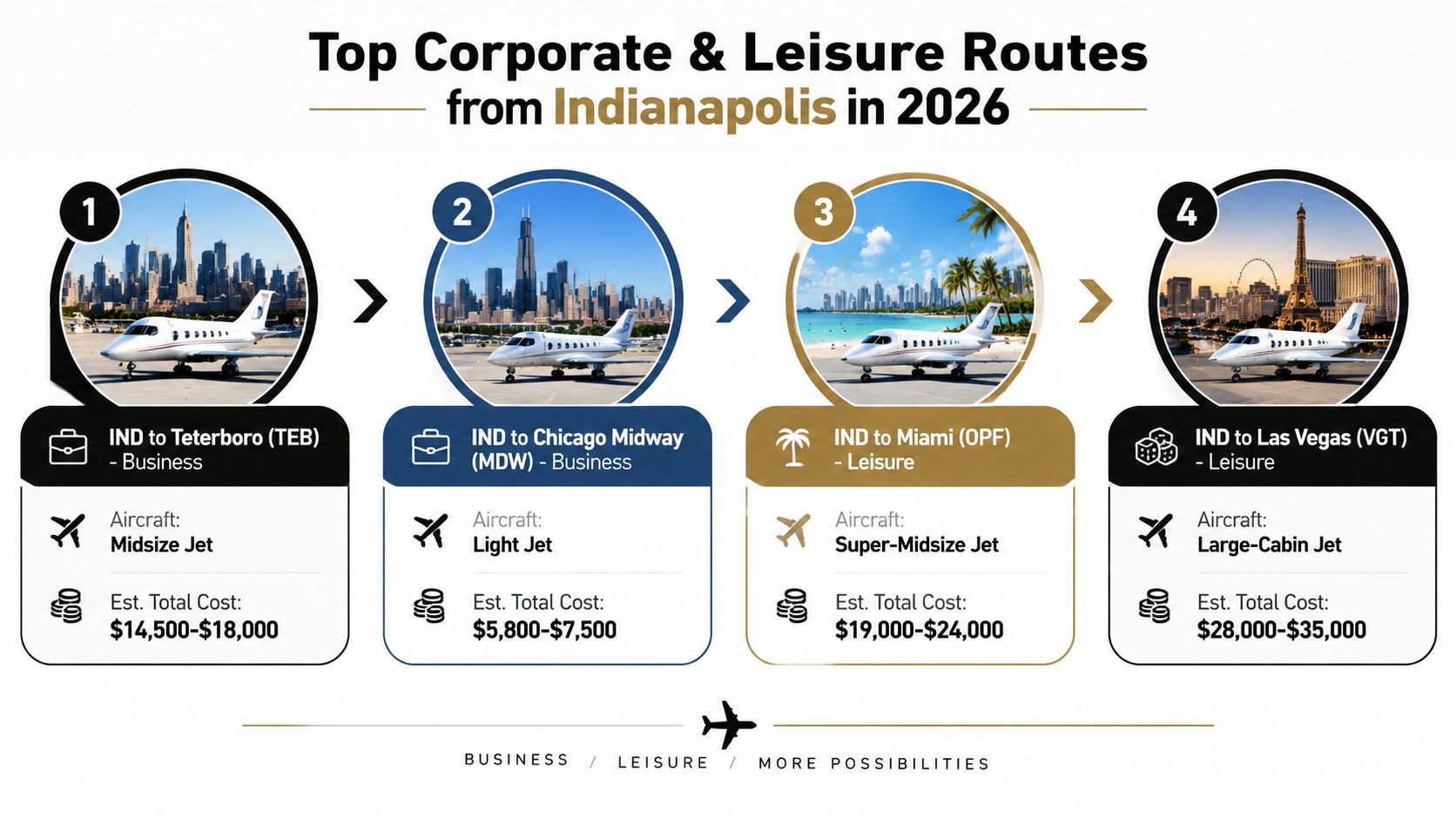
The routes most exposed to repositioning premiums are those into ASE, EGE, MTN, HHH, and MVY, because dedicated Indianapolis-based lift may be limited. Don't assume a popular destination has an aircraft waiting nearby. Ask where the proposed aircraft is based and whether the quote includes the ferry leg.
A corporate travel manager should also distinguish a route's nominal flight time from its operational cost. Airport access, aircraft availability, weather, crew duty requirements, and the need to return the aircraft to its base can all change the final number.
Safety Ratings, FBOs, and What to Demand in Writing
I'd set a firm internal threshold at Wyvern Wingman or Argus Gold or Platinum. These ratings don't eliminate the need for normal diligence, but they give a corporate buyer an independent audit framework instead of relying on a broker's verbal assurance. An operator that won't provide current documentation deserves further scrutiny, not a deposit.
The Indianapolis FBO choice also matters operationally. Signature Flight Support, Atlantic Aviation, and Million Air are the primary names corporate travelers will encounter at major private aviation facilities. Compare them on handling, crew facilities, passenger privacy, catering coordination, ground transport, and customs support for international travel. The best FBO is the one that fits the specific aircraft and itinerary, not necessarily the one with the most polished lounge.
Send this checklist before wiring a deposit
- Safety documentation: Request the current Wyvern Wingman or Argus Gold/Platinum rating document.
- Insurance: Obtain a certificate of insurance naming the company as additional insured.
- Pilot qualifications: Ask for total pilot-in-command flight hours and type-rating hours.
- Aircraft identity: Require the confirmed tail number before departure, with a formal reconfirmation 72 hours out.
- Operational plan: Confirm de-icing, crew rest, catering, ground transport, and international handling.
- Contract terms: Require cancellation, delay, substitution, and refund provisions in writing.
Expired ratings, vague insurance limits, and aircraft swaps inside 24 hours of departure are legitimate reasons to stop and reassess the booking. A substitution may be operationally necessary, but the operator should explain it, provide the replacement aircraft's credentials, and obtain approval before dispatch.
Your Corporate Charter Playbook for Indianapolis
Repeat charter travel becomes easier when the process is standardized. Use this sequence for every Indianapolis departure:
- Confirm the trip purpose, passenger count, baggage, destination, and schedule.
- Decide between IND and a reliever airport based on aircraft performance and ground access.
- Match the aircraft to range, cabin requirements, and baggage volume.
- Request repositioning-inclusive quotes from at least two operators or brokers.
- Verify Wyvern or Argus documentation before approving the aircraft.
- Review the leg-by-leg invoice, including deadhead movement and all applicable fees.
- Confirm the tail number, crew details, weather plan, and passenger manifest before departure.
A broker should answer basic operational questions without hesitation. Ask about aircraft age, crew rest policy, catering source, ground transportation, de-icing plan, cancellation terms, substitution rights, and the exact deadhead line item. If the answers arrive as vague assurances rather than documents, keep shopping.
Three quote red flags
- No leg-by-leg breakdown: The broker may be blending repositioning into the hourly rate.
- Aircraft based more than 400 nautical miles from IND: The distance can create a substantial ferry exposure, so demand the calculation in writing.
- No empty-leg credit: If the broker refuses to document a potential empty-leg adjustment, you can't verify whether flexibility benefits you.
Haute Jets is one option for buyers who want on-demand sourcing across a broad owner-operator network, with operator screening based on Wyvern Wingman or Argus Gold/Platinum credentials. The same diligence still applies: confirm the aircraft, total price, positioning, and documentation before signing.
Haute Jets helps travelers compare Indianapolis departures by airport, aircraft class, and repositioning exposure, rather than relying on an hourly rate alone. Visit Haute Jets to request an on-demand charter quote built around the exact aircraft, safety documentation, and all-in trip cost you need.