
A usable private jet charter instant quote is a mission-based total, meaning occupied flight time plus positioning and handling, not a flat hourly rate. For a one-way U.S. light jet, a realistic range is usually $11,000 to $30,000 before catering and ground transport, so your first job is to submit complete trip details rather than chase a headline rate.
You're probably looking at a route, a date, and a departure time right now, expecting a clean number in your inbox. That number is only useful if it reflects the aircraft that can reach your departure airport, operate the route legally, and complete the mission without adding avoidable ferry legs later.
Why an Instant Quote Is Really a Mission-Cost Estimate
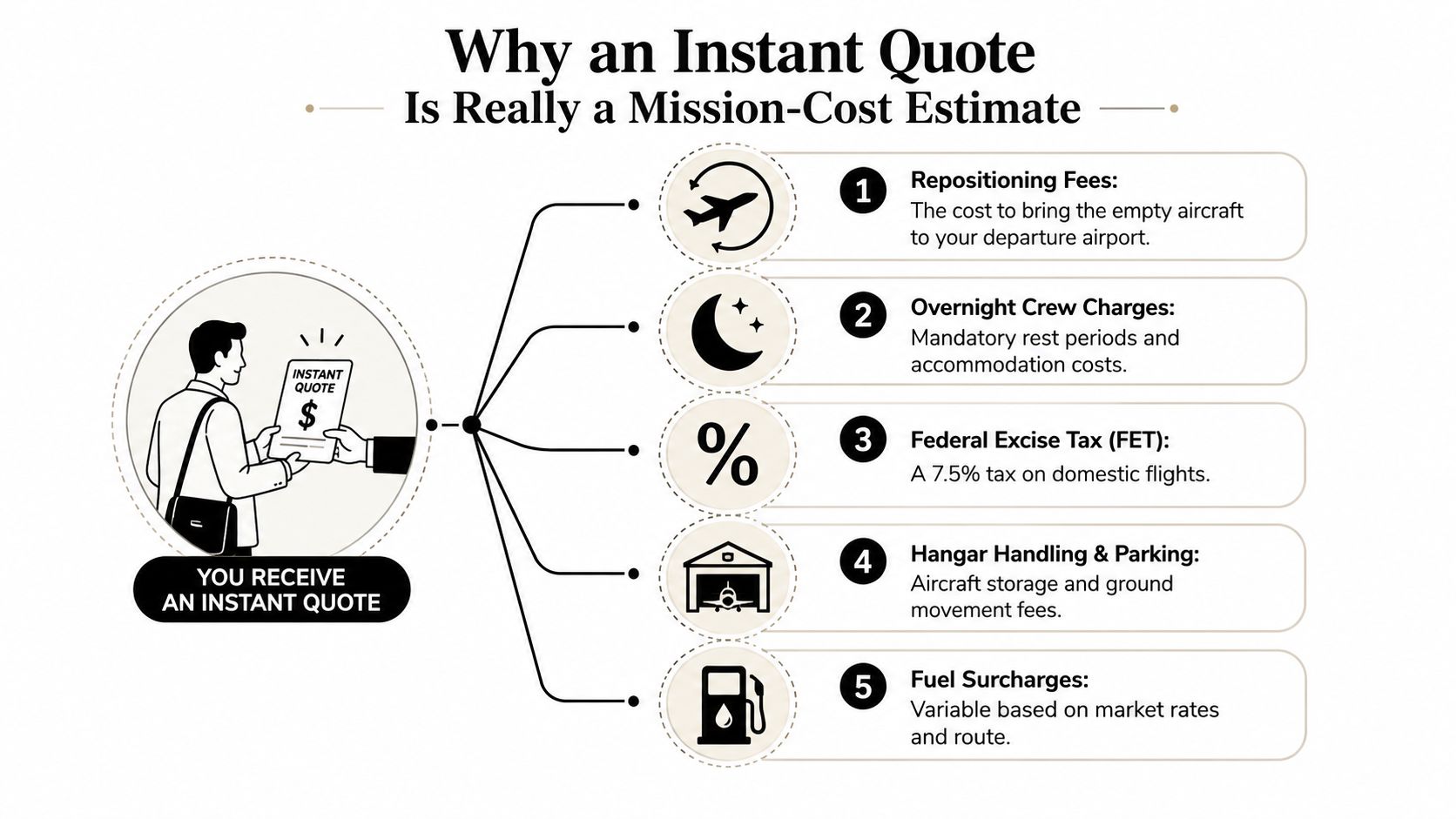
You land at the FBO on a Tuesday expecting the hourly rate you saw online. Instead, the final invoice includes occupied flight time, deadhead positioning, landing and handling fees, crew overnight costs, catering, ground transport, de-icing, and applicable taxes. The surprise doesn't come from private aviation being mysterious. It comes from comparing a base rate with a complete mission.
A one-way U.S. light jet mission usually runs $11,000 to $30,000 before catering and ground transport, but that range is useful only as an initial planning reference. The aircraft category, route, availability, airport, and positioning requirement determine the actual number. A private jet charter cost breakdown should therefore begin with the route and aircraft location, not the advertised hourly figure.
Start with the mission, not the rate card
Ask for five things before comparing offers:
- Occupied flight time: The time your passengers are aboard the aircraft.
- Positioning and deadhead: The inbound and outbound legs required to place the aircraft and move it after the trip.
- Airport and handling charges: Landing, ramp, FBO, parking, hangar, and navigation expenses.
- Crew and operational costs: Overnight accommodation, duty limitations, fuel stops, and de-icing where relevant.
- Passenger extras: Catering, pets, special handling, and ground transportation.
Independent aviation guidance says repositioning can represent 30% to 45% of a one-way charter total and may be billed at 75% to 100% of the occupied hourly rate. A two-hour reposition can add roughly $6,000 to $8,000, depending on aircraft class and market, as explained in this private jet pricing methodology.
The practical lesson is simple. Operator clustering near your departure airport often matters more than a small difference in hourly rate. An aircraft already based near the origin usually produces a faster, more defensible mission total than a cheaper-looking aircraft that must fly empty across the country.
The Information You Need Before You Hit Request
A quote request should read like a compact trip sheet. Send everything in one message, because every missing detail creates another round of questions and gives availability more time to change.
Start with the departure date, local departure time, arrival date, and local arrival time. State whether the trip is one-way, round-trip, or multi-city, then provide the exact departure and destination airports rather than only the city names. Airport selection affects runway suitability, handling, operating hours, and aircraft positioning.
List the number of passengers, including ages where relevant, and describe luggage requirements. Ski equipment, golf bags, strollers, musical instruments, and other bulky items can change the suitable aircraft even when the passenger count stays the same. Add pets, accessibility requirements, special events, catering preferences, FBO preferences, and ground transport needs.
For a more complete booking request, use this private jet booking information checklist.
| Field | Why It Matters |
|---|---|
| Departure and arrival airports | Determines runway compatibility, airport charges, and aircraft positioning. |
| Dates and local times | Establishes aircraft and crew availability. |
| One-way or round-trip | Changes the aircraft's routing and repositioning requirements. |
| Passenger count and ages | Sets cabin, seating, and operator suitability. |
| Bags and approximate weight | Can affect cabin capacity, baggage loading, and aircraft category. |
| Cabin preference | Narrows the aircraft options and comfort profile. |
| Pets | Triggers operator-specific acceptance and cleaning requirements. |
| Special events or onboard needs | Helps the team plan catering, décor, equipment, or timing. |
| FBO preference | May change airport fees and aircraft access. |
| Ground transportation | Allows the delivered total to reflect the complete travel plan. |
The fields that usually move the number most are airport pair, timing, trip type, passenger and baggage requirements, aircraft category, and flexibility. Catering and ground transport may matter less to the aircraft price, but they matter to the amount you'll ultimately pay.
Common mistakes include writing “four passengers” without mentioning oversized baggage, requesting “New York” without naming Teterboro, Westchester, or another airport, and omitting the return leg because it hasn't been finalized. Submit the full picture first. That's how a request moves from a rough estimate to a workable quote without repeated callbacks.
How Different Platforms Price a Charter in Real Time
Not all instant quote systems calculate the same thing. A traditional broker may collect operator offers and apply a margin. A jet-card program may publish a fixed hourly rate that simplifies budgeting but doesn't always expose the mission-specific positioning behind a one-way trip. An on-demand marketplace may use an algorithm to price aircraft that appear available, but the result still depends on whether an operator accepts the itinerary.
| Model | Quote Speed | Accuracy on Real Missions | Typical Hidden Costs |
|---|---|---|---|
| Traditional broker | Can be fast when the broker knows the market | Depends on operator sourcing and margin disclosure | Positioning, handling, crew, taxes, and change terms may be separated. |
| Jet card | Usually fast for eligible routes and aircraft classes | Convenient, but fixed rates can conceal route-specific assumptions | Membership terms, minimums, exclusions, and operational limits. |
| On-demand marketplace | Fast for initial options | Strong only when availability and aircraft location are current | Positioning, operator acceptance, airport fees, and final confirmation. |
The structural problem appears on a one-way leg from a major hub to a smaller city. A remotely positioned aircraft may show a competitive occupied rate, yet a two-hour reposition can add roughly $6,000 to $8,000, depending on aircraft class and market, according to this deadhead pricing guidance. The headline rate hasn't lied, but it hasn't described the mission either.
Aircraft class creates another layer of variation. A 2026 pricing guide lists approximate hourly rates of €1,800 to €2,800 for turboprops, €2,800 to €4,200 for light jets, €4,200 to €6,800 for midsize jets, and €17,000 to €28,000 for VIP airliners. Its route examples range from €11,000 to €16,000 for Paris to Nice to €110,000 to €145,000 for Paris to New York, showing why route length and cabin size can change the total dramatically. See the 2026 private jet pricing guide for those route and category benchmarks.
Practical rule: Compare aircraft by total mission cost, not by the hourly number displayed first.
This is why local sourcing matters. A wholesale-sourced aircraft already near the origin can outprice an aggregator's apparently cheaper option once deadhead legs, handling, and crew requirements are included. Speed and accuracy improve together when the sourcing process starts with nearby, appropriately rated aircraft.
How Haute Jets Builds an Instant Quote You Can Trust
The useful question isn't whether a platform can display a number quickly. It's whether the team has checked the aircraft behind that number.
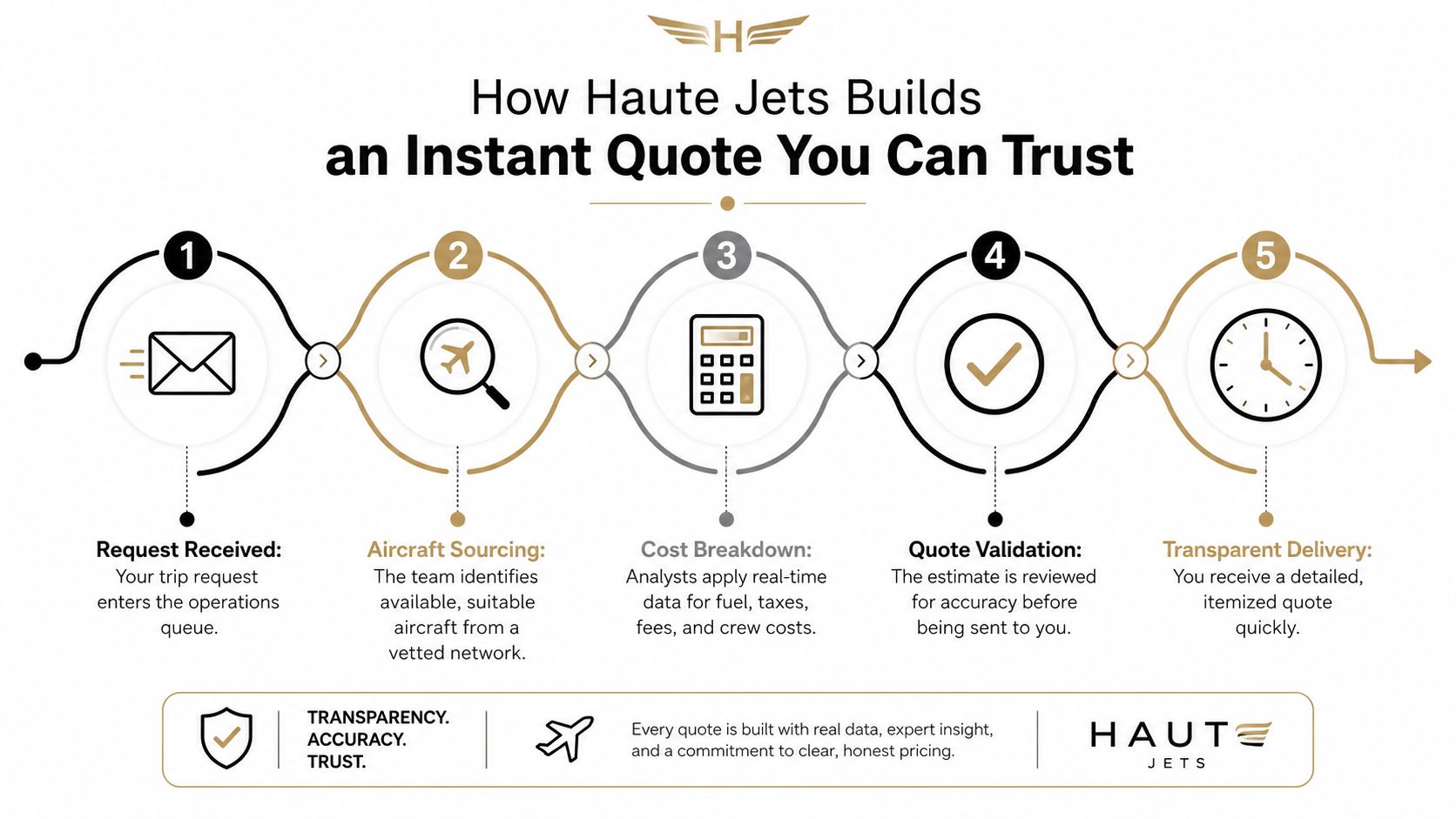
A Haute Jets request enters an operations queue with the itinerary, then the sourcing process begins with owner-operator availability near the departure airport. Wholesale fleet partners can be added when a closer suitable option isn't available. That order matters because it tests local supply before introducing a remote aircraft and its extra positioning legs.
The team verifies the dates, passenger count, destination runway requirements, aircraft suitability, and special handling before releasing the number. Catering preferences and ground transportation can remain flexible until closer to departure, but they should still appear in the original request so the quote doesn't omit them accidentally.
What gets confirmed and what stays flexible
During normal operating hours, the target is a realistic same-business-hour response, with an escalation path for after-hours requests. That response should identify the aircraft or aircraft options, not just return a generic category and a low starting rate.
Before you accept, ask the coordinator to show:
- Aircraft identity and category
- Occupied flight time
- Inbound and outbound positioning
- Airport, handling, and navigation fees
- Crew and overnight assumptions
- Taxes and special operational charges
- Items included versus items still variable
The final quote should arrive as a single all-in figure with line items itemized. It can still change when you alter the itinerary, add services, or request an aircraft hold, but you'll know what caused the change.
For a broader look at the client journey, see booking a private jet with Haute Jets.
A trustworthy quote isn't a black box. It's a documented chain from request, to aircraft sourcing, to operational validation, to delivery.
What Separates a Useful Quote From a Bait Number
The cheapest headline quote is often not the cheapest total on the manifest. It usually rests on optimistic assumptions, such as minimal positioning, no overnight crew stay, favorable fuel treatment, omitted Federal Excise Tax, and no allowance for de-icing or special handling.
A useful quote exposes those assumptions. It tells you whether the aircraft is already near the origin, whether the crew can complete the itinerary within duty limits, and which airport-specific fees have been included. Independent pricing guidance identifies aircraft class, airport and navigation fees, seasonal or operational expenses, fuel stops, de-icing, and VIP catering as components that can shape the final charter price. The private jet pricing factors guide provides that component-based framework.
| Line Item | Bait Quote | Real Quote |
|---|---|---|
| Aircraft rate | Shows the lowest attractive hourly figure | Identifies the aircraft and applies the actual mission rate. |
| Positioning | Assumes the aircraft is nearby | Lists inbound and outbound ferry requirements. |
| Crew | Leaves overnight or duty issues unstated | Shows crew timing and accommodation assumptions. |
| FET | May be excluded from the headline | States whether applicable taxes are included. |
| Airport fees | Uses a broad estimate or omits them | Accounts for landing, handling, parking, and navigation charges. |
| Special handling | Treats catering, pets, or de-icing as an afterthought | Separates included services from variable requests. |
Don't compare three quotes by hourly rate alone. Give each provider identical airports, times, passenger details, baggage information, and service requirements, then compare the all-in delivered total.
Your mental filter is short. If a quote doesn't mention repositioning, crew, FET, and landing fees, it's incomplete. A fast incomplete number wastes more time than a carefully sourced quote that takes a little longer to validate.
Practical Tips to Get an Accurate Quote on the First Try
Use this sequence the next time you request a quote:
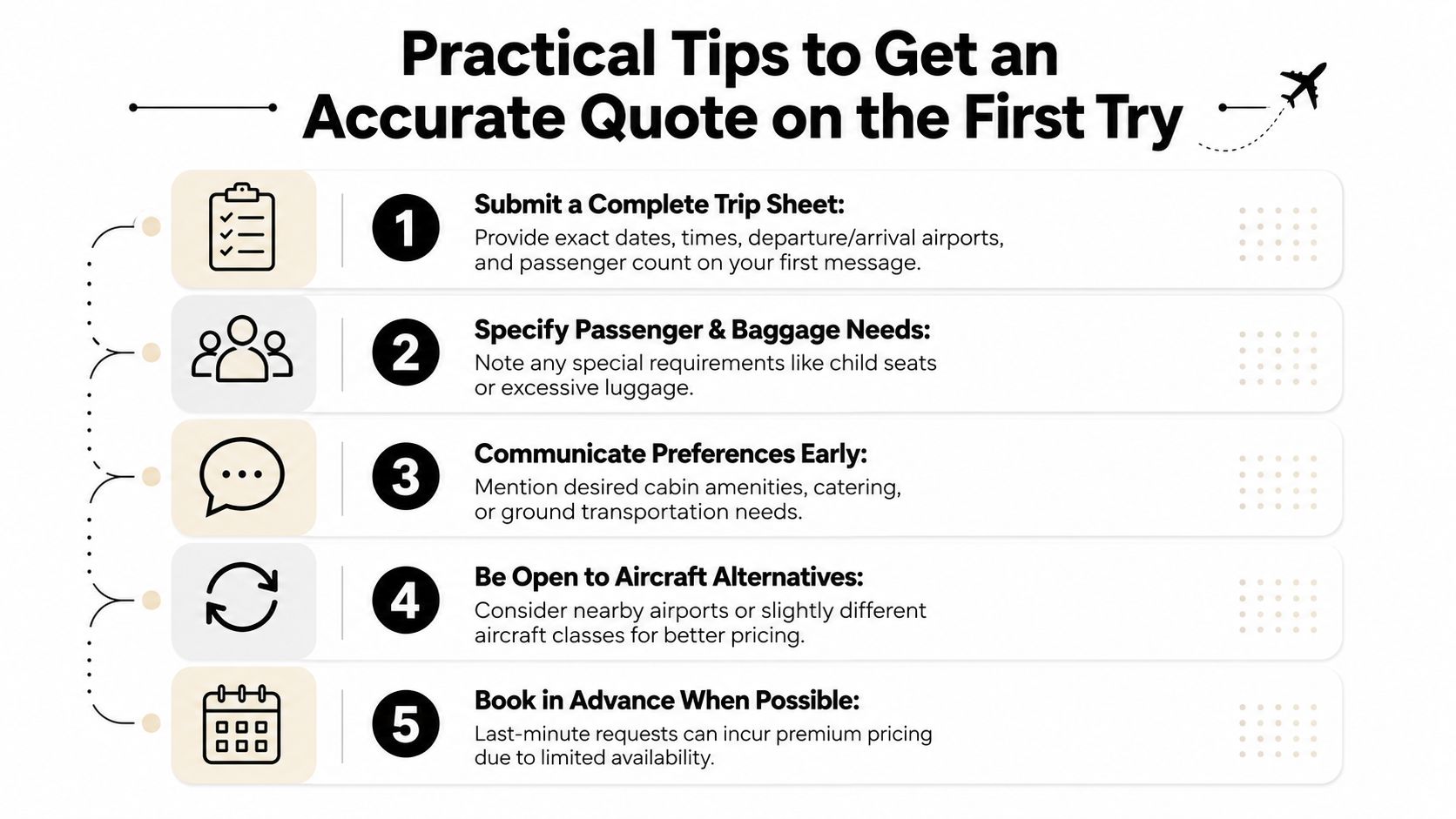
- Send a complete trip sheet: Include exact dates, local times, departure and arrival airports, passenger count, checked bags, and any international handling requirements in the first message.
- Name the airport, not just the city: Runway length, field elevation, operating restrictions, and local fees can change the suitable aircraft.
- Offer a flexible departure window: An hour or two of flexibility can expose better-positioned aircraft and reduce the need for deadhead flying.
- Declare special requirements early: Pets, oversized baggage, child seats, unaccompanied minors, and medical or accessibility needs can trigger specific operator policies.
- State cabin preferences clearly: Say whether you need a light jet, midsize cabin, long-range aircraft, or the best fit for the route and passengers.
- Keep one point of contact: One person should review every revision so the team isn't comparing different versions of the same itinerary.
A destination airport deserves particular attention. Two airports serving the same city can produce different aircraft options because of runway limits, field conditions, handling availability, and where operators base their aircraft.
Before you submit: Write the route, local times, passenger count, baggage profile, aircraft preference, flexibility, pets, and ground needs in one message.
Safety should also be a filter, not an afterthought. ARGUS and Wyvern are widely used third-party safety ratings, and independent safety guidance identifies ARGUS Platinum and Wyvern Wingman among the highest tiers, with on-site auditing and ongoing checks. A separate ARGUS and Wyvern safety comparison describes Wingman and ARGUS Platinum as comparable high-level audits, including review of safety management practices.
A complete request helps the sourcing team find a realistic aircraft faster and gives you a number you can evaluate. Haute Jets offers on-demand charter sourcing from owner-operators and wholesale fleet partners, with aircraft and trip details presented for review rather than reduced to a teaser rate. Visit Haute Jets with your exact route, schedule, passenger count, and baggage needs, and request an itemized private jet charter instant quote built around the mission you intend to fly.