Most advice on private jet charter in Los Angeles is lazy. It gives you hourly rates, lists Van Nuys, Burbank, and LAX, then leaves you to assume the highest quote is the price of convenience. It isn't.
In this market, travelers often overpay because they focus on the aircraft and ignore two decisions that matter more: where the jet starts and which airport you use. Those choices decide whether you're paying for your trip or also paying to move an empty aircraft around Southern California.
That matters in a city where private aviation runs at enormous scale.
A crowded market creates opportunity, but only if you book intelligently. Dense aircraft supply means you can often source a better-positioned jet, use a less congested airport, and avoid the hidden waste that gets buried inside many charter quotes. If you don't ask the right questions, you'll miss that advantage and pay for someone else's ferry leg.
Private jet charter Los Angeles should be approached like a procurement exercise with luxury outcomes. You want privacy, speed, and flexibility. You also want a quote that makes operational sense.
The Insider's View on LA Private Aviation
Los Angeles isn't expensive because private flying here is rare. It's expensive because demand is constant, airport access is fragmented, and too many clients accept the first workable option.
That's a mistake. In a market this deep, the smart move isn't to chase prestige. It's to strip waste out of the trip. A traveler going from Beverly Hills to Las Vegas doesn't need the most famous operator or the closest runway on a map. They need the right aircraft already near departure and an airport that won't trap them in avoidable ground delay.
Why the quoted price often misses the real story
A charter quote usually looks clean. Aircraft type, flight time, total price. What it often hides is the operational mess behind it. If the aircraft has to come from another airport or another region, you're paying for that empty positioning leg whether the quote spells it out or not.
Practical rule: If a quote doesn't clearly state the aircraft's current base or origin, assume you still have homework to do.
Los Angeles magnifies that problem because there are so many workable airports and so many aircraft movements. That's good news if your broker or advisor knows how to source locally. It's bad news if they treat all aircraft as interchangeable inventory.
What sophisticated flyers do differently
Experienced clients usually make three moves:
- They challenge the airport default. Van Nuys is important, but it isn't automatically the smartest departure point.
- They match cabin size to mission. For many regional flights, a practical midsize jet beats a larger cabin that looks impressive and wastes budget.
The Los Angeles market rewards precision. You can absolutely fly beautifully here. You just shouldn't pay blindly for the privilege.
Choosing the Right Los Angeles Departure Airport
The wrong airport can turn a clean private itinerary into a slow, expensive one. In Los Angeles, airport choice shapes drive time, ramp congestion, aircraft availability, and total trip friction.
Recent FAA data shows that ground-handling delays at the busiest California general-aviation airports can add 15–40 minutes to charter turnarounds, which raises crew-hour and airport-fee costs for travelers who always default to the most central field, according to Premier Aviation's Los Angeles airport guide.
How I assess LA airports
I look at four things first:
| Factor | Why it matters |
|---|---|
| Surface access | The closest airport by map isn't always the fastest door-to-door choice |
| FBO congestion | Busy ramps create waiting, slower turns, and more stress |
| Runway and procedure fit | Some airports limit which aircraft make sense |
| Trip profile | A same-day business hop has different priorities than a long-range departure |
The practical trade-offs by airport
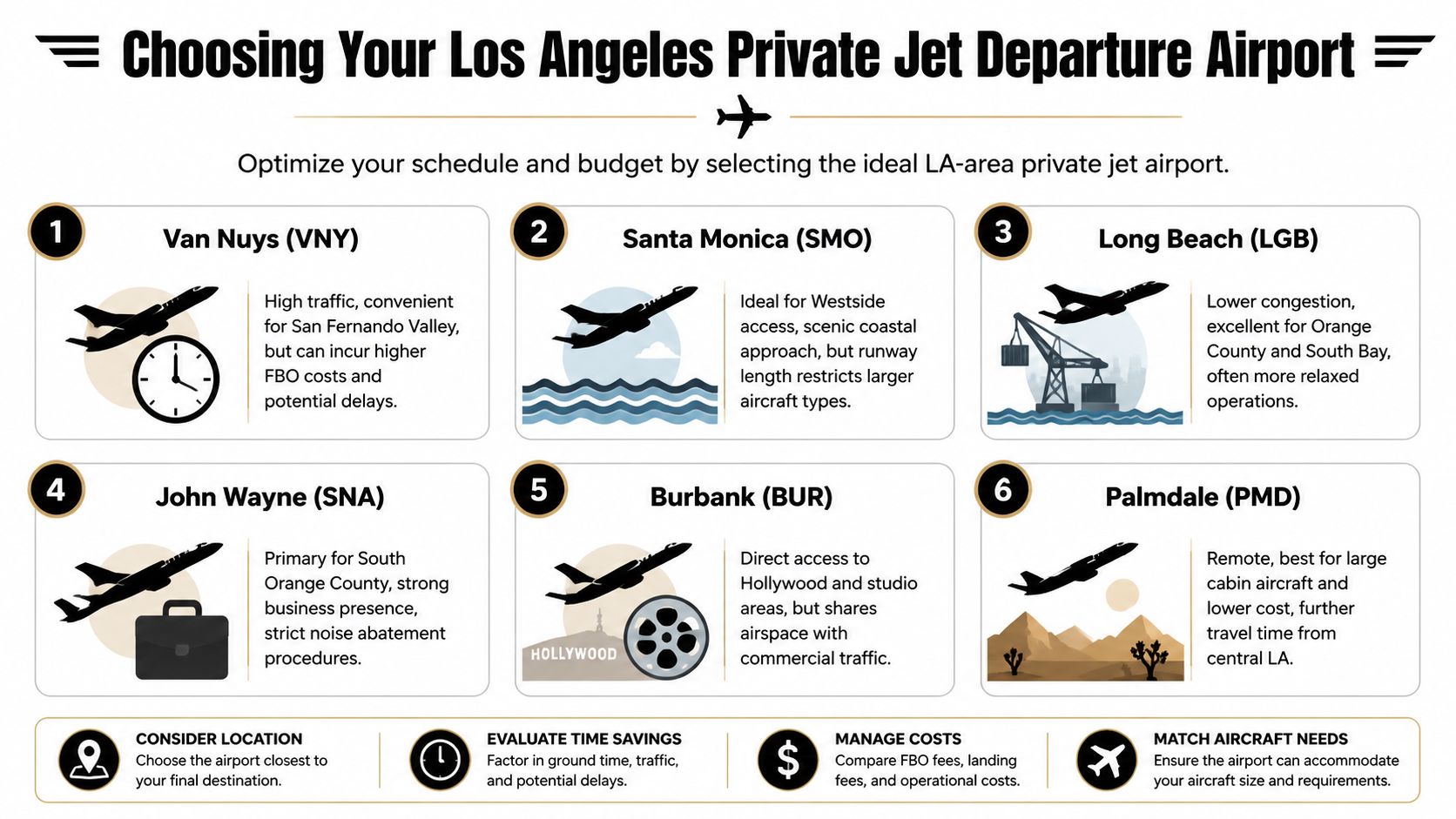
Van Nuys (VNY) is still the center of gravity for private aviation in Los Angeles. It's convenient for much of the Valley and familiar to frequent private flyers. It also gets busy. If you're departing from the west side or on a tight schedule, don't assume VNY is automatically optimal. For airport-specific details, see Haute Jets' Van Nuys Airport page.
Burbank (BUR) is often the sharper choice for studio executives, Pasadena-based travelers, and anyone who values a more straightforward ground experience than the busiest private terminals can offer. It does share airspace with commercial traffic, so planning matters.
LAX works when you need heavy aircraft capability, international handling, or a very specific operating requirement. For many domestic charters, though, it's more airport than you need. Congestion and complexity can erase the convenience private aviation is supposed to deliver.
Airports that often deserve more attention
Santa Monica (SMO) is attractive for Westside access. The trade-off is operational flexibility. It won't suit every aircraft type, so you need to confirm fit before you fall in love with the location.
Long Beach (LGB) is undervalued. For South Bay, parts of Orange County, and travelers who hate unnecessary terminal drama, it can be a calmer option with smoother handling.
John Wayne (SNA) and Palmdale (PMD) can also make sense for specific missions. SNA is useful for South Orange County itineraries and business traffic. PMD is more remote, but that distance can be worth it when cabin size, operating cost, or ramp ease matter more than proximity.
A 10-minute longer drive can be a smart trade if it avoids a crowded FBO and gets you airborne with less waiting.
My recommendation
Don't choose the airport you know. Choose the airport that produces the best door-to-door result.
For many private jet charter Los Angeles bookings, that means:
- VNY if the aircraft is already local and your ground access is easy
- BUR for Hollywood, Pasadena, and many same-day business missions
- LGB when you want a calmer operating environment
- LAX only when the mission requires it
- SMO when Westside convenience matters and the aircraft type fits cleanly
Matching the Aircraft to Your Itinerary
Most travelers shop by category. That's backwards. Start with the mission, then choose the aircraft.
A short business hop, a ski weekend, and a nonstop cross-country flight shouldn't be quoted the same way or flown on the same kind of jet. If someone sends you three random aircraft options without explaining why each fits your route, they're brokering inventory, not advising you.
Short hops need discipline, not excess
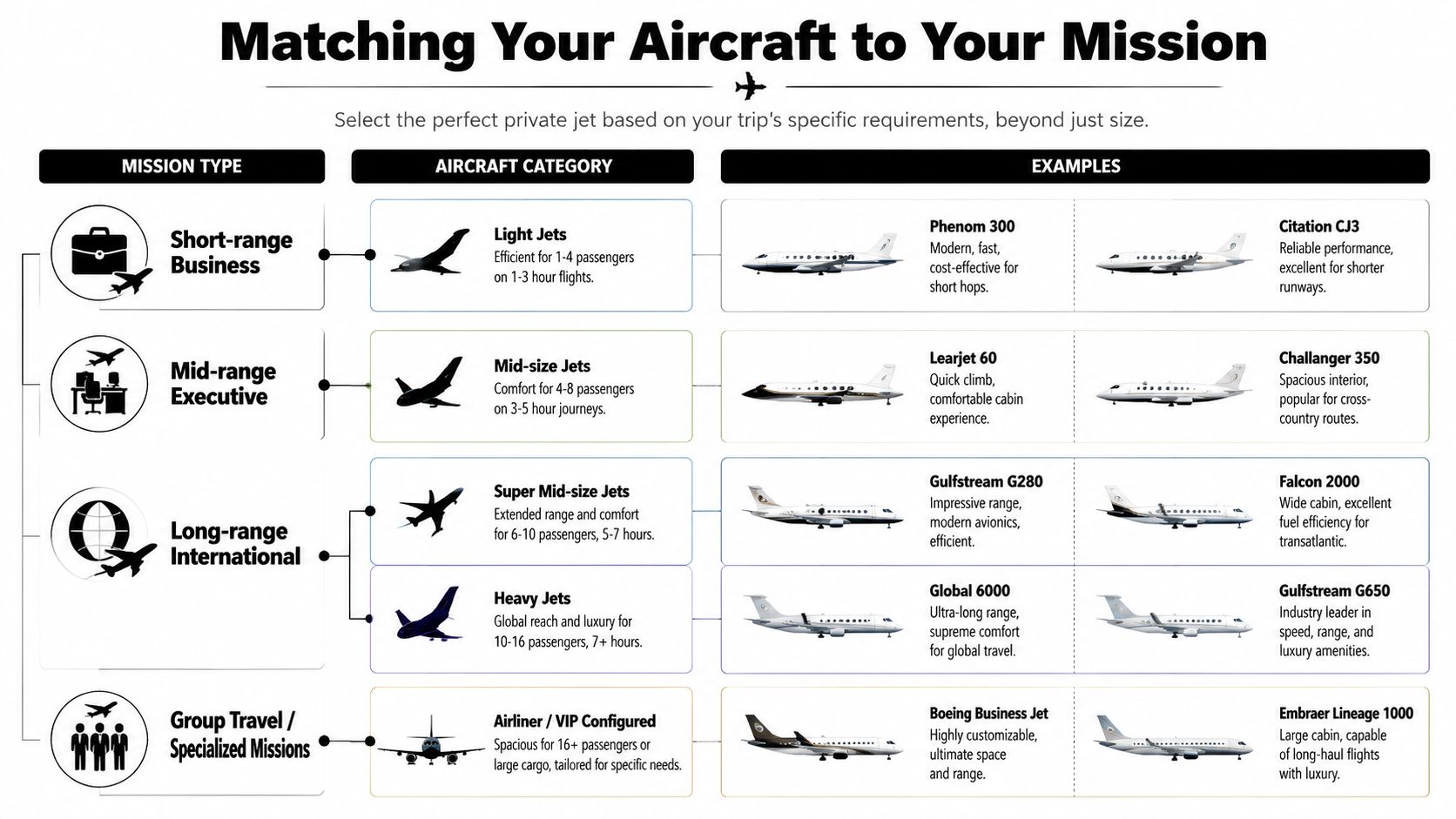
Los Angeles travelers frequently overbuy aircraft for quick regional flights. If you're going to Las Vegas, the Bay Area, or another short mission, the right answer is usually a light jet or a practical midsize option if baggage, comfort, or runway considerations call for it.
Aircraft like the Phenom 300 or Citation CJ3 make sense when the priority is speed, efficiency, and sensible operating economics. They keep the trip focused. You're not paying for cabin volume you won't use.
Mid-range trips reward balance
Flights to mountain destinations, longer domestic business missions, and trips where passengers plan to work en route often justify stepping up.
A Learjet 60, Challenger 350, or another well-chosen midsize or super-midsize aircraft can hit the sweet spot between performance and comfort. You get a more usable cabin, stronger baggage capability, and a more relaxed onboard experience without jumping straight to a heavy jet. If you want to compare available aircraft types more broadly, review the Haute Jets fleet page.
Choose the smallest aircraft that does the mission well, not the largest one you can rationalize.
Long-range and high-comfort trips justify larger cabins
Cross-country flights and longer-haul itineraries change the equation. If you're flying eastbound on a demanding schedule, or traveling with a larger group that needs a true in-flight living and working environment, heavy aircraft earn their price.
A Global 6000, Gulfstream G650, Gulfstream G280, or Falcon 2000 may be appropriate depending on route and passenger profile. The key isn't prestige. It's whether the mission benefits from the range, cabin comfort, baggage space, and onboard service profile.
A simple selection filter
Use this sequence before you approve an aircraft:
Route first
Ask whether the trip is short regional, mid-range domestic, or long-range.Passenger reality second
Count people, bags, pets, golf clubs, production gear, and anything else that affects cabin and hold.Airport compatibility third
Some airports favor specific aircraft classes and operating profiles.Comfort threshold last Decide what level of cabin experience you want once the mission is technically solved.
If you follow that order, you'll usually land on the right aircraft faster and avoid paying for theater.
Decoding the Cost of a Private Jet Charter
A charter quote isn't complicated once you know where the padding hides. The aircraft's hourly rate matters, but it's only the opening line.
What the hourly rate does and doesn't tell you
That hourly figure is useful for expectations. It is not your final number.
Your invoice typically reflects a combination of:
- Aircraft hourly rate
- Actual flight time
- Airport and FBO charges
- Crew-related costs when applicable
- Taxes and required trip fees
- Any repositioning attached to the aircraft
A cheap-looking hourly rate can still produce an expensive charter if the aircraft is badly positioned, tied to a costly airport plan, or mismatched to the route.
Why Los Angeles quotes vary so much
Two flights that look nearly identical on paper can price very differently in Los Angeles. One departs from a crowded airport, requires extra ground handling, and uses an aircraft coming in empty from another market. The other uses a local aircraft and a cleaner departure point. Same city pair. Different economics.
That's why clients who compare only aircraft category often get misled. A midsize jet isn't a commodity if one example is based nearby and the other needs a ferry leg to reach you.
| Cost element | What to ask |
|---|---|
| Aircraft rate | Is this the real billable rate for this tail, or a category estimate? |
| Flight time | Is the quote based on direct routing or padded assumptions? |
| Airport fees | Which departure airport is driving handling or access cost? |
| Crew items | Is this a same-day mission or an itinerary that creates overnight complexity? |
| Positioning | Where is the aircraft coming from before pickup? |
My invoice-reading advice
Ask for a quote that's operationally transparent. I want to see the aircraft, the airport plan, and the aircraft origin. If a provider can't explain those clearly, I don't trust the total.
Private aviation pricing gets expensive when convenience turns into assumption. Every assumption should be tested.
For private jet charter Los Angeles, that discipline matters more than in many smaller markets because there are more airports, more operators, and more ways to overspend without noticing.
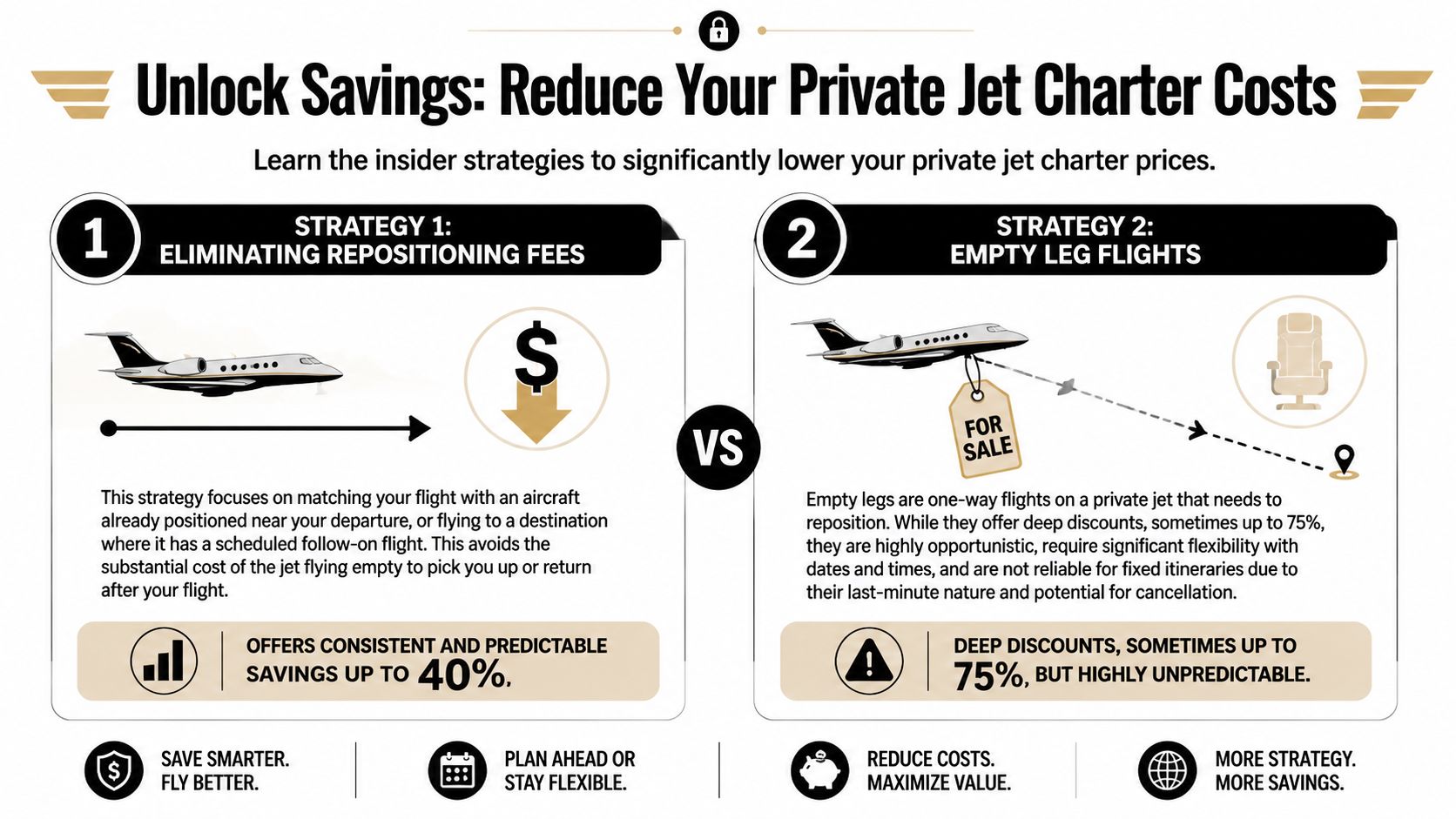
If you want the biggest reliable savings in Los Angeles, stop chasing unicorn empty legs and start eliminating repositioning.
Many travelers lose money.
Local sourcing beats most discount gimmicks
A repositioning fee is simple. The jet isn't where you are, so you pay to bring it to you. That's waste, not transportation value.
Los Angeles gives you a rare advantage because the region has deep aircraft density. If you insist on a locally based aircraft, you can often remove that waste from the quote entirely. That's far more dependable than waiting for a one-off empty leg to line up with your exact schedule.
Empty legs are real, but they're not a planning strategy
Empty legs can be useful for flexible travelers. They are not dependable enough for a board meeting, family departure window, or production schedule that can't move.
If you're curious about how those opportunities work, Haute Jets' empty leg flights page outlines the model. The smarter baseline strategy is still local sourcing first, opportunistic empty leg second.
The questions that actually lower your quote
Ask these in plain English:
Where is the aircraft based?
If the answer is vague, keep digging.Is any ferry or positioning leg included?
You want this disclosed, not implied.Can you quote a comparable aircraft already near my departure airport?
This forces a real market check.Is there a better airport for this exact trip?
Sometimes the better option comes from changing the field, not the jet.
If you don't ask where the aircraft starts, you're not really negotiating the charter. You're accepting it.
My recommendation
- Pick the best airport operationally.
- Source the aircraft locally.
- Compare specific tails, not just categories.
- Use empty legs only when your schedule is flexible.
That's how discerning flyers cut waste without compromising the trip.
Fly with Confidence The Haute Jets Advantage
Safety screening should be boring, strict, and documented. If a broker cannot show you exactly how an operator was vetted, you are buying on trust alone, and that is a weak way to charter in Los Angeles.
FAA Part 135 authority is the starting point. The stronger filter is third-party audit status. As noted earlier, Wyvern Wingman and Argus Gold or Platinum are the standards serious charter clients should look for when they want verification beyond basic regulatory compliance.

What I'd require before approving any operator
Use a simple approval standard:
Part 135 status
Confirm the operator is authorized for on-demand charter.Wyvern or Argus standing
Start there, not after the quote looks attractive.Aircraft-specific fit
The operator may be acceptable while the aircraft is wrong for the route, runway, baggage load, or passenger count.Trip transparency
You should know the aircraft, the operator, and where that aircraft is coming from before you approve the trip.
Why the booking model matters
Los Angeles punishes lazy charter buying. A trip can be safe and still be overpriced, poorly sourced, or built around the wrong airport. The provider matters because the provider controls how hard they push on sourcing, positioning, and aircraft selection.
Providers like Haute Jets aim to address that by sourcing from Wyvern or Argus-rated operators, focusing on local aircraft to reduce repositioning fees, and letting clients choose a specific aircraft without a membership model.
That approach fits this market. You want a broker that can verify operator quality, challenge unnecessary ferry costs, and present real aircraft options near your departure airport instead of sending the first acceptable quote.
My closing advice
Keep your standard simple:
- Approve operators with verified third-party safety standing.
- Ask where the aircraft is based before you review the price.
- Judge the trip by total journey time, not airport name recognition.
That is how experienced clients charter in Los Angeles. They buy safety first, then they buy the trip intelligently.