

Private jet charter means hiring an entire aircraft and crew for exclusive use on a specific trip under FAA Part 135, not buying seats, and is priced per trip by aircraft and route. In practical terms, you're booking the aircraft's trip, not a place on someone else's flight.
You may be looking at a private flight quote after assuming it works like first class. Perhaps you've searched for a Miami to the Bahamas flight, a New York to Miami itinerary, or a business trip that doesn't fit an airline schedule. The important distinction comes before the aircraft photos or hourly rate: a charter booking gives your group control of the aircraft for that contracted journey.
That difference changes how you evaluate price, flexibility, safety, airport access, and cancellation terms. You aren't choosing a more comfortable seat. You're choosing a trip product built around your departure time, route, passenger needs, and preferred cabin.
Introduction What Private Jet Charter Really Means for You
A traveler contacts a broker and asks for “one seat” on a private jet from Miami to the Bahamas. The request sounds reasonable, especially if the traveler is comparing the experience with a first-class airline ticket. But a private jet charter generally doesn't sell individual seats. The client or responsible contracting party hires the aircraft and crew for the trip, then decides who travels within the aircraft's available capacity.
That might mean a family flying for a weekend, a corporate team moving between meetings, or a production group coordinating a time-sensitive itinerary. The aircraft becomes the transportation plan for that group, rather than one seat within a carrier's published schedule.
Haute Jets Journal is designed as an editorial destination for private aviation guides, travel inspiration, and charter insights, not only a route page or promotional listing. Its journal includes educational comparisons and explainers for readers who want to understand the mechanics before requesting a quote, including first-time private flyers, corporate travel managers, and luxury advisors. You can browse the Haute Jets Journal for related private aviation topics.
Why the definition matters before you book
Understanding the private jet charter meaning helps you ask better questions. A quote may reflect the aircraft's size, the requested route, crew requirements, airport arrangements, and any repositioning needed before or after your flight. A lower-looking hourly figure doesn't automatically produce a lower total if the aircraft has to travel empty to reach you.
The guide ahead moves from the basic definition to the practical decision. You'll learn how charter differs from ownership and access programs, what happens during a booking, why quotes vary, and what unfamiliar terms mean at the airport. By the end, you should be able to decide whether an on-demand charter fits your trip and what information to request before committing.
Private Jet Charter Meaning in Plain English
The simplest comparison is the difference between hiring a private car and buying a bus ticket.
With a private car, you hire the whole vehicle for your group. You don't purchase one seat while strangers fill the remaining space under someone else's itinerary. You agree on where the vehicle should go and when it should leave, subject to the service's operating limits.
A private jet charter follows the same basic logic, but the vehicle is an aircraft and the operating framework is more regulated.
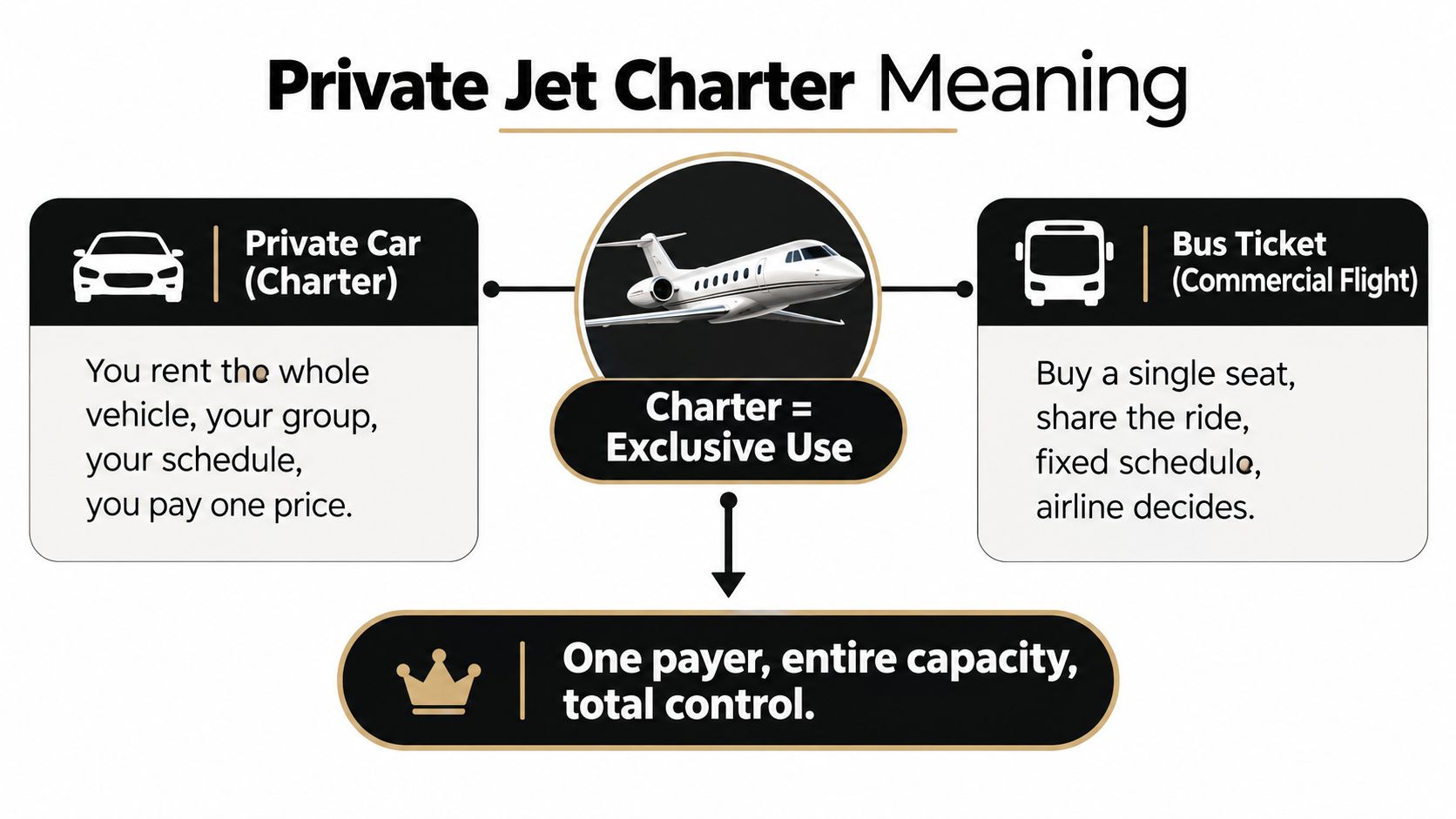
Core definition: Private jet charter means hiring an entire aircraft and crew for exclusive use on a specific trip, rather than buying individual seats.
Four parts of the definition
Entire aircraft. The aircraft's total passenger capacity is engaged for the chartered journey. You're not buying a seat on a publicly advertised service.
One responsible payer. The charterer bears the full cost rather than passengers separately purchasing seats. That structure affects the contract, dispatch decisions, liability arrangements, and the way the operator presents the quote. The United States government's charter rule describes this boundary between a private charter and public carriage.
Exclusive trip use. Your group controls the contracted itinerary, within aircraft capability, airport availability, weather, and regulatory requirements. That control can include the requested departure time, route, cabin setup, catering, and other trip preferences.
For-hire operation. In the United States, legitimate charter operations are governed by FAA Part 135, which requires certificated aircraft and crews. The FAA's charter guidance distinguishes charter as a commercial service for hire, while Part 91 generally covers noncommercial private aircraft use.
Why Part 135 matters
Part 91 flying can involve an owner or private operator using an aircraft for noncommercial purposes. Part 135 applies when an operator provides on-demand air transportation for compensation. That distinction matters because the certificate, aircraft, crew qualifications, operational procedures, maintenance program, and accountability must match the type of service being offered.
For a buyer, the practical lesson is simple: ask who the actual operating carrier is and whether the flight is being arranged with a legitimate Part 135 operator. A broker may coordinate the journey, but the operator conducts the flight and carries the operational responsibility.
For a deeper explanation, see what aircraft charter means.
How On Demand Charter Compares to Other Ways to Fly Private
Private access models can look similar from the passenger's seat, but they create different financial and operational commitments. On-demand charter is a trip-by-trip purchase. Ownership, fractional programs, jet cards, and memberships are access arrangements that may involve continuing obligations or predefined program rules.
The right choice depends less on status and more on how often you fly, how much control you need, and whether you want to commit capital or prepaid funds. A traveler with occasional, changing routes may value a fresh aircraft search for every journey. A frequent traveler with predictable demand may prefer a structured program, even if it limits aircraft choice or ties access to program terms.
Choosing Your Private Access Model
| Access Model | Commitment and Cost Structure | Flexibility and Aircraft Choice |
|---|---|---|
| On-demand charter | Pay for each contracted trip, with the quote based on the aircraft, route, and operating requirements | Strong trip-level control over departure time, route, cabin preferences, and selected aircraft |
| Jet card | Usually involves prepaid hours or a program arrangement | Access follows the card's aircraft categories, availability rules, and program conditions |
| Membership program | May involve membership terms and an ongoing relationship with the provider | Flexibility depends on the program, with aircraft choice and booking windows set by its rules |
| Fractional ownership | You purchase an interest in an aircraft or fleet arrangement and accept related ownership costs | Access is scheduled through the program, often with defined aircraft categories and operational procedures |
| Full ownership | You carry the financial and operational responsibilities of owning an aircraft | Maximum control over the owned aircraft, but with substantial responsibility for management, crew, maintenance, and utilization |
Charter is access without a permanent asset
The most useful way to think about charter is flexible access without ownership. You can request a turboprop for a shorter regional journey, a light jet for a business route, or a larger cabin when the passenger group and baggage require more space. The aircraft decision belongs to the specific trip instead of being permanently tied to one asset or program category.
That flexibility also explains why charter isn't merely “hiring a plane.” It's a complete travel product with coordinated departure timing, routing, passenger details, cabin preferences, ground arrangements, and operating oversight. The private jet charter market overview also frames charter as an on-demand service rather than ownership or fractional access.
For high-net-worth travelers, corporate teams, luxury advisors, and travelers with changing itineraries, the central question is practical: do you want to buy access for this trip, or do you want an ongoing relationship with a specific aircraft program?
How Booking an On Demand Charter Actually Works
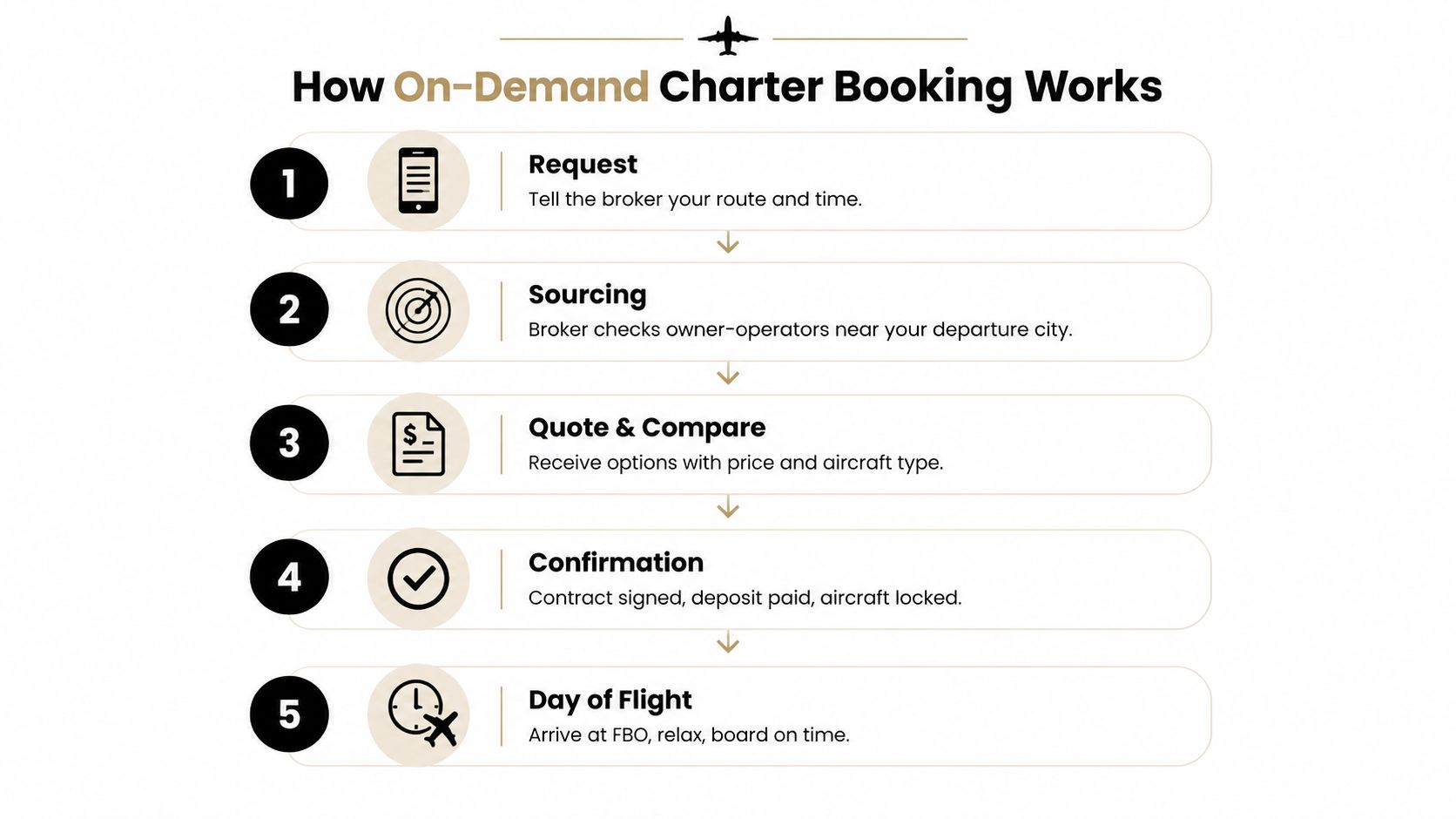
A good charter request begins with useful trip information, not a vague request for “the cheapest jet.” Give the broker your departure city, destination, preferred date and time, passenger count, baggage needs, and any special requirements. A Miami to the Bahamas request may need different aircraft options from a New York to Miami itinerary, even if both are relatively short.
From request to aircraft selection
The broker then searches available aircraft and operating partners. Local sourcing matters because an aircraft near your departure city may avoid an unnecessary empty flight before your passengers board. Haute Jets' stated model is to source from owner-operators across 3,500+ aircraft in 175 countries, but those figures should be verified as part of the specific quote and availability conversation.
The options should identify more than a broad category. Ask for the exact year, make, model, and cabin layout, then confirm whether the aircraft has the features your group expects. That can include Wi-Fi, catering, pet policies, child arrangements, luggage capacity, and ground transportation.
Quote, confirmation, and departure
Once you compare the options, the selected aircraft is placed under contract. Review the operating carrier, payment schedule, cancellation terms, included services, and any additional charges before signing. A charter is a specific trip agreement, so the written terms matter as much as the aircraft's appearance.
The final preparation continues after booking. Haute Jets describes a 24-hour pre-flight confirmation containing the tail number, crew bios, weather briefing, and passenger manifest. Those details give the traveler a final operational picture, although weather, aircraft serviceability, air traffic, and regulatory considerations can still affect a departure.
A trip coordinator may also confirm the FBO, catering, transportation, and passenger arrival instructions. You'll usually travel through a private aviation terminal rather than the main airline check-in flow, but the exact process depends on the airport and aircraft.
The passenger experience is deliberately simple, but the planning behind it isn't. This private charter booking video offers an additional visual reference for how an on-demand journey can be arranged from request through departure.
What Drives Private Jet Charter Pricing and How to Control It
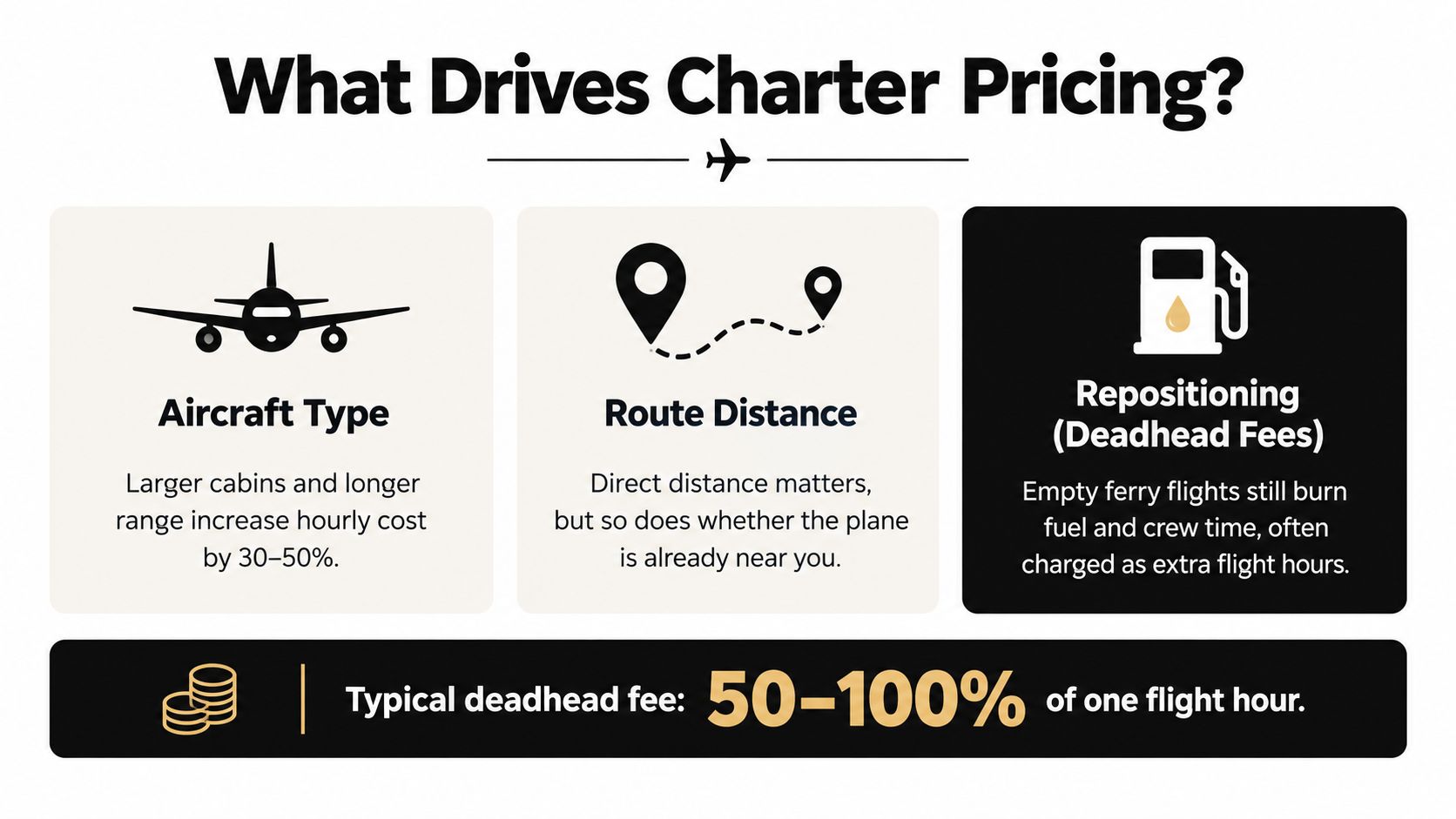
A charter quote reflects the aircraft and the entire trip, not just the time passengers spend in the air. Aircraft type, route, airport requirements, crew logistics, and repositioning can all change the final amount.
Haute Jets publishes charter flight prices starting from $3,500 per hour. Its route examples include a turboprop from Miami to the Bahamas at $3,500 to $7,000 total, and a light jet from Miami to New York City at $12,000 to $18,000 total. These examples show why a traveler should compare complete trip quotes rather than multiplying a headline hourly figure by estimated flight time. See the detailed private jet charter cost guide for more pricing context.
The repositioning problem
Repositioning, also called a deadhead or ferry segment, happens when an aircraft must fly empty to your departure airport or return to its base afterward. The operator still incurs fuel, crew compensation, landing and handling charges, insurance costs, and maintenance-hour consumption during that movement. Industry explanations of repositioning and deadhead fees note that operators often bill those empty segments at the aircraft's hourly rate.
That's why local sourcing can reduce cost pressure. If the aircraft is already close to your departure city, the quote may avoid some empty-flight time. You shouldn't assume every local aircraft will be available or that local sourcing guarantees a lower price, but it's a sensible question to ask before accepting a proposal.
Practical ways to manage the quote
- Compare total trip cost: Ask whether the figure includes repositioning, crew expenses, landing charges, handling, catering, and ground transport.
- Stay open to aircraft categories: A turboprop, light jet, or larger cabin may suit different passenger counts and baggage needs.
- Use practical airports: An alternative airport near your origin or destination may provide better aircraft availability and handling conditions.
- Ask about nearby aircraft: Request an explanation of where the aircraft is positioned before departure and where it must go afterward.
- Confirm the itinerary early: A fixed schedule gives the broker more time to find an aircraft that fits the route without unnecessary ferry movements.
The lowest quote isn't always the best value if it comes with an unsuitable cabin, inconvenient airport, or unclear extra charges. A transparent breakdown lets you decide whether the aircraft and service match the actual trip.
Key Terminology and What to Expect at the Airport
Private aviation uses compact terms that can make a first booking feel more complicated than it is. Once you translate the vocabulary, the airport experience becomes easier to anticipate.
An FBO, or fixed-base operator, is the private aviation terminal where passengers typically check in, wait, and board or transfer to the aircraft. It may offer private lounges, ramp access, fueling, passenger handling, and ground transportation coordination. The exact facilities vary by airport and provider. This FBO guide explains the term in more detail.
Words you'll hear during a booking
Empty leg: A flight segment operated without the original passenger group, often created when an aircraft must reposition for another trip. Availability can be attractive, but schedules and routing may be less flexible.
Repositioning: The movement of an aircraft before or after the passenger flight so it can reach the departure point or continue to its next assignment.
Tail number: The aircraft's registration identifier. It helps distinguish the specific aircraft assigned to your trip from another aircraft of the same model.
ARGUS and Wyvern ratings: Third-party safety audit designations used when evaluating charter operators. They're not substitutes for confirming the actual operating carrier and its regulatory authority, but they're useful questions to raise during the selection process.
Cabin categories: Terms such as turboprop, light jet, midsize jet, super-midsize jet, and heavy or ultra-long-range jet describe broad aircraft groups. The category gives you a starting point, but the exact model determines cabin dimensions, seating arrangement, baggage space, range, and onboard equipment.
What happens on flight day
You'll normally receive arrival instructions for the FBO, including the address, contact details, and recommended timing. Staff handle the passenger process and coordinate with the crew, while the broker or trip manager confirms special requests such as catering, pets, or ground transportation.
A pre-flight confirmation can also include the aircraft registration, crew information, weather briefing, and passenger manifest. Bring valid travel documents for the itinerary, especially when crossing borders, and tell the coordinator about changes before arriving at the terminal.
The private terminal may feel quieter and more personal than a main airline terminal, but it still operates within aviation rules. Security, customs, immigration, and passenger documentation requirements can apply depending on the route.
Making Sense of Charter for Your Next Trip With Haute Jets Journal
The useful answer to private jet charter meaning is broader than “renting a private aircraft.” Charter is on-demand access for one defined journey, with trip-level control over timing, routing, cabin preferences, and passenger arrangements. You pay for the contracted flight rather than buying an aircraft interest, a block of prepaid hours, or a continuing membership.
A responsible decision starts with four checks:
- Trip fit: Does the aircraft suit your passenger group, baggage, route, and timing?
- Operating legitimacy: Is the flight operated under the appropriate commercial charter framework?
- Cost clarity: Does the quote identify repositioning and other trip-specific charges?
- Service detail: Are the aircraft, crew, FBO, catering, pets, Wi-Fi, and transportation requirements confirmed?
Sustainability also deserves a direct question. Chartering doesn't automatically mean lower emissions or complete fuel decarbonization. In parts of Europe, industry coverage of sustainable aviation fuel in business aviation explains that current certifications allow SAF blends up to 50%, while ReFuelEU Aviation requires a 2% SAF share from 2025, rising to 6% by 2030. The environmental implications depend on fuel availability, the route region, and whether a book-and-claim arrangement is used.
Haute Jets Journal identifies itself as a publication for expert charter guides, travel inspiration, and private aviation insights. That makes it a useful place to continue researching aircraft comparisons, airport terminology, pricing questions, and trip-planning decisions before requesting a quote.
Haute Jets arranges on-demand private jet charter by matching your route, schedule, passenger needs, and aircraft preferences with available operating partners. Visit Haute Jets to request a trip-specific option, review the aircraft details, and speak with a charter team about your next journey.