

You’re probably making this decision under pressure.
A principal needs to be in Brickell tomorrow morning. Your family wants to leave Miami for Aspen without losing half a day to airport friction. Or you’re booking your first high-value charter and trying to answer the only question that matters: what will this cost, and what headaches am I buying or avoiding by choosing one airport, one aircraft, and one provider model over another?
That's the main difficulty with private jet charter miami. Booking the plane is the easy part. Getting the right airport, the right aircraft, the right safety standard, and a quote that doesn’t inflate with avoidable fees is where most first-time clients get burned.
Navigating the World of Private Aviation in Miami
Miami is not a fringe private aviation market. It’s one of the most active and strategically important charter hubs in the country. Miami ranks as the 9th busiest city for private jet departures in the United States, and its combination of luxury travel demand and business traffic makes it a serious node in the North American private aviation network, which accounts for 74% of the global market and 1.55 million flights annually according to JetFinder’s private jet statistics.

That matters because busy markets create opportunity and confusion at the same time. You’ll have more aircraft access, more airport options, and more routing flexibility than in smaller cities. You’ll also have more brokers pushing generic quotes that don’t explain why one option is cheaper, faster, or more suitable than another.
What first-time Miami clients usually get wrong
Most new charter clients fixate on cabin photos and hourly rates. That’s backwards.
The smart way to approach Miami is to ask four questions in this order:
- Where are you really going: South Beach, Brickell, Coral Gables, the Keys, or straight onto an international connection.
- What mission are you flying: quick regional hop, domestic business trip, or long-range international sector.
- What hidden costs sit behind the quote: repositioning, handling, crew logistics, and airport-driven friction.
- Who is operating the aircraft: not the brand on the website, but the actual operator and its safety record.
Practical rule: If a charter quote looks simple, ask for the complexity in writing.
Miami rewards strategy, not just spending
A Miami charter can feel effortless when it’s built correctly. You drive onto the ramp, clear through a quiet private terminal, board quickly, and land at the airport that makes your ground move easier.
It can also become expensive theater. You pay a premium for a plane that had to be ferried in, land at the wrong airport for your final destination, and lose time you thought private aviation would save.
That’s why experienced buyers don’t ask, “What’s the jet?” first.
They ask, “What’s the mission, and what’s the total cost of solving it well?”
Choosing Your Miami Gateway Airports and FBOs
Airport choice drives more than convenience. It affects aircraft availability, customs flow, runway capability, ground transfer friction, and the final invoice. If you treat all Miami airports as interchangeable, you’ll overspend or waste time.
Start with mission, not map distance
For long-range or international flying, Miami International Airport (KMIA) matters because it has a 13,016-foot runway and 24-hour Port of Entry capability, which makes it suitable for larger aircraft and heavier departure weights. But that same international role adds process. Customs can add 30 to 90 minutes, which is why domestic travelers often prefer executive airports when the mission allows it, as outlined in AlbaJet’s KMIA airport profile.
If you’re flying domestic and want less friction, executive airports usually make more sense. If you’re flying internationally or need the runway performance margin for a larger aircraft, KMIA often earns its place.
Miami-area airport comparison for private charters
| Airport (Code) | Distance to Downtown | Best For | Key Consideration |
|---|---|---|---|
| Miami International (MIA) | Close to downtown | International arrivals, larger aircraft, complex itineraries | More process and traffic complexity |
| Opa-locka Executive (OPF) | Not specified here | Domestic charter traffic, executive travel, streamlined private handling | Strong private aviation focus, but final ground route still matters |
| Miami Executive (TMB) | Not specified here | South Miami access, travelers heading away from the urban core | Can be smarter than expected depending on final destination |
| Fort Lauderdale (FLL) | Not specified here | North-of-Miami access, overflow options, some scheduling flexibility | Useful alternative when Miami airports aren’t ideal |
| Palm Beach (PBI) | Not specified here | Palm Beach and northern South Florida itineraries | Often too far southbound for a true Miami mission |
What I recommend by traveler type
If your meeting is in Brickell and you’re flying domestic, I’d look hard at OPF before defaulting to MIA. If your destination is south of the city, TMB may cut ground friction even if someone tells you another airport is the “preferred” private option. That label means nothing unless it matches your actual route on the ground.
For a better look at the private terminal experience around Opa-locka, review this Miami FBO and Opa-locka guide.
Don’t measure airport convenience by downtown alone. Measure it by your real destination, your departure timing, and whether you need customs, runway length, or quick-turn simplicity.
FBO quality matters more than most first-time clients expect
The FBO is where the trip either feels polished or sloppy. A strong FBO handles ramp access cleanly, coordinates catering properly, manages baggage without drama, and keeps your car transfer tight.
Ask direct questions before you confirm:
- Ground transfer coordination: Will the car be on the ramp or staged at the terminal?
- Cabin support: Can the FBO execute catering accurately and on time?
- Passenger flow: Is the operation built for quick turns or does it routinely bottleneck?
- Trip type: Is this a strong airport for your route, or just a familiar sales default?
Airport choice in Miami isn’t cosmetic. It’s operational.
Selecting the Right Aircraft for Your Mission
The right aircraft is the one that fits the mission cleanly. Not the biggest one. Not the one with the flashiest brochure. Not the one a salesperson is trying to move that day.
Most mistakes happen because clients buy too much airplane for a short trip, or too little airplane for the bags, passenger count, or route they need.
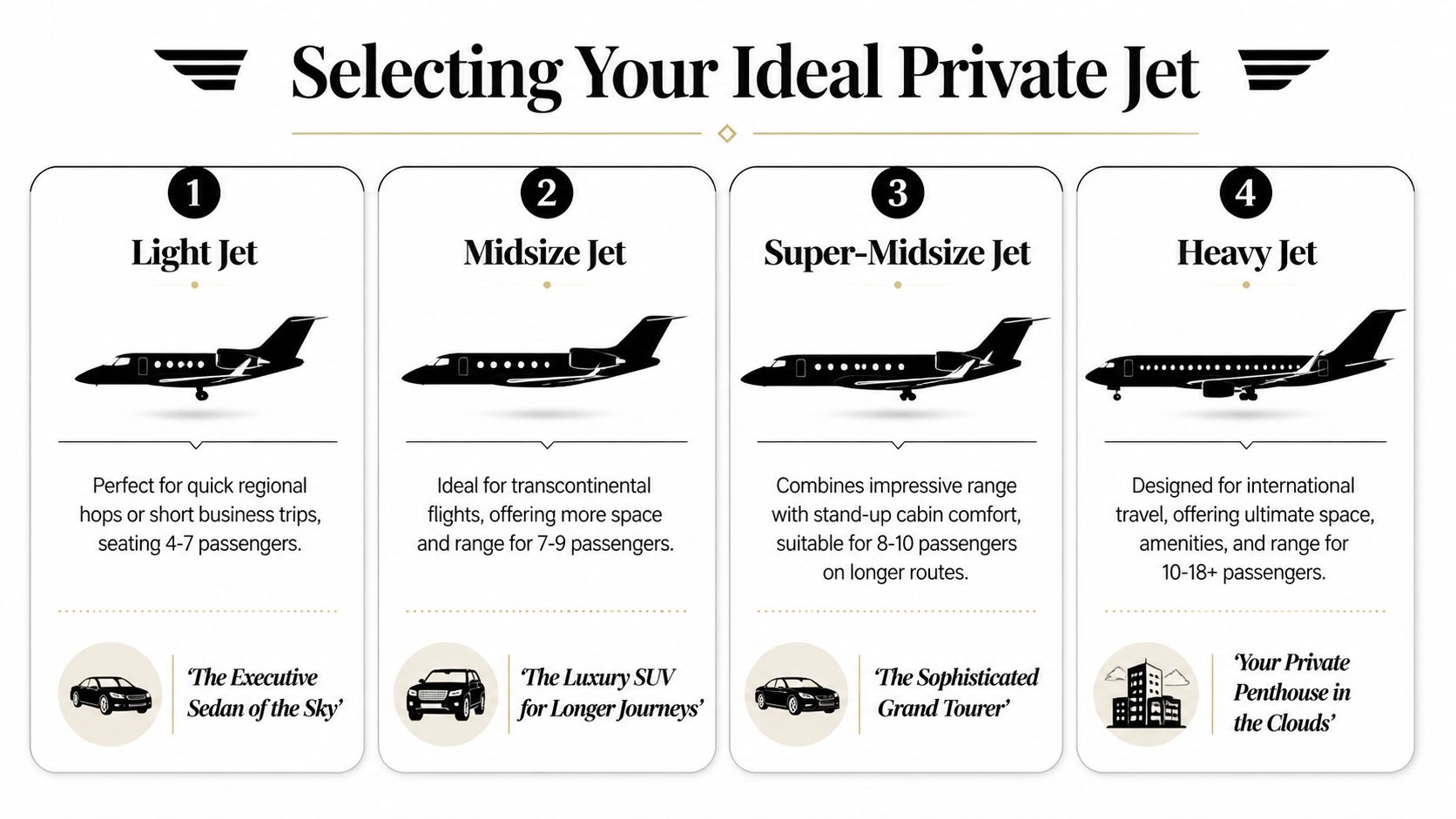
The simplest way to think about aircraft categories
Use this framework when you request options.
Light jet
This is the efficient tool for short regional flying. Think Miami to nearby leisure destinations or compact business trips with a smaller group.
Call it the executive sedan of the sky. It’s fast, practical, and usually the wrong place to overspec. If your mission is short and your group is small, paying for more cabin than you need is just waste.
Midsize jet
For many domestic Miami itineraries, travelers gain more cabin comfort, stronger baggage flexibility, and better trip versatility, particularly for common business routes.
Call it the luxury SUV for longer journeys. It fits travelers who want comfort without jumping unnecessarily into large-cabin pricing.
Super-midsize jet
This category is where comfort and performance start to align nicely for demanding domestic travel. Stand-up cabin feel and longer legs make it attractive for clients who care about cabin experience but still want sensible economics.
Call it the luxurious grand tourer.
Heavy jet
This is built for international missions, larger groups, and travelers who want significant space, range, and onboard amenities.
Call it your private penthouse in the clouds. It makes sense for true long-range travel. It does not make sense just because you like the idea of it.
Match the jet to the mission
A useful shortlist starts with these filters:
- Passenger count: Don’t just count seats. Count how many adults need to travel comfortably.
- Luggage profile: Golf clubs, garment bags, ski gear, and oversized cases change the answer fast.
- Flight length: Regional, domestic, and international missions each narrow the field.
- Cabin expectations: Wi-Fi, stand-up cabin, enclosed lavatory, and service needs matter.
- Arrival constraints: Some airports and runways favor some aircraft more than others.
For aircraft browsing by specific make and model, you can review the Haute Jets fleet options.
A better client brief gets a better quote
Don’t ask for “a midsize jet to Miami” and hope for the best. Give a proper brief.
Use something closer to this:
Who’s flying
Number of passengers, whether it’s executives, family, clients, or a mixed group.What’s coming onboard
Standard luggage, garment bags, sports equipment, pets, or medical equipment.How the cabin will be used
Quiet rest, onboard work, meeting prep, family comfort, or celebration.Which constraints matter most
Lowest total cost, fastest departure, shortest ground transfer, or highest cabin comfort.
A precise request saves money because it narrows the field before the quote is built.
Don’t let category labels replace judgment
The category is only the start. Year, make, model, cabin layout, baggage access, and onboard equipment can materially change the experience.
Two aircraft in the same category can feel very different in practice. One may have the connectivity you need. Another may have the baggage compromise you don’t discover until you’re loading. A disciplined charter advisor should confirm those operational details before you wire a deposit.
Decoding the True Cost of Your Miami Charter
You approve a Miami charter at a rate that looks competitive. Then the invoice grows because the aircraft is coming from another state, the airport choice adds handling friction, and the crew has to sit overnight for a schedule that was never optimized. That is how first-time charter clients overpay.
Many charter quotes become misleading at this stage. The problem is not the hourly rate itself. The problem is treating it like the full trip cost.
The line item that changes the deal
The biggest miss in many Miami quotes is repositioning. If the aircraft is not already near your departure point or your return plan leaves it stranded, you are often paying for flight time that does nothing for your actual itinerary.
That cost can outweigh a lower hourly rate. A jet that looks cheaper on paper can become the more expensive option once ferry legs, extra crew time, and airport fees are added. This is why airport choice, aircraft choice, and sourcing model have to be evaluated together. Looking at any one of them in isolation gives you the wrong answer.
What a transparent quote should show
A proper quote should separate the mission cost from the support cost around it. If it does not, you cannot compare offers intelligently.
Ask for these items to be shown clearly:
- Flight charge: The billed flight time for your actual trip
- Repositioning: Any ferry legs before pickup or after drop-off
- Airport and FBO fees: Ramp, handling, parking, and other airport-specific charges
- Crew costs: Waiting time, overnight expenses, and duty-related schedule changes
- Passenger extras: Catering, Wi-Fi, pets, deicing if applicable, and ground transportation coordination
- Taxes and segment fees: Government charges that should not be buried inside vague totals
If a provider gives you one round number without explaining those parts, you are looking at a sales quote, not a decision-grade quote.
Airport strategy changes the final price
Miami is not one airport. Your departure or arrival point can change both cost and ground time. A closer airport may reduce your drive by an hour but increase parking, handling, or congestion-related delays. A different field may support a more efficient aircraft option already nearby, which cuts repositioning and shortens the day.
That is the missing link many clients never see. The cheapest aircraft is not always the lowest-cost charter. The lowest-cost charter is the one where airport selection, aircraft fit, and aircraft location all work together.
Fuel matters, but context matters more
Fuel is a major operating expense, but clients make poor decisions when they fixate on fuel burn alone. What matters is whether you are paying for productive flight time or paying to move the airplane into place.
A disciplined advisor starts with a simple question. Where is the aircraft now, and does its position make sense for this mission?
If the answer is vague, stop there.
Questions that protect your budget
Before you approve any quote, ask:
- Where is the aircraft based right now?
- How much of this total is repositioning?
- Would another Miami-area airport lower the full trip cost?
- Is this aircraft being recommended because it fits the mission, or because it is the easiest one to sell today?
- Which fees are fixed, and which can still change before departure?
For a clear example of how trip pricing is structured, review the Haute Jets pricing page.
My recommendation
Do not compare Miami charter quotes by top-line price. Compare them by total trip logic.
The right quote is the one with a sensible airport plan, an aircraft that matches the mission without excess, and full fee disclosure before you wire funds. That is how you control cost and avoid operational drag at the same time.
Vetting Your Operator for Uncompromising Safety
Price matters. Airport strategy matters. None of it comes before safety.
If you’re chartering privately, third-party safety audits should be your minimum entry standard. Not a nice-to-have. Not a marketing badge. A requirement.

What to insist on
The operator of your aircraft should hold Wyvern Wingman or ARGUS Gold/Platinum credentials. Those designations matter because they indicate independent review of operational standards, not just self-reported claims on a website.
When an operator meets that threshold, you’re generally looking at a business that has subjected its processes to outside scrutiny. That includes areas like pilot records, maintenance discipline, and operating procedures.
What a good safety conversation sounds like
A credible charter advisor should be able to answer these questions quickly and directly:
- Who is the actual operator of this aircraft
- What third-party safety rating do they hold
- Can you provide operator details before I fund the trip
- Who are the pilots and what experience information will be disclosed before departure
- What happens if the aircraft goes out of service before my trip
If those answers are vague, walk away.
Safety due diligence shouldn’t feel awkward. In private aviation, it’s part of buying intelligently.
A short video can help clarify how serious buyers think about charter standards and operator scrutiny:
Don’t outsource judgment completely
Even if you’re using an advisor or broker, ask to see the operator credentials tied to your specific trip. The brand you booked through is not the same thing as the certificate holder flying you.
That distinction matters. Plenty of first-time clients assume the booking platform itself is the operator. Often it isn’t.
Your standard should be simple: if the operator can’t be clearly identified and independently validated, the flight shouldn’t happen.
The Haute Jets Advantage for Miami Travelers
You land on a quote that looks competitive. Then the bill grows once the routing changes, the aircraft has to reposition from another state, or the airport choice adds ground time you did not account for. Miami charters get expensive that way. The key advantage is not access to a jet. It is getting the airport, aircraft, and sourcing model right before you approve the trip.
Miami rewards buyers who stay out of rigid prepaid programs and buy each flight based on the actual mission. Analysts tracking the private charter market reported that on-demand trips accounted for 51.62% of industry revenue in 2026, according to private jet industry statistics compiled by EpicEdits. That split fits what serious charter clients already do in Miami. They want control over each trip, not a fixed program that pushes them toward whatever inventory is easiest to sell.

Why this model works in Miami
Miami is not a market where you should buy on brand image alone. It is a routing and sourcing market. A quote from Opa-locka can price very differently from one using Miami International or Teterboro repositioning, even if the cabin looks similar on paper.
Haute Jets matters here because the model is built around direct sourcing from owner-operators, access to 3,500+ aircraft across 175 countries, and use of Wyvern Wingman or Argus Gold/Platinum-rated operators only, based on information provided by the company. For a Miami client, that can reduce unnecessary ferry costs, widen your aircraft choices near the point of departure, and keep the quoting process tied to real operator availability instead of a narrow in-house inventory pool.
That is what clients should care about.
What a Miami client actually gets from that approach
A good charter model should make the quote more accurate before it makes the trip more comfortable.
For Miami travel, that usually means:
- Better cost control: The aircraft is sourced closer to your trip rather than pulled in for convenience at your expense.
- Better airport logic: The quote can be built around the airport that best fits your destination, schedule, and ground transfer plan.
- Better aircraft matching: You can choose for cabin size, luggage space, range, and onboard features, not just what sits inside a prepaid program.
- Better trip visibility: You can review the actual aircraft and operating details tied to your mission before departure.
- Better flexibility: You pay for the trip you are taking, not for a membership structure that may or may not fit your flying pattern.
My recommendation
For Miami charter, buy the mission, not the program.
If you fly irregularly, seasonally, or with changing passenger counts, on-demand sourcing is usually the smarter purchase. It gives you a cleaner way to connect total trip cost to actual operating reality. That includes where the plane starts, which airport you use, how long the leg is, and whether the cabin fits the group.
Jet cards can still serve a narrow type of buyer. First-time Miami clients usually do better with a direct, trip-by-trip process that exposes the actual economics instead of burying them inside prepaid convenience.
That is the Haute Jets advantage in practical terms. More pricing clarity, better sourcing discipline, and a booking model that fits Miami’s operational reality instead of fighting it.
From Quote to Takeoff A Seamless Booking Guide
It is 8:30 a.m. in Miami. Your car is waiting, your meeting starts in Nassau at noon, and the charter quote that looked fine yesterday now includes a different airport, a longer drive, and extra charges no one explained. That is how first-time buyers overpay. The fix is simple. Run the trip with a tight process from the first request to wheels up.
What to send in the first request
A good charter outcome starts with a usable brief. Send your departure window, preferred airports, final destination, passenger count, luggage, and any hard requirements such as Wi-Fi, pet travel, catering, or cabin layout.
Include the ground plan too. If you need to land close to Bal Harbour, Brickell, Palm Beach, or a yacht transfer point, say so upfront. Airport choice changes drive time, crew duty planning, repositioning, and sometimes the aircraft options themselves. Those details shape the final price as much as the hourly rate.
Short inquiries create expensive back-and-forth. A precise first message gets you to workable options faster.
What to review in the quote stage
Read each quote like an operating plan.
Check five things first:
- Departure and arrival airports: Do they fit your actual schedule and ground movement, or are they easier for the provider?
- Aircraft fit: Does the cabin handle your group, bags, and flight length without forcing a compromise?
- Line-item clarity: Are repositioning, wait time, de-icing risk, catering, and ground transport assumptions clearly stated?
- Operator disclosure: Is the actual FAA-certificated operator identified?
- Change policy: What happens if your meeting runs late or your return time moves?
If a quote is vague, push back immediately. Unclear language around airport choice, fuel stops, or extra fees usually becomes your problem on departure day.
How personalization should work
Once you select the aircraft, the trip needs exact instructions, not broad preferences.
Request specifics in writing:
Catering
List the meal timing, brands, dietary restrictions, and serving preferences. “High-end catering” means nothing operationally.Ground transport
Confirm pickup time, vehicle type, FBO address, and whether ramp-side coordination is arranged.Pets
Verify the pet policy for that aircraft and operator, including size limits, documents, and cabin handling rules.Connectivity
Confirm Wi-Fi availability on that specific aircraft, not on a similar model in the fleet.
True efficiency lies in the details. Clean instructions reduce delays, prevent last-minute substitutions, and keep the total trip aligned with the quote you approved.
The last 24 hours matter
You should have the tail number, operator name, crew details, FBO information, departure time, and passenger manifest confirmed before the day of travel. Recheck weather, baggage count, catering, and ground transport at the same time.
A well-run trip feels easy because the planning is disciplined. The client experience is the result of operational control, not sales polish.
On departure day, your job is simple. Arrive at the right FBO, verify the aircraft, board, and leave.
If you want a Miami charter quote that reflects your specific mission rather than a generic sales template, Haute Jets can help you compare aircraft, airport options, and trip details on a per-flight basis without a membership structure.