

If you're trying to get from Richmond to New York before breakfast, or you're moving a family, a deal team, or a production crew on a tight clock, the core question isn't whether to charter. It's which Richmond airport, which aircraft, and which sourcing model will keep the invoice sane. That's where most first-time buyers get burned, they chase a glossy jet category and ignore the local airport network that changes the price.
Private Jet Charter Richmond VA works differently from a lot of smaller cities because Richmond isn't a one-airport market. It's a multi-airport sourcing market, and that matters more than most brochures admit. If you know where aircraft are based, which FBOs handle the trip, and how quote structure changes by aircraft class, you can make the same mission cost a lot less without giving up comfort or speed.
Why Richmond Is a Smarter Charter Market Than People Realize
A lot of people still treat Richmond like a single-dot destination. That's the wrong mental model. The city sits inside a dense regional air network, with more than 15 airports within a 50-mile driving radius and five airports within 12 miles, including Richmond International Airport (RIC) and Chesterfield County Airport (FCI), according to the Richmond market data provided by Paramount Business Jets. That density gives charter operators more places to source aircraft locally, which is exactly how you cut deadhead and keep the quote from drifting upward.
If you're an executive based in Henrico trying to make a 6 a.m. Manhattan meeting, that local sourcing advantage is real. The same is true if a Williamsburg family is heading west for ski season, or if a production team needs talent in and out without a lot of visibility. You're not just buying lift, you're buying where the aircraft already is.
Richmond also has the scale to support serious private travel. Its population is listed in the source material at about 220,289 to 227,032, which puts it squarely in mid-sized-market territory with enough corporate and leisure demand to keep charter options active. And Richmond International Airport is described as the third busiest airport in Virginia, which reinforces its role as the region's main private-aviation gateway. That matters because airport activity tends to support better access, more local handling, and more realistic scheduling.
Practical rule: if two quotes look close, choose the one with the better local aircraft position. In Richmond, that can save money faster than chasing a slightly lower hourly rate.
The rest of this guide is the playbook I wish more Richmond flyers used on day one. You'll get the airport names, the FBOs worth using, the aircraft classes that fit common missions, and the booking moves that keep charter pricing grounded in reality instead of marketing copy.
Richmond Airports and FBOs Worth Knowing
Where you depart changes your day more than most travelers expect. In Richmond, the difference between a smooth departure and a messy one usually comes down to airport access, FBO handling, and how far your aircraft had to travel to get to you. That's why I start with the field, then work outward to the fixed-base operator.
Richmond International Airport (RIC) is the anchor. It's about 7 miles southeast of downtown Richmond and operates 24/7 for general aviation through Richmond Jet Center, according to the airport listing from Paramount Business Jets and the Richmond aviation pages. That's the right default for most charter passengers who care about a clean curb-to-car handoff and straightforward handling. The airport's private-aviation infrastructure also includes Million Air Richmond, and the Richmond airport complex lists multiple aviation-service contacts, which is another sign that the charter ecosystem is built to support real traffic, not just occasional flights. For readers who want a deeper airport-specific breakdown, the Richmond International Airport KRIC guide is the right place to compare handling details.
Chesterfield County Airport (FCI) is the more strategic choice when privacy matters more than the main-terminal environment. It sits in the local general-aviation network and gives you another sourcing point when Richmond International is busy or when your aircraft is already positioned closer to the south side of the metro. I'd use it for discreet executive travel, certain cargo-heavy missions, or trips where you care more about a fast aircraft turn than the biggest airport name on the itinerary.
Richmond Executive Airport belongs in the conversation too, especially if your goal is to minimize friction rather than impress anyone with a large-field arrival. Richmond's aviation ecosystem isn't just RIC. The local market also includes other fields and operators, which is exactly why the metro works as a sourcing market instead of a single-airport story.

What Actually Matters at the Airport Level
The best airport isn't the one with the most runway. It's the one that gives you the cleanest handoff from car to cabin. For many Richmond travelers, that means choosing RIC for convenience, FCI for discretion, and a smaller field when the mission is sensitive or the ground plan is more important than the terminal experience.
Richmond flyers should ask one question before they accept a quote, where is the aircraft based tonight. The answer can tell you more about the real cost than the hourly rate.
Aircraft Types That Fit Richmond Trips
Richmond charter pricing makes more sense when you tie it to a specific mission instead of a vague category. I see buyers spend too much because they assume bigger means better, or they book too small and end up cramped, tired, and paying for the mistake in cabin comfort. The right move is simple, match the cabin to the route, the passenger count, and the baggage profile.
Typical Richmond Charter Hourly Rates by Aircraft Class
| Aircraft Class | Hourly Rate Range | Typical Richmond Mission |
|---|---|---|
| Turboprop | about $1,500-$3,000 | Short regional hops, flexible schedules, lower-cost trips to nearby leisure markets |
| Light Jet | about $3,500-$4,800 | New York, Chicago, Miami, executive day trips |
| Midsize Jet | about $4,800-$6,000 | Longer domestic city pairs, better cabin comfort, more workable baggage space |
| Super-Midsize Jet | about $8,500-$10,500 | Coast-to-coast style missions, stronger cabin comfort for mixed business and family travel |
| Heavy Jet | about $8,500-$10,500 | Larger groups, longer range, more cabin volume |
| Long-Range or VIP Aircraft | about $12,000-$15,000 | Longer-haul or premium cabin missions where nonstop range and space matter |
Those ranges come from the Richmond-specific market benchmarks provided by Air Charter Advisors, Jettly, and the Richmond charter pages in the source set. The point is not to chase the lowest number on the page. The pattern is clear. Turboprops sit at the low end, heavy and long-range aircraft sit far higher, and quotes move materially by aircraft age, routing, and availability.
A turboprop makes sense when you care more about efficiency than cabin swagger. A light jet is the workhorse for Richmond-to-Northeast business travel. A midsize or super-midsize jet is where I start looking when the trip gets longer, the cabin time matters, or the baggage load gets annoying. Heavy and long-range aircraft are for missions where the trip itself is the product, or where you need true cabin space and longer legs.
Richmond route examples from evoJets help anchor the logic. One-way pricing lists New York to Richmond from $6,800 in a light jet for 6-8 passengers, Atlanta to Richmond from $6,500 in an executive turboprop for 4-9 passengers, Chicago to Richmond from $10,000 in a light jet, and Miami to Richmond from $8,500 in a light jet. Those examples matter because they show how route and aircraft selection interact, not just one generic hourly figure.
The Selection Rule I Use
If the trip is under a few hours and the group is small, do not overbuy the jet. If the mission is long, sensitive, or luggage-heavy, stop pretending a cheap cabin will feel cheap by hour three. The aircraft class should solve the trip, not decorate it.
For a cleaner breakdown of how aircraft class affects the final bill, the private jet charter cost guide is the right reference point. It helps separate the aircraft hour from the rest of the invoice, which is where Richmond quotes stop looking simple.
What a Richmond Charter Actually Costs in 2026
Published hourly rates are the opening line, not the final invoice. That's the biggest mistake Richmond buyers make. They see a number, assume that's the flight price, and then get surprised when routing, fuel, handling, crew, and aircraft position move the total.

The Cost Drivers That Move the Quote
Start with the aircraft class, then look at the operational add-ons. The quote can move because of fuel surcharges, federal excise tax, segment fees, crew overnight, catering, ground handling, de-icing, and repositioning. The aircraft hour is only the visible part.
If you want the cleanest framework for understanding those variables, the private jet charter cost guide is the right place to compare how different trip components stack up. The key point is that two similar Richmond quotes can still diverge hard once the aircraft's home base, schedule, and turn time are factored in.
Route Examples That Make the Pricing Real
Richmond route quotes vary by city pair and aircraft type. evoJets lists New York to Richmond from $6,800 in a light jet, Atlanta to Richmond from $6,500 in an executive turboprop, Chicago to Richmond from $10,000 in a light jet, and Miami to Richmond from $8,500 in a light jet. Those examples don't just show demand, they show that a city pair is never one-size-fits-all.
The market context matters too. One Richmond-focused source says hourly rates can start around $2,000 for turboprops and reach $17,000 or more for long-range or VIP aircraft, depending on category and trip specifics. Another Richmond benchmark lists turboprops at about $3,500 per hour, light jets at $6,500, midsize jets at $8,500, super-midsize jets at $10,500, and heavy jets at $14,000 per hour. The spread is real, and it tells you exactly why blind shopping is expensive.
The biggest lever in Richmond is local sourcing versus repositioned aircraft. If the jet is already near your departure airport, you don't pay to fly it to you first.
What I Tell Clients Before They Approve the Flight
Ask for the aircraft's base location, not just the category. Ask whether the quote assumes local positioning or ferry time. Ask what changes if you shift from RIC to another nearby field. That's where the quote either stays honest or starts padding itself.
How to Book a Private Jet Out of Richmond Step by Step
Good Richmond charters are booked in a sequence, not in a rush. If you skip steps, you create delays, and delays create costs. The cleanest way to book is to define the mission first, then force the quote to fit the mission instead of the other way around.
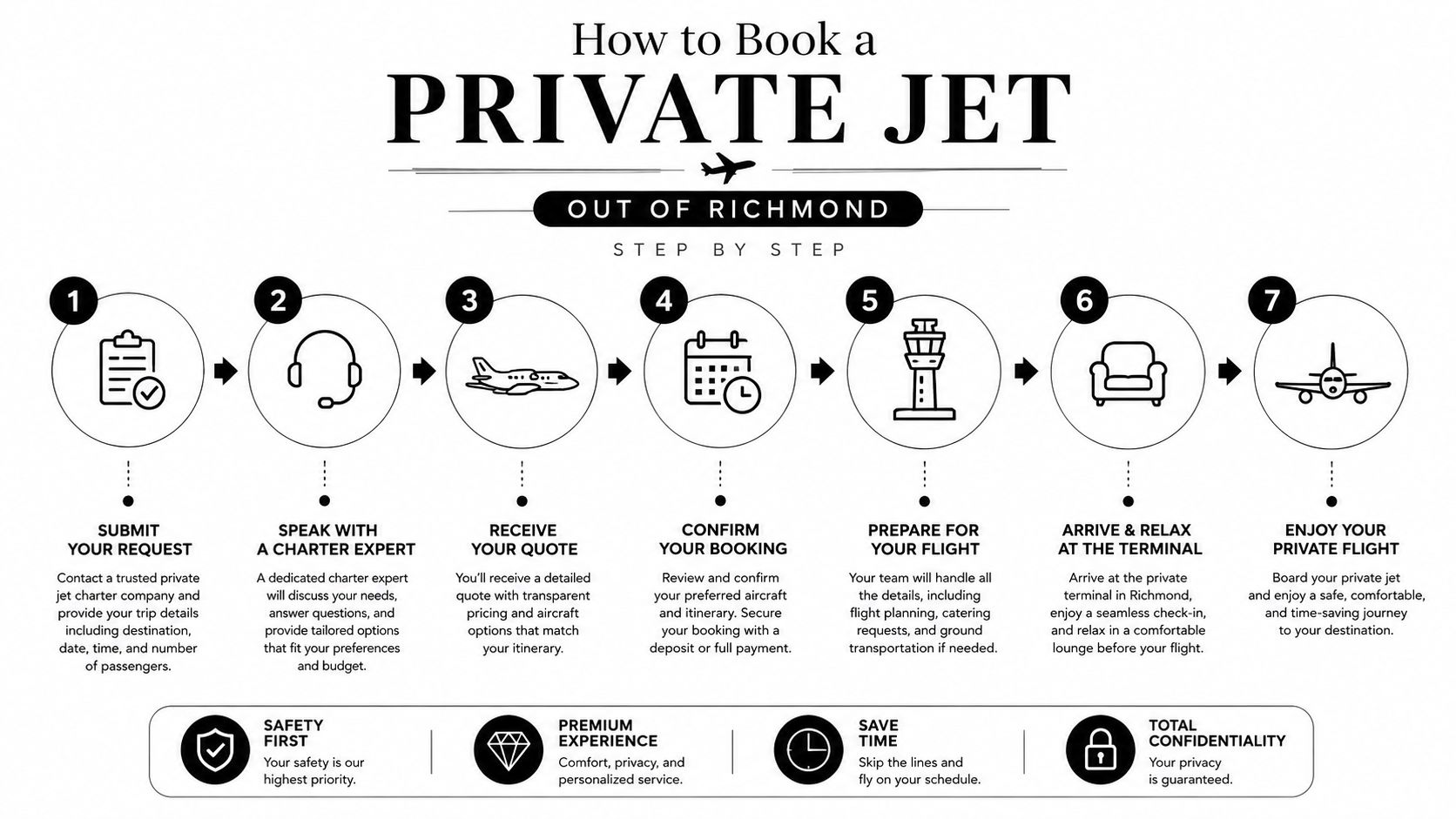
Step 1, define the trip correctly
Lock down passenger count, departure time, baggage, pets, and any ground constraints. A Richmond board meeting, a family ski trip, and a production move are all different missions. If you blur them together, you'll get the wrong aircraft.
Step 2, compare aircraft by year and configuration
Don't compare only by jet class. Compare by year, make, model, and cabin layout when you can, because the cabin experience and the usable baggage space can vary inside the same category. That's how you avoid paying for a label instead of a usable flight.
Step 3, confirm the operator and safety credentials
Ask for crew details, the operator's audit standing, and the actual routing plan. If the charter is brokered, find out whether the aircraft is local or repositioning. If you're dealing with a provider that sources locally, the quote is usually easier to read.
Step 4, review the contract and pay the deposit
Read the itinerary line by line, then make sure the departure airport, timing, passenger count, and baggage assumptions match what you asked for. You should also be clear on any special services before money changes hands.
Step 5, send the right documents early
Bring government ID for every passenger. If the trip is international, get the customs paperwork ready early. If you're traveling with pets or special cargo, send those notes before the day before departure.
Step 6, wait for the 24-hour confirmation
A proper charter flow should end with a final confirmation that includes the core flight details. Missing that step is how people end up learning about changes at the curb.
Broker-supplied aircraft can hide repositioning costs inside the quote. Local sourcing makes those costs easier to see, and often easier to avoid.
Richmond charter providers advertise continuous access, and that helps with last-minute trips. Million Air Richmond says its aircraft are available 24 hours a day, and Air Charter Advisors says brokers are available 24 hours a day to discuss and book Richmond private-charter flights. That doesn't mean every aircraft is instantly available, but it does mean the market is built for fast action when the schedule moves.
Empty Leg Flights From Richmond Without the Hype
Empty legs are useful, but they're not magic. They're one-way repositioning flights that already have a route, a date, and usually a very narrow window. If your plans fit the aircraft's movement, the deal can be excellent. If your plans are flexible only in theory, empty legs waste time.
The advantage is pricing. In practice, empty legs can land at a 25-75% discount off retail, but that discount comes with a catch, timing is last-minute, the routing is fixed, and you don't get much flexibility on the airport or the date. That's why they work well for discretionary trips, especially an Aspen run or a Bahamas getaway, and badly for a board meeting that cannot move.
Richmond travelers usually find empty legs by watching routes that connect major East Coast business hubs to leisure destinations or by setting alerts through charter advisors who see repositioning inventory as it appears. The empty leg flight guide is the best place to understand how the booking logic works before you start chasing a discount.
The wrong way to treat an empty leg is as a guaranteed bargain. The right way is to think of it as a trip-fitting tool. If your schedule is loose, your airport can change, and you're ready to move when the call comes in, empty legs can make sense. If not, they're a distraction.
Richmond's airport density helps here too, because more regional aircraft movement means more chances for inventory to surface. But the word that matters is chance. Empty-leg planning is a discipline, not a shopping spree.
Safety, Ground Logistics, Catering, and Pets
The aircraft gets the attention. The details decide whether the trip feels professional or chaotic. In Richmond, once the jet is selected, your job is to clean up every loose end before the crew ever shows up at the door.
Start with safety. Ask whether the operator holds Wyvern Wingman or Argus Gold or Platinum status. Those are the audits I pay attention to because they're the industry's recognized third-party benchmarks. If a provider can't speak clearly about the operator's standing, move on.
You should also ask who owns the trip on the day of departure. If the aircraft is sourced locally, there's usually less confusion about positioning, crew timing, and handoff. If it's brokered from farther away, ask how the schedule is protected if weather or maintenance pushes the arrival.
Ground logistics matter just as much. Confirm the pickup point, the car type, the driver's contact, and the handoff timing. If you're leaving from RIC, the advantage is that the local private-aviation setup already supports those movements. If you're using a smaller field for privacy, make sure the car plan matches the field's access reality.
Catering is simple if you treat it as a specification, not a guess. Name the meal, name the beverages, and confirm the delivery time. Same with Wi-Fi. Don't assume the cabin has what you need just because the aircraft is large enough to impress someone on paper.
Pets are where first-time charterers lose time. Different operators handle pet travel differently, so confirm the policy before you book, not after. If you're flying with a larger dog or a passenger who needs help with cabin comfort, a resource like airplane seat belt comfort and security is useful for understanding fit and restraint considerations on the passenger side of the trip.
International departures need tighter handling. Customs paperwork, passenger identity checks, and any special cargo notes should be done early. Richmond has the infrastructure to support that kind of trip, but the paperwork still has to be clean.
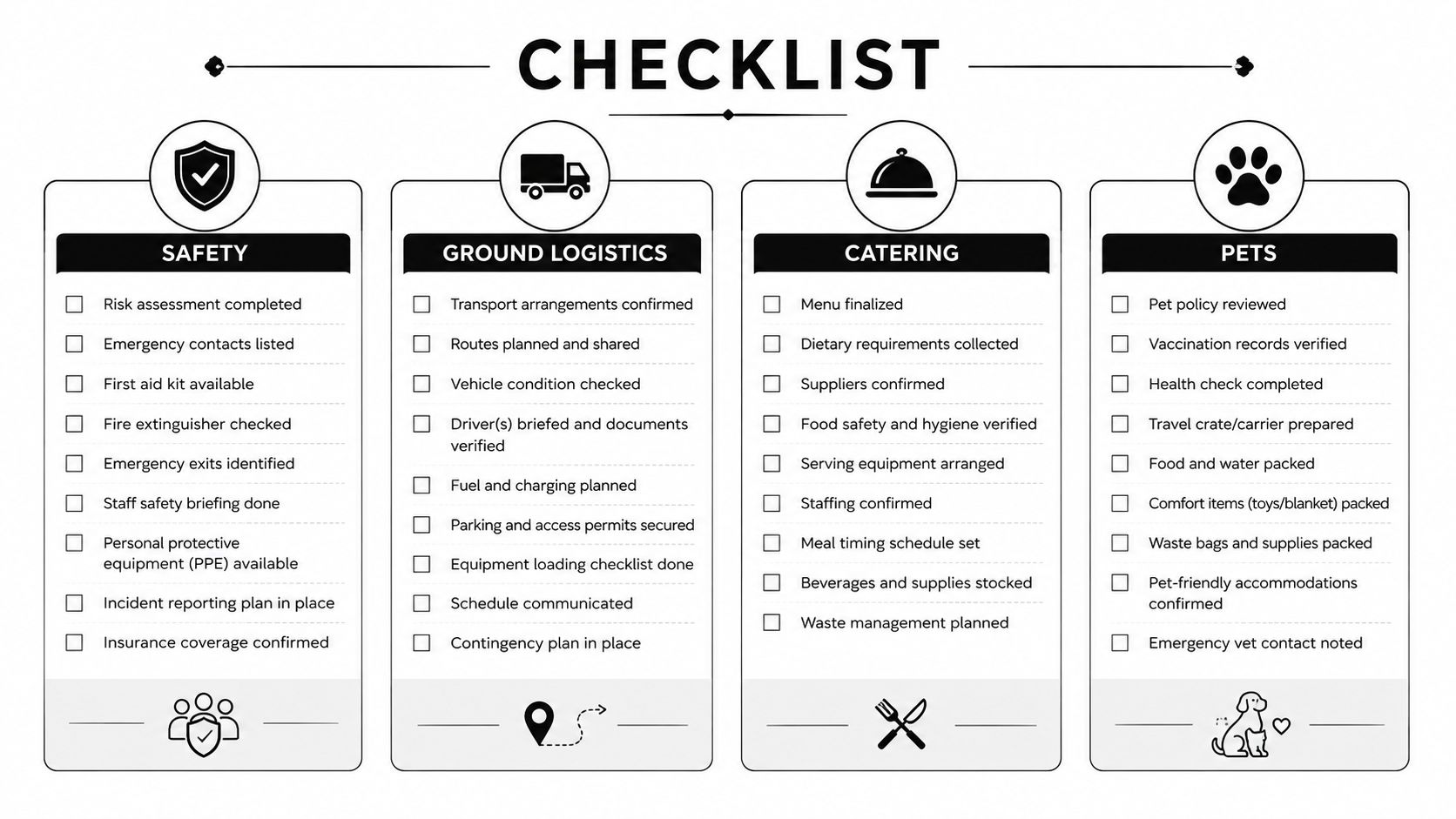
What I Want Confirmed 48 Hours Out
- Tail number and operator name. Don't wait until the last minute to find out which aircraft is flying.
- Crew bios and safety standing. You want the people, not just the airplane, locked in.
- Weather and routing. Richmond departures can change with conditions, so the plan needs a backup.
- Passenger manifest. Make sure every name is correct before the final confirmation.
- Ground transport timing. The car should be ready when you arrive, not ten minutes after.
- Catering handoff. Confirm what's on board and when it's loaded.
- Contingency contact. If anything changes, you need one person who owns the fix.
The Short Version
Choose the specific aircraft, then choose the sourcing model. That's how you get a Richmond charter that feels worth the money instead of merely expensive.
FAQs
How far in advance should I book a Richmond charter?
If the trip is flexible, book early enough to compare aircraft and local positioning. If it's last-minute, Richmond's 24/7 charter market can still support quick turns, but you'll have fewer aircraft choices and a higher chance of paying for repositioning.
Do I need a membership or jet card for private jet charter Richmond VA?
No. On-demand charter works fine for Richmond trips when you know your dates and compare aircraft properly. Memberships only make sense if you fly often enough to justify the structure, and even then the local sourcing question still matters.
What if my preferred aircraft isn't available?
Don't force the mission into the wrong cabin. Switch airports, shift the departure time, or move one class up or down depending on baggage and range. In Richmond, the better answer is often a different aircraft based nearby, not a more expensive one from farther away.
If you want a Richmond charter that's priced on reality instead of repositioning games, Haute Jets can source the aircraft from the right place, line up the trip details, and keep the booking clean from quote to wheels up. Visit Haute Jets to request a Richmond itinerary and compare the aircraft that fit your departure, not just the marketing category.