

Greater Rochester International Airport sits at the center of a market most travelers underestimate. The story in private jet charter Rochester NY is not glamour, it's routing, sourcing, and aircraft choice, because one Rochester source says there are 14 airports within 50 miles of the city and over 247 private aircraft within a 200-mile radius available for on-demand charter. That kind of regional supply changes the booking math immediately.
Rochester is a short-stage market, so the wrong quote can waste money fast. If you book it like New York City, you'll overpay. If you treat it like a regional corridor, you can book smarter, avoid repositioning premiums, and often choose a better airport and a better cabin for the mission.
Why Rochester is a Smarter Charter Market Than Most Travelers Realize
Greater Rochester International Airport, or ROC/KROC, is the anchor point, but it's not the whole market. Rochester private flying works because the city sits inside a dense airport network, and that network gives charter brokers multiple ways to source an aircraft without dragging it in from far away. That matters because the closest jet is not always the cheapest jet, and in Rochester the difference shows up in the final invoice, not just the hourly quote.
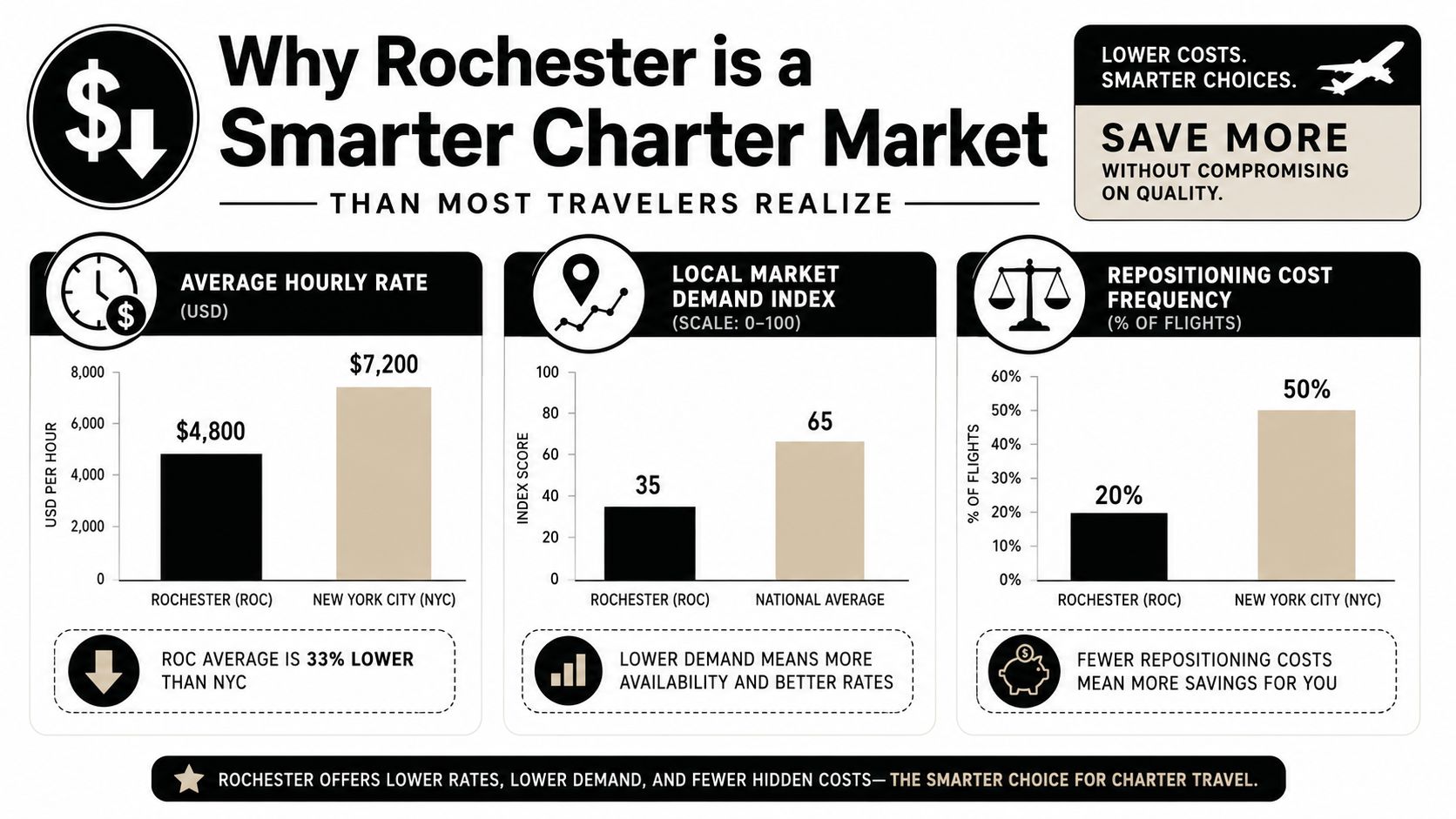
The four decisions that actually control the bill
The first decision is airport selection. ROC is the natural hub, but the broader network can change availability and price. The second is aircraft class, because Rochester is a short-stage market where you should not default to the largest cabin a broker can justify. The third is local sourcing, which is where real savings happen when the aircraft is already nearby. The fourth is operator vetting, because a good price means nothing if the safety paperwork is weak.
A Rochester charter guide pegs a New York to Rochester trip at about 279 miles and roughly 1 hour in a turboprop such as a Pilatus PC-12, with quoted hourly rates of $1,800–$2,300 for turboprops and $6,500–$7,000 for super midsize jets. That spread tells you everything you need to know about how quickly aircraft choice changes economics on this route. The airport guide for KROC is useful for orientation, but the work is choosing the right jet for the stage length.
Practical rule: start with the route, not the cabin. For Rochester, the route usually tells you whether a turboprop, light jet, or midsize jet is the rational buy.
New York is still a major private-aviation state, with about 72,000 private-flight movements in 2024, ranking third nationwide, and Rochester and Buffalo combined accounting for 14,000 legs. That's not a niche trickle, it's a real upstate corridor. A Rochester private jet charter should be booked like a regional business tool, not like a headline luxury item.
For a broader airport context, this is the place to keep the ultimate airport guide open while you compare departure points and aircraft types: private jet airport ultimate 2026 guide.
Choosing Between ROC and Nearby Airports for the Best Deal
Most travelers assume the closest runway is the right runway. That's lazy. ROC is the default for a reason, but the smartest booking is the one that balances FBO access, parking, passenger convenience, and aircraft positioning, not just the map pin.
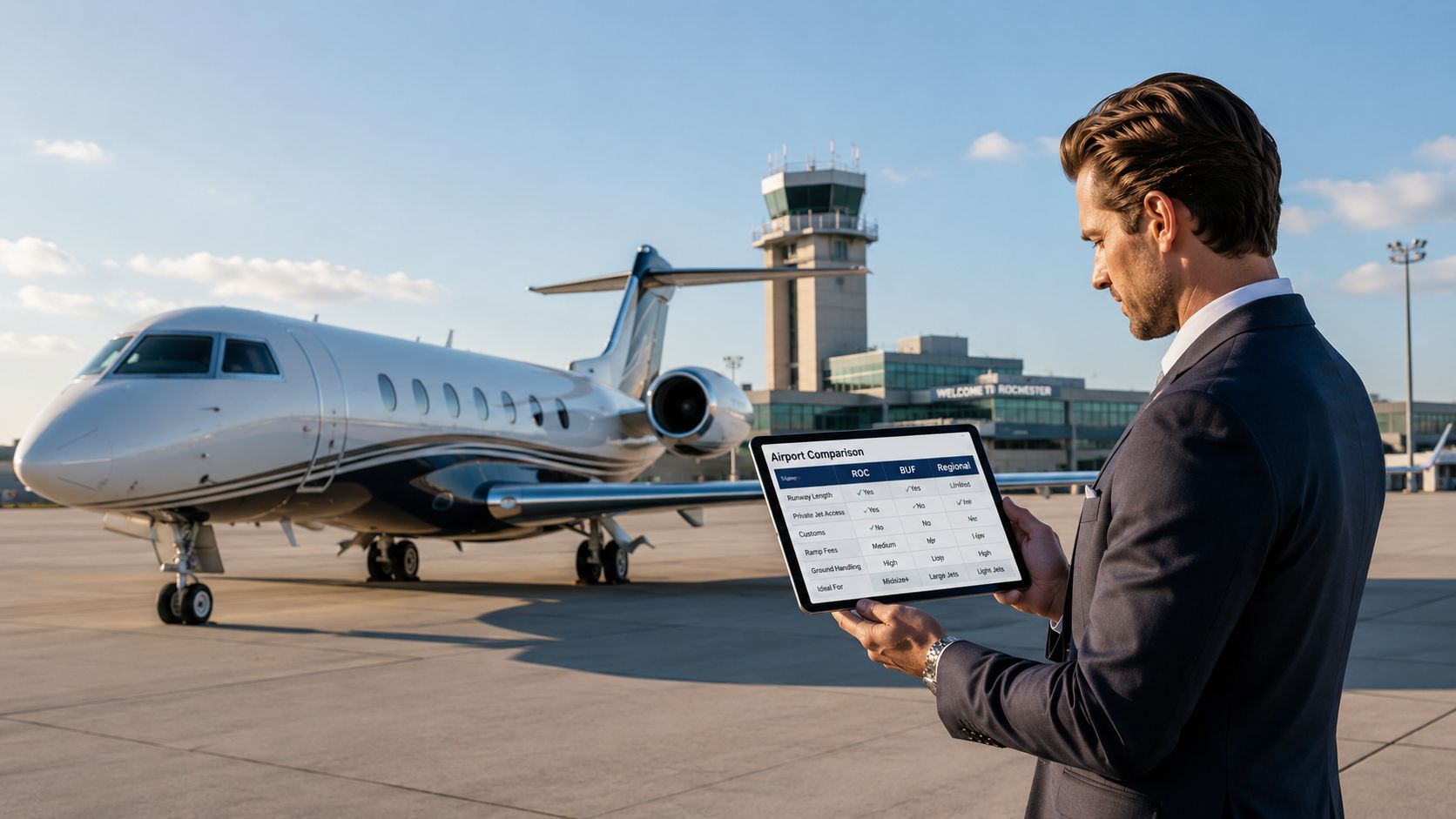
When ROC wins
Use ROC when the aircraft is already in the local market, when you care about straightforward business travel, and when you want the simplest ground transfer into the city. ROC's commercial footprint is meaningful, which is exactly why private flying clusters there. One Rochester airport profile says the airport served more than 2.3 million passengers in 2017 and averaged 240 flights per day, so the airport already has the infrastructure and traffic patterns that support charter demand.
That commercial density helps because private aviation often works best where airline demand and business demand are already established. ROC is one of those gateways. If you want a clean arrival with minimal friction, ROC is usually the first airport to check.
When a nearby field is smarter
If the aircraft you want is based elsewhere, the answer can change quickly. A same-day trip sometimes prices better out of a nearby airport because the operator can avoid moving the jet just to serve you. That's where the broader regional airport network becomes valuable, especially when the itinerary is flexible and the departure or arrival point can move a bit without hurting the trip.
For travelers who want to compare lounge, transfer, and ground options around western New York, Buffalo airport lounge options is a useful planning resource. It's not about luxury for its own sake, it's about knowing whether a nearby airport gives you better waiting space, better timing, or better aircraft availability.
Simple rule of thumb
If you're flying in a hurry and the aircraft is local, keep ROC. If the best aircraft is sitting in Buffalo, Syracuse, or another nearby market, flex on the airport before you force a bad reposition. Airport choice should serve the quote, not the other way around.
For the airport-side reference point, Greater Rochester International Airport details are enough to anchor the decision without overcomplicating it.
Right-Sizing the Aircraft for Rochester's Short-Stage Routes
Rochester is a short-stage market, and that changes the math fast. On trips in the 300 to 500 mile range, the wrong cabin can turn into wasted money, especially if the aircraft is sitting too far away or carries more jet than the mission needs. For a lot of Northeast city pairs, the smartest move is not the biggest airplane, it is the one that fits the stage length and the schedule.
Rochester Aircraft Class Benchmarks
| Aircraft Class | Hourly Rate Range | Best For |
|---|---|---|
| Turboprop | $1,500–$3,000 per hour | Short regional hops, lower-cost point-to-point trips |
| Light jet | $3,500–$4,800 per hour | Faster Northeast city pairs, small groups |
| Midsize jet | $4,800–$6,000 per hour | More cabin comfort, longer regional legs |
| Heavy jet | $8,500–$10,500 per hour | Bigger groups, longer missions |
| Long-range jet | $12,000–$15,000 per hour | Transcontinental and international-range planning |
The New York to Rochester example shows the trade-off clearly. A charter guide places that trip at about 279 miles and roughly 1 hour in a turboprop such as a Pilatus PC-12. For a route like that, stepping up to a larger jet usually buys more cabin than you need and more cost than you should accept. A turboprop wins because the stage is short, the route is straightforward, and the value comes from getting there without paying for excess capability.
The same logic applies across the Northeast corridor. If the trip is short and the calendar is tight, a turboprop often beats a light jet on total economics, especially when the itinerary does not require a faster cruise or a larger cabin. I would choose the turboprop first for most Rochester hops, then move up only when the schedule, passenger count, or cabin expectations justify it.
A light jet makes sense when speed and cabin layout matter more than the lowest possible trip cost. Some travelers want the faster cruise, some want a different interior, and some are comparing options across similar aircraft classes. That is a real preference, but it is still a preference, not a default upgrade.
Bottom line: a turboprop is often the highest-value choice for Rochester because it matches the stage length without dragging in unnecessary cost.
Super midsize and larger cabins are where brokers can make the quote look cleaner than the economics really are. The cabin is nicer, and the trip feels bigger. The bill also climbs fast. For private jet charter Rochester NY, I would rather see a straight recommendation that fits the mission than a padded jet option dressed up as an upgrade. If you want the Rochester cost picture laid out more broadly, private jet charter cost basics is the right reference point.
How Charter Pricing Actually Works and What Repositioning Really Costs
The headline rate is only the opening number. Real charter pricing starts with aircraft hourly rate multiplied by flight hours, then gets adjusted for fuel, taxes, crew overnight costs, and repositioning if the aircraft isn't already near the departure airport. That's why two quotes for the same Rochester trip can land in very different places.
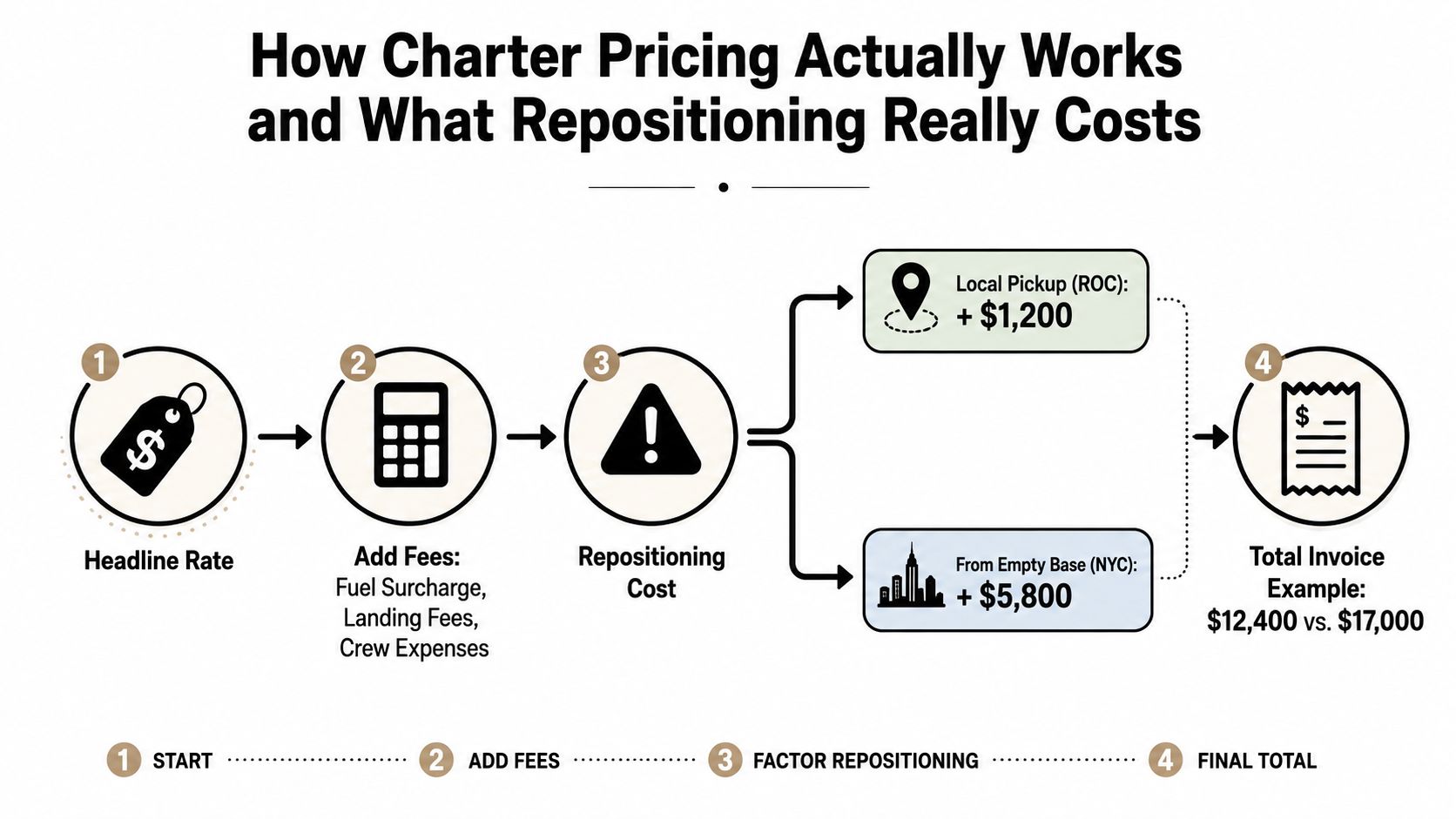
The numbers behind the quote
Industry benchmarks show roughly $1,500–$3,000 per hour for turboprops, $3,500–$4,800 for light jets, $4,800–$6,000 for midsize jets, $8,500–$10,500 for heavy jets, and $12,000–$15,000 for long-range jets. One source explicitly notes that the quoted hourly rate does not include fuel, taxes, or repositioning, which is why the final invoice usually runs higher than the ad-friendly “from” price. This pricing breakdown guide is the clearest way to see why hourly math alone misleads buyers.
Repositioning is the quiet fee most brokers want you to ignore. In the Rochester market, that can materially change the trip cost, especially if the aircraft has to be ferried in from a distant base. The same logic is why local sourcing matters so much on short-haul Northeast trips.
What to ask before you sign
Ask one question first, where is the aircraft right now. If the answer is vague, the quote probably includes hidden movement cost. Ask for the all-in price on aircraft already positioned near Rochester, then compare the total, not just the hourly rate.
EvoJets' sample one-way Rochester quotes show how origin changes everything, with pricing starting at $6,000 from Teterboro, $7,500 from Washington, DC, $9,500 from Chicago, and $6,500 from Philadelphia. Those numbers are a reminder that the same Rochester mission doesn't have one price, it has several depending on where the jet is sitting.
If you want a broker-side explanation of the pricing stack, the charter cost guide is the right internal reference. It lines up with the core point here, never buy on headline hourly rate alone.
Safety Credentials That Should Be Non-Negotiable on a Rochester Flight
Part 135 legality gets you only to the starting line. I tell Rochester buyers to look past the certificate and ask whether the operator runs a tight safety program. If the broker cannot name the operator's safety rating before you commit, stop there.
The audits that matter
The two third-party standards that deserve your attention are Wyvern Wingman and Argus Gold or Platinum. Those audits separate a legal operator from one that has been properly vetted. Haute Jets says every operator in its network carries a Wyvern Wingman or Argus Gold or Platinum rating, and that is the baseline I would demand for any Rochester quote.
A serious broker should give you the operator name, the aircraft tail number, and the safety rating without hesitation. If they dodge those details, the screening process is weak. You do not need a sales pitch. You need verification.
What to ask before you approve the flight
Ask whether the operator holds a current Wyvern Wingman or Argus Gold or Platinum rating. Ask who is flying the aircraft. Ask whether the broker will disclose the operator before payment. If any answer is delayed, that is not premium service, it is a warning sign.
Safety is not a brochure claim. It is a file you can check before the aircraft leaves the ground.
Rochester trips are often short. Short flights do not reduce risk, they just make it easier for sloppy buyers to skip the vetting. Do not.
Ground Logistics, Pets, and the 24-Hour Pre-Flight Confirmation
A charter can look perfect on paper and still feel clumsy on the ramp. In Rochester, the difference usually comes down to the FBO, the car timing, the pet rules, and the final confirmation packet. The cabin matters, but the ground plan decides whether the trip feels controlled or chaotic.
Lock in the ground side early
An FBO is the fixed-base operator, the private terminal where you park, check in, and board. At ROC, the smoother departures usually come from tighter ground coordination, not a fancier aircraft. Ask for the FBO name, the handoff point, and the car timing in writing before you send payment.
I would also book transportation before the flight is finalized. Last-minute ground plans create avoidable delays, especially if you are connecting from downtown or carrying luggage that needs a clean handoff. If you want a local reference for an airport transfer with Max's before you ever reach the terminal, that is the standard I would use for a pre-booked ride.
Pets need the same treatment. Private-jet pet policies vary by operator, and you should never assume an animal is allowed until the terms are spelled out clearly. Confirm pet handling before booking, not at the airport, because that is where avoidable problems start.
What the 24-hour brief should include
The 24-hour confirmation should tell you exactly what is happening and who is responsible for each part of the trip. That means the tail number, the crew, the weather briefing, and the passenger manifest all need to be in front of you before departure. Review each item carefully, then make sure the flight details still match what you approved.
A proper pre-flight packet also gives you a chance to catch simple mistakes before they become expensive ones. If the aircraft changed, if the crew changed, or if the passenger list is off, you want that fixed while there is still time.
The best Rochester trips feel calm because the boring work was done early. The bad ones feel expensive because nobody checked the basics. I would rather confirm the ground plan, the pet rules, and the flight packet twice than discover a problem at the FBO.
Using Empty Legs and Local Sourcing to Cut Rochester Charter Costs
Empty legs are the sharpest pricing lever in Rochester charter, and most buyers do not use them correctly. An empty leg is a repositioning flight with open seats, and if your schedule is flexible, you can turn someone else's movement into your trip. That works especially well in Rochester because local aircraft supply and regional routing create more positioning opportunities than most national guides admit.
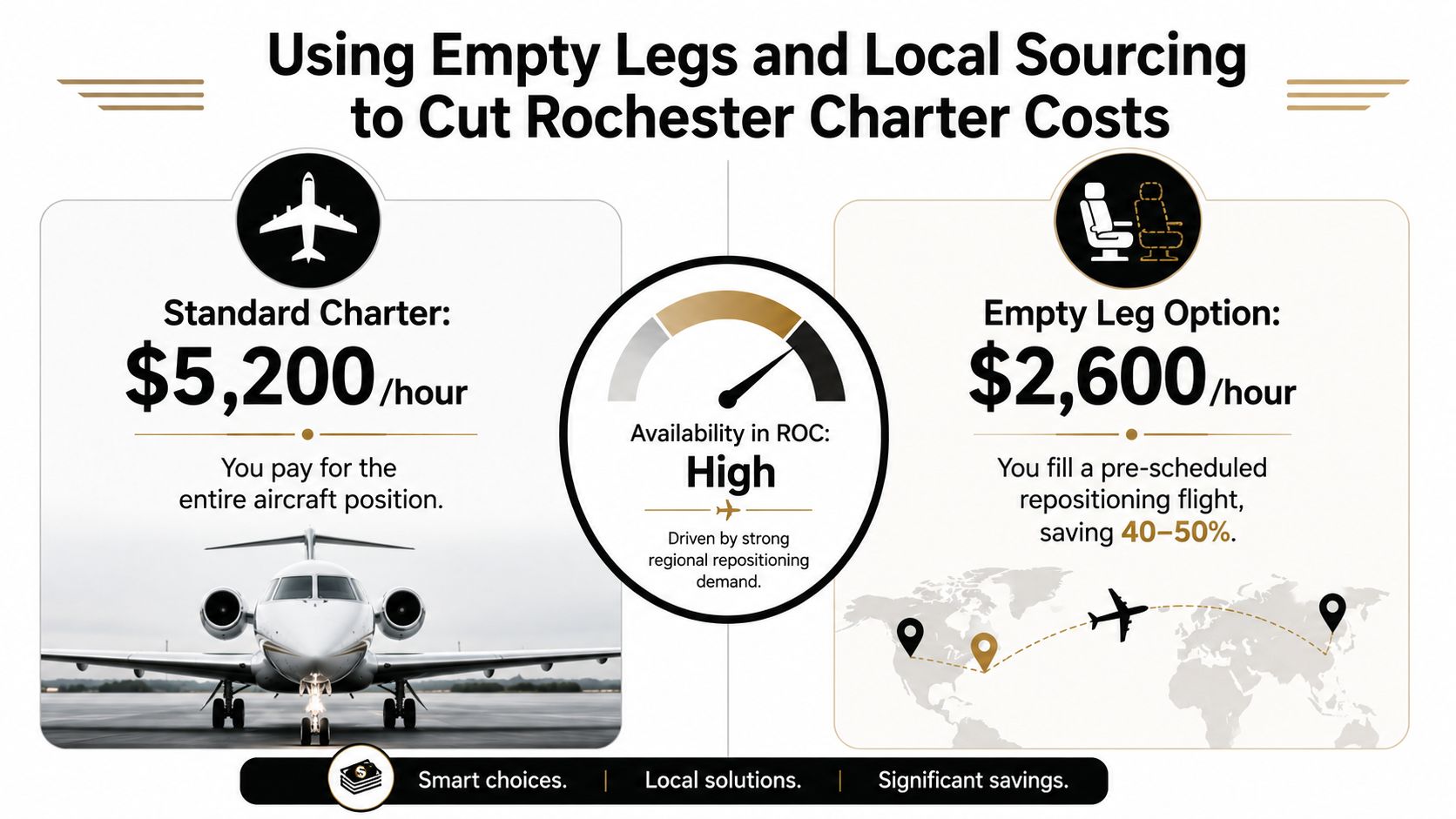
Why empty legs matter here
Empty legs can price well below a standard charter because you are filling a flight that was already scheduled to move. That makes them useful for spontaneous trips, one-way returns, and flexible Northeast travel. On Rochester routes, where repositioning demand is common, they can be the cleanest way to avoid paying full freight for an aircraft's movement.
The right question is not, “Can you quote me a jet?” It is, “What is already near ROC right now?” That question changes the economics immediately, because you are asking the broker to work with the aircraft's actual position instead of creating a new positioning leg. A broad operator network matters here, because the closer the tail is to Rochester, the less waste you pay for.
Local sourcing beats artificial repositioning
Local sourcing within the 200-mile Rochester radius can cut repositioning fees that inflate charter prices by 20 to 40% with traditional brokers and jet card programs. That is the number buyers feel most, because it is the fee they did not intend to pay and rarely notice until the invoice arrives. The fix is straightforward. Source locally whenever possible and compare all-in trip totals, not flashy hourly rates.
This is also why I would rather book on-demand than lock into a program that pushes the wrong aircraft from the wrong base. A flexible model beats a rigid one when the market is regional and the stage length is short. Rochester rewards buyers who act like aircraft position matters, because it does.
The booking workflow I'd use
Ask for the exact aircraft class you need, then ask which tail numbers are already near Rochester. Confirm the operator's safety rating, then confirm the FBO and pet policy. After that, ask for the 24-hour pre-flight brief and verify the tail number, crew, and passenger manifest before departure.
If you want one provider that works on that on-demand model without memberships, jet cards, or blackout dates, Haute Jets is built around that workflow. It sources from a broad operator network, focuses on local aircraft when possible, and gives the buyer more control over the exact jet.
If you are planning a Rochester trip and want the routing, aircraft, and all-in price handled without the usual broker games, start with Haute Jets. Ask for aircraft already positioned near Rochester, compare the total quote instead of the hourly rate, and make the operator's safety rating part of the deal before you pay.