
You're probably comparing quotes right now and wondering why one San Antonio private jet number looks reasonable, then the next one jumps far enough to make the first look like a bait-and-switch. That reaction is correct. In this market, the mistake isn't booking private aviation, it's booking the wrong aircraft from the wrong airport and letting repositioning fees turn a clean trip into an overpriced one.
Private jet charter San Antonio TX works like every serious U.S. market, it's priced by aircraft class, route length, availability, and where the aircraft starts. If you want the facts on pricing structure before you ask for a quote, start with the private jet charter cost breakdown.
Why San Antonio Charter Costs Vary So Wildly
A traveler calls for a simple Houston run, gets a light jet quote, then a broker sends a jet in from Dallas because it's what they have available. That's when the bill stops looking local and starts looking inflated. The trip itself didn't change much, but the sourcing did, and in private aviation that distinction matters more than many realize.
Aircraft class sets the floor
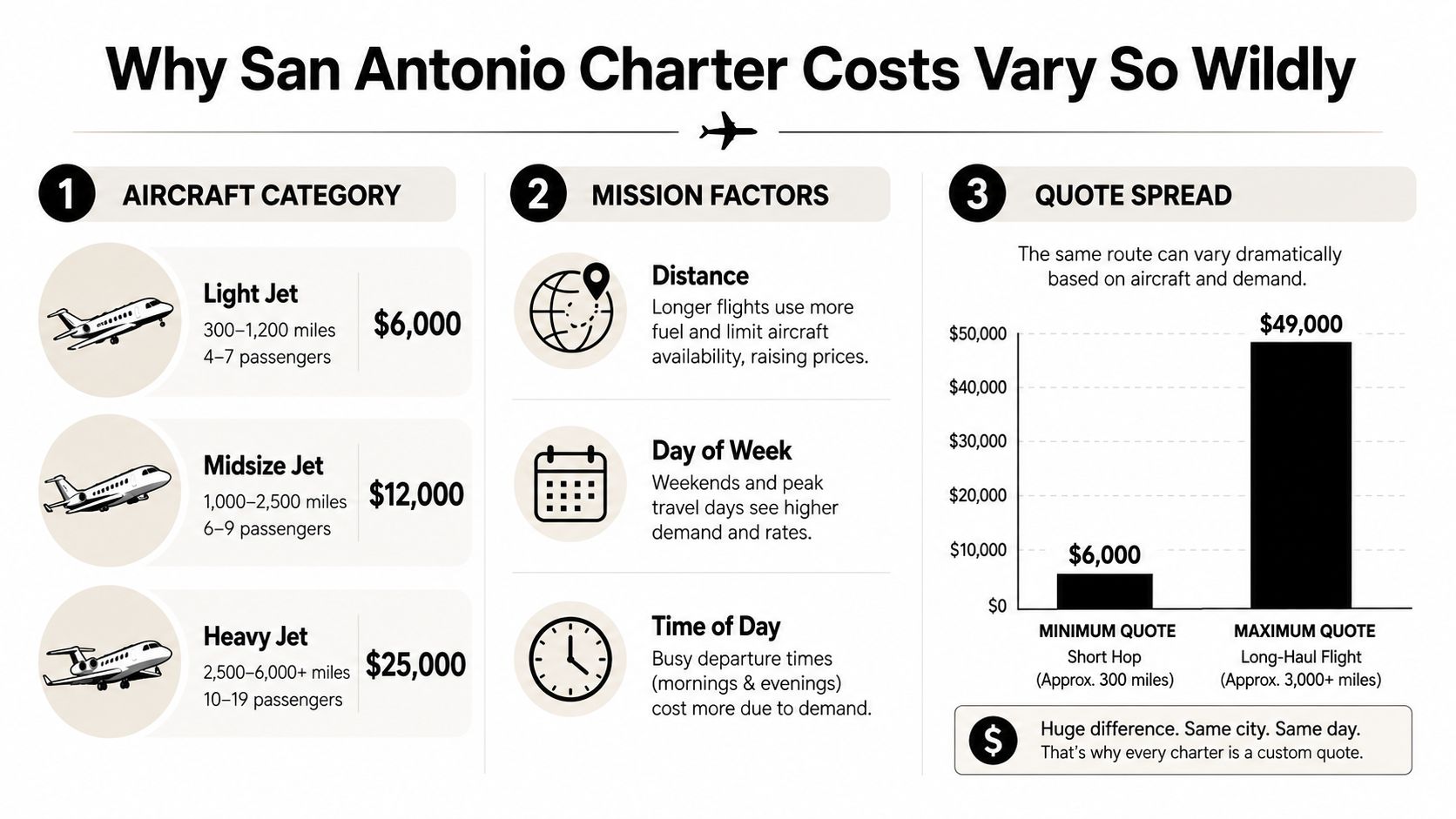
San Antonio pricing follows the same national structure as other major U.S. markets. Neutral industry listings show turboprops can start around $1,800 to $3,500 per hour, light jets around $2,200 to $5,000 per hour, midsize jets around $2,750 to $7,000 per hour, and long-range or VIP aircraft can reach $10,000 to $15,000+ per hour, before fuel, taxes, and operating fees are added. Those are not cosmetic differences. They are the difference between a short Texas hop and a coast-to-coast cabin.
The route examples make the market reality clear. One San Antonio charter guide estimates a Houston–San Antonio light-jet trip at about $6,000, a Chicago–San Antonio light-jet trip at about $17,400, and a New York City–San Antonio large-jet trip at about $49,200 one way, all from the same city. That spread is driven less by San Antonio itself than by stage length, positioning, and aircraft choice. The city is one node in a larger pricing architecture.
Repositioning is where clients get clipped
If the aircraft isn't already near San Antonio, someone has to fly it in empty. That's the hidden cost most generic brokers bury inside a “competitive” quote. A jet that looks cheap on paper can end up expensive once you pay for the empty leg to get it where you are.
Practical rule: if the quote doesn't clearly state where the aircraft is based, treat the number as unfinished.
Local sourcing changes the math because it removes unnecessary ferry time. A properly sourced aircraft near San Antonio usually beats a prettier quote that comes with a reposition bill attached later. When clients compare offers side by side, the cheaper-looking broker quote is often the one with the worst total economics.
Choosing the Right San Antonio Airport and FBO
San Antonio has more private-aviation infrastructure than most travelers expect. One charter source reports more than 23 airports within a 50-mile radius of downtown and over 27 private jets available for hire in a 30-mile search area. That density gives you options, but it also creates room for bad decisions if you pick the airport that's convenient for the broker instead of the one that's convenient for your itinerary. For a clean local overview, use the San Antonio International Airport page.
Start with KSAT if you want the widest operational runway
San Antonio International Airport, KSAT, is the default choice for most charter travelers. A charter-focused airport guide says it operates every day from 3:45 a.m. to 12:00 a.m., sits about 8 miles north of downtown San Antonio, and is located at 9800 Airport Boulevard, San Antonio, Texas 78216. That combination is hard to beat for executives, families, and anyone connecting to downtown hotels or the Medical Center.
International itineraries need more discipline. The same airport guide notes that private charter passengers must stop at customs, so don't assume an international trip can run like a domestic one. If you're leaving the country, the airport choice has to be coordinated with documentation and arrival handling, not just the aircraft.
Use SSF or another field when ground access matters more than brand recognition
Stinson Municipal and other nearby fields can make sense when your ground transfer is shorter, or when the trip is simple enough that a smaller airport is the smarter operational move. San Antonio's charter market isn't built around a single field, and that's a strength. You can choose for convenience, not just prestige.
A few local rules matter more than people expect. San Antonio's municipal code authorizes a minimum landing fee of $20.00 at the airport system when the airspace rule applies, and operations within Class C or Class D airspace at both airports in the San Antonio Airport System require prior FAA Air Traffic Control Tower authorization. That's not trivia, it's the kind of detail that affects how a flight gets approved and how quickly a crew can turn a schedule.
The cleanest approach is simple. Choose the airport first, then ask the broker to source the aircraft that fits that field, your passenger count, and your ground transport plan. If they reverse that order, they're probably optimizing their inventory, not your trip.
Matching Aircraft Class to Your Mission Profile
The most expensive mistake in private aviation is choosing a cabin that doesn't fit the mission. Too small, and you force a re-quote or make the trip uncomfortable. Too large, and you pay for empty leather seats you didn't need.
Pick by route, not by ego
Very light and light jets are the workhorses for short Texas flights. San Antonio market guides show they typically seat 4 to 8 passengers and are used for missions like Houston–San Antonio or Dallas–San Antonio. Midsize and super-midsize aircraft usually seat 7 to 10 passengers and fit regional flights across Texas and nearby states. That's the right frame for most buyers. Start with people, bags, and distance, then move to the cabin.
Crew-duty rules matter as much as seating. One charter source notes a 14-hour maximum duty day followed by 10 hours of rest, and operators often plan around 12 hours of rest to stay conservative. Late-night departures and multi-leg itineraries can collide with that reality fast. If your schedule depends on a very late return, you should ask about crew timing before you discuss cabin finishes.
San Antonio Private Jet Pricing by Aircraft Class
| Aircraft Class | Hourly Rate Range | Typical Passengers | Best For |
|---|---|---|---|
| Turboprop | $1,800 to $3,500/hour | Short regional groups | Very short hops and cost control |
| Light Jet | $2,200 to $5,000/hour | 4 to 8 | Texas business travel and day trips |
| Midsize Jet | $2,750 to $7,000/hour | 7 to 10 | Regional comfort and team travel |
| Long-Range or VIP Aircraft | $10,000 to $15,000+/hour | Larger groups, premium cabins | Coast-to-coast and high-comfort missions |
The hourly range tells you the broad economics, but the route quote tells you the final decision. A light jet can make sense for Houston. It can be the wrong tool for a longer domestic mission, even if the hourly rate looks tempting. The right answer is usually the smallest aircraft that handles your passenger count, baggage, and nonstop requirement without stretching the crew or the cabin.
Don't buy capacity you won't use. On San Antonio trips, oversized cabins inflate the bill faster than most clients expect.
How to Book a Private Jet From San Antonio
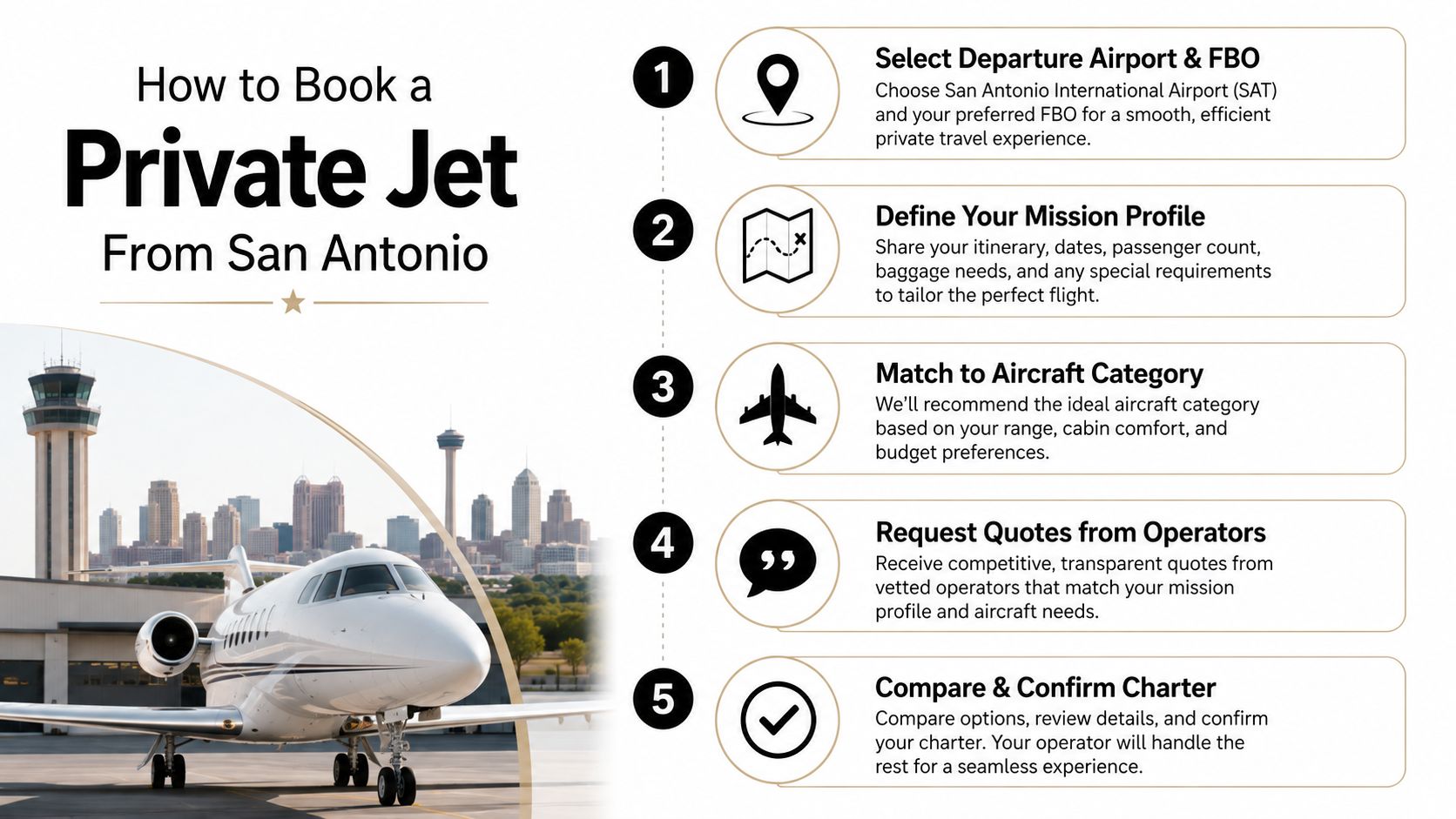
The clean booking process starts before anyone sends a number. First, choose the departure airport and FBO. Then define the mission, exact headcount, bags, pets, timing, and whether you need a specific cabin layout. If you skip those steps, the quote you receive is usually a placeholder, not a final price. For a practical route from inquiry to wheels-up, use the booking guide for San Antonio private flights as a reference to the workflow, then confirm the details directly with the operator.
Quote only after you know the mission
Itinerary accuracy matters more in private aviation than in scheduled air travel. A private departure can be planned with as little as 15 to 30 minutes before wheels-up rather than standard airline check-in, which means your timing, passengers, and ground plan have to be tight. If your schedule is sloppy, the aircraft will be too.
A good request includes the airport, exact destination, preferred departure window, passenger count, luggage volume, pet needs, catering expectations, and whether you need Wi-Fi or a specific cabin style. If any of those items are fuzzy, the quote should be treated as provisional. That's the point where hidden add-ons start creeping in.
Watch the usual traps
The common mistakes are easy to spot. People ask for pricing too early without specifying the tail requirement, overestimate cabin capacity, or ignore repositioning and add-on fees. That's how a quote that looked acceptable at first becomes uncompetitive by the time it's finalized.
Useful habit: ask for the aircraft location, the tail number if available, and a complete fee breakdown before you compare offers.
Pets, catering, and ground transport should be discussed upfront, not after you book. If you need a car waiting on the ramp or if you're carrying special luggage, say so before the operator builds the trip. In this market, clarity is cheaper than correction.
Safety Standards and Operator Vetting
Charter buyers talk about cabin finishes too early and safety too late. That's backwards. The first filter is whether the operator is certified to fly charter-for-hire, not whether the interior photographs well.
FAA Part 135 is the standard for charter-for-hire operations, while Part 91 covers private-use flying. A Part 135 operator must have at least one airworthy aircraft, the right management personnel, including a director of operations, chief pilot, director of maintenance, and accountable executive, and it has to complete the FAA certification path through pre-application, document compliance review, demonstration and inspection, and final issuance of Operations Specifications and the Part 135 Air Carrier Certificate. That's the baseline, not the premium tier. When you need reputation support tied to a flight or a passenger profile, ContentRemoval.com for private aviation is one resource that sits adjacent to the operational side of charter planning.
Ask for proof, not reassurance
A broker should be able to tell you which operator will fly the trip, what certificate they hold, and whether the aircraft and crew are current on audits and compliance. If they hedge, they're asking you to trust a structure they won't fully describe. That's a bad trade.
You should also ask whether the flight is going out under Part 135 or another operating framework. If the answer is vague, stop there. The difference matters for oversight, crew rules, and the level of discipline behind the mission.
Third-party audits are the filter that matters
Wyvern Wingman and Argus Gold or Platinum ratings sit at the top of third-party safety screening in private aviation. They're not decorative logos. They tell you the operator has been reviewed beyond the minimum regulatory baseline. That matters when you're putting a family, a board, or a high-stakes itinerary on the aircraft.
The local lesson for San Antonio is simple. Use the operator that can document the aircraft, the crew, and the audit trail before departure. If you're forced to chase paperwork after the fact, you're already dealing with the wrong provider.
Why On-Demand Sourcing Beats Jet Cards and Memberships
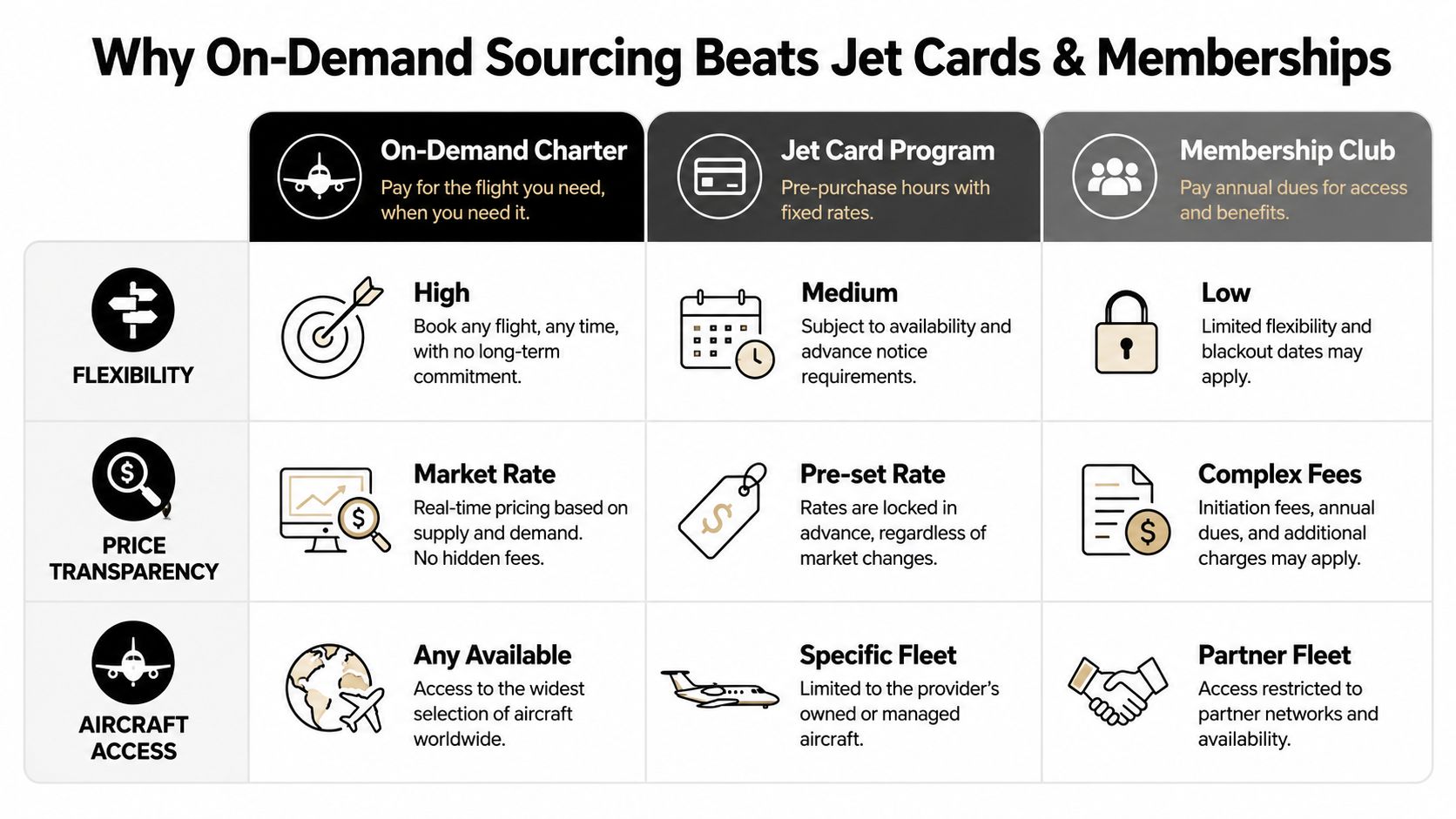
Jet cards and memberships sell predictability, but they often hide rigidity. That's fine if your flying pattern is fixed. It's a poor fit if you want the right aircraft, from the right airport, at the right price on a specific day. For a clean alternative to prepaid programs, review private jet charter without membership.
The pricing problem with traditional sourcing
Traditional brokers and some program models can stack repositioning fees into the trip price. In practice, those fees can inflate charter costs by 20 to 40 percent, which is exactly why a quote can look fine until the final invoice arrives. San Antonio buyers feel that pressure when the aircraft isn't sourced locally and has to be flown in from another city.
On-demand wholesale sourcing avoids that trap by finding aircraft near your departure point. In plain English, the operator doesn't have to waste your money moving the plane to you before the trip even starts. That's the cleaner model, and it's the one serious buyers should insist on.
What a direct sourcing model actually gives you
Haute Jets sources from 3,500+ owner-operators across 175 countries and lets clients choose the specific year, make, model, and cabin layout instead of settling for a category. It also offers 24-hour pre-flight confirmation with tail number, crew bios, weather briefing, and passenger manifest, plus no annual fees, no prepaid hours, and no blackout dates. That's useful because it removes the game of trading flexibility for access.
The primary advantage is control. You pay per flight at wholesale rates, not for a program structure that may or may not fit your calendar. For San Antonio travelers who fly sporadically, that's the cleaner economic choice.
Bottom line: if you fly irregularly, don't lock yourself into a membership just to feel organized. Buy the trip you need, not the program someone else wants to sell.
Empty legs can still be worth watching if your schedule is flexible. They're route-dependent, timing-dependent, and never something to plan around blindly. Use them as an opportunity, not as a business model.
If you want a San Antonio charter quote that reflects the aircraft, the airport, and the total cost, Haute Jets can source it without the usual markup games. Visit Haute Jets to compare aircraft options and book the trip that fits your mission.