

You're leaving Manhattan for a private flight, expecting Teterboro to be effortless. Then the operator calls to say the assigned FBO has changed, the aircraft doesn't fit the planned noise profile, or customs paperwork hasn't been routed correctly. The airport is close to the city, but proximity doesn't eliminate operational friction.
A successful private jet charter at Teterboro depends on more than selecting a cabin and accepting a quote. You need the correct FBO, a compliant aircraft, a realistic departure window, confirmed ground handling, and a complete customs plan when flying internationally. This guide is written for travelers who want the convenience of KTEB without discovering its constraints at the last minute. It will appear on Haute Jets Journal.
Why Teterboro Demands Different Planning Than Other Airports
A traveler arrives at Teterboro expecting a quick walk from car to aircraft. Instead, the driver stops at the wrong FBO, the crew is waiting on a reservation confirmation, and the planned departure time conflicts with the airport's noise requirements. Nothing about the aircraft itself is necessarily wrong. The failure is coordination.
Teterboro is a general aviation airport in Bergen County, New Jersey, approximately 12 miles from Midtown Manhattan. It has no scheduled commercial airline service, and its infrastructure is dedicated to private, corporate, and air-taxi operations. That makes it attractive, but also concentrated. The airport handled 74,577 private-aviation departures in 2023, compared with 73,564 in 2022, an increase of about 1.4%, according to the Teterboro Airport operational overview. Broader data recorded about 177,000 total takeoffs and landings in 2024, or an average of 488 movements per day, from the same source.

The airport's role shapes every booking
Teterboro's history explains its operating model. Walter C. Teter purchased the land in 1917, and the first flight took place in 1919. After the Port Authority took control in 1949, it reported more than $450 million in modernization investment, according to Capital Analytics Associates' airport profile.
A decisive restriction arrived in 1977, when a 100,000-pound aircraft weight limit was imposed. That limit excluded large commercial airliners and reinforced Teterboro's identity as a business-aviation airport. It also means your broker shouldn't treat aircraft category as a purely aesthetic decision. The aircraft's operating weight, runway requirements, and noise characteristics all matter.
The airport has two runways, 7,000 feet and 6,013 feet long, as described in Simple Flying's Teterboro guide. Those runways support a wide range of business jets, but not every aircraft performs identically under every load, temperature, wind, or noise condition.
Reservation discipline is now part of the travel experience
In 2025, Signature Aviation introduced a free mandatory reservation system for its Teterboro facilities to reduce gridlock and delays. It also announced enhanced international-arrivals handling at its customs facility in April of that year, as reported by AIN Online.
That change matters because the FBO isn't a minor detail. It controls where passengers check in, where the aircraft parks, how baggage is handled, and which customs pathway applies. Teterboro has separate FBO and Customs and Border Protection procedures, so a passenger who knows only “KTEB” doesn't yet have enough information to execute the trip.
Practical rule: Treat the FBO assignment, reservation status, aircraft tail number, and ground transfer as one itinerary. Confirm them together, not as separate tasks.
Teterboro is usually the right choice for direct Manhattan access and a private terminal experience. It may be less suitable when the aircraft is near the weight limit, the departure falls inside a sensitive noise window, or the operator can't secure the required FBO handling. Ask your charter provider to compare Teterboro with White Plains or Farmingdale when those constraints affect the mission. For broader airport context, review the Teterboro Airport KTEB charter resource. Travelers pairing New York access with a longer luxury stay may also want to browse penthouses at Irie Tulum Boutique Hotel.
Choosing the Right Aircraft for Your Route and Budget
Aircraft selection should start with the mission, not the brochure. Define the route, passenger count, baggage, desired nonstop capability, departure timing, and tolerance for repositioning before discussing cabin finishes.
A light jet can be the efficient answer for a short regional trip, while a larger aircraft becomes sensible when passengers need more baggage capacity, greater range, or a comfortable cabin for several hours. Teterboro's weight restriction and runway environment add an airport-specific filter to that decision.
Use this decision sequence
Start with the route. Regional trips to the Hamptons or nearby Northeast destinations may suit a turboprop or light jet, depending on the passenger experience you expect. Miami generally calls for a light, midsize, or super-midsize aircraft based on passengers, baggage, and nonstop requirements. London requires a long-range aircraft capable of the route with appropriate reserves and payload.
Count people and luggage. A cabin can appear large enough until golf bags, garment cases, skis, or production equipment consume the available space. Tell the operator what you're carrying, not just how many travelers are flying.
Match the cabin to the workday. The Phenom 300 is a logical light-jet example for shorter missions where speed and a compact cabin are sufficient. A Challenger 350 makes more sense when passengers want additional cabin volume and range flexibility. A Gulfstream G550 belongs in the discussion for transatlantic travel, where long-range performance and a large-cabin environment justify the higher operating cost.
Check the aircraft against Teterboro's constraints. The operator should verify the aircraft's operating weight, runway performance, and noise profile for the proposed departure. A quote that ignores those checks isn't complete.
Route planning is about usable capability
For New York to Miami, choose the smallest aircraft that comfortably handles the passengers, luggage, weather, and nonstop requirement. A light jet may work for a lean itinerary, but a midsize or super-midsize aircraft can provide a better balance when the group needs more space or baggage capacity.
For Aspen, aircraft selection deserves additional scrutiny. High-elevation airports and seasonal conditions can affect payload and runway performance, so the operator should confirm what the aircraft can carry rather than promise a generic category. For London, don't compromise by choosing a jet that requires an inconvenient fuel stop or a payload sacrifice.
| Route Type | Example Destinations | Recommended Aircraft Class | Typical One-Way Cost Range |
|---|---|---|---|
| Regional and short Northeast trips | Hamptons, nearby Northeast destinations | Turboprop or light jet | Qualitative quote required |
| Longer domestic trips | Miami, Palm Beach | Light, midsize, or super-midsize jet | Qualitative quote required |
| Challenging domestic missions | Aspen | Midsize or super-midsize, subject to performance review | Qualitative quote required |
| Transatlantic travel | London | Long-range or ultra-long-range jet | Qualitative quote required |
The available market supports a broad range of one-way estimates, from approximately $7,000 to $91,000, depending on destination and aircraft class, according to JetFinder's Teterboro charter pricing guide. Use that range as orientation, not as a quote. The final aircraft choice should reflect the complete mission, including positioning, fuel, taxes, handling, and crew requirements.
Understanding the Cost Structure Beyond the Base Quote
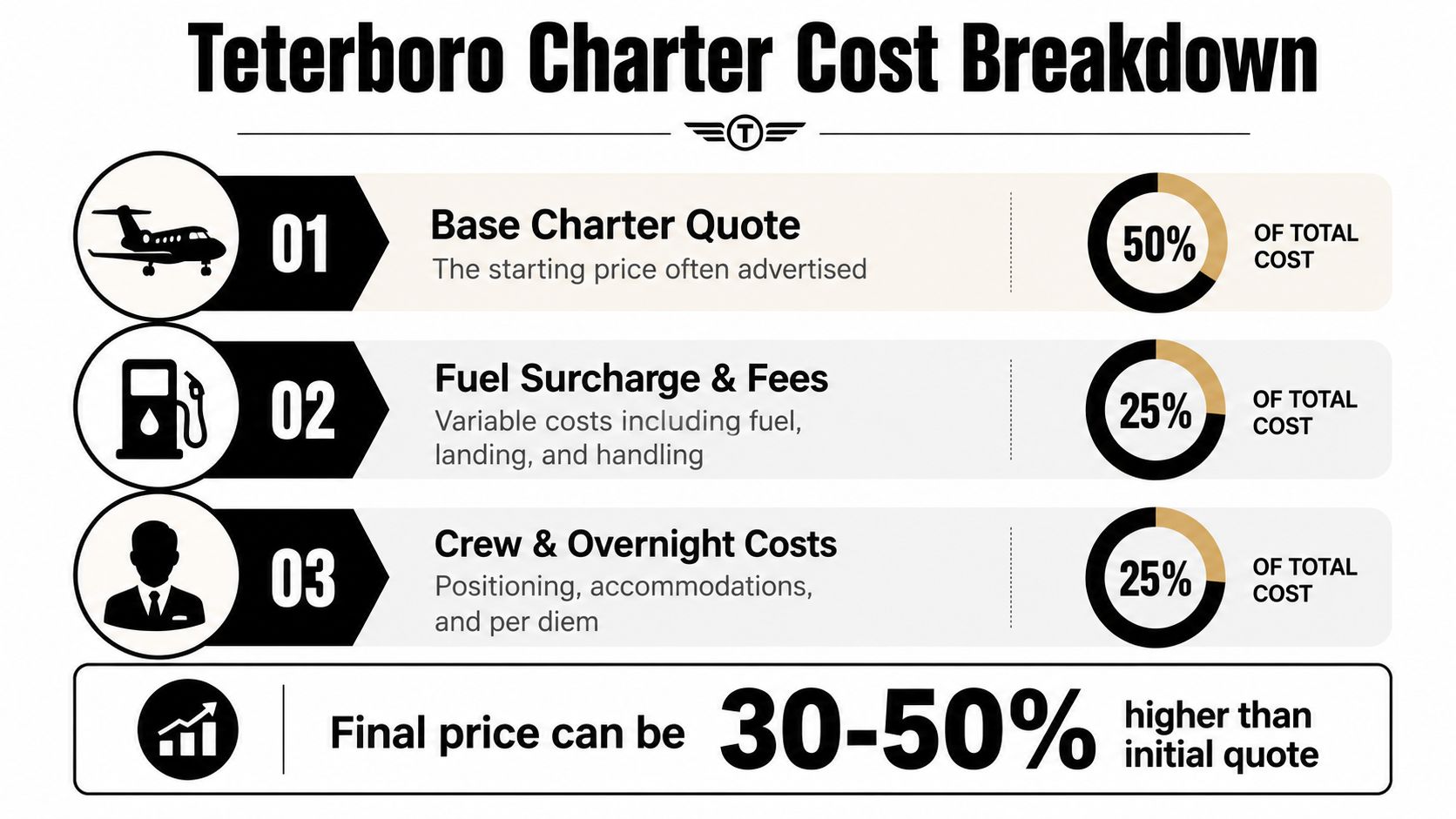
A low Teterboro quote can become expensive once the aircraft is positioned, the FBO adds handling, or the itinerary requires customs support. Treat the advertised figure as an opening estimate, not the amount you will pay. A responsible proposal identifies each material cost driver before you authorize the flight.
What belongs in the quote
The base aircraft and crew charge is only the first line. Variable operating expenses, airport charges, taxes, and services follow. A domestic charter may add a 7.5% Federal Excise Tax plus a per-segment fee, as described in the Teterboro pricing and tax guidance. International itineraries can add customs processing, handling, permits, and coordination work.
Fuel deserves a separate question. A Teterboro FBO rate sheet published in August 2026 listed Jet A at $7.94 to $9.19 per gallon and Sustainable Aviation Fuel at $11.03 per gallon. Those figures show why the fuel assumption matters. Ask whether the quote uses Jet A or SAF, whether fuel passes through at cost, and whether a surcharge can change before departure.
Crew expenses rise when the schedule requires an overnight stay, multiple duty periods, or accommodation away from the aircraft's home base. Positioning may have an even larger effect. Traditional brokers may add repositioning fees that increase the quote by 20% to 40%, while an aircraft already near Teterboro can avoid that empty-leg expense, according to the Haute Jets charter model. For a broader explanation of pricing components, review this private jet charter cost guide.
Separate controllable costs from required ones
Some expenses follow directly from the mission. A long-range aircraft burns more fuel than a light jet. An international arrival needs customs coordination. A crew staying away from home may require accommodation and transportation.
Other charges deserve negotiation or confirmation before you commit:
- Aircraft positioning: Ask where the aircraft is based. A locally positioned aircraft may cost less than one flying empty to Teterboro.
- Fuel selection: Confirm whether SAF is requested or included. It supports a sustainability objective, but raises the fuel charge.
- FBO services: Require itemized handling, parking, de-icing, catering coordination, and ground transportation charges.
- Crew overnight expenses: Confirm whether hotels, meals, transportation, and per diem are included.
- Changes and substitutions: Establish the procedure if the original tail number becomes unavailable.
Ask for the landed price, not the aircraft price. Compare the complete payable amount, with taxes, fuel assumptions, handling, positioning, and crew costs visible.
Broad one-way estimates help only during early planning. Before approving the flight, require the aircraft, route, schedule, FBO, and pricing assumptions in writing.
Navigating FBO Selection and the New Reservation System
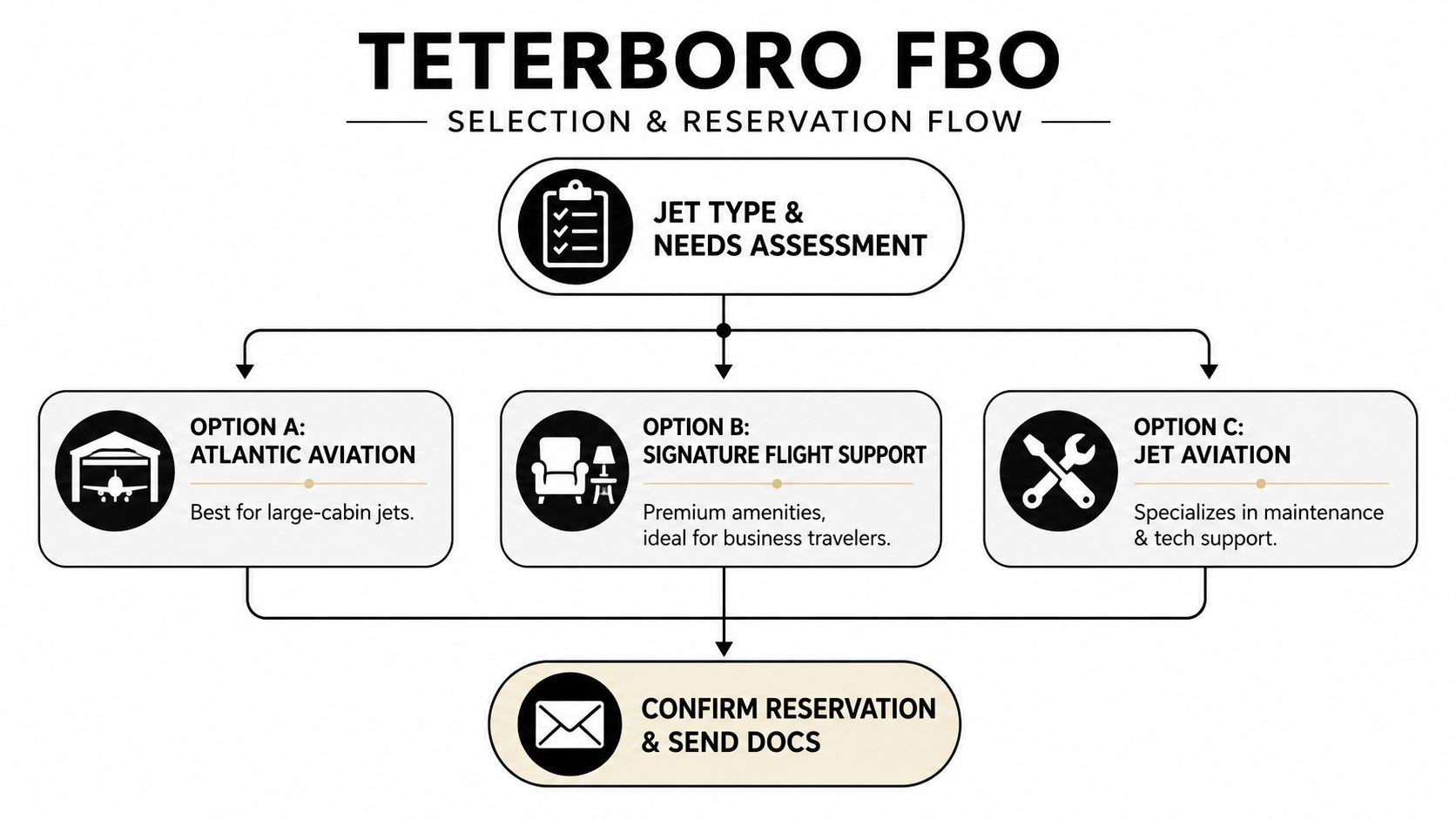
At Teterboro, choosing an FBO affects more than where passengers wait. The airport has five fixed-base operators providing fueling, parking, maintenance, and baggage services, according to Blacklane's Teterboro overview. Their ramp access, passenger flow, customs handling, and ground-transfer arrangements differ. Select the facility before you finalize the rest of the trip.
Assign the FBO before you finalize logistics
Ask the operator for the exact FBO name and location. “Teterboro” gives a driver, caterer, passenger assistant, or international-arrival coordinator too little information. Confirm the ramp location, passenger entrance, parking arrangement, and the person meeting the vehicle.
Match the facility to the mission:
- Large-cabin aircraft: Confirm ramp access, parking coordination, and handling support for the aircraft's size and operating requirements.
- Domestic business travel: Choose the facility with the quickest passenger flow and most practical ground transport for your schedule.
- International arrivals: Confirm the customs pathway before departure. CBP processing differs between the north-side and south-side facilities.
- Maintenance-sensitive itineraries: Verify that the FBO, or a provider it coordinates, can respond if a technical issue affects the aircraft.
Passengers and travel advisors who need the terminology can consult this private aviation guide to what an FBO means.
Treat the 2025 reservation policy as a booking requirement
Signature Aviation introduced a mandatory, free reservation system for its Teterboro facilities in 2025, according to AIN Online. An informal request is not enough. Require the operator to confirm the reservation, document it, and match it to the actual aircraft and planned arrival or departure.
Aircraft substitutions can change parking, handling, and ramp-positioning requirements. If the tail number changes, have the operator reconfirm the FBO reservation. Do not treat that change as an internal adjustment.
Coordinate the ground team with precision
Give the driver the FBO name, terminal address, contact number, passenger name, and expected pickup point. For departures, establish whether the vehicle should wait at the terminal or use a staging area. For arrivals, confirm who releases the aircraft and how passengers will be escorted to the vehicle.
International arrivals follow the Federal Inspection Services process rather than a standard domestic terminal flow. The operator should identify whether the aircraft will use Hangar 1 on the north side or Jet Aviation on the south side, then distribute the corresponding instructions to passengers, crew, drivers, and coordinators.
Mastering Operational Constraints and Customs Procedures
A Teterboro departure can fail before passengers reach the aircraft. Runway noise limits, voluntary overnight restraints, FBO access, and customs paperwork all affect whether the planned schedule works. Treat each item as part of the flight plan, not as an administrative detail handled after booking.
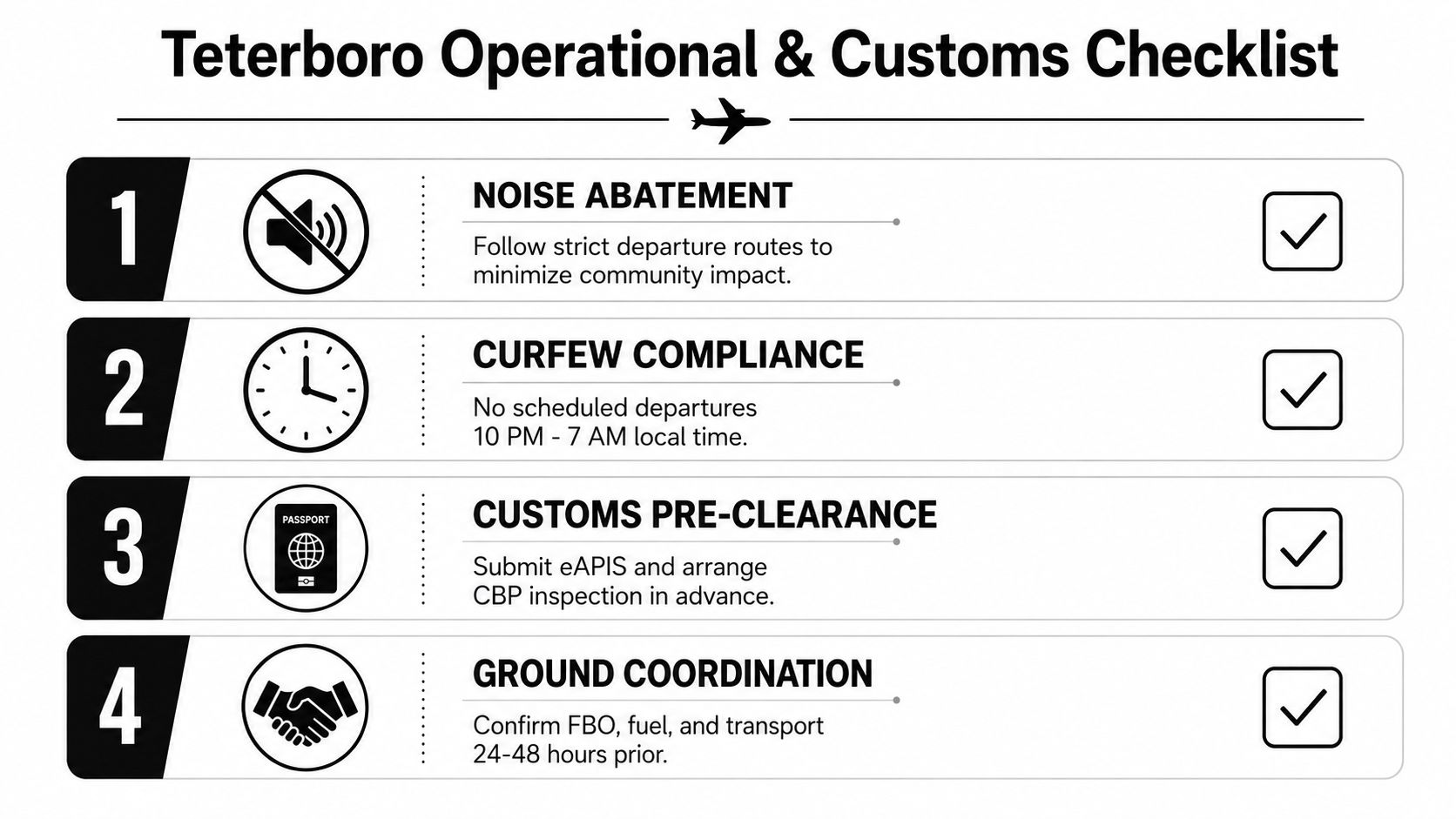
The Port Authority's noise program limits departures on Runway 24 to 80 dB(A) between 22:00 and 07:00, and 90 dB(A) at other times. Runways 01, 06, and 19 are limited to 95 dB(A) at all hours, according to the Port Authority's Teterboro Airport information. Teterboro also applies a voluntary restraint on non-essential operations from 23:00 to 06:00.
Match the aircraft to the departure window
Ask the operator to compare the aircraft's noise profile with the runway likely to be assigned. A quiet aircraft category does not guarantee approval for every time window. Wind, runway assignment, aircraft configuration, and operating weight can change the result.
For an early-morning or late-evening flight, require written confirmation of the departure window and applicable noise requirement. If the aircraft does not meet that profile, the operator must change the time, assess another available runway, or price an alternate airport. Do this before committing the itinerary.
Teterboro remains available to general aviation, yet convenient access depends on the requested time and operating conditions. The voluntary overnight restraint matters most for discretionary travel, where a small schedule shift can avoid an inconvenient airport change.
Complete customs coordination before departure
For an inbound international charter, the operator should submit the required landing-rights notice at least 2 hours before departure from a foreign point, following Port Authority guidance. Inspection services operate 7 days per week, but correct routing and complete paperwork still determine whether the arrival proceeds as planned.
Prepare the following before the aircraft leaves:
- Passenger manifest: Confirm every traveler's name and document details before submission.
- Passports and visas: Check that documents match the itinerary and destination requirements.
- Aircraft documents: Keep required aircraft and crew records ready for inspection.
- FBO pathway: Confirm whether processing uses Hangar 1 on the north side or Jet Aviation on the south side.
- Ground transfer: Schedule the vehicle around the expected release process, not a commercial-terminal assumption.
The Teterboro passenger processing guidance reports that passengers often complete FBO check-in, passport control, and security screening within 15 to 30 minutes, with travelers commonly arriving 30 to 60 minutes before departure. That timing depends on confirmed aircraft positioning, accurate passenger information, and a driver briefed on the correct FBO and release procedure.
The fastest Teterboro trip is the one whose paperwork was finished before the passengers arrived.
Your Pre-Flight Checklist for a Seamless Teterboro Experience
Use a timeline, not a vague promise that the operator will “handle everything.” Teterboro rewards travelers who verify the handoffs between charter sales, flight operations, the FBO, customs, and ground transportation.
At booking
- Define the mission: Confirm route, passenger count, baggage, pets, catering, schedule, and nonstop expectations.
- Select the aircraft: Approve the aircraft class and ask for the operating weight, runway, and noise-profile review.
- Request the landed price: Require taxes, fuel assumptions, positioning, FBO handling, crew costs, and international charges to be identified.
- Name the FBO: Get the exact facility, terminal location, and reservation status in writing.
Before departure
- Confirm the tail number: Ask for the aircraft registration, make, model, cabin layout, and substitution policy.
- Verify the crew: Request crew details and confirm who will coordinate the FBO and flight department.
- Send passenger documents: Provide the final manifest and required identification early, especially for international travel.
- Reconfirm ground transport: Give the driver the correct FBO, pickup procedure, passenger contact, and luggage expectations.
- Review the schedule: Check the planned runway strategy, noise requirements, weather, and any voluntary nighttime operating restraint.
At the 24-hour confirmation
Your operator should provide the complete flight details, including tail number, crew information, weather briefing, passenger manifest, FBO assignment, and ground transport plan. If any of those elements remain open, ask for a resolution before leaving for the airport.
Have a contingency conversation as well. Know what happens if weather changes, the FBO reaches a parking limitation, customs processing takes longer than expected, or the aircraft is substituted. A smooth Teterboro departure isn't created at the lounge. It's created through exact coordination before the vehicle arrives.
Haute Jets arranges on-demand private jet charter flights to and from Teterboro, with access to aircraft sourced through owner-operators and flight details confirmed before departure. Visit Haute Jets to request a Teterboro itinerary built around the right aircraft, FBO, noise requirements, customs pathway, and complete landed cost.