
You're probably here because commercial premium cabins no longer solve the problem.
A founder needs to be in Miami for a morning meeting, New York that evening, and Aspen the next day. A family wants to leave for the holidays without turning the trip into a negotiation with TSA lines, delays, and missed connections. The trigger is usually practical, not flashy. Time gets tighter, schedules get less forgiving, and control starts to matter more than ticket price.
That's when private aviation enters the conversation, and that's also when most first-time buyers get buried in jargon. A private jet club. A jet card. Fractional ownership. On-demand charter. Every option sounds efficient until you read the fine print and realize each one solves a different problem, and creates a different cost structure.
The confusion is understandable because more travelers are entering this market at once. Private aviation logged 3.9 million flights in 2025, up 4% from the previous year, and 2026 activity was already showing another 4% increase according to Business Insider's summary of the private jet travel boom. More demand means more offers, more memberships, and more aggressive sales language.
Most buyers don't need more sales language. They need a framework.
Introduction Beyond First Class Lies a World of Choice
A new client once asked me a simple question: “Should I join a private jet club, or should I just charter when I need it?”
That's the right question. Not “What's the fanciest option?” Not “Which company has the best brochure?” The core question is which access model matches the way you travel.

What buyers usually want
Most high-net-worth clients want some combination of four things:
- Time savings: Less wasted time on connections, security bottlenecks, and rigid airline schedules.
- Schedule control: The ability to leave when the meeting ends, not when the airline says so.
- Privacy: Space for business discussions, family travel, or less exposure.
- Reliability: A clear answer on aircraft availability, service consistency, and backup options.
What they often underestimate is the trade-off between simplicity and flexibility. A private jet club can make booking feel cleaner. It can also lock you into a narrower operating model than you need.
Practical rule: If you don't understand who controls the aircraft, where that aircraft is based, and who pays to move it to you, you don't understand the real cost.
The choice matters more than the branding
A polished membership deck can hide operational limits. A pay-as-you-go charter quote can look expensive until you compare it against annual dues, occupied hourly rates, fuel add-ons, and repositioning exposure inside a club model.
That's why I tell new buyers to ignore branding first and study mechanics second. You're not buying status. You're buying access, logistics, and pricing terms.
Decoding the Private Jet Club Model
A Private Jet Club is not ownership. It's closer to a premium access program.
It's similar to joining a high-end car service rather than buying a vehicle. You pay for access to a network, a booking process, and a service standard. In some cases you also pay for priority access to a controlled fleet. That distinction matters more than the club name.
Two versions of a private jet club
Most private jet clubs fall into two camps.
Asset-heavy clubs
These clubs are tied to a dedicated fleet or a tightly managed operator network. The pitch is straightforward: more consistency, more predictable booking rules, and a clearer expectation of what aircraft category you'll get.
The upside is structure. The downside is constraint. If the fleet is concentrated in specific regions or aircraft classes, you may end up paying for positioning or accepting an aircraft that fits the club's inventory better than your mission.
Asset-light clubs
These clubs act more like curated broker platforms with a membership layer on top. You're paying for preferred access, service handling, and in some cases pricing benefits, but the aircraft may come from a broader outside market.
That can improve flexibility, but it also means the quality of your experience depends heavily on sourcing discipline. Some are excellent. Some are little more than a brokerage with a velvet rope around it.
What your membership fee is really buying
A lot of buyers assume the fee buys cheaper flying. Sometimes it does. Often it buys convenience.
That convenience usually includes:
- Simplified booking: Fewer steps, one account team, and a familiar process.
- Service consistency: Similar catering standards, communication, and trip handling.
- Priority treatment: Better access during peak travel periods, depending on the program.
- Brand assurance: Some clients want one relationship instead of shopping the market every trip.
What it usually does not buy is full control over aircraft economics. If your club needs to move a jet into position, someone pays for that movement. If demand spikes, “guaranteed” access may come with restrictions, peak day rules, or category substitutions.
A private jet club works well for clients who value convenience and repeatability more than aircraft-by-aircraft optimization.
What to compare before joining
If you want to compare jet membership programs, don't stop at headline perks. Ask these questions:
- Is the club fleet-based or broker-based?
- Do you get a guaranteed category, or can you choose a specific aircraft?
- Who absorbs repositioning costs when the nearest jet isn't local?
- What happens on peak days, holidays, and short-notice requests?
- Are your funds prepaid, refundable, or locked into the program?
If a provider can't answer those cleanly, keep moving.
Understanding Private Jet Club Costs and Fees
The advertised rate is never the full story.
That's the first thing I explain when someone asks whether a private jet club is “worth it.” Most club pricing looks tidy on the surface because the brochure is designed to make comparison easy. Your actual spend is rarely tidy.
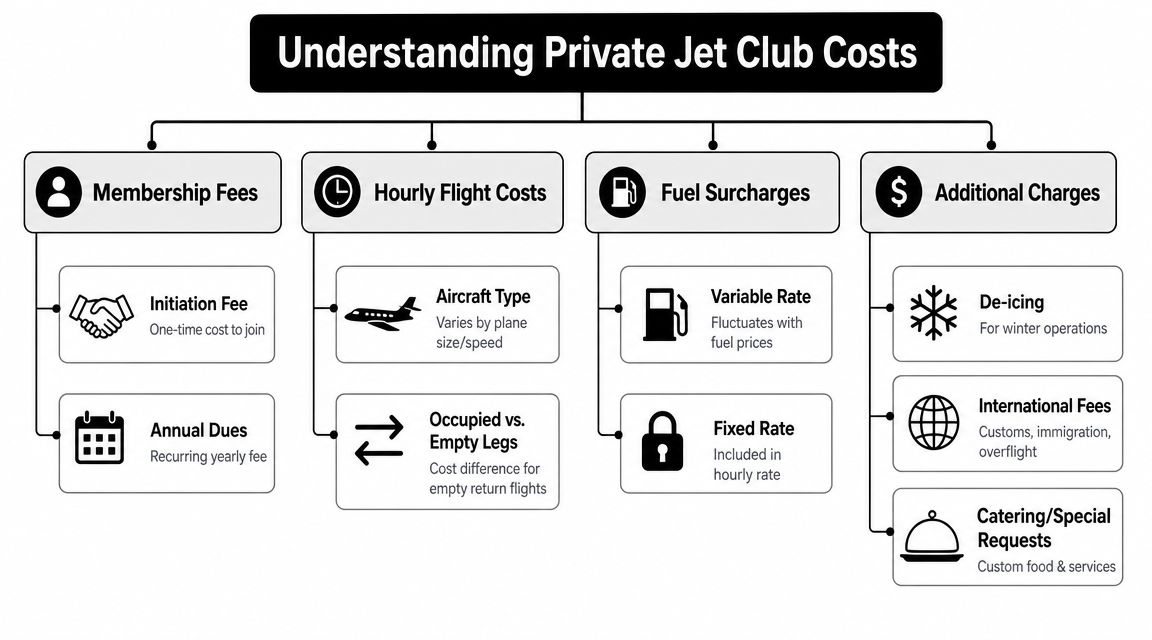
The four cost buckets that matter
A club flight cost usually sits inside four layers.
Membership commitment
This is the money you pay to get in and stay in. It may include an initiation fee, annual dues, or a deposit held on account. Some programs structure this as a membership balance. Others frame it as access pricing.
The important question isn't what they call it. The important question is whether that money is refundable, how it can be used, and whether it expires.
Flight pricing
This is the occupied flight rate or trip rate attached to the actual mission. It often varies by aircraft category. A shorter route on a light jet is priced differently from a longer route on a heavy or ultra-long-range aircraft.
Private aircraft are also segmented by class, including light, super-light, mid-size, super-mid-size, heavy, ultra-long-range, and executive-airliner, with some jets capable of up to 7,300 miles and up to 528 mph, as outlined by Air Charter Service's guide to private jet types. If your club has limited access across those categories, you may end up using a less efficient aircraft for the route.
Fuel and operating adjustments
Some clubs bundle fuel assumptions into pricing. Others pass through adjustments. That matters during periods when operators reprice aggressively or when routing changes require more fuel or a different aircraft.
Incidentals and trip-specific extras
These are the charges buyers complain about after the fact because they didn't ask about them at the start.
- De-icing: A real issue in winter operations.
- International handling: Customs, permits, and related processing.
- Catering and special requests: Particularly if you need premium or highly specific service.
- Ground time and repositioning exposure: Factors that can cause club economics to lose their elegance.
For a clearer baseline on how providers frame charter pricing, Haute Jets lays out its private jet pricing approach in a way that's useful even if you're still comparing models.
The hidden cost that changes the answer
Repositioning is the most misunderstood line item in private aviation.
If your club has an aircraft in the wrong city, somebody has to fly that aircraft to your departure point. In some programs that cost is obvious. In others it's buried inside category pricing, peak charges, or limited service zones. Either way, you're paying.
Advisor's view: If your travel pattern changes often, a fixed membership can become an expensive way to buy inflexibility.
The right way to evaluate a club is to estimate your full annual spend, then test how that spend changes when your routes shift, your booking window shortens, or your preferred aircraft class changes.
Private Aviation Models A Head-to-Head Comparison
Most buyers don't choose between “good” and “bad” options. They choose between different compromises.
That's why comparing models side by side matters more than listening to any one provider explain its own strengths. Membership products tend to sound strongest when they're described in isolation.
The market context behind these models
Scale affects your options. In the first half of 2025, NetJets recorded 196,053 departures and Flexjet recorded 78,322, according to SherpaReport's summary of WINGX business jet activity. That concentration matters because large fleet operators shape the membership and fractional conversation. They don't just sell access. They influence expectations around availability, category guarantees, and service standards.
Private Aviation Models Compared
| Criteria | Private Jet Club | Jet Card | Fractional Ownership | On-Demand Charter |
|---|---|---|---|---|
| Upfront commitment | Usually requires joining fees, deposits, or annual spend commitment | Usually prepaid funds or block-style commitment | Highest commitment because you're buying into an ownership structure | No long-term commitment if booked trip by trip |
| Pricing structure | May look simpler, but total cost depends on rules, aircraft access, and extras | More standardized than charter, but still shaped by program terms | Structured, but carries ownership-style financial exposure and ongoing obligations | Dynamic trip pricing based on route, aircraft, timing, and sourcing |
| Aircraft access | Often access to fleet categories or a curated network | Usually category-based rather than specific tail-level choice | Strong access within the provider's system | Often the broadest aircraft-by-aircraft choice |
| Flexibility | Good for repeat users, less ideal for unusual routing | Convenient for predictable flying patterns | Best for travelers who fly heavily and want a long-term platform | Best for travelers whose needs vary by trip |
| Peak day restrictions | Common in many programs | Common in many programs | Depends on ownership agreement and operator terms | Availability depends on market conditions rather than membership rules |
| Best fit | Clients who want convenience and branded continuity | Clients who value preplanned access and simpler budgeting | Very frequent private flyers with long-term commitment tolerance | Buyers who want to optimize each mission individually |
My blunt assessment of each
Private jet club
A private jet club is useful if you fly enough to value a consistent process, but not enough to justify ownership. It's strongest when your routes are repetitive and your expectations are category-based.
It's weaker when your travel changes often, because club structure can turn into friction.
Jet card
Jet cards appeal to buyers who want predictability. That's legitimate. The problem is that predictability usually comes with program rules, narrower flexibility, and fewer opportunities to exploit local supply.
If you prize budget planning over customization, a card can fit.
Fractional ownership
Fractional only makes sense for a narrow type of client. You need substantial, recurring usage and comfort with a more committed relationship to one provider ecosystem.
For everyone else, it's too much structure for too little agility.
On-demand charter
On-demand charter is the cleanest model for many first-time and even experienced buyers. You pay for the trip, not the membership story. If you want a broader comparison of this trade-off, Haute Jets has a useful breakdown of private jet cards versus charters.
If your flying pattern is irregular, buying flexibility usually beats buying access.
The On-Demand Charter Alternative
You need a jet from Teterboro to Aspen on a peak winter weekend. A membership may quote a familiar hourly rate, then narrow your aircraft options, add peak-day rules, and pass through repositioning costs in less obvious ways. On-demand charter starts with a different question: which aircraft can cover this trip efficiently, from this airport, at this time, with the fewest operational penalties?
That is why smart buyers keep charter on the table. You are paying for a specific mission, not committing money to access you may not use well.
Why this model works
The charter market is fragmented, and that works in your favor. Aircraft are scattered across operators, owners, and local fleets, which gives a capable advisor more ways to find a jet already positioned near your departure point. Fewer ferry miles usually means better economics. It can also mean a better aircraft fit for the route, runway, baggage profile, and passenger count.
This is the part membership sales material often softens. A low headline rate does not help if the provider is moving an aircraft in from another region or pushing you into a category that is larger, smaller, or less suitable than the trip requires.
If you want to compare that flexibility against a more structured option, review the terms of a private jet membership program and focus on what is guaranteed versus what is subject to availability.
Where on-demand wins
- No prepaid commitment: Your capital stays available instead of sitting in a deposit or funded account.
- Better aircraft matching: You can book a light jet for a short regional leg, a super-midsize for coast-to-coast flying, or a long-range cabin only when the mission justifies it.
- Less category friction: You are not boxed into whatever aircraft type the program can provide that day.
- Lower exposure to hidden ferry costs: A well-sourced local aircraft can reduce repositioning time and the charges that often follow it.
- More control over trade-offs: You can decide whether price, cabin size, luggage capacity, Wi-Fi quality, or pet setup matters most on each trip.
A factual example of this model in practice is Haute Jets, which sources from owner-operators, focuses on local aircraft placement, and works on a pay-per-flight basis rather than a traditional annual club structure.
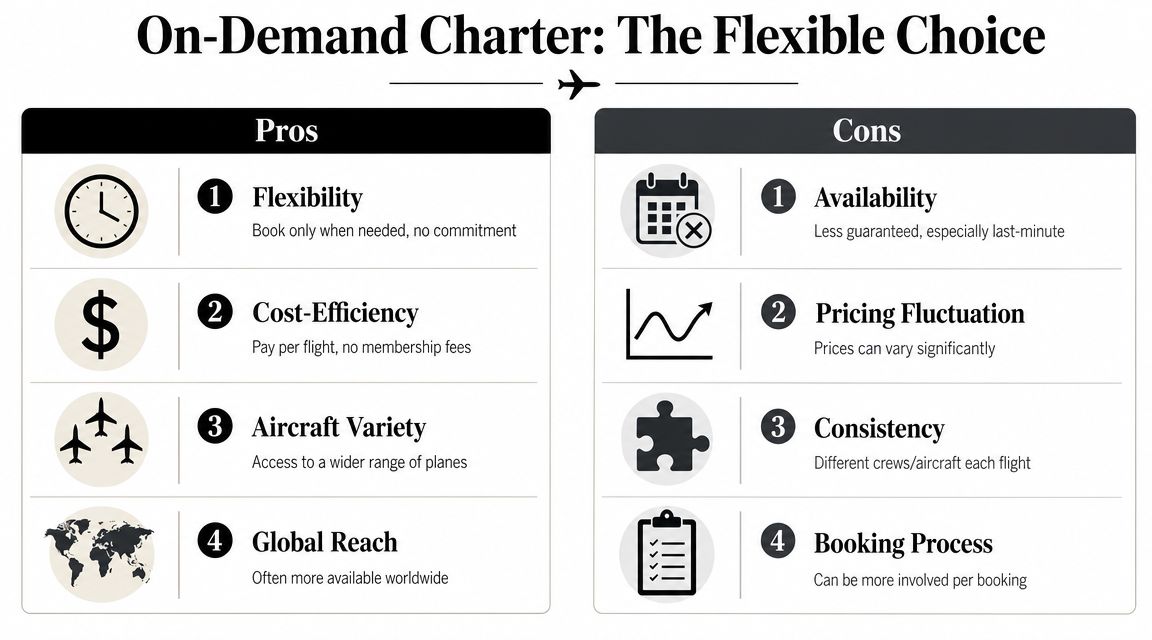
Here's a quick visual on the trade-offs.
Where on-demand loses
Charter is not always the cheapest answer, and it is not the easiest answer for every traveler.
Availability gets tighter on holiday weeks, major sporting events, and true last-minute departures. If you regularly need lift under fixed conditions, with very little notice and no flexibility on timing, a structured program can still justify its higher cost.
Execution also matters. A weak broker can expose you to poor operator screening, inflated pricing, and aircraft that look acceptable on paper but are wrong for the mission. Safety is one area where I'm not flexible. Your advisor should be able to explain operator standards, crew quality, sourcing logic, and why a specific aircraft was chosen.
My recommendation is simple. Choose on-demand charter if your schedule changes, your routes vary, or you care about getting the right aircraft instead of a membership label. It is often the financially smarter option because it forces every trip to stand on its own economics.
How to Choose the Right Private Flight Option
The right model depends less on wealth and more on pattern.
I've seen clients with substantial resources make poor aviation decisions because they bought the model that sounded prestigious rather than the one that fit their calendar. Start with your behavior, not your ego.
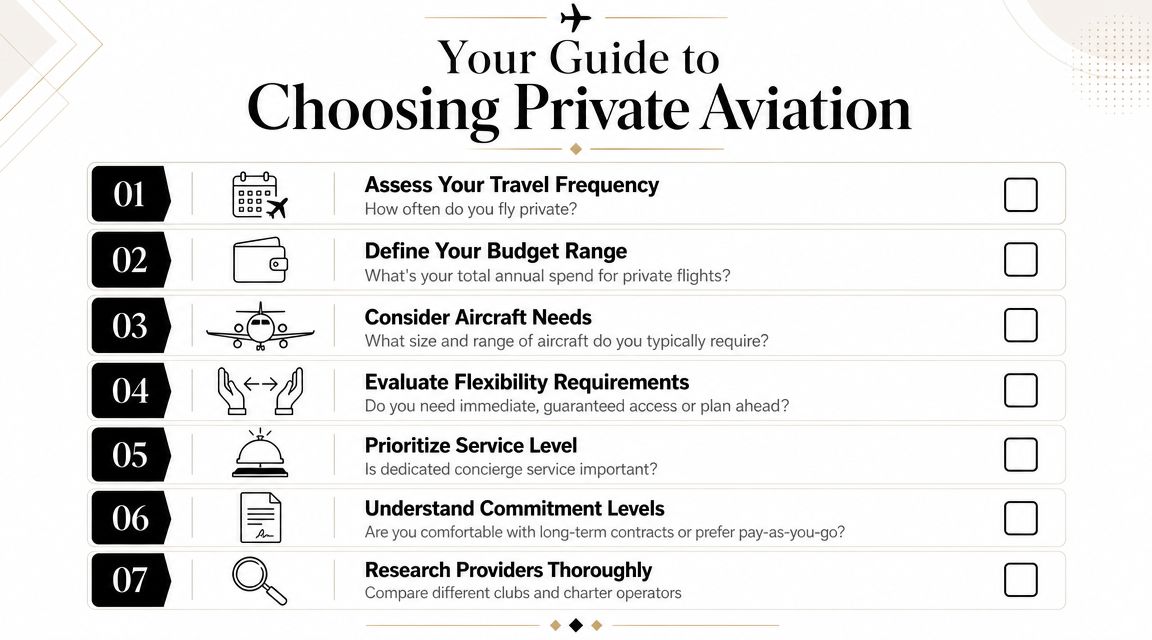
Ask yourself these questions
How predictable is your schedule
If your trips repeat between the same cities and you usually book with notice, a private jet club or jet card can work. If your plans change weekly, on-demand charter is usually the cleaner answer.
A variable schedule punishes fixed models.
Do you care about aircraft category or the exact aircraft
Some clients only care that the cabin is in the right class. Others want the exact model, cabin layout, Wi-Fi setup, baggage profile, or pet suitability.
If specificity matters, broad-market charter often gives you better control than category-based programs. If you're evaluating a more structured option, compare the terms on Haute Jets membership against other models and focus on what is guaranteed.
How comfortable are you with locked-in spend
Some buyers don't mind prepaying. Others hate tying up funds in aviation accounts, annual dues, or long-term commitments.
Be honest with yourself. If you dislike illiquidity in other parts of your life, you probably won't suddenly enjoy it in private aviation.
A simple fit guide
- Choose a private jet club if you want a familiar booking process, you fly regularly enough to use the access, and you're comfortable accepting the provider's operating structure.
- Choose a jet card if you want a more standardized framework and you can live with program rules.
- Choose fractional ownership if private flying is a core, recurring utility in your life and you want a long-term platform.
- Choose on-demand charter if you want maximum route flexibility, broader aircraft choice, and no obligation to keep feeding one program.
Decision shortcut: The less predictable your travel, the less sense a rigid membership usually makes.
What I recommend for most first-time buyers
Start with on-demand charter unless your travel pattern clearly proves otherwise.
That approach gives you real data on how you fly. You'll learn whether you prefer light jets for regional trips, whether your schedule is stable enough for a club, and whether premium access is worth the commitment. After a meaningful period of usage, you can reassess from experience instead of marketing.
Frequently Asked Questions About Private Jet Access
Is a private jet club cheaper than chartering on demand
Not automatically. A private jet club can look cheaper if you focus on the headline rate and ignore annual costs, restricted flexibility, and repositioning exposure. On-demand charter can be the better financial choice when your routing changes often or when local aircraft sourcing is available.
Is guaranteed availability really guaranteed
Usually not in the way buyers first imagine.
“Guaranteed” often means guaranteed within a category, under certain booking windows, and subject to peak-day terms. Read those conditions carefully. If a provider advertises certainty, ask what happens during holidays, event surges, weather disruptions, or fleet shortages.
Can I choose the exact aircraft
Sometimes, but not in every model.
Private jet clubs and jet cards often guarantee an aircraft category rather than a specific tail number. On-demand charter usually gives you more control over exact aircraft selection, assuming the sourcing desk has real market access.
How many passengers fit on a typical private jet
That depends on the aircraft class. Standard charter cabins generally accommodate 4 to 19 passengers, and practical charter capacity under U.S. Part 135-style operations typically tops out at 19 passengers before additional emergency-equipment requirements apply, as explained by Ventura Jet's passenger capacity guide.
Are all private jets equally suitable for every trip
No. Aircraft choice changes range, baggage capacity, cabin comfort, and whether a route can be flown nonstop. That's why aircraft matching matters more than many first-time buyers expect.
How much booking notice do I need
More notice gives you more options in any model. Membership programs may offer cleaner booking mechanics, but no one can repeal the realities of aircraft positioning, peak demand, and weather. If your schedule is tight, work with a provider that communicates clearly about real availability instead of selling false certainty.
What should I ask a provider before committing
Ask these five questions:
- Who controls the aircraft I'll fly?
- Can I select the exact aircraft or only a category?
- How are repositioning costs handled?
- What restrictions apply on peak travel days?
- What safety standards do you require from operators?
Safety is one area where I'm not flexible. Serious buyers should ask about operator vetting and third-party standards such as Wyvern and ARGUS. If a provider gets vague on safety, end the conversation.
If you're weighing a private jet club against jet cards, fractional ownership, or pay-as-you-go charter, Haute Jets is worth considering for a straightforward reason: it centers the decision on the aircraft and the trip, not on forcing you into a membership structure that may not fit how you fly.