
A one-way private jet from Los Angeles to New York usually starts around $30,000 for a midsize aircraft and can exceed $70,000 for heavy or ultra-long-range jets. On this route, the number on the quote matters less than what's driving it, especially aircraft class, flight time, and repositioning.
If you're looking up private jet cost LA to NYC, you're probably not shopping for novelty. You need a clean coast-to-coast solution that saves time, protects your schedule, and doesn't bury you in vague fees. That's the right mindset.
The LA to NYC corridor is one of the clearest examples of how private charter pricing works. Two clients can request the same city pair on the same day and get very different quotes. That doesn't automatically mean one broker is overpriced or another found a miracle deal. It usually means the aircraft category is different, the operator's positioning is different, or the quote was built with different assumptions.
That's why smart buyers don't ask only, “What does it cost?” They ask, “What exactly am I paying for?”
Your Guide to LA to NYC Private Jet Costs in 2026
You leave Beverly Hills after breakfast, expect to land in Teterboro for a late afternoon meeting, and the first two quotes in your inbox are nowhere near each other. That is normal on this route. It is also the first sign that the actual cost is not just about miles flown.
A coast to coast charter from Los Angeles to New York can price very differently even when the date, passenger count, and destination look identical. The biggest reason is aircraft positioning. One jet may already be sitting near your departure airport. Another may need to fly in empty before you ever board, and you pay for that leg whether it is broken out clearly or buried inside the total.
That is where buyers get tripped up.
The smart question is not just, "What is the rate?" Ask where the aircraft is based, whether a ferry leg is included, and whether the quote reflects a plane sourced near departure or pulled in from another market. On a route this long, repositioning can change the economics fast.
If you are comparing options for a Los Angeles to New York private jet charter, focus on quote quality before headline price. A lower number can still be the expensive choice if it comes with hidden positioning cost, the wrong cabin for the mission, or unnecessary operating time.
Haute Jets addresses that problem by sourcing aircraft through a local market model instead of defaulting to a distant operator and passing the ferry cost to the client. That usually produces cleaner pricing and fewer surprises because the quote starts with aircraft availability near the trip, not after the fact.
A serious charter decision on LA to NYC is about efficiency. Get the right aircraft, get clear on positioning, and get the full cost in writing before you book.
LA to NYC Private Jet Costs by Aircraft Class
A coast-to-coast quote can swing hard before you change a single travel detail. The aircraft class sets the baseline, but it does not lock the final price. On LA to NYC, the same category can price very differently depending on where that aircraft is sitting before your trip, how efficiently it can be sourced, and whether the operator is building in deadhead time you do not notice at first glance.
Start with the cabin that fits the mission. Then pressure-test the quote.
Mercury Jets lists a one-way Los Angeles to New York charter at $31,500 to $47,000 for a midsize jet, $36,500 to $49,000 for a super midsize jet, $37,000 to $59,000 for a heavy jet, and $54,000 to $95,000 for an ultra long-range jet in its Los Angeles to New York charter pricing guide. That spread is the point. You are not buying a route alone. You are buying a route on a specific aircraft class, with a specific operating profile, sourced from a specific market.
Estimated cost by category
| Aircraft Class | Typical Passengers | Est. Flight Time | Estimated Cost (One-Way) |
|---|---|---|---|
| Light Jet | Smaller groups | Route-dependent on this city pair | $25,000 to $35,000 |
| Midsize Jet | Smaller to mid-size groups | Around 4.5 hours to transcontinental timing depending on operator assumptions | $31,500 to $47,000 |
| Super Midsize Jet | Group travel with nonstop comfort | About 6 hours 25 minutes | $36,500 to $49,000 |
| Heavy Jet | Larger groups and larger cabins | About 5 hours 45 minutes | $37,000 to $59,000 |
| Ultra Long-Range Jet | Larger groups seeking maximum range and cabin space | About 5 hours 30 minutes | $54,000 to $95,000 |
What each class actually buys you
Light jets show up in broad market ranges, but they are rarely the smart first call for LA to NYC. Range limits, payload tradeoffs, and operating restrictions can turn an apparent bargain into an awkward mission plan.
Midsize jets are where many serious buyers start. If you are flying a small group and your luggage profile is light, this class can make sense. The problem is consistency. One midsize quote can look attractive because the aircraft is nearby. Another can come in much higher because the jet has to be brought in first.
Super midsize jets are often the best value on this route. Air Charter Advisors lists a super midsize charter from New York to Los Angeles starting around $40,000 one way, with estimated flight time of 6 hours 25 minutes, in its New York to Los Angeles charter guide. That mix of nonstop capability, better baggage capacity, and a more comfortable cabin is why this class wins so many coast-to-coast comparisons.
Heavy jets are the right call when you care about cabin volume, luggage, or passenger comfort over six hours in the air. The price jump can be modest compared with super midsize in some quotes, which is exactly why you need to ask whether the operator is sourcing locally or charging you to position the plane.
Ultra long-range jets sit at the top of the range for a reason. You get the largest cabins, the strongest range margins, and the most premium onboard experience. You also pay for it. If you do not need that capability, skip it.
Here is the practical takeaway. Aircraft class explains the first layer of cost. Sourcing explains the second. Haute Jets' local sourcing model matters because it increases the odds of finding the right aircraft already close to departure, which can keep a midsize or super midsize quote from creeping into heavy-jet territory for no good reason.
My recommendation by trip profile
- For 2 to 4 travelers: Price midsize and super midsize side by side. Do not assume the smaller jet is the better deal.
- For 5 to 8 travelers: Start with super midsize. This is usually the strongest balance of comfort, range, and cost discipline.
- For 8 to 10 travelers or travelers with substantial luggage: Get heavy jet quotes early.
- For clients shopping on image alone: Ultra long-range can be justified, but only if you know exactly why you are paying the premium.
Buy the aircraft that fits the trip and the sourcing reality behind the quote. On LA to NYC, a well-sourced super midsize often beats an inefficiently positioned larger jet on both price and value.
Deconstructing Your Charter Quote What You're Paying For
You get two quotes for the same LA to NYC trip. The aircraft categories look close. The totals are nowhere near each other. That gap usually comes from what is buried inside the quote, not from what is written on the first line.
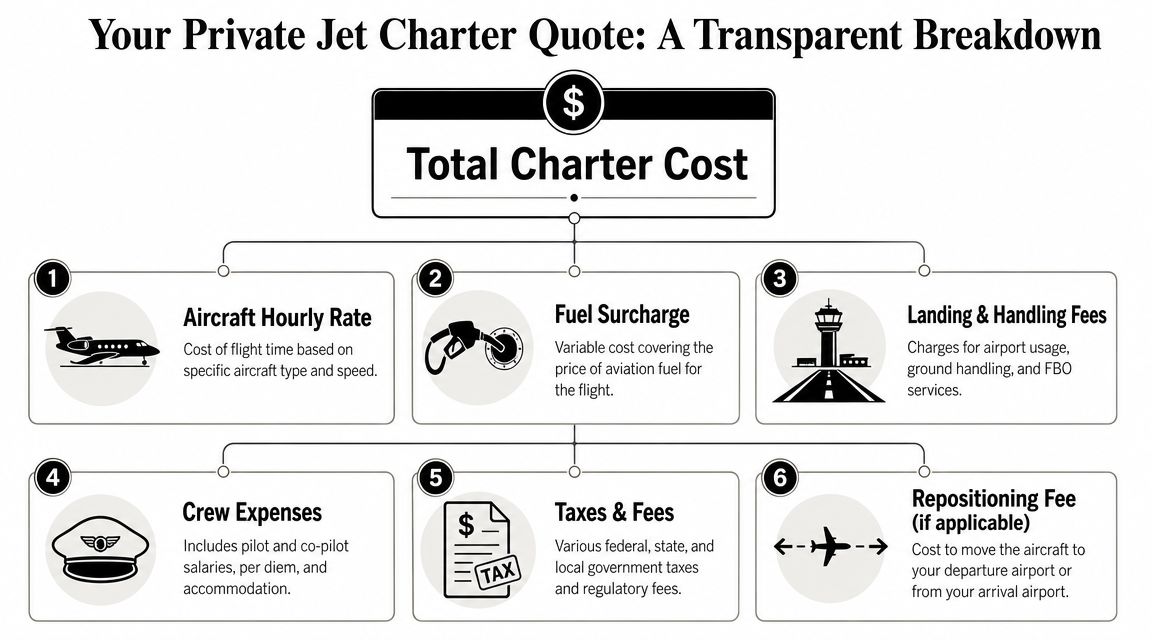
A serious charter quote should show you the cost logic, not just a grand total. If you cannot see how the number was built, you cannot judge value, and you cannot spot padding.
The line items that matter
Most quotes are built from the same core pieces, whether they are itemized or rolled together:
- Aircraft flight cost: The base operating charge tied to the aircraft and planned flight time.
- Fuel surcharge: A coast-to-coast trip burns real fuel. This can move the quote.
- Landing and handling fees: Airports and FBOs charge for ramp access, parking, and ground support.
- Crew expenses: Pilot time, duty costs, and any trip-related crew charges belong in the total.
- Taxes and regulatory fees: These are mandatory charges, not broker markup.
- Repositioning fee: Often the least understood part of the quote, and often the most expensive hidden swing factor.
That last item deserves more scrutiny than buyers usually give it. If you want a quick primer on ferry costs and empty segments, read Haute Jets' guide to deadhead flights and repositioning costs.
Why two quotes can look similar and price very differently
A clean quote is not always a cheap quote. A cheap quote is not always a good quote.
What matters is whether the aircraft is already close to your departure point and scheduled efficiently. If it is, the operator can price the trip on the mission you are flying. If it is not, you may be paying for extra aircraft movement before you ever step onboard.
Buyers get misled when they compare cabin class, assume the smaller jet should cost less, and miss the operational reality underneath the number. A larger aircraft with better positioning can come in lower than a smaller aircraft that has to be ferried in. That is normal.
Haute Jets' local sourcing model addresses this directly. Instead of treating every LA to NYC request like a generic national search, the goal is to source aircraft closer to the trip. That reduces unnecessary repositioning, keeps quotes tighter, and makes the pricing easier to explain. On a route this long, that can be the difference between a fair market quote and an inflated one.
What to ask before you approve anything
Ask these questions and expect direct answers:
- Is the aircraft already based near my departure airport?
- Does this quote include any ferry or deadhead flying?
- What block time is being used for pricing?
- Are taxes and airport fees included?
- Is catering, ground transport, or overnight crew built in or separate?
If a broker cannot explain the quote, do not assume the quote is simple.
The best quote is the one you can audit in plain English. Low price matters. Clear pricing matters more.
How Repositioning Fees Inflate Your Charter Cost
Repositioning is the most misunderstood part of private charter pricing, and on LA to NYC it can swing the quote hard.
A repositioning flight happens when the aircraft you want isn't already where you need it. The operator has to move that plane to your departure airport, or move it again after your trip, without paying passengers onboard. Someone covers that cost. Very often, it's the client.
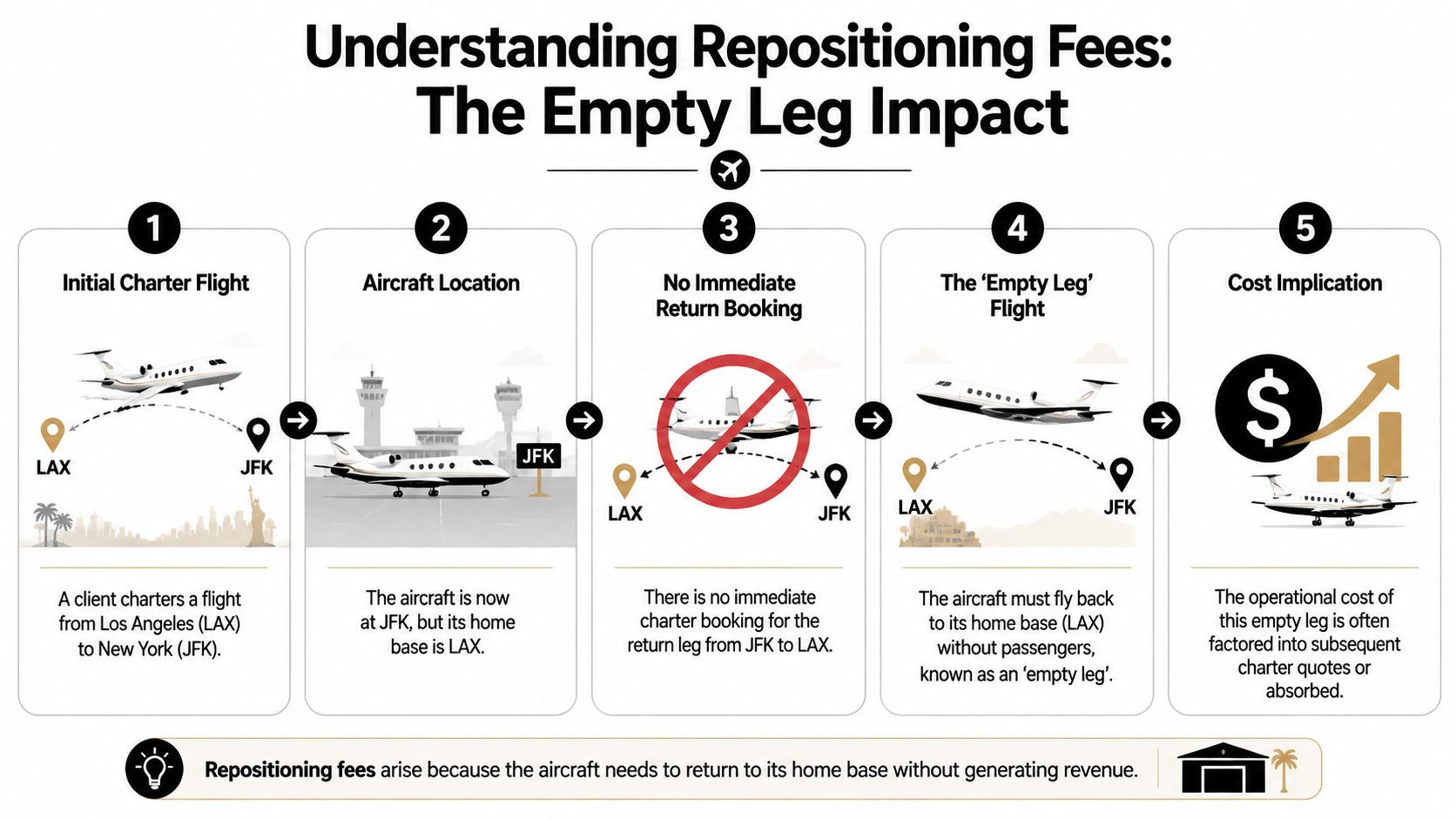
Why the same route gets very different quotes
Monarch Air Group shows a super midsize range of $32,500 to $43,000 for the same LA to NYC trip in its Los Angeles to New York route page. That kind of spread inside one aircraft class usually isn't random. It's often positioning.
If one aircraft is already near Los Angeles and another has to be brought in from somewhere else, the cost basis changes immediately. That's why route pages that present one-way charter as if it were a fixed fare can mislead buyers. Charter pricing is operational, not retail shelf pricing.
What a smart buyer should do
Don't ask only for a quote. Ask for the logic behind the quote.
Specifically, ask whether the aircraft is:
- Locally based near departure
- Coming in from another market
- Expected to remain in New York
- Returning empty after your trip
If you want a deeper primer on how ferry flying affects price, deadhead flights explained gives the operational context.
There's also a practical sourcing angle here. Haute Jets sources from 3,500+ aircraft across 175 countries and focuses on finding aircraft based near the departure city, which can reduce repositioning exposure and make the quote more transparent. That matters more than clever sales language. If the plane starts closer to you, the math usually gets better.
The cheapest airplane on paper can become the expensive one if it has to fly empty before you ever step onboard.
For coast-to-coast charter, repositioning isn't a footnote. It's often the difference between a disciplined buy and an overpriced one.
Actionable Tips to Lower Your Charter Flight Price
You're flying six executives from Van Nuys to Teterboro and two quotes land in your inbox for what looks like the same trip. One is meaningfully lower. Before you assume it's the better deal, check where the aircraft is starting its day. On this route, the fastest way to overpay is to ignore repositioning.

A lower charter bill usually comes from better aircraft sourcing, not from forcing yourself into the smallest jet category that can technically make the trip. Coast-to-coast pricing gets better when the airplane is already near your departure airport, can fly the mission cleanly, and does not create extra crew, handling, or fuel-stop costs.
Haute Jets' local sourcing model matters here. If your broker can pull from aircraft already based near Los Angeles instead of bringing one in from another market, you cut out a common source of waste and get a quote that reflects the actual mission instead of hidden ferry cost.
Start with the right aircraft, not the cheapest one
Fit drives value.
If the cabin is too small, you may add a fuel stop, baggage limitations, or passenger discomfort on a long transcontinental leg. If the aircraft is too large, you can pay for range and cabin volume you do not need. The sweet spot is the aircraft that handles LA to NYC nonstop, fits your passenger count accurately, and starts close to your departure point.
A few practical ways to lower the number without lowering the standard:
- Match the jet to the mission: Passenger count, baggage, airport pair, and nonstop capability should line up.
- Ask for nearby aircraft first: A local super midsize or heavy jet can price better than a smaller aircraft that has to reposition in.
- Use airport flexibility wisely: Van Nuys, Burbank, LAX, Teterboro, White Plains, and Republic all price differently once handling, slot pressure, and aircraft availability are factored in.
- Check both one-way and round-trip structures: Operators price around schedule logic. Sometimes keeping the same aircraft for the return is more efficient than booking two separate one-ways.
- Avoid false savings: A lower quote that adds a fuel stop or long reposition is not a better buy.
Judge the trip by mission value and cost per seat
Private jet pricing is charged per aircraft, not per passenger. That means a coast-to-coast charter can make much more economic sense when you spread the cost across a leadership team, family, or production group.
That is the right lens. Look at the trip as total mission value per seat, not just the topline charter figure.
If you are comparing options, ask what each seat buys you in saved time, schedule control, privacy, and reduced travel friction. Then compare that against whether the quote includes repositioning, airport fees, crew charges, and any expected overnight costs. That gives you a real comparison instead of a sales number.
Here's a short briefing that covers broader private aviation buying logic:
Ask better questions and the pricing gets better
Do not ask for the “best price.” Ask for the best operational fit at the best all-in cost.
Use these questions when you request quotes:
- Which aircraft is already closest to my departure airport?
- Can this aircraft fly the route nonstop with my passenger and baggage load?
- What is included in the all-in quote, including repositioning, crew, handling, and overnight charges?
- Which airport pairing lowers total operating cost without adding inconvenience?
- Is the operator approved under the standards covered in this guide to Wyvern and ARGUS safety ratings?
Those questions change the conversation. They force a broker to show you the operating logic behind the quote, which is exactly where real savings show up on an LA to NYC charter.
Booking Safely The Importance of Wyvern and ARGUS Ratings
A cheap charter isn't a good charter if the operator standards are weak. Safety screening is not the place to get casual.
Wyvern Wingman and ARGUS Gold or Platinum are the safety credentials serious buyers should know. They reflect third-party oversight of operator standards such as crew qualifications, maintenance discipline, and operational procedures. If an operator doesn't meet the safety threshold you require, the price shouldn't matter.
What to ask your broker or operator
You don't need to become an aviation auditor. You do need to ask direct questions:
- Is this flight operated by a Wyvern-rated or ARGUS-rated operator?
- Can you confirm the exact operator before I wire funds?
- Will I receive the tail number and crew information before departure?
A disciplined charter process should answer those questions clearly.
For a fuller explanation of what those ratings mean in practice, Wyvern and ARGUS safety ratings explained is worth reading before you book.
Safety due diligence isn't optional because the cabin looks polished and the quote looks attractive.
If you're comparing two flights and one is cheaper because the vetting is looser, that isn't savings. It's risk.
The Smart Way to Fly from Coast to Coast
The smart way to buy this route is simple. Don't shop LA to NYC charter like a commodity.
Aircraft category drives price. Positioning drives hidden cost. Transparency determines whether the quote deserves your trust. If you only compare top-line numbers, you'll miss the full economics of the trip.
The better approach is to choose the right aircraft for the mission, insist on a clear explanation of repositioning exposure, and evaluate the trip on a per-flight and per-seat basis when traveling with a group. As noted earlier, charter is priced per flight, not per passenger, which is why a $50,000 trip for 10 travelers can be understood as $5,000 per person in the right context.
That's how experienced buyers think about private jet cost LA to NYC. They don't just ask what the flight costs. They ask whether the quote is operationally smart, safety-vetted, and built around the actual trip instead of a generic sales template.
If you want a real answer for your schedule, ask for an all-in quote, ask where the aircraft is coming from, and ask which exact plane fits your group without adding unnecessary cost. That's the standard worth holding.
If you want a transparent coast-to-coast charter quote with the exact aircraft, operator details, and clear visibility into repositioning exposure, request pricing directly from Haute Jets.