
Most advice about private jet leases starts with the wrong premise. It treats leasing as the natural upgrade after charter, when for most flyers it's a way to buy operational complexity, repositioning exposure, and fixed monthly drag you don't need.
The market is real and growing, but that doesn't make the product right for the buyer. WingX reported 3,878,336 private jet departures worldwide in 2025, up 4.6% year over year from 2024 and above the previous record set in 2022, while North America logged 1,312,317 business-jet departures in the first half of 2025, 3.5% higher than the same period in 2024 and 27.4% above the first half of 2019, which tells you utilization is strong across the fleet, not that every flyer should lease one (WingX 2025 flight activity analysis). The smarter question is simpler: how many hours do you fly, how fixed are your routes, and who's going to carry the operational burden when things change?
Why Most Flyers Should Rethink Private Jet Leases
The most popular advice says leasing is the logical middle ground between charter and ownership. I disagree. If you're not flying enough to keep an aircraft busy, a lease doesn't simplify your travel, it just shifts the work from an operator to you.
Utilization, not aspiration, decides the math
The aircraft leasing market is massive because aviation finance loves leasing as a balance-sheet tool. One 2025 estimate puts the broader aircraft leasing market at USD 194.40 billion in 2025, with projections to USD 377.90 billion by 2034 at a 7.60% CAGR, and another forecasts growth to USD 565.1 billion by 2034 (Fortune Business Insights). That scale matters, but it reflects fleet economics, not a mandate for end users to lease.
The practical issue is utilization. A dry lease strips out crew and service, so the lessee absorbs scheduling, maintenance coordination, insurance, positioning, and compliance oversight. That model only works when flight hours are high enough to spread fixed obligations across frequent missions, otherwise the aircraft becomes a cost center that behaves like ownership without the upside.
Practical rule: if your schedule changes often, lease flexibility is mostly an illusion. The lease contract stays fixed even when your calendar doesn't.
Leasing is a business tool, not a default upgrade
Commercial aviation has normalized leasing at scale. IATA says leased aircraft rose from about 10% of the global fleet in the 1970s to 58% at the end of 2023 (IATA aircraft leasing report). That statistic proves leasing is mature, but maturity isn't the same as fit for every private flyer.
For private jet clients, the test is simple. If you need exact aircraft control, you can tolerate operational responsibility, and you're flying frequently enough to justify it, leasing can make sense. If you want flexibility, lower commitment, and no aircraft management headache, charter is the better default. That's the part most leasing pitches skip.
Understanding the Main Types of Private Jet Leases
Private aviation uses the word “lease” for several different products, and that ambiguity causes bad decisions. Some leases give you only the aircraft, some bundle the full operating stack, and some are really financing structures dressed up as access. If you do not separate those categories first, you will compare the wrong numbers and choose the wrong model.
Dry lease and wet lease are not close substitutes
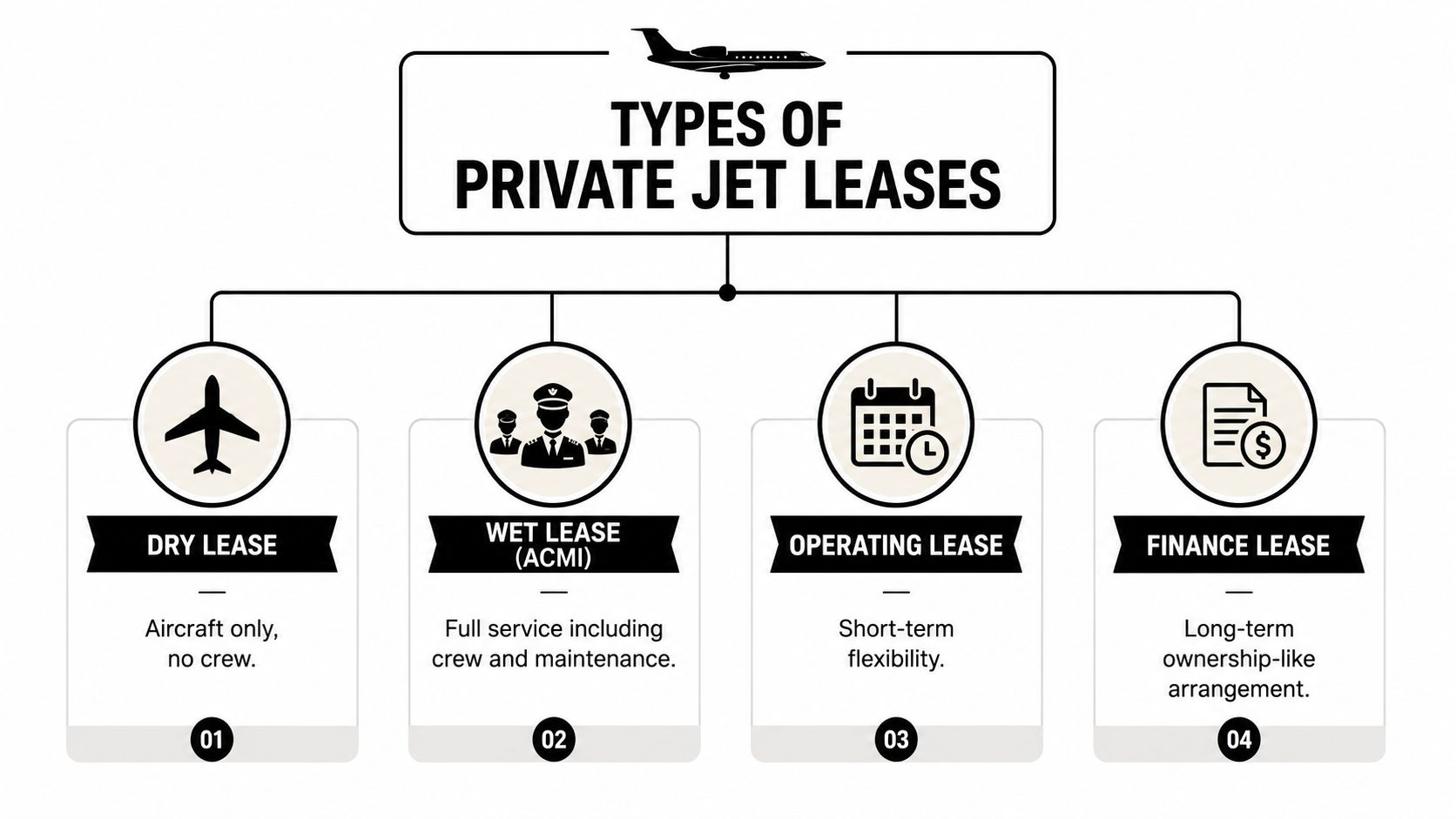
A dry lease gives you the aircraft only, no crew. You supply the pilot, maintenance framework, insurance, and operational control, so the arrangement feels much closer to running a flight department than renting a jet. That is why dry leasing suits experienced operators, corporations with aviation infrastructure, or buyers who already know how to manage the moving parts.
A wet lease, also called ACMI, bundles the aircraft, crew, maintenance, and insurance. The lessee still pays fuel and trip costs, so the quote does not describe the full trip economics by itself. The staffing side is part of that package, and the crew market is visible if you want to find private aviation cabin jobs, because those roles sit inside the operating cost you are buying.
Operating lease and finance lease serve different goals
An operating lease works like a long-term rental. You get access without a built-in ownership path, which can be useful if you want defined use over a set period and do not want to carry the asset.
A finance lease serves a different purpose. It behaves more like a structured, ownership-like arrangement, and the private jet finance market is projected to keep growing, with finance lease described as the largest segment in Market Intelo private jet finance market. That is not niche paperwork. It is a serious product for buyers who want control or eventual acquisition without outright purchase on day one.
Dry lease resembles leasing a vehicle and separately hiring your own driver and mechanic. Wet lease bundles the aircraft, crew, and support together. Operating lease functions as a long-term rental. Finance lease gives you a structured route that can end in ownership-like economics.
The Actual Cost of Leasing a Private Jet
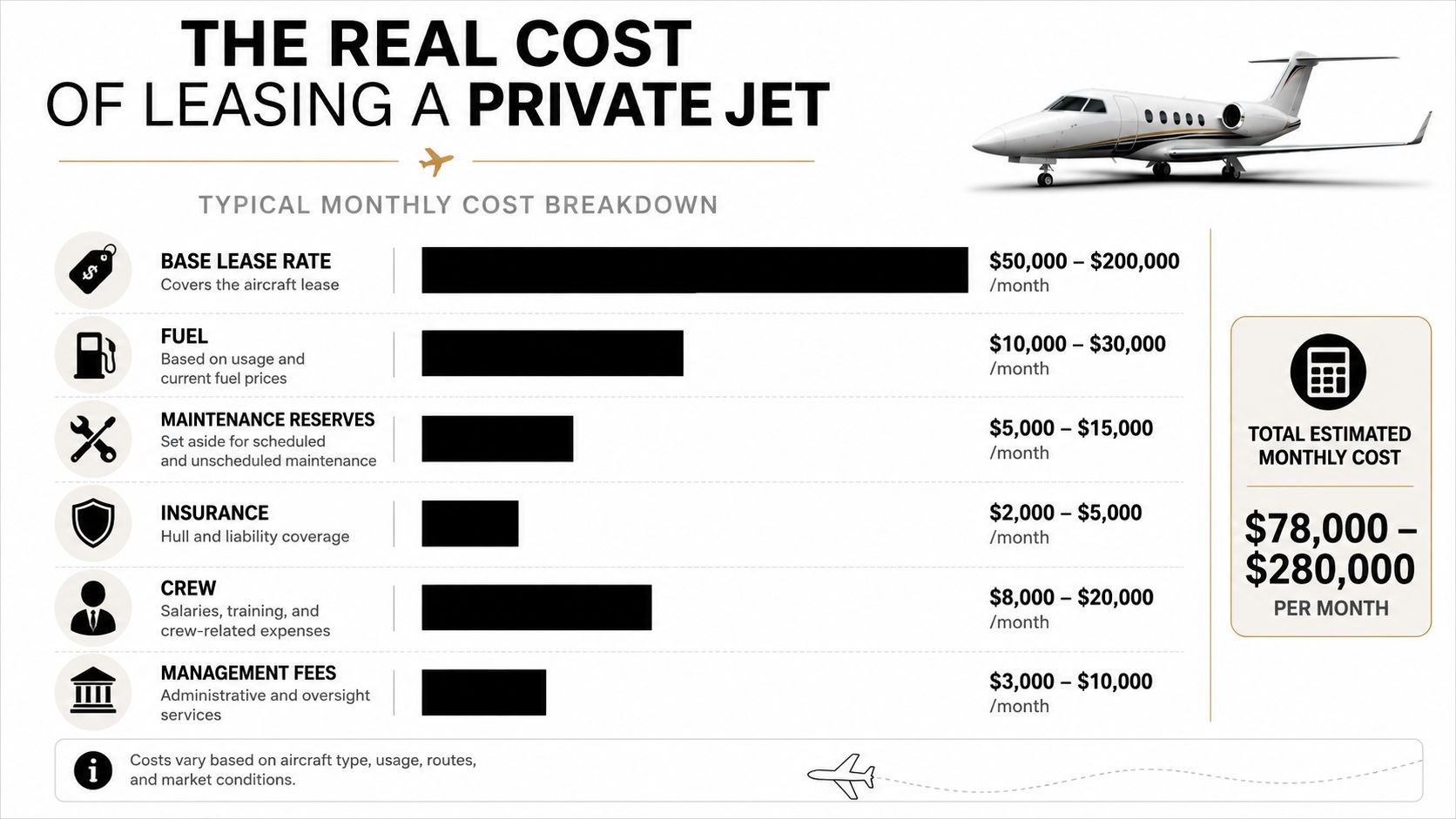
Lease quotes are built to look tidy. They usually are not. The monthly figure is only the starting point, and the true bill comes from the operating stack you take on once the aircraft starts flying around your schedule.
The invoice is bigger than the monthly lease payment
A neutral industry report puts the global private jet aircraft leasing market at $8.4 billion in 2023 and says 25% of private jet owners leased their aircraft in 2022, with average monthly lease rates of $50,000 to $200,000 for large jets (Zipdo private aviation statistics). Those numbers are useful reference points, but they still leave out the operating line items that decide whether leasing makes financial sense.
Fuel, maintenance reserves, insurance, crew, hangar space, landing and handling, and taxes or local charges all land on the bill depending on where the aircraft is based and where it flies. In a dry lease, you also take on staffing and oversight responsibilities, so the apparent savings can disappear quickly if the aircraft is not used enough. If you need a clean benchmark before comparing lease pricing, start with private jet charter cost.
A lease gets expensive when the aircraft sits. Idle time still carries fixed obligations.
Wet lease economics are simpler, but still not cheap
A wet lease includes aircraft, crew, maintenance, and insurance. That removes part of the management burden, but it does not erase trip-level costs. Fuel and repositioning still matter, and buyers often miss that because the headline quote looks cleaner than the operating picture.
The staffing side also matters. For teams comparing leased aircraft with charter programs, the service model is only as strong as the people supporting it. If you want to understand how the cabin staffing market sits inside private aviation operations, find private aviation cabin jobs offers a useful window into the roles that affect consistency, safety, and service quality.
Repositioning turns low quotes into expensive trips
Empty-leg exposure and repositioning risk are the most underestimated parts of private aviation. If the aircraft has to move to you, the trip is distorted by empty flight time, routing limits, and schedule fragility. In practice, a lease or charter itinerary can lose much of its value when the aircraft is not already near your departure point.
That is why local availability matters more than a cosmetically lower quote. Pay for aircraft that are already where you need them, when you need them, instead of chasing a lower rate that gets padded by positioning later. If you want to compare what that looks like in charter pricing, use Haute Jets' charter cost guide as the reference point.
Leasing Versus Charter, Jet Cards, and Fractional Ownership
Buyers usually compare the wrong things. They compare the lease rate to the charter price and stop there. That's lazy analysis. The key comparison is between utilization, operational burden, flexibility, and how painful it is to exit when your flying pattern changes.
The decision matrix is about control versus convenience
| Access Model | Best For (Annual Hours) | Operational Burden | Aircraft Flexibility | Exit Complexity |
|---|---|---|---|---|
| Private jet lease | 200+ predictable hours | High | Low to medium | High |
| On-demand charter | Variable or lower hours | None | High | Low |
| Jet card program | Moderate, recurring use | Low | Medium | Low to medium |
| Fractional ownership | High, stable utilization | Medium | Medium | Medium to high |
That table makes the hierarchy obvious. Leasing wins only when you're using the aircraft often enough to justify the fixed load and when your routes are stable enough to exploit a dedicated airframe.
If you want a deeper side-by-side on the middle options, compare the model details in jet cards versus charters. Jet cards reduce friction, charter preserves flexibility, and neither forces you into a long-term aircraft commitment.
Repositioning should change your answer, not just your quote
A lot of buyers accept repositioning as a normal nuisance. It isn't. When the aircraft has to be ferried to your departure city, the economics shift against leases and many charter itineraries because you're paying for something you're not occupying. That distortion matters especially for travelers who value exact departure times and aircraft availability.
My recommendation is blunt. If your schedule is seasonal, scattered, or client-driven, don't sign a lease. If your travel is concentrated between fixed hubs and your calendar is predictable, then lease economics deserve a serious look. Otherwise, you're paying for flexibility you don't need.
Real-World Scenarios for Private Jet Leasing
The right answer changes with the mission. A lease can make sense for one traveler and be a poor financial move for another, depending on route stability, headcount, and how much control over the aircraft matters. The mistake is treating every premium flyer like they share the same operating profile.

A seasonal HNW traveler should usually avoid a lease
A client splitting time between Miami, Aspen, and the Bahamas usually does not need a lease. That pattern is seasonal, not fixed, and the aircraft requirements change with family size, baggage, weather, and destination airport limits. In that setting, on-demand charter is the smarter default because the aircraft can fit the trip instead of forcing the trip to fit the aircraft.
It also leaves repositioning risk with the operator. If an aircraft is already near Miami for a weekend departure or near Aspen during ski season, charter can cover the trip without a long commitment. A lease does the opposite. You carry the fixed cost of an airframe that may spend too much time waiting for the next usable mission.
A corporate travel manager can justify a wet lease sooner
A 15-person executive team flying North America and Europe on a fixed cadence is a different case. Group size, branding consistency, and recurring schedules can justify a wet lease or a structured finance arrangement, especially when cabin control matters and the flight department can handle the oversight.
For route planning, cabin and performance specs matter more than generic “large jet” labels. A Gulfstream G650 is listed with up to 7,000 nautical miles of range, Mach 0.925 max cruise, and a 51,000-foot ceiling. A Gulfstream G550 is listed at 6,750 nm and Mach 0.87 high-speed cruise. That difference matters when a fuel stop would break an executive schedule. For a closer look at how vetted operators are screened, review Wyvern and Argus rated charter services.
Entertainment and sports work is about cabin volume, not bragging rights
Production teams and touring acts usually care more about seats, baggage, and timing than about ultra-long-range economics. An Airbus A321 charter configuration is listed with about 3,700 nm range, up to 236 passengers, and takeoff distance around 7,400 ft, which suits group movement where cabin volume matters more than range prestige. That is the right lens for cast-and-crew logistics.
For those missions, leasing can work if schedules are dense and repetitive. If the production plan changes every few days, charter usually wins because you can resize the aircraft and avoid paying for a fixed asset that is wrong half the time.
How to Evaluate Lease Providers and Aircraft
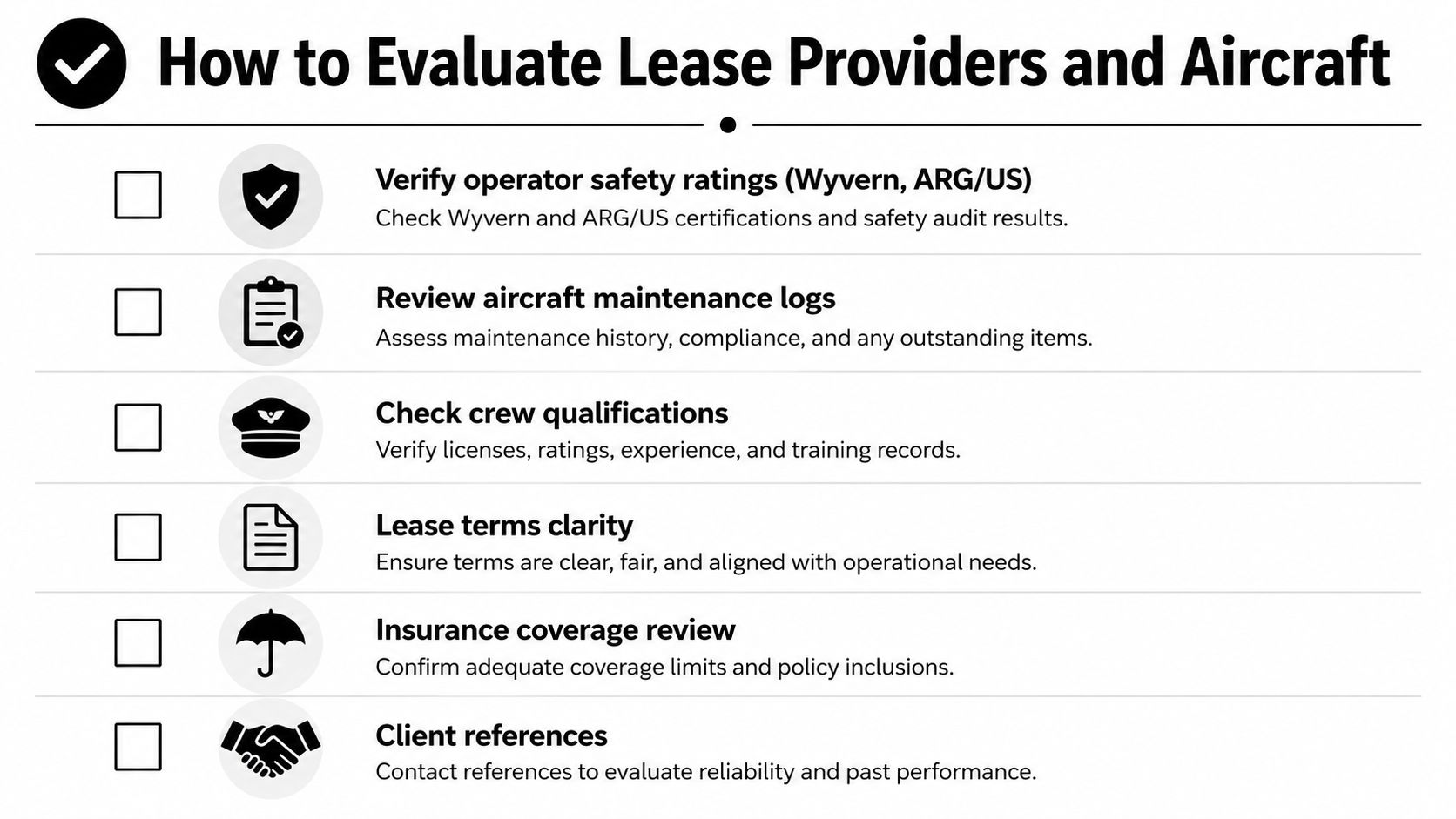
If leasing is still on the table, the due diligence has to be surgical. Don't get distracted by cabin finishes or glossy photos until you've checked the operator, the maintenance paper trail, and the contract terms that decide who eats the unexpected cost.
Start with the operator, not the brochure
Use a safety screen before you talk price. If the provider can't show clear third-party safety credentials, move on. For charter and lease-backed access, a solid benchmark is Wyvern Wingman or Argus Gold/Platinum, because those ratings tell you the operator has been audited rather than merely advertised.
The lease agreement should spell out who handles scheduled maintenance, unscheduled downtime, and replacement lift if the aircraft goes offline. It should also define insurance gaps clearly, because a vague contract is just a future dispute. If you need a reference point for what a properly vetted charter network looks like, review Wyvern and Argus rated charter services.
Match the aircraft to the mission, not the marketing copy
Range numbers are useful, but only when you understand the mission profile. The G650 can solve a long overwater mission that the G550 might handle only with tighter planning, yet actual range depends on passenger load, weather, reserves, and baggage. That's why headline specs never close the deal on their own.
Ask these questions before you sign:
- Who holds operational control? If the answer is fuzzy, stop.
- What happens during maintenance downtime? You need a clear replacement plan.
- What coverage is included? Don't assume insurance is broader than it is.
- What's the exit path? Early termination should be explicit, not implied.
- What maintenance records can you review? If the logs are incomplete, walk away.
- Which aircraft do you get exactly? Model, year, interior layout, and base airport all matter.
If you're comparing a lease against a charter alternative, Haute Jets is one option for on-demand sourcing through a wholesale charter model. That matters because many buyers don't want a membership or a fixed fleet obligation, they want the right aircraft, from the right operator, for the actual trip.
Making the Right Private Aviation Decision
Leasing a private jet only makes sense for a narrow group of flyers. You need high utilization, fixed routes, and enough operational maturity to manage the burden that comes with control. If you don't have those three things, the lease is working against you.
For most high-net-worth individuals, corporate teams with changing schedules, and entertainment productions with shifting call sheets, on-demand charter is the better default. It keeps the aircraft decision tied to the trip, not the contract, and it avoids the hidden cost of repositioning, downtime, and operational oversight. Before you sign anything, review the last 12 months of flying, not the next 12 months of wishful thinking.
Haute Jets gives you on-demand private jet charter without forcing you into lease obligations, jet cards, or a fixed fleet. If you want exact aircraft selection, local sourcing, and a cleaner way to compare charter against leasing, visit Haute Jets and request a quote for the trips you fly.