

A light jet from Los Angeles to Las Vegas typically starts around $6,000 to $12,000 one way, and the flight itself is usually under an hour. For most travelers, the main question isn’t whether the route is fast enough. It’s whether the quote you receive is the true price or a dressed-up number that gets more expensive once the aircraft has to reposition.
That’s the part many first-time charter clients miss.
If you’re looking at a private jet los angeles to las vegas trip, you’re probably doing it for one of three reasons. You want to avoid losing half a day to commercial airport friction. You need schedule control. Or you want the trip to feel simple from wheels up to hotel arrival.
This route is built for private aviation. It’s short, high-frequency, and practical for everything from a same-day business turn to a weekend departure with family or friends. But short-haul charter also exposes pricing games faster than long-haul does. On a route this brief, hidden repositioning can distort the quote more than most travelers expect.
The smartest way to book isn’t just finding a plane. It’s matching the right aircraft to the mission, using the right airports, and making sure the quote reflects a locally based jet instead of a broker’s convenience.
Your Guide to the Ultimate Short-Haul Flight
You finish a meeting in Beverly Hills at 3:30, want dinner in Las Vegas, and do not want the trip to eat the rest of the day. That is exactly why this route works so well by private jet. The flight is short, the airport options are strong, and with the right aircraft in position, the experience is efficient from the first car drop to hotel arrival.
The part that changes the bill is usually not the flight time. It is where the aircraft starts its day.
On Los Angeles to Las Vegas, first-time charter clients often focus on cabin photos, hourly rates, or whether a light jet feels more appropriate than a turboprop. Those details matter, but they are not what usually drives avoidable overspend on this route. Repositioning does. If the aircraft has to come in empty from another city just to pick you up, the quote can climb fast on a flight that is otherwise one of the simplest private sectors in the country.
That is why local sourcing matters more here than many clients expect. A properly sourced aircraft based near Van Nuys, Burbank, Hawthorne, or another practical LA departure point can cut out a large chunk of ferry cost. In some cases, that difference is the margin between a fair market quote and one that is inflated by 40 percent before you ever board. Clients comparing options can review private jet charter pricing guidance from Haute Jets to see how aircraft category and trip structure affect the total.
What first-time clients usually need answered
The first conversation usually comes down to four practical questions:
How fast can I leave?
On a short route, ground handling, crew legality, and aircraft position matter as much as airborne time.Is this the accurate price? A clean quote should show whether the jet is already local or whether you are paying to bring it to you.
Which airport makes the day easier?
In Los Angeles, the wrong departure airport can add more friction on the ground than the flight saves in the air.Will the aircraft fit the trip?
Passenger count, luggage shape, pets, and Wi-Fi expectations decide the right aircraft faster than category labels do.
One rule applies almost every time on this route. The booking model matters as much as the airplane.
If a broker cannot tell you where the aircraft is based, which FBO you are using, and whether any ferry time is built into the number, treat the quote carefully. Vague answers usually mean padded pricing.
What a well-booked LA to Vegas charter looks like
The best outcomes on this route are usually straightforward. The aircraft is close to the departure airport. The airport is chosen around your day, not habit. The cabin matches the actual passenger and baggage load. And the quote answers operational questions before you have to ask twice.
| Decision area | What works | What costs you more |
|---|---|---|
| Aircraft sourcing | Choosing a jet already positioned in the LA market | Paying for an inbound empty leg from another region |
| Departure airport | Using the airport closest to where the day begins | Crossing the city for a familiar airport that adds drive time |
| Quote review | Confirming base location, FBO, and ferry exposure upfront | Comparing headline rates without checking repositioning |
| Trip setup | Locking in bags, pets, catering, and connectivity early | Assuming every aircraft is configured the same |
That is the difference between a short-haul charter that feels sharp and one that feels expensive for no good reason.
Decoding Private Jet Costs for the LA-Vegas Route
The cleanest way to understand pricing on this route is by aircraft class. For a one-way flight, EvoJets’ LA to Las Vegas charter pricing guide places executive turboprops at $4,600 to $6,300, light jets at $6,000 to $12,000, midsize jets at $9,000 to $17,600, and heavy jets at $30,000 to $37,400. Across the route overall, pricing starts at $4,000 and can reach $37,400 depending on aircraft category and mission profile.
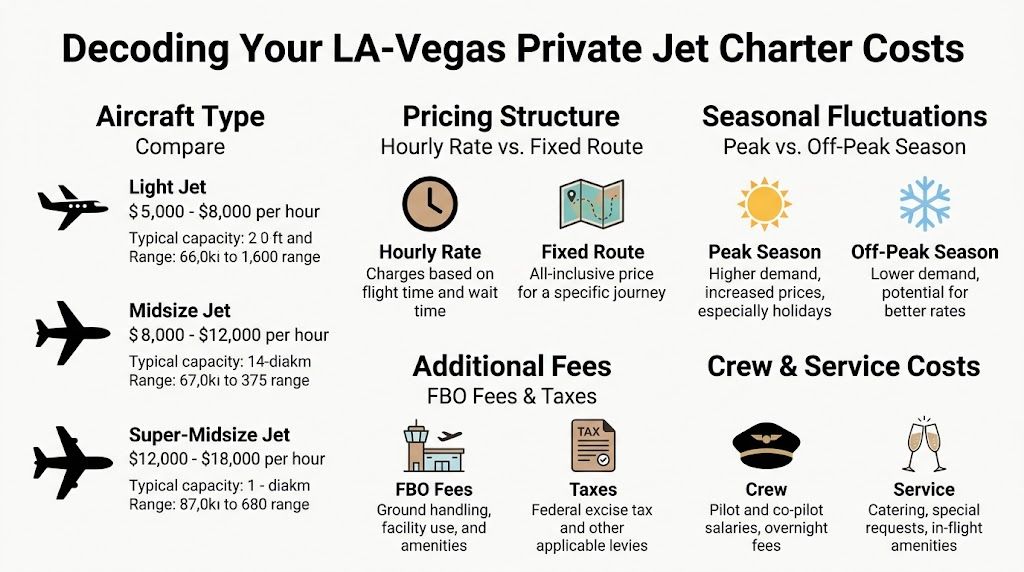
What each charter tier really buys you
The mistake I see most often is treating price brackets like luxury rankings. They’re operational tools first.
Executive turboprop
Best when you want practical value on a short sector. Aircraft like a Pilatus PC-12 or King Air 350 make sense when the group wants efficiency and doesn’t need to pay for jet speed on a route this short.Light jet
This is the default choice for many clients because it feels like the classic private jet experience. Think Citation CJ3 or Hawker 400XP territory. It suits small groups that want speed, comfort, and a true jet cabin without stepping into larger-aircraft pricing.Midsize jet
A midsize cabin starts to matter when you want more room to work, more luggage flexibility, or a more substantial onboard feel for a client-facing trip.Heavy jet
Usually unnecessary for the route itself, but sometimes justified by passenger count, baggage needs, onward routing, or preference for a larger cabin environment.
Why the cheapest category isn’t always the lowest invoice
Category pricing gives you a starting point, not the final number. A route quote can still shift based on where the aircraft sits before pickup, how the operator prices the mission, and whether the charter is structured as a fixed route or an hourly-style build.
That’s why I tell first-time flyers to compare aircraft, not just categories. A Phenom, Citation, Hawker, or Challenger all carry different implications for cabin feel, baggage handling, and mission efficiency.
For clients who want a benchmark before requesting offers, Haute Jets keeps a private jet pricing overview that helps frame how aircraft class affects what you’re paying for.
A practical way to read a quote
Use this filter before you approve anything:
- Check the aircraft class against your actual group size.
- Ask whether the quote is tied to a local aircraft.
- Confirm the departure airport and FBO in writing.
- Review what’s included, especially service items and airport handling.
The right quote feels boring. It tells you exactly what aircraft you’re getting, where it’s coming from, and what the trip includes.
If any of that is fuzzy, the quote needs work.
Choosing the Right Aircraft for Your Trip
For this route, the main decision usually comes down to turboprop versus light jet. Both can work well. The better choice depends on whether you value lower operating cost or shaving a little time off an already short flight.

Monarch Air Group’s analysis of the 200-nautical-mile LA to Vegas route is useful here. It shows turboprops at $4,600 to $6,300 versus light jets at $6,000 to $8,100, with the light jet saving about 10 minutes. It also notes a meaningful fuel-burn difference, 50 to 60 gallons per hour for turboprops versus 150 to 180 gallons per hour for light jets, producing 22 to 30% operating cost savings that can be reflected in the charter price.
When a turboprop is the smarter call
A turboprop is often the disciplined choice, especially for clients who care more about mission fit than image.
Choose one when:
- Your trip is short and direct: This route doesn’t force a turboprop into an awkward use case.
- Your group wants value: You’re getting strong utility without paying for speed you may barely notice.
- Baggage matters: The mission can favor aircraft with practical payload and cabin access.
- You’re optimizing cost across multiple trips: Frequent short-haul travelers tend to appreciate this category quickly.
What doesn’t work is rejecting turboprops automatically because the word sounds less premium. On this route, that assumption often costs money without improving the day much.
When a light jet is worth it
A light jet earns its keep when the perception and pace matter enough to justify the premium.
You may want one if:
| Priority | Better fit |
|---|---|
| Lowest charter cost | Turboprop |
| Faster flight time | Light jet |
| Traditional “jet” experience | Light jet |
| Strong economics for a short hop | Turboprop |
The difference isn’t only cost. It’s expectation. Some clients want the cabin feel and branding of a true light jet, especially for executive travel or guest-facing trips. That’s reasonable. The point is to choose it intentionally.
If your priority is “get me there cleanly and sensibly,” turboprops deserve serious consideration on this route.
For a broader framework on aircraft selection for these missions, this short-haul private flight aircraft guide is a useful reference.
What I’d ask before recommending either one
I’d narrow the choice with four questions:
- Are you traveling solo, as a couple, or with a full group?
- Is luggage simple weekend baggage or bulkier event gear?
- Does anyone care strongly about cabin image?
- Are you optimizing one trip or building a repeat pattern?
Those answers usually make the aircraft decision obvious.
The Hidden Costs Most Brokers Will Not Mention
Most LA to Vegas charter guides stop at the published price range. That’s where the confusion starts.
The largest pricing trap on this route is often repositioning. That’s the cost of moving an aircraft into place before your trip begins, and on a short route it can distort the quote fast because the repositioning can be a meaningful share of the mission.
According to Sky Access on LA to Vegas repositioning fees, these fees can inflate charter costs by 20 to 40%. A light jet quoted at $5,000 to $7,500 can exceed $9,500 if the broker uses a non-local aircraft. The same source notes that local sourcing from airports such as Van Nuys (VNY) can eliminate those fees, which often aren’t disclosed clearly in the first quote.
How hidden repositioning shows up
You usually won’t see a line item labeled “you’re paying for our sourcing problem.” Instead, it appears in softer language or in the all-in number itself.
Watch for these signs:
- The aircraft location is unclear: If the broker won’t tell you where the plane is sitting now, ask again.
- The quote is category-based, not aircraft-specific: Vague categories make it easier to substitute a less efficient option.
- The number jumps during revision: The first quote looked attractive. The final paperwork doesn’t.
- You’re told availability is limited, but alternatives are broad: That often means they’re shopping distance, not suitability.
The right question to ask
Don’t ask only, “What’s the price?”
Ask this instead:
“Is this aircraft based locally for my departure, and does the quote include any repositioning into Van Nuys, Burbank, Henderson, or Harry Reid?”
That single question changes the conversation.
What works better than opaque brokerage quoting
A local sourcing model is the clean solution. If the advisor starts with aircraft already near your departure point, the economics usually improve and the quote becomes easier to audit. The route is busy enough that this approach isn’t theoretical. It’s operational discipline.
What doesn’t work is accepting a polished PDF without asking where the jet is coming from. On a long international trip, repositioning may be unavoidable. On private jet los angeles to las vegas, it’s often a sign that someone sourced lazily or priced opaquely.
Navigating Airports and FBOs in LA and Las Vegas
A client leaves Beverly Hills at 4:30 p.m. for a dinner on the Strip and assumes the jet is the only decision that matters. It is not. The wrong airport adds avoidable drive time, slower ramp access, and, in some cases, extra cost if the aircraft has to reposition to meet you.

On this route, airport selection affects both convenience and pricing. That matters more than many first-time flyers realize. A quote can look competitive until the departure point forces the operator to move the aircraft into position. On a short LA to Vegas leg, that inefficiency stands out quickly.
The Los Angeles side
Van Nuys (VNY) is still the default for many private flights because the airport is built for business aviation and supports a fast curb-to-cabin flow. If the aircraft is already based there, VNY often gives you the cleanest operational setup.
Burbank (BUR) can be the better choice for clients coming from Pasadena, Glendale, or the east side of the city. The same logic applies across the LA basin. The best departure airport is usually the one closest to your day, not the one with the strongest name recognition.
That choice has a cost angle. If you insist on one airport while the best aircraft is sitting at another, someone pays for that ferry segment. In many broker quotes, that cost is blended into the total.
The Las Vegas side
Harry Reid International (LAS) works well for most Strip arrivals because ground transfers are straightforward and private handling is established. Henderson (HND) often suits clients staying farther south, attending a golf weekend, or wanting a quieter arrival experience.
Neither airport is universally better. Hotel location, event timing, and your car service plan should decide it. A good charter advisor will ask those questions before presenting the final option set.
What the FBO changes
The FBO is your private terminal. It controls how quickly you get from the car to the aircraft and how discreet the arrival feels on the other end.
Expect:
- Private check-in
- A quiet lounge
- Direct ramp access
- Fast baggage handling
- Minimal contact with the commercial terminal flow
Good FBO coordination also reduces small but expensive errors. Wrong-side pickups, last-minute airport changes, and loose ramp timing create friction that clients feel immediately on a short-haul trip like this.
For more detail on the arrival side, see this Las Vegas FBO guide for private jet travelers.
The practical takeaway is simple. Choose the airport with the shortest real ground path and the strongest aircraft fit. On LA to Vegas, that usually protects both your time and your final charter cost.
The Haute Jets Booking Process from Start to Finish
A first-time client on this route usually asks one reasonable question. “Why did one quote jump by thousands after I approved the trip?” On LA to Vegas, the answer is often not the cabin, the catering, or the airport. It is aircraft positioning, and whether anyone addressed it before sending the quote.
A disciplined booking process catches that early. You give the mission details: departure area, preferred Vegas airport, passenger count, luggage, pets, and any cabin requirements such as Wi-Fi. The advisor’s job is to source aircraft that fit the trip and show you where the jet is coming from before you commit. If that part is vague, the price is not finished.
What to confirm before you approve
Ask for the specific aircraft. Category labels are not enough on a short-haul route where repositioning can swing the final number more than the flight time itself.
Confirm:
- Aircraft identity: make, model, year, and tail number if available
- Operator quality: Wyvern Wingman or ARGUS Gold/Platinum screening
- Positioning status: whether the aircraft is already local or needs a ferry leg
- Cabin details: Wi-Fi, pet policy, seating layout, and baggage fit
- Trip paperwork: manifest review, schedule, crew details, and final operating terms
That third point is the one many clients miss. A light jet based near Van Nuys and ending in Las Vegas can price very differently from the same model coming in empty from another market. If the advisor cannot explain the sourcing logic in plain terms, there is no way to judge the quote properly.
What makes the process efficient
Short-haul charter works best when the process stays flexible. Some card and membership programs have a place, but they can limit aircraft choice or hide how the trip was sourced. That matters on this corridor because the wrong sourcing decision can erase the convenience you thought you were buying.
Haute Jets handles this as on-demand charter rather than prepaid hours. That keeps the focus on exact-aircraft selection, local sourcing, and pre-flight confirmation instead of forcing the trip into a program structure. For LA to Vegas, that usually gives the client a cleaner comparison between a local option and one carrying unnecessary repositioning cost.
The final review before departure
Before wheels up, have these details in writing:
- The aircraft and operator name
- Departure time and FBO instructions
- Passenger manifest approval
- Any pet, catering, or ground transport requests
- Written confirmation of whether repositioning is included in the quoted total
If that last item is missing, ask before signing. On this route, that single question can save a meaningful amount and prevent the most common pricing surprise.
Your LA to Vegas Flight Your Way
The private jet los angeles to las vegas route is easy to overcomplicate and just as easy to overpay for.
The smart play is straightforward. Choose the aircraft for the mission, not for the label. Use the airport that fits your day. Demand clarity on whether the jet is already local. And don’t confuse a polished quote with a transparent one.
A short flight like this should feel efficient from the first call to touchdown. That only happens when the operator or advisor can tell you exactly what you’re getting, where the aircraft is coming from, and why that choice makes sense for your trip.
If it’s your first time chartering this route, don’t chase the widest range or the flashiest aircraft description. Chase alignment. The best LA to Vegas charter is the one that fits your passenger count, your schedule, your luggage, your ground plan, and your tolerance for paying for someone else’s repositioning problem.
When those pieces line up, private charter on this corridor delivers what it should. A fast departure, a controlled environment, and a trip built around your schedule instead of the airline’s.
If you want a no-obligation quote for your next Haute Jets flight, ask for the exact aircraft, the departure FBO, and whether the jet is locally based. That’s the fastest way to compare real value instead of headline pricing.