
You've signed the purchase agreement. The aircraft is yours. For a brief moment, ownership feels simple.
Then the actual work starts. Who hires the pilots? Who verifies maintenance tracking? Who handles permits for an international trip, hangar arrangements, insurance coordination, invoicing, compliance paperwork, and a late-night parts issue that can ground the aircraft before your Monday meeting?
That's where most owners get blindsided. They think they bought convenience. What they bought is a regulated flight operation attached to a valuable asset that can become expensive, unavailable, and badly managed if the wrong people are running it.
A good private jet manager protects your time, your aircraft, and your money. A bad one hides margin inside vendor bills, buries weak operational discipline behind polished reporting, and turns “full service” into a vague excuse for poor transparency. If you're serious about ownership, you need more than management. You need control.
This Haute Jets Journal guide is built around the question most articles avoid: how do you hire a private jet manager without getting overcharged?
The Reality of Private Jet Ownership
The purchase is the easy part.
An owner buys a jet expecting freedom. The first few flights are exactly that. No TSA lines, no missed connections, no wasted time in terminals. Then the first real disruption arrives. A crew scheduling issue collides with a maintenance requirement. A permit takes longer than expected. A billing statement lands with charges that make little sense. Suddenly the aircraft feels less like a luxury and more like a company that needs a chief executive.
That chief executive is your private jet manager.
If you're still evaluating the ownership route, this aircraft buying overview from Haute Jets Journal is worth reading before you commit. Most owners underestimate how quickly fixed ownership turns into a daily operating responsibility.
Ownership creates a second business
A private aircraft isn't a passive asset. It needs crew oversight, maintenance planning, regulatory compliance, insurance administration, trip support, catering coordination, data security, and financial supervision. Someone has to own those decisions every day, not just when you're traveling.
That's why I tell clients to stop thinking of management as an add-on. It's the operating system for the aircraft.
Practical rule: If your manager can't explain where every dollar goes and who is accountable for every operational decision, you don't have management. You have exposure.
The financial side is getting more complex too. Some owners are exploring alternative payment rails and treasury structures around aviation spending, especially in cross-border environments. If that's relevant to you, Understanding decentralized finance for aviation offers a useful perspective on how newer financial systems intersect with aviation operations.
Glamour fades. Systems matter.
The aircraft might be immaculate. The cabin might be perfect. None of that matters if the operation behind it is sloppy.
Owners usually feel the pain in three places first:
- Availability problems: The aircraft isn't ready when they need it.
- Billing confusion: Charges appear with little backup and even less clarity.
- Communication gaps: Nobody gives a straight answer when something goes wrong.
A disciplined private jet manager solves those issues before they reach you. That's the standard. Anything less is expensive theater.
What a Private Jet Manager Actually Does
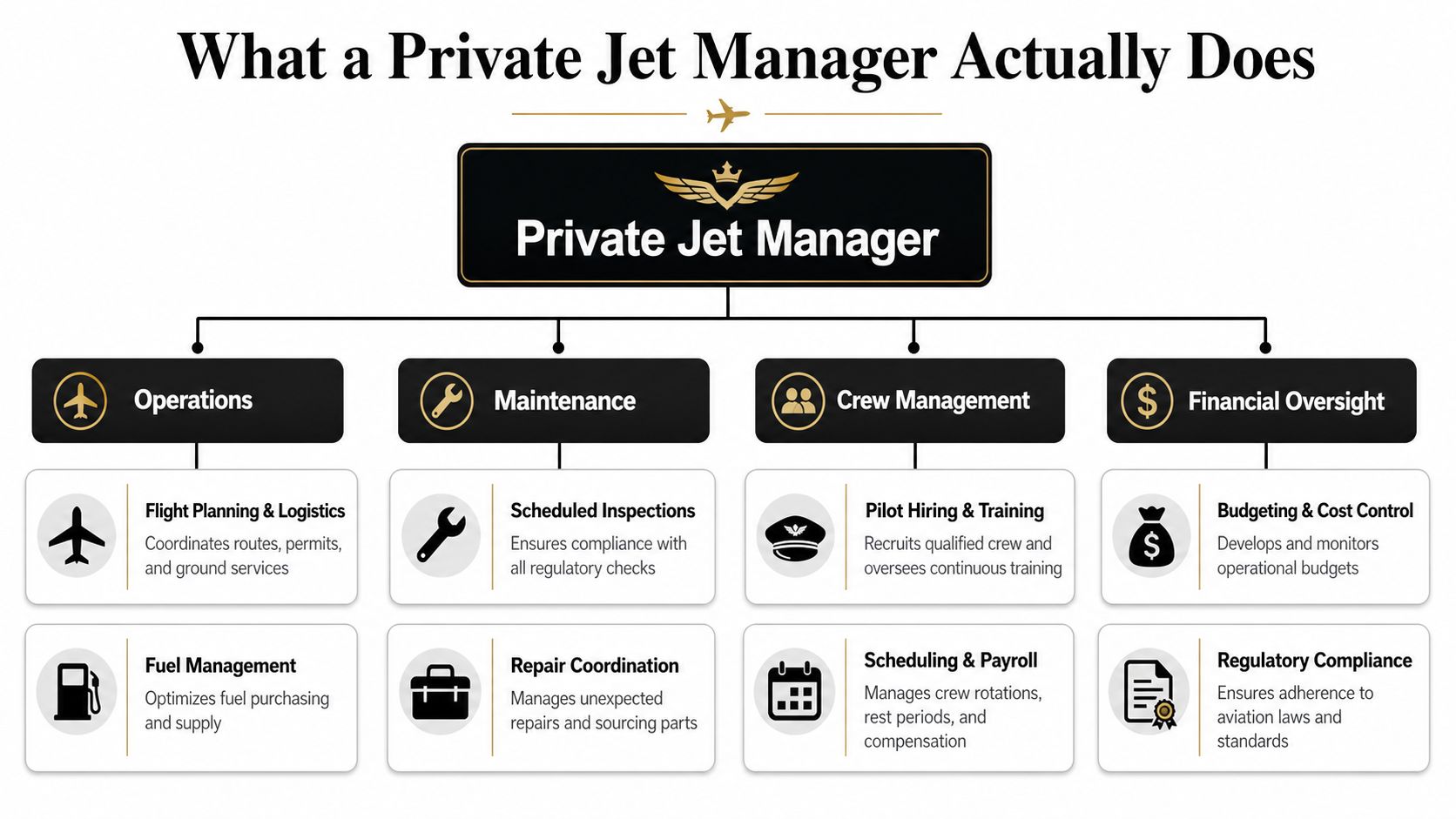
It is often thought that a private jet manager hires pilots and books maintenance. That's only part of the job. A strong manager runs four disciplines at once: operations, maintenance, crew, and financial oversight tied to compliance.
The best way to evaluate the role is to look at the structure behind it.
Operations that protect your schedule
Trip execution is where weak managers get exposed. They're responsible for flight planning, route review, weather monitoring, permits, airport slots, handling arrangements, fuel planning, and ground transport coordination. If any of that is late or sloppy, your itinerary suffers.
Owners love the word “concierge,” but in aviation it only matters if it's backed by process. For a useful consumer-level comparison of what concierge service means in practice, Uptown Rent A Car explains concierge in a way that helps separate hospitality language from real execution.
A serious manager doesn't just react to trips. They build repeatable operating routines that reduce friction before departure day.
Maintenance that preserves value
Money is won or lost here.
A capable manager tracks inspections, maintenance intervals, parts planning, vendor coordination, and repair events without waiting for the aircraft to become unavailable. If you want a grounding in the maintenance side of the business, this MRO explanation from Haute Jets Journal is a solid reference.
One benchmark matters more than most owners realize. High-performance management programs target a Technical Dispatch Reliability rate exceeding 98%. That metric represents the share of scheduled departures completed without mechanical delays and reflects how well a manager limits Aircraft-On-Ground hours through predictive maintenance, according to Robert Wilkos on fleet optimization.
If a management company never mentions dispatch reliability, ask why. They may be tracking appearances instead of performance.
Crew management that goes beyond hiring
Pilots aren't interchangeable. Neither are cabin crew.
Your manager should recruit for aircraft-specific competence, schedule legal rest, oversee training, manage payroll, handle travel logistics, and maintain professional standards around discretion and client service. The right crew culture lowers risk and improves the ownership experience. The wrong one creates turnover, inconsistency, and operational surprises.
Look for managers who can explain how they handle:
- Crew continuity: You want familiarity without overdependence on one person.
- Training discipline: Recurrent training should be treated as operating infrastructure.
- Standards enforcement: Service style matters, but judgment matters more.
Financial oversight and compliance
This part gets ignored until there's a problem.
A private jet manager should control budgeting, invoice review, insurance coordination, records retention, tax-related operating documentation, and regulatory compliance across jurisdictions. If they can't produce clean owner reporting and defend every line item, they're not managing. They're forwarding bills.
The best managers also know when to say no. A manager who protects the owner will push back on risky trips, weak vendors, and shortcuts that compromise compliance.
Decoding Private Jet Management Pricing Models
Most owners ask one question first: what's the monthly management fee?
That's the wrong opening question. The right one is this: where does the management company make its money beyond the stated fee?
A low headline fee often hides expensive billing practices elsewhere. That's why plenty of owners think they negotiated well when they ended up agreeing to a contract that gives the manager multiple ways to add margin after signing.
The common models
Most pricing structures fall into a few buckets:
| Model | How it works | What to watch |
|---|---|---|
| Flat monthly fee | Predictable base charge for oversight | Scope exclusions buried in the agreement |
| Hourly or activity-based billing | Charges tied to trip volume or services used | Incentives can drift toward more billable events |
| Blended model | Lower base fee plus variable charges | Harder to compare across firms |
| Charter-offset model | Management cost partially offset by charter activity | Conflicts can emerge if charter priorities outrank owner availability |
None of these models is automatically bad. The danger is opacity.
The markup problem owners miss
The industry loves the phrase “pass-through costs.” In many contracts, that phrase doesn't mean what owners think it means.
A critical but often overlooked issue is the hidden 5% to 12% surcharge management companies apply to third-party services like fuel and maintenance. Without a 'right to audit' clause in the contract, owners cannot verify net-net pricing, potentially inflating annual operating costs by tens of thousands of dollars, according to FlyEliteJets on family office jet management.
That single issue changes the economics of ownership more than most advertised management fees do.
My view: If a manager resists invoice-level transparency, assume the spread is meaningful.
What to demand in the contract
You don't need a friendlier fee schedule. You need sharper contract language.
Ask for these protections in writing:
- Right to audit: You should be able to inspect original third-party invoices.
- Line-item billing: Fuel, maintenance, catering, ground transport, and handling should be separately shown.
- Original vendor backup: Don't accept only summarized internal statements.
- Markup disclosure: Any surcharge should be explicitly stated, not implied.
- Approval thresholds: Major non-routine expenses should require owner approval.
A transparent manager won't struggle with these requests. A defensive one just told you something useful.
Ignore the pitch. Follow the billing trail.
Some firms sell “white glove” management while treating the aircraft as a profit center from every direction. Monthly fee. Vendor spread. Charter revenue. Administrative add-ons. Internal purchasing margin.
That doesn't mean third-party management is flawed. It means you need to inspect the incentives before you sign.
Choosing Between an In-House Team and a Third-Party Firm
This decision is more strategic than operational. You're choosing how much control you want to keep and how much infrastructure you want to build.
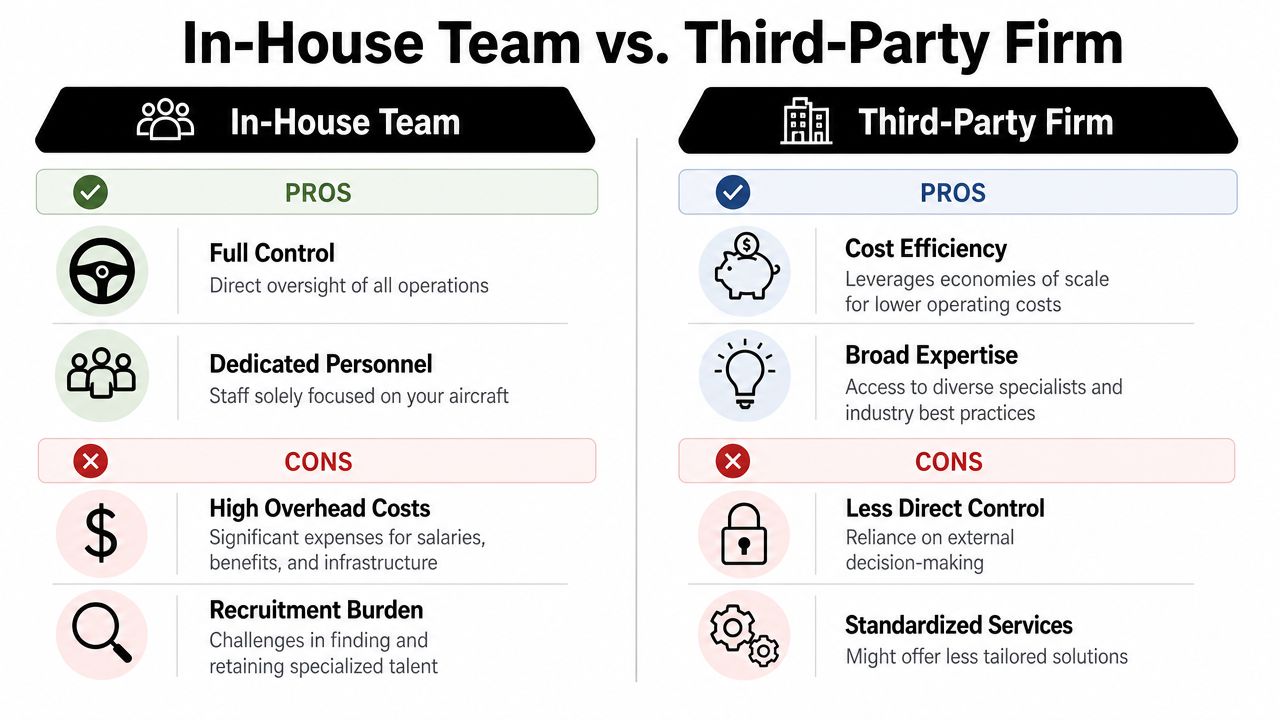
An in-house flight department gives you direct authority. A third-party firm gives you existing systems, vendor relationships, and staffing depth. Neither is automatically superior. The right answer depends on how you use the aircraft and how involved you want to be.
Where an in-house team wins
If privacy, direct command, and a highly customized operating culture matter most, an internal team has real advantages. The crew works only for you. Reporting lines are simple. Standards can be highly personalized.
That setup often suits owners with unusual travel patterns, highly sensitive itineraries, or a strong desire to control every operational decision.
Advantages of in-house management
- Direct oversight: You control people, process, and priorities without an intermediary.
- Dedicated focus: Staff attention isn't divided across multiple client aircraft.
- Custom culture: Service expectations can be built around your family or company.
Drawbacks of in-house management
- Administrative burden: Hiring, payroll, benefits, scheduling, and HR issues land on your side.
- Narrow bench: When one key employee leaves, the disruption is immediate.
- Infrastructure demands: You still need maintenance planning, compliance oversight, and vendor supervision.
Where a third-party firm wins
A competent outside firm can bring structure faster than most owners can build it themselves. They usually have established dispatch systems, maintenance contacts, crew recruiting pipelines, and operational processes already in place.
If you want support without creating a mini aviation company under your family office or corporate structure, this route is often cleaner. It also fits owners who don't want to manage specialists.
If you're still deciding whether ownership itself makes sense, this charter-versus-ownership perspective from Haute Jets Journal is helpful because it frames the question before you build any management structure at all.
The trade-off you can't ignore
Third-party management creates an agency problem. The company may also manage charter activity, control vendor relationships, and influence expense flows. If incentives aren't aligned, your aircraft can become one asset among many rather than the mission-critical tool you expect it to be.
A practical comparison looks like this:
| Priority | In-house team | Third-party firm |
|---|---|---|
| Control | Highest | Shared |
| Privacy | Strong | Depends on firm discipline |
| Operational depth | Limited to team hired | Broader bench of specialists |
| Owner workload | Higher | Lower |
| Transparency risk | Easier to inspect internally | Depends heavily on contract and reporting |
Pick in-house if control is your top priority and you're willing to fund the structure. Pick third-party if you want scale and support, but only with strict reporting and audit rights.
How to Hire the Right Aircraft Management Partner
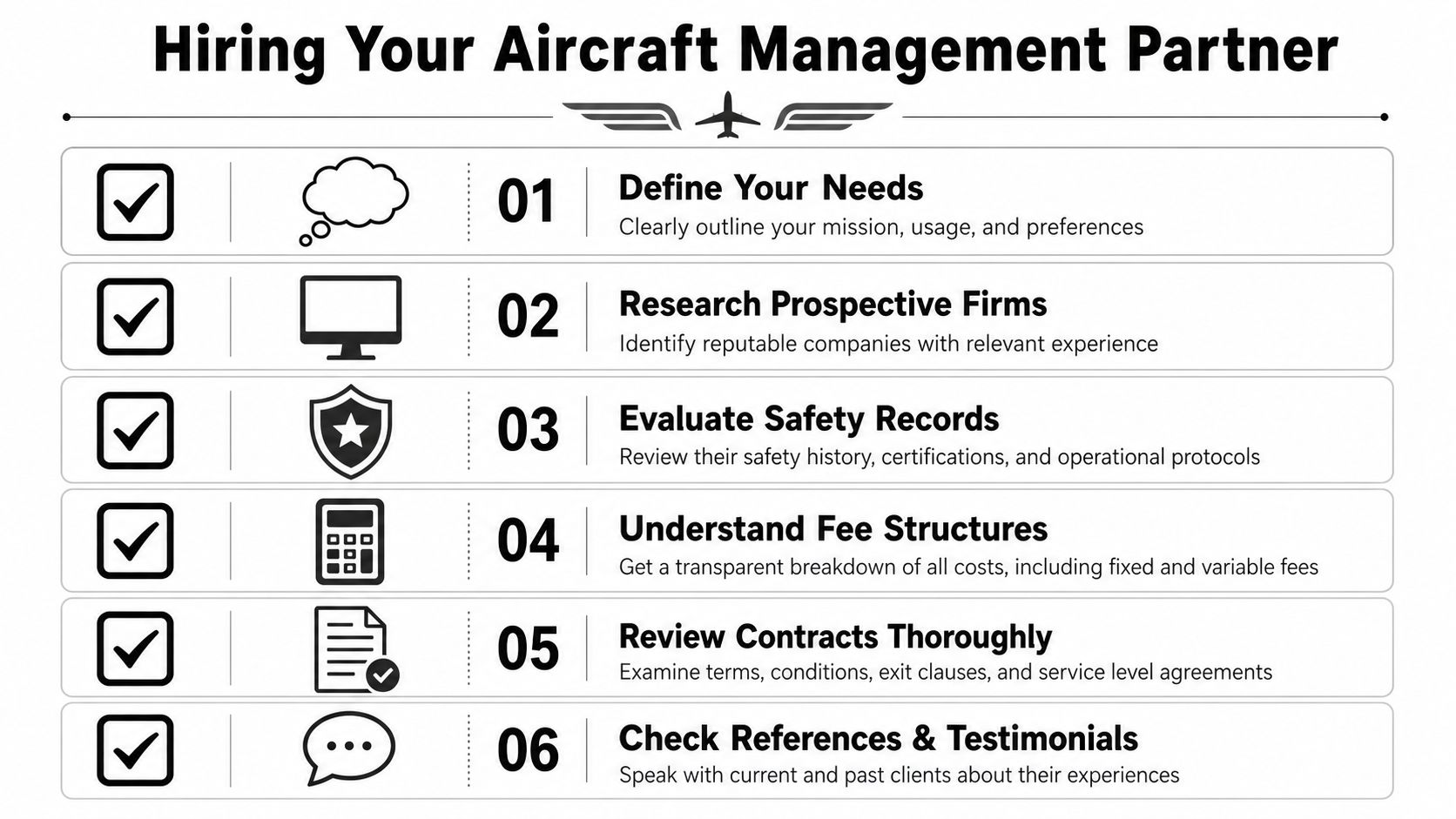
Hiring a private jet manager isn't a beauty contest. It's due diligence on an operator that will touch safety, scheduling, maintenance decisions, and large cash flows tied to your aircraft.
Most owners ask soft questions and get polished answers. Ask harder questions.
The interview script I'd use
Start with operational specificity. Don't ask if they're experienced. Ask how they run your aircraft type, how they handle unscheduled maintenance, and who approves out-of-scope expenses.
Then move into records. You want sample owner statements, invoice formats, and reporting examples before you ever discuss culture fit.
Ask these directly:
- Show me a sample monthly owner report. If it's cluttered, vague, or overly summarized, expect future billing frustration.
- How do you handle third-party vendor billing? Listen for whether they volunteer original invoices and markup disclosure.
- Who manages maintenance planning for my aircraft type? Type-specific experience matters.
- How do you measure dispatch performance and downtime? Serious operators know their numbers even if they present them qualitatively in conversation.
- What does your client communication look like during disruptions? You want names, roles, and escalation steps.
- What happens if I want to terminate the agreement? Exit clauses reveal how confident they are in the relationship.
A useful way to pressure-test the firm is to see how they respond when you interrupt their pitch and narrow the issue to accountability.
“Who, specifically, is responsible when the aircraft is unavailable for a planned departure?”
That question forces clarity.
Check references the right way
Don't ask for generic testimonials. Ask for current clients with a similar aircraft category and usage pattern. Then ask those references what went wrong in the last year and how the manager handled it.
That's far more useful than hearing that the team is “great to work with.”
Place the video below after you've built your shortlist and want broader context on the ownership and operational mindset behind aircraft decisions.
What strong candidates do differently
The best firms don't hide behind jargon. They answer quickly, document cleanly, and speak plainly about limits, cost controls, and safety procedures. They also don't act insulted when you ask about audit rights or contract termination.
Use this final screen before making a decision:
- Clear statements: You can understand the financial reporting without translation.
- Defined responsibilities: Named people own maintenance, operations, and owner communication.
- Contract clarity: Billing, markups, charter usage, and termination rights are spelled out.
- Reference quality: Current clients confirm competence during difficult moments, not just routine trips.
If a firm sells comfort before competence, keep looking.
Essential Safety and Regulatory Oversight
Safety isn't the polished section of the pitch deck. It's the reason the entire operation exists.
Any private jet manager you hire should be able to show disciplined safety infrastructure, not just talk about a “commitment to excellence.” That phrase means nothing without systems behind it.
The minimum standard
A serious operation needs a formal Safety Management System, or SMS. A core requirement for certified jet managers is a formal Safety Management System that adheres to ICAO mandates for hazard handling. This system is foundational to maintaining the Wyvern Wingman or Argus Gold/Platinum safety ratings required by top-tier operator networks, which also mandate rigorous cybersecurity and firewall protection for onboard systems, according to Jettly's jet management checklist.
That matters because safety failures rarely start as dramatic events. They usually start as process drift. Incomplete reporting. Weak follow-up. Poor hazard tracking. Informal workarounds.
What owners should insist on
If a manager can't discuss these topics with confidence, move on.
- SMS discipline: Hazard reporting, risk review, and documented corrective actions should be routine.
- Third-party audit standing: Wyvern Wingman or Argus Gold/Platinum should be treated as the floor, not the ceiling.
- Cybersecurity controls: Onboard systems should be segmented and protected, not loosely connected for convenience.
- Risk documentation: The operator should maintain a usable safety record, not a binder that collects dust.
Safety credibility comes from paperwork, training records, audit standing, and decision discipline. Not branding.
Don't outsource judgment
Owners sometimes assume the manager has “handled safety,” so they stop asking questions. That's a mistake. Delegation isn't abdication.
Your role is to verify that the structure exists, the standards are active, and the manager welcomes scrutiny. A private jet manager who gets impatient with safety questions is telling you they prefer trust over verification. In aviation, that's backward.
Evaluating Alternatives to Full-Time Jet Management
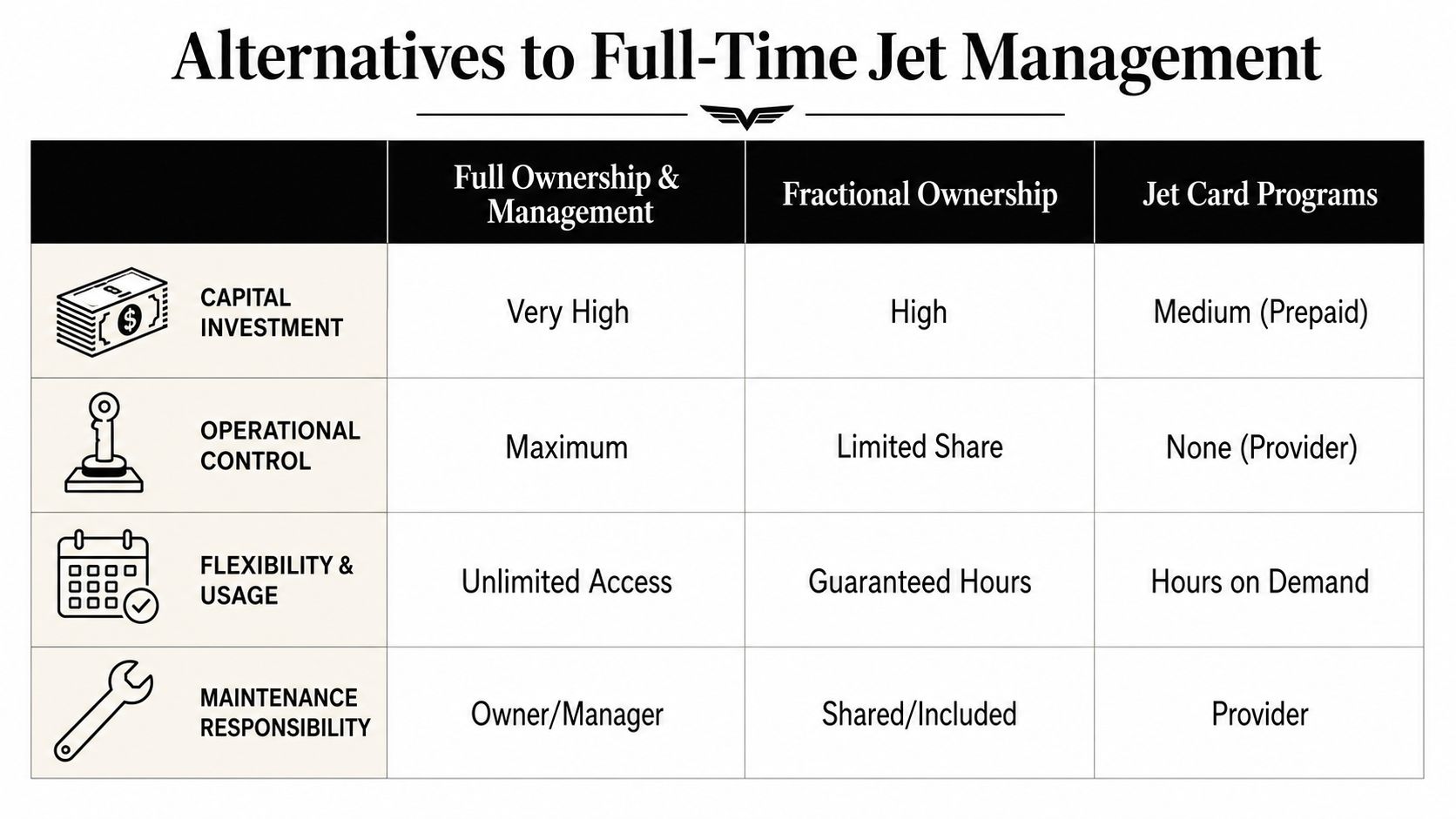
Full ownership with a dedicated private jet manager is only one point on the private aviation spectrum. It's the highest-control option, but it's also the most operationally demanding.
For some clients, that trade-off makes sense. For many, it doesn't.
The alternatives in plain terms
Fractional ownership reduces some burden, but it limits control and often standardizes the experience. Jet cards simplify access, but you're still buying into a provider's structure, availability rules, and pricing logic.
On-demand charter is different. You don't own the asset, you don't carry the management overhead, and you're not locked into one aircraft type for every mission.
Why more clients are moving toward flexibility
The broader market is already shifting in that direction. The global private jet market is shifting, with projections showing a sharp acceleration in on-demand charter services. This growth is driven by clients moving away from fractional and jet card models in favor of pay-per-flight options that eliminate the 20-40% premium caused by repositioning fees, according to Prive Jets on private jet market growth.
That trend makes sense. If your travel pattern changes, ownership can become an expensive commitment to capacity you don't fully use. On-demand charter lets you match the aircraft to the mission instead of forcing every mission to fit the aircraft you own.
A cleaner decision framework
Use this simple lens:
- Choose full ownership and management if control, brand consistency, and permanent availability outweigh cost and complexity.
- Choose fractional if you want some predictability without taking on full ownership responsibility.
- Choose a jet card if prepaid convenience matters more than aircraft-specific flexibility.
- Choose on-demand charter if you want optionality, transparent trip-by-trip buying, and no long-term operating burden.
A lot of owners don't need a better private jet manager. They need to admit they may not need one at all.
If you want the flexibility of private aviation without ownership overhead, Haute Jets offers on-demand access to 3,500+ aircraft across 175 countries, sourced exclusively from operators holding Wyvern Wingman or Argus Gold/Platinum ratings, with no memberships or jet cards required. It's a practical option for travelers who want transparent, pay-per-flight access to the exact aircraft they choose.