
You've just stepped onto a light jet after a busy morning, expecting a proper meal because the flight is private. Instead, there's a paper bag, a sandwich, and bottled water. Your dietary request never reached the caterer. This isn't a rare luxury-travel misunderstanding. It's what happens when passengers treat private jet meals as an automatic amenity instead of a coordinated ground operation.
The operator, broker, FBO, caterer, crew, aircraft galley, and service timing all have to line up. Once you understand that chain, you can order food that arrives safely, fits the aircraft, suits the itinerary, and matches what you want to pay for.
What Counts as a Private Jet Meal
A private jet meal can mean several different things. On one flight, it's a chilled sandwich and fruit placed in the galley. On another, it's a cold-plated spread from a trusted restaurant. On a larger aircraft, it may be a reheated entrée, plated onboard by the cabin crew. The word catering covers all three, which is why passengers should ask what the quote includes rather than assume it means restaurant-style dining.
The first tier is standard onboard provisioning. This usually means bottled water, soft drinks, coffee, and a light snack assortment. On many Part 135 charters, basic catering is included in the charter price, but that baseline is limited. The Jet Finder describes basic Part 135 catering as commonly covering beverages and snacks, with an estimated value of about $15 to $30 per passenger. A specific meal still needs to be requested, priced, and confirmed.
The three practical service levels
Galley provisioning is the simplest output. Crew members load packaged snacks, drinks, sandwiches, or a basic fruit plate into the aircraft's storage area. Nothing about that automatically guarantees a plated meal, a hot entrée, or a particular brand.
Cold-plated catering arrives ready to serve. Think salads, sushi, charcuterie, sandwiches, mezze, breakfast items, or a composed entrée that doesn't require reheating. It's often the most reliable choice on a light jet because it avoids oven capacity, extra handling, and complicated service.
Hot-plated service involves prepared food that the crew reheats and plates onboard. The aircraft may have a convection oven, but the galley remains compact and service conditions can change. A dish that looks impressive on a restaurant menu may be a poor aviation choice if it dries out or depends on delicate last-minute preparation.
Broker's rule: If your quote says “catering available,” ask whether that means snacks, a cold meal, or a separately priced hot menu.
The physical location matters too. Food is generally prepared off-aircraft, delivered through the FBO, and loaded shortly before departure. The galley may hold sealed containers, chilled platters, drinks, and service equipment, while the passenger sees only the final tray or shared board.
Before booking, clarify the aircraft category, meal style, number of passengers, dietary requirements, and service point. Haute Jets' guide to what food and drink are available on a private jet is a useful starting point, but the operator still needs a written order for anything beyond the standard stock.
What's Usually Included at No Extra Cost
The practical starting point on a typical Part 135 charter is modest. Bottled water, soft drinks, coffee, tea, juice, and a light snack basket are commonly bundled into the flight. Pretzels, granola bars, chips, nuts, packaged sweets, and a basic fruit plate usually fall into that category, especially when the crew picks them up during the pre-flight FBO stop.
That baseline exists because the operator can stock it without coordinating a specialist kitchen, custom ingredients, complex labeling, or a precise service plan. It's easy to load, easy to store, and suitable for passengers who want something small rather than a full meal.
What changes the quote
The moment you request a composed menu, specialty brand, premium alcohol, or hot service, the operator usually moves the request onto a separate catering line. In the United States, private-flight catering pricing can start at about $230 and reach $2,000 per leg, depending on the request and cabin size. That range reflects a customized add-on, not a universal meal tariff.
The following figures are useful budgeting benchmarks for bespoke requests, but they aren't a promise from every operator or FBO:
| Item | Bundled at No Cost | Typical Add-On Cost |
|---|---|---|
| Bottled water, soft drinks, coffee, tea, and juice | Usually included | No separate charge |
| Packaged snacks and modest fruit | Usually included | No separate charge |
| Cold-plated catering | Usually not included | $45 to $150 per person |
| Hot multi-course service | Usually not included | $150 to $400 per person |
| Premium champagne or spirits | Usually not included | $75 to $500 per bottle |
The $45 to $150 cold-plated and $150 to $400 hot-service ranges are planning estimates for the kind of upgraded menus passengers commonly ask brokers to arrange. Because the verified industry pricing range is charged per leg and can reach much higher levels for demanding requests, you should treat these figures as a starting point, not a guaranteed retail schedule.
What to confirm before approving
Ask for three separate answers:
- Included stock: Which drinks and snacks are already on the aircraft?
- Meal scope: Is the quoted meal cold, hot, plated, boxed, or shared?
- Alcohol detail: Does the price cover the bottle, delivery, handling, and service?
A champagne request can also fail for a simple reason. The aircraft may have no suitable glassware, the FBO may need to source the bottle, or the passenger may have asked for a label that isn't locally available. Get the exact product and total catering charge in writing.
How Pricing Works Across Markets
A meal quote can look reasonable until you ask what the operator has priced. United States operators generally itemize catering, while European operators more often include it in the charter price, as noted earlier. The same meal can therefore produce two different-looking proposals, even when the food and service are similar.
Treat catering as an operational workflow, not a menu. In the United States, the broker or operator commonly calculates the charge per passenger and per leg. The quote may combine the caterer's invoice, FBO delivery, handling, and any operator or broker markup in one line, or show them separately. A simple cold order on a short flight is easier to price than a larger-cabin request, an unusual departure airport, or catering arranged close to departure.
The operator also needs a delivery window at the FBO. If the caterer cannot load within that window, the team may need a different supplier, additional handling, or a revised menu. Those decisions affect the total before anyone steps aboard.
In Europe, catering is more likely to sit inside the charter rate, particularly on managed fleets. Some operators quote a flat fee for the leg instead. Fewer line items do not mean the meal costs nothing. The charge is embedded in the aircraft quotation, so ask the broker to state its scope.
| Pricing Factor | United States | Europe |
|---|---|---|
| Common presentation | Separate catering line | Often included in charter price |
| Typical billing logic | Per person, per leg | Charter-rate inclusion or flat leg fee |
| Cost visibility | More itemized | Often less visibly itemized |
| Main variables | Aircraft, FBO, menu, timing, handling | Fleet policy, route, operator, menu, handling |
| Best comparison method | Request the full per-leg total | Request the charter rate with catering scope stated |
A transatlantic itinerary can show different catering totals by direction. A New York to London leg booked through a United States broker may list catering as an add-on, while a London-origin booking may include the meal within the charter quotation. Compare the food, delivery, service, and handling covered on each leg, not just the meal line.
Ask for apples-to-apples pricing: “Is catering included, and if so, what exactly is loaded for each passenger on each leg?”
Review aircraft cost and food cost separately in the charter estimate. Haute Jets' information on private jet charter cost can help frame the wider flight quotation. Your broker should still identify the catering model, delivery window, and total charge for every segment.
Requesting Dietary and Bespoke Menus
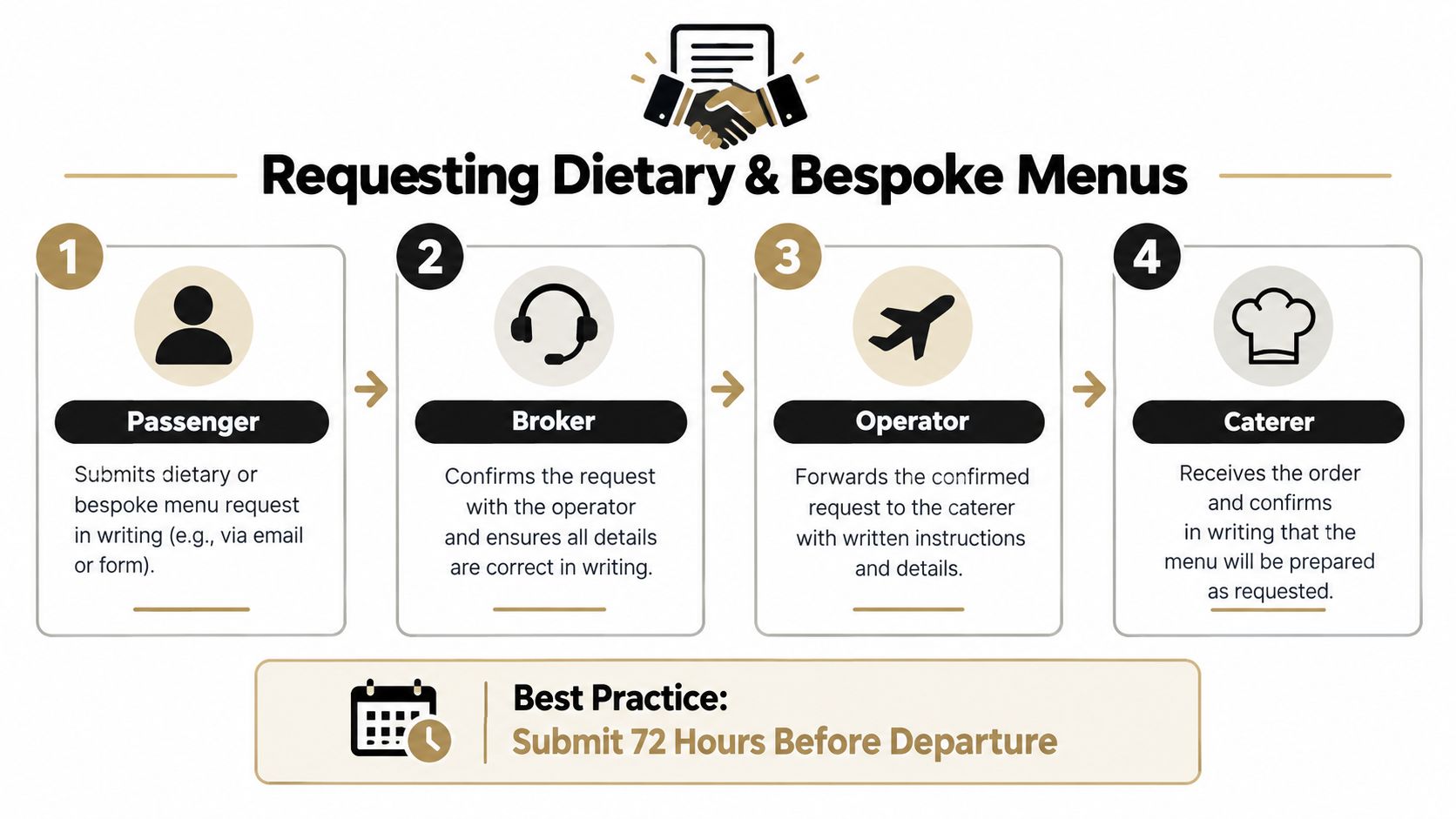
A dietary request is only useful when it survives the handoff from passenger to broker, broker to operator, and operator to caterer. Send the request in writing, name the passenger it applies to, and ask for written confirmation at every stage. A verbal note during a fast booking call is not a reliable control.
The safest industry workflow confirms dietary details 48 hours before departure, with ingredient lists and clear labeling for each item. Private aviation allergy guidance from Gate33 recommends confirming requirements in advance, requesting ingredient information, segregating utensils and storage for severe allergies, and rejecting any item with unclear labeling.
Put the request on the order
When you contact the broker, provide:
- Passenger identity: State exactly who needs the dietary accommodation.
- Restriction type: Separate preference, intolerance, allergy, religious requirement, and medically prescribed diet.
- Leg and timing: Identify the flight segment and whether service is needed before departure, during the flight, or on arrival.
- Portion count: Specify the number of meals, snacks, desserts, and beverages required for each passenger.
- Substitution rules: Say whether the caterer may replace unavailable ingredients or must seek approval first.
The supplied planning notes call for 72 hours for standard vegetarian, gluten-free, or kosher requests, and 96 hours for halal, vegan, low-FODMAP, or diabetic-controlled meals. Those lead times are sensible operational targets for sourcing and verification, but they don't replace the verified best-practice requirement to confirm dietary needs 48 hours before departure. For a severe allergy, submit the request as early as possible and require an explicit cross-contamination protocol.
Treat allergies as a zero-defect process
Recipe complexity isn't the main danger. Cross-contamination is. The caterer should trace allergens through supplier labels, preparation surfaces, storage, utensils, packaging, and loading. Severe-allergy meals should be segregated, clearly labeled, and rejected if the ingredient trail is incomplete.
Ask whether the operator can accept a sealed meal from the caterer and what liability language applies. The crew should receive a passenger-specific briefing before departure, including the identified allergen and the emergency protocol. This is one of the areas where experienced operators resist casual substitutions, because a last-minute ingredient change can invalidate the original safety check.
Bespoke dining follows a different commercial path. Tasting-style courses, a particular restaurant, sommelier pairings, custom plating, and rare ingredients are separate line items, not standard catering. Haute Jets' private jet catering options can help you frame the request, but insist on a final menu approval rather than accepting “chef's choice.”
Timing and Onboard Service Logistics
The meal doesn't appear when the passenger asks for it. It moves through a timed chain that starts on the ground. Catering is typically arranged through the FBO, and one private aviation catering workflow describes delivery to the private terminal about 90 minutes before takeoff. The food is often prepared off-aircraft, brought to the FBO, checked, and loaded before boarding is complete. Magellan Jets' private jet catering overview explains this ground-side handoff and why delivery timing matters.
That window gives the crew time to verify the order, inspect labels, place chilled items into appropriate storage, and coordinate loading with the aircraft's departure preparation. It also leaves little room for an unplanned menu change. A passenger who changes the order after arriving at the FBO may be asking the caterer to source, prepare, label, and deliver food before the aircraft can depart.
Temperature control is the non-negotiable step
Private jet meals require strict time-temperature control. Aviation catering sources place the food safety danger zone at roughly 40°F to 140°F, or 5°C to 60°C, with cold food held at or below about 40°F to 41°F and hot food held at 135°F to 140°F or higher. Corporate Jet Investor's aviation catering guidance also describes receiving food cold or hot, checking its temperature, separating raw and ready-to-eat items, and reheating cooked food to at least 165°F, or 75°C, before service.
A practical onboard sequence looks like this:
- Receive and verify: Check delivery condition, labels, and temperature immediately.
- Store correctly: Refrigerate cold food or hot-hold hot food without leaving it staged.
- Separate items: Keep raw, cooked, ready-to-eat, and allergy-sensitive items apart.
- Finish carefully: Reheat only what needs reheating, then plate close to service.
- Discard unsafe food: If food has remained in the danger zone too long, don't serve it.
The main risk is time spent unrefrigerated during uplift and handling. One aviation expert warns that bacterial risk can become significant after food remains in that range for about 90 minutes. Another aviation catering source states that food entering the danger zone should be consumed within four hours or discarded once it cools to 70°F. These thresholds make delivery discipline more important than decorative presentation.
The video below adds useful context on how private aviation dining depends on coordination between the ground team, aircraft, and crew.
Wine creates another coordination issue. If you're choosing a premium bottle, how airlines pick first class wine offers helpful background on the sourcing and service factors that influence wine selection in aviation.
Cost Considerations and Personalization
Catering is a small part of the total charter on many trips, but it isn't insignificant. One 2025 market report estimates that private aviation catering can represent 4% to 8% of total charter flight costs, compared with 1% to 2% in commercial aviation, because private passengers request more customization and premium handling. The Intel Market Research report also describes private aviation catering as a substantial premium market, rather than a minor cabin amenity.
That share rises when you request a Michelin-trained kitchen, imported specialty ingredients, caviar service, single-estate chocolates, branded champagne, or a restaurant menu that needs careful transport. The smart approach is to itemize the upgrades. You may want the caviar but not the luxury dessert, or the premium wine but not hot multi-course service. A detailed quote lets you make that decision without rejecting the entire menu.
| Flight Profile | Typical Catering Share |
|---|---|
| Standard charter with bundled drinks and snacks | Usually at the lower end of the range |
| Charter with upgraded cold-plated meals | Within the broader 4% to 8% range |
| Charter with premium hot service and specialty sourcing | Can move toward or above the upper end |
| Highly bespoke multi-leg itinerary | Requires a route-specific quotation |
The United States normally treats pricing per leg, so a same-day return can create two separate catering requests. European operators more often quote a daily catering rate that may cover both legs, depending on the fleet and charter agreement. Never assume the outbound provisioning will remain fresh, available, or suitable for the return flight unless the operator confirms it.
Personalization should become a system
Repeat clients shouldn't have to rebuild the same meal request every time. Operators increasingly collect structured preference data covering allergies, religious requirements, favorite cuisines, portion sizes, wine choices, and plating preferences. Digital order tracking and automated confirmation are becoming expected parts of the workflow, particularly for corporate flight departments and frequent charter clients.
That profile doesn't eliminate approval. It creates a reliable starting point. The broker should still confirm the aircraft, route, passenger list, service timing, and any change in medical or dietary requirements before each flight. Mixed groups also need separate passenger records, not one vague note saying “special diets.”
The best private jet meals are not the result of a glamorous menu alone. They come from a clean chain of responsibility, precise timing, safe handling, and a quote that shows exactly what you're buying.
Haute Jets arranges customized private jet catering, including menus selected before departure and meals customized to dietary needs and passenger preferences. Visit Haute Jets to discuss the aircraft, route, catering scope, and per-leg meal requirements before you book.