

You're probably doing this trip for one of two reasons. You either want to leave Miami in full control of your day and land in Aspen without the usual holiday chaos, or you're trying to move family, partners, or clients in a way that feels effortless from curb to chalet.
That's exactly where most bookings go wrong.
The route looks simple on paper. It isn't. Aspen has real operating constraints, winter demand changes pricing fast, and a cheap-looking quote can get expensive once repositioning, aircraft mismatch, and short-notice scarcity show up. If you're booking a private jet Miami to Aspen, the goal isn't just getting airborne. The goal is choosing the right aircraft, from the right origin point, with a quote that won't unravel the day before departure.
The clients who handle this well usually ask the same practical questions. How long is the flight. What aircraft should I choose. How much should I expect to pay. How do I avoid paying for someone else's repositioning problem. And how do I arrive into Aspen without terminal friction, baggage issues, or airport surprises.
From Oceanfront to Mountainside The Ultimate Charter Guide
A Miami to Aspen trip often starts with a familiar pattern. You've finished breakfast in Coconut Grove, Surfside, or on the water in Miami Beach. By afternoon, you want to be on the ground near your house, hotel, or club in Aspen, with ski gear accounted for and no wasted time in a crowded terminal.
That's a premium route for a reason. You're moving between two completely different lifestyles in a single day, from warm-weather ease to mountain precision. The problem is that many charter quotes treat this like any other domestic booking. It isn't.

I've seen travelers focus too heavily on cabin photos and hourly rates, then get blindsided by the issues that matter on this route. A light jet that looks efficient may not be the right nonstop answer. A large-cabin jet that feels expensive may end up being the cleanest operational choice. And the broker who sends the first quote isn't always sending the smartest one.
What matters most on this route
For this trip, I'd focus on four things first:
- Aircraft suitability: Aspen is not where you want to test the limits of range or performance margins.
- Real baggage fit: Ski equipment changes the conversation fast.
- Quote structure: Repositioning can subtly distort an otherwise fair deal.
- Ground flow: FBO timing, driver coordination, and local conditions matter more than people think.
If you want a broader primer on the booking side before narrowing in on this route, these Approved Lux private jet insights are a useful complement to the operator-level thinking that matters here.
A polished booking experience isn't the same thing as a well-built trip. The route, airport, aircraft, and timing have to line up.
Flight Dynamics Miami to Aspen Explained
You can leave a warm dock in Miami after breakfast and be on the ground in ski country by early afternoon. That part is straightforward. The part that costs clients time and money is choosing an aircraft that looks fine on paper but creates avoidable complications by the time Aspen enters the equation.
This route is long enough that aircraft selection drives the whole trip. Analysts at Monarch Air Group's Miami to Aspen route page place it at roughly 1,560 nautical miles with a typical private flight time in the 4 to 5 hour range. Treat that as your planning baseline, not your guarantee.
Why route length is only half the story
Miami to Aspen is not just a cross-country leg. It is a cross-country leg into a mountain airport with real operating constraints. A jet that can cover the mileage may still be the wrong tool if it leaves little margin for weather, payload, runway conditions, or schedule pressure.
That is where clients get burned on cost.
A lower hourly rate can turn into a worse booking if the aircraft needs awkward repositioning, cannot carry passengers and ski gear comfortably, or forces a fuel stop because the mission was priced too aggressively. If you want a smart shortlist before you quote, our guide to top private jets for ski trips is a useful filter.
Why smaller aircraft usually lose on this route
Light jets attract attention because the entry price looks better. I would not build this trip around that category. Even some midsize options can complete the route only under favorable assumptions, and Aspen is the wrong airport for optimistic assumptions.
The right question is not, "Can this aircraft make it?" The right question is, "Can it make it cleanly, with the people, bags, and timing I care about, without adding hidden operating costs later?"
That standard usually pushes the discussion up the market.
What changes your day-of timing
Three variables move this trip more than clients expect:
Your Miami departure airport
OPF, MIA, and TMB can each affect taxi time, routing, and how quickly your ground team gets you to the aircraft.Aircraft speed and operating margin
Faster aircraft can trim time, but the bigger advantage is flexibility. Margin matters more than raw speed on a route like this.Weather and Aspen arrival conditions
En route weather is only part of the story. Conditions around Aspen can influence how comfortably the trip operates, especially in peak winter periods.
Here is my advice. If your Aspen-side schedule matters, do not shop this route by hourly rate alone. Use an aircraft category with enough performance buffer to avoid preventable stops, payload compromises, and last-minute fee creep. That is how you protect both the itinerary and the invoice.
Recommended Aircraft for Your Travel Party and Gear
You feel the mistake on this route before the wheels leave Miami. The party is onboard, the ski bags are loaded, and the quote that looked cheap starts to show its real cost because the aircraft was a category too small, the baggage plan was too optimistic, or the operator built the trip around a repositioned jet that never fit the mission cleanly in the first place.
Choose the aircraft around payload, baggage shape, and Aspen operating margin. That is how you avoid last-minute stops, bag restrictions, and unnecessary ferry cost hiding inside an attractive quote.
A generic passenger count is not enough here. Six adults with compact luggage and no skis is one trip. Six adults, children, ski bags, boot bags, and a preference for a later departure out of Miami is a different trip entirely.
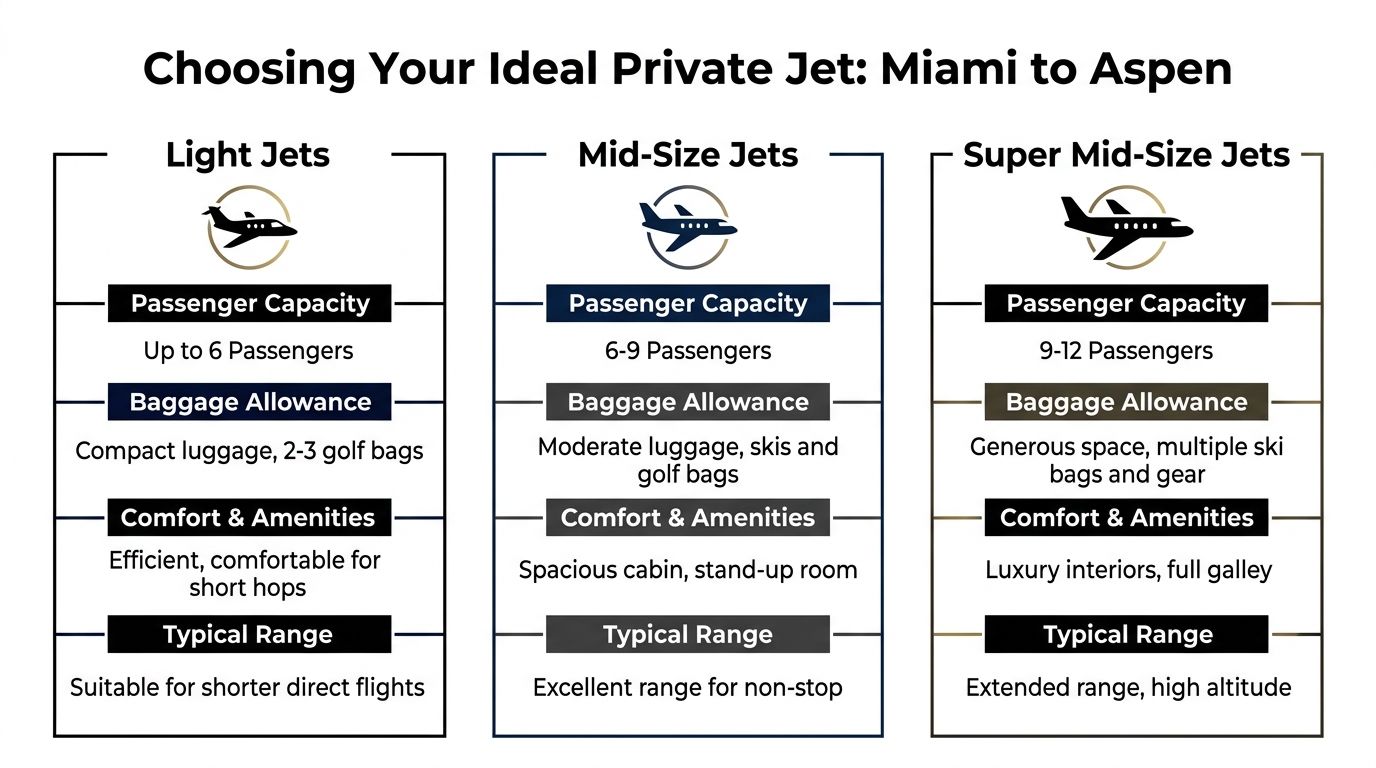
According to Paramount Business Jets' Miami to Aspen route overview, midsize jets can serve the route, while super midsize and large-cabin aircraft give you stronger nonstop capability and more operating margin. That matters at Aspen, where runway, elevation, and winter conditions punish thin planning.
My recommendation on the right category
For most Miami to Aspen bookings, super midsize is the smart buy. It usually gives you the best balance of cabin comfort, baggage practicality, and trip reliability without paying heavy-jet money unless you need the extra space.
Heavy jets earn their keep quickly in four situations:
- You have a larger group
- You have multiple ski bags, snowboard bags, or bulky winter luggage
- You want more margin built into the trip
- You would rather pay correctly upfront than deal with stop risk, payload trimming, or hidden repositioning expense later
Midsize jets still have a place. Use them for lighter passenger loads, lighter gear, and clients who understand the tradeoffs before they book.
Best fit by traveler type
Couple or solo principal
A midsize jet can be fine if you are packing light and the mission is simple. If you want more cabin comfort and less chance of baggage or performance compromises, book super midsize and move on.
Family with children and ski gear
Start at super midsize. Passenger count will mislead you here because ski equipment takes up awkward space and creates loading limits that a basic seat map does not show.
Executive team or multi-party trip
Book heavy. If the schedule matters, if everyone is carrying winter gear, or if the group expects to work comfortably in flight, heavy is the cleaner answer.
Miami to Aspen Aircraft Comparison
| Aircraft Category | Typical Passengers | Luggage Capacity (Skis/Boards) | Avg. Flight Time | Est. One-Way Cost (2026) |
|---|---|---|---|---|
| Midsize | 7 to 8 | Works for lighter ski loads, but plan carefully | About 4.5 hours | About $24,400 to $34,000 |
| Super midsize | 8 to 9 | Better for multiple ski bags and winter luggage | About 4 to 4.5 hours | About $32,000 to $39,900 |
| Heavy | 10 to 14 | Best fit for fuller gear loads and maximum comfort | About 4.2 hours | About $30,200 to $46,100 |
The pricing and category ranges above are compiled from earlier route references already cited in this article. Use them as planning ranges, not a buying decision by themselves.
The decision comes down to three things. How many people are going. What the baggage really looks like. Whether the aircraft is based close enough to your Miami departure point to avoid paying for empty repositioning time.
If you want a broader read on winter mission planning before you choose a category, Haute Jets' guide to top private jets for ski trips is useful.
Book for the trip you are actually flying, with the gear you are actually bringing, on an aircraft that starts close enough to avoid unnecessary ferry cost.
Decoding Charter Prices and Seasonal Demand
You get two quotes for the same Miami to Aspen trip. Same date. Similar aircraft. One looks like a deal, the other looks inflated. In most cases, the difference is not negotiation skill. It is aircraft position, peak-demand pressure, and whether the quote exposes the actual cost or hides it in the fine print.
Here is the pricing reality. Public route data for Miami to Aspen shows one-way charter pricing can vary widely, from the mid-$20,000s to well above $60,000 depending on aircraft type and trip setup, as shown in Linear Air's Miami to Aspen route pricing.

The biggest pricing trap on this route is repositioning. If the aircraft is not already near your Miami departure point, you may pay for the jet to fly empty before your trip even starts. That cost can make a cheap quote expensive very quickly.
Ask one question first. Where is the aircraft coming from?
If the answer is vague, keep looking. A polished quote means very little if part of your budget is covering deadhead time that should have been filtered out before options reached you.
Seasonality adds another layer. Aspen tightens up fast around holiday periods, winter weekends, and high-demand summer dates. Short-notice bookings during those windows usually cost more, and the best-positioned aircraft disappear first. Waiting does not create an advantage on this route. It usually removes options and forces compromises.
My advice is simple. Buy the cleanest itinerary, not the cheapest headline number.
That means confirming these points in writing:
- Aircraft base location. Local or nearby aircraft reduce the odds of paying unnecessary ferry cost.
- Exact tail and operator. Category-only quotes leave too much room for substitutions and surprises.
- All-in pricing. Get clarity on taxes, fees, overnight charges, deicing exposure, and any repositioning before you approve anything.
- Cancellation and recovery terms. Aspen weather can force changes. You want to know the cost of adapting before the day turns.
- Ground coordination on arrival. If you want the handoff handled properly, book an executive chauffeur for private aviation before your wheels are up.
If you want a sharper read on how to audit a quote, Haute Jets lays it out well in this guide to private jet charter pricing cost breakdown.
Empty legs can save money, but they are a secondary tactic. Use them when your schedule is flexible enough to absorb changes. If you need to hit Aspen at a specific hour, for a holiday arrival or a fixed event, book a properly positioned aircraft and treat any empty leg opportunity as a bonus.
The best Miami to Aspen booking is the one with honest pricing, minimal repositioning, and enough operational margin to handle Aspen without expensive last-minute fixes.
Navigating Aspen Airport and FBO Logistics
Aspen is where many otherwise polished itineraries get sloppy. The airport experience can still feel smooth, but only when the booking was built with Aspen's realities in mind from the start.

The airport environment is demanding. Mountain terrain, altitude, changing weather, and concentrated private traffic all affect how the day unfolds. If your advisor treats Aspen like any other ski-market arrival, expect friction.
What smart travelers handle before wheels up
The easiest Aspen arrival starts long before departure. I'd have these items confirmed early:
Your exact ground transfer plan
Don't wait until the aircraft door opens to sort out transport. If you want a premium handoff from FBO to residence or hotel, a dedicated executive chauffeur for private aviation is far better than improvising once you land.Baggage reality, not baggage optimism
Ski bags, boot bags, oversized cases, and cold-weather packing can create loading problems even when passenger count looks modest.Flexibility on timing
Aspen rewards people who leave room in the schedule. Tight same-day chains create avoidable stress.
FBO flow matters more than most people expect
At Aspen, the FBO is your real terminal experience. That means your arrival quality depends on ramp coordination, luggage handling, vehicle staging, and how cleanly your operator communicates on the day.
If your driver isn't coordinated with the FBO, the trip starts to feel amateurish fast.
A helpful overview of these winter-specific arrival issues appears in this Haute Jets Journal guide to navigating Aspen's airports for private winter travel.
Here's a good visual on Aspen operations and approach environment:
My practical advice for Aspen arrivals
I'd keep the arrival plan disciplined:
- Confirm the final passenger and bag list early
- Lock in ground transportation before departure day
- Use an aircraft category with enough margin for the mission
- Avoid scheduling anything important too close to your arrival time
Aspen is manageable. What it doesn't forgive is casual planning.
The Haute Jets Advantage for Miami to Aspen Flights
Common charter problems on this route are predictable. A client gets sold the wrong aircraft, the quote buries repositioning costs, or the operator details stay vague until departure day. On Miami to Aspen, those mistakes cost real money and create avoidable risk because Aspen does not give you much room for sloppy planning.
That is where Haute Jets is stronger.
The advantage is simple. Haute Jets focuses on aircraft sourcing and operator transparency first, because those two decisions shape both your final cost and your margin for error on the day of travel. For a route like Miami to Aspen, that matters more than polished sales language or a low headline quote.
Why this model works better on this route
A standard broker often starts with availability and works backward. A disciplined advisor starts with mission fit, aircraft position, and operator quality. That approach produces better outcomes on this city pair, especially during peak ski demand.
Here is what that looks like in practice:
Smarter sourcing reduces avoidable repositioning cost
If the aircraft is already in a sensible place for your departure, you avoid paying extra just to bring the jet into position. That is one of the easiest ways to cut waste on this route.Specific aircraft selection protects the mission
Miami to Aspen is not a route for vague category quotes. You want the exact make and model, a realistic payload plan, and a cabin that fits both passengers and winter gear without creating performance headaches.No membership requirement
You can access quality lift without locking up capital in prepaid programs or forcing the trip into a card structure that may not suit the mission.
Operator transparency matters more than marketing
A glossy presentation proves nothing. You should know who is operating your flight, what safety standard they meet, and what aircraft will be used.
Haute Jets centers that conversation where it belongs. You get the specific aircraft, the operating carrier, and pre-flight trip details before departure instead of finding out key information at the last minute. That matters on an Aspen mission, where weather, airport restrictions, and timing all punish weak coordination.
What I'd tell a client booking Miami to Aspen
Keep your buying process disciplined.
- Ask where the aircraft is coming from before you approve the quote
- Reject category-only pricing if you are carrying ski gear or heavy winter baggage
- Confirm the operator early, not the night before
- Pay for the right aircraft once, instead of paying later for a bad fit
- Book early during peak Aspen windows, when the best-positioned aircraft disappear first
The best charter advisor does not just find lift. They strip hidden cost out of the quote, choose an aircraft that is suitable for Aspen, and keep the trip out of trouble before departure day.
If you want a cleaner, smarter way to book this route, Haute Jets is built for exactly that. You get access to a large owner-direct network, no memberships or jet cards, and the transparency serious travelers should expect, including the exact aircraft, safety-vetted operators, and pre-flight confirmation. For a private jet Miami to Aspen booking, that is how you save time, cut avoidable cost, and arrive with no surprises.