A private jet from Miami to the Bahamas usually takes under 60 minutes, with entry-level turboprops starting around $4,500 and light jets starting around $9,000. That's the good news. The more important question is whether your quote reflects a locally based aircraft, because how you book often determines whether you keep that price or pay far more than necessary.
You're probably looking at this route for the same reason most first-time charter clients do. You want to leave Miami in the afternoon and be in the Bahamas by sunset, without commercial terminals, missed connections, or losing half a day to airport friction. On paper, this is one of the simplest private charters in the Caribbean.
In practice, it rewards clients who understand the mechanics behind the quote.
A smart private jet Miami to Bahamas booking isn't just about picking a jet and wiring funds. It's about choosing the right airport, matching the aircraft to the mission, avoiding repositioning charges that many brokers bury in the fare, and making sure the operator handles cross-border procedure correctly. If you get those four decisions right, this route feels effortless. If you don't, you can overpay for a short flight and still deal with avoidable delays.
This guide is published on Haute Jets Journal for travelers who want the direct version, not the brochure version.
From Miami Skylines to Bahamas Shorelines in Under an Hour
Miami is built for last-minute movement. A lunch in Brickell turns into a decision to leave. By mid-afternoon, your bags are packed, your driver is headed to the FBO, and you're choosing between Nassau, Harbour Island, or the Abacos instead of waiting at a crowded gate.
That's exactly why this route is so appealing.
A one-way private jet charter from Miami to the Bahamas typically lasts under 60 minutes, with entry-level turboprop charters starting at approximately $4,400 and light jets ranging from $6,300 to $8,100, according to Haute Jets Journal coverage of charter flight pricing from Miami to the Bahamas. For a first-time charter client, that price range sounds straightforward. It isn't always.
What first-time clients usually miss
Most travelers focus on the obvious variables. How many passengers? Which island? Which aircraft category? Those matter, but they're not the trap.
The trap is assuming every quote reflects the same operating logic.
Some quotes are built around an aircraft already sitting in South Florida. Others include an empty aircraft repositioning into Miami before you ever board. The difference can be material, especially on a short route where the actual flying time is brief and every extra charge stands out.
The shortest trips are where hidden inefficiency is easiest to spot. If the route is quick, the extra cost usually comes from how the aircraft is sourced, not from the mission itself.
Why this route should feel simple
For most clients, this mission is ideal for private aviation because it solves several frustrations at once:
- Time compression: You can leave after a meeting in Miami and still arrive in time for dinner by the water.
- Privacy: You move through an FBO, not a public terminal.
- Control: You choose departure timing around your life, not an airline schedule.
- Flexibility: The right aircraft can fit a couple on a weekend escape or a family group with luggage.
That convenience is real. But on this route, convenience shouldn't require paying for inefficiency. A seasoned advisor's job is to protect both your time and your quote.
Your Flight Path Deconstructed Airports and Routing
You leave a meeting in Brickell, drive straight to the FBO, and wheels up follows shortly after. Less than an hour later, you are descending over clear water into the Bahamas. That is the appeal of this route. It is fast, international, and unforgiving of sloppy planning.
The flight itself is short. The routing and airport choices decide whether the trip feels efficient or overpriced.
Pilots on this corridor still need to handle ADIZ procedures, cross-border filing, and overwater operating requirements, as noted by Air Charter Advisors on the Miami to Bahamas route. Clients should not have to manage any of that. You should expect your charter provider to handle it quietly and correctly.
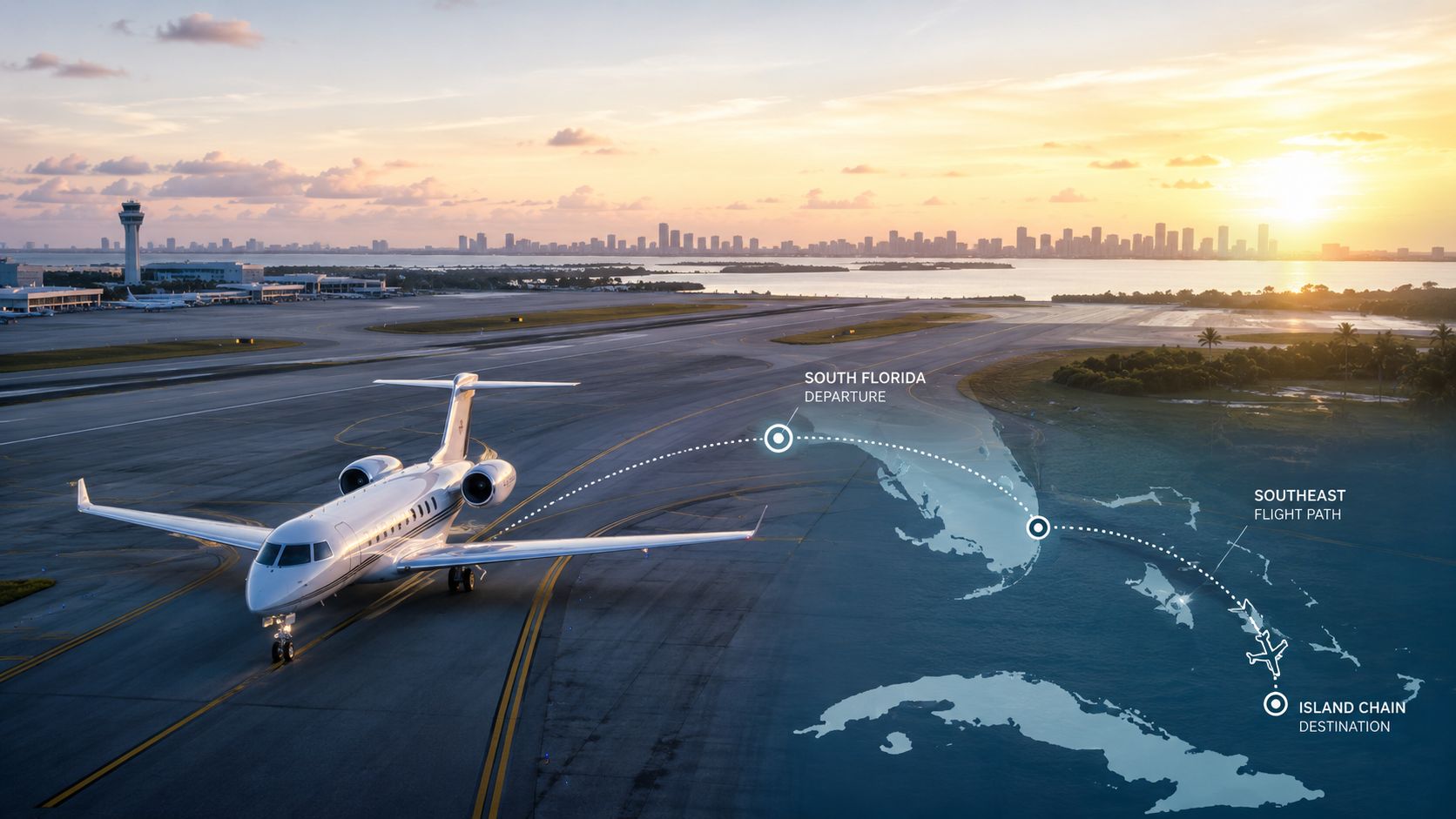
Choosing your South Florida departure airport
Your departure airport matters more than first-time clients expect, because it affects ground efficiency, aircraft availability, and whether you end up absorbing avoidable repositioning cost.
Here is the practical view.
| Airport | Best for | My take |
|---|---|---|
| OPF | Privacy, fast private aviation handling, strong charter availability | Usually the smartest choice for a dedicated private charter out of Miami |
| MIA | Commercial connections or clients staying very close to the airport core | Functional, but less refined and often less efficient for private departures |
| FXE | Travelers based north of Miami or along the Broward and Palm Beach corridor | A smart option if it places the aircraft closer to you and cuts unnecessary ferry time |
OPF is often the cleanest answer. It was built around private aviation traffic, and the experience is usually smoother from curb to cabin. If you want more context on why seasoned charter clients favor it, this Haute Jets Journal guide to Opa-locka's premier FBOs explains the operational advantages well.
There is also a cost discipline point here that many charter guides ignore. On a short international hop like Miami to the Bahamas, an aircraft sourced from the wrong airport, or worse, from another city, can add a disproportionate ferry charge before your trip even begins. Haute Jets' sourcing approach is simple. Start with aircraft already positioned in South Florida whenever possible. That removes deadhead inefficiency at the routing stage, where hidden costs often begin.
Picking the right Bahamas arrival point
Your arrival airport should match your final destination. Anything else wastes time.
- Nassau (NAS): Best for New Providence, Paradise Island, Atlantis, and travelers who want the broadest service infrastructure.
- Marsh Harbour (MHH): A better fit for Abaco stays, private homes, and yacht itineraries.
- North Eleuthera (ELH): The right choice for Harbour Island and northern Eleuthera.
I see clients default to Nassau too often because it is the best-known name on the board. That is lazy planning. If your villa or marina is on another island, the wrong arrival point creates extra boat transfers, additional ground handling, or a second flight segment you did not need.
Routing is brief, but operational standards still matter
This sector is over water and across an international boundary. That changes the operating standard, even if the cabin time is short. A capable operator handles flight planning, permits, equipment compliance, and timing without turning it into your problem.
That is the standard to insist on. Short route. Precise execution. Local aircraft sourcing. Those three decisions protect both your schedule and your charter quote.
Choosing Your Aircraft and Understanding Costs
Your aircraft decision should follow the mission, not the brochure. On a Miami to Bahamas charter, the shortest flight is often paired with the widest pricing spread, and that is exactly where inexperienced buyers overpay.
A one-way quote can look modest at first, then swell once the wrong aircraft category, the wrong operator base, or both are baked in. The smart move is simple. Start with the smallest cabin that meets your passenger count, baggage profile, and comfort standard, then source it locally in South Florida. That is the discipline Haute Jets applies because it protects both cost and schedule on short island sectors.
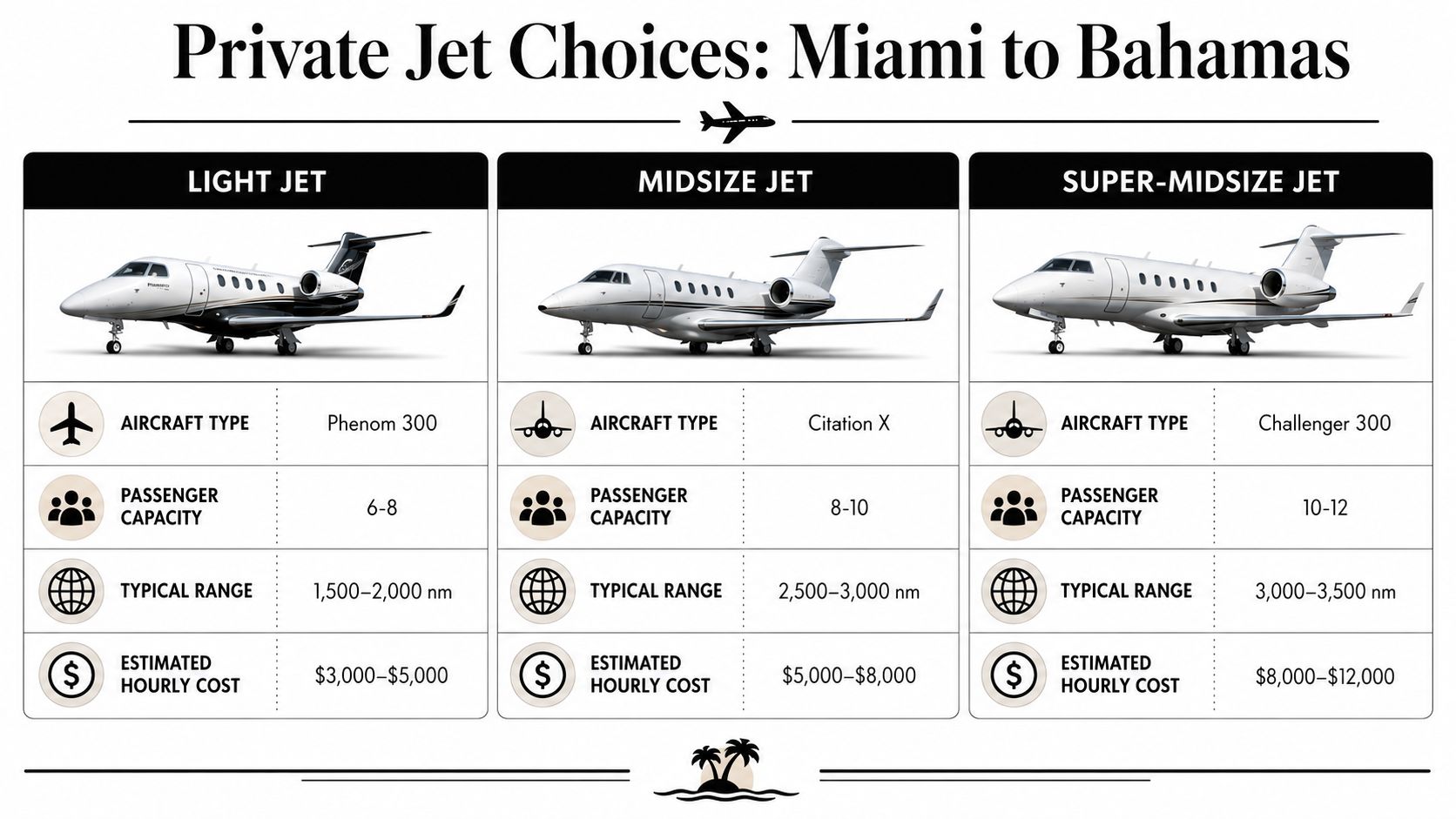
If you want a sharper framework for category selection on short sectors, read Haute Jets' guide to choosing the right aircraft for short-haul private flights.
The practical aircraft choices
Here is the cleanest way to evaluate the field.
| Category | Typical fit on this route | Seats | Best for | Cost guidance |
|---|---|---|---|---|
| Turboprop | Short island hops with light baggage | 5 to 8 | Couples, small families, travelers who care more about efficiency than jet branding | Entry-level option |
| Light jet | The most balanced premium choice | 6 to 8 | Most first-time charter clients, two couples, families, tighter schedules | Common sweet spot |
| Midsize jet | More cabin room and baggage capacity | 7 to 9 | Larger groups, longer onward itineraries, clients who want more space | Higher, but sometimes justified |
| Super-midsize or heavy jet | Significant cabin and range capability | 9 to 12+ | Only when passenger count, luggage, or onward routing truly requires it | Highest cost tier |
My recommendation by travel style
For a couple or a small family, a turboprop is often the best-value answer. The flight is short enough that many clients gain very little by insisting on a jet if comfort expectations are realistic and baggage is controlled.
For most high-net-worth travelers, a light jet is the right place to start. You get a quieter cabin, a more polished onboard experience, and the speed profile clients expect from private aviation, without paying for unnecessary range and cabin volume.
Midsize, super-midsize, and heavy jets should be chosen with intent. They make sense when you have a full passenger load, substantial luggage, a pet setup that needs more cabin flexibility, or a same-day onward mission that justifies the extra capability. Otherwise, they are an expensive way to fly a very short sector.
What the price range really means
Published charter pricing is useful for orientation, not for decision-making. Analysts at EvoJets' Miami to Nassau pricing page show the usual spread by category, from light jets through heavy aircraft, and that spread reflects a real market truth. Two quotes for the same route can differ sharply even when the passenger experience looks similar on paper.
Aircraft type is only part of the story.
The larger pricing mistake is choosing more airplane than your trip needs, then accepting a quote built around an aircraft that is not already in South Florida. On a route this short, unnecessary positioning can distort the economics fast. That is why a locally sourced light jet often beats a poorly sourced midsize quote by a margin that surprises first-time charter clients.
Don't pay for capability you will never use
I see this constantly. A client books a larger cabin because it feels safer, more prestigious, or more appropriate for a private charter. On this route, that instinct usually costs money without improving the trip in any meaningful way.
Use a simple rule. Match the aircraft to four things only:
- Passenger count
- Baggage volume
- Cabin comfort expectations
- Whether you are continuing beyond the Bahamas
If those factors do not support a larger aircraft, do not book one. The best charter decision on Miami to Bahamas is rarely the biggest jet. It is the best-priced aircraft already close to your departure point, with the right cabin for your party and no hidden inefficiency built into the quote.
How to Avoid the 40 Percent Repositioning Fee Trap
A first-time charter client sees a Miami to Bahamas quote, assumes the flight is short, and expects the price to be straightforward. Then an extra charge appears that has nothing to do with your passengers, your bags, or your destination. You are paying to bring the aircraft to you empty.
That is the repositioning fee trap. On this route, it is often avoidable.
Traditional brokers and jet card programs often build repositioning into the quote, pushing the total up by 20 to 40 percent. Clients who insist on a Miami-based or nearby South Florida aircraft can often avoid that markup, saving $1,800 to $3,600 or more per trip, according to Monarch Air Group's analysis of Miami to Bahamas charter pricing.
What repositioning actually means
The aircraft is not where you are. The operator flies it empty to Miami first, and you pay for that leg.
On a longer mission, that can be reasonable. On a short Miami to Bahamas charter, it usually signals lazy sourcing or a broker prioritizing inventory access over your economics. A 35 to 60 minute passenger flight cannot absorb much inefficiency before the quote starts looking distorted.
That is why two similar aircraft can price very differently on the same day.
The questions that expose the markup
Ask these before you approve anything:
- Where is the aircraft based right now?
- Does this quote include any empty repositioning leg?
- If yes, from which airport?
- What is the price on a comparable aircraft already in South Florida?
A serious charter advisor will answer quickly and specifically.
If a provider cannot tell you where the aircraft is coming from, the quote is not transparent.
The booking model I recommend
I prefer local sourcing without exception. On this route, it is the clearest way to control cost without compromising safety or service.
Haute Jets follows that logic by sourcing from owner-operators near the departure city and avoiding the membership and jet card structure that often hides these costs in plain sight. That approach fits Miami to Bahamas charters especially well because South Florida has deep aircraft availability, and disciplined sourcing usually removes the need for expensive empty positioning.
The principle matters more than the logo. For a private jet Miami to Bahamas booking, local aircraft sourcing should be your default expectation.
If you want to review the entry side of the trip with the same level of discipline, use this private jet customs guide for international arrivals.
Navigating Customs and Island Entry Requirements
Luxury doesn't excuse procedural sloppiness. On an international private flight, paperwork is part of the trip.
Private flights to the Bahamas require pilots to file an International Flight Plan, submit three copies of the C7A Bahamas Cruising Permit form, use the eAPIS system before departure, and ensure one U.S. Coast Guard-approved life jacket is on board for each person, according to the Bahamas private aviation pilot FAQs.
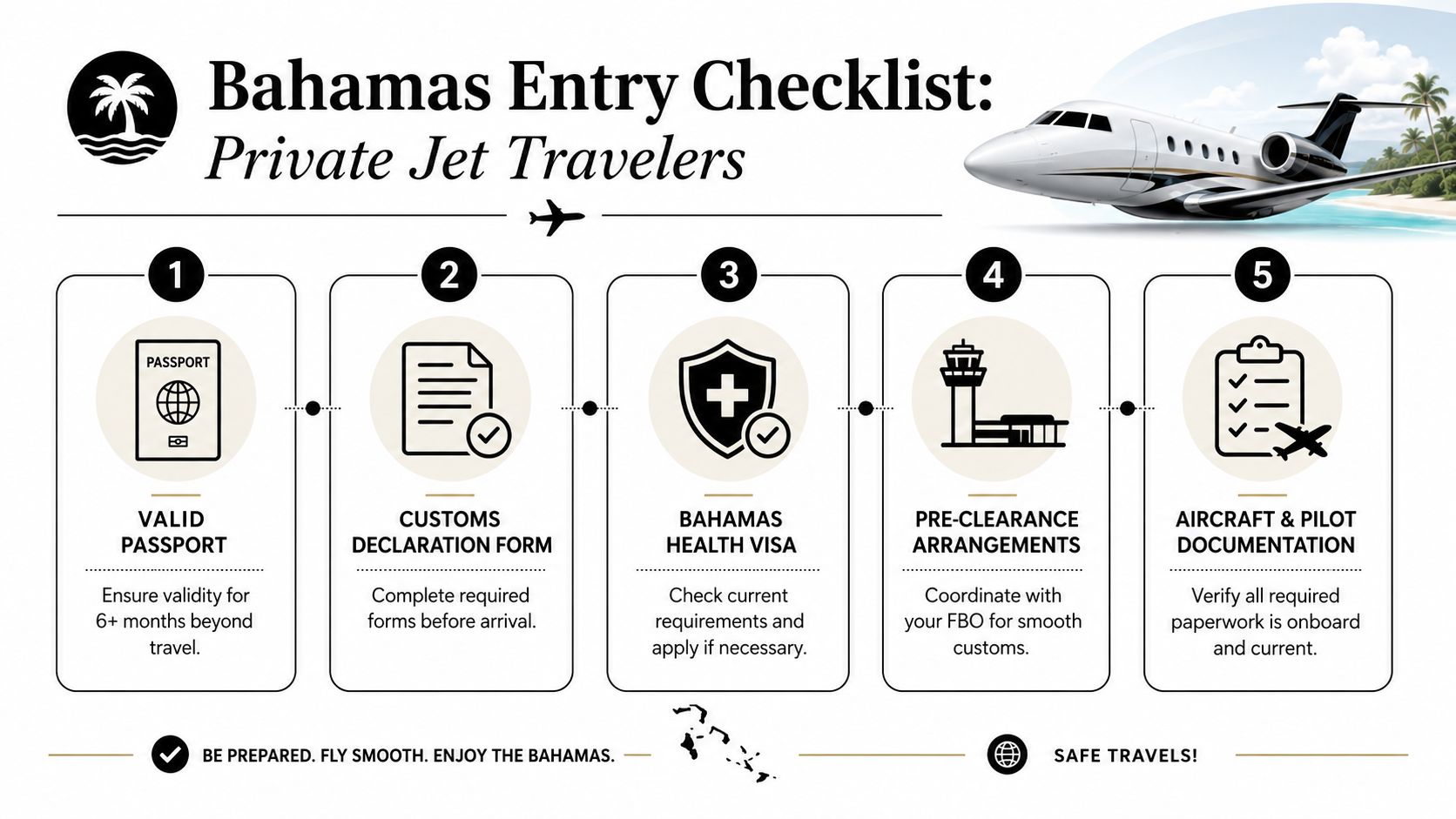
If you want a more general overview of how private jet border handling works, this Haute Jets customs guide provides a helpful reference.
What your operator handles and what you should confirm
A competent charter operator and crew should manage the flight filing and aircraft-side compliance. You still need to confirm that passenger information is accurate and delivered on time.
Use this checklist:
- Passenger details: Provide full legal names and passport information exactly as requested.
- Operator paperwork: Confirm the crew has filed the International Flight Plan and eAPIS submission.
- Bahamas forms: Verify the required C7A documentation is prepared in the proper number of copies.
- Arrival process: Ask where customs and immigration will be completed on landing.
- Safety equipment: Confirm overwater equipment is onboard, including a life jacket for each person.
Where clients get into trouble
Most problems don't come from the rule itself. They come from assumptions.
A traveler assumes the assistant sent passport details. The operator assumes the manifest is final. Someone changes a passenger late. A family adds a nanny or security detail at the last minute. That's how “simple” flights become messy.
Non-negotiable: Finalize the passenger list early and don't make undocumented last-minute changes once paperwork is in motion.
You don't need to personally manage customs mechanics. You do need to choose a provider that treats this route like an international operation, because that's exactly what it is.
The Art of Booking Your Perfect Charter
Price matters. It just isn't enough.
A polished private charter is a stack of decisions that all have to be right at once. The operator must meet serious third-party safety standards. The departure FBO should match your expectations for privacy and pace. Your aircraft needs to fit not just your headcount, but your luggage, pets, and ground plan on arrival.

Safety first, without compromise
I don't treat safety as a marketing line item. I treat it as the baseline filter.
If you're booking through an advisor or charter platform, insist on operators that hold Wyvern Wingman or ARGUS Gold/Platinum ratings. Those are the standards worth taking seriously because they involve third-party review, not self-description.
Ask for specifics before departure:
- Exact aircraft: Year, make, model, and tail number
- Crew details: Experience summary and duty compliance
- Pre-flight confirmation: Passenger manifest, schedule, and operational brief
- Cabin details: Wi-Fi availability, lavatory configuration, baggage profile
If a provider can't give you those details clearly, keep shopping.
The soft factors that affect the whole trip
A private jet Miami to Bahamas charter is short in the air, but the experience starts on the ground.
Consider these details before you approve the trip:
- FBO choice: Some terminals feel discreet and frictionless. Others feel transactional. On a luxury itinerary, that difference matters.
- Pets: Private aviation is far easier for animal travel, but the cabin and paperwork still need advance confirmation.
- Baggage profile: Golf clubs, soft duffels, and family luggage fit very differently depending on aircraft type.
- Ground transportation: Have the car positioned before departure and on arrival. Don't sort this out after landing.
- Catering: On a sub-hour leg, keep it smart. Good coffee, water, light snacks, and any child-specific requests are usually enough.
Empty legs are useful, but don't build your whole trip around them
Flexible travelers sometimes ask about empty legs on this route. They can be worthwhile if your schedule can move and you're comfortable with one-way opportunism. They are not the foundation of a serious, date-specific family or business itinerary.
For a first-time client, I'd frame empty legs this way:
| Booking style | Good fit | Bad fit |
|---|---|---|
| Confirmed on-demand charter | Fixed travel dates, family plans, resort check-ins, business timing | Travelers only chasing the lowest possible fare |
| Empty leg opportunity | Flexible departures, one-way spontaneity, backup plans available | Anyone who needs exact timing and certainty |
What a polished booking process looks like
A proper booking should feel calm, not chaotic.
You request a quote. You receive aircraft options that make sense for the mission. The provider explains why one aircraft is local and another may carry repositioning cost. You choose the exact aircraft, not just a vague category. Your manifest is confirmed. Ground transport is handled. Final trip details arrive before departure.
That's what clients should expect. Not mystery pricing, not vague availability, and not a surprise aircraft substitution unless you explicitly approve it.
Conclusion: Your Direct Bahamas Itinerary Awaits
A Miami to Bahamas charter is short. The money mistakes on this route are not.
Clients who book well focus on one thing first: where the aircraft is coming from. A jet that looks competitively priced can become expensive fast once a 20 to 40 percent repositioning charge is layered in. That is the fee too many charter guides gloss over, and it is usually avoidable. Source locally, and you cut out deadhead cost that does nothing for your trip.
That is how experienced buyers approach this mission. They do not overpay for cabin they will barely use on a sub-hour crossing. They do not treat airport choice as an afterthought. They confirm the exact aircraft, the operating details, and the international handling before departure. They ask direct questions about base location because that single detail often decides whether the quote is sharp or padded.
The route itself is easy. Booking it properly takes discipline.
As noted earlier, this trip is typically under an hour, with pricing varying by aircraft type and whether the jet is already positioned in South Florida. The better strategy is simple: pay for the mission, not for someone else's ferry flight.
If you want a first Bahamas charter done correctly, insist on four things: a locally sourced aircraft, a clear all-in quote, confirmed customs handling, and exact tail-specific availability. Haute Jets follows that sourcing discipline closely, which is why the quoting process tends to be cleaner and the value stronger for clients who care about cost control without compromising safety or discretion.