

The most expensive jet isn't automatically the right jet for a private jet from Miami to Las Vegas. For this route, ultra-long-range aircraft can add cabin prestige and range you may never use, while a well-selected super-midsize jet often delivers the stronger combination of comfort, nonstop capability, baggage space, and price.
The route is long enough to rule out casual light-jet planning, but not so long that maximum-range equipment is always justified. Published route data places the trip at approximately 1,884 to 1,888 nautical miles, with nonstop block times generally spanning about 3 hours 55 minutes to 4 hours 54 minutes, depending on aircraft, routing, and winds. Paramount Business Jets' Miami to Las Vegas route guide supports that practical distinction.
| Aircraft category | Estimated one-way cost | Mission fit | Main advantage | Main limitation |
|---|---|---|---|---|
| Super-midsize | $36,000–$40,000 | Strong default for the route | Efficient comfort and nonstop practicality | Less cabin volume than a heavy jet |
| Large cabin | $45,000–$55,000 | Best for larger groups or bulky gear | More space and baggage capacity | Higher cost than the mission may require |
| Ultra-long-range | $60,000–$70,000 | Selective use only | Maximum cabin flexibility and range | Often unnecessary for a roughly four-hour flight |
The figures in the comparison table come from route-specific aircraft pricing published by Stratos Jets. The right decision starts with the mission, not the badge on the tail.
Rethinking Aircraft Selection for Transcontinental Missions
“Bigger is better” fails when the mission does not require bigger. Miami to Las Vegas sits in a middle ground: it is a transcontinental domestic flight, but a capable super-midsize aircraft can usually handle the nonstop mission without the cost of an ultra-long-range cabin. Paying for extra range and unused cabin capacity is a poor trade unless your itinerary or passenger requirements justify it.
A midsize through heavy jet is the sensible equipment range for this sector. The aircraft must account for distance, reserves, winds, alternates, passenger load, and baggage. A light jet may appear in a basic category search, but the relevant question is whether it can complete the trip nonstop with the required operating margin and passenger comfort. Published route guidance from Paramount Business Jets identifies this route as one that generally calls for a midsize to heavy jet rather than a light jet.
The value sweet spot
For this roughly four-hour mission, a super-midsize aircraft usually covers the features passengers notice most: a more spacious cabin, comfortable seating, useful baggage capacity, and a credible nonstop profile. It also avoids the automatic cost increase that comes with selecting a large-cabin or ultra-long-range aircraft.
Large-cabin jets deserve consideration when you are carrying substantial luggage, golf equipment, production cases, or a larger team. Ultra-long-range aircraft make sense when the cabin layout is the priority, passengers need unusually generous baggage space, or schedule flexibility depends on an aircraft already positioned for the trip. Otherwise, their additional capability can create an unnecessary repositioning premium.
Broker's view: Request a super-midsize aircraft first for a Miami to Las Vegas charter. Move up only when passenger count, luggage, cabin layout, or schedule requirements support the added cost.
Aircraft availability can change quickly during constrained periods. Miami and Las Vegas both draw leisure travelers, conventions, entertainment activity, and corporate traffic. The preferred aircraft at the preferred departure time may disappear while a client compares generic online estimates. During summer 2026, market coverage described both cities as intensely active, with restricted capacity and less incentive for operators to discount short-notice trips. The last-minute charter market analysis from Amalfi Jets provides that context.
Give the broker four inputs before requesting a quote: traveler count, baggage requirements, departure flexibility, and acceptable arrival airport. A clear mission profile produces a more relevant aircraft recommendation and reduces the risk that the quote defaults to the largest available jet.
Route Dynamics and Flight Time Realities
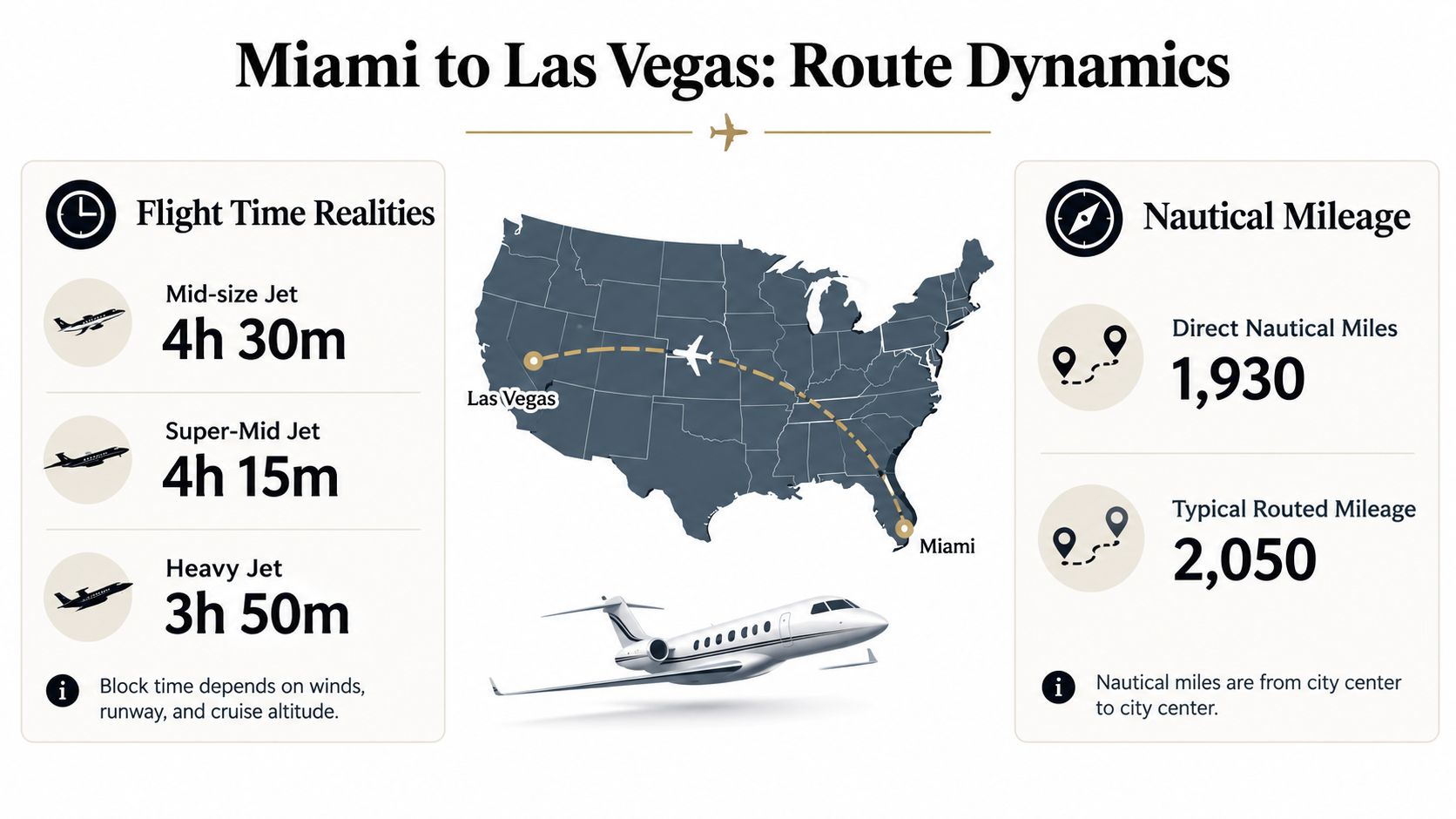
The Miami to Las Vegas route is a four-hour-class private aviation mission, not a reason to default to an ultra-long-range jet. Published route guides place the sector at about 1,884 to 1,888 nautical miles, or approximately 3,489 kilometers. Other route methods describe it at roughly 2,170 to 2,180 miles. Paramount Business Jets' route data and FlightConnections' Miami to Las Vegas route information illustrate why online distance estimates can vary without indicating an operational issue.
Why the schedule varies
Published nonstop estimates range from approximately 3 hours 55 minutes to 5 hours 42 minutes. Aircraft category, routing assumptions, winds, cruise profile, and operating conditions all affect the result. A faster heavy jet may complete the sector sooner, while another aircraft or departure condition can produce a longer block time.
Use block time for planning. It covers the operational period from departure preparation through arrival, making it the relevant figure for a meeting, dinner, event, or onward ground transfer. An attractive quote based on an optimistic airborne estimate can still create a scheduling problem.
Airport selection changes the ground experience more than the route distance. Harry Reid International Airport, North Las Vegas Airport, and Henderson Executive Airport appear among published charter options. Their mileage from Miami differs only marginally, but the choice can affect ground transportation, FBO convenience, and access to the Las Vegas Strip or nearby business locations.
What passengers should expect
Several hours onboard make cabin design a practical consideration. Cabin height, seat layout, lavatory design, connectivity, and baggage access matter more than a jet's maximum range. For ordinary luggage and a comfortable nonstop mission, a suitable super-midsize aircraft often delivers better value than a larger jet that brings excess capability and a possible repositioning premium.
Passenger load matters as well. An aircraft that performs comfortably with a light complement may offer less flexibility when fully occupied and loaded with luggage. The broker should evaluate the actual itinerary, payload, and airport plan rather than quote from an aircraft category alone.
Planning rule: Ask for expected block time, proposed departure and arrival airports, and confirmation that the aircraft can operate nonstop with your passenger and baggage load.
Comparing Super Midsize and Heavy Jet Performance
For this route, the largest aircraft is often the wrong default. The useful comparison is mission efficiency versus excess capacity. Super-midsize, large-cabin, and ultra-long-range jets can all operate the Miami to Las Vegas corridor, but they serve different passenger and baggage requirements.
A super-midsize jet should be the starting point for most travelers booking a comfortable nonstop flight of roughly four hours. It provides a substantial cabin, adequate baggage space for ordinary luggage, and a lower operating profile than the largest categories. Review representative aircraft in the Haute Jets super-midsize fleet.
Large-cabin jets justify their premium through additional space and capacity. Choose one for a larger group, bulky equipment, or a work environment that requires room to meet, dine, and move around. Event, sports, and entertainment travelers may need the added baggage volume, particularly when cases and equipment would crowd a smaller compartment.
Ultra-long-range jets are the category most often over-prescribed for this mission. Their greater range and larger cabins are valuable on longer sectors, but a roughly four-hour domestic flight does not use that range. Select one only when the cabin layout, baggage requirement, passenger experience, or aircraft availability justifies the higher quote.
| Aircraft Category | Est. One-Way Cost | Avg. Flight Time | Max Passengers | Baggage Volume |
|---|---|---|---|---|
| Super-midsize | $36,000–$40,000 | About 4 hours | Depends on aircraft | Generous for typical group luggage |
| Large cabin | $45,000–$55,000 | About 4 hours | Depends on aircraft | Greater capacity for bulky gear |
| Ultra-long-range | $60,000–$70,000 | About 4 hours | Depends on aircraft | Maximum flexibility and capacity |
These one-way ranges come from Stratos Jets' Miami to Las Vegas aircraft estimates. Passenger and baggage figures remain aircraft-specific. Exact make, model, interior configuration, and operator restrictions can change the practical capacity.
Super-midsize aircraft
Choose this category when you want a nonstop flight, a comfortable cabin, strong value, and room for standard personal or business luggage. It fits executives, couples, families, and compact corporate groups that do not need a bedroom-style layout or exceptional cargo capacity.
The savings may extend beyond the aircraft's quoted hourly economics. A super-midsize jet is often easier to source near South Florida than a larger aircraft, reducing the chance of paying for a repositioning sector. Availability determines the actual result, so ask where the proposed aircraft is based before comparing quotes.
Large-cabin aircraft
A large-cabin jet earns its premium when the group needs cabin separation, more baggage volume, or a spacious working environment. Production teams may need room for cases and equipment. Senior corporate groups may prefer additional privacy and space for meetings during the flight.
Do not choose this category because the aircraft crosses the country. Choose it because your passengers need the cabin features and capacity.
Ultra-long-range aircraft
An ultra-long-range jet makes sense for a specific cabin layout, unusually high baggage requirements, or maximum nonstop flexibility. It can also work when the aircraft is already positioned conveniently and the price gap is narrower than usual.
Maximum range does not equal maximum value on Miami to Las Vegas. Much of that capability may remain unused, while the higher category can create a repositioning premium without improving your itinerary. Request the exact aircraft, tail number when available, cabin layout, baggage plan, and total inclusive price before accepting the largest option by default.
Understanding Charter Pricing Volatility and Repositioning
A Miami to Las Vegas charter quote is a planning estimate, not a fixed market price. Operators price the complete aircraft movement, including the passenger leg, positioning sectors, crew logistics, airport handling, and the cost of committing an aircraft to your schedule.
That structure explains why identical aircraft can produce sharply different quotes. One may already be near Miami and ready for your departure window. Another may require a repositioning flight before pickup. The aircraft are comparable, but the second itinerary carries more operational cost.
What changes the quote
Departure timing has a direct effect on price. Prime windows, major event dates, convention traffic, and short-notice requests reduce availability and weaken your negotiating position. Miami and Las Vegas both draw leisure, corporate, entertainment, and event traffic, so demand can shift quickly.
Aircraft location matters just as much. A broker searching only one operator may present a suitable aircraft with an expensive deadhead movement. A wider market search may find a super-midsize jet already positioned near South Florida, avoiding a repositioning premium that adds no value to your four-hour mission.
Use Haute Jets' private jet charter cost guidance to understand the variables behind a quote. Then request a route-specific proposal showing the full total rather than relying on a category-level hourly figure.
Questions that expose hidden costs
Ask whether the aircraft is local, whether repositioning is included, and whether the quote is all-inclusive. Request the exact model, proposed airports, expected block time, catering assumptions, ground handling, crew expenses, taxes, and cancellation terms. Confirm the cabin configuration and baggage allowance as well.
A low base rate can become expensive after operational charges are added. A higher quote may be justified if the aircraft is already positioned, fits the group properly, and includes the services you require. For this route, compare the total mission cost, not the advertised hourly rate.
Ask this directly: “Is this price based on the aircraft already being near Miami, or am I paying to move it into position?”
The market is especially fluid in summer 2026, described as intensely active in Miami and Las Vegas, with restricted capacity and weaker discounting for short-notice travel. Amalfi Jets' market commentary supports requesting live availability instead of trusting an old published fare.
Book early once the date is fixed. If your schedule allows flexibility, give the broker several departure windows and ask for aircraft already positioned nearby. That flexibility improves value only when the broker searches the active operator market and presents the repositioning assumptions clearly.
Navigating Empty Leg Opportunities Safely
An empty leg exists because an aircraft must reposition without passengers. If its movement matches your Miami departure, Las Vegas arrival, date, and timing, you may secure a discounted dedicated charter instead of paying for a separate aircraft movement. The Haute Jets' guide to empty leg flights explains the structure and the flexibility trade-off. Treat the discount as conditional, not guaranteed. The aircraft serves an existing operational plan, so your schedule must fit that plan.
Use this screening process
Confirm the route and timing. Verify the exact departure airport, arrival airport, date, and permitted departure window. Ground transfers can erase the savings.
Ask who operates the flight. Obtain the operator's legal name, aircraft details, and safety credentials. A low price does not justify weak oversight.
Verify the exact aircraft. Confirm the make, model, cabin configuration, tail number when available, and baggage limits. The listing may change if the original passenger itinerary changes.
Clarify cancellation risk. Ask what happens if the original flight is canceled, delayed, or rerouted. An empty leg can disappear because the mission supporting it has changed.
Review the complete price. Request a written quote showing handling, catering, ground transportation, taxes, and any repositioning charges. Compare the total mission cost with a standard charter, including the value of your schedule.
Ask for a firm confirmation deadline and a backup option before committing. If the timing is fixed, a dedicated charter usually provides more control. If your schedule is flexible, an empty leg can work well, provided the operator confirms the aircraft, crew, airports, and cancellation terms in writing.
Safety remains the baseline. Confirm that the operator holds an appropriate third-party audit, such as Wyvern Wingman or Argus Gold or Platinum, before accepting the discount. Empty-leg economics do not lower the standard for the operator or crew.

Matching Traveler Profiles to Optimal Cabin Configurations
Aircraft choice becomes clearer when you start with the passengers rather than the aircraft brochure. The same Miami to Las Vegas itinerary can justify different cabins depending on whether the group needs productivity, personal space, equipment capacity, or schedule control.
The corporate team
A corporate group should begin with the working day, not the departure lounge. If passengers need to prepare for meetings, review documents, or remain connected, prioritize a quiet cabin, reliable onboard Wi-Fi, power access, and a seating arrangement that supports conversation without forcing everyone into the same posture.
A super-midsize aircraft will often fit this profile. It provides a comfortable environment for a four-hour-class mission without charging the group for ultra-long-range capability that may not affect the outcome. Confirm the actual connectivity system and expected service level for the specific aircraft, because “Wi-Fi available” doesn't describe performance adequately.
The family or leisure group
Families usually value space, easy baggage access, and a cabin layout that keeps passengers comfortable over several hours. Pets, strollers, sports equipment, and personal luggage can make the baggage plan more important than a small difference in cruise performance.
For a family with ordinary luggage, super-midsize remains the logical first quote. A large-cabin aircraft becomes more attractive when the group needs more separation, is carrying substantial equipment, or wants a cabin arrangement designed for extended relaxation.
The event, sports, or production group
Entertainment teams and event travelers often have the least flexible schedules and the most complicated baggage. Costumes, instruments, golf clubs, production cases, and other equipment can change the aircraft recommendation quickly.
This group should evaluate the aircraft's usable baggage capacity, loading access, departure slot, and proximity to the required FBO. A large jet may deliver better value than a super-midsize option if it prevents equipment compromises or a separate logistics solution.
Schedule flexibility can also justify a different strategy. If the group can move its departure window, an empty leg may be worth considering. If arrival timing is fixed, a dedicated charter with a locally positioned aircraft is usually easier to control.
Securing Wholesale Rates Without Membership Commitments
Membership isn't the same as value. A jet card can offer a standardized booking process, but it can also tie you to prepaid hours, defined rules, or a narrower sourcing model. For an occasional Miami to Las Vegas traveler, an on-demand charter can provide more useful flexibility because each trip is evaluated independently.
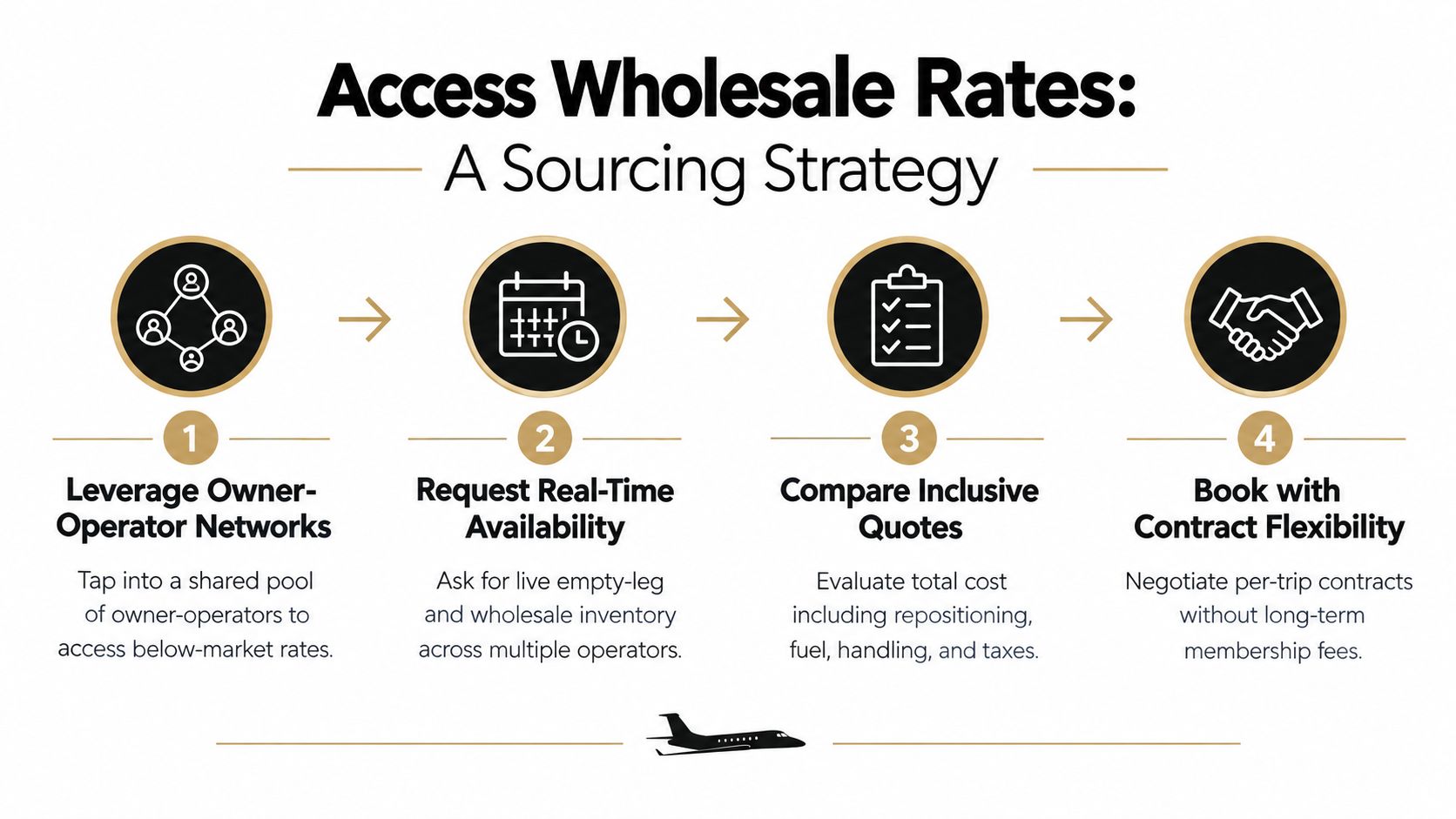
The stronger sourcing approach is to search owner-operator availability across the relevant market, then compare aircraft that are already near Miami or can reach the departure point efficiently. Haute Jets operates as one marketplace option for this model, sourcing aircraft from owner-operators and arranging on-demand charter access without requiring a membership commitment.
A practical sourcing checklist
- Search the local operator market: Ask whether the proposed aircraft is already positioned near Miami and whether another compliant aircraft can reduce repositioning.
- Compare the exact aircraft: Review the year, make, model, cabin layout, Wi-Fi, catering, pet policy, and baggage plan rather than accepting a broad category.
- Demand safety documentation: Confirm the operator's third-party audit status and request the legal operator details before signing.
- Review the contract: Make sure the agreement identifies cancellation terms, payment timing, inclusions, aircraft substitution rules, and operational responsibilities.
- Require pre-flight confirmation: Obtain the tail number, crew information, weather briefing, passenger manifest process, and final airport details before departure.
The right provider should present a choice of compliant aircraft, not pressure you toward whichever jet carries the highest price. You don't need to commit to a long-term program to receive professional coordination, transparent logistics, and a carefully vetted aircraft.
For this route, my recommendation is direct. Start with a super-midsize aircraft, request a locally sourced alternative, and compare the full inclusive price against large-cabin and ultra-long-range options only when your group's space, baggage, or schedule requirements demand them.
Haute Jets can source on-demand aircraft for Miami to Las Vegas, compare available cabin categories, and coordinate flight details with vetted owner-operators without requiring a membership commitment. Visit Haute Jets to request a route-specific quote and identify the aircraft that fits your passengers, baggage, schedule, and budget.