

A private jet new york to london flight typically runs from about $60,000 on the lower end for an option that may require a fuel stop to more than $98,000 for a nonstop trip on an ultra-long-range jet. If you want the smartest booking, don’t just compare aircraft categories. Compare how the aircraft is sourced, which airport pair you use, and whether the quote hides repositioning fees.
You’re probably not booking this route because you want “luxury” in the abstract. You’re booking it because a commercial itinerary destroys the next day. You lose hours on the ground, arrive tired, and still have to perform in London.
That’s why this corridor matters. New York to London is one of the most established private aviation routes globally, and for good reason. Done properly, it turns an overnight crossing into a controlled, quiet, highly usable block of time. Done poorly, it turns into an expensive lesson in why not all charter quotes mean the same thing.
From Manhattan Meetings to London Breakfast
A common first-time client scenario is simple. You finish meetings in Manhattan late afternoon, head straight to the private terminal, board without the normal airport drag, eat on your schedule, sleep en route, and land outside London in shape to work.
That’s the core appeal of this route. It isn’t indulgence. It’s continuity.
According to published New York to London private charter flight data, the typical door-to-door experience uses private terminals to avoid security queues, with a nonstop flight time of 6 to 7 hours depending on aircraft and winds. That setup allows travelers to leave New York in the evening and arrive in London for morning meetings.
Why executives keep choosing this corridor
Commercial first class can be comfortable. It still forces you into the airline’s schedule, the airline’s terminal process, and the airline’s definition of convenience.
Private charter changes the rhythm:
- You leave after your last meeting: No need to build your day around a fixed departure bank.
- You use a private terminal: You avoid the long commercial terminal process and move from car to cabin fast.
- You arrive ready, not depleted: That matters more than people admit on a transatlantic business trip.
The overnight eastbound crossing works best when the aircraft, departure time, and arrival airport are chosen around your next morning, not around a generic route quote.
There’s also a practical detail first-time charter clients often miss. Documentation still matters. Private flying doesn’t exempt anyone from border rules, so before departure it’s worth checking international travel passport requirements to avoid a preventable problem at the end of an otherwise smooth trip.
What the experience should feel like
If you book this route correctly, the evening should feel compressed and efficient. Car to FBO. Brief check-in. Straight to the aircraft. No crowds. No gate hold area. No boarding scrum.
Then the cabin becomes whatever you need it to be: dinner table, secure workspace, or bedroom.
That’s the benchmark I’d use. If the itinerary doesn’t clearly improve your next morning in London, it’s the wrong aircraft, the wrong airport, or the wrong operator setup.
Choosing Your Transatlantic Aircraft
A first-time charter client usually asks about cabin style first. I’d start somewhere else. Start with mission fit.
The wrong aircraft can add a fuel stop, limit baggage, force payload tradeoffs, or trigger a repositioning charge that makes a lower hourly rate meaningless. On New York to London, aircraft choice is not a luxury preference. It is the biggest driver of both trip quality and final cost.
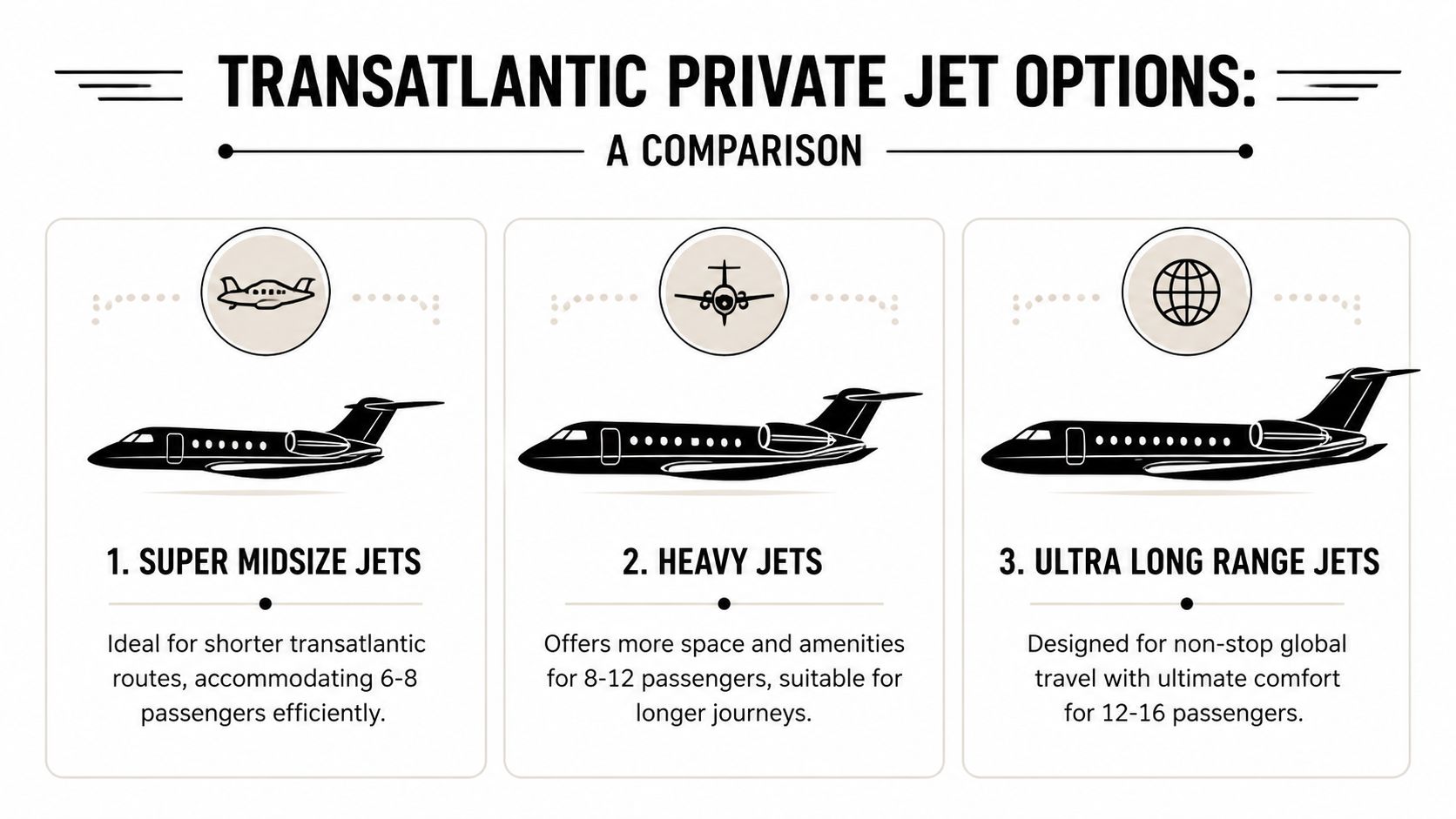
For this route, the realistic charter market falls into three categories. According to evoJets route pricing and aircraft guidance, Super Midsize jets cost $51,900 to $63,400 and often require a fuel stop, Heavy jets cost $58,400 to $71,400 and can fly the route nonstop, and Ultra Long Range jets cost $84,000 to $98,600 with room for 12 to 18 passengers.
Aircraft Comparison New York to London
| Aircraft Category | Typical Models | Passenger Capacity | Non-Stop Capable | Estimated Flight Time |
|---|---|---|---|---|
| Super Midsize | Citation Sovereign, Falcon 50EX | 6-8 | Often no | Around 7 hours, plus fuel stop planning |
| Heavy | Gulfstream GIVSP, Challenger 604 | 10-16 | Yes | About 6 hours 30 minutes |
| Ultra Long Range | Gulfstream G650, Falcon 7X, Global 7500 | 12-18 | Yes | About 6 to 8 hours |
What I’d tell most first-time buyers
For an overnight eastbound crossing, book the smallest aircraft that can fly the trip nonstop with margin. That usually means a Heavy jet at minimum, and an Ultra Long Range aircraft if sleep, schedule protection, or winter operating margin matters.
Here’s the blunt version:
- Choose Super Midsize only for a price-led brief. It can work, but a fuel stop turns a direct overnight crossing into a broken trip. You feel that the next morning.
- Choose Heavy for value. This is the category I recommend most often because it balances nonstop capability, cabin comfort, and charter cost.
- Choose Ultra Long Range for schedule protection and cabin quality. If you need to land rested, carry more passengers comfortably, or reduce operational compromises, pay for the bigger jet.
Practical rule: If the London arrival has real consequences, board meeting, deal signing, press, family event, choose nonstop range first. Sort the quote after that.
Why range margin affects both experience and price
New clients often compare jets by cabin photos and hourly rate. That is how they overpay.
Range margin affects more than whether the aircraft can technically cross the Atlantic. It affects routing flexibility, payload, baggage, departure timing, and how likely you are to need an operational workaround. It also affects sourcing. If the “cheaper” aircraft is not already positioned near your departure airport, the operator may add ferry time before you ever board. That repositioning cost can erase the apparent savings.
Westbound performance is where aircraft differences become even clearer because headwinds punish marginal range. The FAA’s North Atlantic operations guidance outlines how transatlantic operations must account for routing, fuel, and reserve requirements that go well beyond a simple city-pair estimate. That is why serious operators favor aircraft with real mission margin, not brochure range.
If you want a closer look at cabin, range, and layout differences within one of the strongest transatlantic fleets, review these top Gulfstream jets for luxury transatlantic flights before you request quotes.
One more recommendation. Ask your broker a direct question: Is this the best aircraft for the mission, or just the best-priced aircraft currently available? The answer usually tells you whether you’re buying a trip or buying a quote.
Airport and FBO Options in NYC and London
Airport choice isn’t a footnote. It shapes your entire day.
For most travelers departing Manhattan, Teterboro is the obvious answer because it’s built around private aviation. If you’re based in Connecticut, Westchester, or the northern suburbs, Westchester County Airport can be the more efficient play. The goal is simple. Cut ground friction before you ever think about flight time.

What an FBO actually does
A Fixed-Base Operator, or FBO, is the private terminal. That’s where you arrive, check in, meet crew, handle baggage, and board directly to the aircraft.
If you’ve never chartered before, this is the part that changes your perception of air travel. You aren’t entering the commercial system at all. You’re entering a private handling environment designed around speed and discretion.
Key advantages:
- Privacy: You stay out of the main passenger flow.
- Speed: Ground procedures are fast and direct.
- Control: Staff can coordinate baggage, catering, and car service around your actual schedule.
Best London arrivals for different priorities
On the London side, I’d narrow the shortlist quickly:
- Farnborough if you want a purpose-built private aviation arrival with a polished executive experience.
- Luton if you want a very established private jet hub with strong handling familiarity.
- Biggin Hill if your final destination favors that side of London.
Heathrow and Gatwick may sound prestigious, but they’re rarely the smartest pure private-aviation choice when speed and ease are the priority.
If you want a more detailed breakdown of arrival tradeoffs, this Haute Jets Journal guide to FBO options for private jet travel to London gives a useful airport-by-airport view.
Pick the airport that shortens your ground transfer at the end of the trip. Saving time in the air means little if you give it back on the road into London.
Deconstructing the Cost of Your Flight
Most first-time buyers make the same mistake. They compare the top-line quote and assume they’re comparing like for like.
They aren’t.
On this route, the sticker price only tells part of the story. According to Stratos Jets pricing analysis for New York to London, charter pricing can range from $60,000 to $121,800 one way, a spread of more than 100%, and international operational expenses tied to ETOPS certification and crew regulations can add $8,000 to $15,000 per flight.
What you’re actually paying for
A transatlantic charter quote usually reflects several layers of cost:
- Aircraft category and mission suitability: Larger, longer-range aircraft cost more to operate.
- Crew and international compliance: This isn’t a domestic shuttle. Crew rules and ocean-crossing requirements change the economics.
- Fuel and operating profile: Range, speed, and payload all affect burn and pricing.
- Airport and handling variables: The departure and arrival setup influence the total.
That all makes sense. The cost driver that frustrates clients is the one they often don’t see clearly.
The hidden line item that distorts the market
The biggest variable is often repositioning. That means the aircraft isn’t where you need it, so someone has to pay to bring it to your departure airport.
This is why two quotes for what looks like the same New York to London trip can be far apart. One aircraft may already be near Teterboro. Another may be nowhere close.
Ask these questions before you sign anything:
- Where is the aircraft based right now?
- Is repositioning included in this quote?
- What portion reflects the actual passenger leg versus aircraft movement?
- Are there extra charges tied to crew, international handling, or airport choice?
If a broker can’t explain why one quote is materially higher than another, assume the aircraft positioning is part of the problem.
If you want to understand how quotes are usually structured, this Haute Jets Journal article on private jet charter pricing and cost breakdowns is a useful reference.
My blunt advice: don’t reward vague pricing. On a route this established, a serious advisor should be able to explain the quote in plain English.
The Haute Jets Advantage Sourcing Locally
Once you understand repositioning, the smarter booking strategy becomes obvious. Source the aircraft as close to your departure point as possible.
That’s not marketing language. It’s basic charter economics.

Why local sourcing matters
According to Jettly’s analysis of hidden repositioning surcharges, traditional charter brokers often increase final costs by 20% to 40% through repositioning charges, and sourcing aircraft locally can eliminate those fees entirely.
That changes how I’d evaluate any provider on this route. I’d ask less about polished sales language and more about network structure.
A model built around direct access to locally based owner-operators is more rational for a New York departure. It reduces wasted aircraft movement, improves quote transparency, and often gives you better control over the exact aircraft you’re booking.
What I’d prioritize in a booking partner
For this route, I’d want four things:
- Local aircraft access: So you’re not funding a long empty reposition to New York.
- Specific aircraft selection: Not just “heavy jet category,” but the actual make, model, and cabin layout.
- Clear pre-flight confirmation: Aircraft details, crew information, and final handling notes before departure.
- Third-party safety standards: Wyvern Wingman or Argus Gold/Platinum level operators only.
Haute Jets fits that practical model by sourcing from a network of 3,500+ owner-operators across 175 countries and limiting bookings to Wyvern Wingman or Argus Gold/Platinum-rated operators, while allowing clients to select the exact aircraft and receive pre-flight confirmation before departure.
That’s the right structural answer to the pricing problem on this route. It doesn’t make every flight cheap. It makes the quote easier to trust.
Booking Your Charter Step by Step
Booking a private jet new york to london trip isn’t difficult. It just needs to be handled in the right order.
Start with the mission, not the aircraft. Your ideal departure window, arrival-side ground plan, passenger count, luggage profile, and next-morning obligations matter more than brand-name jet shopping at the start.
The booking checklist I’d use
- Set the schedule first. Give a realistic departure window from New York and a required arrival outcome in London.
- Confirm passengers and passports. Names must match travel documents exactly.
- Decide your airport pair. Don’t default blindly. Choose the airports that reduce total trip friction.
- State luggage and special items early. Golf clubs, garment bags, instruments, and oversized cases affect aircraft fit.
- Declare pets and catering needs in advance. These are easy to arrange when handled early, annoying when added late.
- Request the exact aircraft details before final approval. You want the actual tail-specific trip plan, not a broad category promise.
What to customize before departure
First-time clients often underuse the flexibility they’re paying for. You should be explicit.
- Cabin setup: If you need to sleep immediately after takeoff, say so.
- Food timing: Some travelers want dinner onboard. Others want a lighter setup and immediate rest.
- Ground transfers: Coordinate both ends so the handoff is clean.
- Work requirements: If you need connectivity or a quieter cabin layout, mention it up front.
A short visual overview of the booking flow can help if this is your first time:
Good charter planning feels quiet. By the time you reach the FBO, there should be no unanswered questions about documents, baggage, catering, or arrival logistics.
Private Jet vs First Class The True Value of Time
You finish a late meeting in Manhattan, head to the airport on your schedule, sleep properly on the crossing, and arrive in London ready for an 8 a.m. decision. This is the primary comparison.
First class sells comfort inside an airline system. Private charter buys control of the trip itself. You choose the departure window, the airport pair, the terminal experience, and the cabin environment. On a route like New York to London, those choices matter more than the width of the seat.
The value gap gets wider once you price time correctly. Airline first class still means fixed schedules, earlier airport arrival, crowded commercial terminals, and limited recovery options when delays stack up. A well-planned charter cuts friction at every step and protects the part that matters most: your ability to arrive useful, not just present.
Where the value shows up
Speed matters, but it is only part of the equation. As noted earlier, top-tier ultra-long-range jets can make this crossing faster under favorable conditions. More important, they do it in a cabin designed for rest, privacy, and uninterrupted work. You are not sharing space, adapting to an airline meal schedule, or hoping the person in front of you keeps their seat upright.
Cost should be judged the same way. The biggest mistake is comparing a first-class fare to a charter quote without accounting for hidden trip variables. Repositioning fees, airport choice, late-notice scheduling, and aircraft mismatch can move the private price sharply. Get those decisions right and the charter becomes far more rational than it looks at first glance.
That is why experienced flyers do not ask only, “What does the seat cost?” They ask what the day costs if the trip runs poorly.
If the London meeting affects revenue, if the trip includes family or senior executives, or if missing half a day creates a real business penalty, private charter is not a luxury comparison. It is a performance decision.
For travelers weighing time against money, even commercial benchmarks point in the same direction. The U.S. Department of Transportation Air Travel Consumer Report tracks the kinds of delays and service disruptions that turn a simple international itinerary into a long, expensive day. Private aviation does not remove every operational risk, but it gives you far more control over the ones you can choose.
If you’re planning a New York to London charter and want a transparent quote built around the right aircraft, the right airport pair, and no unnecessary repositioning surprises, request a trip review through Haute Jets. A good transatlantic charter should be easy to understand before it’s easy to enjoy.