
You’re probably dealing with the same frustration I see all the time. You want one clean answer on a private jet flight, and instead you get a pile of jargon. Part 135. broker. operator. jet card. managed aircraft. empty leg. Suddenly a simple charter request feels harder than buying the plane.
The fix is simple. Stop starting with the brand name on the quote and start with the operator.
In private aviation, the operator is the FAA-certified company that maintains the aircraft, staffs the crew, and conducts the flight. That matters more than the sales pitch, the glossy app, or the membership program. If you understand the operator, you understand your real exposure on safety, pricing, flexibility, and service quality.
That’s especially important in a market that keeps expanding. The global private jet charter market reached $48.13 billion in 2026, with flights up 33% versus pre-pandemic 2019 levels, according to private jet industry statistics compiled here. More demand means more options. It also means more noise.
Navigating the World of Private Jet Operators
A first-time charter client usually makes the same mistake. They think they’re choosing a jet. They’re actually choosing a chain of decisions behind that jet.
Say you need to fly from Miami for a weekend trip. You receive three quotes. One is from a broker, one is from a large branded fleet, and one is from a company representing a managed aircraft. The aircraft category looks similar on paper. The experience won’t be.

What the operator actually controls
The operator handles the parts that clients care about most, even when they don’t realize it yet:
- Aircraft legality: Is the aircraft properly available for charter under the right certificate?
- Crew quality: Who is flying it, and how current are they on that specific aircraft type?
- Maintenance discipline: Are issues handled proactively or only when they become visible?
- Dispatch reliability: Can the flight go as planned without a scramble behind the scenes?
- Trip economics: Is the quote built around an aircraft that’s already near you, or are you paying to drag it in from somewhere else?
A broker can be useful. A marketplace can be useful. A jet card can be convenient for some flyers. But none of those labels tell you who is operating your flight.
Practical rule: If you can’t identify the actual operator, you don’t yet know what you’re buying.
Why this matters more than the aircraft photo
Clients often obsess over cabin photos and overlook the operating structure. That’s backwards. A beautiful cabin means little if the plane has been bouncing through back-to-back trips, the crew timing is tight, or the operator’s standards barely clear the minimum.
The smartest private flyers don’t ask, “What jet can I get?” They ask, “Who operates it, where is it based, and what’s the cost structure behind this quote?”
That’s the difference between booking private travel and controlling it.
Decoding Operator Types and Business Models
Not all private jet operators work the same way. That’s why prices vary so widely, even for what looks like the same trip. The business model determines availability, consistency, and whether you’re paying for efficiency or someone else’s deadhead problem.
The three models that matter
Owner-operators are individual owners or small companies that place aircraft on a charter certificate and make them available when the aircraft isn’t being used privately. This model often creates excellent value because the aircraft may already be near your departure point.
Aircraft management companies manage planes for multiple owners. They oversee crew, maintenance, scheduling, and charter activity. These firms can offer strong service, but the economics depend on where each aircraft is based and how the owner uses it.
Dedicated charter fleets operate branded fleets at scale. That can mean consistency and broad availability, but it can also mean you’re buying into a larger overhead structure. Scale is real. Fractional ownership is now the fastest-growing segment, and NetJets alone accounted for 15% of all U.S. private flights in 2025, according to this review of the largest private jet companies.
Private Jet Operator Models at a Glance
| Operator Model | Fleet Source | Typical Cost Structure | Best For |
|---|---|---|---|
| Owner-operator | Independently owned aircraft placed into charter service | Often leaner, especially when aircraft is locally based | Flexible on-demand trips where cost discipline matters |
| Aircraft management company | Multiple owner aircraft managed under one platform | Varies by owner usage, positioning, and management setup | Clients who want broad access with some local market depth |
| Dedicated charter fleet | Company-controlled branded fleet or fractional system | Usually more standardized, often with higher structural overhead | Flyers who prioritize brand familiarity and fleet consistency |
My view on each model
Owner-operator access is usually the best hunting ground for value. You can source the right aircraft for the mission instead of forcing the mission into a fixed program.
Management companies sit in the middle. They can be excellent, but you need to know which aircraft you’re getting, where it’s coming from, and whether the quote reflects owner convenience more than your efficiency.
Dedicated fleets work well for clients who want a familiar product and don’t mind paying for that comfort. But many new charter clients assume “bigger brand” automatically means “better trip economics.” It often doesn’t.
If you're weighing charter against a longer-term commitment, read this comparison of chartering a private jet versus ownership. It helps clarify when flexibility beats fixed aviation costs.
Bigger fleet brands sell predictability. Network access sells fit. For most on-demand flyers, fit is where the savings are.
The Gold Standard of Safety Wyvern and ARGUS Audits
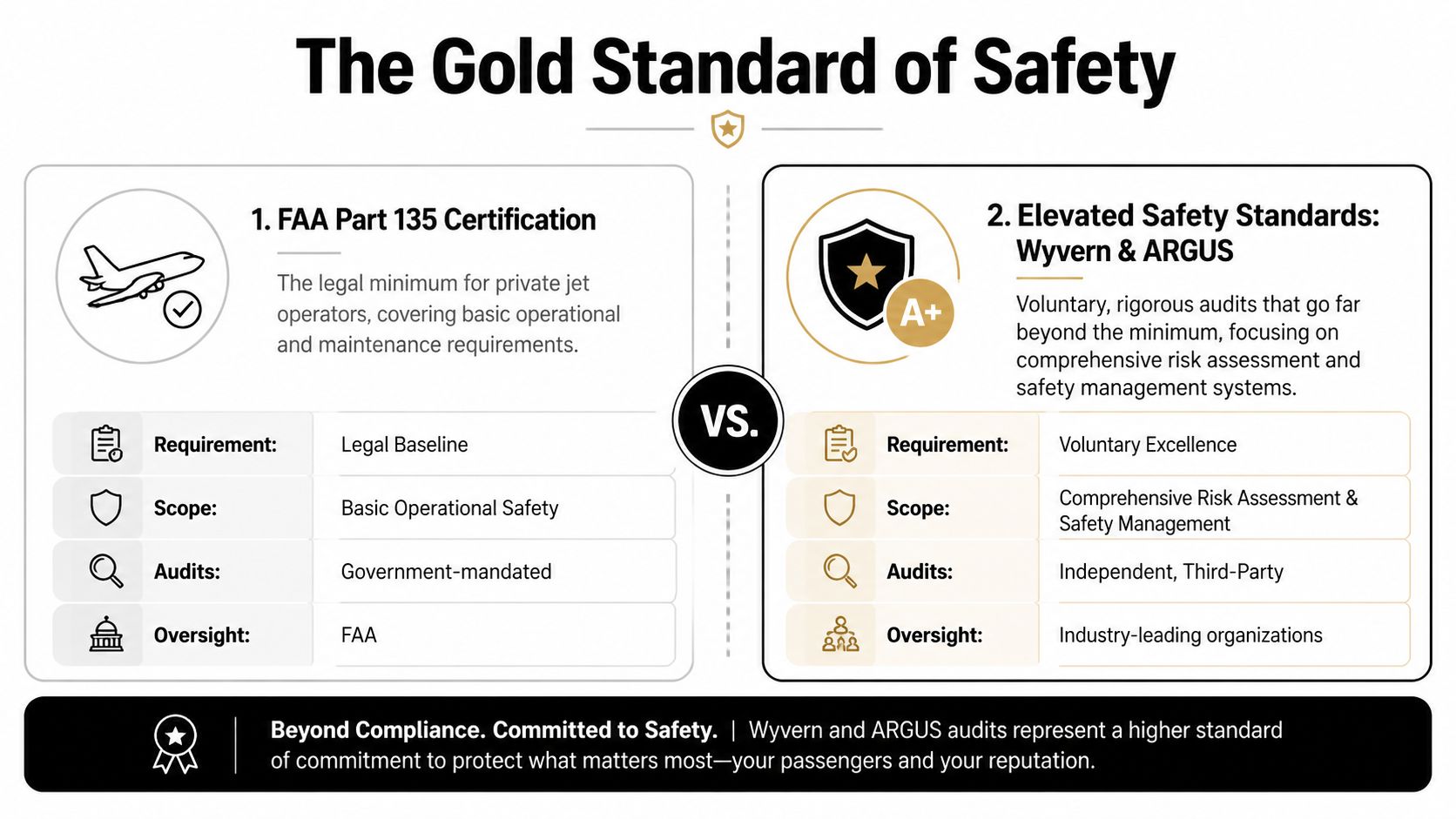
FAA certification is the legal minimum. Treat it that way. It tells you the operator is allowed to conduct charter flights. It does not tell you the operator meets the safety standard I’d recommend for a family office principal, public figure, or corporate executive.
The operators worth your time usually go further with Wyvern or ARGUS audits.
What these audits actually tell you
A proper third-party audit gives you more than a badge. It gives you an outside check on how the operator runs the business when clients aren’t watching.
That includes:
- Crew standards: pilot qualifications, training, and experience on the aircraft type
- Maintenance discipline: documentation, inspection cadence, and operational controls
- Insurance review: whether coverage aligns with serious charter activity
- Safety systems: whether the company uses a formal safety management approach instead of improvising trip by trip
- Operational consistency: whether policy and real-world execution match
The rating threshold I’d insist on
For charter, I’d use this filter first and ask questions second. If the operator doesn’t hold Wyvern Wingman or ARGUS Gold or Platinum, move on.
That standard removes a lot of weak options fast. It also helps you avoid the trap of assuming a polished website equals a disciplined operation.
The fastest way to improve charter safety isn’t reading more marketing. It’s refusing to book below a serious third-party audit threshold.
Why minimum compliance isn’t enough
Luxury travelers sometimes think their biggest risk is getting a tired cabin or weak catering. It isn’t. The actual risk is invisible. Weak procedures. Thin oversight. A company that can legally fly charter but doesn’t operate at the level you’d want for your family.
If you want a deeper explanation of what those ratings mean in practice, this guide to Wyvern and ARGUS safety ratings is worth reading before your next booking.
My advice is blunt. Don’t negotiate with yourself on safety standards. There are too many quality operators in the market to settle for one that only clears the floor.
Understanding Charter Costs and Repositioning Fees
Most clients focus on the hourly rate. That’s where confusion starts.
A charter quote reflects the aircraft, the route, the operator, where the plane is sitting before your trip, and what has to happen after you land. If you ignore positioning, you can overpay by a painful margin.

What you’re actually paying for
A private charter quote usually includes flight-related operating charges plus airport and handling items. But the most abused line item is the one many clients don’t recognize at first: repositioning.
Repositioning happens when the aircraft isn’t based where you need it. If you’re flying out of Miami and the plane is sitting in New York, someone has to pay to bring that jet to Miami before your trip even begins. That someone is usually you.
Traditional brokers and fixed fleet programs often pass along repositioning costs that can inflate pricing by 20% to 40%, a cost issue noted in the verified industry data provided for this article. That’s why two quotes for the same route can look wildly different.
Why local aircraft matter
At this point, aircraft selection becomes strategic, not cosmetic.
For short hops, Very Light Jets can operate at costs 30% to 50% lower than midsize jets, and turboprops like the Pilatus PC-12 can come in even lower. Using a nearby aircraft for routes such as Miami to the Bahamas is one of the clearest ways to cut charter expense, as outlined in this guide to private jet types and operating costs.
A lot of people book too much airplane because they’re sold status instead of mission fit. That’s expensive. A short regional trip often doesn’t need a midsize or super-midsize cabin if a locally based VLJ or turboprop can do the job cleanly.
The quote test I use
Ask these questions before you approve any charter:
- Where is the aircraft based? If it’s not near your departure city, expect extra cost.
- Is this quote charging repositioning both before and after my trip? Some do.
- Is there a better local aircraft for this mission? Often there is.
- Am I paying for category, or for actual trip efficiency? Those aren’t the same thing.
For a fuller breakdown of how private charter pricing works, this private jet charter pricing guide is useful background.
This short video gives a helpful visual explanation of how pricing works in practice:
If the aircraft has to travel just to start your trip, you’re not buying efficiency. You’re buying logistics.
A Practical Checklist for Selecting Your Operator
Most charter mistakes happen before wheels up. Clients skip the verification work, rely on a polished quote, and assume the details will sort themselves out. Serious travelers do the opposite.
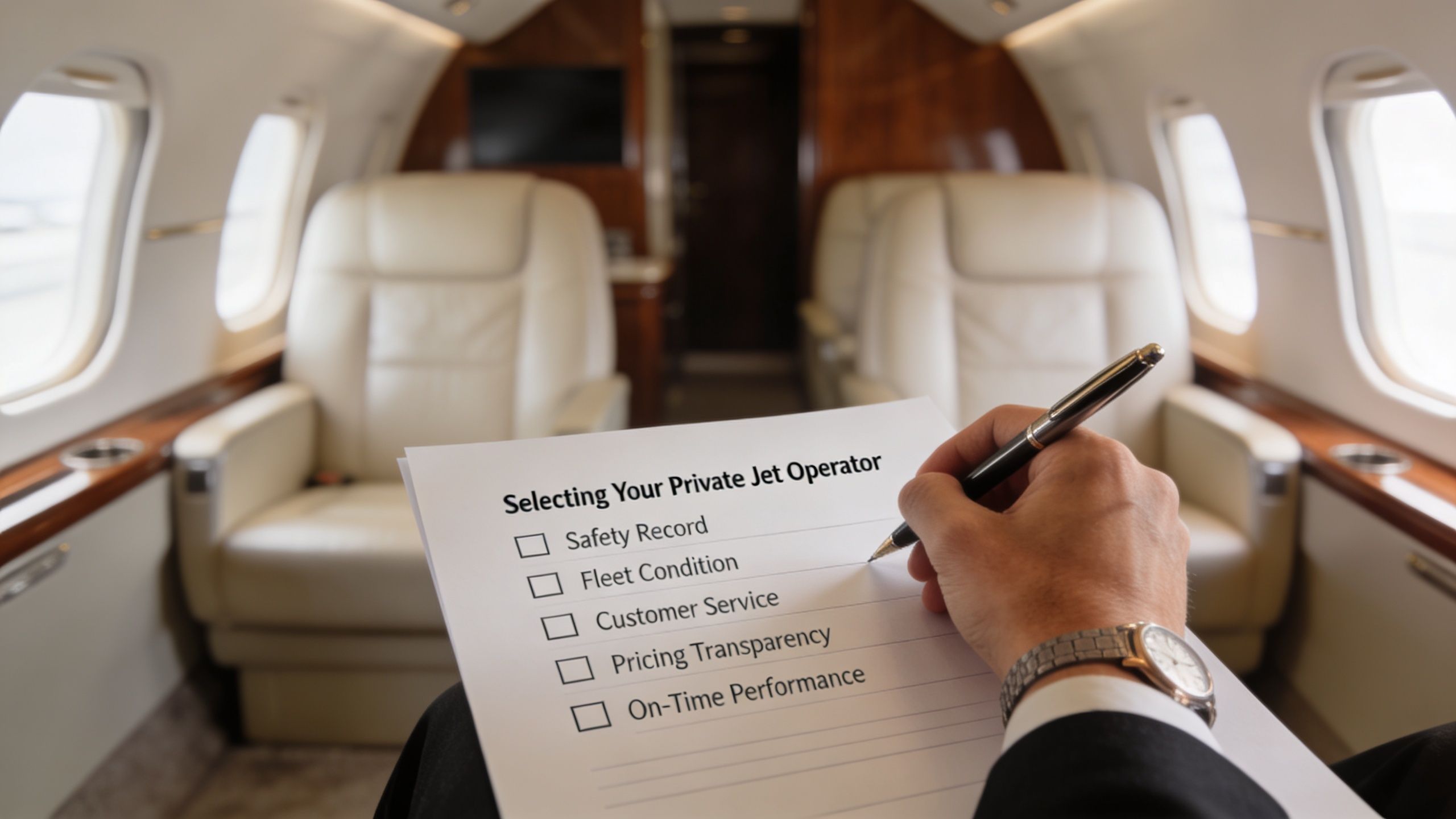
Use this checklist every time, especially if the flight involves pets, custom catering, Wi-Fi needs, or a specific cabin setup.
Start with operator quality
Begin with the essentials. If the operator doesn’t meet your safety threshold, nothing else matters.
Confirm the safety rating
Ask for the operator’s current Wyvern or ARGUS status. Don’t accept vague language like “safety is our top priority.” Ask for the actual rating level.
Identify the actual operator
Make sure you know which company is conducting the flight. The seller may not be the operator.
Verify the exact aircraft
Don’t settle for “or similar.” Get the specific year, make, model, and tail number once assigned.
Check the aircraft, not just the category
Luxury clients often get surprised. The aircraft may be legally compliant and still feel tired.
Aviation Week put it plainly. Charter aircraft are often “crisscrossing skies, battling weather, ferrying families with kids and pets,” which means wear may not show up in a brochure, as noted in this Aviation Week viewpoint on the reality of private aviation service.
That’s why you should ask:
- What was the aircraft’s recent usage? A hard-flown jet needs closer scrutiny.
- What does the cabin look like right now? Recent photos beat old marketing images.
- Is the Wi-Fi confirmed on this specific tail? Not all aircraft in a category are identically equipped.
- What’s the cabin layout? Club seating, divan, enclosed lavatory, baggage access. Details matter.
Client-side habit: Ask for aircraft-specific details late in the booking cycle, not just at quote stage. That’s when substitutions and surprises usually appear.
Sort out policy details before payment
The final layer is operational friction. Avoid it early.
- Pets: Get the pet policy in writing. Weight, crate expectations, cabin rules, and cleaning charges can vary.
- Catering: Confirm what’s included and what requires special sourcing.
- Ground transport: Don’t assume car service is coordinated unless someone says so clearly.
- Cancellation terms: Read them before you wire funds, not after plans change.
A clean charter experience usually comes down to one thing. Specificity. The more specific the operator and seller are willing to be, the better your trip tends to go.
The Haute Jets Advantage On-Demand Charter Reimagined
Most private jet operators force you into one of two compromises. You either accept the limits of a fixed fleet, or you overpay through a brokerage model that treats repositioning as your problem. There’s a better way.
The smarter model is a curated on-demand network built around access, not inventory. That means sourcing from a broad pool of owner-operators, selecting the aircraft that fits the mission, and avoiding the artificial markups created when the wrong plane has to be dragged in from another market.
That approach matters on both ends of the spectrum. For a short regional hop, the advantage is lower cost and less waste. For a long-haul international mission, the advantage is reach. Ultra-long-range jets like the Gulfstream G550 can fly over 6,000 nautical miles non-stop, connecting routes such as New York and Tokyo directly, as shown in this aircraft comparison reference.
The best version of this model also fixes the two other chronic charter problems. First, safety is filtered upfront by limiting options to operators with serious third-party audits. Second, transparency improves because the client can evaluate the exact aircraft, not just a generic category promise.
That’s why I’m firmly in favor of pay-per-flight on-demand access over memberships and jet cards for most clients. If you don’t need guaranteed hours under a fixed program, don’t prepay for someone else’s convenience. Buy the right aircraft for the trip in front of you.
Frequently Asked Questions About Private Jet Charters
What’s an empty leg flight?
An empty leg is a repositioning segment flown without the paying passenger originally associated with that aircraft movement. Sometimes you can buy that segment at an attractive rate. Sometimes it looks cheaper than it really is because the schedule is rigid and the trip can disappear if the primary itinerary changes.
For most clients, I treat empty legs as opportunistic, not dependable. If the trip matters, book on-demand around your schedule.
Is on-demand charter better than a jet card?
Usually, yes, if you value flexibility and don’t want prepaid commitments. Jet cards can suit travelers who want a program structure and are happy to live within its rules. On-demand charter is better when you want to choose the best aircraft for each mission and avoid program lock-in.
My bias is simple. Don’t buy hours before you know you need them.
Can I pay for a private jet with crypto?
Many modern charter arrangements can accommodate crypto-friendly clients through approved payment processes. The key is confirming the payment method before the contract stage, not after the aircraft is being held for you.
If crypto is important, say it at the start. Don’t treat it as an end-of-deal detail.
Can I fly with pets?
Yes, often quite easily, but pet policies vary by aircraft and operator. You need confirmation on the specific flight, including cabin rules, cleaning policies, and whether any breed or size restrictions apply.
Private aviation is usually far better for pets than commercial travel. It’s quieter, simpler, and less disruptive. But “pet-friendly” still needs to be verified in writing.
What is an FBO?
An FBO, or Fixed-Base Operator, is the private terminal side of the airport experience. That’s where you arrive, check in, wait briefly if needed, and board the aircraft without going through the normal commercial terminal flow.
If you’re new to private flying, the FBO is one of the biggest practical advantages. It saves time, reduces exposure, and makes last-minute schedule changes far easier to handle.
What should I ask for before departure?
Ask for the final aircraft details, crew information, departure instructions, baggage guidance, pet approval if relevant, and any last-minute service confirmations. A serious charter setup should provide a clean pre-flight package rather than forcing you to chase details.
If an operator or seller becomes vague right before departure, take that as a warning sign.
If you want charter advice that prioritizes the right aircraft, serious safety standards, and straightforward on-demand pricing, contact Haute Jets. Their model is built around access to a large network of safety-rated aircraft without memberships or jet cards, which is exactly how modern private aviation should work.