

A private jet rental app usually becomes relevant when the trip is already under pressure. A meeting is pulled forward. An aircraft needs to depart the same day. Commercial options no longer fit, and the old sequence of calling brokers, waiting on callbacks, and sorting through uneven quotes starts to feel slow for a service that depends on precision.
The best apps improve speed, but speed is only part of the value. What matters in charter is whether the platform helps you see the operational details that drive the final decision. An aircraft may look available and competitively priced, yet the final cost can change once repositioning, airport restrictions, crew duty limits, or deicing risk are accounted for. Safety can look straightforward too, until you ask which operator is flying the trip and how that operator has been vetted.
That is the shift behind digital charter tools. They make a fragmented market easier to search, compare, and book, while giving clients a clearer view of pricing logic and operator information before funds are committed.
Demand is growing, but discerning flyers are not using apps for convenience alone. They use them to reduce wasted time, pressure-test quotes faster, and avoid paying for avoidable inefficiencies that are often hidden in the first number they see.
The Modern Way to Charter a Private Jet
A private jet rental app is the modern answer to a very old charter problem. For years, booking private aviation meant submitting an itinerary, waiting for a broker to call operators, receiving several quotes in different formats, and then trying to compare aircraft that weren't described with the same level of detail. That model still exists. It still works. It's also inefficient when your flight needs to move quickly.
Digital charter platforms changed the expectation. Clients now expect the same basics they get elsewhere in premium travel. Fast search, visible options, clear booking flow, and mobile access. In private aviation, that's harder to deliver because aircraft aren't interchangeable inventory. Each mission depends on the actual jet, its position, airport constraints, crew legality, and operator approvals.
VistaJet has described on-demand charter as one of the most popular ways to fly privately, and notes that digital platforms help operators provide more efficient and transparent access, including nearby aircraft, shared-jet options, and empty-leg opportunities, as cited in this market report reference. That's the core appeal of a well-built app. It shortens the path between demand and viable lift.
What clients expect now
Most discerning flyers aren't looking for novelty. They want friction removed from a high-stakes purchase.
- Immediate searchability: A client wants to know whether a trip is possible before spending half an hour on calls.
- Cleaner comparison: It's easier to evaluate options when aircraft data, route fit, and inclusions are presented consistently.
- Faster commitment: Short-notice charter often rewards the traveler who can identify and secure the right aircraft first.
Practical rule: If a platform only feels fast on the surface, but still pushes the hard questions into email and phone follow-up, it isn't solving the real charter problem.
The best private jet rental app doesn't replace expertise. It brings the operational reality closer to the client so decisions can happen faster and with fewer surprises.
How Private Jet Rental Apps Work
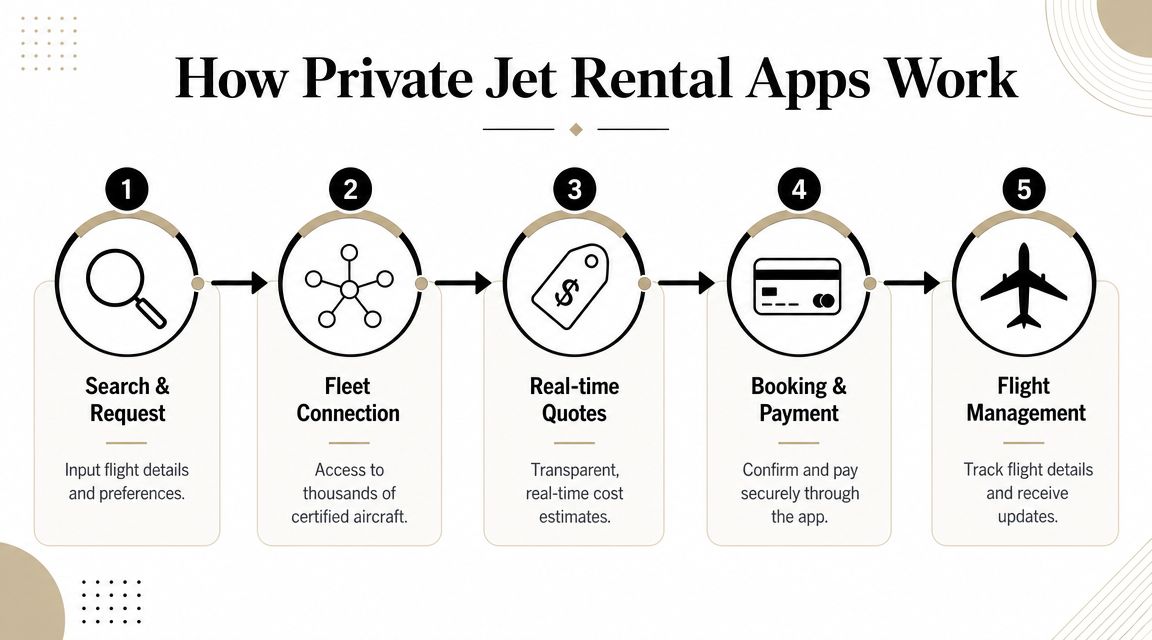
A good way to think about a private jet rental app is as a live charter marketplace, not a static catalog. It's closer to a logistics engine than a travel brochure. The user sees a clean search flow. Behind that, the platform is trying to match a specific trip request with aircraft that can legally, efficiently, and profitably fly it.
What happens behind the search bar
When you enter departure airport, destination, date, passenger count, and sometimes preferences like pets or Wi-Fi, the app starts filtering for operational fit. That means range, cabin suitability, airport compatibility, and timing. A polished app makes this look simple, but its core value is in the orchestration happening under the hood.
Some platforms connect directly to operator scheduling systems and vendor feeds, showing real-time availability and aircraft position data instead of relying on delayed manual updates. JetSmarter publicly described this model, including the ability to select a specific tail by itinerary, review photos, amenities, insurance, and safety history, and book cashlessly in-app. JetSmarter also said it had over 3,000 aircraft integrated into that system, as shown in its published product demonstration.
That's a meaningful distinction. If the app only displays broad aircraft categories, you're still dependent on back-office reconciliation. If it's tied to live scheduling, the platform can behave like a real inventory engine.
The user journey when the app is working properly
From the client side, the process should feel straightforward:
- Enter the mission details with airports, timing, and passenger needs.
- Review viable aircraft rather than generic wishful options.
- Compare specifics such as cabin layout, onboard amenities, and operator information.
- Approve the quote and pay through a secure workflow.
- Manage the trip with updated flight details and pre-departure coordination.
A useful way to judge technical maturity is to ask whether the app lets you move from search to booking without losing clarity. If you still have to ask where the aircraft is coming from, whether the price is firm, or who operates the flight, the software is only halfway built.
There's a wider lesson here for anyone interested in building market-leading apps. In charter, the hard part isn't the interface. It's syncing live supply, operational constraints, and payment into one flow without creating false certainty for the user.
The video below gives a sense of how app-based private aviation is presented to travelers in practice.
A charter app earns trust when the aircraft shown on screen is the aircraft that can actually fly the trip.
Key Features to Evaluate in Any App
Most app reviews focus on convenience. That's not where discerning buyers should spend most of their attention. A vital test is whether the platform gives you enough control to evaluate cost, aircraft quality, and operator quality before you pay.
Inventory depth matters more than design polish
Private aviation is a thin market. There are only about 23,000 private jets in operation worldwide, and 14,632 are in the United States, or roughly 62.5% of the global fleet, according to Jettly's fleet overview. That's why network access matters so much in a private jet rental app. You're not shopping an abundant commodity. You're searching scarce lift distributed unevenly across geography.
An app with shallow sourcing may still look elegant, but it won't perform well when your route is time-sensitive, your airport is secondary, or your departure window is tight.
Specific aircraft versus vague aircraft category
This is one of the biggest quality markers.
A weak platform lets you request “a light jet” and leaves the exact aircraft unresolved until later. A better one allows you to review the actual aircraft proposed, including make, model, year, cabin details, and ideally the tail number before funds are finalized.
Use this checklist when comparing apps:
- Exact aircraft visibility: Can you review the actual aircraft, not just a cabin class?
- Tail-level transparency: Does the app confirm the specific aircraft assigned to your trip?
- Operator disclosure: Can you see who will operate the flight, not just who sold it?
- Amenity confirmation: Wi-Fi, pet acceptance, baggage limitations, and catering shouldn't be left to assumptions.
- Support for complex trips: Multi-leg and short-notice changes expose weak platforms quickly.
Safety information should be easy to verify
Many travelers now ask a simple and important question. Can I verify the operator before paying?
That question exists because many apps emphasize access and speed but don't make the operating entity easy to assess. For a corporate flyer, family office, or entertainment principal, that's not a minor omission. It's a trust problem.
A strong app should make these items visible or available on request:
| What to check | Why it matters |
|---|---|
| Operating company name | Confirms who is actually flying the aircraft |
| Third-party audit status | Helps separate marketing claims from audited standards |
| Insurance confirmation | Important for internal risk review |
| Crew details | Relevant for corporate and security-sensitive travelers |
| Aircraft-specific policies | Prevents last-minute surprises around pets, baggage, or onboard connectivity |
What works: A platform that treats safety and aircraft identity as first-order booking information.
What doesn't: An app that reveals the operator only after payment or pushes aircraft specifics into fine print.
A private jet rental app should reduce uncertainty, not merely compress the sales cycle.
Decoding Private Jet Pricing Models
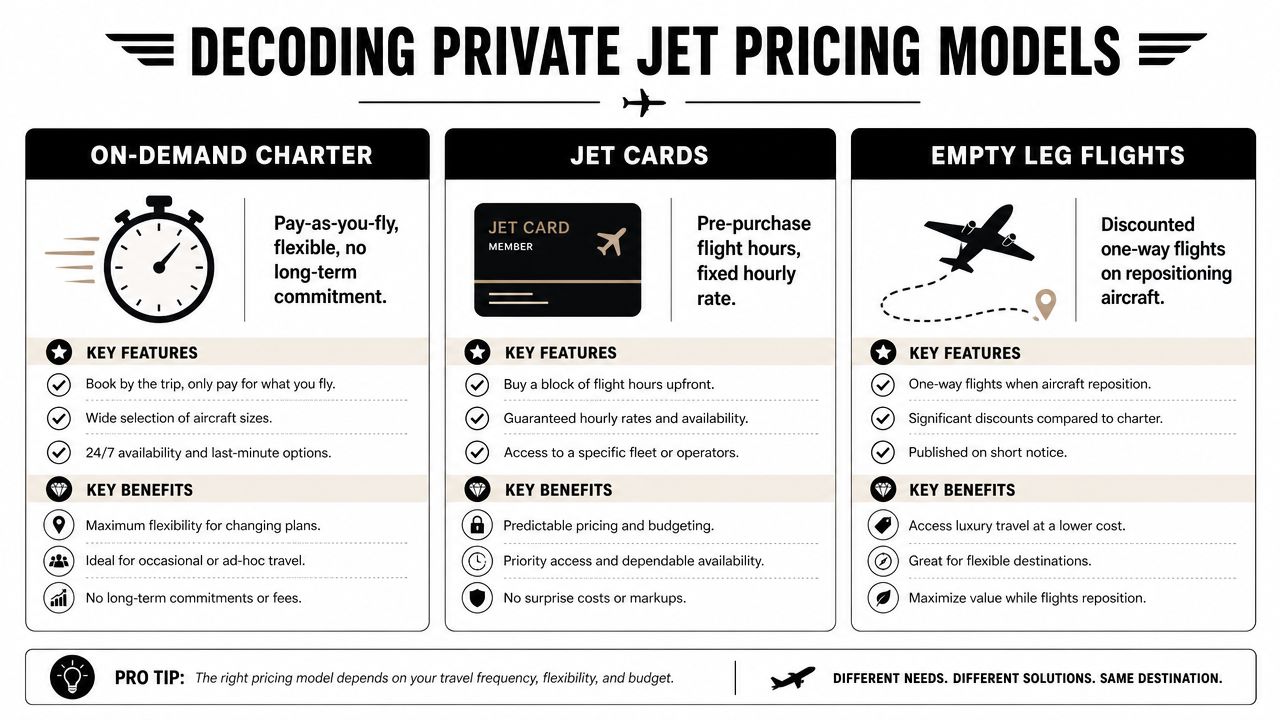
Private aviation pricing gets confusing because clients often compare products that solve different problems. A private jet rental app might show on-demand charter, empty legs, or membership-style options in one place, but the economics behind those options aren't the same.
On-demand charter
On-demand charter is the cleanest model for occasional and route-specific flying. You request a trip, the market prices that trip, and you pay for that mission. No prepaid commitment. No annual buy-in. No obligation to use a specific fleet.
This model tends to work best when you value flexibility over predictability. It also exposes the underlying route economics more transparently, especially if the app shows where the aircraft is based and how pricing was constructed.
Jet cards
Jet cards appeal to travelers who want simplified purchasing and a sense of access continuity. You pre-purchase hours or deposit funds, usually in exchange for fixed-rate logic, program rules, or scheduling preferences.
The trade-off is that “predictable” pricing can hide inefficient routing. If the provider has to bring an aircraft in from elsewhere, the client often absorbs that cost indirectly, even when the invoice looks standardized.
Empty leg flights
Empty legs are opportunistic. They arise when an aircraft needs to reposition anyway, and a traveler can use that one-way movement. For flexible leisure schedules, they can be useful. For business travel with fixed timing, they're unreliable by design.
They're best treated as a bonus market, not a primary travel strategy.
The hidden line item clients miss most often
The biggest pricing mistake in charter isn't usually choosing the wrong category. It's ignoring where the aircraft starts its day.
Some platforms use AI and operational modeling to evaluate over 300 points, including range, airport constraints, and aircraft performance, in order to produce more transparent route-specific pricing, according to Resident's coverage of AI in private aviation. That operational modeling matters because repositioning an aircraft to your departure city can inflate charter prices by 20 to 40 percent compared with sourcing a local aircraft, as described in the same report.
That's the number discerning buyers should remember. Not because every quote will show it explicitly, but because that's where many avoidable costs live.
A practical comparison
- Choose on-demand charter when you want the best aircraft for a specific mission.
- Choose a jet card when you prioritize program convenience and expect to fly often enough to value that structure.
- Use empty legs when your schedule is flexible and the route happens to align.
A transparent app should help you understand which model you're buying, not blur the differences.
For a deeper look at how fees stack up beyond the headline quote, this private jet charter pricing breakdown is worth reviewing before you compare providers.
Buyer's shortcut: Ask one question early. “Is this quote based on an aircraft already near my departure airport?” If the answer is vague, the price probably is too.
Verifying Safety The Role of ARGUS and Wyvern
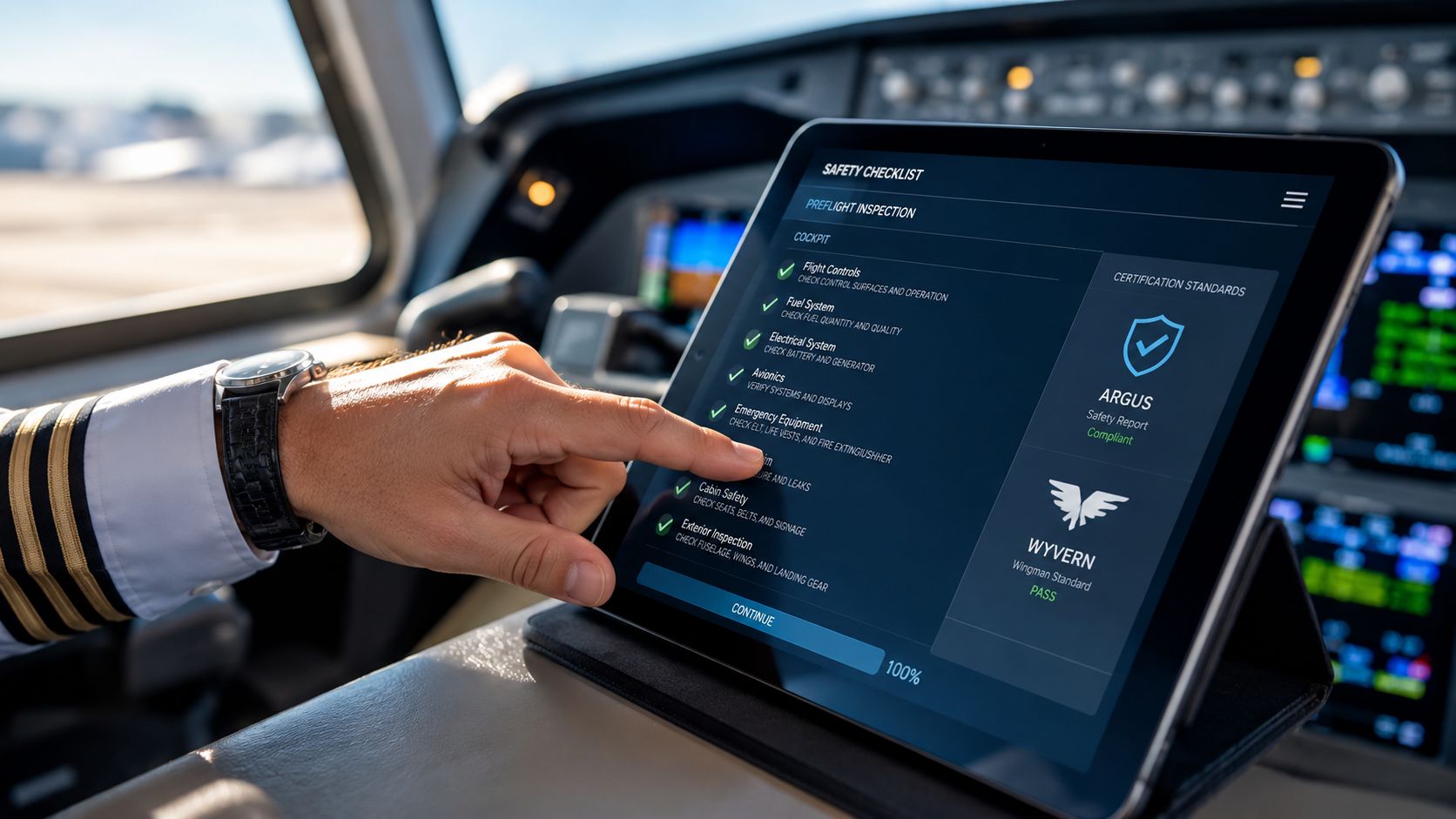
Safety claims in private aviation are easy to make and hard for clients to verify on their own. That's why third-party audit standards matter so much. They give travelers a way to separate polished sales language from independently reviewed operating discipline.
Why audited standards matter in app-based booking
Many travelers want to know whether they can verify the operator before paying. That concern is valid. App stores and booking platforms often emphasize broad access, while providing less clarity on who operates the aircraft, what third-party audit status they hold, and what crew or tail details can be confirmed prior to departure, as reflected in this discussion of app-based charter transparency.
That information shouldn't be buried. It should be part of the buying process.
What serious clients should ask for
ARGUS and Wyvern matter because they represent outside scrutiny. In practice, a strong safety screen should include operator audit status, aircraft identity, and crew-level confirmation before the trip is finalized.
Ask these questions directly:
- Who is the operating carrier? The seller and the operator are not always the same.
- What third-party audit status does that operator hold? Don't accept generic claims of being “fully vetted.”
- Will I receive the exact tail number before departure? Serious travelers should insist on aircraft-level clarity.
- Can you confirm crew and insurance details? Corporate flight departments and security teams often require this.
A provider that hesitates on those points is telling you something.
Safety is not a marketing feature
Some clients still treat safety information as a nice extra after pricing and aircraft photos. That order should be reversed. Price only matters after you've established that the operator meets the standard you require.
For a more detailed primer on how these audit systems are used in practice, this guide to Wyvern and ARGUS safety ratings is a useful reference.
Don't ask whether the app is reputable. Ask whether the operator flying your trip is independently audited and fully disclosed before payment.
Modern Payment Options Including Cryptocurrency
A modern private jet rental app shouldn't stop innovating at search and booking. Payment matters too, especially for international clients, principals moving quickly across borders, and buyers who prefer more flexible settlement methods.
Cryptocurrency comes up most often in situations where traditional banking rails are slower than the travel timeline. A client may be overseas, moving funds across jurisdictions, or trying to avoid delays tied to bank cutoffs and manual approvals. In those cases, crypto can be a practical payment option, not a novelty.
When crypto makes operational sense
The best use case is speed paired with clarity. The provider quotes the trip, confirms the aircraft, locks the booking terms, and converts the payment workflow into a process the client can complete without waiting on a conventional wire cycle.
This usually works well for:
- International bookings: Cross-border settlement can be smoother than traditional transfer timing.
- Time-sensitive departures: Same-day or next-day flights often benefit from faster payment completion.
- Privacy-minded clients: Some travelers prefer not to route every high-value transaction through standard banking channels.
Businesses evaluating the broader operational side of digital settlement can get a useful overview from Suby's guide to accepting crypto payments for business.
What to verify before paying this way
Crypto payments still require discipline. Confirm the aircraft, operating carrier, cancellation terms, and booking status before funds move. A reputable provider should document the transaction process clearly and explain how payment timing affects release of the aircraft.
Clients interested in this route can review Haute Jets' crypto charter payment options for a practical example of how a private aviation company handles digital-asset bookings.
The point isn't that every traveler should pay this way. It's that a modern charter experience gives clients more than one workable path to close a flight.
The Haute Jets Model Smarter On-Demand Charter
A client opens an app, sees an attractive quote, and assumes the job is done. In practice, the important questions come after the first number appears. Where is the aircraft based? Who is the actual operator? Has that operator been screened beyond a basic certificate check? Those details decide whether the trip stays efficient, safe, and predictable.
Why the market is moving this way
Demand for private charter is growing, and clients are less willing to accept vague sourcing or category-only promises. They expect speed, but they also want to know what is driving the quote and who is operating the flight.
That shift matters because app convenience alone does not fix charter inefficiency. If an aircraft has to reposition from another region, the traveler still pays for that movement one way or another. If operator review happens late, the booking can look clean on screen and still raise avoidable questions during final confirmation.
What a smarter model looks like
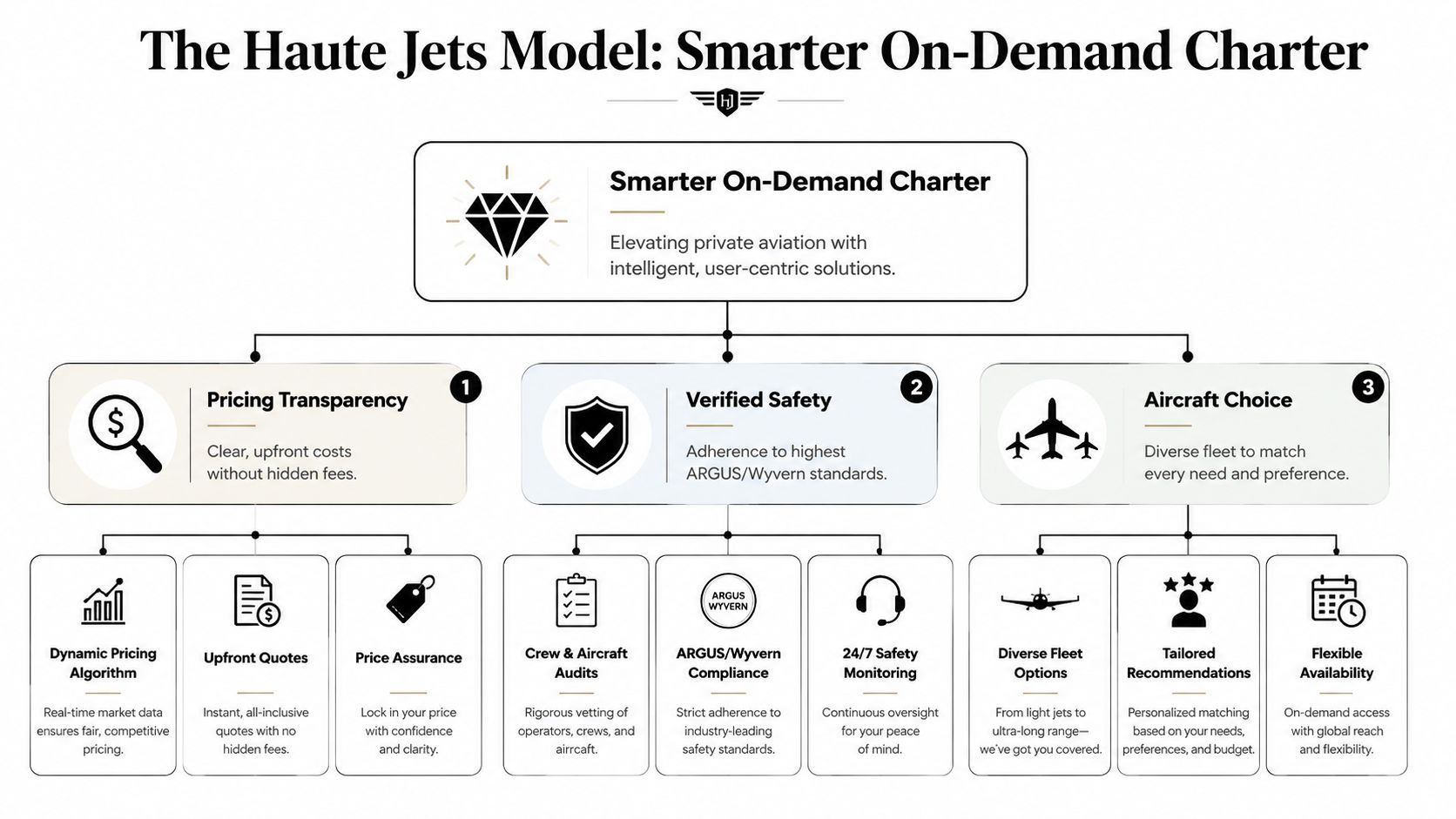
A stronger on-demand model is built around a few operating principles:
- Direct access to owner-operator supply: Fewer intermediaries usually means cleaner communication and less price distortion.
- Local or regional aircraft sourcing: Aircraft closer to the departure point often reduce ferry time, crew complexity, and repositioning cost.
- Aircraft-specific approval: Clients should see the actual tail option being offered, not just a cabin category.
- Audited operator standards: ARGUS and Wyvern screening should be part of sourcing before the quote is presented, not treated as an afterthought.
Each of those points affects both cost and risk. A nearby aircraft can look slightly more expensive at first glance, then become the better trip once repositioning exposure is considered. An exact aircraft assignment gives the client a chance to review cabin condition, range fit, baggage capacity, and operator history before committing.
Why this solves the fundamental app problem
Many private jet apps are polished on the front end and thin on the operating side. They make it easy to request a flight, but they do not always show how the aircraft was sourced or whether the quoted option is the one most likely to hold up operationally.
The stronger model treats charter as an execution business first and a software business second. That is the difference between a platform that only displays inventory and one that helps clients avoid paying for inefficiency they did not choose.
For repeat charter users, that distinction shows up quickly. Travel managers care about fewer surprises. Family offices care about operator quality and documentation. Principals care about time, discretion, and avoiding last-minute aircraft swaps.
If a platform cannot explain repositioning exposure, operator vetting, and exact aircraft assignment in plain language, the app is doing less than it appears to do.
If you want a charter experience built around transparent pricing, exact aircraft choice, and access to 3,500+ aircraft in 175 countries through Wyvern and ARGUS-rated operators, Haute Jets offers a direct, on-demand model designed to reduce hidden repositioning costs and give clients more control before they book.