

If you're in Calgary and need an aircraft quickly, the pressure usually isn't about whether private aviation can work. It's about whether the quote is clean, whether the airport choice makes sense, and whether the jet you're being shown is right for the trip.
That's where most first-time charter clients get tripped up. They compare hourly rates, skim past ferry charges, and assume all Calgary departures work the same way. They don't. A same-day meeting in Vancouver, a family departure to Aspen, and a nonstop long-range mission all call for different aircraft, different airport logic, and a different cost structure.
Calgary is also not a fringe private aviation market. It has real operating depth. In a global 2024 industry review, Calgary-based AirSprint ranked as the sixth-largest charter and fractional operator, flying 33,490 hours across 45 jets, with an average of 744 hours per aircraft, noted as the third-highest average after NetJets and Flexjet in the same review. The same review also cited a 2022 Canadian operator ranking that placed Calgary-based AirSprint at the top of the country's private aviation list with 27,233 flight hours. That matters because it points to a city with meaningful fleet activity, not just passenger demand (SherpaReport industry review).
Your Guide to Private Jet Travel from Calgary
A Calgary client calls at 7:15 a.m. They need to be in Vancouver by lunch, want to bring skis for a weekend extension, and assume the closest answer is the first light jet available. In practice, the actual decision often starts one step earlier. Depart from YYC or Springbank, and the difference can show up in drive time, handling pace, repositioning cost, and how quickly the aircraft can get airborne.
That is the part generic charter guides usually miss. Calgary private aviation is not just about picking a jet category and applying an hourly rate. It is about matching the mission to the airport, checking where the aircraft is coming from, and understanding how local operating realities affect the final invoice.
For Calgary travelers, four questions usually settle the trip fast:
- How quickly can the aircraft be ready? Availability means little if the jet still has to reposition into Calgary.
- Which airport fits the mission better? YYC can make sense for some itineraries, but Springbank is often the cleaner option for private departures that value speed on the ground and a quieter FBO experience.
- Will the aircraft still perform as expected in real conditions? Winter temperatures, baggage volume, passenger count, and runway choice can all change what works on paper.
- Is the quote built around the actual trip or a headline rate? A low hourly figure can lose its appeal once positioning, de-icing, handling, and waiting time appear.
A practical quote review starts with airport logic. YYC offers airline-level infrastructure and can be the right choice for certain international routings, larger cabin aircraft, or clients connecting from commercial service. Springbank often wins on convenience for domestic charter because it is purpose-built around general aviation and usually involves less ground friction. That said, Springbank is not automatically cheaper. If the aircraft is parked at YYC, or if your operator has stronger support there, forcing a YBW departure can add repositioning time that wipes out the convenience advantage.
That trade-off is where experienced brokerage matters. I would rather show a client two honest options, one from YYC and one from YBW, than present a single attractive number that falls apart once the trip is confirmed. If you want a useful baseline before requesting a trip-specific quote, Haute Jets lays out the moving parts clearly on its private jet charter pricing page.
The same discipline applies when the mission is more specialized. A medical movement, for example, follows a different cost structure and airport decision tree than an executive charter. The medical plane cost guide is a helpful reference for understanding that difference.
Calgary has long supported serious charter activity, and that history shows up in how the market operates today. The city serves corporate travel, resource-sector movement, family leisure departures, and long-range international flying. Clients who understand that local mix tend to ask better questions, choose the right airport faster, and avoid paying for inefficiencies that never needed to be there in the first place.
Decoding Calgary Private Jet Costs
Most clients ask for an hourly rate first. That's fine as a starting point, but it's not how I'd evaluate a charter quote. I'd look at the billable flight time, then check every extra line item that can shift the final number.
Industry benchmarks give you a workable baseline. Turboprops often price around $1,200 to $1,800 per hour, light jets around $2,200 to $3,000 per hour, midsize jets around $2,800 to $3,800 per hour, and heavy jets around $5,000 to $8,000 per hour. A complete quote should also account for fuel, crew, and landing fees, plus the 7.5% Federal Excise Tax on U.S. domestic legs (charter pricing benchmarks from EVO Jets).
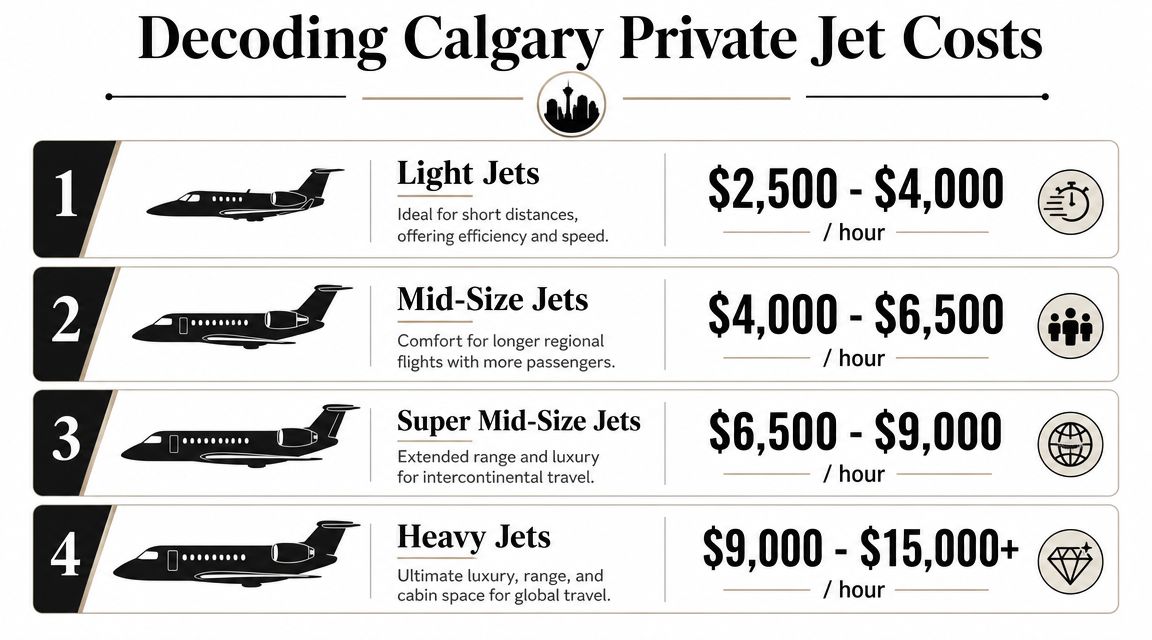
What actually drives the total
A quote usually breaks down into a few categories:
| Cost element | What it means in practice |
|---|---|
| Billable flight time | The flying time you're charged for, which may differ from your simple gate-to-gate assumption |
| Fuel and crew | Often folded into the rate on some quotes, separated on others |
| Landing and handling | Airport-specific charges that vary by routing and ground support |
| Tax exposure | Relevant on U.S. domestic legs because of the 7.5% Federal Excise Tax already noted above |
| Repositioning | Empty ferry flying before or after your trip, often the biggest avoidable cost |
The mistake I see most often is comparing aircraft category first and sourcing logic second. It should be the reverse. A slightly higher hourly rate on a locally positioned jet can beat a lower hourly rate on an aircraft that has to come in empty from another city.
The hidden line item clients miss
For private jet rental in Calgary, the biggest avoidable cost is often repositioning. If the aircraft has to ferry into Calgary before your departure, that empty leg is usually reflected in your quote whether it's labeled clearly or not. In practice, that can reshape the economics of the trip faster than a small difference in hourly pricing.
That's why I advise clients to ask these questions before approving anything:
- Where is the aircraft based right now
- Is the quoted time all passenger time, or does it include ferry segments
- Are fuel, crew, landing, and handling itemized
- Does this itinerary include any U.S. domestic portion that triggers tax treatment
A clean quote isn't the one with the lowest opening number. It's the one you can audit in two minutes.
If you're comparing private aviation pricing with specialized transport categories, a useful outside reference is this medical plane cost guide, which shows how mission profile and operational requirements can change aircraft economics in ways passengers don't always expect. For a general charter benchmark and category pricing view, Haute Jets also maintains a pricing page for on-demand charter.
Choosing Your Aircraft and Calgary Airport
Aircraft selection should start with the trip, not with a favorite model. Calgary travelers often ask for a light jet because it sounds efficient, or a heavy jet because it sounds safer for longer sectors. Neither approach is precise enough. What matters is range under real conditions, passenger count, baggage, and the airport plan on both ends.
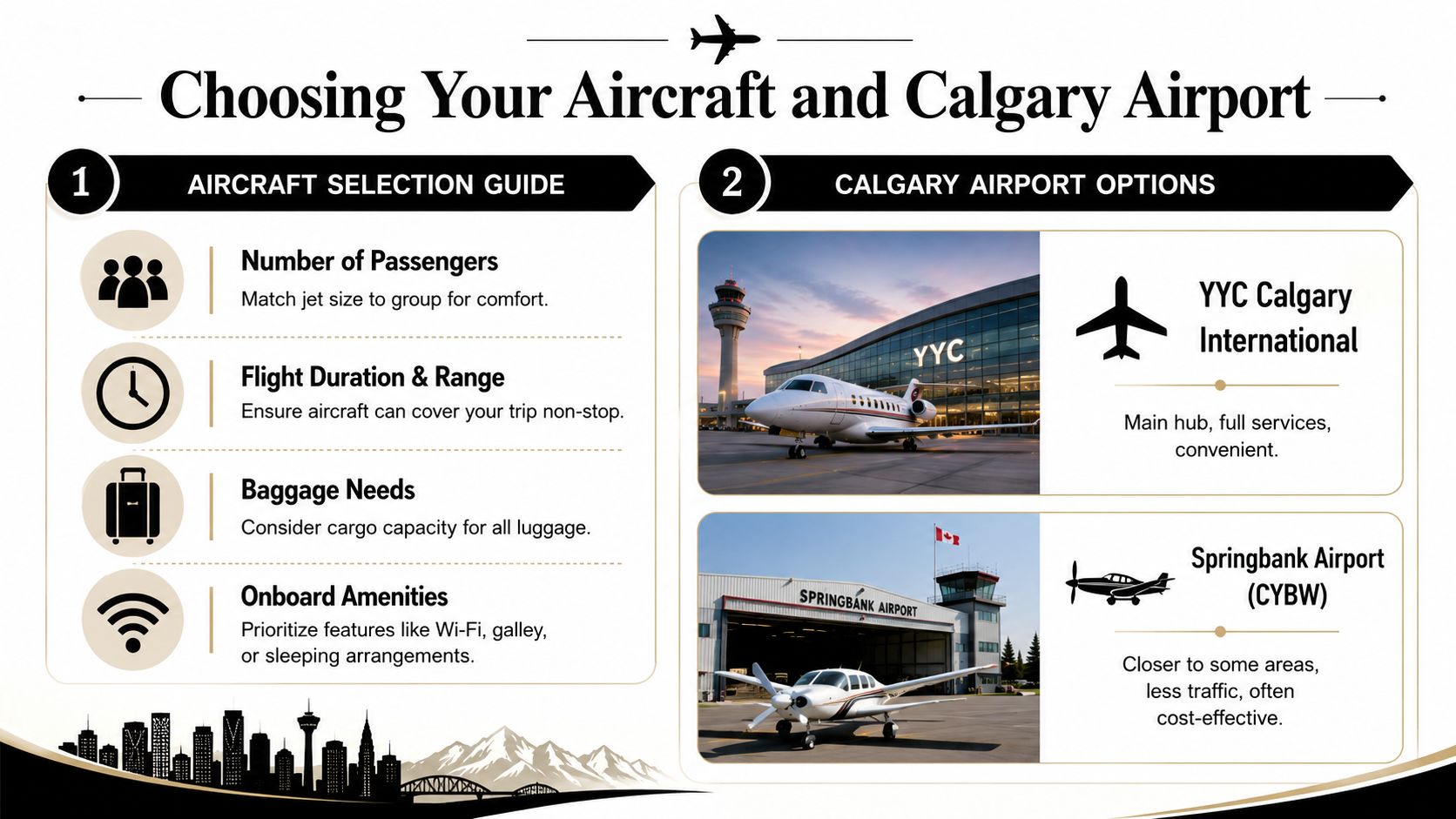
Match the aircraft to the mission
For short regional flying, a smaller aircraft may be exactly right. If the trip is a quick business hop or a short leisure route with light baggage, you don't need to pay for more cabin and range than the mission requires.
For a longer North American route, the answer often shifts. You may want a midsize aircraft for additional comfort, operational margin, and baggage flexibility, especially when the itinerary includes executives, winter gear, or schedule sensitivity.
For true long-range departures, Calgary changes the equation. A Calgary to Hawaii mission is commonly framed as about 6 to 7 hours, and aircraft such as the Falcon 7X and Challenger 604/605 are used for that profile because range and cabin size are central to the trip, not optional features (Sunwest Aviation on Calgary to Hawaii planning).
That's the practical takeaway. If you're trying to fly a long westbound route out of Calgary in winter with passengers and luggage, the conversation isn't just about whether a jet can technically make the distance. It's about whether it can do it nonstop, with the right cabin, with baggage, and without compromising payload.
YYC and Springbank are not interchangeable
Most generic city pages mention both airports. Few explain how to choose between them.
A better way to think about it is this:
| Decision factor | YYC Calgary International | Springbank YBW |
|---|---|---|
| International handling | Often the more natural fit for international departures and arrivals | Better suited when the mission and aircraft profile align with a quieter alternative |
| Facility depth | Broad private aviation support and full-service environment | Simpler, lower-traffic feel |
| Ground strategy | Can work well if your business, home, or onward transfer makes YYC logical | Often appealing if you want a more discreet, less congested experience |
| Cost impact | May reduce repositioning if the locally available aircraft is already tied to YYC support | May reduce time on the ground depending on where you're headed and how the operator is positioned |
Independent Calgary charter material points to the market being structured around airport-specific service points rather than one citywide private terminal, with YYC's private aviation facilities and Springbank positioned as a quieter alternative (Calgary charter airport overview).
Choose the airport the aircraft can serve efficiently, not the one that sounds more exclusive.
How I'd choose between YYC and YBW
Use YYC when the trip involves international processing, broader handling support, or an aircraft already staged around Calgary International. That can simplify the operation and reduce the chance that your chosen plane needs to be moved around the city before departure.
Use Springbank when discretion, lower traffic, or west-side convenience matters more, and when the aircraft type and operator setup make that airport the cleaner operational choice.
A smart broker should be able to tell you three things immediately:
- Which airport reduces your door-to-door friction
- Which one aligns with the aircraft's actual position
- Whether the airport choice changes the quote, not just the drive
If you want to compare actual aircraft classes and cabin options before narrowing the mission, a useful reference point is the Haute Jets fleet overview.
The Charter Booking Process From Quote to Takeoff
A Calgary client often reaches out with a simple brief: four passengers, early departure, same-day return if possible. The quote only gets reliable once the operating details are clear, especially if timing is tight or the trip may require customs, de-icing, or a specific airport handoff. Small omissions at the start usually show up later as delay, aircraft swaps, or added cost.
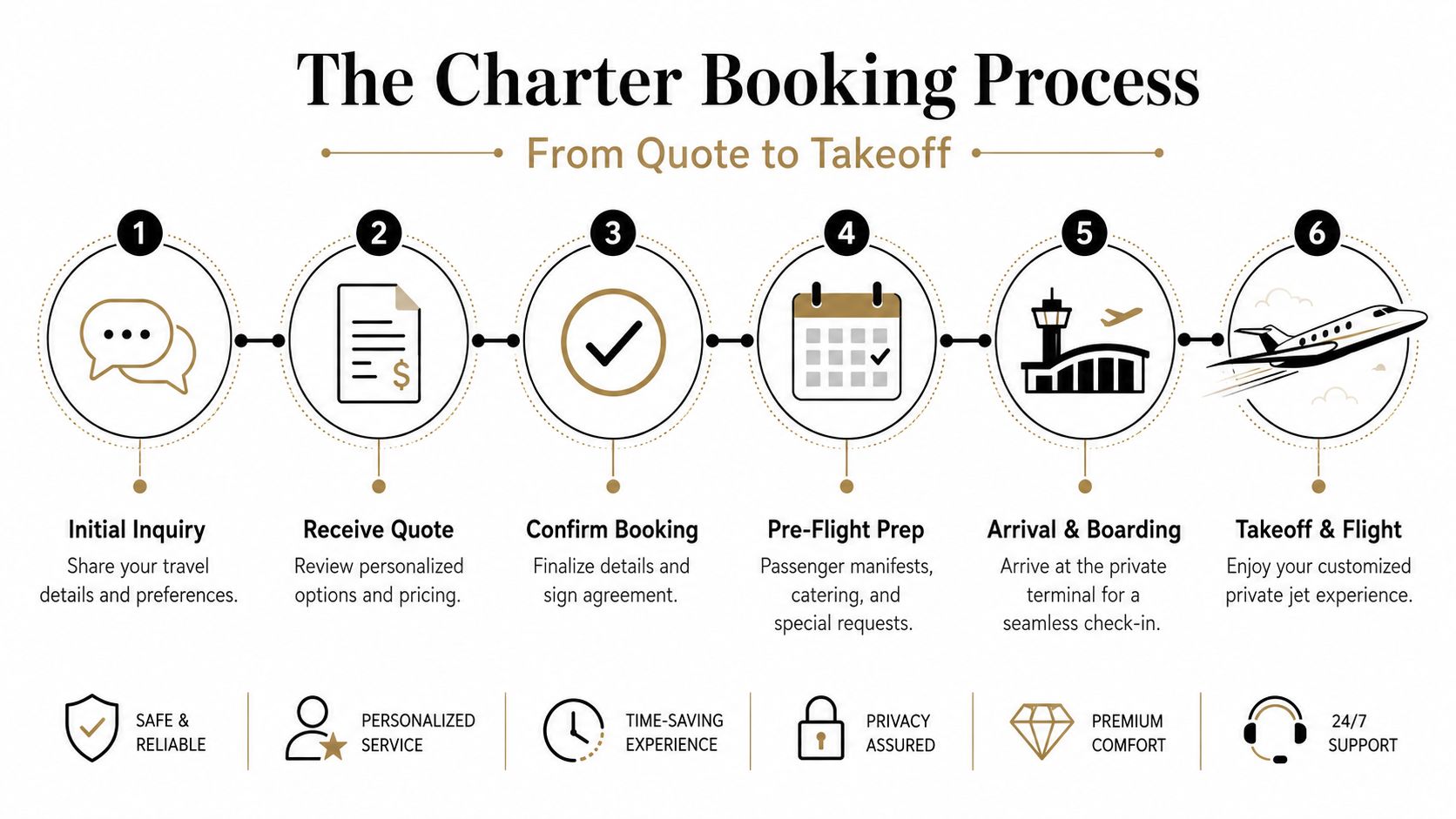
Start with the details that shape the quote
The fastest way to get to a usable quote is to give the broker the actual mission, not a rough outline.
That means:
- Passenger count
- Desired departure timing
- One-way or round-trip routing
- Baggage profile
- Pet travel, catering, or ground transfer needs
- Preferred airport if you already have one
From Calgary, I also want to know what is fixed and what is flexible. If the meeting is in Vancouver and the arrival time matters more than the exact aircraft model, that creates more room to source efficiently. If you need a specific cabin size, a pet-friendly operator, or a late-night departure from Springbank, say that at the start. It saves time and avoids quotes that look competitive until the operation is built properly.
For clients who ask about special pricing opportunities, it also helps to review how empty leg flight booking works in practice. Those trips can offer value, but only if your schedule can absorb the limits that come with them.
Review the agreement like an operator would
Once the quote arrives, the aircraft type and total price are only part of the decision. The contract tells you how the trip will be handled if weather changes, the aircraft goes mechanical, or the schedule moves by a few hours.
Read these points closely:
- Cancellation terms
- Aircraft substitution language
- De-icing, handling, and special service charges
- Passenger manifest requirements
- Payment timing and accepted methods
In Calgary, winter terms matter more than many first-time charter clients expect. A quote can be clean on paper and still leave room for added operational charges if the agreement does not spell out how cold-weather services are handled. The same applies to airport-specific coordination. If your departure is built around YYC or YBW for a practical reason, make sure that airport is clearly reflected in the paperwork and final itinerary.
Some clients also want payment flexibility, including digital assets. Raise that early. Payment delays are one of the easiest ways to slow a charter that was otherwise ready to go.
Safety verification and final trip confirmation
You should know exactly who is operating the flight before travel day. That includes the operator name, aircraft tail number, crew details, and the final departure plan.
A disciplined process should include:
- final passenger manifest confirmation
- any catering adjustments
- pet handling instructions
- ground transport coordination
- airport and FBO confirmation
Ask for the tail number, crew details, and final itinerary before the day of departure. Serious operators and brokers expect that request.
A sound on-demand model keeps this process straightforward. No membership layer. Specific aircraft options. Clear pre-flight confirmation. Haute Jets follows that structure and sources from Wyvern Wingman or ARGUS Gold or Platinum-rated operators, with a 24-hour pre-flight confirmation that includes the tail number, crew bios, weather briefing, and passenger manifest. That is the kind of process I would want in place for a Calgary departure, particularly when timing is tight and there is little room for last-minute confusion.
Insider Tips to Save on Your Calgary Jet Charter
The easiest way to overpay for a charter is to focus on headline rates and ignore sourcing. The easiest way to save money without cutting corners is to reduce avoidable aircraft movement.

Local sourcing beats bargain hunting
For private jet rental in Calgary, repositioning fees can inflate a charter quote by roughly 20% to 40% when the aircraft must ferry in from another city. Calgary-specific charter information also notes that local availability can support departures with as little as 4 hours' notice when aircraft and crew are positioned nearby (Calgary charter availability and repositioning guidance).
That single issue changes how I'd shop the market. I wouldn't start with "Who has the lowest rate." I'd start with "Which suitable aircraft is already near Calgary."
Here's what tends to work:
- Prioritize local metal: Ask for aircraft already based at or near Calgary first.
- Be flexible on model, firm on mission: If two aircraft can do the trip equally well, choose the one that avoids ferry cost.
- Use airport choice strategically: Sometimes the smarter airport is the one that aligns with where the aircraft is already positioned.
- Book same-day only when the setup supports it: Fast departures are realistic when crew and aircraft are nearby, not when the operation has to be assembled from another city.
Empty legs can help, but they aren't a plan
Empty leg flights get attention because they can look attractive in a quote comparison. The problem is reliability. They depend on someone else's primary itinerary, and that can change.
They're best used when:
- your schedule is flexible
- the route already matches your need
- you're comfortable with the fact that the opportunity may disappear
For a grounded explanation of how that market works, this guide to booking empty leg flights is worth reading before you build a trip around one.
Calgary is a better sourcing market than many clients realize
A useful advantage in Calgary is that the city isn't just consuming charter capacity. It supports meaningful fleet activity. That improves the odds of finding an aircraft nearby that fits the mission without layering on unnecessary repositioning.
That's where a sourcing-driven approach pays off. You're not trying to buy the lowest advertised category rate. You're trying to remove waste from the operation before the quote is finalized.
Your Pre-Flight Checklist for a Perfect Charter
Before you approve any booking, stop and run a final check. Most charter problems show up before departure, not in the air. If the details are tight, the trip usually is too.
The checklist I'd use in Calgary
- Confirm the exact aircraft: Don't settle for a broad category if the actual tail assignment matters to you.
- Verify the operator's safety credentials: Ask for the third-party safety standard the operator holds.
- Audit the quote: Make sure fuel, crew, landing, and handling assumptions are clear.
- Lock the airport plan: Confirm whether you're using YYC or Springbank, and make sure the FBO details are in writing.
- Check baggage realism: Golf clubs, ski bags, work equipment, and pet gear all change aircraft suitability.
- Finalize special requests early: Catering, pets, car service, and security support should be arranged before the last day.
- Read the cancellation terms: Weather, aircraft substitution, and client schedule changes should all be addressed.
The smoothest charter day usually comes from the least glamorous work done two days earlier.
What works and what doesn't
What works is a booking process built around the mission. The aircraft fits the route. The airport fits the ground plan. The quote reflects where the aircraft is. The operator credentials are documented. The passenger list is final.
What doesn't work is rushing from a low headline number to a signed agreement without checking the positioning, airport logic, and operating terms.
That's the true value in understanding private jet rental Calgary at a practical level. Once you know how to read the trip correctly, private aviation stops feeling opaque. It becomes what it should be: a precise, efficient travel tool.
If you want help structuring a Calgary charter the right way, Haute Jets can source on-demand aircraft near your departure point, show the exact jet available, and provide a clear quote before you commit.