
A lot of private jet rental in Canada starts with a simple assumption that turns out to be wrong. The assumption is that if you know the route and the aircraft category, you know the price.
You usually don't.
A Toronto departure with a same-day meeting in Calgary, followed by a lodge transfer or a return through a smaller airport, can price very differently depending on where the aircraft is based, whether the airport can legally receive the flight as planned, and whether winter operations are in play. Canada rewards private aviation because distances are long, airline schedules are rigid, and many trips don't fit the usual hub-and-spoke pattern. But Canada also punishes vague planning.
That's why private jet rental Canada needs a Canada-specific lens, not a generic charter checklist copied from a U.S. market page.
Navigating Private Jet Rental in Canada
A client leaves downtown Toronto after an early board meeting, needs to be in Calgary the same afternoon, then wants to continue to a smaller airport the airlines do not serve well. On paper, that sounds like a simple charter. In Canada, it rarely is.
Private flying works exceptionally well here because the country is large, the major business centres are far apart, and many profitable trips involve a second stop that commercial schedules handle poorly. The key is knowing what turns a workable itinerary into an expensive one. In Canada, that usually comes down to aircraft positioning, winter operating conditions, and whether the airports on your routing can support the flight you want to make.

For a first charter, the right question is straightforward: what setup gives you the itinerary you need without adding avoidable cost or regulatory friction?
The Canadian variables that change everything
A Canadian charter quote usually hinges on a few operational realities:
- Long repositioning distances: An aircraft may need to come from another province before your trip even starts. That ferry time is often one of the biggest pricing differences between two otherwise similar quotes.
- Airport of Entry planning: If the itinerary involves an international leg, or even a domestic routing that connects with cross-border travel, using a CBSA-designated Airport of Entry can determine whether the plan is practical or needs to be reworked.
- Winter operations: De-icing, weather delays, and cold-weather procedures are standard parts of Canadian flying for much of the year. They affect both cost and timing.
- Aircraft fit: A larger jet is not automatically the better choice. For many domestic missions, the smarter option is the aircraft that can operate efficiently from the airports you need and is already close to the point of departure.
Practical rule: The best charter in Canada is usually the aircraft that is nearby, approved for the route, and scheduled through the correct airport pair, not the one with the highest cabin category.
Clients who are new to private aviation often benefit from reading our guide to chartering a private jet in 2026. For Canadian trips, the advantage comes from understanding the operating details before the quote is issued, not after the aircraft is booked.
Understanding Private Jet Rental Costs in Canada
The headline hourly rate is only the starting point. In Canada, the all-in charter price often depends more on positioning logic than on the published aircraft category.
Independent Canada-facing charter sources place typical pricing around $2,000 to $14,000 per billable flight hour, with approximate starting points of $2,000 for a turboprop, $5,000 for a light jet, $7,000 for a midsize jet, and $10,000 or more for a long-range jet, as summarized by Monarch Air Group's Canada charter pricing guide. Those ranges are useful, but they don't explain why two quotes for the same route can be far apart.
What's actually inside a Canadian charter quote
A real quote usually combines several moving parts:
- Billable flight hours: The airborne portion you expect to pay for.
- Repositioning or ferry time: If the aircraft isn't local, the client often covers the leg to bring it to the departure city.
- Crew time and overnights: These become relevant on longer or multi-day itineraries.
- Airport and handling charges: Especially relevant when using less common airports or cross-border routing.
- Winter operational costs: Most notably de-icing when conditions require it.
The repositioning issue is where many clients overpay. In Canada, aircraft aren't evenly distributed across every city pair. If your departure is far from the aircraft's base, that deadhead movement gets absorbed into the quote.
Why local sourcing matters more in Canada
NovaJet's Canadian pricing discussion is one of the clearest explanations of this issue. It notes that a 10-seat midsize jet is often quoted around CAD $4,500 to $7,500 per flight hour, while a transcontinental one-way mission can move into the CAD $32,000 to $48,000 range depending on aircraft and city-pair, with repositioning being a major factor in the final quote, as detailed in NovaJet's breakdown of hourly private jet costs in Canada.
The farther the aircraft must travel before your trip begins, the less meaningful the advertised hourly rate becomes.
That's why clients should ask a direct question before comparing quotes: Where is the aircraft based right now?
Estimated One-Way Charter Costs for Popular Canadian Routes 2026
The figures below use only verified Canadian pricing ranges and should be read as broad planning estimates, not fixed quotes.
| Route | Aircraft Class | Estimated Cost (CAD) |
|---|---|---|
| Toronto to Montreal | Turboprop or light jet | Based on typical starter pricing of about CAD $2,000/hour for turboprops and CAD $5,000/hour for light jets, final quotes vary with positioning and airport factors |
| Vancouver to Calgary | Light jet or midsize jet | Based on common guidance of about CAD $5,000/hour for light jets and CAD $7,000/hour for midsize jets, with local availability affecting the all-in quote |
| Toronto to Vancouver | Midsize jet or long-range jet | One-way transcontinental missions can range from CAD $32,000 to $48,000, depending on aircraft and where it is based |
How to read a quote properly
A discerning buyer doesn't fixate on the cheapest hourly number. Look for these signals instead:
- Is the aircraft local to the departure city?
- Is the quote specific about airport pair and timing?
- Is winter cost exposure already reflected?
- Does the cabin size match the mission, or are you paying for range and space you don't need?
For a deeper look at how operators and brokers structure these charges, this private jet cost breakdown is worth reviewing before you approve a trip.
Canadian Airspace Regulations and Documentation
Many charter problems in Canada aren't caused by flying. They're caused by paperwork, airport choice, and customs timing.
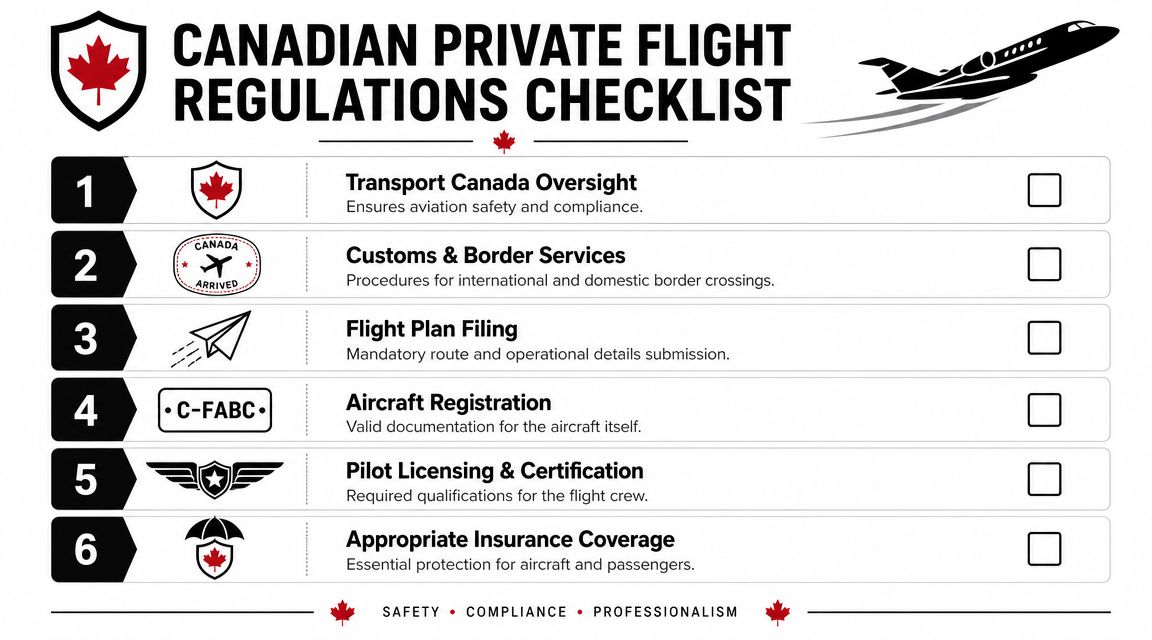
For cross-border private flights, it helps to think of the process this way. Transport Canada is the safety and operating side. CBSA is the border and entry side. One governs whether the flight is compliant as an aviation operation. The other governs whether the aircraft, crew, and passengers may legally enter as planned.
The non-negotiable entry rules
For U.S.-registered private aircraft entering Canada, the aircraft must carry original registration and airworthiness documents, a valid FCC radio station license, liability insurance meeting Canadian minimums, and travel documents for crew and passengers. BasicMed is not accepted for the pilot medical requirement in this context. Pilots must also submit CANPASS Private Aircraft arrival details to CBSA no less than 2 hours and no more than 48 hours before ETA, and the first landing must be at a designated Airport of Entry, according to Icarus Jet's guidance on Canada private flight entry and winter operations.
That timing window matters. Too early or too late can be a problem. So can choosing the wrong first airport.
A practical compliance checklist
For clients, most of this is handled behind the scenes. Still, you should know what must be correct:
- Aircraft documents: Original registration and airworthiness records must be available.
- Radio licensing: The aircraft needs the required FCC documentation for this operating context.
- Insurance proof: Coverage must meet Canadian requirements.
- Crew and passenger documents: Passports and any destination-specific travel requirements must line up before departure.
- Customs notice: CANPASS timing must be filed inside the allowed window.
- Airport selection: The first Canadian landing point must be a designated Airport of Entry.
A private flight can be operationally possible and still be commercially unusable if the customs notice is late or the first airport isn't approved for entry.
Where clients get into trouble
The most common planning mistake is treating a private charter like a purely flexible car service in the sky. It isn't. Flexibility is real, but it sits inside a regulatory frame.
If you're flying domestically within Canada, the burden is lighter than a cross-border arrival. But if your aircraft starts in the U.S. or your itinerary enters Canada from abroad, legal entry mechanics affect both schedule and airport choice. Good charter coordination solves this early, not on departure day.
Choosing Your Aircraft and Departure Airport
A client wants to leave Muskoka on a January morning, reach Calgary for meetings, and return the same night. The wrong charter choice turns that into a costly day. The right one starts with two questions: which aircraft can do the trip efficiently, and which airport keeps repositioning, winter handling, and ground time under control.
In Canada, aircraft selection is rarely just about cabin preference. Geography drives the decision. A jet based in southern Ontario may be workable for Toronto to Montréal, but expensive for a pickup in Kelowna or Halifax once ferry time is added. The aircraft that makes the most sense is often the one that fits the trip and is already positioned close to your departure point.
Matching aircraft to the mission
The mission should set the aircraft category.
- Turboprop for shorter sectors, secondary airports, and trips where operating cost matters more than speed. In Canada, that can be the smart choice for regional flying and airports with shorter runways.
- Light jet for quick business travel between major city pairs with a small group and limited baggage.
- Midsize jet for longer domestic sectors, better luggage capacity, and a more comfortable cabin for multi-hour flying.
- Long-range cabin for coast-to-coast itineraries, premium nonstop flying, or missions that continue onward to the U.S., Europe, or the Caribbean.
Range on paper is not the whole story. Winter winds, payload, runway conditions, and de-icing delays all affect what is practical. A light jet that looks fine for the route in summer may need a different fuel plan, or a different aircraft entirely, during a Canadian winter.
Baggage matters too. Ski equipment, golf clubs, and heavy winter luggage can push a smaller cabin out of contention faster than clients expect.
Departure airport can change the quote
Airport choice is one of the fastest ways to improve or worsen charter economics.
Your departure airport affects:
- Aircraft availability nearby
- Repositioning cost
- Runway and operating suitability for the aircraft
- De-icing and ground handling charges
- Customs practicality for cross-border itineraries
- Drive time to and from the airport
In large markets such as Toronto, Montréal, Vancouver, and Calgary, private flyers usually depart through an FBO, or fixed-base operator. That means a private terminal environment, faster ramp access, and less wasted time than the commercial side of the airport.
The largest airport is not automatically the best one. For some trips, a reliever airport lowers handling delays and gets the aircraft airborne faster. For others, a major airport is the better choice because the jet is already based there, the crew is in place, and winter support is more reliable. That trade-off should be priced, not guessed.
For cross-border arrivals or departures, airport choice also has to respect customs practicality. If the itinerary requires CBSA processing, using an Airport of Entry that matches your timing and aircraft plan avoids unnecessary repositioning or schedule friction.
The best departure airport is the one that fits the aircraft, supports the trip legally and operationally, and does not add avoidable ferry cost.
Clients often focus on upgrading the cabin. In Canada, choosing the right airport can save more money and more time than moving up one aircraft category.
Safety Vetting and Smart Cost-Saving Strategies
If a quote looks unusually cheap, the first question shouldn't be “How fast can I book it?” The first question should be “What exactly was removed to get the price down?”
In private aviation, there are smart savings and careless savings. They aren't the same.
Start with operator quality
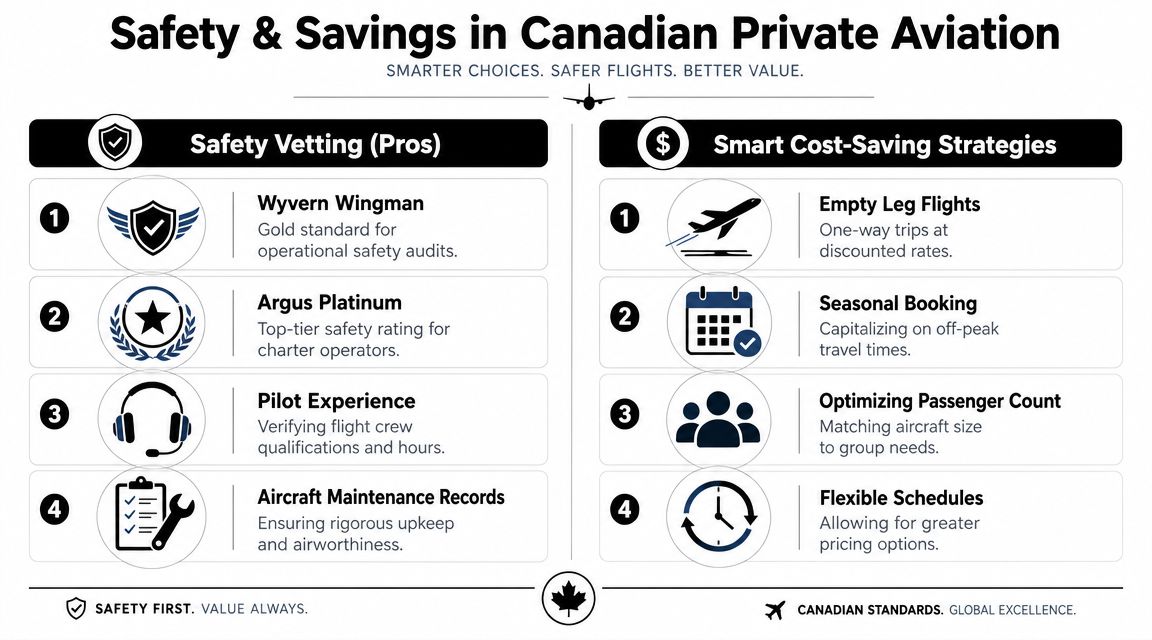
A professional charter process should begin with third-party safety vetting such as Wyvern Wingman and ARGUS Gold or Platinum operator standards. Those ratings matter because they give clients an external framework for evaluating operator discipline, pilot qualifications, and maintenance oversight.
If a provider can't clearly explain the operator's safety standing, that's a warning sign. Savings gained by stepping outside well-vetted operators are usually the wrong kind of savings.
The cost-saving moves that actually work
The mission should decide the buying strategy. That's especially true in Canada, where some trips justify charter immediately and others don't. Air Charter Service's Canada guidance makes the useful point that charter is often the rational choice for multi-stop itineraries, remote access, or confidentiality-sensitive travel, while simpler and more price-sensitive trips may be better served by another option.
That principle leads to a better savings framework:
- Use charter when the mission demands it: Multi-stop days, remote destinations, privacy requirements, and schedules that airlines can't support.
- Use local aircraft when possible: This usually reduces deadhead exposure and quote volatility.
- Be flexible on aircraft model: Flexibility inside the right cabin class often helps more than insisting on one specific tail.
- Treat empty legs carefully: They can work for flexible one-way trips, but they're not a reliable solution for time-critical travel.
Here's a short explainer that helps frame the trade-offs visually:
What doesn't work
These approaches sound good in theory and often disappoint in practice:
- Booking the biggest cabin for a short mission “just in case”
- Chasing an empty leg for an inflexible trip
- Accepting a vague quote with no aircraft location detail
- Prioritizing price over operator quality
A disciplined buyer saves money by matching the flight to the mission, not by stripping out the safeguards that make charter useful.
The Haute Jets Advantage for Canadian Charters
Canada exposes the weak points in a generic charter model. Large geography, uneven aircraft distribution, smaller-airport routing, and winter operating friction all make lazy sourcing expensive.
That's why the more effective approach is to solve the quote from the aircraft position outward, not from a marketing rate inward.
What a stronger charter model looks like
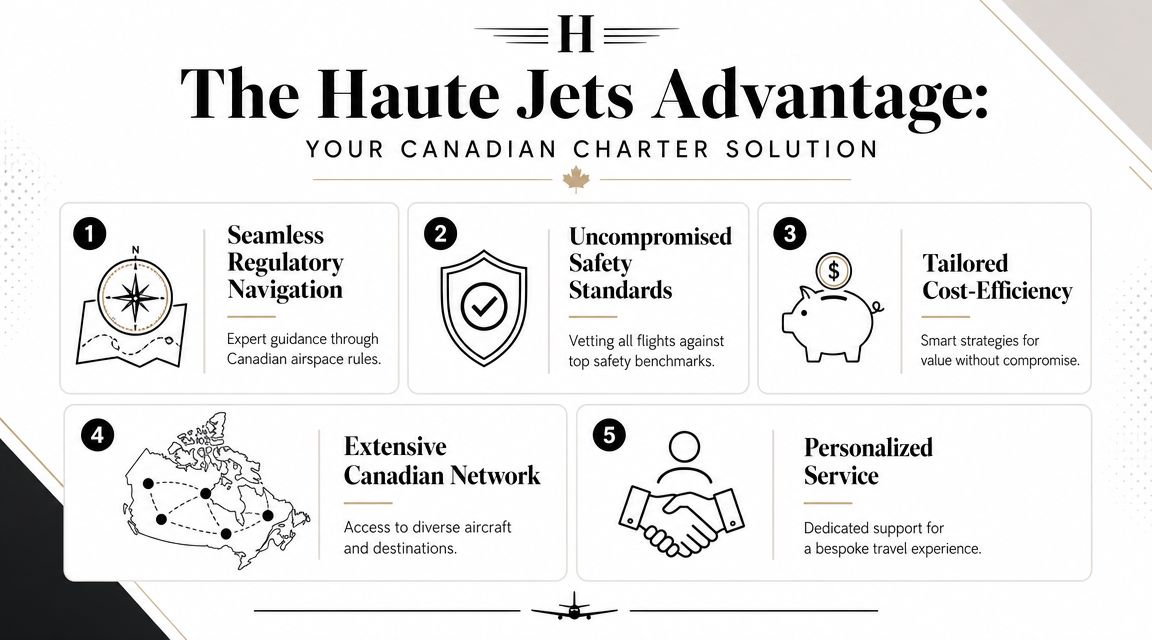
One of the biggest information gaps in this market is the difference between a low advertised rate and a realistic all-in price. Mercury Jets' Canada charter page reflects that gap clearly. Many providers lead with hourly pricing but don't explain how ferry legs, de-icing, and airport fees can change the final quote. The same discussion notes that local sourcing can reduce or eliminate repositioning charges often embedded by traditional brokers.
That's the practical lens serious buyers should use. Ask how the aircraft is sourced, how safety is vetted, and whether you can see the actual aircraft being offered.
Why this matters for Canadian clients
A provider such as Haute Jets private jet charter fits that Canada-specific need by focusing on local sourcing, exact aircraft selection, and chartering only through Wyvern or ARGUS-rated operators. For a Canadian traveler, those aren't branding details. They address the three issues that most often distort a trip: repositioning cost, operator quality, and quote opacity.
Bottom line: The right charter platform in Canada should tell you what aircraft you're flying, where it's coming from, and why that choice makes sense for your route.
The pay-per-flight structure also matters. Many infrequent charter clients don't need a membership or jet card. They need a clean quote for a specific mission, with less hidden positioning waste and tighter control over the assigned aircraft.
FAQs and Your Pre-Flight Checklist
Common questions from Canadian charter passengers
Can I bring pets on a private charter in Canada?
Often yes, but pet acceptance depends on the operator and aircraft. Confirm it at booking, not the night before departure. Cabin rules, cleaning requirements, and destination entry requirements can all differ.
How much luggage can I bring?
That depends on the aircraft type and the shape of the bags, not just the passenger count. Soft-sided luggage is usually easier to accommodate, especially on smaller aircraft. If you're traveling with skis, golf clubs, or bulky winter gear, disclose that early.
How far ahead should I book?
Earlier is better when the itinerary falls in peak periods, involves smaller airports, or needs a specific aircraft type. Last-minute charter is possible in many cases, but flexibility on timing and aircraft helps.
Is private charter always the right choice for short Canadian routes?
No. For a simple, price-sensitive trip with flexible timing, another premium travel option may be more sensible. Charter becomes far more compelling when the route, schedule, privacy need, or airport access makes commercial travel inefficient.
Your pre-flight checklist
Before you leave for the FBO, confirm these points:
- ID ready: Bring the passport or identification required for your route.
- Names verified: Make sure the passenger manifest matches legal travel documents.
- Airport confirmed: Verify the exact departure FBO, not just the airport code.
- Ground transport arranged: Confirm pickup and drop-off details on both ends.
- Baggage reviewed: Reconfirm any oversized luggage or special items.
- Pets cleared: Make sure the operator has approved them in advance.
- Arrival timing understood: Private terminals are faster, but you still need the correct reporting time.
- Weather discussed: In winter, ask whether de-icing or schedule adjustments are likely.
A well-run private flight feels effortless to the passenger because someone handled the details before they became problems.
If you're planning private jet travel within Canada or a cross-border itinerary into Canada, Haute Jets can help you evaluate aircraft sourcing, airport strategy, and operator vetting before you book. That's usually where the biggest cost and reliability differences show up.