

You need to leave New York fast. The meeting moved up, the family wants a weekend departure, or the commercial schedule no longer fits the day you need. Then the quotes start coming in. Same city pair, wildly different numbers, different airports, different aircraft categories, and very little explanation of what's changing the price.
That's normal in this market. New York is one of the busiest private aviation environments anywhere, and demand has expanded sharply. Independent industry reporting shows global private flights rose from 3.3 million in 2021 to nearly 5 million in 2022, with the United States leading departures at 3.3 million that year, and private flying was already 32.1% above 2019 levels by mid-May 2024 according to a trend report summarized by JetFinder's private aviation statistics. In practice, that means availability moves quickly, especially around business peaks, holidays, and destination surges.
Most first-time charter clients focus on the route. Experienced buyers focus on where the aircraft is coming from, which airport fits the mission, and whether the cabin is sized for the trip instead of the ego. That's where a New York charter gets efficient or expensive.
Navigating the New York Private Aviation Market

The New York charter market rewards precision. It punishes vague requests.
If you ask for “a jet to Miami tomorrow morning,” you'll get options. If you ask for “a nonstop departure for four passengers, light luggage, flexible between Teterboro and White Plains, wheels up after breakfast,” you're far more likely to get a quote that fits your budget and timing. The difference isn't wording. It's operational clarity.
Why New York feels more complicated than other markets
New York has several viable departure points, constant traffic pressure, and a heavy mix of business and leisure demand. That combination creates real price variation even before anyone talks about cabin class.
A charter from the right airport with a nearby aircraft can be straightforward. The same trip can become inefficient when the aircraft has to reposition from another field, when the selected airport is poorly matched to your destination on the ground, or when the requested cabin is larger than the mission requires.
Practical rule: In New York, the route is only one part of the quote. Airport choice and aircraft sourcing often decide whether the price feels reasonable or inflated.
That's the central issue in private jet rental in New York. Many travelers think they're comparing the same product when they're comparing very different operating setups.
What smart buyers control first
Before you approve a charter, tighten these four variables:
- Departure airport: The closest airport to Manhattan isn't always the most efficient for your actual day.
- Aircraft origin: A locally based jet usually creates a cleaner quote than one flying in to pick you up.
- Cabin size: Book for the mission, not the maximum category you can afford.
- Timing flexibility: Even a narrow window of flexibility can improve aircraft matching.
Some operators and brokers work from broad inventory and then fit your trip into whatever is available. The more disciplined approach is to source aircraft close to your departure city and compare real mission-fit options instead of generic categories. That's the logic behind the Haute Jets model: reduce waste by minimizing repositioning and giving the client control over the actual aircraft choice rather than pushing a broad class and backfilling details later.
What works and what doesn't
What works in New York is a short brief, a clear passenger count, realistic luggage details, and flexibility on airport when practical.
What doesn't work is locking yourself into a single airport too early, assuming the biggest jet is automatically the right one, or judging a quote by hourly rate alone.
A low hourly rate can still produce a bad total trip cost if the airplane isn't local to your departure point.
That's why the smartest New York charters aren't just booked quickly. They're structured carefully.
Strategic Airport and Aircraft Selection
Most articles about private jet rental in New York spend too much time on route pricing and not enough time on airport strategy. That's backwards. Independent charter guidance notes that comparing Teterboro, White Plains, and JFK by FBO quality, drive time, and aircraft suitability can materially affect total trip time and final cost, especially when it helps avoid unnecessary repositioning, as outlined in Air Charter Service's New York airport guide.
New York area private airport comparison
| Airport | Code | Drive Time from Midtown | Best For | Notes |
|---|---|---|---|---|
| Teterboro | TEB | Short drive for many Manhattan itineraries | Core business travel, fast access to Manhattan | Often the first airport clients ask for. Strong private aviation infrastructure. Can be busy during peak periods. |
| Westchester County | HPN | Better for northern suburbs and some uptown itineraries | Westchester, Greenwich, northern access | Often a smart alternative when Manhattan isn't the only priority. |
| JFK | JFK | Longer and more variable from Midtown | Long-range and some international missions | Useful for specific aircraft and mission profiles, but commercial congestion changes the experience. |
| Newark Liberty | EWR | Practical for some downtown and New Jersey departures | Clients based downtown or in New Jersey | Can work well, but traffic and airport flow matter. |
| Republic | FRG | Better for Long Island travelers | Long Island departures, Hamptons access strategy | Often overlooked by first-time buyers focused only on Manhattan. |
How to choose the right airport
For most Manhattan business travelers, Teterboro is the first conversation for good reason. It's built around private aviation, and when the aircraft is sourced correctly, it usually creates a smooth departure day. If you want more detail on the field itself, Teterboro Airport KTEB is worth reviewing before you lock in a quote.
White Plains is often the better play when your real destination is north of the city, when your passengers are coming from Westchester or Connecticut, or when a locally available aircraft there creates a cleaner operating setup.
JFK makes sense on missions that require runway capability, international handling, or a heavier aircraft profile. It's not the wrong airport. It's just often the wrong default for a domestic charter client who thinks “big airport equals better option.”
Match the aircraft to the mission
Airport choice and aircraft choice work together. If you miss that relationship, you'll overspend.
Use this framework:
- Turboprops: Good for short regional flying when runway flexibility and efficiency matter more than cabin prestige.
- Light jets: Often the right answer for short to mid-range trips with a smaller group.
- Midsize and super-midsize jets: Strong fit for longer domestic routes where comfort, baggage, and range all matter.
- Heavy and long-range jets: Appropriate when the mission requires cabin space, range, or a larger passenger count.
A common mistake is booking a heavy cabin for a trip that a midsize or super-midsize aircraft can handle comfortably. Another is forcing a light jet onto a mission that needs more luggage capacity or margin. Good charter planning sits in the middle. Efficient, but not cheap in the wrong places.
Airport strategy should answer one question first: which field gets the passengers and the aircraft together with the least friction?
What I'd tell a first-time New York client
If you're flying a short domestic route with a small group, start with the smallest suitable aircraft and the airport closest to the airplane, not just closest to your office. Then compare the total day, not just the airborne segment.
If you're flying long range, reverse the logic. Start with the aircraft requirements first, then pick the airport that supports the mission cleanly.
That's how experienced charter buyers cut waste. They stop treating New York as one market and start treating it as several operating choices.
Decoding New York Charter Costs and Maximizing Value
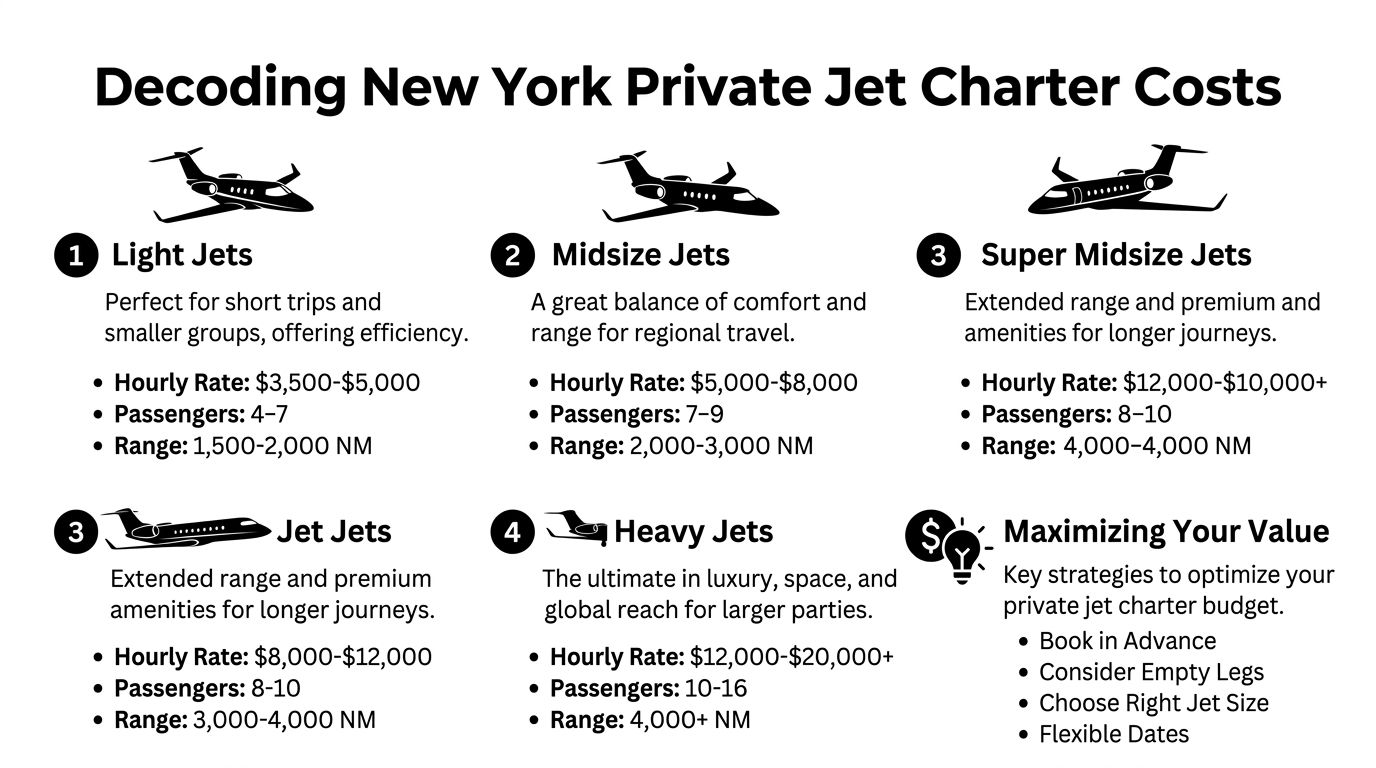
Price matters, but the quoted hourly rate doesn't tell the whole story. In New York, charter pricing is usually quoted by aircraft category rather than route alone, and neutral market pages commonly list about $1,500 to $3,000 per hour for turboprops, $3,000 to $6,000 for light jets, $5,000 to $8,000 for midsize and super-midsize jets, and $8,500 to $15,000 for heavy or long-range jets. One New York pricing guide also lists long-range jets at $12,000 to $15,000 per hour and VIP airliners at $18,000 to $30,000 per hour. That same guide gives New York to Miami and New York to Las Vegas examples commonly falling in the $16,400 to $30,500+ range depending on aircraft and airport selection, as shown in this New York charter rate overview.
What actually moves the final quote
In practice, four things usually swing the number:
- Aircraft class: This is the obvious one. Bigger cabin, longer range, higher hourly cost.
- Airport selection: Not every New York airport creates the same operating pattern.
- Aircraft positioning: A jet that has to come to you can make an ordinary route expensive.
- Peak-demand timing: Same route, same day, different inventory. Different price.
The hidden cost many first-time clients miss is positioning. A quote can look competitive until you realize the airplane isn't based anywhere near your departure airport. Then the operating cost of getting it into position shows up in the total.
Why local sourcing matters
If I'm advising a client on value, I'm not trying to win the quote with the lowest sticker rate. I'm trying to remove waste from the structure of the trip.
That's where a local sourcing model changes the economics. Instead of taking a broad-market aircraft and forcing it onto your itinerary, you start with aircraft already near the departure city. If you want to compare that approach on a trip-by-trip basis, Haute Jets pricing shows how on-demand quoting is structured without a membership framework.
Cost-control move: Ask where the aircraft is based before you compare quotes. If nobody answers clearly, you're not looking at the full cost picture yet.
Peak demand changes the question
During event-driven or seasonal spikes, asking “what does this route cost?” isn't enough. The better question is, what is driving the spread between these options?
That's especially clear on routes with wide aircraft dispersion. Recent New York to Jackson Hole examples show about $29,900 to $35,100 for a midsize jet, $33,800 to $39,000 for a Legacy 500, and $46,800 to $54,600 for a heavy jet, with an approximate 4.5-hour block time according to Stratos Jets' New York to Jackson Hole route page.
That kind of spread tells you something important. You're not just paying for distance. You're paying for cabin class, availability, and aircraft positioning.
How to maximize value without downgrading the trip
Use a short checklist before you book:
- Choose the smallest suitable cabin. Don't pay for unused range and volume.
- Stay flexible on airport if the ground plan allows it. That can improve local aircraft matches.
- Book ahead when you can. Better inventory usually means cleaner choices.
- Use empty legs selectively. They can work well for flexible travel, but not every mission can depend on them.
The best New York charter buyers don't chase the cheapest quote. They eliminate the unnecessary expensive parts.
The Seamless Booking Process From Quote to Takeoff
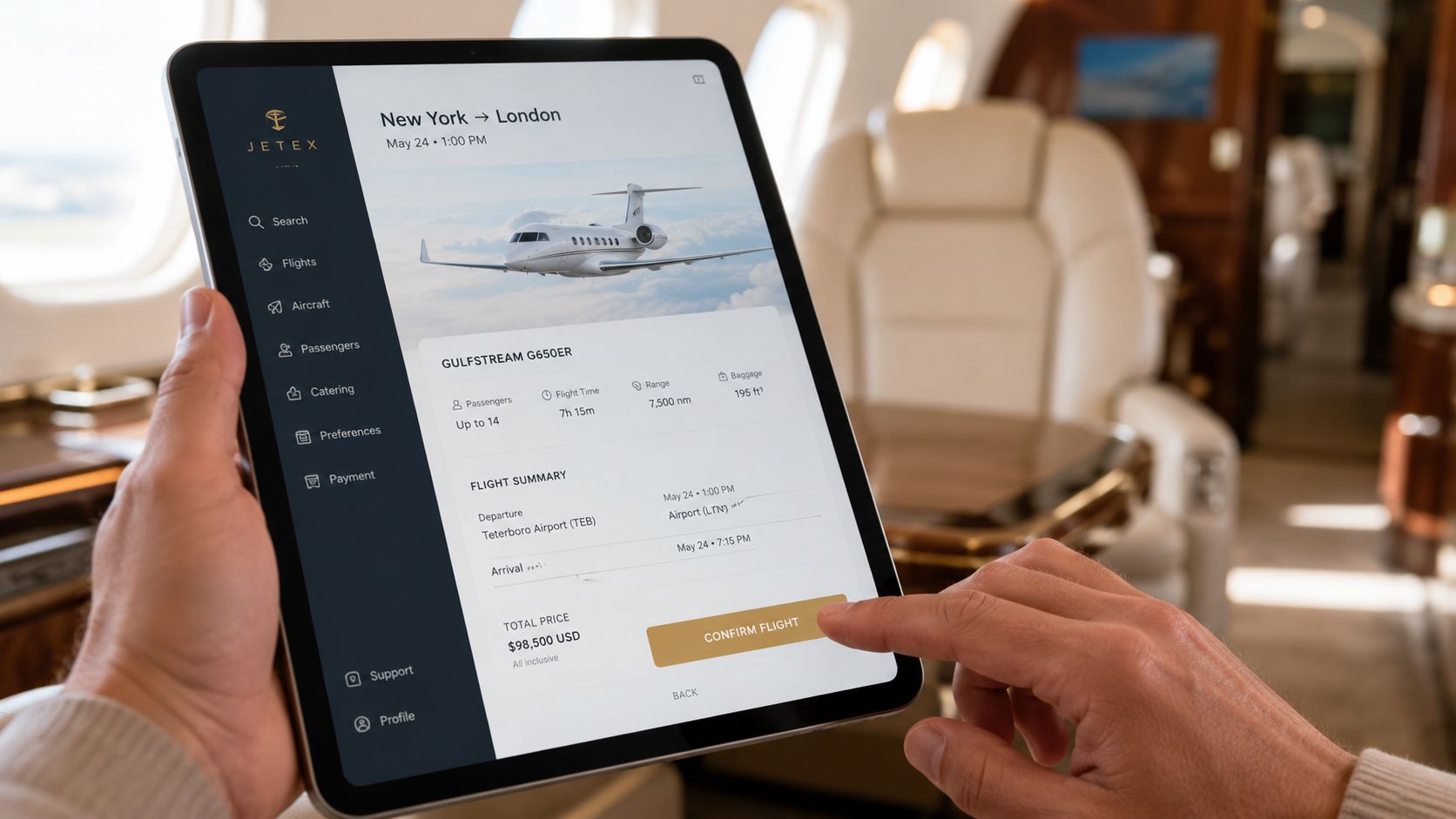
A clean booking process reduces mistakes, pricing drift, and day-of-travel surprises. Industry operators generally describe charter booking as a 5 to 7 step process: provide trip details, compare aircraft options, review the charter agreement and cancellation terms, sign, arrange payment, then send passenger names and preferences before departure. That sequence exists for a reason, and Clay Lacy's charter booking overview lays out why matching depends on passenger count, route, timing, luggage, and cabin needs before a quote can be finalized.
Step one starts with a better brief
A good request includes:
- Who's flying: Exact passenger count, not an estimate.
- When you need to leave: Give a preferred departure and a realistic window.
- What's coming onboard: Luggage, golf clubs, skis, pets, or anything oversized.
- How you want to travel: Wi-Fi needs, catering, ground transfer, privacy concerns.
If you want to start the process directly, use the private charter quote request form and submit the trip details with the variables above included clearly.
The more specific the brief, the more precise the aircraft options will be. That matters in New York because the wrong assumptions at quote stage usually get expensive later.
Review the aircraft, not just the category
“Light jet” isn't enough information for a serious booking. You want the actual aircraft option, its cabin fit, and any operational notes that matter to your route.
Ask for clarity on these points:
- Exact aircraft type
- Wi-Fi availability
- Cabin layout
- Luggage practicality
- Pet policy if relevant
- Cancellation terms before signing
At this stage, experienced travelers separate polished sales language from actual charter planning. A category gets you close. A specific aircraft gets you confidence.
Don't approve a charter because the class sounds right. Approve it because the aircraft fits your trip.
Payment and final confirmation
Once the agreement is signed, payment follows the operator's process. Some clients prefer traditional wire instructions. Others want a faster digital path. For crypto-forward travelers, this is the point to confirm whether digital asset payment can be accommodated operationally before release.
Later in the process, the passenger manifest, preferences, and final service items are submitted. That's also when catering, ground transport, and any special handling should be locked down rather than “noted for later.”
A short visual on the booking flow can help if this is your first charter:
What the best operators provide before departure
The strongest charter experience feels quiet because the work is already done. Before departure, you should expect complete trip details, confirmed passenger information, and a clear pre-flight brief.
For many high-value clients, one of the most reassuring details is getting the exact tail number, crew information, and final operating summary before wheels up. That removes ambiguity. It also makes security teams, executive assistants, and family offices much more comfortable with the trip.
Empty leg opportunities can also surface during this stage, but treat them as a tactical option, not the foundation of a mission-critical itinerary. They're useful when the schedule can flex. They're less useful when the meeting cannot.
Customizing Your Flight and Ensuring Onboard Safety
A private charter should solve more than transportation. It should support the way you travel.
For some passengers, that means a quiet cabin and stable Wi-Fi so they can work from wheels up to final approach. For others, it means a pet-friendly itinerary, specific catering, car service waiting planeside, or cabin setup that makes a family trip feel easy instead of improvised.
Customization should feel operational, not decorative
The useful customizations are the ones that remove friction:
- Catering that fits the day: Breakfast on an early departure, a proper meal on a longer leg, or specific dietary requests handled before departure.
- Ground transport coordination: Driver timing should match wheels down, not the original estimate.
- Pet planning: Confirm pet acceptance and cabin handling in advance rather than assuming every operator treats it the same way.
- Connectivity: If you need live connectivity, verify it on the actual aircraft offered.
These details matter because the cabin isn't just a luxury setting. It's part office, part family space, part recovery buffer between obligations.
Safety is not an add-on
No client should trade safety for price, category, or aesthetics. This is the fundamental part of the conversation.
Haute Jets states that it works exclusively with Wyvern Wingman and ARGUS Gold or Platinum rated operators. For clients, that matters because those third-party ratings are widely used as a serious screening standard in business aviation. The practical takeaway isn't the badge itself. It's what the badge signals: documented operating discipline, oversight, and a higher threshold than “the aircraft is available.”
If a provider talks more about leather seats than operator standards, you're hearing the wrong pitch.
What to ask before confirming any aircraft
You don't need to be an aviation auditor. You do need to ask direct questions.
Use this short filter:
- Who is the operating carrier? You want the actual operator, not just the broker name.
- What third-party safety rating does that operator hold? Ask for the level, not a vague assurance.
- What are the cabin and service specifics on this exact aircraft? Wi-Fi, pets, baggage, and layout should all be confirmed.
- What will I receive before departure? Tail number, manifest review, and trip details should be standard.
Luxury only works when the basics are controlled
The reason top-tier clients keep flying private isn't just privacy or convenience. It's control. That control has to include service standards and safety standards at the same level.
A well-run New York charter doesn't feel flashy from the inside. It feels calm, accurate, and fully anticipated. That's the result of strong operator screening and disciplined trip planning, not marketing language.
Practical FAQ for the Modern New York Traveler
How far ahead should I book a New York charter
For the best mix of aircraft selection and pricing, a practical benchmark is 4 to 6 weeks ahead, while 24 to 48 hours is commonly cited for last-minute charters or empty-leg opportunities when availability allows, according to SkySouth's charter planning guide.
If your dates are fixed and the trip matters, book earlier. Last-minute New York chartering is possible, but the market shifts from choice to inventory-driven decisions.
Can I book same day
Sometimes, yes. But same-day requests depend on what aircraft are already available, where they're positioned, and whether the airport setup works operationally.
For a mission-critical trip, don't assume same-day means broad choice. It usually means moving quickly on what fits.
Which New York airport is usually best for business travel
For many Manhattan itineraries, Teterboro is the first look. That said, “best” depends on where the passengers are, where the aircraft is, and whether your day ends in Manhattan, Westchester, Long Island, or New Jersey.
A good charter plan looks at the full day, not just the departure board.
Is JFK a bad choice for private aviation
No. It's just often unnecessary for domestic missions that would run more cleanly through a dedicated private aviation airport.
JFK can make sense for certain international or long-range missions. It shouldn't be your default without a reason.
Should I take an empty leg for an important trip
Only if your schedule can tolerate change. Empty legs can offer strong value, but they work best when the traveler has flexibility.
For a board meeting, closing, or event with a hard start time, a dedicated charter is usually the safer decision.
Empty legs are a smart tool for flexible travelers. They are not a substitute for certainty.
Can I pay with cryptocurrency
Many crypto-forward travelers ask this early, and they should. Payment flexibility is often possible, but it needs to be confirmed before documentation and release because charter transactions still have operational and compliance steps behind them.
The right time to ask is at quote stage, not after the agreement is circulating.
What's the biggest pricing mistake first-time charter clients make
They compare aircraft categories without comparing aircraft location, airport strategy, and mission fit. That's how a quote that looks reasonable on paper turns into an inefficient booking.
The better move is to compare total trip logic. Where is the aircraft? Why this airport? Why this cabin?
What information should I prepare before requesting a quote
Have these ready:
- Passenger count
- Departure window
- Origin and destination airports if known
- Luggage profile
- Pet or special service needs
- Ground transportation preferences
- Payment preference, including crypto if relevant
That short list speeds up the process and improves the quality of the options you receive.
If you're planning a New York departure and want the quote built around the right airport, the right aircraft, and the actual economics of the trip, Haute Jets offers on-demand charter access without memberships or prepaid hours. Submit the mission details early, stay flexible where it helps, and ask for the exact aircraft logic behind the quote before you sign.