

You need to get from New York to Miami tomorrow morning. Or from Los Angeles to Las Vegas for a same-day meeting and dinner back home. Airline schedules don't fit. First class still means terminals, delays, and someone else's timetable. So you start looking at private aviation and immediately hit the usual mess: jet cards, memberships, fractional programs, broker promises, “starting at” rates that don't resemble the final invoice.
That confusion is why first-time charter clients overpay.
The good news is that private jet rental in the USA is simpler than it appears once you know what truly drives price, aircraft selection, and safety. The bad news is that a lot of the market still sells convenience with opaque pricing.
Navigating the World of Private Aviation in the USA
The U.S. is where private aviation operates at scale. More than 15,000 private jets, or about two-thirds of the world's fleet, are based in the country, and industry reporting also estimates the U.S. private jet charter market reached $28.9 billion in 2025 according to industry reporting on the U.S. private jet market.
That scale matters to you for one reason: choice.
If you're booking a domestic charter, a deep U.S. fleet improves your odds of finding the right aircraft near your departure city, with the right cabin, at the right time. It also makes short-haul business and leisure routes far more practical than many first-time clients assume. You're not trying to force an international repositioning operation for a domestic mission. You're matching a domestic trip to a dense domestic market.
For travelers comparing private jet rental USA options, that's the main advantage of booking in a mature market. You can review route-specific choices across major hubs and regional airports, especially if your trip begins or ends in a market covered by Haute Jets United States charter destinations.
Why clients get stuck
The idea of chartering a jet doesn't present a struggle. The difficulty arises with the buying model.
A first-time client usually sees three paths:
- Jet cards that ask for prepaid commitment
- Fractional ownership that makes sense only if you fly often enough to justify the complexity
- On-demand charter that looks simple, but can hide fees inside the quote
Only one of those models lets you buy exactly what you need for one trip without inheriting a long-term structure you may never use properly.
Private aviation should be bought like a tailored service, not like a timeshare.
What actually matters on your first booking
Forget the marketing language. Focus on four practical questions:
- Where is the aircraft based? Local aircraft usually mean cleaner economics.
- What is the all-in price? The quote matters, not the teaser rate.
- Is the aircraft right for the route? Bigger isn't automatically better.
- Who is operating the flight? Safety standards aren't uniform.
That's how experienced charter clients think. It's how you should think too.
Decoding Private Jet Rental Pricing
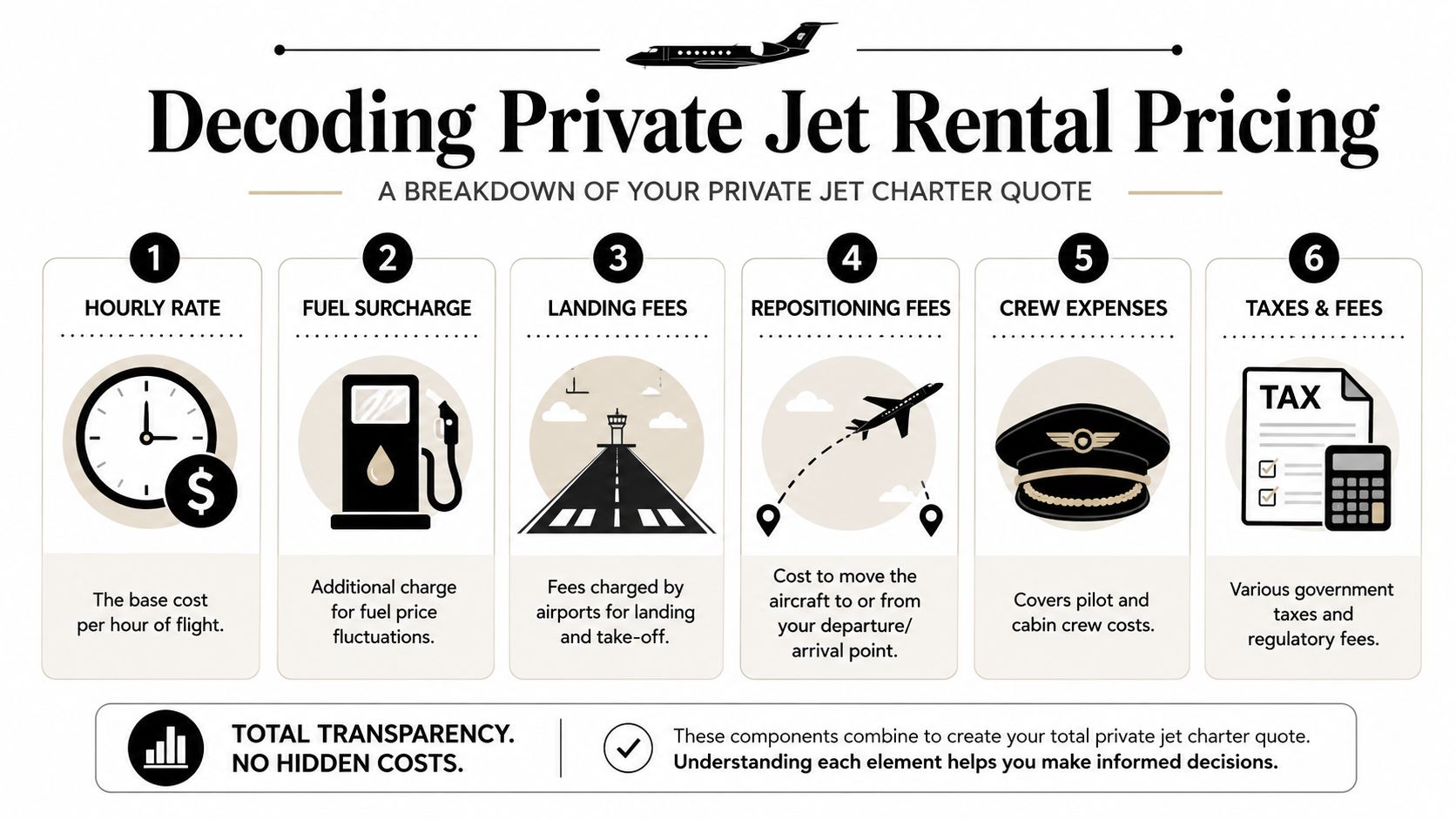
The biggest mistake first-time clients make is treating the hourly rate as the trip price. It isn't. It's one line item.
Private jet rental pricing in the U.S. is shaped by aircraft size and trip length, with typical hourly rates ranging from about $2,000 to $14,000+ per billable flight hour in 2026, while domestic flights commonly add a 7.5% Federal Excise Tax plus a $5.30 per passenger, per leg segment fee, according to this private jet charter cost guide.
What makes up a charter quote
Think of a charter quote like a custom suit. The fabric is the hourly rate. The final fit and final bill come from everything layered on top.
Here are the components that deserve your attention:
- Base hourly rate. This is the starting aircraft cost and it changes by cabin class.
- Federal Excise Tax. On domestic U.S. flights, this adds 7.5%.
- Segment fee. You'll also see $5.30 per passenger, per leg.
- Repositioning. If the aircraft has to move to reach you, that movement can show up in your bill.
- Crew expenses. Multi-day trips can add overnights and related operating costs.
- Airport and operating charges. Ramp fees, fuel surcharges, and similar items can materially affect the final number.
Typical aircraft pricing by class
Some market guides break pricing down further:
| Aircraft class | Typical range |
|---|---|
| Light jets | $2,500 to $4,500 per hour |
| Midsize jets | $4,500 to $7,500 per hour |
| Super midsize jets | $7,500 to $12,500 per hour |
| VIP airliners | Can exceed $23,000 per hour |
That table is useful, but only if you keep one rule in mind: class pricing helps you estimate, not approve. Your final decision should always be based on the all-in quote for your exact route and timing.
Route examples that show why quotes vary
A light-jet trip from New York to Miami is often quoted around $9,000 to $19,000 for a one-way, depending on aircraft class and availability. That spread is the point. Same route, very different invoice potential.
If you're shopping private jet rental USA options, don't ask, “What's your hourly rate?” Ask these instead:
- What aircraft is this quote based on?
- Is the aircraft already near my departure airport?
- Are taxes and segment fees included?
- What charges apply if the trip runs overnight or one-way?
Practical rule: If the quote looks vague, the invoice probably won't.
How to read a quote like an advisor
When you receive options, compare them in this order:
- Aircraft suitability first. Don't pay for cabin you won't use.
- Positioning second. An aircraft close to you often beats a “cheaper” jet flying in from elsewhere.
- All-in total third. The total matters more than the hourly rate.
- Flexibility last. A quote with clear terms is better than one that looks low but shifts later.
Clients who focus only on rate usually buy the wrong deal. Clients who focus on mission and total cost usually buy the right aircraft.
Choosing the Right Aircraft for Your Mission
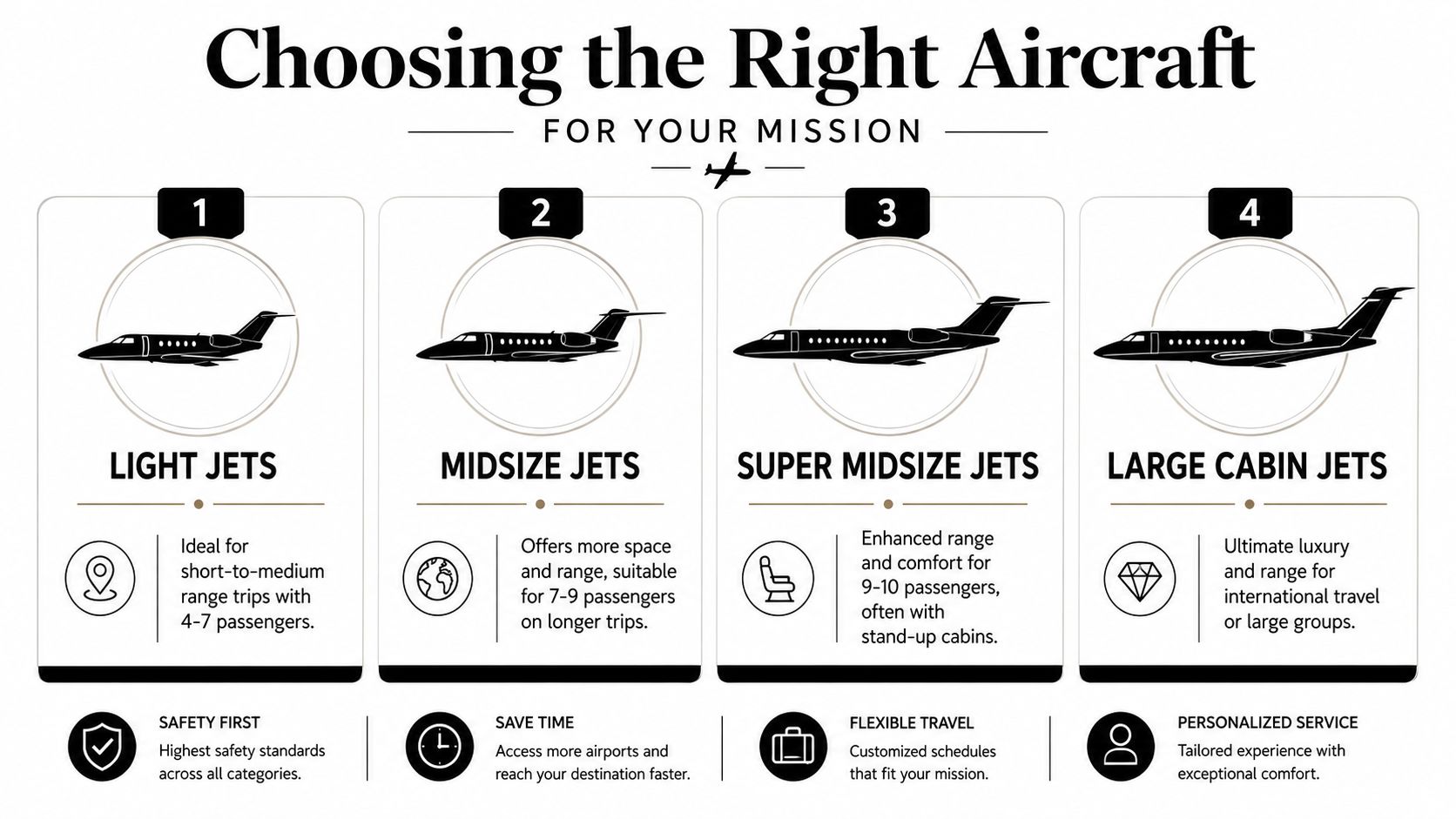
Most charter mistakes come from booking the wrong category. Not an unsafe aircraft. Not a bad aircraft. Just the wrong tool for the trip.
Under U.S. Part 135 charter operations, aircraft with up to 19 passengers can typically be flown without triggering more complex emergency-equipment requirements, which is why many charter fleets are engineered around 4 to 19-seat cabin layouts, as explained in this review of private jet passenger capacity and Part 135 limits. That's why aircraft matching matters so much in private jet rental USA planning. Operators aren't just filling as many seats as possible. They're optimizing range, baggage, passenger comfort, and dispatch practicality inside that operating framework.
The simple way to choose
Start with the mission, not the jet name.
Ask yourself:
- How many people are flying?
- How much luggage are they bringing?
- Is this a short regional hop or a longer nonstop?
- Do you want to prioritize runway access, cabin comfort, or speed?
That sequence prevents overspending.
A practical category framework
Here's the mental model I use with first-time clients:
| Category | Best use |
|---|---|
| Turboprops | Short regional trips where runway access and efficiency matter more than speed |
| Very light and light jets | Short to medium domestic flights for smaller groups |
| Midsize and super midsize jets | Longer domestic sectors where cabin comfort starts to matter much more |
| Large cabin jets | Transcontinental, international, or group travel where range and space drive the decision |
A Los Angeles to Las Vegas trip doesn't need the same aircraft logic as a New York to London itinerary. A family ski trip with bulky luggage doesn't need the same answer as a two-executive same-day meeting run.
Where first-time buyers go wrong
They usually do one of two things.
Some clients book too small and regret the baggage limitations, the tighter cabin, or the fuel stop risk on a route that needed more capability. Others book too large because they assume bigger equals better, then pay for cabin volume they never use.
The right aircraft feels efficient, comfortable, and unsurprising. The wrong one feels compromised or wasteful.
My recommendation
For short-haul domestic flying, keep your decision framework tight:
- Use turboprops when airport access and efficiency are more valuable than jet speed.
- Use light jets when you want a clean, fast solution for a smaller party.
- Move up to midsize or super midsize when the trip is longer, the group is larger, or the cabin experience matters.
- Reserve large cabin aircraft for trips that justify them.
Buying private aviation well means resisting ego. Match the aircraft to the mission and the economics usually improve on their own.
Prioritizing Safety with Wyvern and Argus Certification
Safety isn't a branding line. It's the first filter.
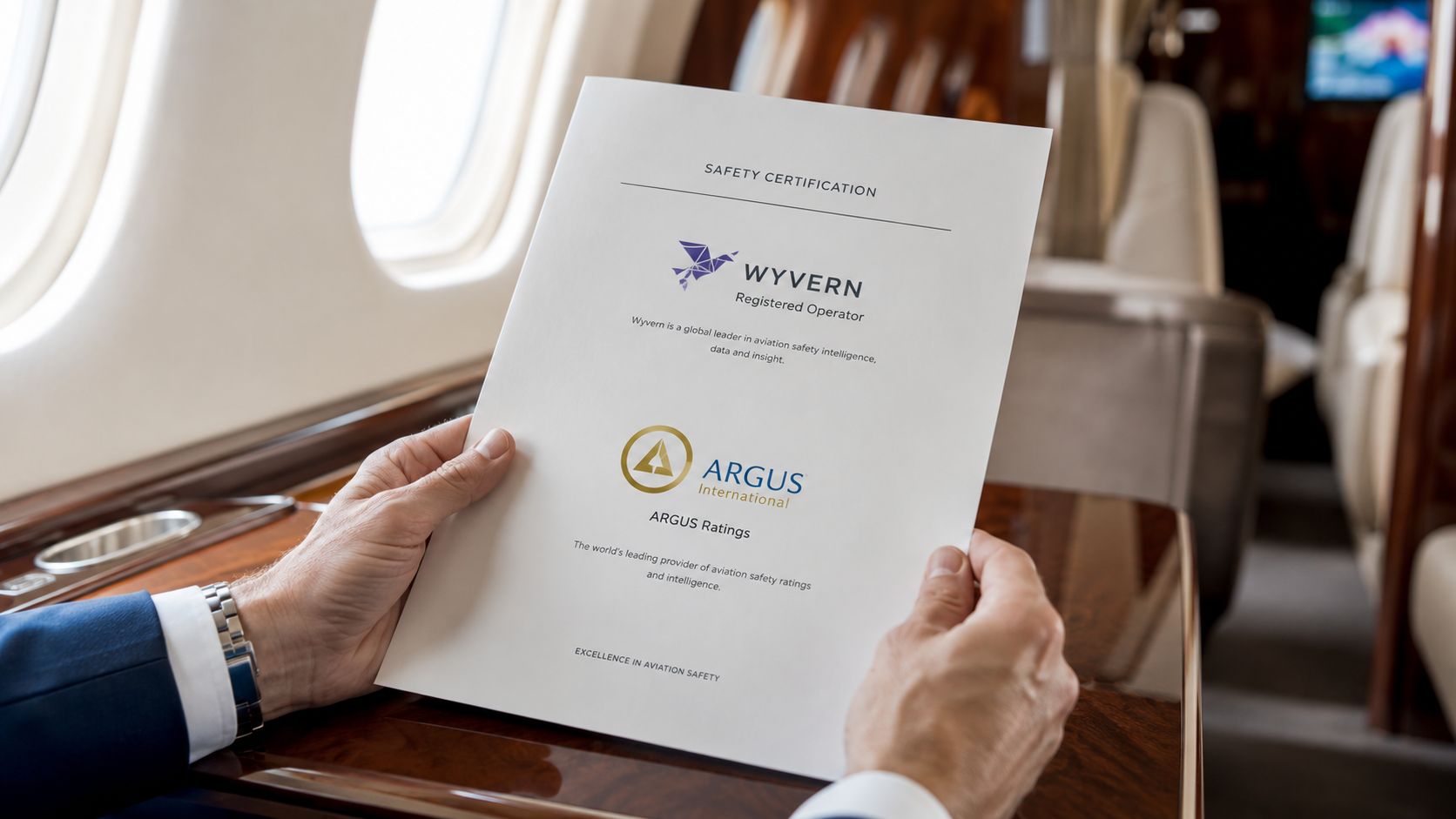
If you're new to charter, you'll hear operators say they meet regulatory requirements. That's expected. It's not enough on its own for a premium booking decision. You want third-party oversight that goes beyond the operator's own claims.
Why these ratings matter
In private aviation, the names that matter most to clients are Wyvern and ARGUS. When an operator holds a recognized rating from one of these organizations, it signals that someone independent has reviewed the operation more rigorously than a basic sales conversation ever could.
That matters because not all charter operators run at the same standard. Aircraft age, maintenance culture, pilot training, documentation discipline, and operating procedures vary. Serious clients don't guess on any of that.
If you want a deeper explanation of what those ratings mean in practice, read Haute Jets' breakdown of Wyvern and ARGUS safety ratings.
What to ask before you book
Don't ask broad questions like “Is this safe?” Ask precise ones:
- Which operator is flying the aircraft?
- Does that operator hold a current Wyvern or ARGUS rating?
- Will I receive the tail number and crew details before departure?
- Are there any operator substitutions planned or possible?
Those questions force clarity.
A polished cabin doesn't tell you anything about operational discipline. The paperwork and operator record do.
My position
Treat third-party audited safety standards as paramount. If a provider gets evasive when you ask who is operating the aircraft and what independent safety ratings they hold, move on.
Luxury means confidence. Without that, the leather seats and catering are just decoration.
The On-Demand Booking Process Step by Step
You request a flight from Teterboro to Miami for Friday morning. Two quotes arrive. One looks cheaper. Then the add-ons start showing up. The aircraft is not nearby, repositioning is extra, and the final operating details stay fuzzy until late in the process.
That is the problem with many traditional charter buying models. The headline price gets attention. The actual trip cost shows up later.
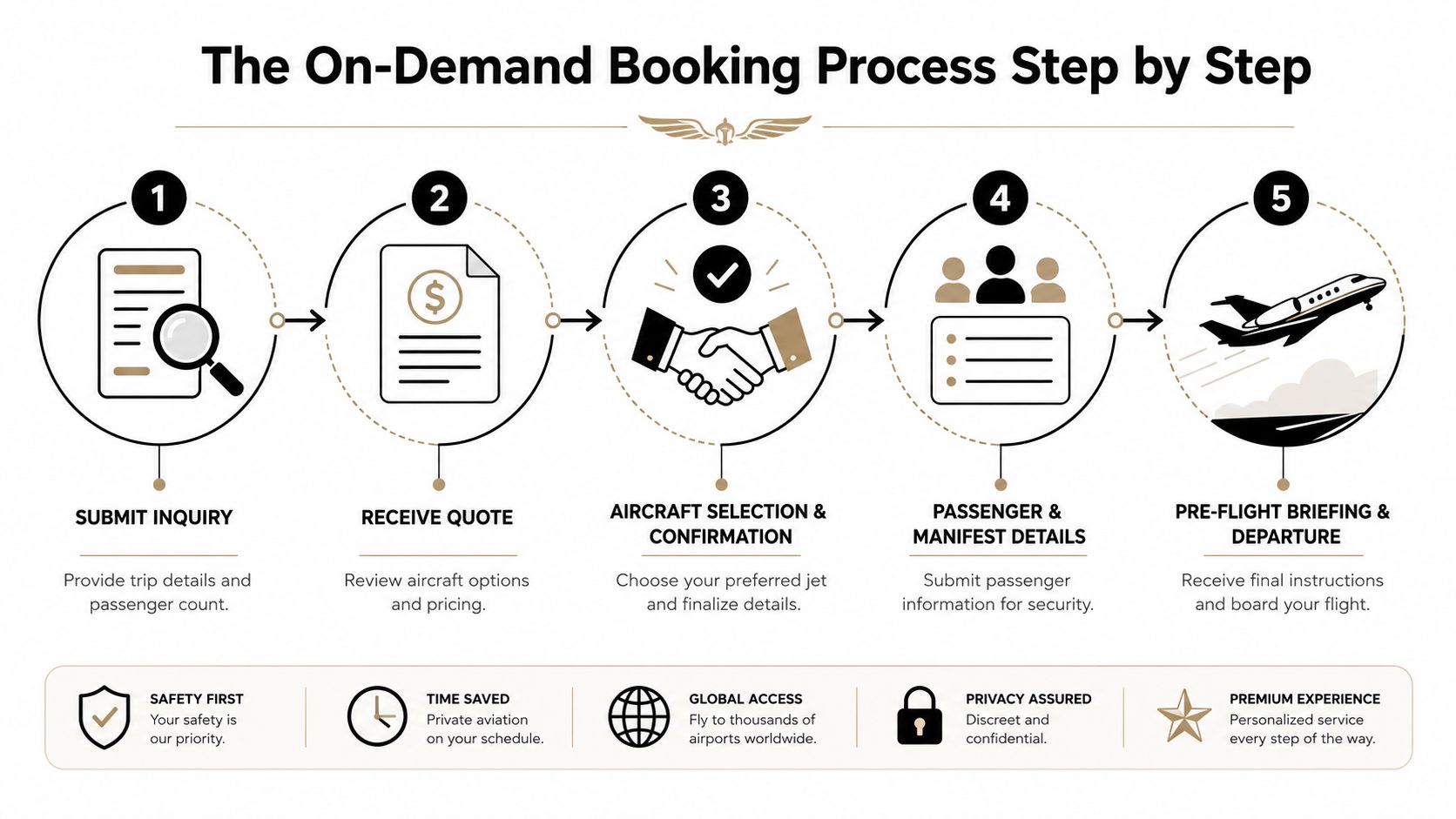
A strong on-demand process fixes that early. You should see the exact aircraft, the operating terms, and the likely cost drivers before you commit. Direct-to-operator, no-membership booking tends to do this better because it strips out layers that often hide fees and slow down clear answers.
The five stages that matter
Inquiry
Send the route, dates, passenger count, and any trip details that affect aircraft choice or cost, such as pets, luggage, catering, golf clubs, skis, or ground transport. Include schedule flexibility if you have it. That can open up better aircraft positioning and reduce wasted ferry time.Quote review First-time charter clients often make their biggest mistake here. They compare totals without checking what is behind them. Review the aircraft type, where the aircraft is coming from, whether repositioning is built into the quote, and what is included versus billed later. If a quote stays vague on those points, reject it.
Aircraft selection
Once you choose, the trip should shift from shopping to execution. Cabin layout, Wi-Fi, baggage fit, pet rules, catering, and ground handling should be confirmed in practical terms, not left as assumptions. This is also the point to confirm whether the aircraft offered is the one you will fly, not a placeholder used to win the booking.
Before departure, a clear visual summary helps. This is the process I recommend clients expect from any serious charter provider.
What should happen after you commit
Manifest and passenger details
Passenger information must be submitted accurately and on time. A disciplined provider will collect it early, verify names and dates, and flag any issue before it creates a departure problem.Pre-flight confirmation
You should receive a final briefing before departure with the itinerary, FBO details, operator name, tail number, and key trip notes. If those details arrive late, the process is weak. Premium service means clarity before you leave for the airport.
What separates a clean process from an expensive one
Use this standard:
- Exact aircraft disclosure, not broad category language
- Clear pricing terms, including whether repositioning is included
- Specific trip inclusions for catering, pets, deicing, and ground transport
- Early manifest completion so last-minute paperwork does not create risk
- Pre-flight details in advance, including operator and tail number
Haute Jets is one example of the no-membership approach. The model is simple. You book trip by trip, review the actual aircraft offered, and avoid the extra complexity that often comes with membership sales structures.
Advisor's view: If a provider cannot explain where the aircraft is coming from, what is included in the quote, and who is operating the flight, you do not have a firm booking process. You have a sales pitch.
Strategic Ways to Save on Private Jet Rentals
Most articles treat empty legs as the main savings strategy. That's too simplistic.
Yes, empty legs can offer value. But they're opportunistic, not dependable. They work when your schedule and route happen to align with an aircraft's existing movement. If they don't, they're irrelevant.
The more important issue is the hidden cost that inflates many standard charter quotes: repositioning.
Why route pricing can swing so much
Independent market examples show how dramatically charter pricing can vary. U.S. estimates range from $3,900 for a Van Nuys to Las Vegas round trip in an Eclipse 500 to $58,900 for a New York to Los Angeles round trip in a Challenger 601, with hidden repositioning often driving major quote differences, according to these U.S. private jet charter pricing examples.
That doesn't mean one route is unfair and the other is fair. It means charter economics are highly aircraft- and routing-dependent.
The savings strategy that matters more
If the aircraft is already based near your departure airport, you're often in a stronger pricing position from the start. If the aircraft has to fly in empty to pick you up, you may end up paying for movement that provides no value to you as a passenger.
That's why I advise clients to think this way:
- First, ask where the aircraft is coming from
- Second, ask whether the quote includes positioning
- Third, compare one-way economics carefully
- Fourth, treat empty legs as a bonus, not a plan
Empty legs versus local aircraft
A useful way to consider:
| Option | Strength | Weakness |
|---|---|---|
| Empty leg | Can reduce cost when timing matches | Timing and route flexibility are limited |
| Locally sourced aircraft | More reliable quote structure | You still need to verify what's included |
The better long-term buying habit is not chasing random discounted segments. It's avoiding avoidable positioning costs in the first place.
My recommendation
Don't shop private aviation the way people shop flash sales. Shop it the way a procurement advisor would.
A transparent quote on a properly matched local aircraft usually beats a supposedly cheap option burdened by inconvenient timing, poor aircraft fit, or hidden ferry cost. Savings in private aviation come from better sourcing, not just lower advertised numbers.
The Haute Jets Advantage No-Membership Charters
The market is moving toward flexibility. That's the right direction.
Industry coverage notes that on-demand services, empty legs, and hybrid models are expanding because travelers want more flexible, route-specific solutions than traditional jet cards or fractional ownership can provide, as discussed in this overview of evolving private charter models. I agree with that shift, but only partly. Flexibility alone isn't enough. It has to come with pricing clarity.
Why traditional models lose first-time clients
Jet cards and fractional structures appeal to people who want certainty. The problem is that many buyers pay for certainty they don't, in fact, need.
Common friction points include:
- Prepaid commitment that locks up capital before you know your real travel pattern
- Category access instead of exact aircraft choice
- Pricing complexity that can still leave room for extra charges
- Reduced adaptability when your routes, timing, or passenger profile changes
For a first-time charter client, those models often solve the wrong problem.
What a better model looks like
A cleaner approach is simple:
- Pay per trip
- Choose the exact aircraft
- Review the full quote before committing
- Avoid long-term fees and artificial loyalty structures
That model fits how many clients travel. Some fly often for a season, then barely at all. Some need a light jet for one trip and a larger cabin for the next. A fixed membership structure doesn't automatically help with either.
My view on the right buying approach
If you're evaluating private jet rental USA options for the first time, start with on-demand charter and hold a hard line on three issues:
- Transparent all-in pricing
- Clear operator and aircraft disclosure
- No long-term commitment unless your usage justifies it
That doesn't mean memberships or fractional programs are always wrong. It means they're often oversold to clients who would be better served by buying one flight at a time, with full visibility into what they're paying for.
The smarter way to charter is route-specific, aircraft-specific, and commitment-light. That's how you keep control of cost without giving up the speed and convenience that made private aviation attractive in the first place.
If you want help comparing aircraft, spotting hidden repositioning costs, or booking an on-demand charter without a membership structure, contact Haute Jets. Ask for the exact aircraft, the operator details, and the full all-in quote before you commit. That's how experienced clients book private aviation.