

You're probably in the same spot as many successful travelers right now. You've outgrown commercial first class. You want to skip crowded terminals, long lines, and the wasted hours wrapped around a simple trip. But you also don't love the idea of paying for an entire aircraft every time you fly.
That's exactly why private jet seat sharing gets attention. It promises a middle ground. You buy one seat instead of the whole jet, keep much of the private aviation experience, and avoid the full charter bill.
The concept is real. The value can be real too. But most coverage of seat sharing is too flattering and not nearly practical enough. It talks about access and convenience, then ignores the obvious trade-off: once you give up control of the schedule, the cabin, and the aircraft, you're no longer getting the full private aviation advantage. You're buying a premium shared transport product.
That doesn't make it a bad option. It makes it a specific option. If you understand where it works and where it falls apart, you'll make much better decisions.
The Allure of Private Aviation Without the Price Tag
A lot of travelers want the same thing. They don't need to own an aircraft. They don't need a long-term aviation program. They want a smarter way to move.
For a solo executive going from South Florida to New York, or a couple heading from Los Angeles to Las Vegas for a weekend, full charter can feel like overkill. The experience is attractive. The invoice often isn't. That gap is what private jet seat sharing tries to solve.
Why the offer is so tempting
Seat sharing sells the part of private aviation that most travelers care about first:
- Private terminal access: Less friction on the ground.
- Faster boarding: You're not moving through a commercial passenger funnel.
- A quieter cabin: Even shared, it's still a different environment from the airlines.
- A more premium rhythm: The trip feels managed, not endured.
That's the emotional hook, and it's a strong one.
Practical rule: If your main goal is avoiding the commercial airport experience, seat sharing can make sense. If your main goal is total control, it usually won't.
Where people get this wrong
Travelers often compare seat sharing to airline business class and stop there. That's too narrow. A better comparison is between several private flight models, each with a different compromise.
Seat sharing lowers the barrier to entry. It does not eliminate the usual constraints of aviation. It shifts them. Instead of paying more money for full flexibility, you accept someone else's route logic, someone else's departure timing, and someone else's cabin mix.
That's the part many buyers discover too late.
Defining Private Jet Seat Sharing
Private jet seat sharing is simple. Instead of chartering the entire aircraft, you book a single seat on a private flight that other passengers are also using. Think of it as the aviation version of a high-end shared car service. You still get the premium vehicle. You just don't have exclusive use of it.
That distinction matters. You're not buying a private jet in the pure charter sense. You're buying access to a seat on a private aircraft.
What you're actually purchasing
In practical terms, private jet seat sharing usually includes:
- A seat on a pre-arranged flight
- Use of private terminals or private terminal-style handling
- A faster ground experience than commercial travel
- A smaller cabin environment
What it usually does not include:
- Choosing the exact departure time
- Selecting the exact aircraft
- Controlling who shares the cabin
- Building the itinerary around your schedule
That's why I tell clients not to confuse “private aircraft” with “private travel.” Those aren't always the same thing.
Why the pricing looks attractive
The economics are straightforward. Full private charter carries a high fixed aircraft cost. One industry summary cited private jet hourly pricing at about $1,500 to $15,000, with light aircraft around $2,000 to $3,500 per hour, mid-size aircraft at $4,000 to $8,000 per hour, larger jets at $8,000 to $13,000 per hour, and VIP configurations reaching $15,000 to $20,000 per billable hour. On some high-demand shared routes, per-seat listings have been quoted at $500 to $1,500 one-way according to JetFinder's private jet statistics summary.
That's the whole appeal. Divide the aircraft cost across multiple travelers and the entry point drops sharply.
Seat sharing isn't a gimmick. It's a pricing model built to spread the fixed cost of the aircraft across several passengers.
What that means for the traveler
If you're flying alone on a popular route, the value proposition can be compelling. You may get private terminal convenience and a much calmer travel day without paying for the whole cabin.
But don't romanticize it. Once you buy by the seat, the operator's economics start driving the experience. Routes need enough demand. Schedules need to be viable for more than one traveler. The aircraft needs to fit the route and the passenger mix. Your personal preferences move down the priority list.
That's why private jet seat sharing works best when your trip already lines up with a provider's commercial logic. When it doesn't, the compromises show up fast.
Understanding the Seat Sharing Business Models
Not all seat sharing works the same way. That's where many travelers get burned. They assume every shared private flight is just a cheaper version of charter. It isn't.
Some models are predictable. Others are demand-dependent. That difference affects whether your flight feels dependable or fragile.
The two models that matter
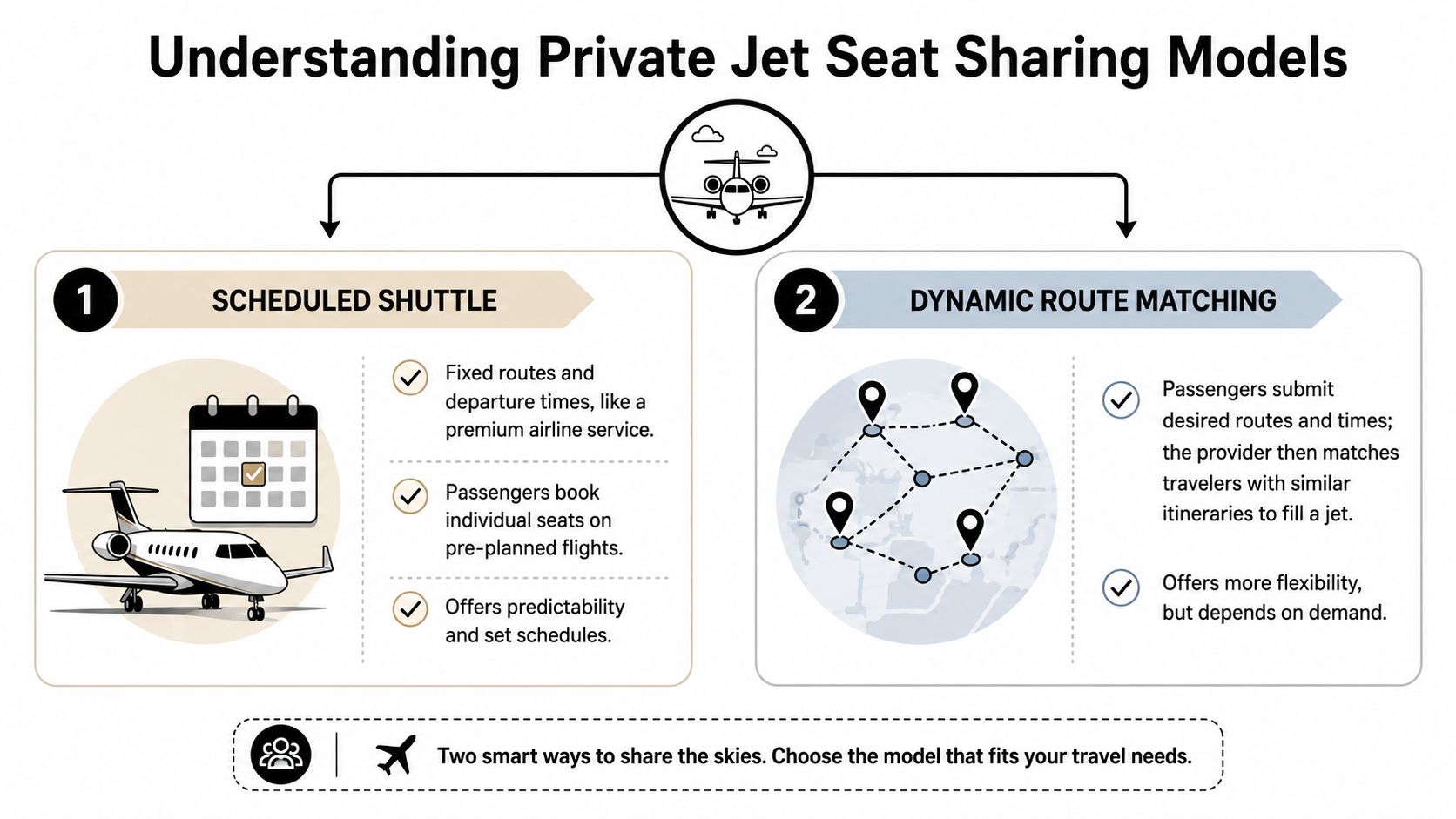
Scheduled shuttle
This is the cleaner model. The operator offers a fixed route and a fixed departure pattern on corridors with repeat demand. Think New York to Miami or Los Angeles to Las Vegas. You book a seat the way you'd book a premium airline service, just through a private aviation framework.
The upside is obvious. You know the route exists. The provider is selling against a known schedule. If your plans match that pattern, the experience can be efficient.
The downside is just as obvious. The operator owns the timetable, not you.
Dynamic route matching
This version sounds more flexible than it usually is. Travelers express interest in a route or proposed departure, and the provider tries to match enough passengers to make the flight work.
When it works, it can look clever. When demand doesn't materialize, you're dealing with uncertainty. That's fine for leisure travelers with room to adapt. It's not fine for a meeting, a closing dinner, or a family transfer tied to a villa check-in.
Why capacity controls everything
Shared flights aren't infinitely flexible because the aircraft isn't infinitely flexible. Shared private flights usually carry 4 to 16 passengers, and standard charter setups often fall in the 4 to 19 passenger range depending on aircraft and cabin layout, according to BlackJet's guide to sharing a private plane.
That ceiling drives the economics.
| Business model | What works well | What breaks first |
|---|---|---|
| Scheduled shuttle | Repeated city pairs, predictable leisure demand | Fixed timetable limits |
| Dynamic route matching | Travelers with flexible timing | Activation risk and weaker reliability |
The operational reality most buyers miss
As more seats fill, the per-seat logic improves. But another problem takes over. Luggage, cabin layout, and weight-and-balance constraints become more important than the empty seat count.
That's why seat sharing works best on short to medium missions with a tight route profile and a clear passenger pattern. It's not a universal private travel solution. It's an operationally narrow product that performs well only when supply, route, cabin, and demand line up.
Comparing Your Private Flight Options
If you're deciding how to fly, don't compare prices in isolation. Compare the structure of the product. Cost matters, but so do privacy, timing, aircraft control, and cancellation exposure.
The four models most travelers consider are seat sharing, empty legs, jet cards, and on-demand charter.
Here's the visual overview first.
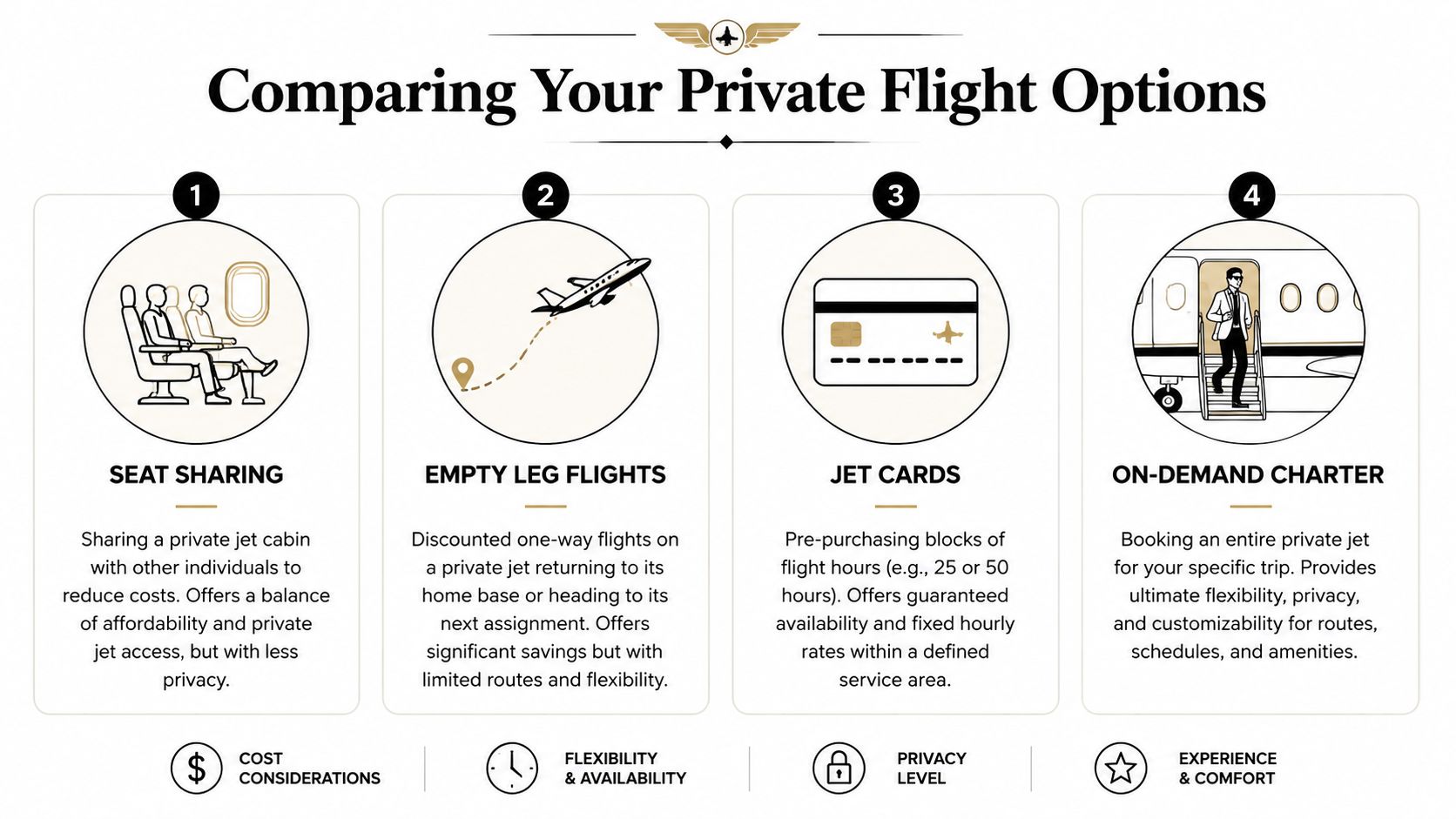
Private Flight Models Compared
| Model | Cost Structure | Flexibility | Privacy | Aircraft Choice |
|---|---|---|---|---|
| Seat Sharing | Pay per seat | Low to moderate | Limited | Usually limited |
| Empty Leg Flights | Discounted repositioning opportunity | Low | High if you take the whole aircraft opportunity | Very limited |
| Jet Cards | Prepaid hours or deposits | Moderate | High | Usually category-based, not exact aircraft |
| On-Demand Charter | Pay per trip | High | High | Highest control |
Seat sharing is the simplest compromise product. You lower the cost by surrendering exclusivity. If your trip fits an existing route and your expectations are realistic, it can work well.
Empty legs are different. They can look attractive because the aircraft is moving anyway, but they're opportunistic by nature. Route availability is narrow, timing can be inconvenient, and changes to the underlying aircraft movement can affect the flight. If you want a deeper look at how repositioning flights work, read Haute Jets' guide to what an empty leg flight actually is.
Where jet cards fit
Jet cards appeal to travelers who want structure. You prepay for access, usually within a service area and under fixed program terms. That can create consistency, but it also reduces flexibility in a different way. You're buying into a program, not shopping each trip on its own merits.
For some frequent flyers, that trade is acceptable. For many occasional or route-variable travelers, it isn't.
A quick video can help frame the differences in how travelers approach these options.
My recommendation by traveler type
- Choose seat sharing if you're flying solo or as a pair on a route with repeat demand and you care more about access than control.
- Use empty legs only if your schedule is flexible and the route happens to match.
- Consider jet cards if you fly often enough to value program consistency over shopping each mission independently.
- Book on-demand charter when privacy, timing, family logistics, or business confidentiality matter.
Shared seats save money. Full charter saves the trip when the schedule is non-negotiable.
High-net-worth travelers should be blunt with themselves. If you're taking a confidential call, moving with children, bringing significant baggage, or coordinating with a business calendar, the cheapest seat is rarely the best value.
Navigating Safety and Regulatory Standards
This is not the place to cut corners.
Any seat-sharing arrangement that involves paid passenger transport needs to be treated as an aviation operation first and a luxury product second. The aircraft can be beautiful. The catering can be polished. None of that matters if the operator standard is weak or unclear.
What to verify before booking
Ask direct questions.
- Operator certification: Confirm the flight is being performed by a properly certificated charter operator.
- Aircraft operator identity: Don't accept vague answers about “our network” without knowing who is operating the flight.
- Safety audit status: Ask whether the operator maintains recognized third-party safety credentials.
- Contract clarity: Make sure the commercial arrangement is documented clearly.
If a provider gets evasive on any of that, move on.
Why third-party ratings matter
A serious traveler shouldn't rely on branding alone. Third-party audit standards give you an external filter. That's why operator quality matters more than the marketing label attached to the flight.
For a useful overview of those audit frameworks, Haute Jets has a clear explainer on Wyvern and Argus safety ratings in private aviation.
Safety due diligence is simple. Ask who operates the flight, what certification they hold, and what third-party audit standard backs it up.
My view as an advisor
If you're comparing private flight options and one of them is cheaper because the operator transparency is weaker, that isn't value. It's risk transfer. You're taking on uncertainty so someone else can win the sale.
Premium private aviation should be curated, documented, and easy to verify. If you have to dig through vague answers to understand who's flying you, the service model is already failing the test.
When Is Seat Sharing the Right Choice for You
Seat sharing has a legitimate use case. It also gets overprescribed. The fact that nearly 4 in 10 private jet flyers expressed interest in shared and by-the-seat private flights, while the market still remains fragmented across only a handful of providers, tells you what you need to know. Interest is real. Broad adoption is not. It remains specialized and route-dependent, as noted by Private Jet Card Comparisons' report on shared private flight interest.
That's why you should treat private jet seat sharing as a tool, not a default answer.
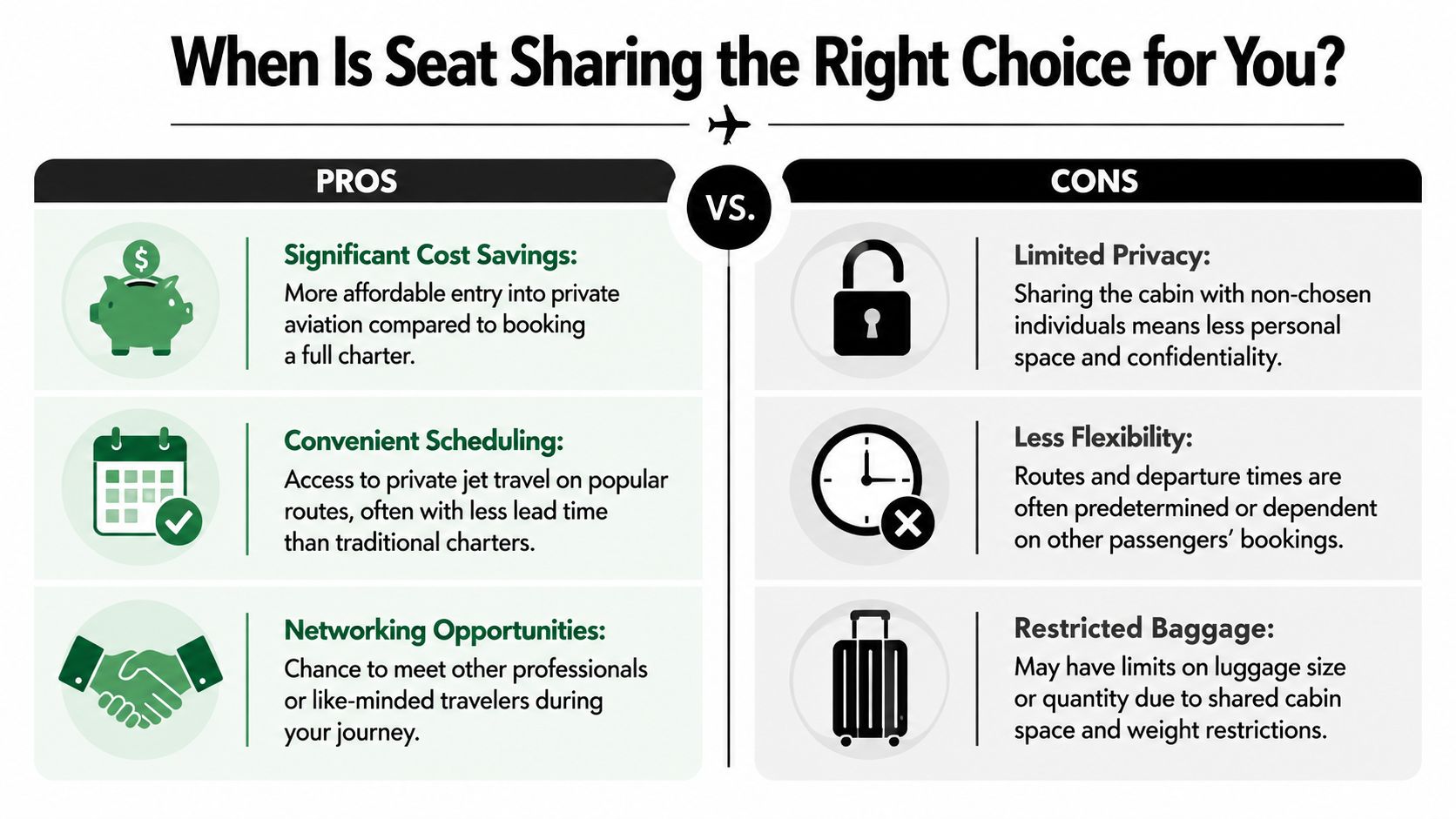
When it makes sense
Seat sharing is a smart choice in a narrow but useful set of situations.
- You're traveling solo: Paying for the whole aircraft would be inefficient.
- Your schedule is fixed but not fragile: You can work within a published or provider-driven departure pattern.
- Your route is popular: Repeated leisure and shuttle corridors are where the product has the best chance of functioning smoothly.
- You care about airport efficiency more than cabin exclusivity: That's the core value.
For that traveler, seat sharing can be a practical upgrade from first class without stepping into full charter economics.
When it's the wrong fit
It's the wrong product the moment privacy or timing becomes central to the mission.
A business team discussing a transaction should not be sharing a cabin with strangers. A family traveling with children, gear, and shifting timing needs shouldn't be relying on a shared-seat setup. A traveler connecting to multiple destinations in one day shouldn't hand over control to a route-dependent model.
Here's the simplest decision filter:
| Your priority | Better fit |
|---|---|
| Lower entry cost on a popular route | Seat sharing |
| Absolute departure control | On-demand charter |
| Confidential cabin environment | On-demand charter |
| Opportunistic savings with flexibility | Empty leg |
If missing the exact departure time creates real consequences, don't buy a seat. Charter the aircraft.
The honest middle ground
Seat sharing sits between airline premium cabins and true private charter. That's useful. It's not revolutionary. Once your trip requires flexibility, confidentiality, aircraft preference, baggage freedom, or coordinated ground timing, the product stops behaving like private aviation and starts behaving like a premium shuttle.
That's not a criticism. It's just accurate.
The On-Demand Charter Alternative for True Privacy
The biggest mistake travelers make is assuming the only alternative to seat sharing is overpaying for a full charter. That's not always true.
A well-structured on-demand charter model can reduce waste without forcing you into a shared cabin or a fixed schedule. The key is how the aircraft is sourced. If the provider pulls a suitable aircraft that's already positioned near your departure point, you avoid the worst cost inflation that comes from unnecessary repositioning.
That's the practical case for booking through a direct-sourcing model rather than defaulting to shared seats. You keep the core benefits seat sharing takes away: privacy, control of departure timing, aircraft choice, and mission-specific planning. If you want a primer on the booking process itself, start with Haute Jets' guide on how to charter a private jet in 2026.
Haute Jets is one example of that approach. It sources from owner-operators directly, works on a per-flight basis rather than through memberships or jet cards, and limits its network to Wyvern Wingman and Argus Gold or Platinum-rated operators. For travelers who want private aviation to function like private aviation, that structure makes more sense than buying a shared seat and accepting someone else's schedule.
The bottom line is simple. If your main objective is paying less to access a private terminal and a smaller cabin, seat sharing can work. If your objective is privacy, control, and a trip built around you, charter is still the better fit.
If you want help choosing between seat sharing, empty legs, and full charter for a specific route, Haute Jets can help you evaluate the trade-offs and book the model that matches your schedule, privacy needs, and aircraft preferences.