
A private jet share cost in 2026 usually starts around $4,000 per seat on a one-off shared flight, runs $3,000 to $8,000+ per occupied hour under fractional programs, and sits against $2,000 to $14,000+ per flight hour for full charter. The number that matters isn't the headline rate. It's the landed cost after monthly fees, repositioning, and minimum-flight rules get added in.
Private aviation sells convenience, but the invoice rewards people who understand the structure. A “share” can mean a seat on a pooled route, a long-term fractional stake, or a full aircraft split among travelers, and those are not remotely the same product. If you only compare hourly rates, you'll overpay or pick the wrong model.
What a Private Jet Share Actually Means in 2026
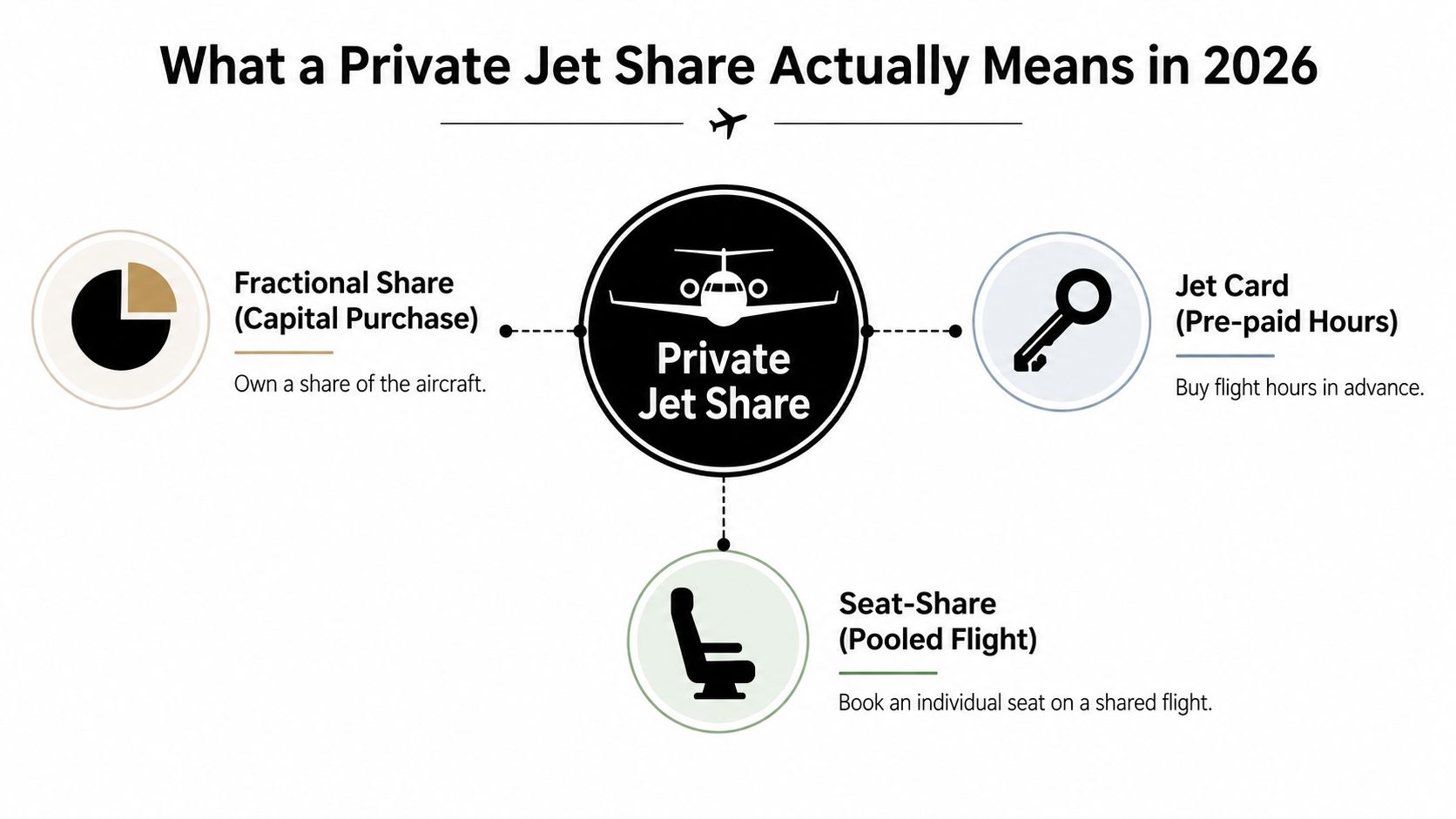
A private jet share is a sloppy phrase unless you pin down the access model first. In today's market, it usually means one of three things. A fractional share is a capital ownership slice with fixed monthly fees and hourly usage charges, a seat-share is a one-off booked seat on a scheduled private route, and a shared charter is a whole aircraft split among travelers who are all using the same trip.
Fractional share, seat-share, and shared charter are different animals
Fractional ownership is the most committed version. You buy a slice of an aircraft, pay ongoing management costs, and still get billed by the hour when you fly. Seat-share is lighter and simpler, because you're buying one seat, not an aircraft interest. Shared charter sits in the middle, because the whole jet is booked once and then divided among passengers.
That distinction matters because providers market all three with the same loose language. Some sell a fractional share with long-term obligations. Others sell a pooled flight on a set route with a per-seat price. The cost logic changes completely depending on which lane you're in.
Practical rule: If you don't know whether you're buying a seat, a time block, or an ownership slice, you don't know what the trip really costs.
For a clean reference point, keep your terms straight before you ask for quotes. If you want a deeper primer on the category differences, Haute Jets already has a useful private jet share guide. When you're comparing payment mechanics in adjacent travel products, even something like Samba payment fees becomes a helpful benchmark for how providers structure billed access versus true ownership.
Who each model usually suits
Fractional ownership fits flyers who use private aviation often enough to justify fixed overhead. Seat-share works for travelers who want private terminals and private-cabin service without taking on an entire aircraft bill. Shared charter is the cleaner answer for groups that already know each other and can agree on dates, destinations, and cost splits.
If your travel is occasional and unpredictable, fractional is usually too much structure. If your travel is concentrated on a known route, seat-share can work. If you want the exact aircraft and full control, charter is the more honest choice.
The Three-Part Cost Stack of Fractional Ownership
Fractional pricing looks clean on a sales page because it is broken into a simple package. The total bill has three parts. You pay the upfront buy-in, then the monthly management fee, then the occupied-hour charge every time you fly.
The buy-in is only the first bill
Public market estimates put upfront entry for private jet share programs at about $275,000 to over $1.2 million, depending on aircraft type and share size. Smaller light-jet examples like a 1/16 share often land around $250,000 to $450,000, while a 1/8 share can run around $500,000 to $800,000+. Monthly management fees are commonly $8,000 to $15,000+, and occupied hourly fees can run $1,800 to $8,000+ per flight hour (Flyt). That is before you even look at how often you will fly.
The structure is familiar because it has been around for decades. A historical New York Times example described an eighth share of a Learjet 31A at $700,000, with a $5,500 monthly fee and $1,500 per hour flown (The New York Times). The mechanics have stayed recognizable. The numbers have moved.
Why the all-in number lands higher than it looks
The surprise comes when you annualize the fixed costs and divide them by the hours you fly. One industry explanation says a 1/16 share is often designed around about 50 flight hours per year, while a 1/8 share is closer to 100 hours per year. In one light-jet example, a fractional share was described as starting around $850,000 upfront plus about $325,000 per year in operating costs for 50 flight hours, which shows how fast carrying costs stack up (YouTube example).
That is why the effective cost often lands around $6,000 to $18,000 per occupied hour once depreciation, fixed fees, and variable charges all sit on the same invoice. Treat that range as the decision number, not the headline buy-in. If your flying pattern cannot absorb the fixed base, you are not buying flexibility, you are funding idle aircraft time.
How to read a fractional proposal
Read it the way an operator does. Add the buy-in, annual management, and expected hourly spend. Then divide by the number of occupied hours you expect to use.
- Low utilization: Fractional gets ugly fast.
- Predictable high utilization: Fractional can make sense.
- Irregular schedules: Full charter usually wins.
If you are flying fewer hours than the program was built around, the economics turn against you quickly. The sales deck may sound smooth, but the math is blunt.
Hourly Rates by Aircraft Category
Aircraft category drives the bill more than most buyers expect. A light jet and an ultra-long-range jet are not close substitutes, because they serve different missions, burn fuel differently, and access different airports. If you compare quotes without matching the aircraft class to the trip, the numbers will mislead you.
Private Jet Hourly Rates by Aircraft Category
| Aircraft Category | Typical Hourly Rate (USD) | Best Use Case |
|---|---|---|
| Turboprops | $2,000 to $4,000 | Short regional hops, lower runway requirements |
| Very light jets | $2,000 to $3,000 | Short city pairs with fewer passengers |
| Light jets | $3,000 to $4,500 | Business routes, fast regional travel |
| Midsize jets | $4,500 to $6,000 | Longer domestic trips, more cabin room |
| Super-midsize jets | $6,000 to $8,000 | Coast-to-coast U.S. travel |
| Ultra-long-range jets | $10,000 to $14,000+ | International and transcontinental missions |
Those bands are consistent with charter pricing guidance that starts around $4,000 per hour and can climb above $15,000 per hour once you move into larger, longer-range aircraft (Haute Jets). That spread is not a sales trick. It reflects cabin size, range, aircraft age, and the operating profile behind the quote.
Why the plane matters as much as the price
A Phenom 300 and a Gulfstream G650 do not solve the same problem, even if both can be quoted quickly. The lighter jet can be the right tool for a short business hop, while the larger cabin aircraft is built for longer legs, bigger groups, and trips that demand more range and comfort. Book the wrong class, and you either pay for space you do not need or end up with an aircraft that cannot realistically cover the mission.
The better question is simple. What is the smallest aircraft that can cover this route cleanly and safely? That question keeps you from buying cabin size you will not use.
For a broader cost check, review the full charter cost breakdown before you compare hourly quotes to share pricing.
My rule from booking hundreds of trips: If the route is short, buy the smallest aircraft that does the job cleanly. If the route is long, do not fake it with a cheap cabin that cannot realistically cover the trip.
What Drives the Final Invoice Beyond the Hourly Rate
The hourly rate gets attention. The final invoice tells the truth. Repositioning, fuel, taxes, airport charges, crew overnights, and minimum flight-time rules all shape what you pay.
Repositioning is the silent markup
Most charter quotes assume the aircraft has to come to you first. That empty ferry leg can swing the total hard, which is why two quotes that look similar on paper can end at very different numbers. In broker models, repositioning can add a serious premium, and local aircraft sourcing is one of the strongest ways to cut that cost.
Expect the usual add-ons to show up after the base rate. Fuel surcharges, landing and handling, crew overnight charges, catering, and de-icing all belong on the invoice. For U.S. domestic legs, the Federal Excise Tax is 7.5% on the flight leg, so a quote that looks clean at first can grow once it is built out correctly. For a broader pricing check, use the private jet charter cost guide while you compare all-in numbers.
The invoice changes when the flight structure changes
Minimum daily flight time is another big cost lever. A short hop can still be billed like a much longer trip if the operator applies a floor, especially when repositioning is part of the move. Crew wait time and overnight charges also hit multi-day itineraries, so a weekend trip can get expensive fast if the aircraft and crew have to sit in place.
Read every quote line by line.
- Check the aircraft location. If the jet is not local, repositioning is probably part of the price.
- Look for minimums. A daily floor punishes short flights.
- Separate taxes and fees. Do not let them hide inside one vague total.
- Ask what is optional. Catering and ground transport should never surprise you.
Why local sourcing beats clever packaging
The cheapest trip is usually the one that does not need repositioning. That is plain, but it is the biggest truth in this part of the market. If the operator already has the aircraft near your departure city, you remove one of the largest hidden premiums in private aviation.
A quote is never just about the aircraft category. It is about where the jet is parked, how the schedule lines up, and whether the operator is adding empty-ferry miles to your bill.
Seat-Share vs Full Charter vs Jet Card vs Fractional
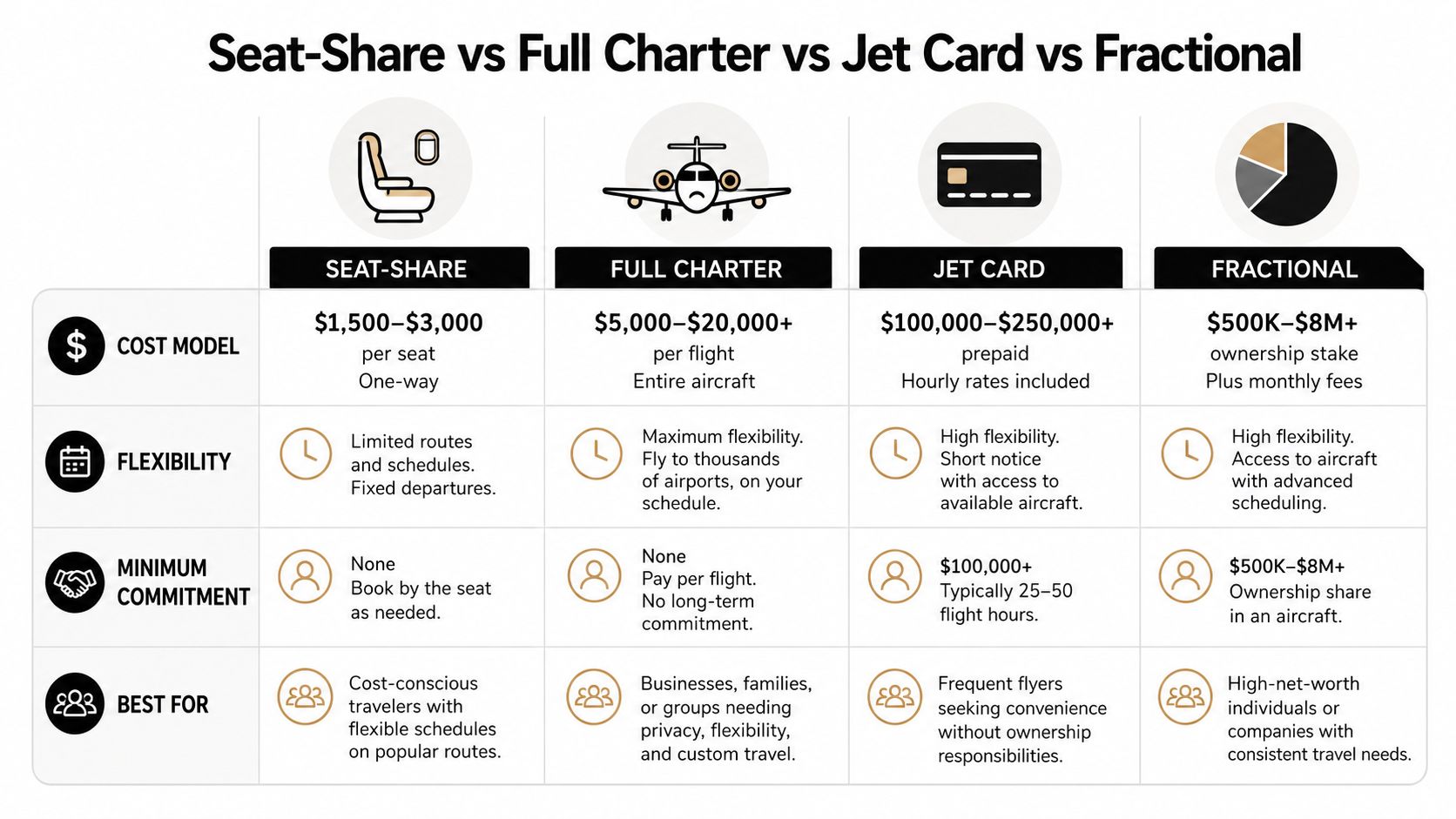
These four access models look similar until you compare commitment, flexibility, and total annual spend. The wrong choice usually comes from chasing the lowest visible fare instead of matching the booking model to the way you fly. The right choice depends on how often you fly, how much control you need, and whether you care more about a lower seat price or a lower all-in landed cost.
Choose by usage, not by fantasy
Seat-share and pooled flights work when you want occasional private access on a known route and you are fine giving up control over the departure time. Published examples for member-club style models show routes starting around $4,000 per route, which can make sense if convenience matters more than locking in the whole cabin (New York Post). Full charter wins when you want the exact aircraft, the exact time, and the least friction. Jet cards sit between the two, because you prepay for access and usually trade some flexibility for predictable booking.
Fractional ownership sits in a different bucket. It is a long-term commitment that only starts to make sense when your annual utilization is high enough to absorb the fixed burden. Based on the operating structure already outlined, roughly 50 occupied hours per year is the point where you should start asking whether fractional can compete, and below that it usually does not.
The honest comparison
- Seat-share: lowest commitment, least control, best for occasional travelers who can live with shared timing.
- Full charter: highest flexibility, best aircraft selection, cleanest pricing logic because you are buying the whole aircraft.
- Jet card: predictable access, but you are prepaying for convenience and accepting the operator's rules.
- Fractional: only for frequent flyers who can use the hours and tolerate the fixed ownership burden.
The mistake is comparing a shared seat to a full charter quote and stopping there. A seat-share fare may look cheap until you add the limits on schedule, route, and baggage, while a charter quote may look high until you factor in control, privacy, and the ability to avoid a bad connection day. If you are traveling with a group, seat-share and pooled routes can still be useful. If you are traveling for business with shifting schedules, charter is usually the cleaner answer. If you are flying enough to care about consistency across many trips, a card or fractional model deserves a real cost model, not a sales pitch.
Real-World Pricing on Three Common Routes
Route examples beat abstract ranges because they show how the invoice behaves in real life. A short, popular trip can look cheap on paper and still turn expensive once you load in the full aircraft economics. The same trip, split across the right number of travelers, can look reasonable fast.
New York to Miami
A light-jet shared trip on this route can land in a range that explains why shared private travel gets attention, but it still sits far above commercial. A lifestyle example cited a shared New York to South Florida light-jet trip at about $15,000 each way. That is the kind of figure that only works when time, privacy, and schedule control matter more than price.
Los Angeles to Las Vegas
This is the classic short-hop test case. A light jet on a route like this can work for a group because the trip is simple and the aircraft class is straightforward. If the flight is shared across enough passengers, the per-seat number can look manageable. If the group is small, the math turns fast because minimums and positioning take over.
Miami to Turks and Caicos
Route choice and aircraft choice start to matter together. A light jet can be the right tool if the mission fits, but the final quote still depends on aircraft location and route structure. If the aircraft is not local, the repositioning cost can erase the savings a buyer thought they had.

What the split means in practice
The breakeven is not about a single passenger. It is about how many people share the cabin and how much aircraft time the route burns. A bigger group can make charter surprisingly rational. A smaller group usually gets pushed toward seat-share, charter, or even commercial first class depending on urgency and flexibility.
The practical rule is simple. If your group can fill the aircraft without hurting schedule or comfort, splitting a charter can work. If not, you are paying for empty seats. For discounted repositioning inventory, the empty-leg flight guide is the right next read.
How to Actually Lower Your Share Cost
The biggest savings come from eliminating waste, not chasing a cute deal. Empty legs, local sourcing, and flexibility beat every brochure trick I've seen. Everything else is secondary.
Start with the savings that actually move the bill
Empty-leg flights are the sharpest discount path because the aircraft has to move anyway. The tradeoff is schedule control, since you're taking the operator's repositioning problem and turning it into your opportunity. If you can live with the timing, it's the only place where private aviation pricing can drop hard.
Second is local sourcing. If the aircraft is already near your departure city, you cut the repositioning premium that inflates so many charter quotes. That's exactly why many buyers should compare nearby aircraft before they compare categories.
Third is timing. Midweek departures and flexible dates usually beat peak demand windows. The smallest aircraft that safely covers the route also matters, because every extra cabin tier adds cost that your mission may never use.
Best savings order: local aircraft first, flexible timing second, aircraft size third, empty legs when your schedule can absorb them.
For a deeper walk-through of discounted repositioning inventory, the empty-leg flight guide is the right next read. Haute Jets also sources aircraft from nearby operators, so the quote can be built around local availability instead of padding the trip with avoidable ferry time.
Booking Considerations Before You Confirm
Don't book on price alone. Verify the operator's safety audit, confirm the tail number and crew details, and get the actual flight package before you wire anything. A quote without those details is a promise, not a booking.
Check the Wyvern or Argus rating, confirm Wi-Fi, catering, pet policy, ground transport, and cancellation terms, and make sure the payment method is clear. If the provider can't give you a full pre-flight confirmation package, keep shopping. The right trip is the one that's clean on paper before it ever leaves the ground.
Haute Jets sources aircraft from thousands of owner-operators across many countries, so the quote can be built around the right jet instead of a repositioned placeholder. If you want a straight answer on private jet share cost, charter alternatives, and the actual landed number per trip, visit Haute Jets and compare a real itinerary before you commit.