
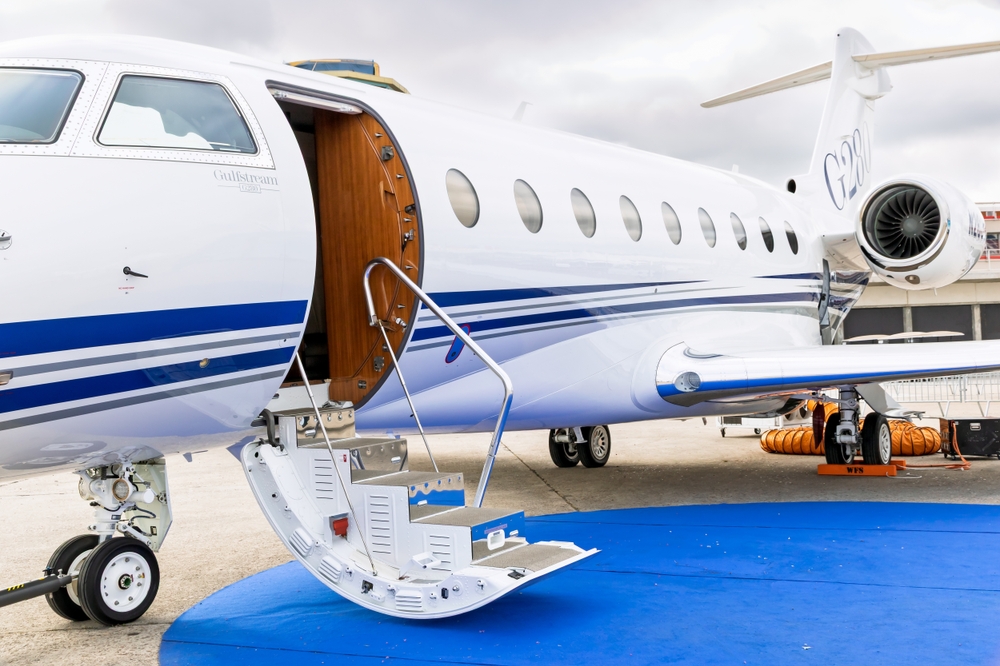
Ever wondered how you can get all the perks of owning a private jet without the massive price tag and logistical headaches? The answer for many is private jet shares. Think of it as a sophisticated timeshare for the skies, but with far more flexibility.
What Are Private Jet Shares

Often called fractional jet ownership, this model lets individuals and companies buy a slice of a private jet. Instead of purchasing an entire aircraft, you acquire a share in a specific jet, which really means you’re buying into a professionally managed fleet.
This setup is perfect for those who fly frequently but not enough to justify buying a whole jet outright. It hits the sweet spot for travelers flying between 50 and 400 hours a year—providing the consistency and on-demand availability of ownership while spreading the costs across a small group of fellow owners.
How a Private Jet Share Works
At its core, the concept is straightforward: the size of your share determines how many hours you can fly each year. The most common entry points into a fractional program are 1/16th and 1/8th shares.
- A 1/16th share typically gives you 50 occupied flight hours annually.
- A 1/8th share doubles that, offering 100 occupied flight hours.
You’re not just buying time; you're buying guaranteed access. With just a few hours' notice, you can have a plane from your provider's fleet ready and waiting for you, piloted and managed by a team of professionals.
To make this clearer, let's break down the key components of a typical fractional program.
Fractional Jet Ownership at a Glance
| Concept | What It Means for You |
|---|---|
| Capital Investment | The upfront cost to purchase your share of the aircraft. |
| Occupied Flight Hours | The guaranteed number of hours you can fly each year (wheels-up to wheels-down). |
| Monthly Management Fee | A recurring fee that covers indirect costs like pilot salaries, training, and insurance. |
| Hourly Operating Rate | An additional fee you pay only when you fly, covering fuel, in-flight catering, and landing fees. |
| Fleet Access | The ability to use other aircraft in the provider's fleet, not just the one you "own." |
Essentially, you’re buying into a full-service flight department without having to run one yourself. It's a structure built for convenience and predictability.
The real value of a private jet share is not just in owning a piece of an airplane, but in buying access to a comprehensive flight department. You get the plane, pilots, maintenance, and logistics, all bundled into one program.
More Than Just One Plane
Here’s where fractional ownership really shines. You might own a share in a midsize jet like a Citation Latitude, but what if you need a larger cabin for a transatlantic flight? Or a smaller, more efficient jet for a quick trip?
Modern share programs are built on this exact kind of flexibility. You can exchange your hours to access different aircraft types within the provider's fleet. This "interchange" privilege means your investment isn't locked into a single tail number; it’s a key that unlocks a whole hangar of options, ensuring you always have the right aircraft for the mission.
This managed approach strips away the enormous operational burdens—think FAA compliance, crew scheduling, and hangarage—and puts them on the provider's shoulders. All that's left for you to do is decide where you want to go.
How Fractional Ownership Actually Works

So, you’ve bought a share in a private jet. What happens next? The real value of fractional ownership isn't just owning a piece of the plane; it's buying your way out of the immense logistical burdens that come with it.
Think of the fractional provider as your personal, full-service flight department. This management company is the invisible engine that makes everything run smoothly. They handle the nitty-gritty: complex maintenance schedules, pilot hiring and training, insurance, hangarage, and navigating the maze of FAA regulations. You get the benefits of ownership with none of the operational headaches.
From Purchase to Takeoff
Once you're in the program, flying is refreshingly straightforward. Need to book a trip? You simply contact your dedicated owner services team or use a mobile app. One of the biggest selling points is guaranteed access, often with as little as four to ten hours' notice.
You never have to wonder if a pilot is available or if the jet is ready. The management company orchestrates everything behind the scenes, ensuring an aircraft from the fleet is perfectly positioned and prepared for your flight. This level of reliability is why shared private jet use in 2025 is trending 60-70% higher than it was before 2019, with no signs of slowing down.
Key Takeaway: Fractional ownership is less about owning an asset and more about securing access. You're buying into a fully managed, on-demand aviation service that handles every single detail for you.
The Power of the Fleet
Here’s where fractional ownership really shines: you aren't stuck with just one plane. While you might technically own a share in, say, a specific Citation XLS, you gain access to the provider’s entire fleet through "interchange rights."
This means you always have the right aircraft for the mission. Let’s say your share is in a light jet, which is perfect for your usual two-hour business flights. But next month, you’re planning a family ski trip to Aspen and need more space and range. No problem. You can simply use your hours on a larger, super-midsize jet from the fleet.
Common Interchange Scenarios:
- Upgrading: Using your hours to fly on a larger jet for more passengers or longer, non-stop flights.
- Downgrading: Choosing a smaller, more efficient jet for a quick solo trip, which often gives you bonus flight time.
- Peak Day Access: During holidays or major events, the provider juggles the fleet to guarantee every owner can fly, even if their specific jet is already booked.
This system gives you incredible flexibility that a single aircraft owner could only dream of. The provider manages this complex logistical ballet, giving you a seamless experience every time you fly. Of course, this convenience is factored into the program's costs, and you can see a full breakdown of how a private plane timeshare's cost is structured. Ultimately, private jet shares are designed to deliver the private jet lifestyle with minimal hands-on involvement.
The Real Cost of a Private Jet Share

When you start looking into private jet shares, it's easy to focus on the initial purchase price. But that figure is really just the down payment on a much larger financial picture. To truly understand what you're getting into, you need to break the cost down into three distinct parts.
First up is the one-time acquisition cost. This is the big, upfront investment you make to buy your slice of the aircraft. For a typical 1/16th share, which gives you 50 hours of flight time a year, you could be looking at anywhere from $500,000 for a light jet to more than $4 million for a brand-new, ultra-long-range model. It's your ticket into the club.
After that initial buy-in, you’ll have monthly management fees. Think of these as the fixed, predictable costs of having a world-class flight department on retainer. They aren’t for flying; they’re for everything that has to happen on the ground to make your flights possible.
What Your Management Fee Covers
These recurring fees handle the immense logistical and operational burden that would otherwise fall on you as an owner.
- Pilot and Crew Costs: This covers everything from salaries and benefits to the constant, rigorous training required to keep crews at the top of their game.
- Hangarage: You're paying for a secure, often climate-controlled, home for the fleet at various operational bases.
- Comprehensive Insurance: This is the massive liability and hull insurance policy covering a fleet of multi-million-dollar assets.
- Administrative and Support Staff: It funds the owner services team—the people you call to book a trip and coordinate all the moving parts.
This structure provides a stable cost model, ensuring the complex machine of a flight operation is always humming in the background. If you want to dive deeper into these numbers, our complete private jet cost breakdown provides a more granular view.
The third piece of the puzzle is the occupied hourly fee. This is the variable cost you only pay when you're actually flying—from the moment the wheels leave the runway to the moment they touch down again.
This per-hour rate covers the direct costs of your trip: fuel, standard catering, airport landing and handling fees, and maintenance reserves tied to flight hours. The rate naturally changes depending on the jet, as a light jet burns far less fuel and has lower operating costs than a heavy one.
Uncovering the Hidden Costs
Beyond those three core costs, a few other expenses can catch new owners by surprise. Some programs charge repositioning fees (or "ferry fees") if the aircraft has to fly empty to pick you up from an airport outside their main service area, though most of the big players absorb this.
The most overlooked financial aspect of private jet shares is often depreciation. While the management company guarantees to buy back your share at the end of the typical five-year contract, it will be at the current fair market value, which will be less than your initial purchase price.
Finally, you can’t forget taxes. In the U.S., a federal excise tax of 7.5% is applied to your flight charges, including the occupied hourly fees and any fuel surcharges. It’s crucial to factor in these extra layers of expense to get a true picture of your total investment and decide if the fractional model really fits your goals.
Comparing Your Private Aviation Options
So, you're considering flying private. The first thing you need to know is that there’s no single "best" way to do it. The right choice really comes down to a personal calculation of your travel habits, your budget, and how much control you truly want.
While private jet shares are a fantastic solution for some, they're just one piece of a bigger puzzle. Let's walk through the four main ways people fly private so you can see where you might fit in.
Full Aircraft Ownership
This is the dream, right? Your own jet, ready to go whenever you are. You pick the aircraft, the paint job, the interior, and your crew. It’s the absolute peak of convenience and personalization in private travel, available 24/7.
But that level of freedom comes with an equally staggering level of responsibility. We’re talking about a multi-million-dollar purchase followed by the relentless costs of crew, hangar space, insurance, and maintenance. These operational costs can easily pile up into millions each year. In our experience, full ownership only starts making sense if you're flying well over 400 hours annually.
Fractional Ownership and Private Jet Shares
As we've covered, this is the industry's answer to the full ownership headache. You buy a slice of the pie—a share that gives you a fixed number of flight hours each year. The management company handles all the logistics, from pilots to maintenance, giving you a taste of ownership without the all-consuming work.
It’s an elegant compromise, offering the predictable availability many high-frequency travelers need. The catch? It’s still a major capital expense upfront, and you’re typically signing on for a multi-year contract, usually five years. This works beautifully for those with consistent travel patterns who fly often and value having a guaranteed ride.
Jet Cards
Think of a jet card as a sophisticated pre-paid calling card for air travel. You purchase a block of flight time, often 25, 50, or 100 hours, on a specific class of aircraft. The big appeal here is the fixed hourly rate, which makes budgeting incredibly simple and protects you from market price swings.
Jet cards are a great fit for people who want cost predictability without the long-term commitment of ownership. The trade-off is often less flexibility, potential surcharges on peak travel days, and the fact that you've paid for those hours whether you end up using them all or not. We dive deeper into this in our guide comparing private jet cards vs charters.
On-Demand Private Jet Charter
This is private aviation at its most accessible and flexible. On-demand charter is a pure pay-as-you-go service. You book a trip, you pay for that trip, and that's it. No massive upfront investments, no long-term contracts, and no membership fees.
The market for this kind of travel is exploding—one analysis projects it will reach $48.13 billion by 2026, driven by people who demand this exact flexibility. This is where modern providers like Haute Jets excel. By tapping into a global network of over 3,500 aircraft from owner-operators in 175 countries, we can find the right jet in the right place, often avoiding the huge repositioning fees that can add 20-40% to a flight's cost with older brokerage models. You can read more about these private jet industry statistics and why this model is gaining so much traction.
On-demand charter offers the freedom to choose the perfect aircraft for every single trip—from a light jet for a quick business meeting to a heavy jet for a family vacation—without being tied to a specific fleet or program.
To help you visualize how these options stack up, we've put together a simple comparison.
Private Aviation Models Compared
This chart breaks down the four primary ways to fly private, helping you see at a glance which model aligns best with your needs for cost, commitment, and flexibility.
| Feature | Full Ownership | Fractional Ownership | Jet Card | On-Demand Charter |
|---|---|---|---|---|
| Upfront Capital | Very High | High | Moderate (Pre-paid) | None |
| Cost Predictability | Low (Variable) | High (Fixed + Hourly) | Very High (Fixed Hourly) | Moderate (Market Rates) |
| Commitment | Very Long Term | Long Term (3-5 Years) | Medium Term (1-2 Years) | Per Flight |
| Aircraft Choice | Your Specific Jet | Fleet Interchange | Aircraft Category | Entire Market |
| Operational Control | Full Control | None | None | None |
| Ideal User (Hours/Year) | 400+ | 50-400 | 25-100 | 10-100+ |
As you can see, each model serves a different purpose. Private jet shares are tailored for a very specific type of flyer with predictable, high-frequency needs. For everyone else—those who value agility, financial prudence, and the freedom to choose—the smart money is often on the nimble and efficient world of on-demand charter.
Weighing the Pros and Cons of Jet Shares
So, is fractional ownership the right call for you? It’s a classic trade-off. You're balancing incredible convenience against a very serious financial commitment. To know if it’s the right fit, you have to get real about what you gain and what you give up. Let's dig into the good, the bad, and the fine print.
The biggest draw is how predictable it all is. Once you’ve made the initial purchase, your costs are boiled down to two simple numbers: a fixed monthly management fee and a locked-in hourly rate for when you’re in the air. This completely sidesteps the wild, unpredictable expenses that come with owning a whole aircraft, making it much easier to budget for your travel year after year.
You’re also buying guaranteed access to an entire fleet of top-tier aircraft. With just a handful of hours' notice, a jet is waiting for you, crew and all. In a market where finding a high-quality charter can be a scramble, that kind of reliability is gold. Just look at the numbers—North America saw 45,016 private jet departures in the first week of 2026 alone, part of a massive four-week total of 281,420 flights, according to recent private jet flight activity analysis. Having a guaranteed seat is a powerful advantage.
The Upside of Fractional Ownership
For frequent flyers who value consistency above all else, the benefits of a fractional program are hard to overstate. You're not just buying hours; you're buying total peace of mind.
- You Fly, They Handle the Rest: Forget about maintenance logs, crew salaries, insurance policies, or FAA paperwork. The provider manages everything. You just show up and fly.
- Your Jet is Always Ready: Unlike charter, which depends on market availability, your access is written into a contract. Even on the busiest holiday weekends, you have a plane.
- Top-Tier Safety: The major fractional companies run their operations with safety standards that often go far beyond what the FAA requires. It's an unparalleled level of security.
- The Right Jet for Every Trip: Even if you own a share in a light jet, most programs let you access larger aircraft from the fleet when you need more seats or range.
The core value proposition of private jet shares is trading a degree of flexibility for absolute consistency. You get the same high-quality cabin experience, the same level of service, and the same safety rating on every single flight.
The Downside and Its Considerations
But it's not all smooth flying. The single biggest hurdle is the price of entry. The upfront capital needed to buy your share can easily run from hundreds of thousands into the millions of dollars. That’s a huge amount of cash to tie up in a depreciating asset.
That investment is locked in by a long-term contract, which is another major point to consider. Most fractional agreements bind you for five years. If your life changes—you sell the business, your travel patterns shift—getting out of that contract early is both difficult and expensive. You’re committed for the long haul.
Finally, let's be clear: you don't actually own a plane. You won't have a specific tail number to call your own. You own a slice of a large, uniform fleet, and you’ll likely be on a different (though identical) aircraft for every trip. For anyone who dreams of the pride and personal touch of true aircraft ownership, this can feel a little impersonal. It's the ultimate trade-off: you give up owning a single plane for guaranteed access to an entire aviation solution.
Finding the Right Flight Solution for You
Choosing your path in private aviation really comes down to an honest look at your personal and business travel habits. As we've covered, private jet shares are a fantastic solution, but they’re built for a specific kind of flyer—one whose travel is frequent, predictable, and who prioritizes guaranteed access over anything else.
Think of the executive who flies the same multi-city route each month or the family that heads to the same vacation home on a set schedule. If you fly between 50 and 400 hours a year and want the feeling of ownership without the headaches of managing an aircraft, fractional ownership makes a lot of sense. It’s a major commitment, but one that pays off in pure reliability.
This decision path can help you see if the structured nature of private jet shares lines up with how you actually travel.
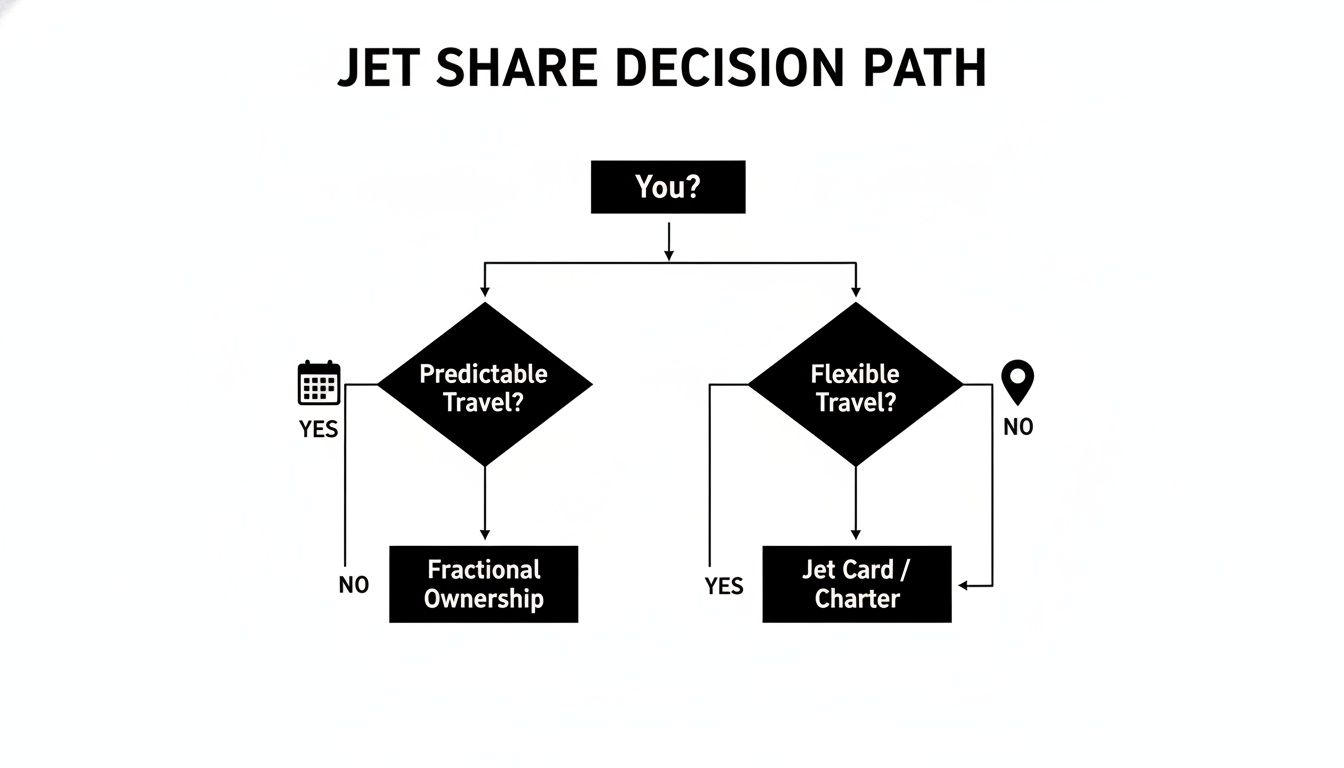
As the chart shows, while fractional ownership is a perfect match for consistent travel, it starts to lose its appeal when your plans are more spontaneous or varied.
The Modern Alternative: On-Demand Charter
For many of us, life and business just aren't that predictable. Schedules pivot, unexpected opportunities pop up, and destinations change at a moment's notice. For the flyer who values agility and financial common sense, the on-demand charter model is simply a smarter, more adaptable choice.
On-demand charter is private aviation on your terms. Instead of a five-year contract and a huge capital investment, you pay for each flight as you book it. No membership fees, no block hours to burn through, and no long-term financial handcuffs. This structure gives you absolute freedom.
On-demand charter frees you from the limits of a single program or fleet. You get access to the entire global market, ensuring you always have the perfect jet for every unique mission.
The Power of a Tech-Forward Charter Solution
This is where a modern approach to charter, like the one we’ve built at Haute Jets, really shines. By using a vast, tech-powered network, we connect you with thousands of safety-vetted aircraft from top-tier operators all over the world.
This model delivers some powerful advantages over both fractional programs and old-school charter brokers:
- No Capital Outlay: You can fly private without sinking millions into a depreciating asset. That capital stays in your pocket, free for you to invest elsewhere.
- Total Flexibility: Pick the exact aircraft you need for each trip. Maybe a light jet for a quick business meeting, or a heavy jet for that transatlantic family vacation. You're never locked into one size.
- Cost Efficiency: We find aircraft already positioned near your departure point, which eliminates the repositioning fees that can easily inflate your costs by 20-40%.
For the vast majority of private flyers, on-demand charter is just a more intelligent way to travel. It gives you all the luxury and convenience of flying private while protecting your financial freedom and adapting to your world as it changes.
Frequently Asked Questions About Private Jet Shares
Once you start digging past the big-picture concepts, the practical, real-world questions always surface. We've guided countless clients through this process, and these are the questions that come up time and time again.
Let's get you some straight answers.
Can I Sell My Private Jet Share Early?
Technically, yes, but it’s rarely simple or financially painless. Most fractional agreements are built around a five-year term, and they're designed with that commitment in mind.
While every provider has a process for an early exit, it's not like selling a stock on the open market. The provider has to facilitate the sale for you, and you'll face some significant financial hurdles. They control the process, and you’ll be selling at the current market value, which is almost guaranteed to be a loss from your initial investment. It's crucial to go into a fractional deal seeing it as a long-term relationship.
Do I Get to Choose My Pilots and Crew?
No, and that's by design. A huge part of what you're buying into is the provider's fully managed, standardized service. They handle every aspect of crewing—from hiring and intensive training to scheduling—across their entire fleet.
This is a feature, not a flaw. Centralized crew management is how fractional companies maintain exceptionally high and consistent safety standards, which often go well beyond FAA minimums. You gain the confidence that every single flight is operated by a top-tier, deeply vetted, and experienced team.
What Happens if My Jet Is Unavailable?
This is where the power of the fleet comes into play. While your share is tied to a specific aircraft on paper, your access is to the whole fleet. If your "home" jet is booked by another owner or is down for maintenance, the provider simply swaps in an identical one. It's a seamless process.
If an identical model isn't available for some reason, they are obligated to provide you with a comparable or even upgraded aircraft at no additional cost. This guarantee of access is a core reason why people who can't afford delays choose fractional ownership over the uncertainties of on-demand charter.
Are Pets Allowed on Fractional Jets?
Absolutely. Private aviation is meant to be for the whole family, and fractional providers understand that includes furry members. You just need to give them a heads-up when you book.
- Requirements: They may ask for health or vaccination records, so have those handy.
- Safety: For everyone's safety, pets usually need to be in a carrier or restrained during takeoff and landing.
- Aircraft Size: Be realistic about space. Bringing a Great Dane onto a very light jet can get cramped. It’s always smart to chat with your owner services team about your specific needs before booking.
Tired of long-term contracts and hefty capital investments? Haute Jets offers a smarter way to fly private. Access a global network of 3,500+ safety-rated aircraft on a pure pay-as-you-fly basis—no memberships, no jet cards, just the perfect jet for every trip. Book your next flight on-demand.