

You've booked a private jet to Houston for a meeting that can't move. The aircraft is ready, the flight is smooth, and you arrive ahead of schedule. Then the itinerary loses its advantage because you've landed at the wrong airport, selected an inconvenient FBO, or created a ground transfer across the metro area that could have been avoided.
Houston isn't one private-aviation gateway. It's a spread-out business market with different airports, runway profiles, customs capabilities, FBO hours, and access routes. The right decision isn't which aircraft you want. It's where that aircraft should land.
Why Airport Choice Defines Your Houston Trip
A traveler heading to the Energy Corridor may see George Bush Intercontinental Airport, IAH, as the obvious choice because it's Houston's best-known international gateway. But if the aircraft lands at an FBO that puts the passenger on the wrong side of the metro area, the flight's efficiency can disappear during the ground transfer. A trip into Uptown, downtown, or the Texas Medical Center can demand a completely different airport strategy.
That's why an experienced charter advisor starts with the final destination, not the aircraft brochure. The advisor considers where the passenger needs to be, whether customs is required, how much luggage is traveling, whether the aircraft needs a longer runway, and which FBO can coordinate ground transportation without adding unnecessary repositioning.

Houston operates as a multi-airport market
Independent Houston airport guides identify at least 6 airports and 12 FBOs across the metro area for private aviation, including HOU, IAH, DWH, CXO, SGR, and GLS, as listed by The Jet Finder's Houston airport guide. That range gives travelers flexibility, but it also creates a planning problem. A quote that says “Houston” leaves out one of the most important operational decisions.
William P. Hobby Airport, Ellington Airport, Houston Executive Airport, and George Bush Intercontinental all serve different purposes. Dedicated general-aviation fields may reduce commercial-terminal congestion, while IAH and HOU offer broader FBO access and, where applicable, customs handling.
Practical rule: Choose the airport that minimizes total door-to-door time, not the airport that looks most familiar on a map.
Houston's commercial scale reinforces the importance of that decision. IAH recorded about 17.4 million arriving passengers, 17.3 million departing passengers, and 171,103 scheduled departures in 2025, according to BTS TranStats airport data. That level of scheduled activity makes private terminals attractive, but it doesn't make every Houston airport interchangeable.
The hidden cost of a poor choice is often not the flight itself. It's the vehicle transfer, the aircraft repositioning requirement, a customs delay, or an FBO schedule that doesn't fit the arrival. A good private-jet itinerary solves those issues before the aircraft is selected.
Comparing Houston Airports for Private Aviation
Houston's principal airports should be evaluated against the mission. Hobby is generally the strongest inner-loop option for domestic business travel, while IAH offers runway length and international capability that can matter more than proximity. Ellington, Houston Executive, and David Wayne Hooks add useful alternatives when the passenger's destination or aircraft performance favors a general-aviation field.
William P. Hobby, or KHOU, has a 7,602-foot runway and multiple FBOs. That makes it suitable for most light and midsize charter missions, as well as many super-midsize flights, while keeping passengers comparatively close to downtown and the Texas Medical Center. Signature Aviation's HOU location information also identifies HOU as a strategically positioned private-aviation gateway.
George Bush Intercontinental, or KIAH, has a 12,001-foot runway and international port-of-entry capability. That profile makes it the more logical choice for many heavy jets, long-range aircraft, fully loaded missions, and international arrivals. Travelers using IAH should confirm the specific FBO's operating schedule, particularly for late-night or early-morning movements. Signature Aviation's IAH facility lists operating hours from 6 a.m. to 10 p.m., seven days a week, while other Houston-area private terminals operate around the clock.
| Airport | Runway Length | FBOs | Customs | Best For |
|---|---|---|---|---|
| William P. Hobby, KHOU | 7,602 feet | Multiple FBOs, including full-service facilities | Full-time U.S. Customs available | Downtown, inner-loop travel, Texas Medical Center, domestic light through many super-midsize missions |
| George Bush Intercontinental, KIAH | 12,001 feet | Private aviation facilities with varying hours | International port-of-entry capability | Heavy jets, long-range missions, international arrivals, larger payloads |
| Ellington Airport | Not specified here | Private-aviation services available | Confirm for the specific operation | Southeast Houston access and selected general-aviation missions |
| Houston Executive, KTME | Longer general-aviation runway profile | Dedicated executive-airport FBO access | Confirm before booking | Energy Corridor access and missions avoiding commercial congestion |
| David Wayne Hooks, KDWH | Longer general-aviation runway profile | General-aviation FBO access | Confirm before booking | Northwest Houston destinations and regional business travel |
For a closer look at the airport's private-aviation operation, review George Bush Intercontinental private jet services. The practical choice depends on the final address. Houston Executive may be efficient for an Energy Corridor itinerary, HOU may win for downtown or the medical center, and IAH may be unavoidable for customs or aircraft-performance reasons.
Airport selection is also a cost lever. Houston Jet Charter's airport guidance explains why repositioning, taxi delays, and passenger ground time should be considered together rather than treated as separate line items.
Matching Aircraft to Your Houston Mission
The aircraft category should follow the itinerary. Start with four questions: how many passengers are traveling, how much luggage is coming, how far is the flight, and which Houston runway can support the mission with an appropriate performance margin?
A light jet such as the Phenom 300 can be a sensible choice for a short Texas hop from Dallas or Austin into Hobby, particularly when the passenger count and luggage volume are modest. It offers a more efficient cabin and operating profile than a larger aircraft when the mission doesn't require additional range or space.
A midsize jet makes more sense when the itinerary demands greater cabin comfort or additional baggage capacity. For coast-to-coast travel, a super-midsize aircraft such as the Challenger 350 provides a stronger balance of range, cabin volume, and passenger comfort. A large-cabin aircraft, such as the Gulfstream G550, becomes relevant for international arrivals, heavier payloads, or missions where runway and takeoff performance margins deserve priority.

The category isn't enough
Two aircraft in the same class can produce very different experiences. Confirm the exact year, make, model, and cabin layout, then verify the details that affect the trip:
- Connectivity: Confirm whether the aircraft has the Wi-Fi capability you need for calls and secure work.
- Cabin arrangement: Ask how many seats are forward-facing, how the seats recline, and whether the layout supports meetings or rest.
- Luggage: Match the available baggage space to hard cases, presentation materials, golf equipment, or other bulky items.
- Pets: Confirm the operator's pet policy before the aircraft is secured.
- Catering: Specify dietary requirements and whether the request is for a meal, light snacks, or a service appropriate to your needs.
- Airport compatibility: Check the runway, weight, customs, and operating constraints at the selected Houston field.
Runway length matters because aircraft performance changes with payload, fuel requirements, temperature, and operational conditions. KHOU's 7,602-foot runway suits most light, midsize, and many super-midsize charter missions, while KIAH's 12,001-foot runway gives heavy and long-range aircraft more operating room. The Haute Jets fleet can be evaluated by mission rather than by category alone, which is the right way to compare aircraft for Houston.
The best aircraft is the one that fits the passenger load, range, cabin expectations, and destination airport without forcing an avoidable repositioning or ground transfer.
How to Book a Private Jet to Houston
A good booking process begins with a precise inquiry. Give the advisor your departure city, preferred dates, passenger count, luggage requirements, pets, destination address, schedule flexibility, and whether the trip is domestic or international. “I need a private jet to Houston” is a starting point, not enough information for a reliable recommendation.
Start with the operational details
The sourcing process should then focus on aircraft that are already near the departure point and compatible with the Houston airport that best serves the itinerary. Haute Jets sources from 3,500+ owner-operators across 175 countries, and its model is designed to eliminate repositioning fees that inflate traditional broker and jet-card pricing by 20–40%, as described in the supplied Haute Jets company information.
That approach matters because an aircraft that looks attractive in isolation may require an empty repositioning leg before collecting you. Ask whether the quoted aircraft is locally based, whether the price includes repositioning, and whether any additional ferry, crew, handling, or ground charges can change the final amount.

Review the aircraft, not just the quote
A useful quote should identify specific aircraft options and explain the relevant trade-offs. Compare cabin layout, Wi-Fi, luggage capacity, pet acceptance, catering, FBO location, departure window, cancellation terms, and any ground-transport arrangements before choosing.
On-demand charter is often more practical for travelers who want to pay for a specific trip rather than commit to annual fees, prepaid hours, or restricted availability. Jet cards and membership programs can suit travelers with highly predictable patterns, but they're not automatically the right structure for a client booking one Houston itinerary or an irregular series of trips.
After you confirm the aircraft, the provider should coordinate the FBO, passengers, catering, ground transportation, and required documents. A complete pre-flight briefing should arrive 24 hours before departure with the tail number, crew bios, weather information, and passenger manifest, based on the Haute Jets service information.
For a broader explanation of the booking process, see how to charter a private jet in 2026.
The final question is simple: does the quote represent the aircraft you selected, or are you paying for a repositioning plan you never requested?
Weather Disruptions and Operational Resilience
Private aviation removes commercial security lines and reduces exposure to crowded terminals. It doesn't remove weather, air-traffic-control restrictions, runway closures, ramp congestion, or airport-wide ground stops.
Houston's Gulf Coast location makes weather planning especially important. In June 2026, Houston airports experienced a temporary FAA weather ground stop and ongoing delays during flood conditions, demonstrating that private aircraft can face the same regional operating constraints as commercial flights, according to Forbes coverage of weather and airport disruption.
Build the backup before departure day
Your advisor should discuss the departure window, likely storm timing, alternate airports, crew duty considerations, and the practical limits of moving the aircraft. A flexible schedule can create room to depart before a weather system closes the region or to delay until the airport and airspace reopen.
Airport choice can also influence the recovery plan. HOU's inner-loop position may be more convenient for a downtown itinerary, while IAH may offer the runway, customs, or aircraft support required for a particular mission. Executive airports such as Houston Executive or David Wayne Hooks may provide useful alternatives when the aircraft and final destination allow them.
A resilient plan should answer four questions:
- What is the alternate airport? Confirm which Houston-area field can accept the aircraft and serve the final destination.
- What triggers a schedule change? Ask whether the operator is monitoring FAA restrictions, radar, airport closures, and ramp conditions.
- Who handles the ground transfer? Make sure a vehicle can follow an airport change without creating a second delay.
- How much flexibility is available? Decide whether the departure can move earlier or later if the forecast changes.
Weather may also affect the flight experience even when the aircraft operates normally. If you're facing a long sector, how to sleep on a plane offers practical guidance on managing rest, cabin conditions, and arrival readiness.
The right expectation is not guaranteed punctuality. It's competent contingency planning and fast communication when Houston's weather changes the operating picture.
Safety Ratings and Operator Transparency
The aircraft's appearance tells you almost nothing about the quality of the operation. Before booking, verify the Part 135 operator, third-party safety rating, crew information, insurance position, and maintenance oversight.
Wyvern Wingman and Argus Gold or Platinum are the safety-rating standards Haute Jets identifies for operators in its network. These audits are intended to provide independent review of areas such as pilot qualifications, training, maintenance practices, operational history, and insurance documentation. A charter advisor should be able to identify the actual operating company, not just the name of the broker or booking brand.
Ask for the operator's identity
ARGUS tracks Part 135 operators through audited rating systems. The cited safety directory lists 840 operators in its register and 657 rated operators, providing useful context for why travelers should distinguish between an operator that appears in a directory and one that has an audited rating, as shown by CheckBravo's private-aviation safety directory.
Request the following before final payment:
- Operating certificate: Identify the legal Part 135 operator flying the mission.
- Aircraft identity: Confirm the tail number once the aircraft is assigned.
- Crew details: Review the crew bios and relevant experience provided before departure.
- Safety rating: Ask whether the operator holds Wyvern Wingman or Argus Gold or Platinum status.
- Insurance and documentation: Confirm that the provider can furnish the required operational details.
- Passenger information: Verify that the manifest is accurate and complete.
Transparency should continue through the final briefing. Haute Jets' stated process provides the tail number, crew bios, weather briefing, and passenger manifest 24 hours before departure. That information gives you a final opportunity to identify discrepancies before arriving at the FBO.
A private charter should feel discreet, not opaque. If a provider won't identify the actual operator or explain the aircraft and crew assignment, choose a different provider.
Your Pre-Flight Checklist for Houston Charters
Use this checklist before you approve a Houston itinerary. Each item protects the part of the journey that can undermine an otherwise excellent flight.
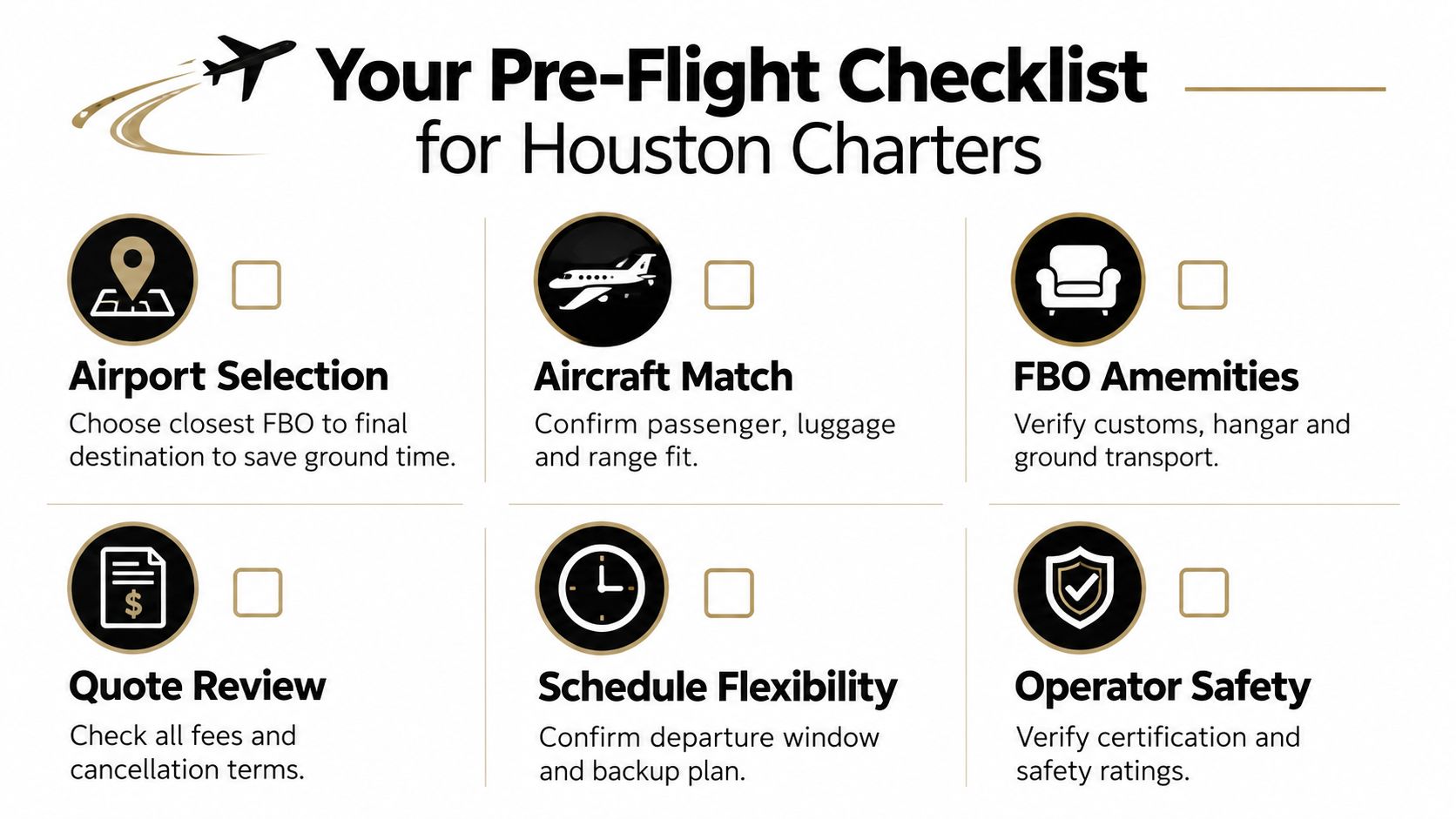
- Airport selection: Choose the FBO closest to your final destination, while confirming runway, customs, and operating-hour requirements.
- Aircraft match: Verify passenger capacity, luggage space, range, cabin layout, Wi-Fi, and pet acceptance against the actual mission.
- FBO services: Confirm lounge access, customs handling, hangar arrangements, catering, and vehicle coordination.
- Quote review: Check repositioning, handling, ground transportation, cancellation terms, and every included or excluded charge.
- Schedule flexibility: Establish a departure window and backup airport plan in case Houston weather affects the original itinerary.
- Operator safety: Identify the Part 135 operator and verify its certification and third-party safety rating.
Ground transportation deserves special attention. A Houston-based transfer service launched dedicated FBO transfers at both IAH and HOU in April 2026, a development reported by EvoJets' Houston airport coverage. The practical lesson is clear: aircraft access alone doesn't complete the journey. Your provider should coordinate the final transfer as carefully as the flight.
Before departure, reconfirm the passenger manifest, catering, pets, luggage, FBO address, driver contact, and weather plan. Those details turn a private flight into an efficient Houston itinerary.
Haute Jets arranges on-demand charters using its network of owner-operators, with aircraft and airport selection built around your actual destination, schedule, and cabin requirements. Visit Haute Jets to request a Houston flight plan that accounts for the aircraft, FBO, ground transfer, and operational details before you book.