

Installing Wi-Fi on a private jet can cost about $100,000 to more than $700,000, while top-tier monthly plans can reach $20,000. For a charter passenger, however, the visible charge may be bundled, added as a per-flight fee, or absorbed into the aircraft's hourly rate.
That distinction is the key to understanding private jet Wi-Fi cost in 2026. The aircraft owner or operator makes the capital decision. The traveler experiences the result through aircraft selection, service quality, and the line items on a charter quote. Confusing those two sides is how buyers compare a basic onboard connection with a high-throughput satellite system as if they were the same product.
What Private Jet Wi-Fi Actually Costs in 2026
The headline range is wide because private jet connectivity isn't a simple cabin accessory. A light-aircraft retrofit can sit near $100,000, while complex installations on large-cabin aircraft can exceed $700,000, depending on airframe size, retrofit difficulty, antenna technology, certification, and coverage requirements. Virtual Hangar Media outlines the installation range and the factors that drive it.
Then comes the subscription. Reported 2026 Starlink Aviation plans start at about $2,000 per month for 20 GB and reach $10,000 per month for unlimited use, while other business-aviation services have been reported around $5,650 to $9,995 per month for high-data or unlimited plans. BlackJet's private jet Wi-Fi cost overview compares these ownership-side figures. Current Starlink business-aviation coverage also reports a $20,000 monthly Global Unlimited plan, a $12,500 Regional Unlimited plan, and a $4,000 Regional 25GB plan with $250 per extra gigabyte. GlobalAir details those 2026 Starlink Aviation tiers.
Two different questions hide inside one price
Owners ask, “What will it cost to equip this aircraft and keep it connected?” Charter travelers ask, “Will Wi-Fi work for my meeting, and what will appear on my quote?”
Those questions produce different answers. The operator may amortize a six-figure installation across years of flying, then include service in the hourly rate. Another operator may disclose a connectivity fee. A third may offer an aircraft with no meaningful Wi-Fi at all, despite describing it as “Wi-Fi capable.”
| Cabin Category | Install Range | Monthly Plan | Per-Flight Surcharge |
|---|---|---|---|
| Light jet | About $100,000 to $225,000 | Varies by system and data allowance | Often bundled or separately quoted |
| Midsize or super-midsize jet | Varies with retrofit and antenna class | Can reach high-data business-aviation pricing | Often quoted by operator |
| Large-cabin aircraft | About $350,000 to $400,000, with broader satellite estimates reaching $500,000 or more | Top plans can reach $20,000 monthly | May be bundled, disclosed, or passed through |
The practical rule is simple: never evaluate the installation figure without asking about the subscription tail. The hardware determines what the aircraft can support. The active plan determines whether that capability is available on your flight.
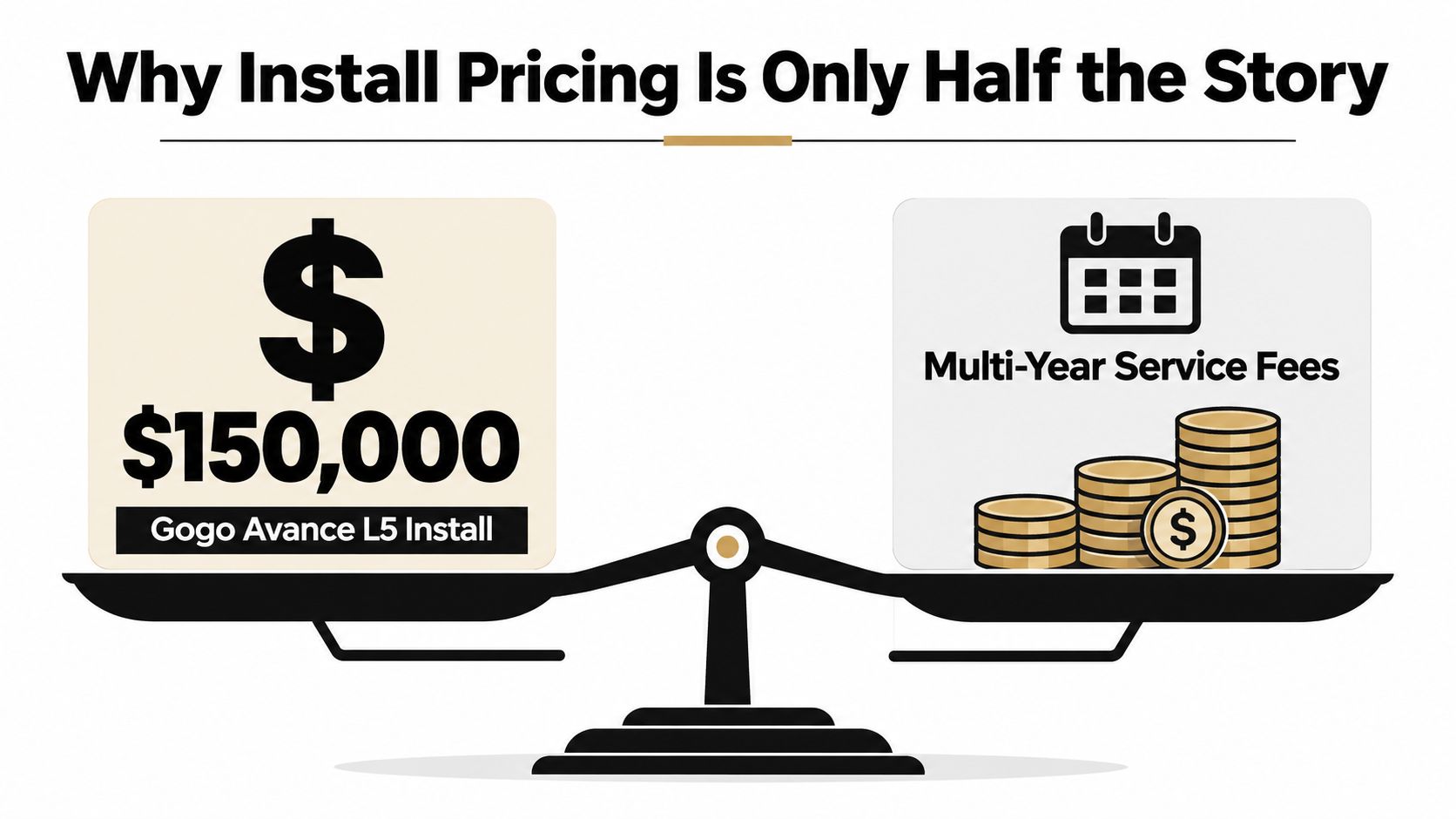
Why Install Pricing Is Only Half the Story
A connectivity system can carry a modest equipment quote and a heavy operating bill, or demand a large installation payment before proving economical over time. The installation figure answers what the aircraft owner spends upfront. It does not tell a charter traveler what the operator may recover through hourly rates, service fees, or flight-specific charges.
A reported $150,000 Gogo Avance L5 installation may come with a multi-year service commitment. A reported $500,000 Starlink retrofit places more emphasis on a high-bandwidth monthly plan. Those are different ownership-side cost profiles, not interchangeable products. BlackJet compares installation and recurring service economics across private aviation systems.
The operator spreads capital across flying hours
Aircraft owners recover major equipment investments over multiple years, not from one passenger's itinerary. A charter customer may therefore see a connectivity charge that covers more than the data used on that flight. The amount can also reflect equipment recovery, maintenance, access to the service, and the operator's margin.
Ask what you are paying for before negotiating. Separate cost recovery from actual usage billing. A disclosed flat fee is easier to evaluate than “Wi-Fi available,” but the fee still needs a defined service level.
Cheap hardware can still deliver a poor cabin experience
A jet with a roughly $200,000 system can deliver disappointing service if its operator uses an entry-level plan or an older network. A less expensive installation paired with a premium plan may perform better for your actual workload. Virtual Hangar Media explains why the lifetime connectivity bill matters alongside the retrofit price.
For a charter booking, ask for four details: the installed system, active plan, data allowance, and overage terms. Ownership economics explain where the money goes. Charter pricing determines what appears on your quote. “The aircraft has Wi-Fi” is not a performance specification.
Major Connectivity Options Compared
Private aviation buyers usually encounter four broad connectivity families. Gogo remains relevant for light and midsize aircraft, especially where air-to-ground service fits the route. Viasat Ka-band serves operators seeking stronger satellite performance on larger aircraft. Inmarsat SwiftBroadband still appears on older airframes. Starlink Aviation has changed the conversation by making low-latency, high-throughput service a central selling point.
The right system depends on the aircraft, route, and workload. A short overland hop for email doesn't require the same architecture as an ocean crossing with multiple executives on video calls.
| System | Install Range | Monthly Plan | Speed / Latency | Best Fit |
|---|---|---|---|---|
| Gogo Avance L3 or L5 | Varies by aircraft and retrofit | Varies by contract and allowance | Light to moderate productivity over supported coverage | Light and midsize jets, short regional trips |
| Viasat Ka-band | Varies by airframe and antenna | High-data business-aviation plans | Strong satellite throughput, higher latency than LEO | Super-midsize and large-cabin aircraft |
| Inmarsat SwiftBroadband | Legacy installation dependent | Varies by legacy service plan | Limited bandwidth and slower response | Older fleets, messaging, basic VPN |
| Starlink Aviation | Retrofit cost varies widely, with broader private-jet installation estimates reaching $500,000 or more | Reported 2026 tiers include $4,000 Regional 25GB, $12,500 Regional Unlimited, and $20,000 Global Unlimited | High throughput and low LEO latency | Heavy business use, streaming, global routes |
Gogo is often the practical answer for a smaller aircraft, but travelers should match expectations to the system. It may handle email, messaging, and lighter browsing without issue, yet that doesn't make it suitable for a cabin-wide video-conferencing workload.
Viasat occupies the dependable middle ground for many larger aircraft. Starlink is the aggressive high-throughput option, particularly when the flight requires consistent collaboration rather than occasional browsing. Legacy satcom remains relevant because aircraft upgrades happen on physical airframes, not on a content calendar.
For a broader aircraft-by-aircraft view, review which private jets have Wi-Fi before you select a category. The important question isn't whether a model can carry Wi-Fi equipment. It's which tail has the system you need today.
How Charter Wi-Fi Is Priced on a Per-Flight Basis
Charter passengers usually encounter three billing models: a flat fee for the flight, a charge for each connected device, or Wi-Fi bundled into the operator's overall quote. The third model hides the connectivity cost, but it does not make the service free.
A domestic leg may carry a flat Wi-Fi fee of $500 to $3,500. Per-device billing may run $50 to $200 per seat per leg, based on the provided industry pricing data. Treat these figures as quote benchmarks, not fixed tariffs. The aircraft, installed system, contract terms, and operator's recovery policy determine the final charge.
| Pricing Model | Typical Cost | Common On | What It Signals |
|---|---|---|---|
| Flat per-flight fee | About $500 to $3,500 for a domestic leg | Modern satellite or high-capacity systems | Operator is pricing access or recovery at the itinerary level |
| Per-device billing | About $50 to $200 per seat per leg | Older Gogo-equipped light and midsize jets | Bandwidth may be constrained or usage is being tracked closely |
| Subscription bundled into charter | No separate passenger charge | Managed fleets, jet cards, and selected charter programs | Operator is recovering service through broader pricing |
Per-device billing deserves direct scrutiny. Ask whether each fee buys extra data, merely grants network access, or reflects an older service contract. A flat charge can cost less for a full cabin. Bundled service may be simpler when the operator has already built the subscription into its fleet economics.
Ownership-side economics explain why the operator's cost and your charter surcharge can differ sharply. The aircraft owner or fleet manager absorbs installation, service, and contract costs. The charter quote then passes through some combination of those costs, access fees, and broader operating expenses. Ask, “What am I paying for, and is the charge tied to access, usage, or the aircraft?” That question exposes the pricing model.
For background on usage-based access, how pay as you go WiFi works explains the basic billing concept. Confirm the model before accepting the quote, especially when several passengers will connect at once.
Compare the Wi-Fi line with the broader private jet charter cost. A higher total quote may reflect aircraft positioning, crew, fuel, and operating structure rather than an inflated internet charge.
Real-World Performance Differences In the Cabin
A speed label doesn't tell you how the cabin will feel at altitude. Antenna design, satellite band, coverage area, network congestion, and the number of connected devices all affect the result. A connection that feels responsive to one passenger can become frustrating when a full cabin starts synchronizing files, streaming video, and joining meetings.
Legacy Gogo air-to-ground systems on light jets may deliver roughly 3 to 10 Mbps shared across the cabin, according to the provided performance data. That's enough for email and light browsing, but it's a poor match for sustained video calls. Gogo Biz 4G and Viasat Ka-band installations can reach roughly 15 to 40 Mbps, supporting a video call alongside ordinary office work.
Match the connection to the workload
| System | Typical Throughput | Latency | Practical Use |
|---|---|---|---|
| Legacy Gogo ATG | About 3 to 10 Mbps shared | Lower than GEO satellite, but variable | Email, messaging, light browsing |
| Gogo Biz 4G or Viasat Ka-band | About 15 to 40 Mbps | Satellite delay may affect live conversation | Office work and a single video call |
| Inmarsat SwiftBroadband | Below 1 Mbps in practice | Noticeable satellite delay | Messaging and basic VPN |
| Viasat-2 or Starlink Aviation | About 50 to 220 Mbps | Starlink LEO latency can stay under 50 milliseconds | Multiple calls, streaming, cloud applications |
L-band systems such as Inmarsat SwiftBroadband sit below 1 Mbps in practice, making them appropriate for messaging and basic VPN use rather than media-heavy work. At the upper end, Viasat-2 and Starlink Aviation can deliver approximately 50 to 220 Mbps, enabling multiple calls, streaming, and cloud-based applications. The performance comparison in the provided research distinguishes Starlink, Viasat, and Gogo by throughput and latency.
Geostationary satellite systems can introduce delays of 600 milliseconds or more, while LEO systems such as Starlink can reduce latency to under 50 milliseconds. That difference matters most during two-way conversation, remote desktop work, and interactive cloud software. Use private jet internet speed as a starting point, then confirm the specific tail and plan with the broker.
Who Is Actually Paying for the Connectivity
The most useful question on a charter quote is often not “Why is Wi-Fi this expensive?” It's “Who absorbed the capital cost, and how is it being recovered?”
A fractional owner or jet-card program may pay for the installation and recurring plan through management or program fees, then distribute the investment across many flights. A Part 135 operator flying a customer-owned aircraft may pass connectivity through at cost, add a margin, or absorb it to remain competitive. On-demand charter operators can disclose Wi-Fi separately or build it into the aircraft's hourly pricing.
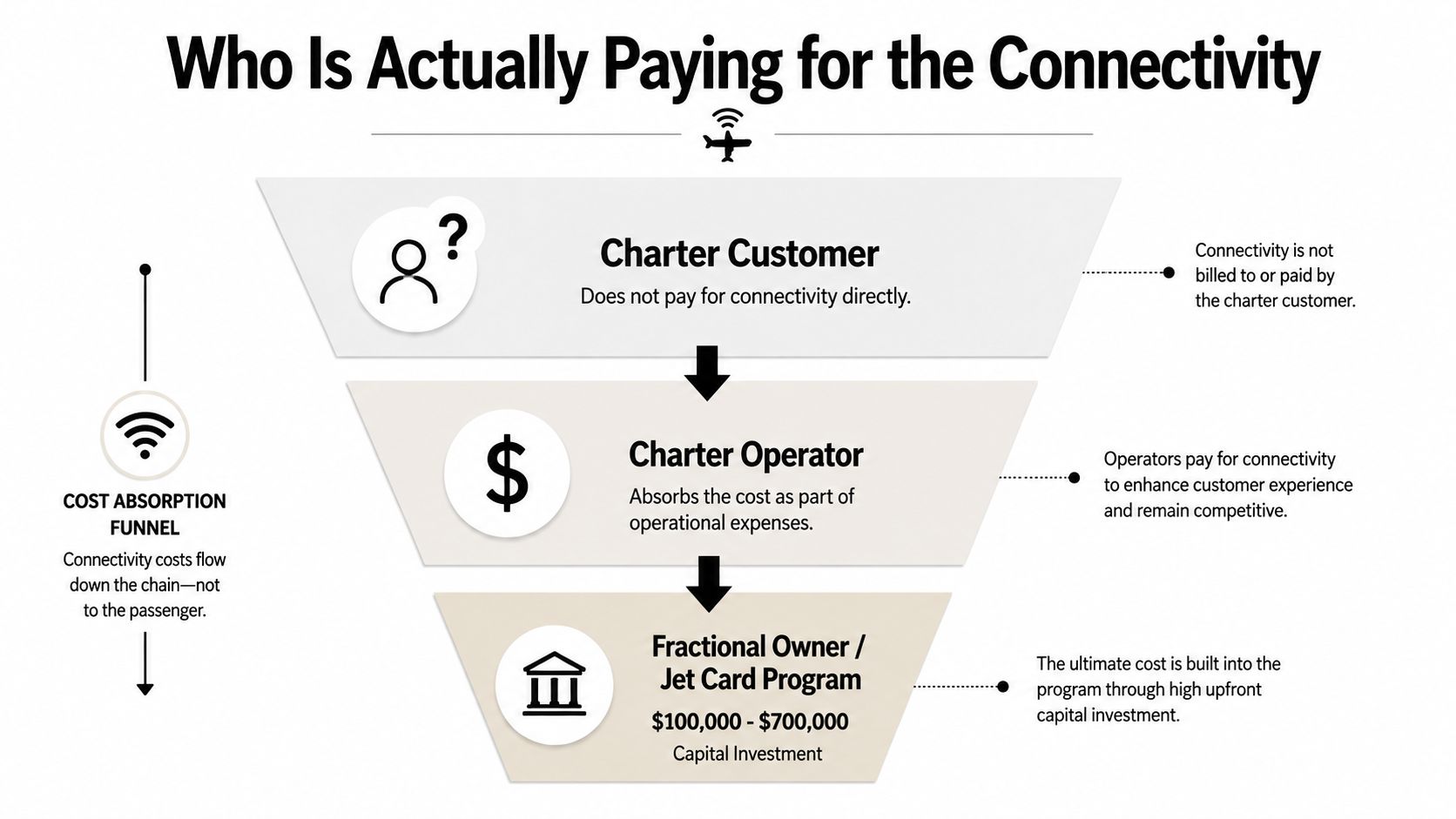
The same fee can mean different things
A $1,200 per-flight Wi-Fi charge may represent an operator recovering part of a six-figure installation over time, not the raw cost of the passenger's data session. It might also include the service plan, support, and a commercial markup. Without the billing explanation, you can't tell whether the fee is reasonable.
The ownership-side economics are substantial. Published coverage places installed packages at roughly $225,000 on a light jet and $350,000 to $400,000 on a large-cabin aircraft, while reported Starlink Aviation pricing includes a $20,000 monthly Global Unlimited plan. Flyius discusses the gap between operator ownership costs and what charter passengers see.
Ask this before negotiating: Is connectivity included in the aircraft rate, listed as a fixed add-on, or billed according to usage?
You can negotiate the aircraft, route, timing, and sometimes the operator. You usually can't redesign the antenna package after the quote arrives. That's why a broker who can source among multiple suitable tails has more practical influence than a passenger arguing over a system already installed on one aircraft.
Booking Considerations When Wi-Fi Is Required
Start with the task, not the technology. Email and messaging require a very different cabin connection from full video conferencing, cloud-based design work, or simultaneous streaming. Tell the broker exactly what you need to accomplish, then ask for an aircraft and system that can support that workload.
Use this pre-booking checklist
- Define the workload: Say whether you need email, messaging, video conferencing, streaming, VPN access, or several of these at once.
- Identify the system: Ask for the provider and product installed on the specific aircraft, not just the aircraft model.
- Confirm the active plan: Verify whether the tail is currently subscribed, what data allowance applies, and whether overage charges exist on the route.
- Check the route: Ask whether the system supports the full itinerary, including oceanic, island, or remote segments.
- Request recent operational context: Ask whether the operator has reported hardware, firmware, or service issues on that aircraft.
- Get the fallback in writing: If the aircraft can't support the workload, request a specific replacement tail or system class rather than a generic “Wi-Fi capable” substitute.
For a transcontinental workday, I'd prioritize a Starlink-equipped heavy jet where available. Viasat Ka-band is a strong choice for many domestic business trips. Gogo AVANCE can be perfectly adequate for shorter regional hops when light browsing is the realistic requirement, but don't book it expecting the same experience as a high-throughput LEO system.
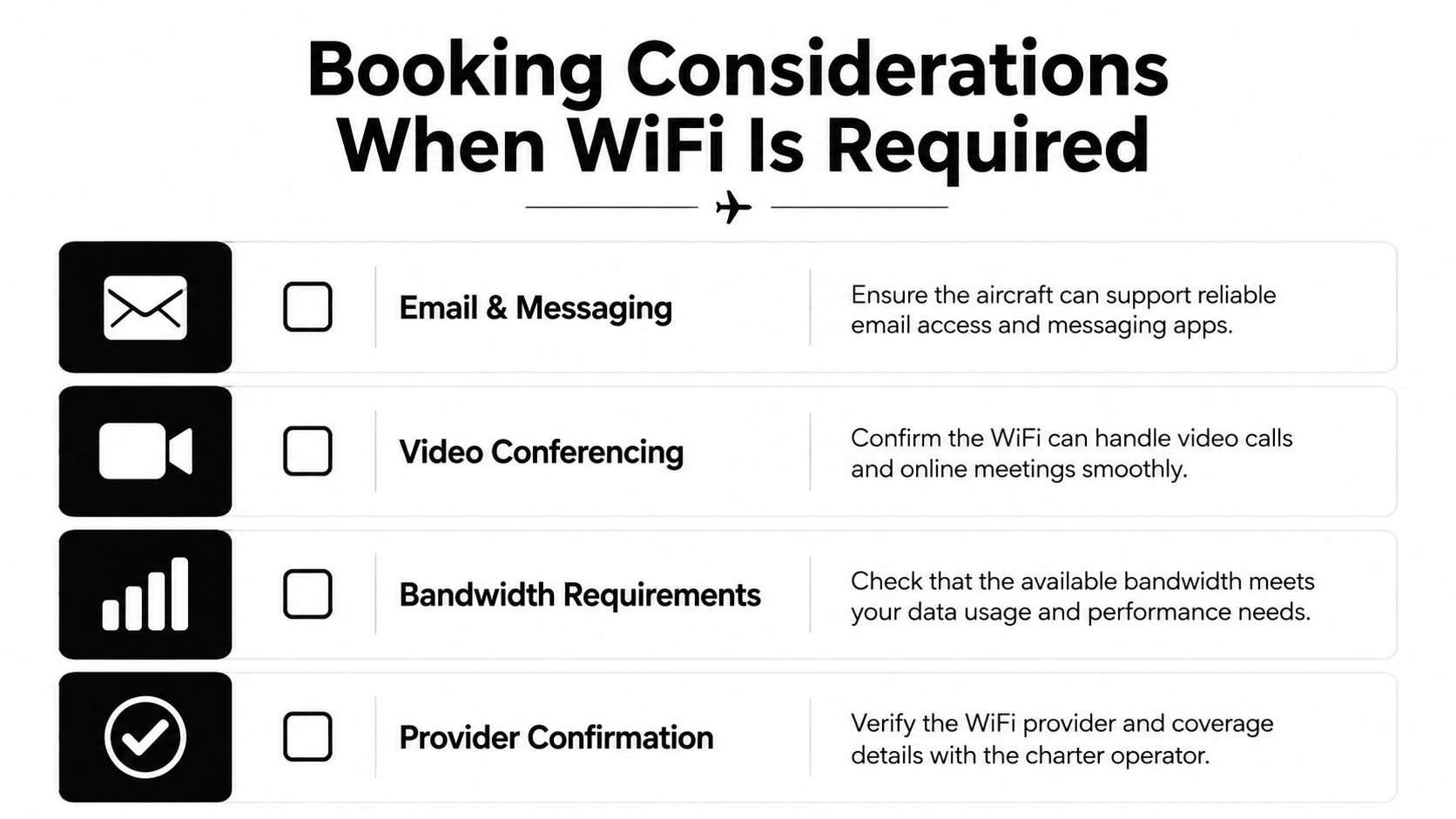
Confirm the details 24 to 48 hours before departure, especially the tail number and active service plan. New Supplemental Type Certificates can expand the pool of eligible aircraft, and availability can change quickly. A statement that was accurate earlier in the booking process may not describe the aircraft ultimately assigned.
The following video provides additional context for travelers assessing onboard connectivity:
Key Takeaways for Charter Travelers
The installation bill is primarily an operator problem. Your concern is whether the chosen aircraft has the right system, the right active plan, and a quote that explains how connectivity is being recovered. A broker who can offer a different suitable tail may solve the problem more effectively than one who discounts a fee on an unsuitable aircraft.
Three pricing structures dominate the passenger experience:
- Bundled service: The operator absorbs the subscription into the aircraft rate, management fee, or program structure.
- Per-flight access: The quote lists a fixed connectivity charge, which can range from a modest add-on to several thousand dollars depending on the aircraft and itinerary.
- Per-device billing: Each connected device or seat carries a charge, a model that's less attractive for a working group and more common on older or tightly managed systems.
Performance still varies sharply. Starlink generally leads when low latency and high throughput matter. Viasat offers a capable satellite middle ground. Gogo systems can suit email and light productivity, while legacy satcom should be treated as limited connectivity rather than full cabin broadband.
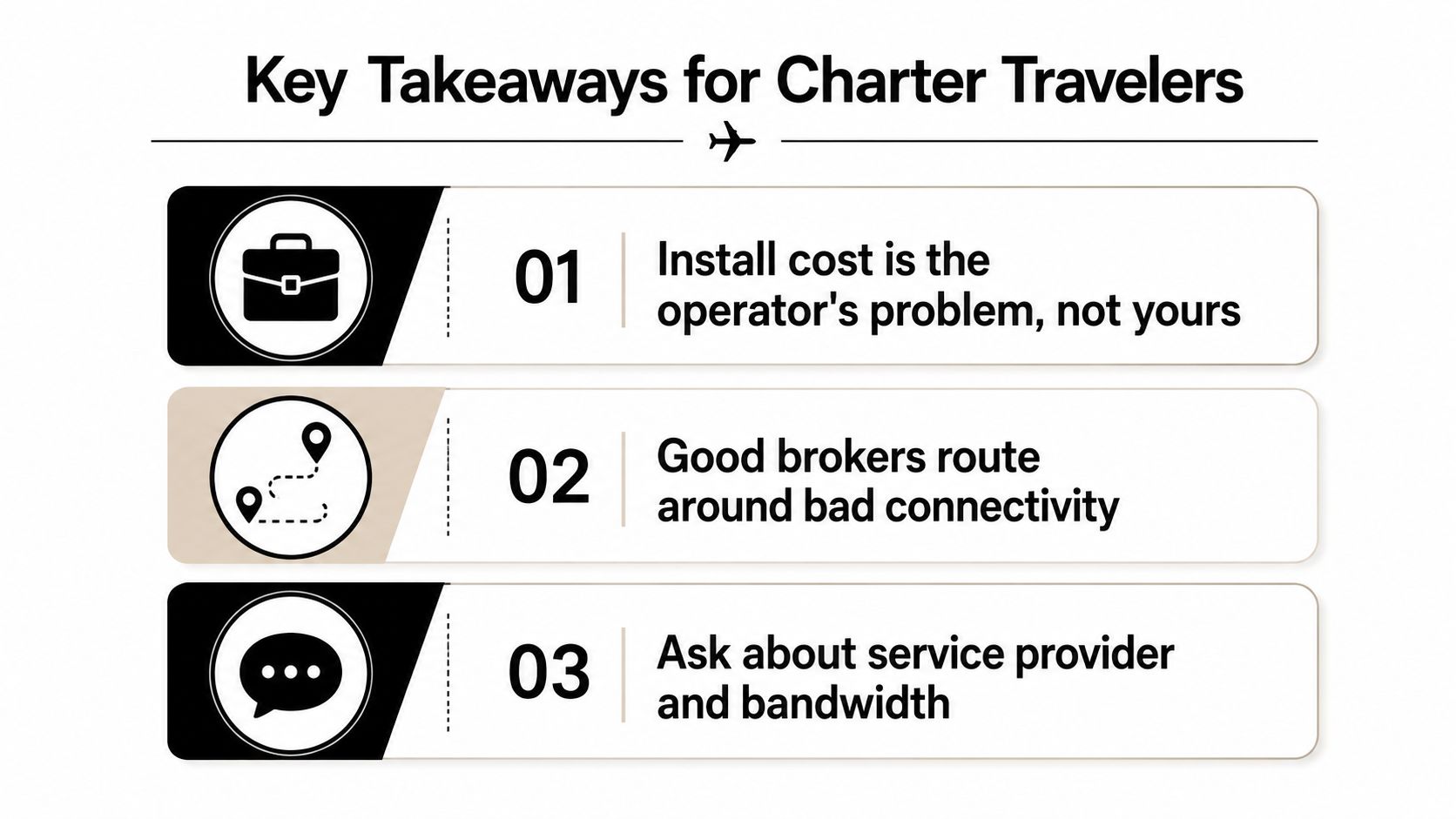
Your booking question should be specific: Which tail, which system, and which plan is active?
The upgrade cycle will continue to change aircraft availability and pricing as operators evaluate LEO connectivity through 2026 and 2027, but that should be treated as a planning consideration rather than a guarantee about any particular fleet. Reconfirm the aircraft and service terms before every major trip series.
Haute Jets can source the specific aircraft for your itinerary and confirm the tail, cabin configuration, Wi-Fi system, and operating details before departure. Visit Haute Jets to request an on-demand charter quote built around the connectivity your trip requires.