
Most advice about private jets for lease gets the core decision wrong. Buyers don't lose money because they picked the “wrong” contract label, they lose money because they leased the wrong aircraft, in the wrong place, for the wrong mission, and then paid for unused capacity they never needed. The market is big enough to prove this is no fringe niche, the global private jet charter and lease market was valued at $21.24 billion in 2024 and is projected to reach $24.28 billion in the near term, while private flying itself logged 5 million flights in 2023, 15% above pre-pandemic levels, and another market summary said it had already surpassed 2019 levels by 32.1% by mid-May 2024 (industry market summary). That growth makes sourcing, availability, and lease structure matter more, not less.
If you're shopping for access, don't start by asking wet or dry. Start by asking whether you need guaranteed aircraft access for a window of time, a specific tail number, or the cheapest way to move people on a trip-by-trip basis. Leasing can be the right call, but only when your utilization, route pattern, and operational tolerance line up.
What Leasing a Private Jet Actually Means in 2026
Leasing a private jet is not a single product, and treating it like one leads to bad decisions. In practice, private jets for lease range from a short dry lease on a Phenom 300 to a longer operational arrangement on an ultra-long-range cabin. The label matters less than the access model. The primary question is whether you need aircraft control, schedule certainty, or a lower-commitment alternative to ownership overhead.
Leasing has become normal across aviation because operators use it to match capacity to demand without buying every aircraft they fly. IATA says leasing grew from about 10% of the global airline fleet in the 1970s to 58% at the end of 2023, which shows how far lease-based access has moved from the edge of the market into the center of it (IATA fleet leasing data). Private aviation follows the same logic. Corporate flight departments, seasonal operators, and high-frequency personal travelers use lease structures because they need capacity without taking on the full burden of buying and holding an aircraft.
Who leasing actually serves
Leasing works for operators with uneven demand, companies with repeat travel but not enough scale to own comfortably, and travelers who want guaranteed availability without full ownership risk. It also fits short-term fleet expansion, tour schedules, and routes that keep calling for the same cabin layout. If your travel is erratic, charter is usually cleaner. If your trips are predictable and the same aircraft keeps showing up on the mission plan, leasing starts to make real sense.
Utilization decides whether lease economics hold up. According to the NBAA, as cited in a business-aviation economics article, ownership becomes less financially sensible than leasing or fractional models for travelers flying fewer than 400 hours per year because depreciation and operating costs hit harder at that level (business aviation economics article). That does not make leasing automatically cheaper. It means the break point often shows up before ownership starts to pay for itself, especially when your utilization band is steady and your mission profile is clear.
The aircraft itself matters as much as the contract. A lease on the wrong tail, in the wrong base, for the wrong route pattern can be more expensive than chartering trip by trip. A lease on the right aircraft, with the right sourcing and enough hours to justify it, can outperform ownership on simplicity and control.
Practical rule: If you cannot define your annual hours, route pattern, and aircraft size with confidence, you are not ready to sign a lease.
Wet, Dry, Damp, and Operational Leases Explained
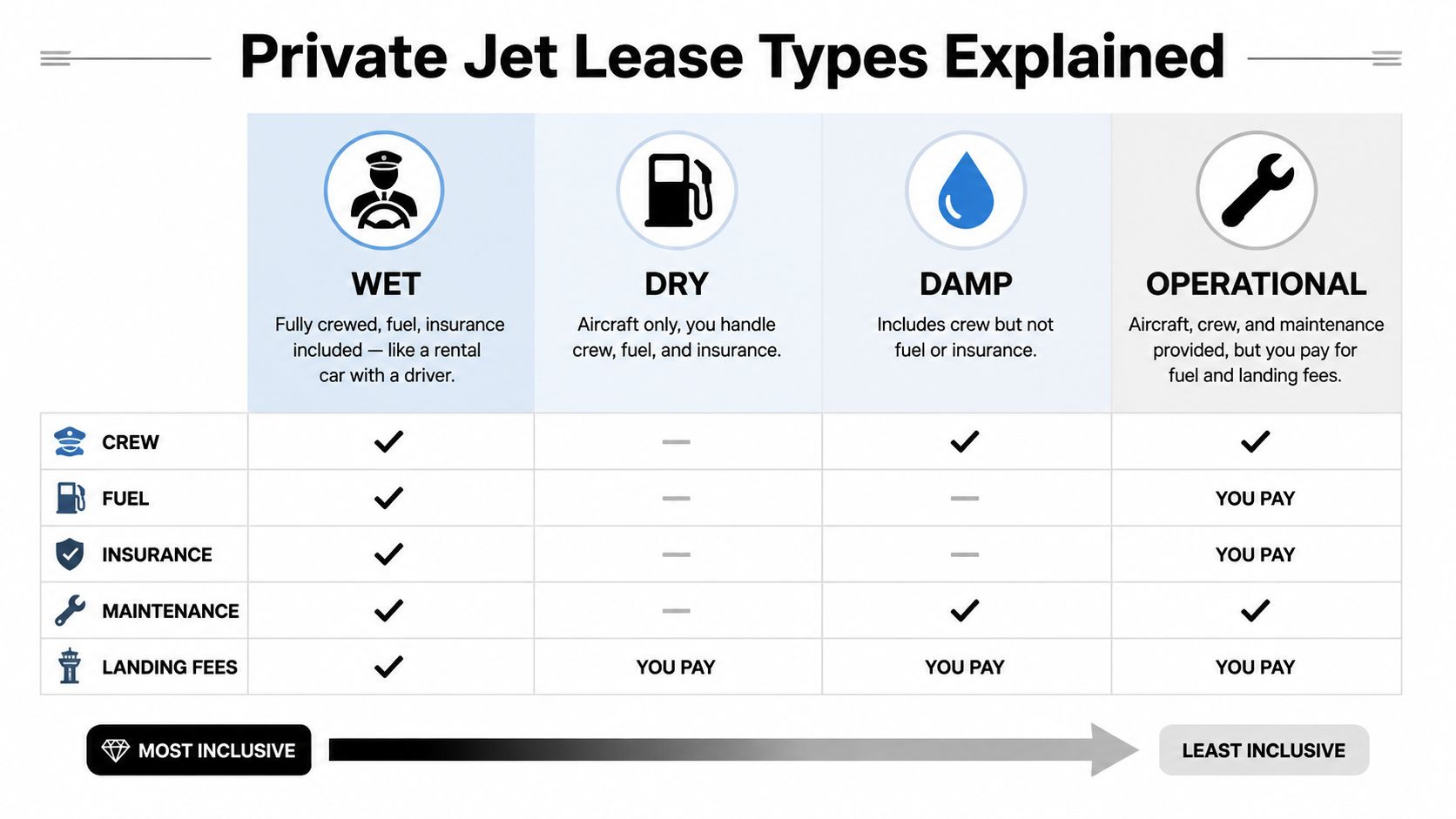
A lease structure is just a way of deciding who handles the airplane, the crew, and the operating headache. Think of a wet lease as the fully crewed rental car with driver, fuel, and insurance included. Think of a dry lease as getting the vehicle with the keys, then hiring the driver, covering fuel, and managing the paperwork yourself. The middle ground is where most real-world flexibility lives.
Wet and dry are not interchangeable
A wet lease is the turnkey option. The lessor provides the aircraft, crew, maintenance, and insurance, which is why it's the natural fit when the buyer wants hands-off flying. A dry lease is the opposite end of the spectrum, the aircraft comes bare, and the lessee handles crew, maintenance, insurance, and operational compliance. That makes dry leasing closer to temporary ownership than to charter.
Damp and operational leases sit between those poles. They're common in regional and ACMI-style flying, where the buyer wants some operating support but not a completely hands-off package. A useful way to think about them is this, you're buying a managed operation, but not necessarily the full stack of expenses.
What to watch in the contract
Lease duration usually runs in bands, not in one neat shape. Industry descriptions point to monthly or annual commitments, selected flight-hour blocks, and sometimes interchange hours, which means the provider can swap aircraft within a category rather than promise a specific tail. That is fine if your mission is flexible, and a problem if you need the same cabin, same crew, and same departure readiness every time.
Read the return-condition language carefully. Dry-lease contracts often include requirements tied to aircraft condition at handback, plus insurance allocation clauses that can shift liability in ways buyers don't expect. If the language is vague, the bargain probably isn't a bargain.
If a lease quote doesn't say who owns the maintenance risk, who carries the insurance, and who controls dispatch, you're not comparing real offers.
How Lease Costs Are Calculated and What Drives the Number
Lease pricing lives in the details. The headline figure only tells part of the story, and the comparison starts with what is fixed, what moves with usage, and what is hidden in the fine print. A serious quote should separate the base monthly fee, any hourly block-hour rate, fuel, FET, crew lodging, landing and handling fees, repositioning, and special-event or international costs such as de-icing and overflight permits. If a provider will not break those items out, the quote is not clean enough to compare.
The market ranges are wide because the aircraft and the mission are wide. Industry pricing sources put annual leasing expenses at $500,000 to several million depending on cabin class and utilization, with monthly lease payments ranging from about $55,000 for a turboprop to well over $1 million for a large-cabin, ultra-long-range jet (aircraft leasing rates overview). Another industry source describes light jets at $80,000 to $160,000 per month, midsize jets at $160,000 to $350,000, and large-cabin or ultra-long-range aircraft at $400,000 to over $1 million monthly (2026 lease cost summary). Those ranges are far apart for a reason. The only sensible move is to price your actual mission profile, not a theoretical one.
Typical monthly lease ranges by aircraft class
| Aircraft Class | Indicative Monthly Lease | Typical Mission |
|---|---|---|
| Turboprop | Lower monthly access band | Short regional hops, remote fields |
| Light jet | Lower to mid five figures monthly range | Short business routes, quick point-to-point travel |
| Midsize jet | Mid five figures to mid six figures monthly range | Regional and transcontinental work |
| Large or ultra-long-range jet | High six figures to over $1 million monthly | Intercontinental and long-haul missions |
Utilization changes the answer fast. As noted in the broader economics discussion, once annual flying stays below the 400-hour range, ownership starts to make less sense than leasing or fractional access models (business aviation economics article). That is not a trigger to sign a lease on the spot. It means the economics begin to favor a fixed-access structure when you fly often enough that dispatch reliability matters more than trip-by-trip shopping.
Aircraft sourcing also moves the number. A lease on a readily available light jet from a large managed fleet will price differently from a scarce cabin class that has to be repositioned for your mission. If your trips are repeatable and your route pattern is stable, you can often keep the cost tighter. If you need specific cabin features, short-notice departures, or irregular international trips, the quote climbs because the provider has less flexibility in where and how it can source the aircraft.
Bottom line: Demand a quote that shows base rent, fuel, fees, crew, and overages separately. If the provider only gives you one glossy number, they are hiding the actual comparison.
For a cleaner cost framework, use this private jet cost per hour breakdown as a benchmark before you sign anything.
Lease vs Charter, Jet Cards, and Fractional Ownership
Most buyers compare only lease versus charter and miss the broader access stack. That's a mistake. The right comparison is minimum commitment, peak-day pricing, blackout exposure, aircraft specificity, and total cost at the hours you fly. Lease, charter, jet card, and fractional ownership solve different problems, and pretending they're all substitutes creates bad buying decisions.
A lease gives you commitment and control, but it also locks you into a structure that's hard to unwind. Charter stays flexible, but the tradeoff is variable pricing and aircraft availability that can change with the market. Jet cards and fractional ownership sit in the middle, useful when you want predictability without carrying the operational burden of a lease.
The key dividing line is utilization pattern. If your flying is bursty, seasonal, or tied to changing destinations, charter is usually the sane answer. If you fly repeat routes, need the same cabin, and care more about guaranteed availability than per-trip optimization, a lease can win. Frequent flyers with stable schedules often like jet cards or fractional programs because the product is built around predictability, not sourcing the exact aircraft every time.
| Model | Minimum Commitment | Peak-Day Pricing | Blackout Exposure | Aircraft Specificity | Best Fit |
|---|---|---|---|---|---|
| Lease | Medium to long term | Typically fixed by contract | Low if structured well | Specific tail or category | Stable, repeated travel |
| Charter | Per flight | Dynamic | Possible | Fleet dependent | Irregular or one-way travel |
| Jet Card | Prepaid deposit or term commitment | Usually locked | Often present | Fleet dependent | Predictable flying with flexibility |
| Fractional Ownership | Multi-year commitment | Usually locked | Limited | Specific type | High-frequency, repeated use |
For recurring flyers comparing program structures, this charter versus jet card guide is the cleaner benchmark than a generic lease brochure. The difference is not just pricing, it's the amount of control you want to own.
A lease earns its place when guaranteed capacity matters more than trip-level optimization. That's why it shows up in sports travel, short-term fleet expansion, and corporate schedules with repetitive routes. Charter wins when the travel pattern won't sit still.
A Step-by-Step Checklist for Leasing a Private Jet
Start with the mission, not the aircraft. A corporate travel manager booking a two-week regional lease should define the routes, passenger count, luggage load, and departure windows before asking for price. If that first brief is sloppy, every quote after it will be messy too.
What to collect before you talk to a provider
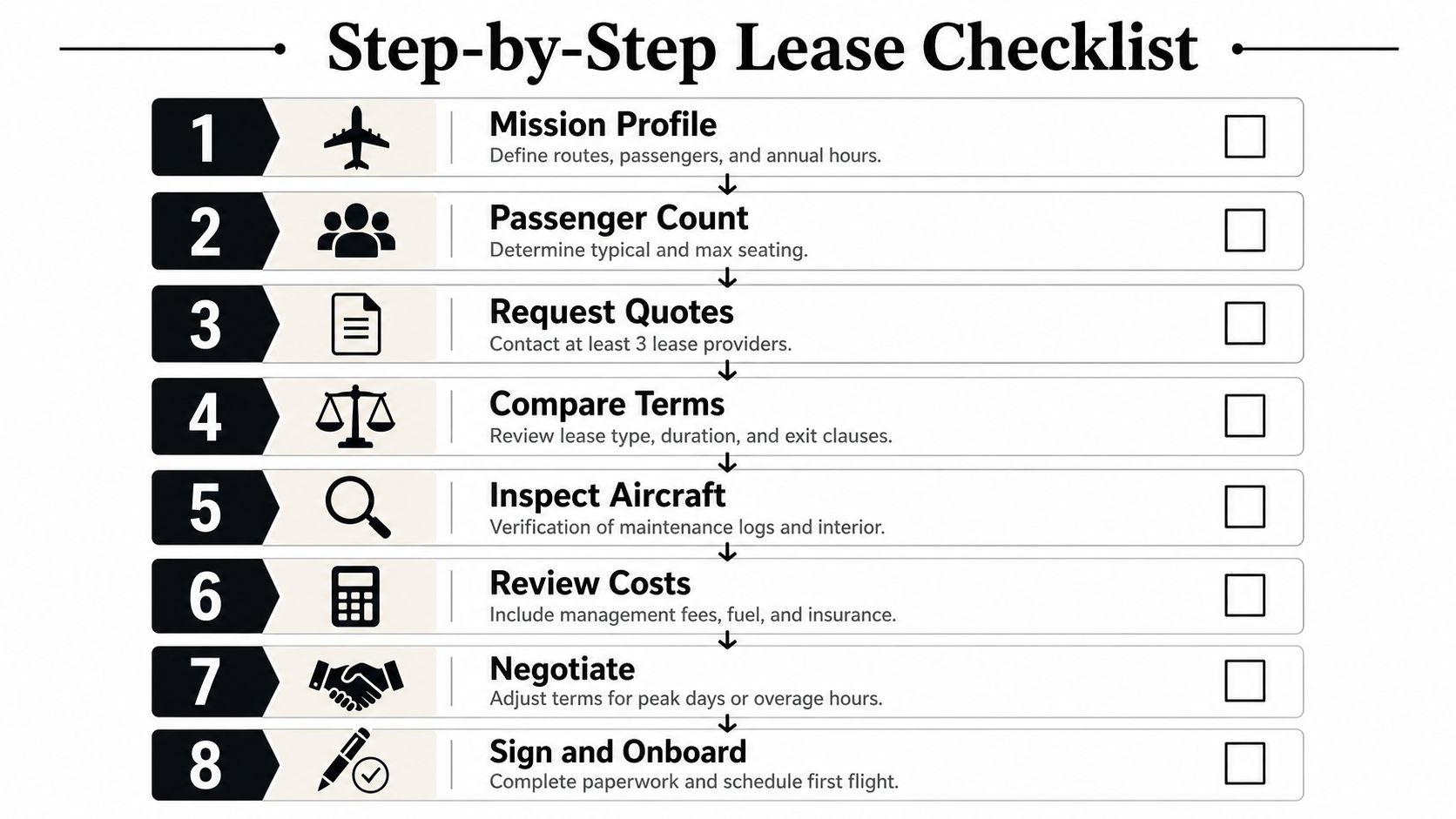
- Mission profile. List routes, trip lengths, and the likely annual hour band.
- Passenger count. Identify typical and maximum seating needs, not just average load.
- Request quotes. Ask at least three lease providers for structured bids.
- Compare terms. Focus on lease type, duration, exit clauses, and overage language.
- Inspect the aircraft. Review maintenance logs and the cabin condition before commitment.
- Review costs. Add management fees, fuel, insurance, and all pass-through charges.
- Negotiate. Push on peak-day terms, minimum usage, and replacement lift.
- Sign and onboard. Confirm paperwork, crew details, and your first flight plan.
A good lease process also requires a hard look at the provider's documentation habits. If they can't send you tail number, crew details, and insurance status in a clean format, they're not ready for a serious buyer. A strong commercial lease habit helps here too, and the logic in negotiating a commercial lease carries over, because you're still negotiating access, risk, and exit language, just in aviation form.
The sourcing question matters as much as the paperwork. If you want a specific tail number rather than a broad category, the provider has to be able to source to that level of precision. That is where many lease programs fall short, especially when availability is organized by class instead of by exact aircraft.
Practical rule: Ask for the lease terms in writing before you inspect the cabin. If the business terms are fuzzy, the aircraft details won't save the deal.
Safety, Legal, and Tax Considerations You Cannot Skip
Safety is the first filter, and it should stay that way. I would require current third-party audits such as Wyvern Wingman and Argus Gold or Platinum before I look at anything else. If a provider brushes past outside audits, I walk.
Operating authority matters just as much. A lease can sit under Part 91 or Part 135 depending on the structure, and that choice changes who controls the operation, who carries the compliance burden, and how the aircraft can legally be used. International flying adds another layer, because overflight permissions and country-specific handling rules can make a lease workable or turn it into a headache.
Tax treatment needs the same level of discipline. Corporate users should have their advisors review how lease and charter expenses are handled, and whether the structure matches the way the aircraft is flown. If the paperwork says one thing and the operation does another, you invite tax trouble and liability exposure at the same time.
The issue buyers miss most often is misclassification. A dry-hire arrangement can look like a lease while functioning like a charter, and that mismatch creates risk if the operator, lessee, and paperwork do not line up. That is not a paperwork detail, it is the difference between real operational control and a contract that only claims to give you control.
For buyers who want a sourcing-first model rather than a paper-heavy lease structure, a wide audited aircraft network can serve as a useful benchmark for what to expect in practice. The point is simple. Insist on third-party safety audits, clear operating authority, and transparent responsibility for every flight.
Sample Pricing Scenarios Across Three Real Missions
A regional lease is where light jets usually make the most sense. Think a Phenom 300 or a Citation Latitude handling short hops with limited fuel burn and fast turnarounds. The cost driver is less about range and more about avoiding overpaying for cabin size you won't use.
A transcontinental mission changes the equation. A Challenger 3500 is listed with a 3,400 nautical mile range, 541 mph maximum cruise, 45,000 ft maximum altitude, and 4,835 ft takeoff distance, which makes it strong on long domestic legs and shorter runways (Challenger 3500 specifications). That range profile is exactly why super-midsize aircraft often become the lease sweet spot for buyers who need coast-to-coast capability without stepping into full heavy-jet economics.
The transatlantic case is different again. A Gulfstream G550 or Falcon 7X is where lease structure starts to matter more than hourly spontaneity, because the cabin has to be available across the whole mission window. The trip is less about one city pair and more about holding aircraft, crew, and schedule together for the full chain.
| Scenario | Mission Shape | What Drives Cost |
|---|---|---|
| Regional light jet | Short domestic or regional hops | Access, turnaround speed, and fuel efficiency |
| Transcontinental super-midsize | Long domestic sector with one aircraft | Range, runway performance, and cabin comfort |
| Transatlantic heavy jet | Long-haul international mission | Availability, crew continuity, and route planning |
The crossover point is simple. If the mission is irregular, charter keeps you from paying for a jet that sits idle. If the mission is fixed and the aircraft has to be there on command, the lease starts to look like insurance against sourcing friction.
Choosing Where to Source Your Lease Aircraft
Your sourcing channel should match how you fly. A broker makes sense when you want broad market reach, a jet-card program fits when you want a packaged access model, and a sourcing-first operator matters when you need the right aircraft, not just a category on a quote. Availability is usually the bottleneck, not cabin finish.
The decision comes down to frequency, mission length, peak-day pressure, and cabin preference. Heavy repeat flying on the same routes points toward lease sourcing. Irregular city pairs and scattered dates usually favor charter, because you are not paying to hold an aircraft that sits idle. Predictable travel with some flexibility can fit a packaged access model, but only if the aircraft supply is real and the dispatch is disciplined.
One operator built around that sourcing problem is Haute Jets, which pulls from a wide network of 3,500+ Wyvern- and Argus-rated aircraft across 175 countries for direct-to-owner pricing on a specific tail number. See the Haute Jets fleet for the aircraft base behind that model. That matters because the aircraft already positioned near your departure city usually costs less and moves faster than one that needs repositioning from far away.
What to require from any provider
- Third-party safety audits. Do not accept vague safety language without named ratings.
- Line-item pricing. Base rent, fuel, crew, and fees should be visible.
- Tail confirmation. Get the exact aircraft and crew details before departure.
- Local sourcing. Ask where the aircraft is based, not just what category it belongs to.
- Dispatch transparency. Know whether the aircraft is available or only “for lease” on paper.
The smart buyer does not ask which model sounds impressive. The smart buyer asks which aircraft will actually show up on time, at the right airport, with the right crew.
If you are comparing real aircraft, real lease structures, and real sourcing options, talk to Haute Jets about the mission you fly, not the one a brochure assumes. Visit Haute Jets to request aircraft access and get a flight plan built around the exact route, cabin, and timing you need.