
You’re probably here because a simple search for private jets near me turned into a maze. One site asks you to “request pricing” without showing what drives the quote. Another promises instant availability but won’t tell you which aircraft you’re getting. A third makes every option look interchangeable, right up until the invoice grows and the airplane on the day doesn’t match the sales pitch.
That’s normal in charter. It shouldn’t be, but it is.
The first on-demand booking usually goes wrong in the same places. The client focuses on departure time and cabin size. The broker controls everything else: where the aircraft is coming from, whether the operator is vetted, what’s included, and what changes at the last minute. The result is a trip that still gets done, but often at the wrong price and with too much uncertainty.
Smart booking starts with a different standard. You want to know where the aircraft is based, whether the operator has credible third-party safety standing, how the quote is structured, and what gets confirmed before wheels up. Once you know those pressure points, the industry becomes far easier to manage.
Your 'Private Jets Near Me' Search Ends Here
A client in Miami might search private jets near me expecting a quick answer. Instead, they get aggregator pages, polished promises, and a stack of forms. What they usually don’t get is clarity on whether the aircraft is local, whether the listed price is realistic, or whether the operator behind the flight has been vetted beyond marketing copy.
That confusion is especially frustrating because the aircraft supply is there. North America commands 72% of worldwide business-jet traffic, which makes local sourcing highly practical in major U.S. markets, as noted in this private aviation traffic overview.

That matters because geography alone isn’t the problem. Transparency is the problem. In a healthy market with deep aircraft availability, a client should be able to book the right jet near the departure airport without paying for somebody else’s inefficient logistics.
Practical rule: If a charter quote feels vague, it usually is. Ask what aircraft is being sourced, where it’s based, and what costs are embedded before you compare anything else.
For first-time charter clients, I advise treating the booking like a controlled procurement exercise, not a luxury impulse purchase. You’re not just buying a seat. You’re buying aircraft positioning, operator quality, schedule reliability, and service execution.
If you want to start with a clean quote request instead of a generic lead form, use a direct private jet charter quote request and insist on aircraft-specific details from the outset.
How to Find Local Aircraft and Eliminate Repositioning Fees
The most common waste in private aviation is simple. The aircraft isn’t where you are.
A broker sells you a light jet for a short trip. The quote looks acceptable. Later, you learn the airplane had to come in from another city before your flight even began. That transit cost gets buried in the total. You pay for empty movement because the broker sold availability first and efficiency second.
What repositioning fees do to a quote
Repositioning fees are the costs of bringing an aircraft to your departure point or returning it after your trip. In traditional charter brokerage, they often inflate the price by 20 to 40%, and that distortion is especially visible in secondary markets. One example: San Angelo, Texas has 136+ jets available within a 200-mile radius, yet travelers are often steered toward repositioned aircraft from larger hubs instead of nearby options, according to this San Angelo charter market page.
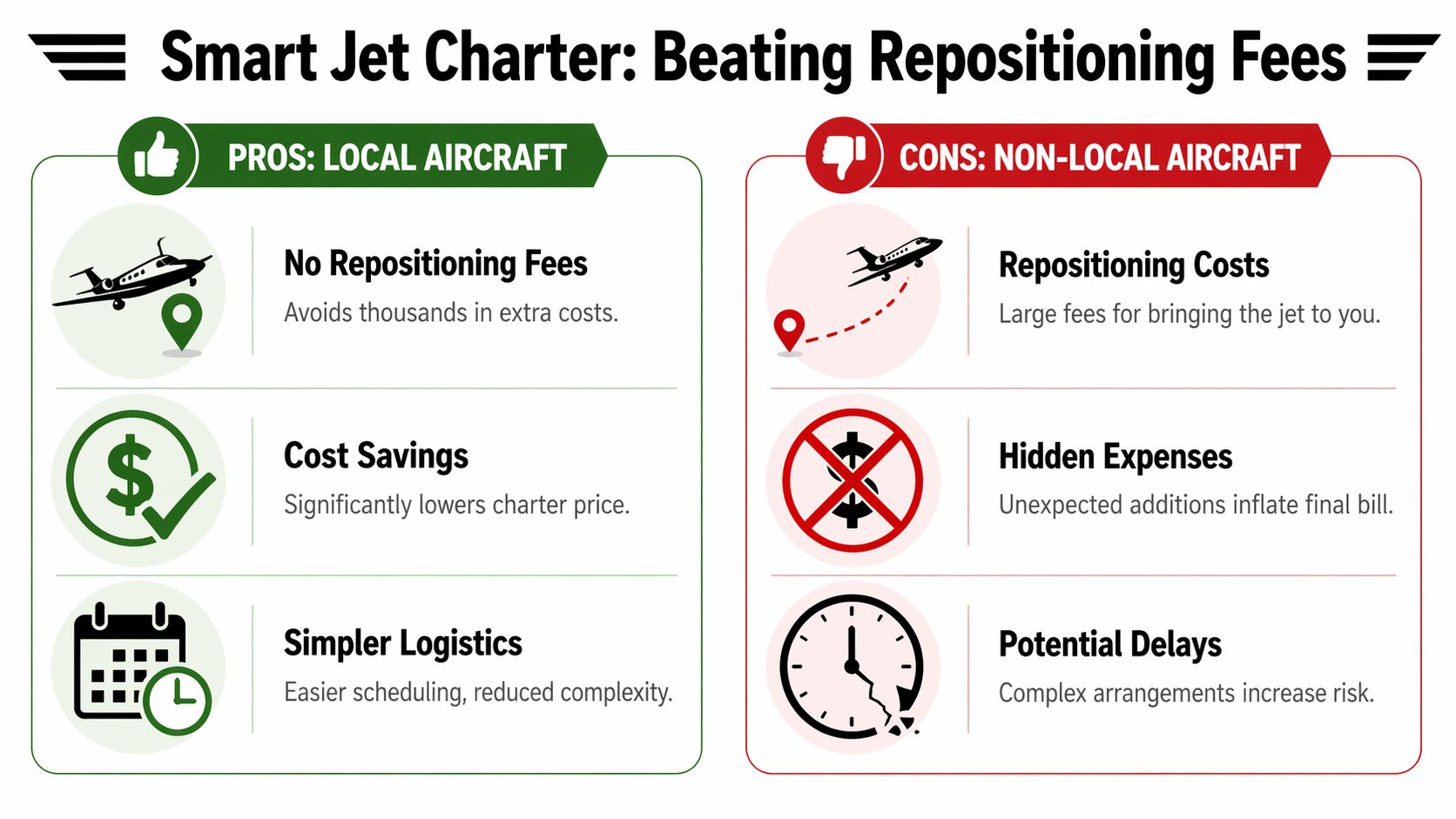
A lot of clients assume this only happens in small cities. It doesn’t. I’ve seen the same issue in major markets when a broker pushes the aircraft they can place quickly rather than the aircraft that’s best positioned.
Questions that expose hidden positioning costs
When reviewing quotes, ask these directly:
- Where is the aircraft based right now? Don’t accept “nearby.” Ask for the actual home base or current location.
- Is the quoted flight time only my trip time? Some quotes implicitly include ferry segments.
- Am I paying for the aircraft to return somewhere else? That can appear as part of minimums or bundled hours.
- Which exact aircraft is being quoted? “Super midsize” is not enough if the actual tail assignment can change.
If the answers are slippery, the pricing probably is too.
What a better sourcing model looks like
A smarter charter process starts with the departure airport and works outward. The advisor searches for qualified aircraft already positioned close enough to fly your trip without expensive ferry legs. That changes both cost and reliability.
Here’s what works better in practice:
| Decision point | Weak approach | Strong approach |
|---|---|---|
| Aircraft search | Starts with broad category | Starts with nearby qualified aircraft |
| Pricing | Bundled and opaque | Aircraft-specific and location-aware |
| Availability | “We’ll find something” | Specific aircraft options near departure |
| Day-of execution | More moving parts | Fewer handoff risks |
Local sourcing doesn’t just reduce cost. It removes one of the biggest reasons a charter itinerary becomes more complicated than it needs to be.
Empty legs can help in some situations, but they’re tactical. If you want a deeper look at when they make sense and when they don’t, this guide to booking empty leg flights is a useful reference.
Decoding Wyvern and ARGUS Your Safety Checklist
Most charter sellers say safety comes first. That statement is meaningless unless they can show how the operator was evaluated.
The gap in the market isn’t a lack of safety language. It’s a lack of explanation. Many providers mention third-party ratings without telling clients what those ratings represent, why they matter, or what questions the client should ask next. That’s exactly why understanding the difference between Wyvern Wingman and ARGUS Platinum matters, as highlighted in this discussion of charter safety claims.
What these ratings actually do for you
For a client, the value of a third-party audit is simple. It forces the conversation away from branding and toward records, standards, and operating discipline.
When I evaluate a charter option, I’m not impressed by a polished website or a premium cabin photo. I care about whether the operator’s documentation, crew standards, maintenance practices, and safety management are being reviewed in a way that can be independently verified.
That’s where these names matter:
- Wyvern Wingman signals that the operator has met a recognized third-party benchmark tied to operational review.
- ARGUS Gold or Platinum indicates a different but similarly important external audit path.
- Neither label should end the conversation. They should trigger follow-up questions.
The client checklist I’d use on every first booking
Ask your advisor or broker for these items before you sign:
Operator identity
Get the legal operator name, not just the brokerage brand.Current rating status
Ask whether the operator currently holds Wyvern Wingman or ARGUS Gold/Platinum standing.Aircraft-specific assignment
Confirm the actual aircraft being proposed, not just a category promise.Crew details
Ask who is scheduled to fly and whether substitutions are possible.Operational consistency
Ask what happens if the original operator or aircraft changes before departure.
If a provider can’t answer safety questions in plain English, they probably don’t control the booking process tightly enough.
A more detailed primer on what to verify is available in this deep dive into Wyvern and ARGUS safety ratings.
For a visual explanation of how safety oversight fits into business aviation, this video is worth a few minutes:
What doesn’t work
Clients get into trouble when they accept broad assurances like “all our operators are vetted” without asking who did the vetting, how current it is, and whether the specific aircraft on their itinerary is tied to that review. Safety isn’t a slogan. It’s a paper trail and an operating standard.
The Real Cost of Flying Private On-Demand vs Jet Cards
Jet cards are popular because they simplify the buying decision. On paper, they look predictable. Prepaid access. Familiar brand. A sense of guaranteed convenience.
The trade-off is that convenience often comes with financial rigidity.
In the first half of 2025, activity at fractional and jet card operators such as NetJets and Flexjet rose by over 10%, yet that model often comes with high upfront costs, while on-demand charter avoids six-figure minimums and membership fees, as noted earlier in the market data. That difference matters most to clients whose travel patterns shift from month to month.
Where the models separate
On-demand charter is straightforward. You buy the trip you need. Jet cards ask you to buy future access first and flying second.
Here’s the practical comparison:
| Model | Best for | Main strength | Main drawback |
|---|---|---|---|
| On-demand charter | Variable travel needs | Flexibility and aircraft choice | Requires disciplined quote review |
| Jet card | Repeat travelers who value program structure | Easier repeat booking process | Upfront commitment and program rules |
| Fractional | Very frequent flyers | Deep operational ecosystem | Long-term financial commitment |
For many first-time or occasional private flyers, on-demand is the cleaner fit. You can choose the aircraft based on route, passenger count, baggage profile, and service preferences instead of forcing every trip into one prepaid framework.
Where clients misjudge value
The mistake isn’t choosing a jet card. The mistake is assuming a jet card automatically lowers the true cost of flying private. It may lower friction. That’s different.
If you want a useful outside reference on how clients should think about cost layers beyond the headline quote, this breakdown of the true cost of flying private is worth reading alongside any proposal.
Client test: If you can’t explain the program’s deposit structure, usage rules, peak restrictions, and aircraft substitution policy in one minute, you don’t understand the real price yet.
Where empty legs fit
Empty legs are real opportunities, but they’re not a core travel strategy. They work best when your schedule is flexible and your route happens to match an aircraft’s repositioning need. They are less useful when you need certainty, exact timing, or a fixed airport pairing.
That’s why I treat empty legs as opportunistic inventory, not a foundation for business travel or important family itineraries. They can be excellent. They can also disappear when the primary charter changes.
The Pre-Flight Playbook Confirming Every Detail
The most important part of a private flight happens before you arrive at the airport. If the pre-flight package is thin, the booking was thin.
A proper confirmation package gives you the final proof that the aircraft, operator, and trip details are aligned. It also protects you from last-minute surprises that many first-time clients don’t know to anticipate.
What should arrive before departure
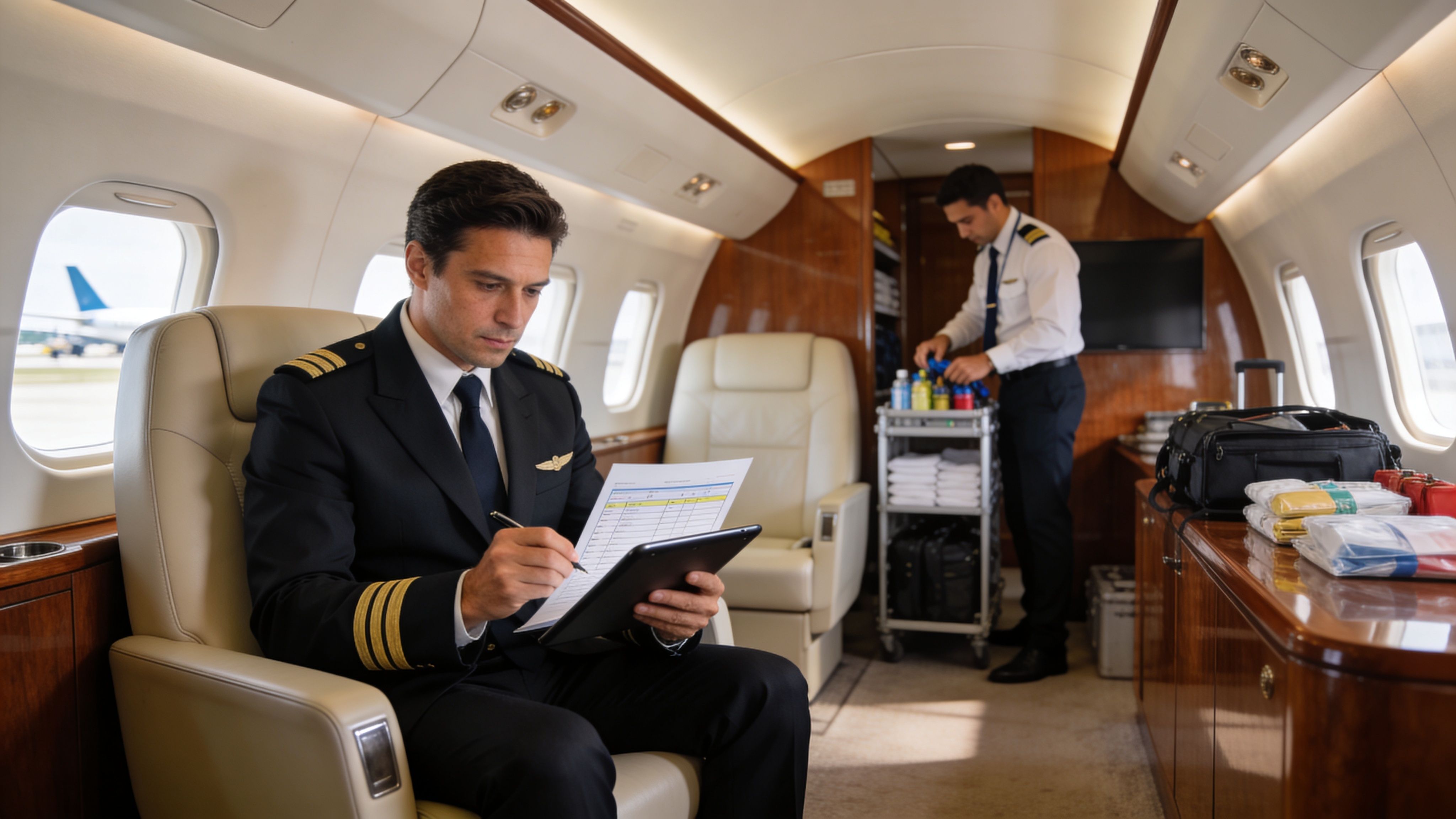
Requesting a 24-hour pre-flight confirmation that includes the tail number, crew bios, and weather brief helps avoid 15% of last-minute surcharges and operator-change issues, according to this charter booking reference for Milwaukee.
That confirmation should also cover the practical details that affect the trip experience:
- FBO location and arrival instructions so your driver doesn’t default to the commercial terminal
- Passenger manifest review to catch name errors before departure
- Catering confirmation if you’ve requested anything specific
- Wi-Fi and pet approval if those items matter on your itinerary
- Ground transport plan on arrival so nobody is arranging cars after landing
The day-of sequence that should feel effortless
A smooth private departure is very different from commercial travel. You’ll usually drive to the FBO, not the main terminal. Staff there will verify your party and direct you to the lounge or straight to the aircraft, depending on timing.
What separates a polished charter from an average one is coordination. Your car should know which entrance to use. The flight team should know who’s traveling. The aircraft should match the confirmation you received. If you asked for pets in cabin, specific catering, or onboard connectivity, those details should already be settled.
For destination planning, especially in alpine or event-driven itineraries, good ground transport matters as much as the flight. If you’re connecting onward in northern Italy, for example, this guide to a private transfer from Malpensa Airport shows the kind of coordination standard worth expecting on the ground.
A short pre-flight checklist
Before leaving for the airport, confirm these five items:
- Tail number matches your final confirmation
- Crew names are listed
- Departure FBO is correct
- Special requests are documented
- Arrival transport is assigned
The easiest charter trips are the ones that feel boring in the final 24 hours. No swaps. No billing revisions. No “one quick update” messages.
Frequently Asked Questions About On-Demand Charters
Can I pay for a private jet charter with cryptocurrency?
Yes, many modern charter providers can accommodate cryptocurrency payments, including digital assets such as Bitcoin and Ethereum. The key issue isn’t novelty. It’s process. You want a provider that can issue a clear quote, confirm the conversion method, and finalize the booking through a secure payment workflow without slowing down aircraft assignment.
For clients who already hold digital assets, this can be a practical way to settle a trip discreetly and efficiently. I’d still apply the same rule I apply to wire payments. Don’t let payment convenience distract you from aircraft details, operator identity, and final confirmation standards.
What are empty leg flights and are they reliable?
An empty leg is a repositioning flight an aircraft needs to make because of another booked trip. If your route happens to align, you may get attractive pricing compared with a standard one-way charter.
They are not reliable enough for critical travel. The reason is structural. If the primary customer changes or cancels the original itinerary, the empty leg may vanish with it. They’re useful for flexibility, leisure travel, and occasional route luck. They’re a poor fit for board meetings, weddings, or any trip where timing can’t move.
How does booking for a major event like the World Cup 2026 work?
Event traffic changes the booking equation. The aircraft itself may be easy to source, but airport slots, parking, and routing complexity become more restrictive. For that reason, serious event travel should be planned as early as your schedule allows.
The clients who handle these trips best aren’t just booking an airplane. They’re securing a workable airport strategy, alternate airport options, and coordinated ground movement. If your event window is tight, ask your advisor to plan around access constraints first and cabin preferences second.
What is the process for flying with pets on a private jet?
Flying with pets is one of the strongest practical advantages of private charter. Most of the stress of commercial pet transport disappears when the animal can remain with you in the cabin, subject to operator approval and route requirements.
The process is simple when handled early:
- Tell your advisor at booking what type of pet is traveling.
- Confirm cabin approval with the selected operator before documents are finalized.
- Check destination rules for any health or import paperwork if the flight is international.
The most common problem here is late disclosure. If you mention a large dog after the aircraft is assigned, you may force a change in operator or cabin layout. Raise it early and the trip is usually straightforward.
Can I choose the exact aircraft, or only the category?
You should push for the exact aircraft once the quote moves beyond the exploratory stage. Category shopping is useful at first, but a serious booking should become aircraft-specific. That means make, model, and final tail assignment before departure.
First-time clients often get caught when they approve a “midsize jet” and assume that promise is precise. It isn’t. The cabin, baggage space, onboard amenities, and ride profile can vary within the same broad category. If Wi-Fi, pet comfort, sleeping layout, or luggage volume matter, get those confirmed against the actual aircraft.
What’s an FBO, and why does it matter?
An FBO is the private terminal used for most charter departures and arrivals. It handles the ground side of the experience: lounge access, ramp coordination, fueling support, and direct aircraft access.
It matters because the FBO is where smooth travel becomes visible. A well-managed itinerary gets you to the correct location, with the correct vehicle routing, and onto the aircraft without confusion. If a provider gives vague terminal instructions, that’s usually a warning sign that the booking is being managed too loosely.
If you want a cleaner way to book than the usual broker maze, Haute Jets is built around the points that matter most: local aircraft sourcing, exact-aircraft transparency, Wyvern and ARGUS-rated operators, and pay-per-flight pricing without jet cards or annual fees. For clients who want on-demand charter done with precision, it’s a smarter place to start.