If you're considering a private jets subscription, ask the only question that matters first. Will you fly enough, on predictable enough routes, to justify paying for access before you pay for any flights at all?
Most buyers start in the wrong place. They compare brand names, cabin photos, and headline hourly rates. That's backwards. The primary issue is financial efficiency. A subscription can look tidy on paper and still be a poor fit in practice if your schedule changes, your routes move around, or the aircraft you need isn't positioned where you are.
My view is simple. For most flyers, on-demand charter is the smarter default. Subscription products make sense for a narrow group of high-volume travelers with stable patterns. Everyone else should be skeptical of prepaid access, vague availability promises, and “fixed” pricing that stops feeling fixed the moment the mission gets complicated.
Decoding Private Jet Subscriptions
Why pay for access before you know whether access is the right buying model?
A private jet subscription is a prepaid access product. You commit capital first, then book flights under that program's rules, pricing terms, and availability standards. You are not buying a specific aircraft. You are buying a framework that aims to make repeat flying easier, faster, and more standardized.
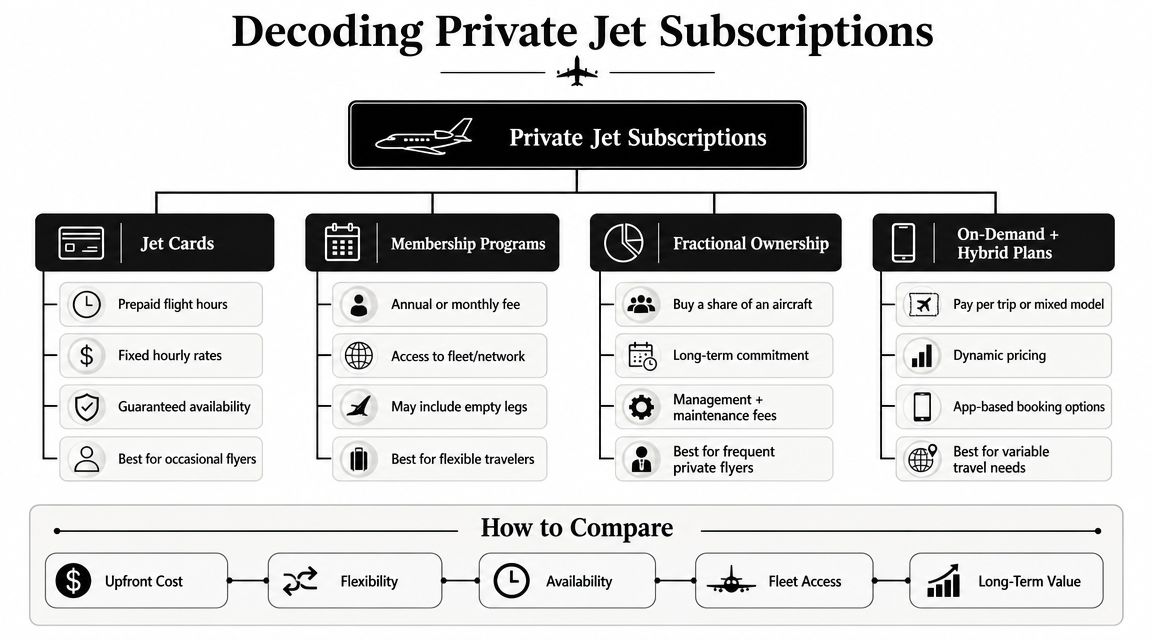
The two models most buyers encounter
Most programs fit into a small number of structures, even when the branding makes them sound very different.
Prepaid hour blocks
You deposit funds or purchase a set number of hours in advance. In return, you get access to a defined rate sheet and service terms. Jet cards commonly use this structure.Fixed-rate access programs
You pay a membership fee or contract for access, then book flights under a preset commercial arrangement. The sales argument centers on convenience, service consistency, and priority treatment.Fractional-style access
Some offerings borrow features from fractional aviation without giving you the full economics or legal structure of ownership. The practical point is simple. You are still committing money upfront in exchange for future flying under someone else's program terms.
What you are actually buying
Buyers often focus on the aircraft category and miss the contract structure. That is a mistake.
The product is a bundle of rights and restrictions. Booking windows. Peak-day treatment. upgrade and downgrade rules. Recovery policy during irregular operations. Daily minimums. Service area coverage. Whether the provider gives you guaranteed access, best-effort access, or a carefully worded version of both.
If you want a clear benchmark for how providers present these economics, review a transparent private jet pricing breakdown and compare it against any subscription proposal line by line.
Practical rule: If the headline promise is predictability, read the agreement like a procurement officer.
A straightforward way to frame it is this:
- Ownership gives you a long-term asset commitment.
- Subscription gives you prepaid access under house rules.
- On-demand charter lets you buy the exact trip you need, when you need it.
That distinction matters because private aviation missions vary. A short executive shuttle, a multi-stop family itinerary, and a ski trip with bulky luggage do not belong in the same commercial box. Subscription programs reduce buying friction by standardizing the experience. That helps if your travel pattern is repetitive. It wastes money if your needs change month to month.
Why these programs appeal to buyers
The appeal is real.
Frequent flyers like having one account team, one service standard, and fewer pricing surprises on routine trips. For a client with stable routes and consistent aircraft needs, that can save time.
The problem is that convenience often gets sold as value even when flexibility matters more. For most clients, true on-demand charter remains the smarter default because it matches aircraft, routing, and cost to the mission instead of forcing the mission into a prepaid structure.
What problem subscriptions claim to solve
Subscriptions are built to reduce friction in repeat booking. Providers usually promise:
- Faster booking
- Less pricing uncertainty
- Preferred access during busy periods
- A smoother repeat-customer experience
Those benefits can be legitimate. They are not free. They are purchased through upfront commitment, narrower terms, and less freedom to shop each trip on its own merits.
The broader market context matters here. Charter availability exists because the global private jet fleet is large enough to support real sourcing flexibility, even though published fleet totals vary by methodology and reporting year (private jet fleet estimates and market context). That is exactly why subscription should be treated as a specialized tool, not the default answer.
The Real Cost of Subscription Flying
Why do so many private jet subscriptions look efficient on paper and disappoint in practice? Because the headline rate hides the cost of commitment, restrictions, and unused access.
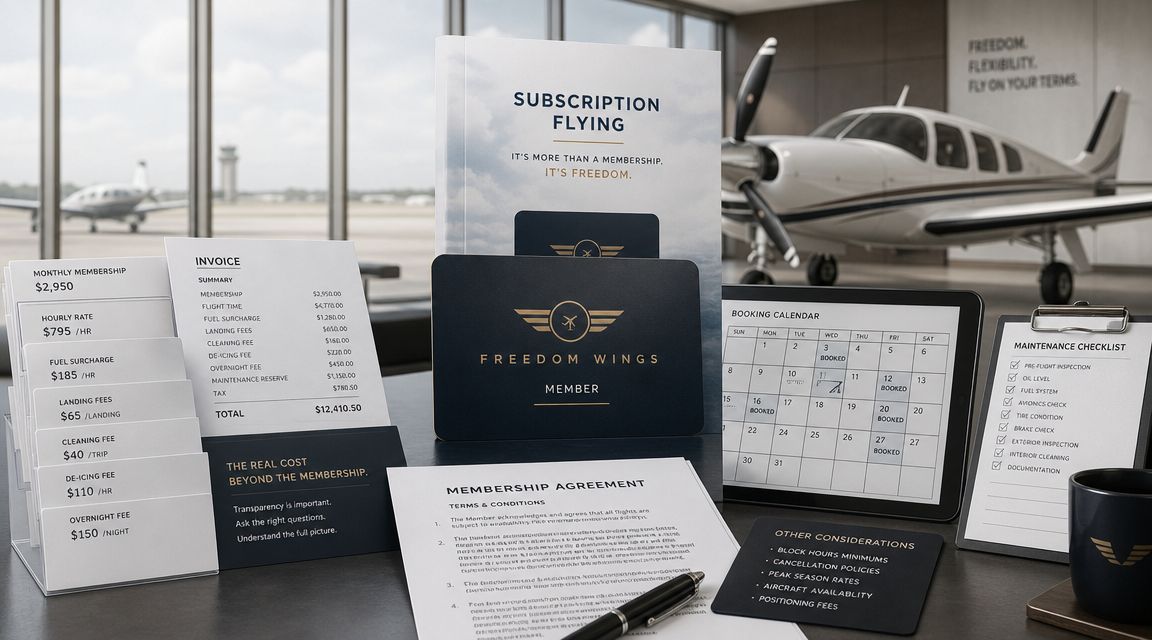
A subscription should be judged on one standard only. What does it cost to complete your actual trips, with the right aircraft, on your schedule, without paying for terms you do not use?
That is where many buyers lose money. The problem is not the concept of membership. The problem is paying upfront for predictability, then discovering that the contract still shifts cost back to you through billing minimums, blackout periods, service zones, category substitutions, and deposit drag. For most flyers, that makes on-demand charter the better default because you buy the mission, not the program.
Where subscription costs expand
Start with the fixed commitment.
Membership fees, initiation charges, and prepaid balances reduce flexibility before you take the first flight. If your travel pattern changes, that capital sits inside a structure that may offer limited refunds, weak rollover terms, or neither.
Then look at the billing mechanics. Many programs apply daily minimums, segment minimums, or category rules that make short trips expensive relative to actual airtime. A subscription can look tidy in a sales deck and still produce poor trip economics.
Peak periods are another pressure point. The dates that matter most to clients, holidays, major events, and heavy seasonal windows, often come with stricter cancellation terms, longer callout windows, or higher charges.
Aircraft access is equally important. Many providers sell a class of aircraft rather than a specific jet. That works until your mission requires real baggage volume, a shorter runway, enclosed lavatory standards, or a cabin layout suited to executives rather than a generic category label.
The cost buyers miss most often
Repositioning is usually the quietest line item in the deal.
If the aircraft is not based near your departure point, the repositioning cost does not disappear. It gets absorbed, averaged, limited to certain regions, or pushed into higher effective pricing elsewhere in the contract. You still pay for it.
This is why subscription economics often break down outside a provider's strongest operating corridors. The farther your trip profile moves from the network sweet spot, the more likely you are to subsidize inefficiency. Clients who compare these terms against understanding private jet access usually see the issue quickly. A branded program may feel controlled, but true on-demand sourcing often prices the actual mission more cleanly.
A fixed hourly rate means very little if the contract decides when that rate applies, which aircraft qualifies, and how much deadhead cost is buried around it.
What to request before you sign
Ask for the operating terms, not the marketing summary.
Request these items in writing:
- A full fee schedule covering standard days, peak days, short-notice bookings, de-icing, and any interchange fees.
- Billable minimum rules by aircraft category and by trip type.
- Repositioning treatment for departures outside core service areas.
- Substitution rules when the promised category is unavailable.
- Cancellation, refund, and rollover terms for unused funds or hours.
If the provider cannot show you a clean all-in framework, do not sign.
Use transparent private jet charter pricing guidance as a benchmark, then compare that trip by trip against the subscription contract. That is the fastest way to see whether you are buying convenience at a fair premium or prepaying for utilization risk.
Subscription vs Jet Card vs On-Demand Charter
Most comparisons in this category are too polite. They list features and avoid judgment.
Here's the judgment. If your mission profile changes, pay-as-you-go usually beats prepaid access. Flexibility has economic value. So does the ability to source outside a captive or semi-captive network.
For readers who want a broader primer before deciding, this guide to understanding private jet access is useful because it lays out how membership structures differ at a practical level.
Private Aviation Models Compared
| Feature | Private Jet Subscription | Traditional Jet Card | On-Demand Charter (Haute Jets) |
|---|---|---|---|
| Cost structure | Usually combines access fees with flight charges | Prepaid structure tied to hours or funds on account | Pay per trip |
| Cash commitment | Higher upfront commitment is common | Prepayment is central to the model | No prepaid hours |
| Pricing clarity | Looks predictable at first, but restrictions often shape the real price | More standardized than ad hoc booking, but still contract-driven | Best when quoted trip by trip with full aircraft details |
| Aircraft choice | Often tied to a provider network or category access | Usually category-based rather than exact aircraft first | Exact aircraft selection is easier to prioritize |
| Route flexibility | Best on common, repeat routes inside the provider's strongest coverage | Better for repeat users than occasional flyers | Strong for changing missions and one-off itineraries |
| Exposure to repositioning | Often embedded in the economics | Can be reduced on some programs but still matters | Can be managed by sourcing aircraft close to departure |
| Best fit | High-frequency users with stable travel patterns | Frequent travelers who want structured access | Most travelers who want cost control and aircraft choice |
Where subscriptions lose ground
Subscriptions lose their edge when buyers assume frequency and reality doesn't cooperate.
A founder may think they'll fly the same corridor every month. Then board meetings move, vacation plans change, children's school calendars change, and the profile becomes irregular. Once that happens, a prepaid product starts punishing flexibility instead of supporting it.
Jet cards improve on some of that by standardizing access, but they still push you toward precommitted spending. That isn't necessarily bad. It's just rarely the most efficient choice unless your annual use is stable and substantial.
Why on-demand wins for most sophisticated buyers
On-demand charter does three things better than the other two models:
- It prices the actual mission instead of forcing the mission into a prepaid template.
- It expands sourcing options beyond a narrow in-network fleet.
- It keeps power with the buyer because every trip is a fresh pricing event.
That last point matters. When every flight is contestable in the market, providers have to earn the trip.
If you want a sharper breakdown of the trade-offs between prepaid products and trip-based sourcing, this comparison of private jet cards vs charters is worth reviewing before you lock money into a program.
Who Truly Benefits from a Jet Subscription
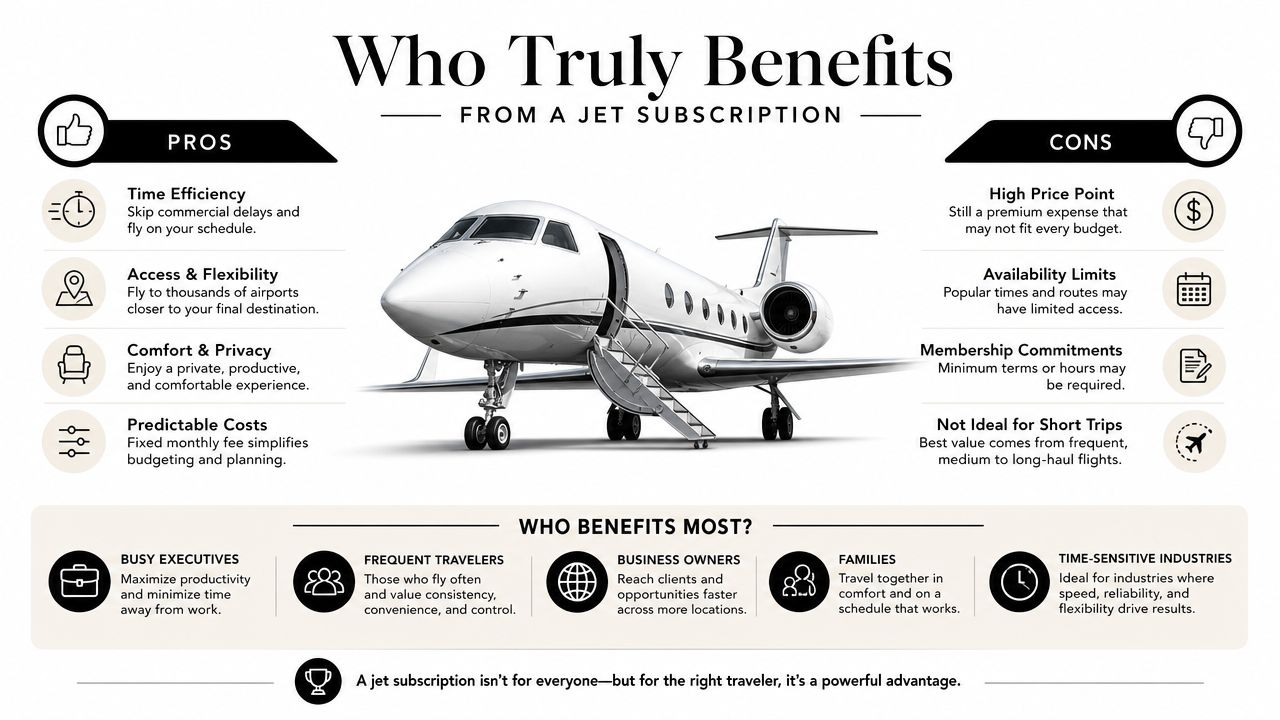
Who should buy a jet subscription? A small, disciplined slice of the market.
A subscription makes sense for a client with repeatable flying habits and little interest in shopping each trip. If your schedule is steady, your routes repeat, and your aircraft needs rarely change, a subscription can reduce booking friction and simplify budgeting. That buyer exists, but it is not the default private flyer.
The client who can justify a subscription
Buy a subscription only if your travel pattern is predictable enough to offset the premium you pay for prepaid access.
That usually means all of the following are true:
- You fly often enough to use the program consistently
- You repeat the same city pairs or a tight route cluster
- You book the same aircraft class on most trips
- Your provider has reliable coverage near your home base and regular destinations
- You prefer administrative simplicity over trip-by-trip price pressure
This is a narrow use case. It fits the buyer who treats private aviation like a recurring operating expense, not a flexible purchasing decision.
Who should skip it
The better question for most buyers is not whether a subscription sounds convenient. It is whether the pattern of your actual flying will support it.
For many affluent travelers, the answer is no. Their trip profile changes too often. A business meeting turns into a family weekend. A light jet mission becomes a super-midsize requirement because baggage, pets, or passenger count changed. A prepaid structure starts to work against you the moment your travel stops behaving like a template.
That is why on-demand charter should be the default starting point for most buyers. You keep capital uncommitted, you match the aircraft to the mission, and you force every trip back into a competitive market.
A practical fit test
Skip the subscription and book on demand if these statements describe you:
- Your routes shift throughout the year
- You want to choose the exact aircraft when the mission justifies it
- You do not want money tied up in hours or deposits
- You want fresh pricing every time you fly
- You occasionally benefit from one-off market opportunities, including empty legs
One more point matters. If a provider is selling convenience as the main reason to prepay, ask what oversight sits behind that convenience. A polished membership model does not replace operator scrutiny. Review how Wyvern and ARGUS safety ratings work in private aviation before you commit to any access model.
For the broader market, subscription is the exception. On-demand charter is the smarter default because it prices the trip you need, not the flying pattern a provider hopes you will maintain.
Safety Beyond the Brand Name
A luxury brand does not make a flight safer. The operator does.
That's the point many subscription buyers miss. They assume a polished membership platform, strong branding, and high annual spend must translate into superior flight standards. It doesn't work that way in aviation.
What actually matters
The critical question is not, “Which company sold me the flight?”
It's, “Which operator is flying the aircraft, and what independent safety oversight does that operator maintain?”
The benchmark serious buyers should ask for is third-party audit status. In business aviation, Wyvern Wingman and ARGUS Gold or Platinum are the meaningful signals because they assess the operator's standards, not the elegance of the sales platform.
Why broker brand names can mislead buyers
A subscription provider, jet card company, or charter broker may not operate every aircraft it offers. It may source lift from outside operators depending on route, timing, and aircraft availability. That's normal in the industry. But it means the marketing brand and the operating entity are not always the same thing.
So stop asking whether the membership company is prestigious. Ask these instead:
- Who is the operating carrier on this trip
- What independent audit rating does that operator hold
- Is the aircraft and crew current for the mission profile
- Will I receive aircraft and crew details in advance
If a provider talks more about lifestyle benefits than operator-level audits, you're looking at the wrong end of the safety equation.
The standard I recommend
I advise clients to treat third-party safety ratings as mandatory. If a provider can't confirm operator-level audit status clearly, keep looking.
If you want a deeper explanation of what those audit tiers mean in practice, read this breakdown of Wyvern and ARGUS private aviation safety ratings. It explains why experienced flyers focus on the operator certificate and independent review, not the membership logo on the invoice.
Safety is not a perk. It's the baseline filter that should remove options before pricing even starts.
Frequently Asked Questions About Private Jet Access
Can on-demand charter work on short notice
Yes, often very well.
Short-notice access depends on aircraft positioning, airport logistics, crew legality, and weather. It does not depend on whether you paid an annual membership fee. In many situations, trip-based sourcing is faster because the provider can search broadly for lift that fits the mission instead of staying inside a narrower contracted structure.
Are subscription rates really fixed
Not in the way most buyers assume.
The base structure may be fixed. The total mission cost often isn't. Restrictions around category, routing, minimums, and operational realities can still reshape what you pay or what aircraft you receive. That's why I tell clients to ignore the headline rate until they understand the full booking rules.
When do empty legs matter
Empty legs matter when your timing is flexible and your route happens to align with an aircraft's repositioning schedule.
They're not reliable enough to build your whole travel plan around, but they are valuable when used opportunistically. Buyers using on-demand charter are often better positioned to take advantage of them because they aren't boxed into one provider's internal economics.
Is a jet card safer than on-demand charter
Not by itself.
Safety doesn't come from prepaying. It comes from operator standards, maintenance discipline, crew qualification, and independent third-party oversight. The right question is always about the company operating the flight.
What's the cleanest buying strategy for most people
Use a simple filter:
- Choose on-demand charter if your travel changes, your routes vary, or you care about selecting the exact aircraft.
- Consider a jet card only if you fly regularly enough to value prepaid structure and can tolerate category-based access.
- Use a subscription only if your volume is high, your routes are consistent, and the provider is strong in the exact markets you use most.
What do experienced buyers usually overlook
They overlook utilization risk.
They focus on access and forget that unused hours, mismatched aircraft categories, and out-of-network departures all erode the economics. Private aviation rewards precision. The more your buying model matches your actual travel behavior, the better the outcome.
If you want private access without annual fees, prepaid hours, or opaque membership economics, Haute Jets offers an on-demand model built around sourcing the exact aircraft for each trip, with operator-level safety standards and trip-specific pricing that matches the mission instead of forcing you into a subscription.