
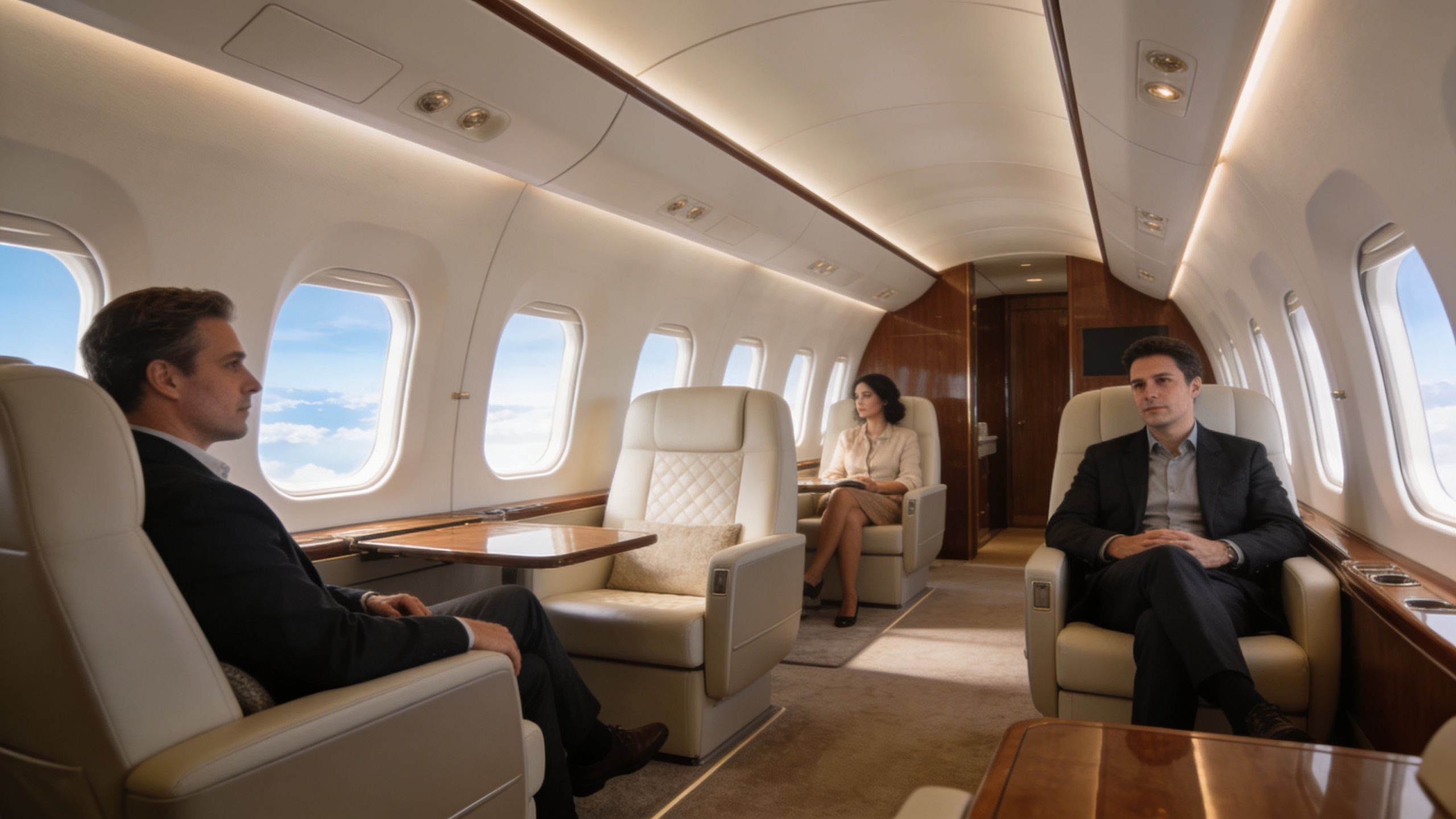
You notice it the moment the cabin door closes. Conversation feels easy. A phone call doesn't require raised voices. The aircraft has speed and power, but the cabin feels removed from the machinery making the trip possible.
For many charter clients, that quiet is filed under "luxury." In reality, it's often the result of a very specific engineering choice: rear mounted engines. When designers place the engines on the aft fuselage instead of under the wings, they change far more than the aircraft's silhouette. They reshape the cabin experience, influence how the jet handles, and affect which airports it can use comfortably.
If you charter often, this isn't trivia. It's useful buying knowledge. Engine placement can help explain why one aircraft feels calmer in flight, why another is better suited to a short-runway mountain airport, and why certain jets remain favorites for executives who work en route.
Why Your Private Jet Experience Is So Quiet
A client flying from New York for a transatlantic meeting usually notices the same thing first. Not the seats. Not the finish materials. The sound level.
On many business jets with rear mounted engines, the forward cabin feels insulated from the loudest part of the aircraft because the engines sit behind the passenger space, not beside it. That matters in the most practical ways possible. You can hold a normal conversation, review documents, or rest without the constant edge of engine noise close to the wing root.
This isn't a new idea dressed up as modern luxury. It has deep roots in commercial aviation. The Sud Aviation Caravelle, introduced in 1955, was the world's first commercial airliner with rear-mounted engines, and its design reduced cabin noise by 15-20 decibels compared to wing-mounted designs, setting a new passenger comfort standard according to Simple Flying's history of the Caravelle.
Why passengers notice it so quickly
The reason is straightforward. Sound and vibration sources are moved aft, away from where people sit. In a private jet cabin, especially in the forward club seats, that difference becomes part of the overall travel experience.
For a charter client, the takeaway is simple:
- Better conversation quality means meetings in the air feel more natural.
- A calmer cabin environment makes longer sectors less fatiguing.
- Luxury feels more convincing when comfort comes from engineering, not just upholstery.
A quiet cabin isn't only about refinement. It changes how usable the flight time actually is.
That is why rear mounted engines continue to matter in private aviation. The layout supports the kind of travel many high-value passengers want most: productive, discreet, and comfortable from wheels up to touchdown.
Understanding Rear Mounted Engine Design
The easiest way to understand rear mounted engines is to think about carrying weight. If you hold two heavy bags straight out from your sides, the load feels awkward and tiring. If you carry that same weight closer to your body, control feels easier. Aircraft designers wrestle with a similar balance problem.
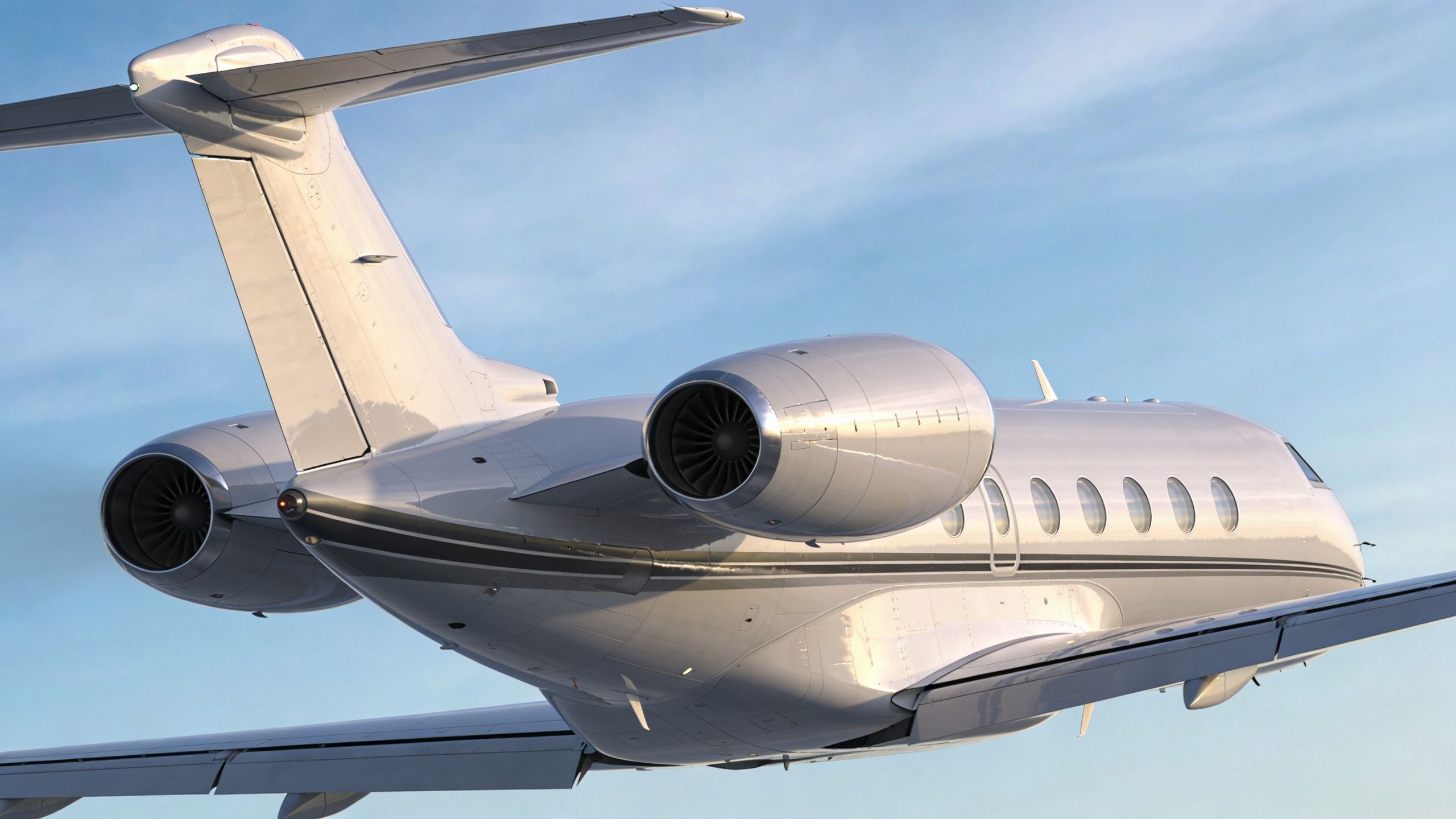
In this configuration, the engines are attached to the rear fuselage, usually on either side of the tail section. On some aircraft, a third engine may also be mounted at the rear. This moves major propulsion components away from the wings and changes how the aircraft is balanced, supported, and controlled in flight.
What designers gain
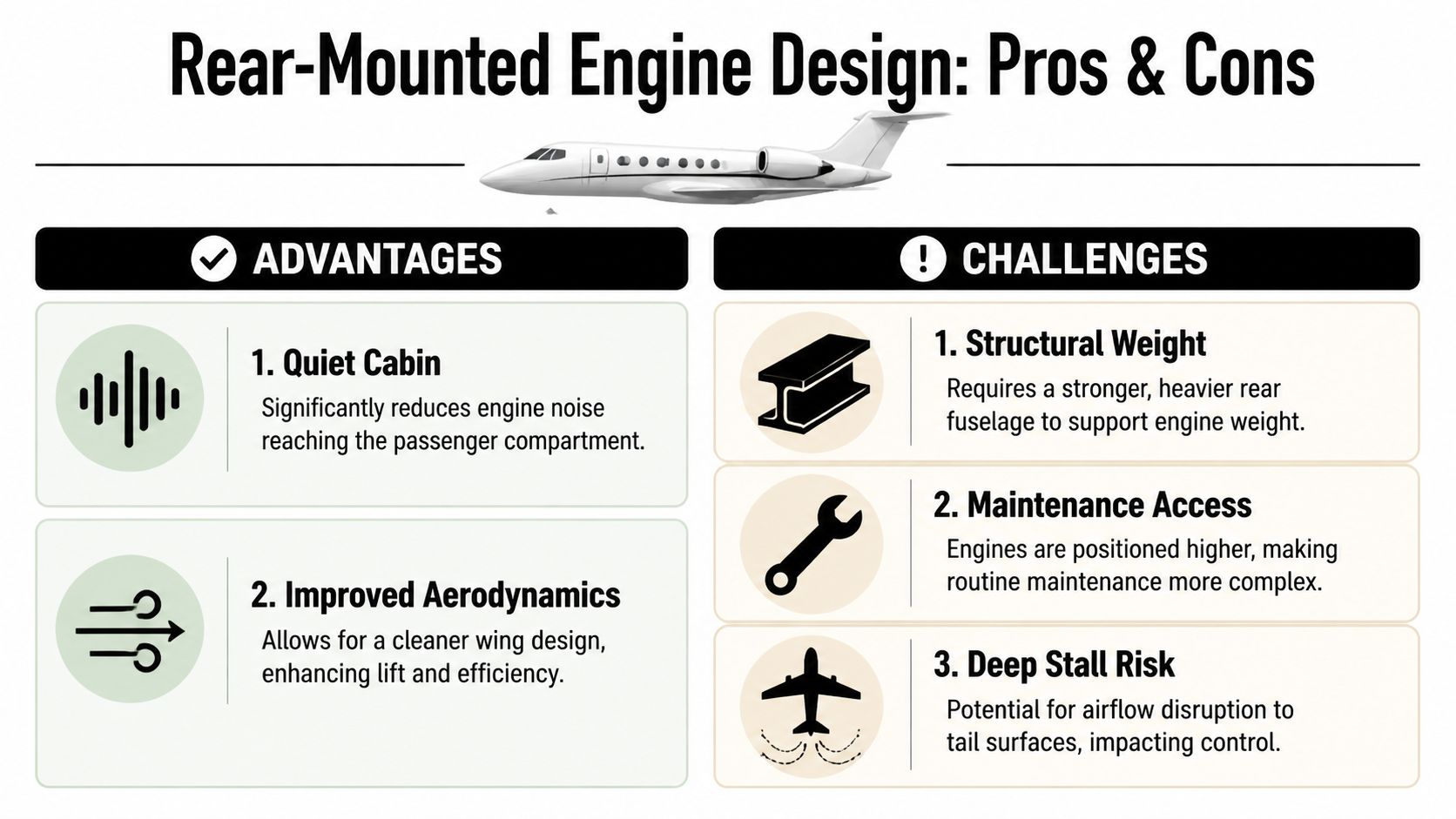
One of the biggest benefits is the clean wing. Without engines hanging below it, the wing can be designed more freely for lift and low-speed performance. That matters during takeoff and landing, where wing behavior is especially important.
Designers also gain a cabin benefit. With the engines moved aft, the passenger area is physically separated from the main noise source. That's one reason so many premium business jets use this layout.
A good primer on how these design choices evolved in business aviation appears in Haute Jets' look at the evolution of private jet design.
What designers must solve
The trade is that moving engines to the tail doesn't make weight disappear. It concentrates mass at the back of the airplane, so the rear fuselage and tail structure must be engineered to support it. That can complicate structure, maintenance access, and tail design.
Rear mounted engines also usually pair with a T-tail, where the horizontal stabilizer sits high on the vertical tail. Clients often see this as a styling cue, but it is really part of the aircraft's aerodynamic package. The tail must work in harmony with the engine placement and the airflow around the rear fuselage.
Practical rule: If you see engines at the back and a high tail, you're looking at an aircraft designed around a very deliberate set of comfort and performance priorities.
A quick mental model
Here is the simplest way to read the design:
| Design choice | What it means for the aircraft |
|---|---|
| Engines on rear fuselage | Quieter forward cabin and different weight distribution |
| No engines under the wing | Cleaner wing airflow |
| High tail arrangement | Tail surfaces positioned to work with aft engine placement |
This is why rear mounted engines aren't just an aesthetic preference. They are a whole-aircraft decision, with consequences that reach from cabin acoustics to runway performance.
The Quiet Advantage Noise Comfort and Aerodynamics
The appeal of rear mounted engines becomes most obvious once you're in the cabin, especially if you're seated forward.
On business jets, moving the engines aft can reduce cabin noise in the forward sections by up to 10-15 dB, and the cleaner wing airflow can increase lift coefficients by 5-10%, helping enable shorter takeoff runs according to Simple Flying's review of rear versus wing mounted engines. For a charter passenger, those are not abstract engineering wins. They affect how the trip feels and where the aircraft can operate efficiently.
Comfort that changes how you use the flight
A quieter cabin isn't only pleasant. It changes behavior onboard.
Clients who take calls during flight often prefer aircraft where speech sounds more natural in the forward cabin. Families notice it too, especially when some passengers want to rest while others talk or work. On a longer sector, less background noise and vibration can make the cabin feel less busy and less tiring.
Three practical effects stand out:
- Work becomes easier: Calls, reading, and conversation require less effort.
- Rest improves: The cabin feels more like a lounge and less like a machine room.
- The aircraft feels more private: Reduced cabin intrusion supports discretion.
The clean wing matters on the ground too
The aerodynamic benefit is less visible, but often just as important. A wing without engine pylons beneath it has fewer interruptions in airflow. That cleaner wing can support effective high-lift devices and better low-speed behavior.
For charter clients, that can translate into stronger suitability for airports where runway performance matters. Mountain airports and shorter-runway business destinations are where these design choices become practical rather than theoretical.
The video below gives useful visual context for how aft-mounted engines change the aircraft's layout and proportions.
A quieter jet can also be a more protected jet
Rear mounted engines also sit higher off the ground than many wing-mounted alternatives. That higher position can help reduce exposure to runway debris and foreign object damage. For operators using a variety of airports, including secondary airports, that is a meaningful operational advantage.
When engines are farther from the cabin and higher above the ramp, passengers usually notice two things. Less noise inside, and fewer visible compromises in cabin layout.
For a non-technical client, the summary is simple. Rear mounted engines often support the version of private aviation people want: quiet enough to work, refined enough to relax, and capable enough to reach airports that save time on the ground.
The Engineering Tradeoffs Weight Safety and Maintenance
Rear mounted engines solve some problems and create others. Good aircraft design is never free. It is a sequence of choices.
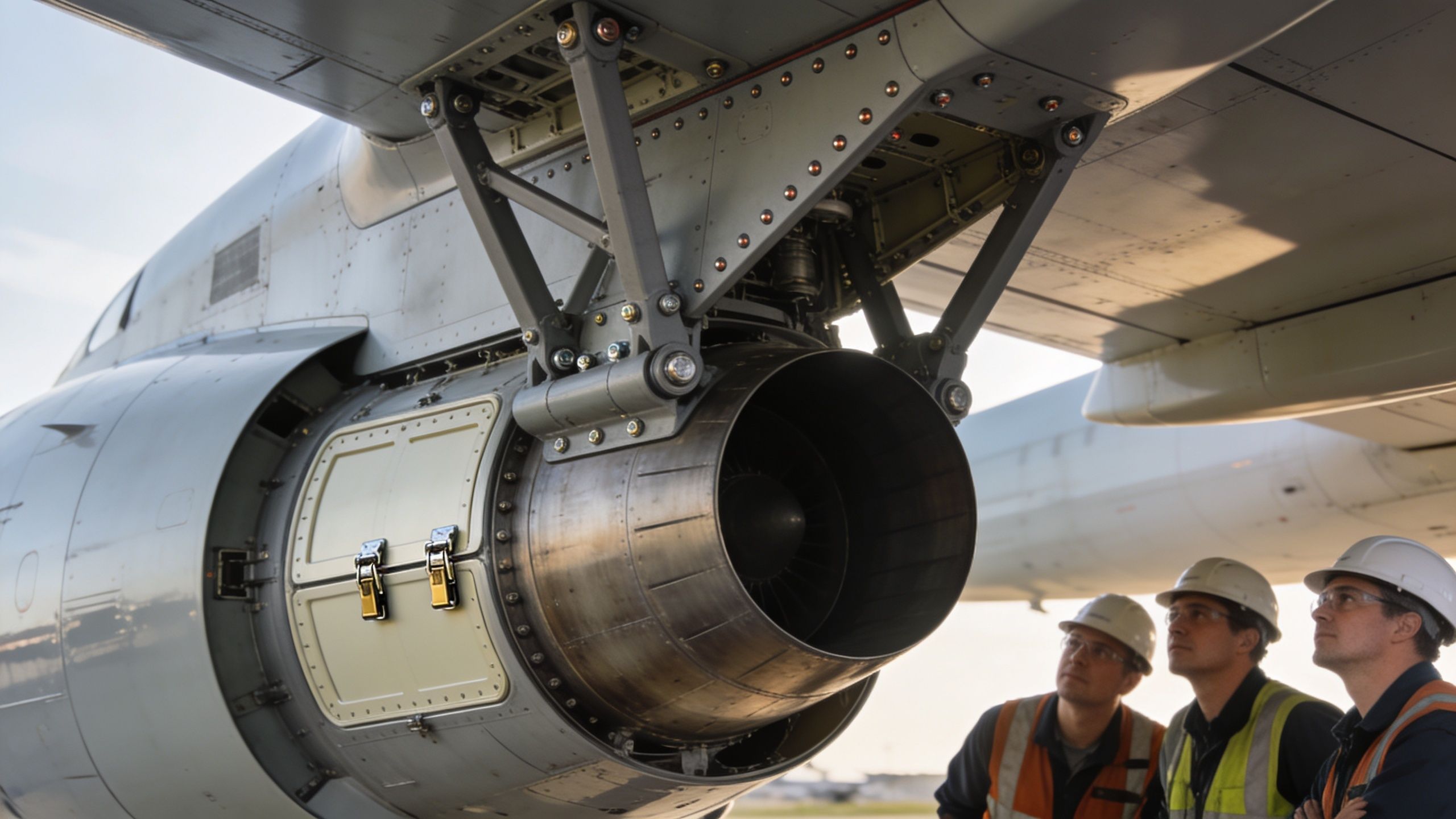
The first tradeoff is structural. If engines are attached to the rear fuselage instead of the wing, the aircraft needs strong support in the aft body and tail area. Designers also have to manage airflow around the tail, especially in high-angle flight conditions, and they must route systems through the aircraft in ways that fit the rear-engine layout.
The cost of putting weight at the back
From a design standpoint, wing-mounted engines can help relieve some wing bending loads because the weight is suspended under the wing itself. Rear mounted engines don't provide that same structural benefit. As a result, designers must carefully manage weight and reinforcement elsewhere.
Maintenance crews also face a mixed picture. High-mounted engines can help with ground clearance, but access is not always as straightforward as on some underwing installations. That's one reason aircraft choice is always about mission fit, not a universal "best" layout.
The important safety upside
One of the strongest arguments in favor of rear mounted engines is what happens if one engine fails. Because the engines sit closer to the aircraft's center of gravity, the aircraft experiences less asymmetric yaw than it would if the failed engine were far out on the wing.
According to the verified data, rear-mounted engine jets can reduce asymmetric yaw moments by 30-50% during a single-engine failure, requiring significantly less rudder input from the pilot to maintain control, as noted in this technical reference on engine placement and aircraft handling. For a client evaluating safety, that matters because easier engine-out control lowers pilot workload in a demanding situation.
A good safety feature is often invisible to the passenger. It only reveals its value when something abnormal happens.
The tradeoff in plain English
If you compare rear mounted engines with wing-mounted engines, the practical picture looks like this:
- Rear mounted engines often deliver a quieter cabin and more benign engine-out handling.
- Wing-mounted engines can simplify some structural and maintenance considerations.
- Neither layout is automatically superior in every mission. The right answer depends on range, runway environment, payload, and cabin priorities.
Discerning clients don't need to memorize the engineering. They just need to know that the elegant cabin experience is supported by real technical compromises, and some of those compromises produce real safety advantages.
Iconic Business Jets with Rear Mounted Engines
The easiest way to make rear mounted engines tangible is to look at the aircraft you see on charter ramps.
In the light-jet category, the Embraer Phenom 300 is a familiar example. Its rear-engine layout supports the kind of mission many owners and charter clients value most: fast regional flying with a cabin that feels more polished than the aircraft's size might suggest. That configuration also helps preserve the clean-wing design discussed earlier, which is one reason aircraft in this class are often favored for business trips into more demanding airports.
Light and midsize examples
The Cessna Citation Latitude is another aircraft that shows how practical this layout can be. It combines a flat-floor cabin with the classic rear-engine business jet profile, which many passengers associate with a quieter, more executive-focused travel experience.
The Bombardier Challenger 350 uses the same basic placement logic for a different mission. In midsize charter work, clients usually care about a blend of comfort, baggage capacity, and reliable point-to-point flexibility. Rear mounted engines fit that brief well because they support a cabin environment that feels calm without giving up the performance expected from a premium business jet.
Larger and longer-range aircraft
Dassault's Falcon family is particularly instructive. The Falcon 900, with three engines mounted at the rear, shows how the concept scales into large-cabin, long-range travel. In that context, the layout isn't just about noise. It also reflects a design philosophy centered on control, redundancy, and premium passenger comfort.
If you're comparing aircraft categories and want to see how these jets sit within the wider charter market, the Haute Jets fleet page is a useful reference point for the types of aircraft commonly offered.
Some aircraft become charter staples because their design choices align cleanly with client priorities. Rear mounted engines are often part of that equation.
A simple way to recognize the pattern
If you want a quick visual shorthand when reviewing aircraft options, look for these signs:
- Engines attached near the tail: Common on many light, midsize, and large-cabin business jets.
- A T-tail profile: Often paired with rear-mounted engine layouts.
- A quieter forward seating area: One of the cabin traits clients tend to notice first.
Once you spot the pattern, many aircraft comparisons start to make more sense. The layout often signals a jet designed around cabin refinement and versatile business aviation missions.
How Engine Placement Impacts Your Charter Flight
When you book a charter, engine placement affects more than the aircraft's look. It can influence comfort, airport access, handling characteristics, and operating economics.
For comfort, the logic is direct. Rear mounted engines place the loudest mechanical activity behind the cabin, which is why many passengers prefer these jets for flights where they need to work, rest, or travel with family. If your usual missions involve board-level conversations or overnight sectors, that feature deserves attention.
Where it matters most in booking decisions
This design also matters when your itinerary is operationally demanding. Trips into mountain airports, short-runway business destinations, or airports where debris exposure is a concern can favor aircraft built around the benefits discussed above.
On the safety side, verified data cited for this topic states that rear-engine business jets had 15-20% lower crash rates in Part 135 operations from 2015-2025, according to this rear versus wing mounted engine review. For a charter client, the practical lesson isn't to reduce safety to one variable. It's to treat engine placement as one useful signal within a broader safety conversation.
A smart booking discussion usually includes:
- Mission profile: Are you flying short regional sectors, coast-to-coast routes, or challenging airport pairs?
- Cabin priority: Do you care more about meeting space, sleep quality, or baggage flexibility?
- Operator quality: Aircraft design matters, but crew standards and operator oversight matter too.
The most useful question to ask
When reviewing options, don't stop at category labels like "light jet" or "super midsize." Ask which specific aircraft best fits the trip and why. A rear-engine aircraft may be the better choice if cabin quiet, engine-out handling, or airport flexibility are high on your list.
For shorter sectors in particular, this kind of aircraft-level matching can make a noticeable difference, and this guide to choosing the right aircraft for short-haul private flights is a helpful companion read.
The best charter decision usually isn't the biggest aircraft or the newest one. It's the aircraft whose design fits the mission you actually have.
Rear mounted engines won't be the deciding factor on every booking. But for discerning travelers, they are one of the clearest examples of how engineering shows up in the actual experience of flying private. If you know what to look for, you can choose more intelligently and travel better because of it.
If you want help matching the right aircraft to your route, cabin preferences, and safety requirements, Haute Jets can help you compare exact aircraft, not just categories, so you can book with more clarity and less guesswork.