

Monday starts in Houston with a calendar that already feels too full. You've got a breakfast meeting near downtown, an afternoon presentation in Dallas, and a dinner reservation back home that you'd like to keep for once. The usual commercial routine means traffic, parking, security lines, gate delays, and the familiar feeling that half the day disappeared before the actual work even started.
That's why more travelers are looking at semi private flights from Houston. They sit between airline first class and full private charter. You still share the aircraft, but with far fewer people, and you usually board from private terminals instead of a crowded gate. For Houston travelers, that middle ground matters because the city's airport network gives you several ways to leave quickly, whether you're heading across Texas or farther out.
Most guides stop at the lifestyle pitch. They tell you semi-private is more comfortable and faster than commercial. That part is true, but it's incomplete. What matters is route math from Houston, what you're paying for, where you're departing from, and whether hidden repositioning fees are subtly changing the economics.
This Haute Jets Journal guide focuses on those Houston-specific questions. If you've ever wondered when semi-private is smarter than first class, when charter still makes sense, or how to spot pricing that looks clean but isn't, you're in the right place.
Introduction to Semi Private Flights in Houston
A Houston traveler can lose more time getting to the right terminal, parking, and waiting to board than in the flight itself. That problem shows up on short hops to Dallas, Austin, and other common business routes, where every extra step on the ground eats into the value of the trip.
Semi-private flights from Houston appeal to people who want a faster airport routine without paying for an entire aircraft. The model works like a premium shuttle with jet-level convenience. You buy a seat, not the whole plane, but you often depart through private terminals and avoid the crowded flow of a standard airline gate.
Houston makes that option easier to evaluate because the city gives travelers several airport choices, and those choices change the math. For example, William P. Hobby Airport is located southeast of downtown Houston, and the Houston Airport System overview of Hobby Airport shows why many local travelers view it as a practical departure point for shorter trips. If your goal is to protect two or three working hours in a day, airport location matters almost as much as the flight time.
That is also where many guides stop too early. Comfort matters, but the better question is more specific. How much time are you saving per dollar on a Houston route once you account for ground access, check-in style, schedule frequency, and any repositioning cost that may be buried inside the quote?
That last point causes a lot of confusion. Some Houston travelers compare a semi-private seat to an airline ticket and assume the seat price tells the whole story. Others compare it to charter and miss the fact that a charter quote can rise if the aircraft has to reposition before pickup. In plain terms, the airplane may need to fly empty to reach you, and that empty leg can show up in the bill even though you never sat on it.
A simple way to frame the choices is this:
- Commercial first class fits travelers who need many daily departures and care most about schedule flexibility.
- Semi-private fits travelers who want a quieter terminal process, fewer fellow passengers, and better time efficiency on the right routes.
- Full charter fits travelers who need full control over departure time, passenger list, or airport selection.
For Houston-based buyers, the smart comparison is not just price versus price. It is process versus process, and total trip time versus total trip cost. That is the lens that makes semi-private either a smart shortcut or an expensive upgrade.
Understanding Semi Private Flights
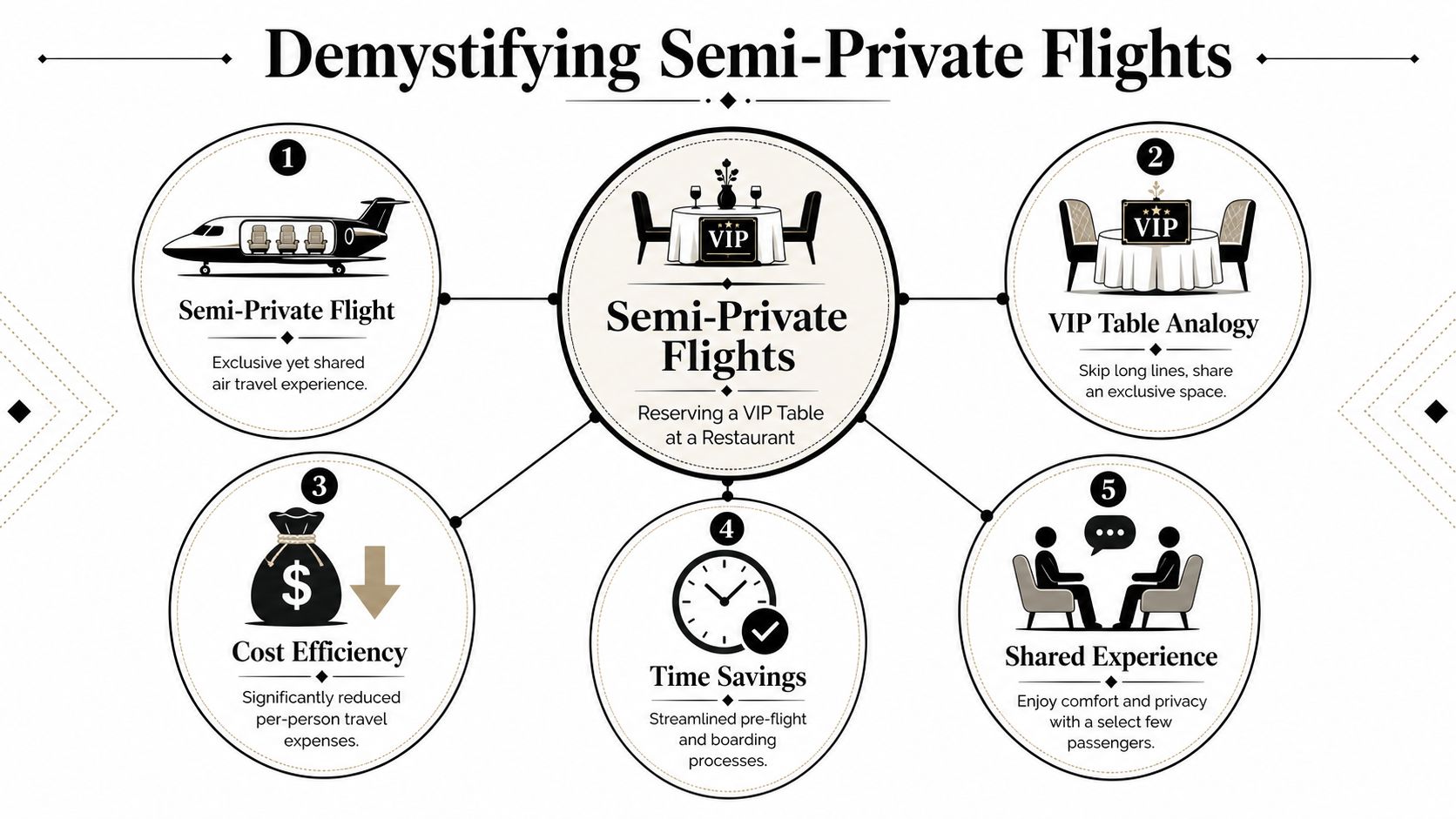
Semi-private flying is easiest to understand with a restaurant analogy: reserving a VIP table in a busy dining room. You skip the line and avoid the main crowd, but you're still sharing the experience with a select group. That's the basic model. You're not buying the whole aircraft. You're buying a seat inside a more controlled, more comfortable setup.
How the model works
Most semi private flights from Houston operate under FAA Part 135 charter rules using 15 to 30 seat aircraft. That setup allows passengers to avoid commercial TSA screening and much of the terminal congestion that comes with standard airline travel, while keeping costs below full on-demand charter. A clear example comes from this guide to JSX semi-private flights in Texas, which notes that JSX uses Embraer ERJ-135 and ERJ-145 regional jets, configured in a 1-2 layout with no middle seats, and offers Dallas to Houston flights at $169 to $329 one-way.
That same source compares those fares with a $7,500 light jet charter on the route and frames the seat purchase as a 60 to 75% cost reduction versus chartering the aircraft yourself. That's the heart of semi-private economics. You give up sole use of the airplane, and in return you buy back a lot of convenience at a lower entry price.
What you actually experience on travel day
Semi-private often feels different in three places:
- Arrival. You usually show up at a private terminal or hangar area instead of a standard gate.
- Boarding. The passenger count is much smaller than on a commercial flight.
- Cabin layout. Operators often use roomier seating, and the smaller headcount changes the atmosphere.
You're still on a shared flight. You're just skipping many of the slowest, most frustrating parts of airline travel.
The two aircraft types most travelers see
Houston travelers will usually encounter one of two broad setups.
- Regional jets such as the Embraer aircraft used by JSX. These feel familiar if you've flown commercial regional service, but with fewer seats and a more premium boarding process.
- Turboprops such as the Pilatus PC-12 used by some Texas-focused operators. These are especially practical for shorter regional trips.
If you're new to the category, a useful companion read is this shared private jet guide, which helps frame where semi-private sits inside the broader shared aviation spectrum.
Comparing Operators and Route Options
Houston doesn't have a single semi-private model. It has a mix of scheduled operators, membership-based services, and traditional charter alternatives that sometimes compete for the same traveler. That's why route-level thinking matters more than brand recognition.
What Houston routes reveal
Houston is a major departure point for both regional and long-haul private flying. According to Paramount Business Jets' Houston charter route page, sample one-way charter pricing includes Houston to Dallas at around $5,500 for a turboprop with 4 passengers, Houston to Las Vegas at approximately $13,500 for a light jet with 6 passengers, and Houston to New York City at roughly $30,000 for a large jet with 12 passengers.
Those figures are for full charter, not semi-private seats. Still, they're useful because they show the ceiling that semi-private products are trying to undercut on a per-person basis.
Operator and Route Comparison
| Operator | Aircraft Type | Sample Route | One-Way Price |
|---|---|---|---|
| JSX | Embraer ERJ-135/ERJ-145 | Dallas ↔ Houston | $169 to $329 |
| Ladybird Jet | Pilatus PC-12 | Houston, Dallas, Fredericksburg corridor | Membership-based pricing not specified in verified data |
| Surf Air | Houston service mentioned in market gap discussion | Houston routes vary by availability | Pricing not specified in verified data |
| Aero | Semi-private operator referenced in market gap discussion | Longer premium routes | Pricing not specified in verified data |
How to choose between them
Different operators fit different travel habits.
For repeat Texas business trips
If your calendar regularly pulls you between Houston and Dallas, JSX stands out because the route and price point are specific and visible in the verified data. The regional jet format also appeals to travelers who want a more airline-like aircraft with a premium feel.
For a Texas corridor mindset
Ladybird Jet is better suited for regional point-to-point Texas travel. Its network expansion into Houston created a corridor connecting Houston, Dallas, and Fredericksburg, which is especially interesting for travelers whose trips don't map neatly to traditional airline hubs.
For less frequent or less predictable travel
When your exact city pair or timing doesn't fit a scheduled semi-private network, you're often back to comparing commercial flying with full charter. That's where route economics become less about branding and more about the total schedule fit.
The best operator isn't the one with the flashiest marketing. It's the one whose actual departure pattern matches how you travel from Houston.
Cost and Time Savings Compared to Commercial and Charter
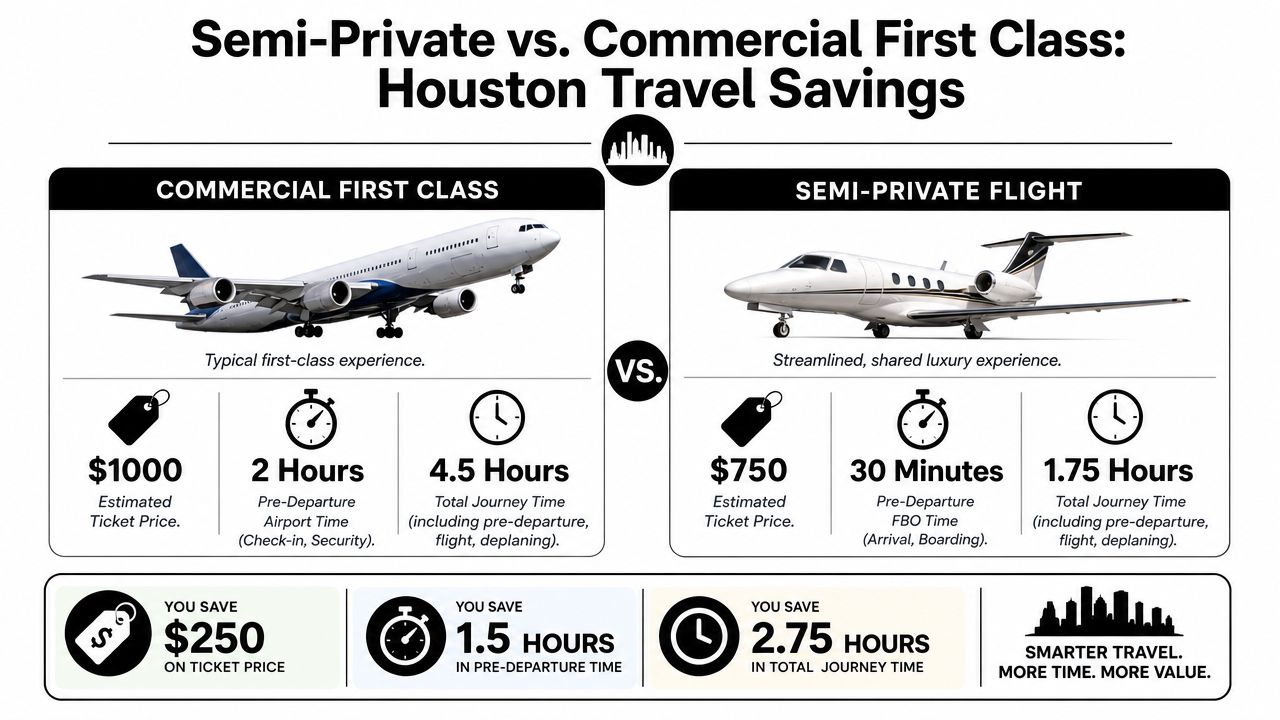
A Houston traveler booking a morning meeting in Dallas often compares only the fare on the screen. That misses the true trade-off. The better question is how many hours you save for each extra dollar, after you count drive time, terminal time, and any aircraft positioning cost hidden in the quote.
The right baseline
Semi-private sits between two very different products.
Commercial first class sells you one seat on a fixed airline schedule. Full charter sells you the whole aircraft and the freedom to set the timing. Semi-private gives you part of the charter experience, usually the private terminal process and a smaller cabin, without asking you to pay for every empty seat on board.
That middle position is why simple fare comparisons can mislead. A lower airline ticket can still cost you more of your day. A charter quote can look efficient until extra aircraft movement shows up in the final number.
Why Houston changes the math
Houston is a wide, traffic-heavy metro, so airport choice affects value more than many travelers expect. A departure closer to your office or home can shrink the part of the trip that never appears on a boarding pass.
That matters most on short regional routes. If you are flying from Houston to another Texas city, the flight itself may be brief enough that check-in friction and ground transfer time become a large share of the total trip. In plain terms, saving 60 to 90 minutes on the ground can matter more than saving a small amount in the air.
A practical way to compare your options
Use three buckets and total them together:
- Seat or aircraft price
- Door-to-aircraft time
- Schedule fit for the trip you need
That framework works like comparing a rideshare, a car service, and a rental car. The sticker price is only one part of the decision. Convenience and control have a cost, but they also return time.
Commercial first class usually wins on route frequency. Full charter wins on control and privacy. Semi-private often wins when you want a shorter airport process and a premium cabin, but do not need to buy the whole jet.
The hidden fee Houston travelers should check first
Repositioning is the cost of moving an aircraft to where your trip starts before your trip even begins. It is one of the easiest ways to misread a quote.
For Houston travelers, this matters because not every aircraft is already based at the airport you want to use, at the time you want to leave. A charter estimate may rise once the operator prices in the ferry leg to get the plane into place. Semi-private scheduled seats usually reduce that risk because the operator is selling space on a flight that was already planned. The catch is that route design still matters. If the schedule forces you into a less convenient airport or timing, your time savings can shrink quickly.
Ask one direct question before you book: Is any part of this price covering aircraft repositioning?
If you are comparing charter alternatives, this empty leg flight guide explains how one-way repositioning flights sometimes lower the cost when your schedule is flexible.
Semi-private versus the extremes
| Option | Best For | Main Tradeoff |
|---|---|---|
| Commercial first class | Frequent schedules and broad airline networks | Longer airport process and more terminal friction |
| Semi-private | Better time savings on the ground and a premium shared cabin | Fewer departure times than major airlines |
| Full charter | Private group travel, custom timing, and full control | Highest total spend and possible repositioning costs |
The key point is simple. For Houston departures, the smartest comparison is not seat price versus seat price. It is total trip time versus total trip cost, with hidden positioning charges pulled into the open.
Key Airports and FBOs in Houston
Where you depart from shapes the whole experience. Houston travelers often focus on the aircraft and forget that the terminal decision can change the day just as much as the seat.

William P. Hobby Airport
Hobby is the practical favorite for many travelers heading in and out of central Houston because of its location. As noted earlier in the market data, it's 7 miles southeast of downtown with a typical drive of 15 to 25 minutes to the city center. For anyone trying to compress a same-day business itinerary, that convenience matters.
Semi-private operators that use private terminal facilities near major airports benefit from this kind of access. You're not only shortening the flight process. You're shortening the city-to-aircraft handoff too.
Houston Executive and the regional Texas case
Houston Executive Airport, often shortened to TME, plays a different role. It's especially relevant for travelers looking at regional Texas flying and avoiding repositioning complications. According to National Today's report on Ladybird Jet's Houston expansion, the company expanded its network to include Houston and uses Pilatus PC-12 turboprops from Houston Executive in a three-market corridor connecting Houston, Dallas, and Fredericksburg. The same source says the aircraft have 11-seat capacity and 1,800 nm range, and that this setup aims to eliminate repositioning costs that can inflate conventional charter pricing by 20 to 40%.
That makes TME especially interesting for travelers who value local sourcing and regional efficiency over broad airline-style route maps.
Other Houston-area airports travelers ask about
Travelers also hear about Ellington Field and Lone Star Executive when exploring private aviation in the region. The right fit often depends on where you live, where your meeting is, and whether the operator has a consistent local setup there.
For airport-specific context on the broader Houston private aviation sector, this George Bush Intercontinental airport guide offers useful background on one of the city's best-known air travel gateways.
Some travelers optimize for the aircraft. Frequent flyers often optimize for the driveway-to-terminal experience instead.
Booking Process and Practical Tips
Booking semi-private sounds simple, but first-time buyers often stumble over the same issues. They find a route, see a seat price, and assume they've solved the problem. Then they discover the schedule is narrow, baggage rules vary, pets need advance handling, or the flight structure isn't as local as it first appeared.
Start with the route, not the brand
The first step is matching your city pair and travel window to actual operator availability. Semi-private works best when the route is already part of a scheduled or recurring pattern. If you start with brand loyalty instead of schedule fit, you can waste time trying to force a service into an itinerary it doesn't serve well.
The booking flow that keeps things clean
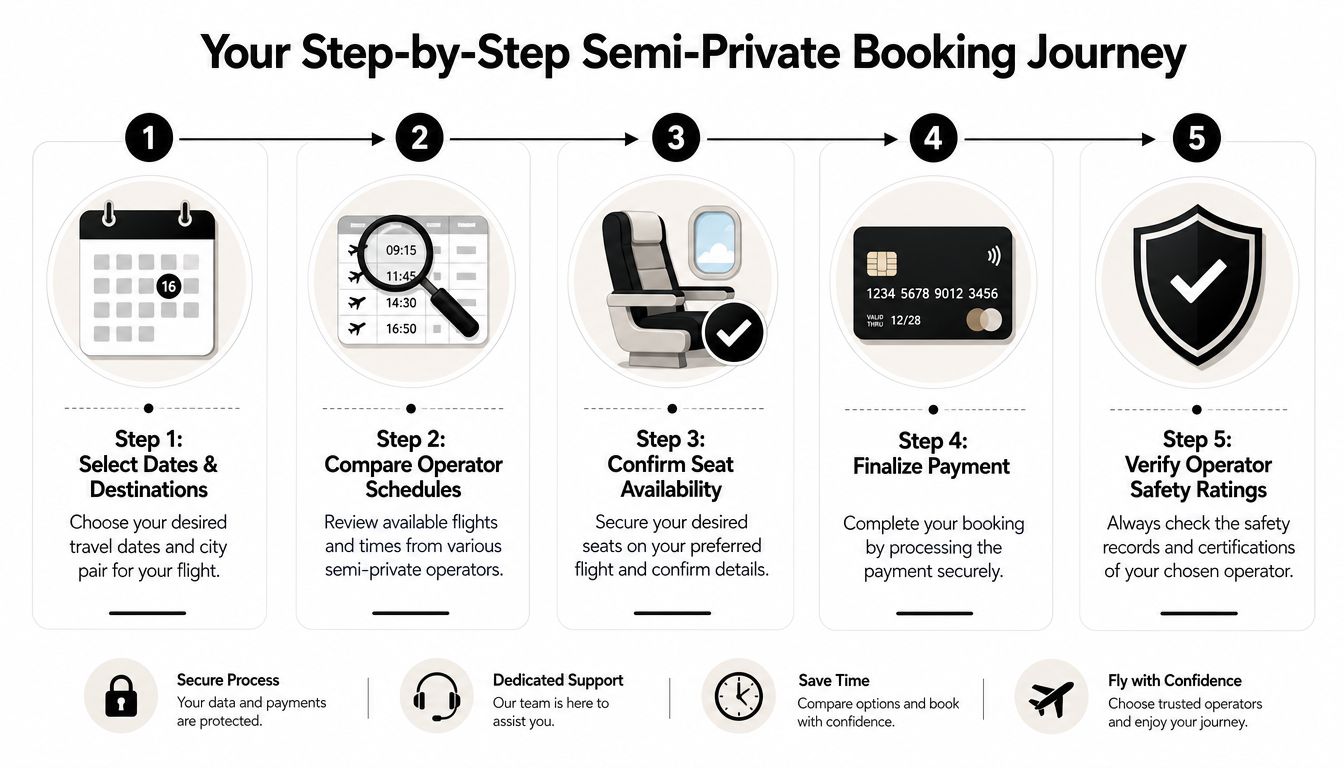
- Choose travel dates and city pair. Be realistic about flexibility. A one-day range can open up much better options.
- Compare departure patterns. Don't just compare prices. Compare where the aircraft boards, and whether the arrival airport aids your ground plan.
- Confirm seat and baggage details. Semi-private isn't one-size-fits-all. Cabin layouts and luggage handling vary.
- Review payment and policy terms. Change rules matter more here than on a large airline network.
- Check operator safety credentials. Ask whether the operating carrier holds Wyvern Wingman or Argus Gold/Platinum credentials if that information isn't already provided.
How to avoid hidden pricing surprises
The biggest Houston-specific caution is repositioning. The market gap in this category is clear: traditional brokers can inflate prices by 20 to 40% through repositioning fees, yet many semi-private discussions don't clearly address whether local aircraft sourcing is taking place or whether similar cost pressure appears in other ways.
Use direct questions:
- Is the aircraft based in Houston or nearby?
- Is the quoted price all-in for this route?
- If the operator changes aircraft or timing, does pricing change too?
Booking shortcut: If an offer sounds unusually simple, ask what happens operationally when the aircraft isn't already local.
Pets, bags, and practical prep
If you're flying with an animal, don't assume private-style boarding means unlimited pet flexibility. Operators still have their own requirements. For a good pre-trip checklist, Pet Magasin's ultimate guide for pet travel is a helpful reference for documents, carrier prep, and common airline-style pet rules that can still influence your planning.
For baggage, the safe move is to ask for the exact luggage policy in writing before payment. Smaller aircraft, especially on regional hops, can have tighter practical limits than travelers expect.
Why Choose Haute Jets
Some travelers start with semi-private and then realize their route, timing, group size, or privacy needs point them back toward charter. That's where pricing discipline matters most. The usual frustration isn't just the total number. It's finding out later that you paid for aircraft movement you never asked for.
Haute Jets approaches that problem differently by sourcing aircraft locally whenever possible instead of defaulting to repositioned lift. The company's network includes 3,500+ aircraft across 175 countries, and it works only with Wyvern Wingman and Argus Gold/Platinum-rated operators. That matters because it shifts the conversation from generic category shopping to specific aircraft selection, operator quality, and cleaner quote logic.
What stands out in practice
A few details make the model easier to understand.
- Local sourcing first. Haute Jets looks for aircraft based near the departure city, which helps avoid the repositioning fees that can inflate charter pricing.
- No memberships or jet cards. You pay per flight instead of prepaying into a program with annual commitments or blackout frustrations.
- Specific aircraft choice. You can select the actual year, make, model, and cabin layout rather than being assigned a broad category at the last minute.
Why that helps Houston travelers
Houston travelers often book short business hops one week and longer leisure trips the next. A rigid access product doesn't always fit that pattern. On-demand sourcing does.
Say you're traveling with a small executive group and need a cabin layout that supports in-flight work. Or you're traveling with family and care more about pet policy, baggage ease, and boarding simplicity. In those cases, choosing the exact aircraft can matter more than buying access to a category.
A good charter experience isn't only about flying private. It's about knowing exactly which aircraft is showing up and what you're paying for.
The confirmation piece many buyers appreciate
Haute Jets also provides 24-hour pre-flight confirmation with the tail number, crew bios, weather briefing, and passenger manifest. That gives travelers a level of clarity that can be hard to find in looser broker models.
For clients who've been frustrated by vague aircraft assignments, that's often the difference between “private” as a concept and private travel as a controlled, reliable experience.
Frequently Asked Questions
Can I change a semi-private booking at the last minute
Sometimes, but it depends heavily on the operator and route structure. Scheduled semi-private service usually has tighter change rules than full charter. Ask for the cancellation and change policy before you pay, especially if your meeting schedule shifts often.
Can I book empty-leg semi-private seats
Sometimes operators release one-off opportunities, but availability is inconsistent. Empty legs are better treated as opportunistic savings than a core travel strategy. If your timing must be exact, don't build your day around one.
Can I pay with digital assets
Some private aviation providers support digital asset payments, especially on charter bookings. Semi-private seat purchases are more operator-specific. Confirm accepted payment methods before you lock in a route.
What happens if weather disrupts the schedule
Weather can affect semi-private flights just like commercial and charter service. The key difference is recovery options. Large airlines may have more fallback flights, while semi-private operators may offer fewer same-day alternatives. Ask in advance how rebooking, credit, or rerouting is handled.
If you've outgrown commercial friction but don't want to overpay for unclear charter pricing, Haute Jets offers a cleaner way to book. You get access to 3,500+ aircraft sourced through Wyvern and Argus-rated operators, transparent per-flight pricing, no memberships, and aircraft matched to your actual route instead of a generic category.