

You're trying to get from one regional airport to another, but the airline schedule turns a simple trip into a half-day puzzle. Maybe the commercial option means a long connection, a missed meeting, or landing too far from the place you need to be. Small charter flights solve that problem by letting you choose the aircraft, the airport, and the timing around the trip, not around a fixed airline network.
That's why these flights matter for more than luxury travel. They bridge the gap between private jet service and air taxi-style point-to-point flying, especially when the primary constraint is runway access rather than distance alone. In a market as broad as the U.S. charter flights industry, which IBISWorld estimates at $52.6 billion in 2026 with 19,165 businesses and 10.9% CAGR from 2021 to 2026 (IBISWorld charter flights industry outlook), small aircraft aren't a side note. They're part of a mature transportation system built for time-sensitive regional travel.
Introduction to Small Charter Flights
A business traveler flying from a major metro to a remote client site often faces the same choice. Take commercial service, then spend hours on connections and ground transfers, or book a smaller aircraft that can land closer to the meeting. Small charter flights are built for that second path, and they're especially useful when the destination has limited commercial service or a short runway.
That distinction matters because this market isn't just about larger jets flying long distances. Charter aviation includes nonscheduled passenger and cargo transport, so it covers on-demand trips across aircraft types, from short-hop turboprops to light jets and beyond. The scale of the industry helps explain why availability can vary by city, since the U.S. market is spread across 19,165 businesses rather than a single centralized carrier network (IBISWorld charter flights industry outlook).
For travelers, the practical value is simple. You're not buying a status symbol, you're buying route control. That can mean landing at a smaller airport, keeping the itinerary tight, and avoiding the mismatch that often happens when a commercial schedule doesn't fit a regional mission.
A good rule is to think about small charter flying the way you'd think about a direct train on a local line. It's not the biggest vehicle in the system, but it's often the one that reaches the place you need. Runway access, timing, and aircraft fit are the first questions, not the last ones.
Understanding Small Charter Flights and Light Aircraft Categories
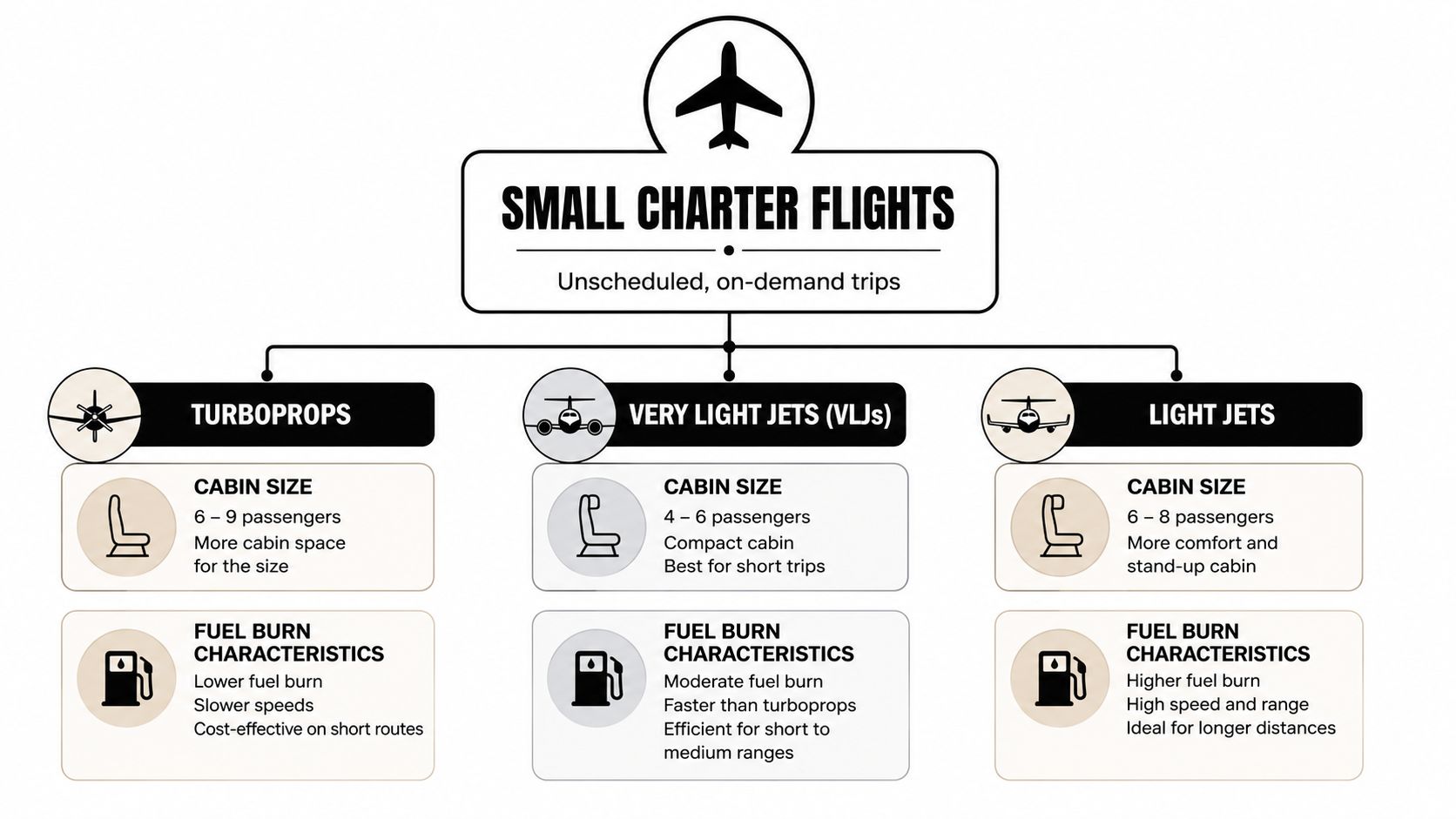
A useful way to understand small charter flights is to treat them as an on-demand trip in a smaller aircraft category, not as a generic “private flight” label. The aircraft choice shapes everything, from fuel use to airport access to whether your baggage fits without compromise. IBISWorld's 2026 U.S. market estimate of $52.6 billion shows that this is a scaled transport sector, not a boutique exception (IBISWorld charter flights industry outlook).
Turboprops
Turboprops work well when the runway is short and the route is relatively direct. They're often the practical answer for regional hops because they burn less fuel, usually need smaller crews, and can use shorter runways, which broadens the airport list and can cut ground-transfer time (Air Charter Service aircraft guide).
Think of a turboprop like a rugged compact SUV. It's not built to win a top-speed contest, but it can handle rougher conditions and tighter spaces better than a larger cabin aircraft. For travelers going to islands, mountain airports, or smaller regional fields, that versatility can matter more than cabin flash.
Very Light Jets
Very light jets, or VLJs, are better suited to quick business trips where a small group wants speed and flexibility. They're often used for solo executives or two-person teams on short regional hops, especially when the runway is adequate and the mission doesn't call for a larger cabin. The point isn't luxury for its own sake, it's getting an aircraft that matches the route instead of forcing the route to fit the aircraft.
Light Jets
Light jets sit between the compact feel of a VLJ and the extra comfort of a larger cabin. They're a good fit when the route is regional but the passengers need a bit more space, a bit more baggage room, or a bit more range. If a VLJ is a sedan, a light jet is the midsize car that still parks easily but gives you more room to breathe.
Practical rule: choose the smallest aircraft that still covers your nonstop distance, baggage, and runway needs. Oversizing the aircraft can add cost without improving the trip.
Ultimately, small charter isn't just a cheaper category. It's an operational choice. Aircraft specifications, including cabin layout, estimated hourly pricing, and performance characteristics, are used before a quote is even finalized because the aircraft has to match the mission technically, not just cosmetically (Aircraft specifications guide).
Comparing Turboprops Very Light Jets and Light Jets
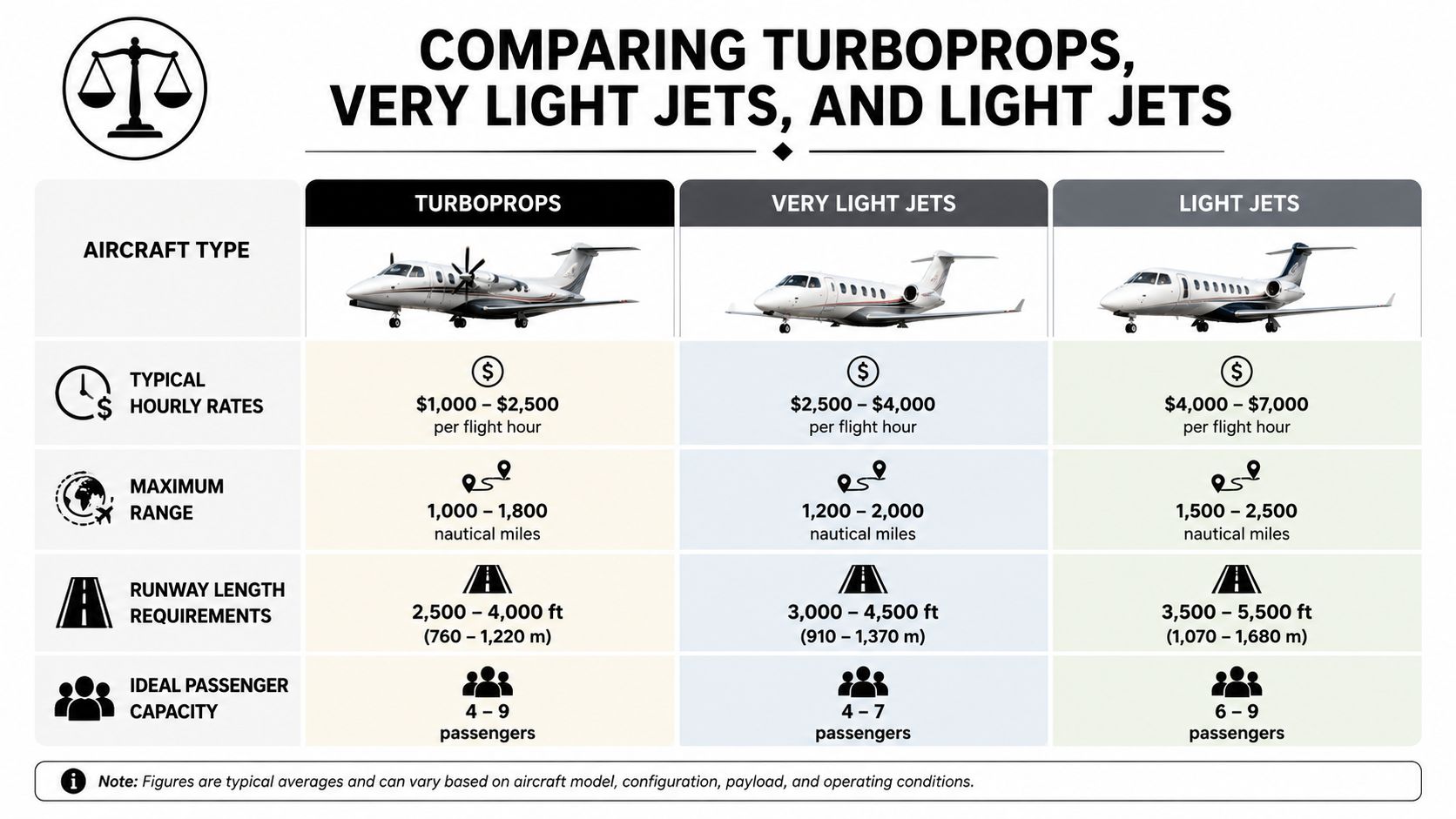
A side-by-side comparison makes the choice much easier. Turboprops win on short runway access and efficiency. Very light jets usually make the most sense for faster regional travel with a small passenger count. Light jets bring more cabin comfort while still staying in the small-aircraft category.
| Comparison of Small Charter Aircraft Categories | Hourly Cost Range | Max Range (NM) | Min Runway (ft) |
|---|---|---|---|
| Turboprop | Varies by mission and operator | Varies by model | Often the shortest among these three categories |
| Very Light Jet | Varies by mission and operator | Varies by model | Shorter than larger jets, but still route dependent |
| Light Jet | Varies by mission and operator | Varies by model | More runway than a turboprop in many cases |
The pattern matters more than the blank cells. Turboprops and very light or light jets typically have lower hourly operating costs because they burn less fuel, require smaller crews, and can use shorter runways, which expands airport choice and cuts ground time (Air Charter Service aircraft guide). If you're comparing a short regional hop, that shorter runway access can matter more than a small difference in cabin style.
Which aircraft fits which mission
- Turboprop: best when the airport is small, the runway is limited, or the route is short enough that efficiency beats speed.
- Very Light Jet: useful when the trip is quick, the passenger count is tiny, and the traveler wants jet speed without a larger cabin.
- Light Jet: a balanced option when comfort matters but the mission still fits a regional profile.
One common mistake is assuming the fastest aircraft is always the right one. On a route with a short runway or a remote field, the aircraft that can physically land is the better aircraft, even if it's slower. For readers comparing fleet options, the Haute Jets turboprop fleet page is a useful example of how operators organize aircraft by mission fit rather than by generic size alone.
Typical Use Cases and Route Scenarios
A board team needs to fly 300 nautical miles for a same-day meeting, return that evening, and land as close to the client site as possible. In that case, a light aircraft can save time because the route is short enough to favor convenience over long-range capability. The difference isn't just in the air time, it's in the airport pairing and the ground transfer that comes after.
Three common regional missions
A simple way to think about the decision is by mission type:
- Four passengers, regional board meeting: a light jet or turboprop may fit, depending on runway access and baggage.
- Island escape on short notice: a turboprop often makes the most sense when the airport is smaller or the route has limited commercial service.
- Mountain resort access: short runway geometry can make a turboprop the practical option even if a jet feels more glamorous.
These are not abstract examples. They're the kinds of bookings where aircraft fit matters more than cabin branding. A traveler may want the speed of a jet, but if the destination runway is restrictive, the jet choice can create a dead end.
A small aircraft is sometimes the trip itself, not just the transport. That's especially true when the destination airport is part of the convenience you're buying.
Commercial airline planning also misses the point for many regional travelers. If the schedule forces a connection, the time savings of a private booking can disappear. Small charter flights avoid that mismatch by aligning the aircraft with the route geometry, the airport, and the number of people on board.
The clearest use case is the one that looks impossible on paper. If the destination has a short strip, limited service, or rough geography, small charter flying isn't a luxury workaround. It's the operationally correct solution.
How Costs Vary and What Drives Pricing
A lot of charter pricing confusion comes from comparing one headline figure to another without looking at the mission behind it. Some point-to-point private flights start at about $1,700 for New York to Miami, according to Grand View Research's market overview, while higher-end light jets can run much higher depending on the itinerary and aircraft type (Grand View Research chartered air transport market report). That spread is normal because charter pricing is tied to aircraft class, route, and how efficiently the aircraft can be positioned for your trip.
The biggest driver is aircraft fit. A turboprop flying a short hop on a short runway may be far more cost-efficient than a larger cabin aircraft that's designed for longer range and more speed than the route needs. For buyers, that's why the right aircraft can lower the total trip cost even when the hourly rate looks similar at first glance.
The main pricing levers
- Fuel use: more efficient aircraft tend to be cheaper to operate on short routes.
- Crew needs: smaller aircraft often need smaller crews, which helps control operating costs.
- Airport choice: shorter runway capability opens more airports and can reduce ground transport.
- Route shape: a direct regional hop is easier to price than a trip that requires repositioning.
- Positioning logic: if the aircraft has to be moved to your departure airport, that extra flight can change the quote.
Repositioning fees matter. Traditional brokers sometimes quote an aircraft that isn't based near you, then pass along the cost of moving it into position. That's one reason local sourcing can matter so much for small charter flights, especially when you're comparing airports in the same metro area.
If you want a practical pricing reference, the Haute Jets private jet charter cost page is a useful starting point for understanding how route and aircraft type influence quotes. The broader market trend also shows why demand stays steady: Grand View Research places the global chartered air transport market at USD 38.41 billion in 2023, projecting it to reach USD 60.97 billion by 2030 at a 7.1% CAGR (Grand View Research chartered air transport market report). That kind of growth helps explain why pricing varies across markets, airports, and booking styles.
Safety Certifications and Operational Considerations
A legitimate charter booking starts with the operator, not the aircraft photo. FAA guidance says charter operators must hold an Air Carrier Certificate and be insured under U.S. DOT requirements, and passengers can verify legitimacy with the local FAA Flight Standards District Office (FAA legal charter guidance). That's the first thing to check before comparing cabin finishes or catering menus.
What to ask before you book
- Certificate status: ask to see the operator's Air Carrier Certificate.
- Insurance proof: confirm the operator is insured under U.S. DOT requirements.
- Pilot qualification: make sure the crew is operating under the correct charter framework.
- Oversight channels: if something feels unclear, check with the local FAA Flight Standards District Office.
There's also a licensing point that travelers miss. FAA guidance explains that pilots who are paid to fly passengers generally can't operate just because they hold a Commercial or Airline Transport Pilot license, they must be employed by a company operating under a Part 119 certificate, or hold that certificate themselves. In plain language, paid passenger flying is treated as common carriage, and the charter operator has to meet the right regulatory structure (FAA Part 119 charter guidance).
Third-party audits matter too. Operators often reference ratings such as Wyvern Wingman and ARGUS Gold or Platinum because they add an extra layer of review on top of the baseline regulatory requirements. Those badges don't replace FAA oversight, but they do help narrow the field when you're comparing operators that all claim to offer private service.
If an operator hesitates to share certificate details, insurance proof, or crew information, that's a reason to keep looking.
For travelers who already use ground transport for group trips, the logic is similar. A reputable coach or bus operator should be easy to verify before the first pickup, and the same mindset applies here. If you're arranging regional movement on the ground as part of a larger itinerary, Oz Coach Hire's Sydney bus services is a useful example of how a transport provider presents charter options clearly. The standard is the same, transparent operator information before money changes hands.
For a deeper checklist on verification and passenger-facing precautions, the Haute Jets safety page is a practical reference point.
Booking Process and Avoiding Repositioning Fees
The smoothest booking starts with a clean quote request. You give the route, passenger count, baggage needs, preferred departure window, and any airport flexibility, then the operator matches an aircraft that can do the trip. The best quotes are the ones that are based on your real mission, not just a category name.
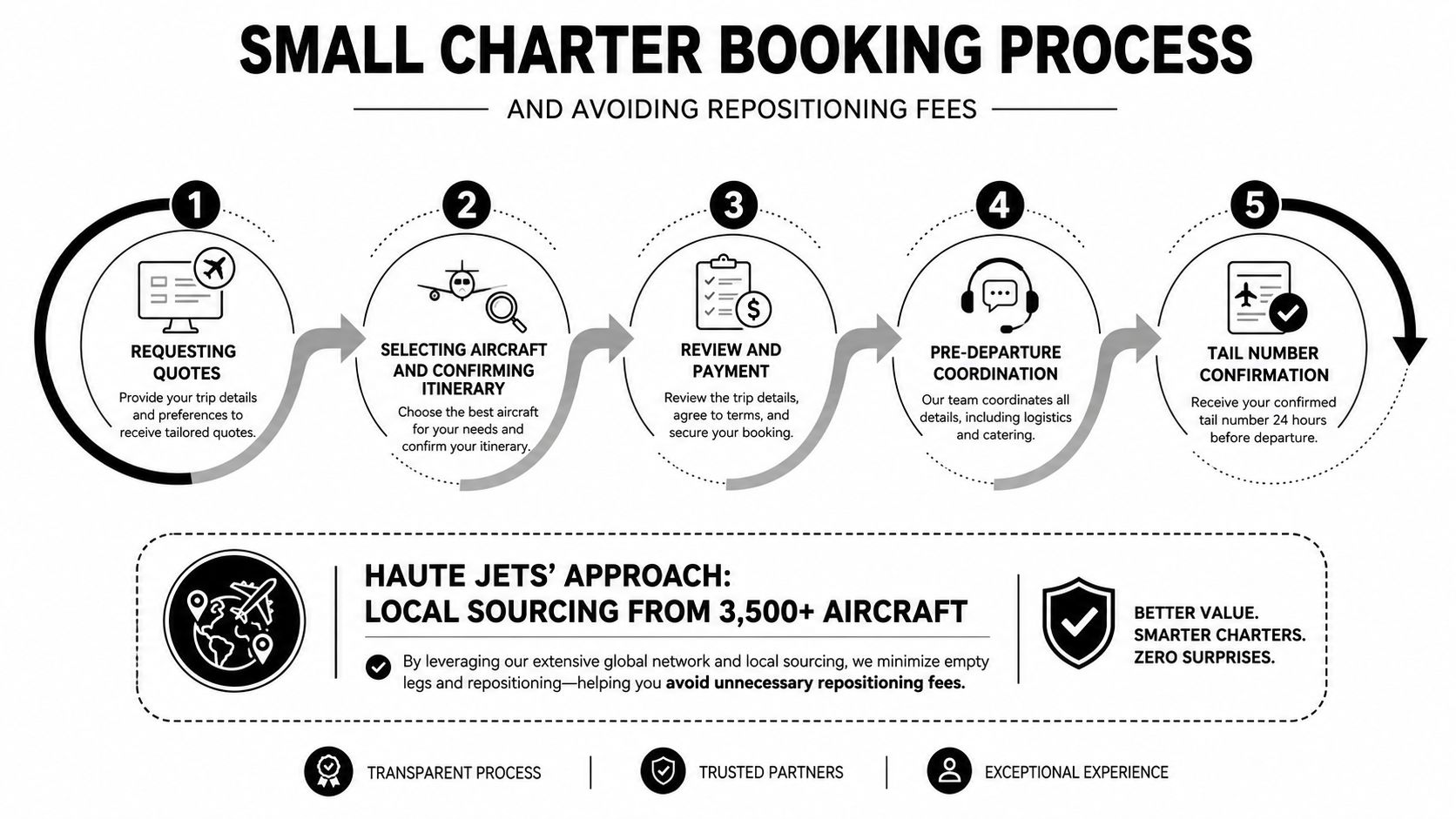
A practical booking sequence
- Request quotes early. Give the exact airports if you know them, because small differences in location can change aircraft availability.
- Compare aircraft, not just prices. A cheaper quote can hide a poor airport fit or a repositioning charge.
- Confirm the operator base. Local aircraft usually reduce deadhead flying and make the quote cleaner.
- Lock the itinerary. Once the route and timing are set, make sure the aircraft still matches the mission.
- Get final details before departure. Tail number confirmation close to departure helps verify the actual aircraft that will operate the flight.
The reason this matters is repositioning. Industry practice can add meaningful cost when the aircraft has to fly in from another market, and that fee often shows up only after the first quote. A local-sourcing model helps avoid that issue because the aircraft is already near your departure airport.
Haute Jets says it sources from 3,500+ owner-operators across 175 countries, which is designed to match aircraft locally and reduce repositioning exposure. That local matching approach is the part most travelers overlook, because the aircraft's home base can matter as much as the cabin itself. If the aircraft is already in your departure metro, the quote is usually cleaner and the itinerary is easier to operate.
Useful habit: ask where the aircraft is based before you compare hourly rates. A lower rate on a faraway aircraft can become the more expensive option once positioning is added.
Flexibility also helps. If your departure window can move by a few hours, the broker or operator has more room to place a nearby aircraft. That can improve availability, reduce wasted ferry time, and make small charter flights feel much more predictable. For readers comparing booking workflows and transparent pricing, the Haute Jets booking cost guide is a helpful companion reference.
When Small Charter Flights Are the Optimal Choice
Small charter flights make the most sense when the route is narrow, the airport is small, or the schedule leaves no room for wasted time. They're especially useful on shorter regional missions, remote destinations, and airports where larger aircraft aren't a fit. In those cases, the aircraft isn't just a premium option; it's the only practical option.
That's why small aircraft often become the only viable choice for routes under roughly 1,500 km or to remote airports with short runways (Iona Jets short-haul air taxi guidance). The same logic applies whether the trip is a business hop, an island transfer, or access to a mountain field. If the destination airport constrains the aircraft, size and runway performance matter more than cabin prestige.
Where small charter wins most often
- Short regional hops: the traveler values door-to-door speed over long-range capability.
- Remote or limited-service airports: smaller aircraft can reach places commercial airlines don't serve well.
- Short runway destinations: the aircraft must fit the field, not the other way around.
- Last-minute travel: small charter can remove connection risk and compress the itinerary.
This is also where the misconception about “small” needs correcting. Small charter isn't a budget version of a bigger jet. It's a different operating tool. The right aircraft can reduce ground time, avoid unusable airports, and keep the mission on schedule without forcing a larger cabin than you need.
When the trip is regional and the runway is the primary constraint, the smartest booking decision is usually the simplest one. Choose the aircraft that can get you there cleanly, not the one that sounds most impressive on paper.
If you're planning a regional trip and want a quote that reflects the actual airport, runway, and aircraft fit, contact Haute Jets to compare small charter flight options with clear routing and operator details.