
You're probably looking at a trip that commercial service handles badly.
A partner wants you in another city tomorrow morning. Your family wants to leave Friday afternoon, not Saturday at dawn. Or you need to hit two stops in one day and still sleep in your own bed. That's where small jet charter earns its keep. Not because it feels exclusive, but because it removes wasted time, rigid schedules, and airport friction that has no business being part of a high-value trip.
The mistake most first-time charter clients make is simple. They focus on the aircraft category and the advertised hourly rate, then assume they understand the quote. They don't. Small jet charter is easy to buy badly. A “cheap” quote can become an expensive one if the aircraft isn't based near you, if the cabin doesn't fit the mission, or if the operator is solving your trip with convenience for them instead of value for you.
Why Choose a Small Jet Charter for Your Next Trip
A small jet makes the most sense when the mission is short to medium haul, time sensitive, and too important to leave to airline schedules.
Take a standard example. You need to leave South Florida after lunch, meet in Atlanta, and return the same evening. Commercial turns that into a full-day production with early arrival buffers, security lines, gate changes, and a high chance of schedule drag. A small jet turns it into a direct business tool. You leave when you need to leave, land closer to the meeting, and keep control of the day.
That's not a niche use case. The private jet charter services market is projected at USD 17.67 billion in 2026 and expected to reach USD 25.79 billion by 2031, according to Mordor Intelligence's private jet charter services market analysis. The same analysis ties that growth to flexible, on-demand travel on short to medium routes, which is exactly where small jets perform best.
Where small jets win
- Business trips with fixed timing: Board meetings, investor meetings, plant visits, and same-day turns.
- Leisure trips with poor airline options: Weekend escapes, resort transfers, island connections, ski access.
- Multi-stop travel: Two or three regional stops in a day is where private aviation stops being luxury branding and starts being pure logistics.
- Smaller groups: If you're moving a few people, not a large entourage, a small jet is often the right tool.
Practical rule: If your priority is time control on a short or medium route, start with a small jet. Don't jump to a larger cabin unless the trip actually requires it.
The advantage isn't just speed. It's precision. But precision only helps if the aircraft is matched to the mission and sourced correctly. That's where most quotes start to separate.
Decoding Small Jet Aircraft Categories
Book the wrong category and you pay for it twice. First in the quote. Then in the cabin, when the aircraft is too tight, too limited on bags, or forced into a fuel stop that should have been avoided.
That is why aircraft category matters. Small jets are not one product. For most trips, the primary decision is between a very light jet, a light jet, and, in a narrower set of missions, a super light jet. The difference is not cosmetic. It affects range margin, baggage capacity, lavatory privacy, and how much flexibility you have before the quote starts climbing.
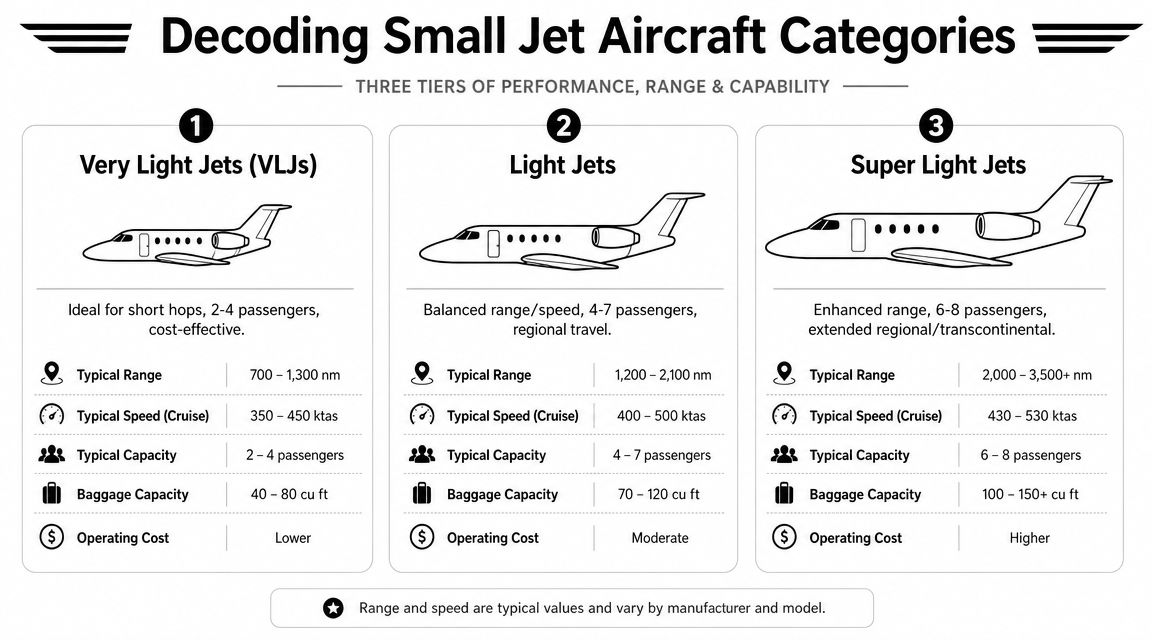
Very light jets
A very light jet, or VLJ, is the cost-conscious option for short sectors with a small passenger count. It works best when the mission is simple: a quick regional flight, light baggage, and no need to stretch the cabin's limits.
The tradeoff is straightforward. You get lower trip cost potential, but less cabin privacy, less baggage flexibility, and a tighter range envelope. On a short leg with two or three passengers, that can be perfectly fine. On a longer flight with colleagues, family, or client-facing travelers, the compromises become obvious.
VLJs are a smart fit when you want:
- Short regional flying
- A lower-cost aircraft class
- A compact cabin for a small group
- Access to airports where a larger jet adds no practical benefit
Choose a VLJ when the cabin is transportation, not part of the experience.
Light jets
A light jet is the category I recommend most often because it gives you better odds of getting the trip right on the first quote. You get more seats, more usable baggage space, better range, and usually a fully enclosed lavatory. That matters more than first-time charter clients expect.
A light jet also gives the broker more room to optimize cost without forcing an uncomfortable fit. If the local market has several suitable aircraft, a light jet quote can come in surprisingly close to a VLJ once repositioning is factored in. That is the pricing mistake many clients make. They compare categories by hourly rate and ignore where the aircraft is based.
A light jet is usually the better call when:
- you are flying with executives, clients, or family members who expect privacy
- you need more baggage flexibility
- you want nonstop margin instead of operating near the edge of the range
- you want a cabin that feels appropriate for the trip, not merely acceptable
If you want examples of aircraft in this class, see Haute Jets' review of light jets for short and mid-range business travel.
Super light jets
A super light jet sits between the standard light jet and midsize territory. It is still part of the small-jet conversation, but only for trips that need extra range, better climb performance, or a little more cabin breathing room without stepping into a larger and more expensive class.
This category can be the right answer for longer regional missions or routes where weather, passenger count, and baggage would leave a standard light jet with less cushion than I like to see. It is not the default choice. It is the category you use when the mission justifies it.
Small Jet Comparison At a Glance
| Aircraft Model | Category | Typical Seats | Range (NM) | Lavatory |
|---|---|---|---|---|
| Embraer Phenom 100 | Very Light Jet | Small-group configuration | 1,000 | Curtained |
| Eclipse 500 | Very Light Jet | Small-group configuration | 1,000 | Curtained |
| Cessna Citation CJ series | Light Jet | Up to 8 | 1,500 to 2,000 | Fully enclosed |
| Embraer Phenom 300 | Light Jet | Up to 8 | 1,500 to 2,000 | Fully enclosed |
How to choose without wasting money
Start with the mission, not the brochure.
Ask these three questions:
How many people are flying, and how much baggage are they bringing? A six-seat aircraft is not a comfortable six-seat aircraft on every trip.
How much cabin privacy do you need?
A curtained lavatory is fine for some short flights. It is the wrong setup for many executive and family itineraries.Are you optimizing the total trip cost, or just the hourly rate?
The cheaper category on paper can become the more expensive option once ferry time is added. A locally sourced light jet often beats an out-of-position VLJ on total spend.
The right aircraft is the one that fits the route, passenger mix, and local availability without adding avoidable repositioning cost. That is how experienced buyers keep small jet charter efficient.
Popular Routes and Common Use Cases
Most clients don't start by thinking in aircraft classes. They start with a trip.
A CEO needs to visit two offices in one day. A family wants to leave Miami for a warm-weather weekend without turning the first day into airport theater. A sports agent needs to move quickly between markets and can't afford a missed connection. Small jet charter works because it solves those trips cleanly.

Business travel that actually benefits from private aviation
The strongest business use case is regional travel with tight timing.
A management team can leave early, visit multiple facilities, and return the same evening. A founder can make an investor presentation and still hold a dinner meeting in another city that night. The value isn't abstract. It's calendar control.
Common business patterns include:
- Same-day out-and-back meetings
- Regional multi-stop site visits
- Travel to smaller airports near plants, resorts, or private estates
- Trips where confidentiality matters onboard
Leisure travel where small jets make sense
Leisure clients use small jets differently, but the logic is the same. They want direct access, cleaner timing, and less wasted energy.
Typical examples include:
- Miami to the Bahamas
- Miami to Turks and Caicos
- New York to South Florida
- Los Angeles to Las Vegas
- A family ski trip with a tighter travel window
On these trips, the cabin doesn't need to be huge. It needs to be right-sized, comfortable, and positioned where you need it.
Why some routes are consistently active
Certain city pairs stay busy because they fit the profile of small jet travel almost perfectly. They're short enough to avoid the need for a larger cabin, valuable enough that time matters, and common enough that aircraft availability tends to be stronger.
That's why you see so much traffic on business and leisure corridors like New York to Miami and Los Angeles to Las Vegas. Those routes reward direct access and punish delay.
A Realistic Breakdown of Small Jet Charter Costs
If you remember one thing, remember this. Hourly rate is not the trip price.
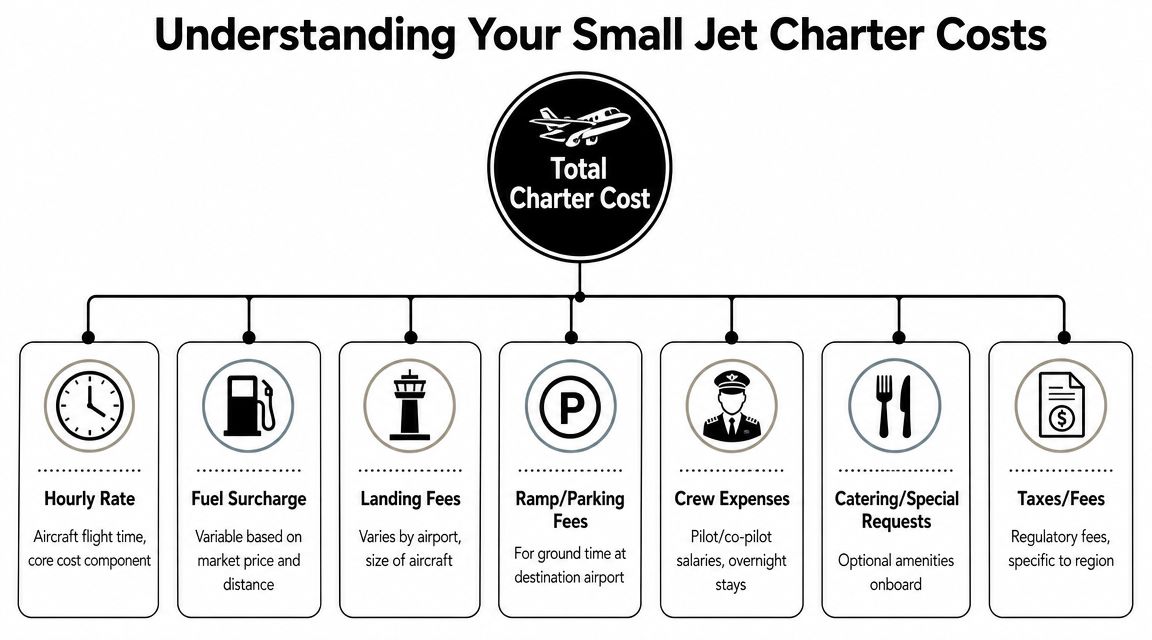
That number is only the starting point. Small jet charter pricing is built around the total mission, not the marketing headline. evoJets' light jet pricing overview cites about $2,200 to $3,200 per flight hour for light jets, before fuel, fees, and taxes. That's useful context. It's not enough to evaluate a quote.
What you're actually paying for
A real charter quote usually includes several moving parts.
- Aircraft flight time: This is the core hourly charge and the number most buyers focus on first.
- Fuel-related cost: Depending on the trip structure, fuel may appear directly or be embedded in the operating economics.
- Taxes and regulatory fees: These apply based on the trip and jurisdiction.
- Airport charges: Landing, handling, ramp, and parking fees can vary by airport.
- Crew-related expenses: Waiting time or overnights can change the total.
- Catering and special requests: Optional, but often added.
For a more detailed walkthrough, read Haute Jets' charter pricing cost breakdown.
The line item buyers miss
The quote swings most when the aircraft isn't already where you are.
If the operator has to move the jet to your departure airport before your passengers even board, that positioning time often flows into the economics of the trip. That's why two quotes for what looks like the same route can feel irrationally far apart.
A smart buyer asks, “Where is the aircraft based?” before asking whether the hourly rate looks fair.
How to judge a quote properly
Don't compare offers by aircraft type alone. Compare them by mission logic.
Use this checklist:
- Departure proximity: Is the jet local, or is someone ferrying it in?
- Trip structure: Is this one-way, round-trip, or wait-and-return?
- Airport profile: Some airports are operationally simple. Others aren't.
- Cabin fit: Don't overpay for space you won't use, but don't underbuy comfort either.
The best quote is usually not the lowest advertised rate. It's the cleanest total mission cost with the fewest avoidable extras.
The Secret to Lower Costs Avoiding Repositioning Fees
You book a short flight. The quote comes back high enough to make the route look unreasonable. The problem usually is not the route. It is the aircraft placement.
Repositioning, also called deadhead, is the empty flying required to get the jet to you or to move it after your trip. That empty time is one of the fastest ways to overpay on a small jet charter, especially on short sectors where non-passenger flying can distort the entire quote.
Why small jet prices swing so much
Two aircraft can quote the same city pair and produce very different totals because one is already nearby and the other has to be ferried in from another market.
That difference matters more than many first-time buyers expect. A light jet with a higher hourly rate can still be the better deal if it is based close to your departure airport. A cheaper-looking aircraft across the region often becomes the expensive option once empty legs, crew logistics, and schedule inefficiency are folded in.
This is the part many buyers miss. They compare cabin category and hourly rate, but the primary cost driver is often geography.
What a smart buyer asks first
Start with aircraft position.
Ask these questions before you spend time negotiating:
- Where is the aircraft based right now?
- How much empty flying is built into this quote?
- Is this jet staying with my trip, or bouncing to another assignment after drop-off?
- Can you source a local aircraft with less ferry time?
Those four questions will save more money than haggling over the posted hourly rate.
Why local sourcing matters
Small jet economics work best when the airplane is already in the market or can cover your trip with very little repositioning. That is why sourcing discipline matters as much as aircraft type.
Haute Jets uses a local sourcing approach through owner-operators to reduce unnecessary repositioning exposure. That model addresses the core pricing problem instead of hiding it behind a low headline rate. If you want to see how that process works from the client side, review this private jet booking guide from Haute Jets.
My recommendation
Treat repositioning as the first line item to challenge.
A clean quote on a nearby aircraft usually beats a flashy rate on a distant one. Get the placement right, and small jet charter starts to make financial sense. Get it wrong, and you pay for empty miles that do nothing for your trip.
The best-value charter is often the aircraft closest to your departure point, not the one with the lowest advertised hourly rate.
Your Step-by-Step Guide to Booking a Flight
Booking a small jet isn't complicated. Buying the wrong one is.
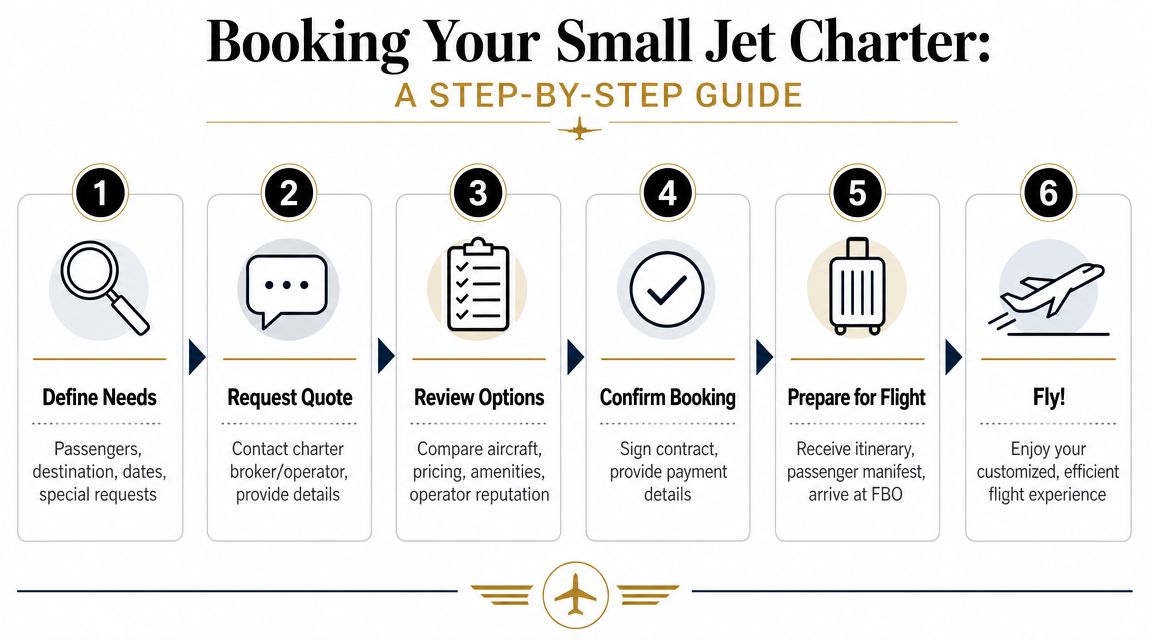
The process gets easier when you focus on a few decisions in the right order and insist on specifics. That matters because a vague request invites vague quoting.
Start with the mission, not the airplane
Give exact trip details first.
- Passenger count: Tell the broker how many are flying.
- Route and timing: Include preferred departure windows, not just the city pair.
- Baggage and special needs: Golf clubs, skis, pets, car seats, onboard Wi-Fi, and catering all matter.
- Flexibility: If your timing can shift, say so. That can open up better aircraft placement.
Review the quote like a buyer, not a browser
Once options come back, compare the aircraft and the structure of the trip.
Ask to see:
- Exact aircraft make and model
- Where the aircraft is based
- Lavatory configuration
- Baggage limitations
- Whether the trip includes waiting time or repositioning logic
For a practical walkthrough of the client side of the process, review Haute Jets' booking guide.
This short video gives a useful visual overview of the charter process.
Verify safety and operating quality
This part is not optional.
The publisher states that its network uses Wyvern Wingman or ARGUS Gold/Platinum operators. More broadly, those are exactly the kinds of third-party safety standards you want to ask about. Don't settle for “fully licensed” or “FAA compliant” as if that ends the conversation.
Confirm:
- Operator identity
- Third-party safety rating
- Crew details
- Tail number and trip confirmation before departure
Ask for the exact aircraft, exact operator, and exact safety standing. If a seller gets slippery on any of those, move on.
Sample Itineraries and When to Choose a Larger Jet
A client books a small jet for what looks like a simple trip, then pays too much because the airplane has to fly in empty, wait, or force a fuel stop that should have been avoided at quote stage. That mistake is common. The right aircraft category matters, but aircraft position matters just as much.
The market is deep enough to support real choice, with over 23,000 aircraft globally and about 71% based in North America, according to Stratos Jets' private jet statistics. That concentration helps on busy U.S. routes. It also explains why local sourcing can cut costs sharply. If the jet is already near your departure point, you avoid paying for unnecessary ferry time.
Three realistic mission examples
Here is how I would assess three common trips.
| Trip | Likely small jet fit | What matters most |
|---|---|---|
| New York to Miami | Strong fit | Aircraft availability near departure, real trip pricing, avoiding unnecessary repositioning |
| Miami to Turks and Caicos | Often a fit, depending on party and luggage | Range margin, baggage volume, customs timing, passenger comfort |
| Los Angeles to Las Vegas | Excellent fit | Short sector efficiency, local aircraft access, minimizing empty-leg positioning |
New York to Miami is the classic small-jet mission. Demand is high, supply is usually strong, and pricing can vary more by aircraft location than by cabin category. A nearby light jet can beat a cheaper-looking quote from a distant operator once ferry costs are added.
Miami to Turks and Caicos needs more discipline. Buyers often get sloppy with luggage assumptions. Four passengers with soft bags is one trip. Six passengers with resort luggage is another. If the aircraft is tight on range or baggage, move up early and avoid a bad fit.
Los Angeles to Las Vegas should be easy. Sometimes it is. Sometimes the quote is inflated because the airplane is coming from another market. On a short route like this, repositioning can distort the total more than the flight itself. That is exactly why local sourcing matters.
When to move up to a larger jet
Choose a larger aircraft when the mission demands it, not when the sales language sounds impressive.
Move up when:
- Your passenger count pushes past what a small jet handles comfortably
- Your luggage is bulky, heavy, or unusually high-volume
- Your route needs more nonstop range and better performance margin
- Your travelers need a taller cabin for a longer day
- Your mission is long-haul, including transatlantic flying such as New York to London
That last point is simple. A small jet is the wrong tool for long-haul flying. Buy the mission, not the label.
The simplest decision rule
Use a small jet for regional trips where speed, airport access, and cost control matter more than cabin size.
Choose a larger jet when people, bags, or distance start putting pressure on the mission. That decision usually saves money, because it prevents reroutes, payload compromises, and overpriced last-minute fixes. As noted earlier, Haute Jets' local sourcing model addresses one of the biggest pricing problems in this category: paying for an aircraft that is nowhere near you.